INTRODUCTION
Radioactive isotopes of heavy metals are considered to be particularly dangerous matter which is produced in the course of anthropogenic activities, industrial accidents and nuclear tests. Strontium-90 isotope is mainly fixed on the sur -face of clay minerals [Bobovnikova 1990]. Ra-dionuclides undergo physicochemical reactions on the border between solid and liquid phases in soils, where strontium is found in different forms. There are cations of radionuclides in the soil solu-tion and casolu-tions which are fixed in solid (non-ex -changeable). Fixation of exchangeable form and remobilization of fixed radionuclides are caused by cations diffusion in solid particles [Bulgakov 1998, Bondarenko and Kononenko 2001]. The majority of water-soluble 90Sr (76%) occurs in cation forms [Martyushov et al. 1995].
The authors Ningping and Mason [2001] propose strontium-free ground water for Sr(II) removal from silica colloids and
Ca-montmoril-lonites. The desorption from montmorillonites is a time-consuming and ineffective process – the amount of recovered strontium is 16.5% after 90 days. Desorption in the study [Martyushov et al. 1995] was executed with different concentrations of HCl and HNO3. The most effective outcome was achieved with 0.1 M solutions – 83% and 82% for HCl and HNO3, respectively. However, strong acids are too expensive and they form acidic soils which are not applicable.
The review of the literature on the 90Sr de-sorption process indicates that there is a need to detect an eluent for radioactive soils re-cultivation which is safe and provides effec -tive desorption parameters.
It was proposed that ion exchange of strontium with high complex formation properties will pro -mote the extraction of radionuclides from soils. Cations of Fe3+ are characterized by a high charge and a small radius. Due to the high ionic potential, which is equal to z/r, Fe3+ displaces other cations from mineral surface, including 137Cs and 90Sr.
Published: 2018.03.01
Volume 19, Issue 2, March 2018, pages 149–153
https://doi.org/10.12911/22998993/81838
The Efficiency of Strontium-90 Desorption Using Iron (III) Solutions
in the Decontamination Process of Radioactive Soils
Olga Cheremisina
1, Vasiliy Sergeev
1*, Varvara Alabusheva
1,
Alexander Fedorov
1, Alexandra Iliyna
11 Department of Physical Chemistry, Saint Petersburg Mining University, Saint-Petersburg, 21 Line 2, 199106,
Russian Federation
* Corresponding author’s e-mail: [email protected]
ABSTRACT
The paper presents the investigation on the estimated efficiency of iron (III) chloride solutions in the decontamina -tion process of radioactive soils with 90Sr, according to kinetic and thermodynamic characteristics of the desorption process. The specific 90Sr radioactivity of soil samples was (3.9±0.3)·104 Bq·g. The adsorption isotherms of Sr2+
and Fe3+ are described with the Langmuir equation. The values of Gibbs energy G0
298 = -4.65 kJ·mol-1 and equilibri-um ion exchange constant Keq = 6.5 confirm the hypothesis of strontium removal from soils with iron (III) cations. The effectiveness of the method is substantiated by experimental and calculated results of this study samples of radioactive soils are deactivated in 90% after 9.5 hours, whereas the kinetic constant is 6.77·10 s-1. The suggested
method of soil cleanup with 0.2 M Fe3+ solutions is optimal and complies with the environmental requirements. Keywords: decontamination of radionuclides, thermodynamic and kinetics investigations, desorption of
Therefore, it was suggested to apply iron (III) chloride solutions with ammonium chloride (for pH stabilization) for soils decontamination.
The aim of this investigation was to estimate the efficiency of iron (III) chloride solutions in the decontamination process of radioactive soils with 90Sr according to kinetic and thermodynamic characteristics of the desorption process.
MATERIALS AND METODS
The process of sorption was performed on samples using water solutions with the specific radioactivity of 10-5 Ci·dm-3. The process was carried out with the limited value method. The sample weight was brought into contact with the 90Sr solution, interblended roundly with a churn over two weeks in order to obtain a stable solu-tion. The solid phase was separated from the liq-uid phase and washed with distilled water. The specific 90Sr radioactivity of soil samples was (3.9±0.3)·104 Bq·g-1.
The 90Sr desorption was applied dynami-cally. It was chosen to apply 0.02 mol·dm-3 iron (III) chloride as an eluent solution. The process was held in a 5 cm height glass column with the cross-sectional area of 0.7 cm2 and the interstitial volume of 3 cm2. The underside of the column was filled with glass fiber and a Sr-adsorbed soil sample of 2 g weight above it. The desorption agent was carried through the solid structure with the 9·10–4 m·s-1 rapidity. After 3 cm3 of the eluent passed the column, 5 and 10 ml portions were col-lected and their 90Sr radioactivity was analyzed. If there are both 90Sr and 137Cs radionuclides in soils,
it is necessary to supplement ammonium chloride as a cesium carrier.
Real contaminated soil patterns were collect-ed in the area which is 15 away from the 4th plant unit of the Chernobyl Electric Power Station.
RESULTS AND DISCUSSION
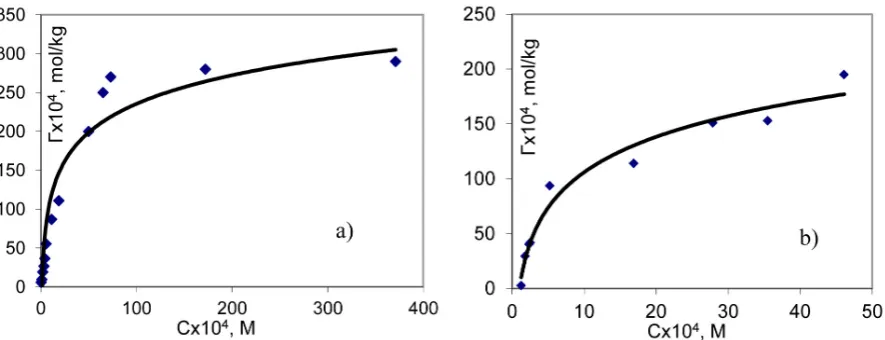
The adsorption isotherms of Sr2+ and Fe3+ are described with the Langmuir equation and shown in Figure 1, where ∇∞ is equilibrium con-centration of the cations, g – the activity factor and DS/L is the distribution constant between the solid and liquid phases.
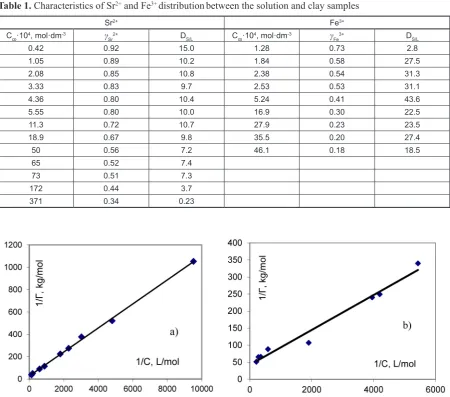
Figure 2 shows the linear dependence be-tween the inverse of sorption and concentration. The equations are 1
Г = 0.1075 1
С + 26.588 and
1
Г = 0.0512 1
С + 42.18 for strontium and iron (III),
respectively. This result is in accordance with the study [Chirkst et al. 1994, Chirkst et al. 2003], where effectiveness of the Langmuir equation is described for cesium cations sorption on a variety of minerals.
The absolute term of the Langmuir equation is equal to the inverse of the limit value of sorp-tion, which is 0.034 mol·kg-1 for Sr2+ and 0.024 mol·kg-1 forFe3+. Slope ratios were used to de-termine the adsorption thermodynamic equilib-rium ratios of strontium and iron on clay minerals which are 294 and 731, respectively.
The distribution coefficient of strontium be -tween the solid and liquid phases depends on strontium (2+) concentration in equilibrium solu -tion and coverage ratio of the adsorbent:
𝐷𝐷Т ж⁄ =𝛾𝛾 Г∞К
Sr2+(1 + Кс∞) (1)
However, limit dilution brings about the value of DS/L = Γ∞K = 10.0 which is the same as the experi -mental result (Table 1). For the Sr2+aq ⇔ Sr2+адс
equilibrium, which characterizes the sorption ability of a strontium cation, the value of Gibbs energy is 𝛥𝛥𝛥𝛥0298 = −RTln𝐷𝐷𝑆𝑆 𝐿𝐿⁄ = −5.7 kJ mol⁄ .
This value illustrates rising of the sorption abil-ity in response to hydroxonium cations tran -sition with strontium cations due to increase of the charge.
According to the study [Thermodynam-ic constants… 1981], under the condition of
𝛥𝛥𝑓𝑓𝐺𝐺0298(Sr2+aq) = −563.9 𝑘𝑘𝑘𝑘 mol⁄ , the value
of Gibbs energy for adsorbed cation formation is
𝛥𝛥𝑓𝑓𝐺𝐺0298 = −569.6 kJ mol⁄ .
The following equations are defined with the distribution coefficient of Fe3+ and the Langmuir constant:
Fe3+aq Fe3+ads (2)
Fe(OH)2+
aqFe(OH)2+ads (3)
Fe(OH)2+aqFe(OH)2+ads (4)
The main forms of iron (3+) in solutions with the value of pH 3.1 are taken into account with corresponding thermodynamic characteristics. The sorption of iron (III) polymeric forms is ne -glected. The summary of the equations (5)-(7) describes the adsorption process of iron (III) with m, n and p coefficients:
𝑛𝑛 𝑚𝑚 =
[Fe(OH)2+]
[Fe3+] =
𝐾𝐾ℎ,1
[𝐻𝐻+] (5)
Table 1. Characteristics of Sr2+ and Fe3+ distributionbetween the solution and clay samples
Sr2+ Fe3+
Сꝏ·104, mol·dm-3 γ
Sr2+ DS/L Сꝏ·104, mol·dm-3 γFe3+ DS/L
0.42 0.92 15.0 1.28 0.73 2.8
1.05 0.89 10.2 1.84 0.58 27.5
2.08 0.85 10.8 2.38 0.54 31.3
3.33 0.83 9.7 2.53 0.53 31.1
4.36 0.80 10.4 5.24 0.41 43.6
5.55 0.80 10.0 16.9 0.30 22.5
11.3 0.72 10.7 27.9 0.23 23.5
18.9 0.67 9.8 35.5 0.20 27.4
50 0.56 7.2 46.1 0.18 18.5
65 0.52 7.4
73 0.51 7.3
172 0.44 3.7
371 0.34 0.23
𝑝𝑝 𝑛𝑛 =
[Fe(OH)2+]
[Fe(OH)2+] =
𝐾𝐾ℎ,2
[𝐻𝐻+] (6)
𝑚𝑚 + 𝑛𝑛 + 𝑝𝑝 = 1 (7)
Hydrolysis constants of iron (3+) are Kh,1 = 6.74 ∙ 10–3 and [9]. Hydroxonium cations concentration is found due to pH = 3.1. Conse-quently, m = 0.024. n = 0.20 and p = 0.776. The summary equation of the iron (III) adsorption process is:
0.024 Fe3+
aq+ 0.2 Fe(OH)2+aq +
+ 0.776 Fe(OH)2+aq ⇔
⇔0.024∙Fe3+ads+ 0.2Fe(OH)2+ads +
+ 0.776 Fe(OH)2+ads
(8)
Using the summary distribution coefficient, it is possible to determine the Gibbs energy for the reaction (8): Δ (8)G0
298 = Δ RTln DS/L= – 8.2±0.3 kJ·mol-1.
In order to calculate the equilibrium constants for (2)-(4), it is necessary to make a series of operations.
Δ(8)G0298 = m Δ(2)G0298 +
+ n Δ (3)G0298 + p Δ (4)G0298. (9)
Then: D= D1m ·D2n·D3p, (10)
where: D is the experimental summarized distri -bution coefficient of iron (III), Dn – partial distribution coefficients of different iron forms for the equations (2)-(4), and their values are:
𝐷𝐷1=[Fe 3+ads]
[Fe3+aq] (11)
𝐷𝐷2=[Fe(OH) 2+ads]
[Fe(OH)2+aq] (12)
𝐷𝐷3=
[Fe(OH)2ads+ ]
[Fe(OH)2aq+]
(13)
𝐷𝐷 =[Fe(OH)
2+ads] + [Fe(OH)
2ads+ ]
С (14)
The sorption of Fe3+ ions is neglected in (14) due to their small concentration. Calculating (11)-(14), the values of D2 and D3 are:
𝐷𝐷3=𝐷𝐷 ⋅ 𝐶𝐶 − [Fe(OH)
2+ads]
[Fe(OH)2aq+]
=𝐷𝐷 ⋅ 𝐶𝐶 − 𝐾𝐾2⋅ [Fe(OH)2+aq]
[Fe(OH)2aq+]
(15)
The values D = 27, [Fe(OH)2+aq] = 0.776C,
[Fe(OH)2aq+] = 0.2𝐶𝐶 are substituted into the
equation (15). Calculating together the equa -tions (11) and (14), where the exchange coupling constant is approximately 1 (and D1 ≈ D21.5, D
2 ≈ D32 и D
1 ≈ D2·D3), the distribution constants are D1=1200, D2=60 and D3=20. Then Δ(2)G0
298= -17.6 kJ∙ mol-1, Δ
(3)G0298= - 10.2 kJ∙ mol-1and Δ(4) G0
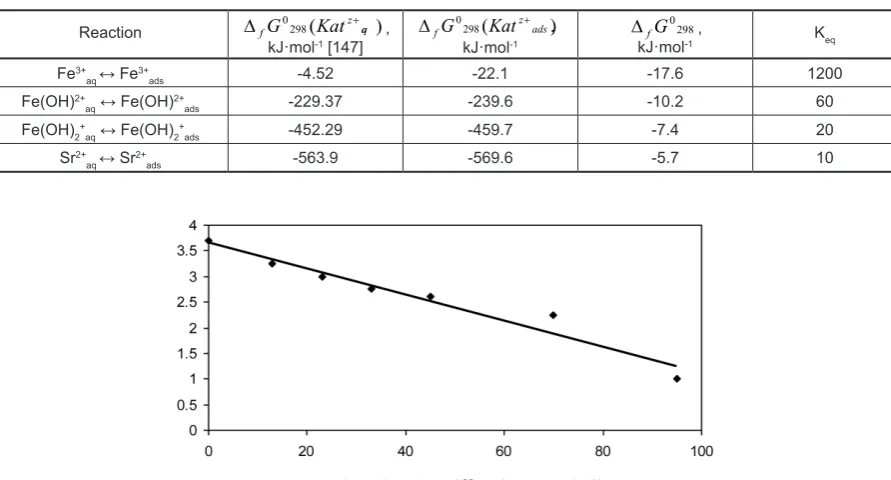
298= – 7.4 kJ∙ mol-1. Table 2 shows the calcu-lated Gibbs energy of adsorbed iron (3+) cations formation and sorption equilibrium.
Furthermore, there are three exchange reactions:
13Fe3+aq+ 12Sr2+ads ⇔ ⇔ 13Fe3+ads+ 12Sr2+aq Δ(16)G0298 = -3.02 kJ·equiv-1;
К(16) = 3.4.
(16)
12Fe(OH)2+aq+ 12Sr2+ads ⇔ ⇔ 12Fe(OH)2+ads+ 12Sr2+aq
Δ (17)G0298 = -2.25 kJ·equiv-1; К(17) = 2.5.
(17)
Fe(OH)2aq+ + 12Sr2+ads ⇔ ⇔ Fe(OH)2ads+ + 12Sr2+aq
Δ (18)G0298 = -4.55 kJ·equiv-1; К(18)= 6.3.
(18)
The Gibbs energy for the summary ion ex -change reaction with strontium is:
DSG0
298 = 0.072D(16)G0298 +0.4D(17) G0298+0.776D(18) G0
298 = -4.65 kJ· mol-1.
Consequently, the total ion exchange equilib -rium constant is 6.5. It means that strontium cat -ions will expel from clay minerals after a leaching operation with iron (III) solutions.
radioac-tivity of soils is (3.9±0.3)·104 Bq·g-1. As a result, the time required to achieve 90% desorption is approximately 2.2 hours.
After the process of ablution, the value of initial specific 90Sr radioactivity changed from 7.23·102 Bq·g-1 to 1.87·102 Bq·g-1. As a conse-quence, the extent of desorption is 75±5%. The kinetic constant for natural soil samples is 6.77·10 с-1 and the period of 90% desorption is 9.5 hours. Accordingly, the kinetic constant of real samples sorption is 5 times bigger than modelling samples.
CONCLUSIONS
The values of Gibbs energy G0
298=-4.65 kJ·mol-1 and equilibrium ion exchange constant Keq = 6.5 confirm the hypothesis of strontium removal from soils with iron (III) cations. The effectiveness of this method is substantiated by experimental and calculated results of this study samples of radioactive soils are deactivated in 90% after 9.5 hours, the kinetic constant is 6.77·10 s-1. The suggested method of soil cleanup with 0.2 M Fe3+ solutions is optimal and complies with environmental requirements.
REFERENCES
1. Bobovnikova Ts.I., Virchenko E.P., Konoplev A.V.
1990. Chemical deportments of long-lived
radio-nuclides and their transformation in the soils of the
Chernobyl accident area. Soil Science, 10, 20–25.
2. Bondarenko G.N., Kononenko L.V. 2001. Kinetics of 90Sr and 137Cs deportments transformation in soils. Mineralogy Journal, 3, 48–57.
3. Bulgakov A.A. 1998. Prediction methods of 90Sr
and 137Cs distribution in natural soil-water sys
-tems. Extended abstract of dissertation. Vernadsky Institute of Geochemistry and Analytical Chemis
-try of Russian Academу of Sciences.
4. Chirkst D.E., Chaliyan K.N., Chaliyan A.G. 1994.
Thermodynamics study of radioactive 137Cs soils
deactivation after the Chernobyl accident.
Radio-chemistry, 36 (5), 459–462.
5. Chirkst D.E., Cheremisina O.V., Ivanov M.V. 2003. Thermodynamics study of iron (III) cations sorption on clay materials. JAC, 76(6), 992–925. 6. Martyushov V.V., Spirin D.A., Bazilev V.V., Fe
-dorova T.A. 1995. The forms of radionuclides in the soils of East-Ural Radioactive Trace, Ecology,
2, 110–113.
7. Ningping L., Mason C.F. 2001. Sorption-desorp-tion behavior of strontium-85 onto montmoril-lonite and silica colloids. Applied Geochemistry,
16(14), 1653–1662.
8. Rohwedder J.R., Cadore S., Abate G., Grassi M.T.
2014. Montmorillonite and vermiculite as solid phases for the preconcentration of trace elements in natural waters: Adsorption and desorption
stud-ies of As, Ba, Cu, Cd, Co, Cr, Mn, Ni, Pb, Sr, V, and Zn. Applied Clay Science, 99, 289–296.
9. Thermodynamic constants of materials: the book of
references. 1981. Edited by Glushko V.P. USSR, 1–10. Table 2. Thermodynamic characteristics of iron and strontium cations adsorption on clay minerals
Reaction DfG0298(Katz+aq ),
kJ·mol-1 [147] ( ), 298
0
ads z fG Kat +
D
kJ·mol-1
298 0
G
f
D ,
kJ·mol-1 Keq
Fe3+
aq ↔ Fe3+ads -4.52 -22.1 -17.6 1200
Fe(OH)2+
aq ↔ Fe(OH)2+ads -229.37 -239.6 -10.2 60
Fe(OH)2+
aq ↔ Fe(OH)2+ads -452.29 -459.7 -7.4 20
Sr2+
aq ↔ Sr2+ads -563.9 -569.6 -5.7 10