Volume 10, Number 2, June 2015
The Impact of Logistics Management on Reverse Logistics
In Thailand’s Electronics Industry
Punyapon Tepprasit
Department of Logistics and Supply Chain Management Sripatum Business School, Sripatum University
61 Phaholyothin Road, Chatuchak, Bangkok 10900 Thailand +662-561-2222, [email protected]
Prangtip Yuvanont
Graduate College of Management, Sripatum University 61 Phaholyothin Road, Chatuchak, Bangkok 10900 Thailand
+662-561-2222, [email protected]
ABSTRACT
This paper examines the direct and indirect effects of logistics management on the effectiveness of reverse logistics in Thailand’s electronics industry. The study uses a mixed method of qualitative and quantitative research. In-depth interviews with 20 supply chain directors at the best-in-class electronics manufacturing companies centered on five elements of logistics management – namely, product design and choice of materials; transportation and movement; manufacturing; packaging; and communication. The study examines the impact of these five elements on reverse logistics activities such as product return, reuse of materials, and waste disposal, specifically in the context of Thailand’s electronics industry. The study provides a new perspective that departs from traditional theory, primarily because it takes into consideration the fact that Thailand has a more complex business environment than most other countries. The results will benefit supply chain and logistics managers in the electronics manufacturing industry as they set priorities to improve reverse logistics management in their respective companies. The major limitation of the study is that it is limited to the impact of the five elements of logistics management in the context of Thailand only.
International Journal of Business and Information
1. INTRODUCTION
‘
Green’ logistics is a new concept [1] [2] in which the ecological environment is considered in every procedure and activity of an organization [3]. The concept has spread worldwide and is especially prevalent in developed countries and multinational corporations (MNCs) [4] [5]. Many companies take the new concept into consideration when defining their vision and mission [6]. The European Union (EU) and the government of many other developed countries have enacted green or environmental laws that strictly apply to all companies [7] that export products to the EU or to those countries with such laws. Companies that want to conform to these green laws must emphasize reverse flow [8] because reverse logistics is a dimension of green logistics. Reverse logistics consist of return policy, product return, backhaul, remanufacturing, refurbishment, and waste disposal.Stock [9] found that companies that want to succeed in reverse logistics management need to emphasize forward flow (forward logistics), including such elements as inbound, manufacturer, and outbound, because every forward logistics activity affects reverse logistics activities [10]. For example, some companies do not design products that can be reused or recycled; therefore, when a product is returned to the company, the material cannot be used for remanufacturing and is fit only for waste disposal. Such an event means that the company will lose opportunity costs such as reductions in long-term cost and will suffer loss of organization image. Companies using reverse logistics management need to consider cause and effect because upstream activities always affect downstream activities.
Volume 10, Number 2, June 2015
Economic Community (AEC) case study [12], McKinsey & Company, an American global management consulting firm, found that the electronics industry is a high potential business sector that will support economic growth in the AEC countries. This situation is true in Thailand, where electronics products rank first among exports. Thailand aims to be the world hub of the electronics industry. This study will help Thai managers to understand the relation between logistics activities and reverse logistics management and thus increase their efficiency and effectiveness without increasing long-term costs.
2.
LITERATURE REVIEW
The literature review focuses on issues relating to logistics management and reverse logistics management.
2.1. Logistics Management
For many decades, the definition of logistics management covered only product movement and distribution [13], [14], [15], [16]. In 1986, the Council of Logistics Management (CLM), the leading global association for supply chain management professionals [later renamed the Council of Supply Chain Management Professionals (CSCMP)], defined logistics management as that part of supply chain management that plans, implements, and controls the effective, efficient forward and reverse flow and storage of goods, services, and related information between the point of origin (manufacturer) and the point of consumption (consumer).
In 1992, Christopher [17], a professor at the Cranfield School of Management, who has been in the forefront of new thinking in logistics and supply chain management for more than 30 years [18], defined logistics management as the strategic management of procurement and purchasing, movement, storage, inventory, and information flow between departments of an organization for value added on cost reduction as well as effectiveness. Christopher’s concept has been developed by many logistics theorists, professors, researchers, and associations, including Cooper, Lambert, and Page [19], Rushton and Walker [20], Bowersox, Closs, and Cooper [21], and Mangan et al.[22].
International Journal of Business and Information
2013 from the National Institute of Development Administration (NIDA), defines logistics management in terms of balance, which means that organization supply (upstream) must match customer demand (downstream).
The definition of logistics management does not differ significantly between Thailand and the countries of Europe and the USA. In essence, logistics management theory comprises 14 activities [15], [16], [18], and [21]:
Transportation
Storage and warehousing
Packaging
Materials movement
Inventory management
Order fulfillment
Forecasting
Time scheduling and manufacturing plan
Procurement and purchasing
Customer service
Location
Reverse logistics
Supporting activities
Waste and remanufacturing
The question is: Do all activities impact reverse logistics? To answer the question, the current study conducted in-depth interviews with supply chain directors (specialists) at the best-in-class electronics manufacturing companies in Thailand. Their responses indicate that not all activities have an impact on reverse logistics. The supply chain directors identified five elements that impact reverse logistics activities; namely:
1. Product design and choice of materials 2. Transportation and movement
3. Manufacturing 4. Packaging 5. Communication
Volume 10, Number 2, June 2015
policy and procedure, recycle management, and waste management) have an impact on the activities of reverse logistics such as product return, reuse of materials, and waste disposal. The results of the in-depth interviews not only reveal the context of logistics and reverse logistics management in Thailand, but also offer insight into how Thai managers can improve reverse logistics management efficiency and effectiveness in terms of cost and service, which are the core competencies of business in the age of free trade competition.
2.2. Reverse Logistics
In their 1998 study, Rogers and Tibben-Lembke [25] defined reverse logistics as the integration of a plan to process, implement, and control the efficient, cost-effective flow of materials and related information from the point of consumption (downstream) back to the point of origin (upstream). This definition remains the core meaning of reverse logistics [4].
To examine how reverse logistics management works, it is worthwhile to take a closer look at ABC Company, which is a manufacturer of consumer electronics, audio equipment, and computer products in Japan. In the past, ABC did not have a return policy. When a customer had a problem with an ABC product within the warranty period, the customer could return the product to XYZ Company, which was authorized by ABC to solve such problems. Because ABC Company did not have a direct return policy, there were no logistics management activities within the company [4]. This example reveals that a return policy is the origin of reverse logistics management.
When a company receives a product that has been returned by a customer, the company must decide whether it can reuse or recycle the materials in that product. If the answer is yes, the materials will be put back in use through recycle management. If the answer is no, the product will be subjected to waste disposal through waste management. To succeed in global competition, a company must place a high priority on reverse logistics because its successful use is the greatest differentiation in customer service, long-term cost reduction, eco-friendliness, and conformance to environment conditions (non-tariff barrier).
3.
RESEARCH FRAMEWORK
International Journal of Business and Information
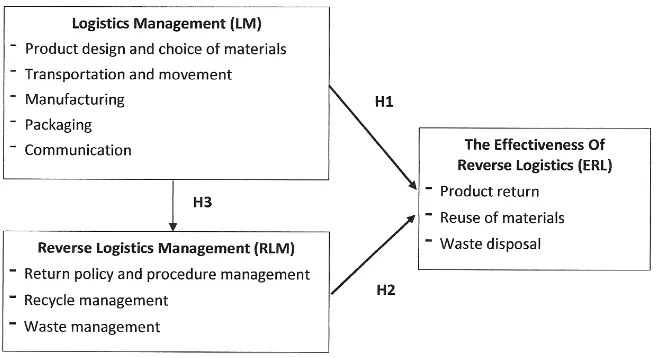
Figure 1. Research Framework for Current Study
4. RESEARCH HYPOTHESES AND SAMPLING
This research posits three hypotheses drawn from the literature review:
H1: Logistics management has a positive influence on the effectiveness of reverse logistics.
H2: Reverse logistics management has a positive influence on the effectiveness of reverse logistics.
H3: Logistics management has a positive influence on the effectiveness of reverse logistics.
Volume 10, Number 2, June 2015
5. DATA ANALYSIS AND HYPOTHESIS EXAMINATION
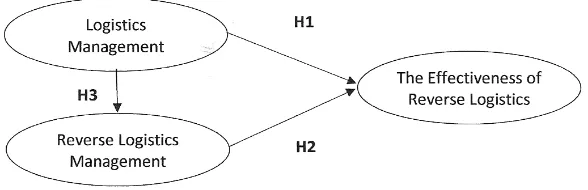
The current study used factor analysis to analyze factor loading and set up a model of three factors that conform to the Thailand context (Figure 2). In the chart, the logistics management factor includes five elements (product design and choice of materials, transportation and movement, manufacturing, packaging, and communication). The reverse logistics management factor consists of return policy and procedures management, recycle management, and waste management. The other factor is the effectiveness of reverse logistics.
Figure 2. Research Framework by Factor Analysis
After transformation of the data to the new factors shown in Figure 2, simple regression analysis was performed. Table 1 presents the results for H1. As indicated, the test confirmed that logistics management has a positive influence on the effectiveness of reverse logistics at the p-value 0.01, R-square equal to 0.135. The equation for H1 is shown below.
Unstandardized Equation (1) ERL = 84.565 + 0.693 LM
International Journal of Business and Information
Table 1
Results Confirming Hypothesis 1 (H1)
Dependent Variable:
The Effectiveness of Reverse Logistics (ERL)
B Std.
Error
β t p-value
(Constant) 84.565 0.065 1294.980 0.000
Logistics Management (LM)
0.693 0.066 0.370 10.474 0.000**
R2 = 137, Adjusted R2 = 135, F = 109.696, P-value = 0.000
** P-Value = 0.001
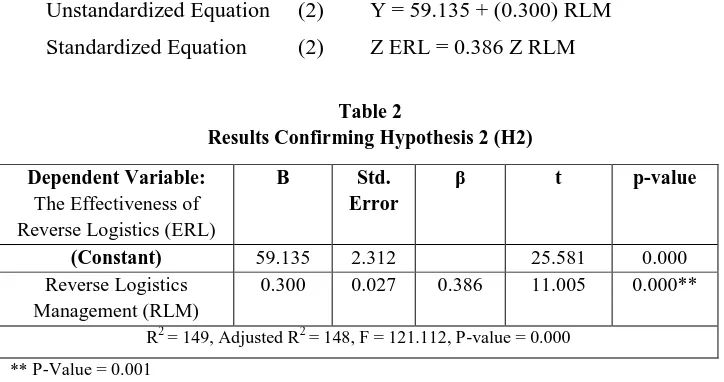
Table 2 presents the results of the hypothesis test for H2. The results confirmed that reverse logistics management has a positive influence on the effectiveness of reverse logistics at the p-value 0.01, R-square equal to 0.149. The equation for H2 is shown below.
Unstandardized Equation (2) Y = 59.135 + (0.300) RLM
Standardized Equation (2) Z ERL = 0.386 Z RLM
Table 2
Results Confirming Hypothesis 2 (H2)
Dependent Variable:
The Effectiveness of Reverse Logistics (ERL)
B Std.
Error
β t p-value
(Constant) 59.135 2.312 25.581 0.000
Reverse Logistics Management (RLM)
0.300 0.027 0.386 11.005 0.000**
R2 = 149, Adjusted R2 = 148, F = 121.112, P-value = 0.000
** P-Value = 0.001
Volume 10, Number 2, June 2015
Unstandardized Equation (3) Y = 84.680 + (1.820) LM
Standardized Equation (3) Z ERL = 0.756 Z LM
Table 3
Results Confirming Hypothesis 3 (H3)
Dependent Variable:
Reverse Logistics Management (RLM)
B Std.
Error
β t p-value
(Constant) 84.680 0.059 1433.288 0.000
Logistics Management (LM)
1.820 0.060 0.756 30.408 0.000**
R2 = 572, Adjusted R2 = 571, F = 924.652, P-value = 0.000 ** P-Value = 0.001
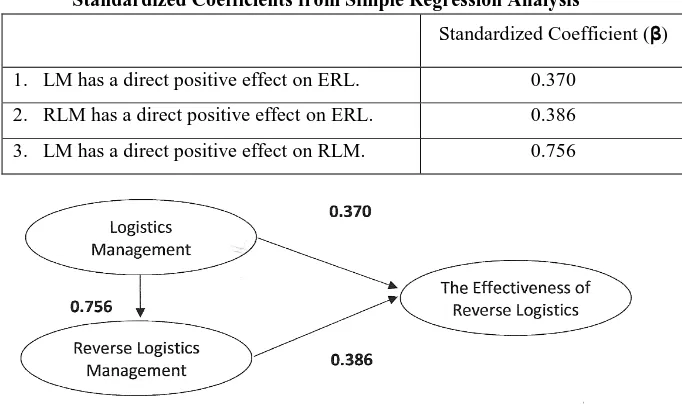
Tables 1, 2, and 3 show the direct effect of LM (logistics management) on ERL (effectiveness of reverse logistics); RLM (reverse logistics management) on ERL; and LM on RLM. Table 4 and Figure 3 present standardized coefficients from simple regression analysis.
Table 4
Standardized Coefficients from Simple Regression Analysis
Standardized Coefficient (β) 1. LM has a direct positive effect on ERL. 0.370
2. RLM has a direct positive effect on ERL. 0.386 3. LM has a direct positive effect on RLM. 0.756
International Journal of Business and Information
The result of total effect calculation indicated that the LM factor has a direct positive effect on ERL (β = 0.370) and an indirect positive effect on ERL through RLM (β = 0.292); whereas, the RLM factor has a direct positive effect on ERL (β = 0.386), and LM has a direct positive effect on RLM (β = 0.756).
1. The total effect calculation of LM on ERL
1.1. Direct effect = 0.370
1.2. Indirect effect
LM on RLM on ERL = (0.756) (0.386)
= 0.292
The effect of logistics management (LM) on the effectiveness of reverse logistics (ERL) equals 0.662 (from 0.370 + 0.292).
2. The total effect calculation of RLM on ERL
2.1. Direct effect = 0.386
3. The total effect calculation of LM on RLM
3.1. Direct effect = 0.756
6.
DISCUSSION
Path analysis is an extension of the regression method, which helps researchers to analyze indirect and direct effects of independent and dependent variables. In this study, the results indicate that logistics management and reverse logistics management have an impact on the effectiveness of reverse logistics at the p-value 0.01 (Table 1 and Table 2). Moreover, the results show that logistics management has an impact on reverse logistics management at the p-value 0.01 (Table 3), thus confirming the study’s three hypotheses.
Volume 10, Number 2, June 2015
The results of the current study conform with the findings of many researchers and logistics theorists, including Stock [9], Gupta [27], and Greve and Davis [28], who found that the key success factor in reverse logistics is logistics management from upstream to downstream because logistics management is related to all internal and external activities of the organization. Any changes in activities upstream will affect all of the flow, especially downstream. This fact explains why the literature identified balance as the key concept in logistics.
With regard to product design and choice of materials, a company that focuses on green logistics will produce a product that is eco-friendly, which means that, in reverse logistics, the materials or packaging can be reused or recycled in remanufacturing to minimize its ecological impact. Reverse logistics management has an influence on the effectiveness of reverse logistics because the effectiveness of reverse logistics is an outcome of reverse logistics management [25], [4]. This situation is called the cause and effect concept.
Return policy and procedures management is the origin of reverse logistics activities in business. Any business that has a policy to serve its customers must set up a product return procedure that covers, for example, the collection process and backhaul, among other things. In addition, the best practices of recycle management in reverse logistics will help businesses to succeed with regard to the effectiveness of reverse logistics as measured by cost reduction and the recapture of value during reuse or recycling of materials. Waste management activities must conform to international or domestic laws, corporate governance (CG), and corporate social responsibility (CSR). Demonstrating waste disposal procedures that meet or exceed these laws and regulations will raise the brand image and reputation of the company.
7.
IMPLICATIONS AND CONCLUSION
International Journal of Business and Information
In the quantitative research, all hypotheses tests supported the qualitative results that logistics management and reverse logistics influence the effectiveness of reverse logistics. The results also indicated that logistics management has both indirect and direct effects on the effectiveness of reverse logistics; that logistics management has a direct effect on reverse logistics; and that reverse logistics has an impact on the effectiveness of reverse logistics.
The qualitative and quantitative results of this study will help supply chain managers and logistics managers in electronics manufacturing firms better specify important priorities to improve reverse logistics management. In the past, the cost of such activities has been defined primarily in monetary terms. As concern for the environment rises, however, more and more countries have enacted laws to minimize the ecological impact of logistics with regard, for example, to climate change, air pollution, noise, waste, and accidents. Firms that succeed in terms of “green logistics” will concentrate on not only the activities of logistics management (product design and choice of materials, transportation and movement, manufacturing, packaging, and communication), but also the activities of reverse logistics management (return policy and procedure management, recycle management, and waste management). Effective reverse logistics will enable companies to do their best not only from the economic perspective, but also from the environmental and community perspective.
REFERENCES
[1] Liu, X. 2014. China-based logistics research: A review of the literature and implications, International Journal of Physical Distribution and Logistics Management 44(5): 392 – 411.
[2] Isaksson, K., and M. Huge-Brodin. 2013. Understanding efficiencies behind logistics service providers’ green offerings, Management Research Review 36(3), 216–238. [3] Pazirandeh, A., and H. Jafari. 2013. Making sense of green logistics, International
Journal of Productivity and Performance Management 62(8), 889 -904.
[4] Tepprasit, P. 2012. The reverse logistics process and the problem in reverse logistics management: A case study of Thailand electronics industry, Journal of Business Administration 1(1), 49–70.
Volume 10, Number 2, June 2015
[6] McKinnon, A; M. Browne: and A. Whiteing. 2013. Green Logistics: Improving the Environmental Sustainability of Logistics, Philadelphia: Kogan Page.
[7] Rodrigue, J.-P.; N. Slack; and C. Comtois. 2013. Green Supply Chain Management: The Sage Handbook of Transport Studies, London: Sage.
[8] Turrisi, M.; M. Bruccoleri; and S. Cannella. 2012. Impact of reverse logistics on supply chain performance, International Journal of Physical Distribution and Logistics Management 43(7), 564–585.
[9] Stock, J.R. 2008. Cover Story Developments in Reverse Logistics, Sustainability and Environmentalism in Logistics and Supply Chain Management, Bangkok: Supply Chain Biz.
[10] Ho, G.T.S.; K.L. Choy; C.H.Y. Lam; and D.W.C. Wong. 2012. Factors influencing implementation of reverse logistics: A survey among Hong Kong businesses, Measuring Business Excellence 16(3), 29–46.
[11] Office of the National Economic and Social Development Board. 2012. The Eleventh National Economic and Social Development Plan (2012– 2016), Bangkok: Office of the Prime Minister.
[12] Department of Trade Negotiation. 2014. ASEAN Economic Community, downloadable from website http://www.thaifta.com/trade/corner/ aec_about.pdf [13] Stone, C.A. 1968. Logistics: Definition, The Logistics Review 4(16), 9.
[14] James et al. 1973. Business Logistics: Physical Distribution and Materials Management,New York:Ronald Press.
[15] Stock, J., and D. Lambert. 2001. Strategy Logistics Management (4th ed.), London: McGraw-Hill.
[16] Langley, J.C., Jr.; J.J. Coyle; B.J. Gibson; R.A. Novack; and E.J. Bardi. 2008. Managing Supply Chains: A Logistics Approach (8th ed.), Ontario: Nelson Education.
[17] Christopher, M. 1992. Logistics and Supply Chain Management: Strategies for Reducing Costs and Improving Service (Logistics & Distribution Management Series (1st ed.), New Jersey: Financial Times Prentice Hall.
[18] Christopher, M. 2014. Supply Chain Complete. [Online at URL:http://www.martin-christopher.info/about-me]; Accessed February 8, 2014.
International Journal of Business and Information [20] Rushton, A., and s. Walker. 2007. International Logistics and Supply Chain
Outsourcing: From Local to Global,London: Kogan Page.
[21] Bowersox, D.; D. Closs; and M.B. Cooper. 2012. Supply Chain Logistics Management, New York: McGraw-Hill/Irwin.
[22] Mangan, et al. 2012. Global Logistics and Supply Chain Management, New Jersey: Wiley.
[23] Chantijiraporn, K. 2008. International Logistics and Supply Chain Management, Bangkok: SCM Education.
[24] Tepprasit, P. 2012. Influences on Logistics Process and Problem in Reverse Logistics Management of Electronic Industry in Thailand, Bangkok: Sripatum University.
[25] Rogers, D., and R. Tibben-Lembke. 1998. Going Backwards: Reverse Logistics Trends and Practices, Las Vegas: University of Nevada, Reno.
[26] Department of International Trade Promotion, Thailand. 2014. Thailand export directory, downloadable from website http://application.ditp.go.th/ Center_Public/thailand_export_directory.html
[27] Gupta, S.M. 2003. Reverse Supply Chain: Issues and Analysis, Florida: CRC Press. [28] Greve, C., J. Davis. 2012. An Executive’s Guide to Reverse Logistics: How to
Find Hidden Profits by Managing Returns, Pennsylvania: Greve-Davis.
ABOUT THE AUTHORS
Punyapon Tepprasit was born in Bangkok, Thailand, in 1985. He received his
M.B.A. degree in logistics and supply chain management from Sripatum University. In 2013, he was the recipient of the thesis award from the National Institute of Development Administration (NIDA). He is a scholar with a doctorate in business administration (DBA) and also the CEO of MVP Consultants, the top-ranked research and consulting firm in Thailand and South East Asia. He is also an instructor in the logistics and supply chain management department, Sripatum Business School, Sripatum University, and guest speaker on business management topics for small, medium, micro, and large enterprises in Thailand.
Prangtip Yuvanont received her bachelor of social studies degree from
Volume 10, Number 2, June 2015