ISSN Online: 2329-3292 ISSN Print: 2329-3284
DOI: 10.4236/ojbm.2019.73103 Jul. 29, 2019 1494 Open Journal of Business and Management
Supplier Selection Problem Based on Interval
Intuitionistic Fuzzy Multiattribute Group
Decision Making
Danyi Song, Jiao Wang
Beijing Wuzi University, Beijing, China
Abstract
Aiming at the supplier selection problem where the decision information is an interval intuitionistic fuzzy number and completely does know the attribute and decision maker’s weight, this problem is reduced to a mul-ti-attribute group decision problem. A decision method based on information entropy to determine the decision-maker’s weight and the deviation maximi-zation method to determine the attribute weight is proposed. Finally, this method is applied to the selection of automotive parts suppliers, and the re-sults are compared with the relevant methods, which fully illustrates the ef-fectiveness of this method.
Keywords
Interval Intuitionistic Fuzzy Numbers, Multi-Attribute Group Decision Making, Fuzzy Entropy, Maximum Dispersion, VIKOR
1. Introduction
With the development of economy and society, the competition between enter-prises is no longer the unilateral competition between price and quality, but the competition between supply chains. The supplier is at the source of the supply chain and plays a very core role in the whole supply chain. Choosing the right supplier is a good foundation for enterprise development. The evaluation and selection of suppliers is not the individual behavior of purchasers, but actually a complex multi-attribute group decision-making problem. Generally, there are not only quantitative indicators in the index system, such as product price and market share, but also qualitative indicators, such as product research and de-velopment capacity, after-sales maintenance level, etc., and the relationship
be-How to cite this paper: Song, D.Y. and Wang, J. (2019) Supplier Selection Problem Based on Interval Intuitionistic Fuzzy Mul-tiattribute Group Decision Making. Open Journal of Business and Management, 7, 1494-1503.
https://doi.org/10.4236/ojbm.2019.73103
Received: July 9, 2019 Accepted: July 26, 2019 Published: July 29, 2019
Copyright © 2019 by author(s) and Scientific Research Publishing Inc. This work is licensed under the Creative Commons Attribution International License (CC BY 4.0).
http://creativecommons.org/licenses/by/4.0/
DOI: 10.4236/ojbm.2019.73103 1495 Open Journal of Business and Management
tween indicators usually has incompatibility and incommensurability. Thus it can be seen that in the process of selecting parts suppliers, enterprises usually have vague and uncertain understanding of suppliers due to the objectivity and complexity of things, and even the effect of evaluation indexes has certain am-biguity, so it is difficult to draw a clear boundary [1], and accurate description becomes impossible. Therefore, the evaluation and selection of suppliers is es-sentially a fuzzy group decision making problem, which is more suitable to be solved by fuzzy group decision making method, and can effectively improve the scientificity and effectiveness of decision making results. The fuzzy multi-attribute group decision-making problem has been widely studied by many scholars and achieved excellent research results. In practical application, it has also solved many complex and significant problems in fields, such as supplier selection [2] [3] [4] [5] [6] and risk identification [7] etc.
2. Knowledge Preparation
1) Related concepts
Definition 1 interval intuitionistic fuzzy number [8]
Set X is A non-empty classic collection, I[ ]0,1 interval [0,1] said on the set of
all closed subinterval, for each x∈X , said A=
{
x U, A( ) ( )
x V, A x}
for Arange of X on intuitionistic fuzzy sets, including UA
( )
x and VA( )
x arere-spectively A interval-valued membership functions and interval-valued mem-bership functions, among them, the UA
( )
x ∈[ ]
0,1 , VA( )
x ∈[ ]
0,1 , and meet theconditions 0≤SupUA
( )
x +SupVA( )
x ≤1, x∈X . For simplicity, the upperand lower endpoints of interval value membership UA
( )
x and interval valuenon-membership VA
( )
x are denoated as( )
L AU x , U
( )
AU x , L
( )
AV x and
( )
U AV x , respectively. So, for each x∈X , interval-valued intuitionistic fuzzy sets A usable form of interval value is expressed as
( )
( )
( )
( )
{
, AL , UA , AL , AU}
A= x U x U x V x V x . Make
( )
1 U( )
U( )
,1 L( )
L( )
A x UA x VA x UA x VA x
π
= − − − − for the element ofinter-val-valued intuitionistic fuzzy sets A’s hesitation.
2) Distance measure of interval intuitionistic fuzzy sets [9]
Definition 2 Let A and B be two interval intuitionistic fuzzy sets, then define the weighted Hamming distance between A and B as:
(
)
1
, 1 4
m
L L U U L L U U L L U U
j A B A B A B A B A B A B
i
d A B
U U U U V V V V
ω π π π π
=
=
∑
− + − + − + − + − + − 3) Interval intuitionistic fuzzy entropy [10]
Definition 3 Let A be an interval-valued intuitionistic fuzzy set, then the fuzzy entropy of the interval-intuitionistic fuzzy number A is defined as:
{
}
{
}
{
}
{
}
min , min , max , max ,
L L U U L U
iq iq iq iq iq iq
L L U U L U
iq iq iq iq iq iq
U V U V
EA
U V U V
π π
π π
+ + +
=
DOI: 10.4236/ojbm.2019.73103 1496 Open Journal of Business and Management
4) Interval intuitionistic fuzzy weighted set settlement
Definition 4 Let A=
{
x U, iL( )
x U, iU( )
x , ViL( )
x V, iU( )
x }
be aninter-val-valued intuitionistic fuzzy set, then The interval intuitionistic fuzzy weighted set settlement is:
(
1 2)
(
)
(
)
( )
( )
1 1 1 1
, 1 1 ,1 1
, , ,
,
m z m z m z m z
L U L U
Z m i i i i
i i i i
G A A A U U V V
= = = =
= − − − −
∏
∏
∏
∏
3. Supplier Selection Method Based on Interval Intuitionistic
Fuzzy Set for Multi-Attribute Group Decision Making
1) Description of the problem
An enterprise need to choose the optimal supplier from alternative suppliers as partners, A=
{
A A1, 2,,Am}
is alternative suppliers, C={
C C1, 2,,Cp}
ispolicymakers set, a=
{
a a1, 2,,an}
is attributes (indicators), weights ofattributes
ω
j and weights of decision makers ∂k are unknown, decisionmakers weights vector sets Z= ∂ ∂
(
1, 2,,∂p)
, ∂ ∈k[ ]
0,1 and 1 1 pk k=∂ =
∑
, theproperties of vector sets
ω
={
ω ω
1, 2,,ω
n}
,ω
j∈[ ]
0,1 and 1 1 nj j=ω =
∑
, thenthe decision makers of all the attributes of each alternative suppliers give evalua-tion informaevalua-tion, and then take a certain method to various alternative sorting or preferred supplier. Attribute value matrix can be expressed as
( )
k k
m n ij m n
X × = x × . xijk is policymakers Ck for alternative suppliers Ai about
attribute aj’s value, by using interval intuitionistic fuzzy number
(
, , ,)
k L U L U
ij ij ij ij ij
x = U U V V said.
2) Determining the weight of decision makers
The weight of decision makers depends on how reliable the information is. The vaguer the judgment information provided by the decision-maker, the less the decision-maker knows about the decision object, and the less the weight is given. On the contrary, a larger weight is given. In this paper, the entropy and similarity of interval intuitionistic fuzzy number are considered comprehensive-ly from the decision matrix given by decision makers, which can not oncomprehensive-ly guar-antee the objectivity of the weight vector, but also reflect the subjective intention of decision makers. Firstly, the interval intuitionistic fuzzy entropy of the deci-sion maker Ck on m alternatives under each attribute is determined, and the
weight of the decision maker Ck is determined ∂k1:
( )
{
}
{
}
{
}
{
}
1 1
1 1
1
min , min ,
1
max , max ,
h m
k k
iq
q i
L L U U L U
iq iq iq iq iq iq
h m
q i L L U U L U
iq iq iq iq iq iq
E A e
hm
U V U V
hm U V U V
π π
π π
= =
= =
=
+ + +
+ + +
=
∑ ∑
∑ ∑
(1)( )
( )
(
)
1 1 1
1 k
k p k
k
E A E A
=
− ∂ =
−
DOI: 10.4236/ojbm.2019.73103 1497 Open Journal of Business and Management
Then use the interval intuitionistic fuzzy Hamming distance to find the dis-tance between the decision maker Ck and other decision matrices, and find the
2 k
∂ of the decision maker Ck:
( )
1 1 1(
)
1
,
p n m
k k l
ij ij
l j i
D A d r r
pnm = = =
=
∑ ∑ ∑
(3)( )
( )
(
)
2 1 1
1 k
k p k
k
D A D A
=
− ∂ =
−
∑
(4)The weights for policymakers Ck eventually: ∂ = ∂ + −k
δ
k1(
1δ
)
∂k2. δ canbe adjusted according to actual condition, the
δ
∈( )
0,1 . This article take the 0.5δ = . The weight vector set of the decision maker is obtained as
(
1, 2, , p)
Z= ∂ ∂ ∂ .
3) Determining attribute weight
As for attribute weight, due to individual differences of decision makers, attribute weight cannot be completely determined, and it is given comprehen-sively according to the opinions of p decision makers. This paper determines the attribute weight based on the idea of maximum deviation. The principle of the deviation maximization method is that if the evaluation value of an attribute in each alternative scheme is very small, then the attribute has little effect on the scheme ranking and gives a small weight. On the contrary, the attribute should be given a greater weight. In this paper, the weighted Hamming distance of in-terval intuitionistic fuzzy number is used to measure the deviation between all attribute values of each alternative scheme.
For the attribute aj, the dispersion dj
(
A Ai, t)
between the decision scheme tA and the other decision scheme At can be defined as:
( )
1(
,)
m
j i t j j i t
d A =
∑
=ω
d A A (5) The sum of the total dispersions for all alternatives is:( )
(
)
1 1 1 ,
m m m
j i j i i t j j i t
S =
∑
= d A =∑ ∑
= =ω
d A A (6) The attribute weight vector(
)
T1 j
W = ωω should be selected so that the total dispersion of each alternative is maximized, so the following optimal model solution is established:
( )
1 1 1 1(
)
maxD ωj =
∑
nj=Sj =∑ ∑ ∑
nj= im= tm=ωjdj A Ai, t (7)Restrictions:
2
1 1
n j j=ω =
∑
(8)0 j
ω
≥ (9) where i=1, 2,, ;m j=1, 2,, ;n k=1, 2,,p. Solving the optimization model (7), you can construct a Lagrangian function:( , ) 1 1 1
(
,)
(
1 2 1)
n m m n
j j i t j
j i t j
DOI: 10.4236/ojbm.2019.73103 1498 Open Journal of Business and Management
Partial derivative 1 1
(
)
2 1
, 2 0
1 0
m m
j i t j
i t
n j j
L
d A A
L σω ω ω σ = = = ∂ = + = ∂ ∂ = − = ∂
∑ ∑
∑
; Find a solution:(
)
(
)
1 1
2
1 1 1
,
,
m m
j i t
i t
j
n m m
j i t
j i t
d A A d A A
ω = =
= = =
=
∑ ∑
∑ ∑ ∑
; Calculateω
j using Python programming.Traditional weighting vectors also need to satisfy normalized constraints:
* 1 j j n j j ω ω ω = =
∑
(10)4) Based on the expansion of VIKOR supplier ranking method
When selecting suppliers, it is difficult for decision-makers to choose one supplier from many potential suppliers that can fully meet all requirements of the enterprise’s evaluation system. Therefore, it is particularly important to choose a good compromise solution in practical decision-making. The VIKOR decision method shows an advantage in this respect. According to the decision matrix, the steps to optimize the decision object according to the VIKOR me-thod are as follows:
a) according to the decision matrix, the positive ideal solution and the nega-tive ideal solution of the intuitionistic fuzzy decision matrix of group interval are defined as respectively: A
(
x1,x2, ,xj)
+= + + +
and A
(
x1,x2, ,xj)
− = − − −
. Among
them, xj max
( )
xij+= ;
( )
min
j ij
x− = x ; i=1, 2,,m; j=1, 2,,n;
(
)
1 1 1 1 1
max≤ ≤i mxij = max≤ ≤i mUijL, max≤ ≤i mUijU , min≤ ≤i mVijL, min≤ ≤i mVijU ;
(
)
1 1 1 1 1
min min L, min U , max L, max U
i mxij i mUij i mUij i mVij i mVij
≤ ≤ = ≤ ≤ ≤ ≤ ≤ ≤ ≤ ≤ .
b) Calculate the group utility value Si and individual regret value Ri of
each alternative scheme:
(
)
(
)
1
j ij n
i j j
j j x x S x x
ω
+ = + − − = −∑
(11)(
)
(
)
max j ij
i j j
j j x x R x x
ω
+ + − − =− (12)
where
(
xj xij)
+− and
(
)
j j
x+−x− are the differences between two interval intui-tionistic fuzzy numbers, and the interval intuiintui-tionistic fuzzy Hamming distance is used to calculate the metrics d x
(
j,xij)
+ and
(
)
, j j
d x+ x− .
c) Calculate the comprehensive evaluation value of each alternative
(
)
(
i)
(
1)
(
(
i)
)
i
S S R R Q
S S R R
ε
ε
− − + − + − − − + − − −= (13)
where S maxi
{ }
Si+ = ,
{ }
mini i
S−= S , R maxi
{ }
Ri+= ,
{ }
mini i
R−= R .
ε is the coefficient of decision mechanism,
ε
∈[ ]
0,1 , ε>0.5 means that theutil-DOI: 10.4236/ojbm.2019.73103 1499 Open Journal of Business and Management
ity of the group; ε<0.5 means that the decision is made according to the
deci-sion mechanism of minimizing individual regret; ε =0.5, it means that the
strategy is formulated according to the equilibrium situation. In the inter-val-intuitionistic fuzzy VIKOR method proposed in this paper, the coefficient of decision-making mechanism is chosen to be 0.5, that is, the optimal supplier is selected according to the mechanism that the decision-makers negotiate to reach consensus.
d) Determine the compromise solution
According to the order of Si and Ri and Qi sorted from small to large,
three sorting sequences are obtained. For the candidate suppliers ranked first in
i
Q, the optimal compromise solution is determined according to the following two conditions:
Assume that the first and second schemes are sorted as A1 and A2,
respec-tively.
Condition 1: 2 1 1
1
Q Q m
− ≥
− , where m is the number of scenarios, which
represents an acceptable advantage.
Condition 2: If the A1 stability of the scheme is accepted by the decision
maker during the decision process. A1 is also the first scheme in Si and Ri.
If the above two conditions are met, the optimal solution is A1; if the two
conditions cannot be met at the same time, a compromise is obtained: i) If only condition 1 is satisfied, the compromise solution is A A1, 2;
ii) If only condition 2 is satisfied, based on 1 1
1 i
Q Q m
− ≤
− , the maximum i
can be obtained, then A A1, 2,,Ai are close to the ideal solution.
4. Case Analysis
In this paper, an example of an automobile enterprise’s choice of parts supplier is taken. The interval intuitionistic fuzzy multi-attribute VIKOR method estab-lished in this paper is adopted to help automobile enterprises choose the best auto parts supplier. Weber [11] adopted the method of statistical analysis to col-late and analyze 74 literatures published from the 1960s to the 1990s and recol-lated to the evaluation and selection of suppliers, and studied and analyzed 23 indica-tors proposed by Dickson from different perspectives, among which price, qual-ity and service were the most frequently discussed indicators. Car companies now J want to choose the optimal battery supplier to build the cooperation, the existing four alternative battery supplier A ii
(
=1, 2,3, 4)
, J company establishedthree evaluation attributes aj
(
j=1, 2, 3)
(product price, product quality andservice), in order to make decisions scientifically, from procurement, finance, technology, three departments take a human Ck
(
k=1, 2, 3)
.1) supplier selection scheme based on interval intuitionistic fuzzy VIKOR method
DOI: 10.4236/ojbm.2019.73103 1500 Open Journal of Business and Management
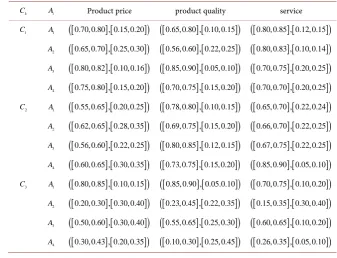
According to their own experience, the three decision makers respectively provide decision information for three attributes of the four suppliers, represented by interval intuitionistic fuzzy number, as shown in Table 1.
Step 2 Determine decision maker weights
The weight set Z =
(
0.37, 0.35, 0.28)
can be obtained by aggregating theweights of decision makers with ∂k according to Equations (3) and (4).
Step 3 Aggregate group interval intuitionistic fuzzy decision matrix
The interval intuitionistic fuzzy aggregation operator is used to aggregate the decision matrix of three decision makers into a group decision matrix, and the comprehensive evaluation is obtained by value Definition 4.
[
] [
]
(
)
11 0.69, 0.78 , 0.15, 0.20
r = , r12=
(
[
0.77, 0.84 , 0.08, 0.13] [
]
)
,[
] [
]
(
)
13 0.73, 0.78 , 0.16, 0.19
r = , r21=
(
[
0.55, 0.60 , 0.27, 0.34] [
]
)
,[
] [
]
(
)
22 0.54, 0.63 , 0.19, 0.25
r = , r23=
(
[
0.64.0.70 , 0.18, 0.23] [
]
)
,[
] [
]
(
)
31 0.66, 0.70 , 0.18, 0.24
r = , r32 =
(
[
0.77, 0.84 , 0.11, 0.16] [
]
)
,[
] [
]
(
)
33 0.66, 0.73 , 0.16, 0.23
r = , r41=
(
[
0.61, 0.67 , 0.21, 0.28] [
]
)
,[
] [
]
(
)
42 0.61, 0.67 , 0.17, 0.25
r = , r43=
(
[
0.70, 0.75 , 0.08, 0.14] [
]
)
Step 4 Determine attribute weights
According to Formula (6), the total dispersion of all the schemes under each attribute is: S1=1.07ω1, S2=1.69ω2, S3=0.90ω3.
The selection of the attribute weight vector
(
)
T1 j
[image:7.595.201.539.471.729.2]W = ωω should maxim-ize the total dispersion of each alternative, so the following optimization model is established:
Table 1. Initial decision information matrix.
k
C Ai Product price product quality service
1
C A1
(
[
0.70, 0.80 , 0.15, 0.20] [
]
)
(
[
0.65, 0.80 , 0.10, 0.15] [
]
)
(
[
0.80, 0.85 , 0.12, 0.15] [
]
)
2
A
(
[
0.65, 0.70 , 0.25, 0.30] [
]
)
(
[
0.56, 0.60 , 0.22, 0.25] [
]
)
(
[
0.80, 0.83 , 0.10, 0.14] [
]
)
3
A
(
[
0.80, 0.82 , 0.10, 0.16] [
]
)
(
[
0.85, 0.90 , 0.05, 0.10] [
]
)
(
[
0.70, 0.75 , 0.20, 0.25] [
]
)
4
A
(
[
0.75, 0.80 , 0.15, 0.20] [
]
)
(
[
0.70, 0.75 , 0.15, 0.20] [
]
)
(
[
0.70, 0.70 , 0.20, 0.25] [
]
)
2
C A1
(
[
0.55, 0.65 , 0.20, 0.25] [
]
)
(
[
0.78, 0.80 , 0.10, 0.15] [
]
)
(
[
0.65, 0.70 , 0.22, 0.24] [
]
)
2
A
(
[
0.62, 0.65 , 0.28, 0.35] [
]
)
(
[
0.69, 0.75 , 0.15, 0.20] [
]
)
(
[
0.66, 0.70 , 0.22, 0.25] [
]
)
3
A
(
[
0.56, 0.60 , 0.22, 0.25] [
]
)
(
[
0.80, 0.85 , 0.12, 0.15] [
]
)
(
[
0.67, 0.75 , 0.22, 0.25] [
]
)
4
A
(
[
0.60, 0.65 , 0.30, 0.35] [
]
)
(
[
0.73, 0.75 , 0.15, 0.20] [
]
)
(
[
0.85, 0.90 , 0.05, 0.10] [
]
)
3
C A1
(
[
0.80, 0.85 , 0.10, 0.15] [
]
)
(
[
0.85, 0.90 , 0.05.0.10] [
]
)
(
[
0.70, 0.75 , 0.10, 0.20] [
]
)
2
A
(
[
0.20, 0.30 , 0.30, 0.40] [
]
)
(
[
0.23, 0.45 , 0.22, 0.35] [
]
)
(
[
0.15, 0.35 , 0.30, 0.40] [
]
)
3
A
(
[
0.50, 0.60 , 0.30, 0.40] [
]
)
(
[
0.55, 0.65 , 0.25, 0.30] [
]
)
(
[
0.60, 0.65 , 0.10, 0.20] [
]
)
4
DOI: 10.4236/ojbm.2019.73103 1501 Open Journal of Business and Management
( )
1.07 1 1.69 2 0.90 3maxD
ω
j =ω
+ω
+ω
s.t. 2
1 1
n j j=ω =
∑
0 j
ω
≥The optimization model is calculated using Python programming, and the attribute weight vector set is obtained: W =
(
0.49, 0.77, 0.41)
. Then normalizedaccording to Formula (10) to obtain *
(
)
0.29, 0.46, 0.25W = .
Step 5 Sorted by the extended VIKOR method to select the optimal solution According to the first step a) of the VIKOR method, the positive ideal solution and the negative ideal solution are defined:
[
] [
]
(
0.69, 0.78 , 0.15, 0.20 , 0.77, 0.84 , 0.08, 0.13 , 0.73, 0.78 , 0.08, 0.14)
(
[
] [
]
)
(
[
] [
]
)
j
x+ = ;
[
] [
]
(
0.55, 0.60 , 0.27, 0.34 , 0.54, 0.63 , 0.19, 0.25 , 0.64, 0.70 , 0.18, 0.23)
(
[
] [
]
)
(
[
] [
]
)
j
x− = .
Calculate the group utility value Si and the individual regret value Ri of
each decision scheme by Formula (11), Formula (12) and Formula (13), taking
0.5
ε= , calculate the comprehensive evaluation value Qi of each alternative scheme Ai, and obtain S1=0.17, S2=1, S3=0.39, S4=0.61; R1=0.17,
2 0.46
R = , R3=0.24, R4=0.35; Q1=0, Q2=1.44, Q3=0.37, Q4=0.82.
The sorting results are S1<S3 <S4 <S2; R1<R3<R4<R2; Q1<Q3<Q4<Q2.
It can be obtained that the value of Q1 is at least the scheme A1.
2) Sensitivity analysis
In the interval intuitionistic fuzzy VIKOR method, the decision mechanism ε
coefficient has an important influence on the optimal ranking results of the auto parts supplier. This article performs sensitivity analysis by setting different ε
values and observes changes in the choice of compromises to investigate the in-fluence of different ε values on the evaluation results. Take the value ε from the interval [0,1] at 0.1, and conduct 11 experiments in total. The three ranking re-sults obtained by each experiment are the same as those obtained by the above method. That is to say, the best supplier is always A1 while setting different
de-cision mechanism ε. This shows the stability of this method. 3) Contrastive analysis with TOPSIS method
In order to compare the effectiveness and feasibility of the algorithm, I used the interval intuitionistic fuzzy TOPSIS method in reference [12] to make deci-sion on the data of case analysis. And compared with the decideci-sion results ob-tained by the interval intuitionistic fuzzy VIKOR method proposed in this paper. In the interval intuitionistic fuzzy TOPSIS method, using the relative proximity between the alternative suppliers and the ideal solution
(
,) (
(
,) (
,)
)
i j ij j ij j ij
K =d x− x d x+ x +d x− x to sort alternate suppliers. And the larger the value Ki, the closer to the ideal scheme. Where d x
(
j,xij)
+ and
(
j, ij)
d x− x are the weighted interval intuitionistic fuzzy Hamming distances of the alternative supplier Ai and the positive ideal solution xj
+ and the negative
ideal solution xj
−, respectively. Weight is the weight of each attribute. The
intui-DOI: 10.4236/ojbm.2019.73103 1502 Open Journal of Business and Management
tionistic fuzzy TOPSIS method and VIKOR method are K1=0.91, K2 =0, 3 0.73
K = , K4 =0.37 respectively. And The ranking result is
1 4 3 2
K <K <K <K . It can be seen that the ranking results of the alternatives ob-tained by the interval intuitionistic fuzzy TOPSIS and VIKOR methods are completely consistent, and the optimal scheme is always A1, which further
vali-dates the effectiveness of the proposed method. In addition, the interval intui-tionistic fuzzy VIKOR method can also express the subjective attitude of deci-sion makers, considering the mutual compromise between group benefits and individual regrets, and has greater objectivity and flexibility than the TOPSIS method. And the paper determines the weights of each decision maker based on the interval intuitionistic fuzzy entropy, making the results more objective and in line with the actual situation, while the reference [12] only considers the situ-ation of a single decision maker.
5. The Summary
Suppliers are at the input of the supply chain and play a decisive role in the de-velopment of the entire supply chain. Aiming at the problem of supplier selec-tion, this paper proposes a decision-making method with interval intuitionistic fuzzy sets for supplier attribute evaluation information. A new VIKOR model of interval intuitionistic fuzzy multi-attribute group decision-making is con-structed when attribute weight and decision maker weight are unknown. Then the model is applied to the evaluation and selection of automotive parts suppli-ers, and the validity of the model is verified by comparing with the relevant me-thods.
Conflicts of Interest
The authors declare no conflicts of interest regarding the publication of this pa-per.
References
[1] Wan, S., Wang, Q. and Dong, J. (2013) The Extended VIKOR Method for Mul-ti-Attribute Group Decision Making with Triangular Intuitionistic Fuzzy Numbers.
Knowledge-Based Systems, No. 52, 65-77.
https://doi.org/10.1016/j.knosys.2013.06.019
[2] Pang, J. and Song, P. (2015) Multi-Stage Vendor Selection Based on Fuzzy Group Decision and Extended VIKOR. Statistics and Decision-Making, No. 13, 43-46. [3] Zhang, L., Wang, J., Zheng, D., Che, F., Shi, C. and Mao, H. (2019) Decision-Making
of Equipment Supplier Selection Based on Intuitionistic Fuzzy Entropy and VIKOR.
System Engineering and Electronic Technology, No. 3, 1-10.
[4] Zhao, M., Ren, R. and Li, G. (2013) Fuzzy Entropy Group Decision Making Method Based on Interval Intuitionistic Fuzzy Sets. Operations Research and Management, No. 5, 117-121.
DOI: 10.4236/ojbm.2019.73103 1503 Open Journal of Business and Management [6] Yuan, Y., Guan, T., Li, X. and Li, Y. (2014) Supplier Selection Decision Model Based
on Hybrid VIKOR Method. Control and Decision, 29, 551-560.
[7] Xu, H., Liu, G. and Zhou, Z. (2017) Interval Intuitionistic Uncertain Linguistic Multi-Attribute Group Decision Model for Risk Identification of Engineering Projects. Journal of Civil Engineering and Management, 34, 68-74.
[8] Atanassovkt, G. (1989) Interval-Valued Intuitionistic Fuzzy Sets. Fuzzy Sets and Systems, 31, 343-349. https://doi.org/10.1016/0165-0114(89)90205-4
[9] Gao, Z. and Wei, C. (2012) For Mulaofinterval-Value Dintu-Itionistic Fuzzy Entro-py and Its Applications. Computer Engineering and Application, 48, 53-55.
[10] Wang, P. and Wei, C. (2011) A Construction Method of Interval Intuitionistic Fuzzy Entropy. Computer Engineering and Applications, No. 2, 43-45.
[11] Weber, C.A. and Current, J.R. (1991) Vendor Selection Criteria and Methods. Eu-ropean Journal of Operational Research, 50, 2-18.
https://doi.org/10.1016/0377-2217(91)90033-R