M E T H O D O L O G Y
Open Access
Improving benchmarking by using an explicit
framework for the development of composite
indicators: an example using pediatric
quality of care
Jochen Profit
1,2,3*, Katri V Typpo
4, Sylvia J Hysong
2,3, LeChauncy D Woodard
2,3, Michael A Kallen
5,
Laura A Petersen
2,3Abstract
Background:The measurement of healthcare provider performance is becoming more widespread. Physicians have been guarded about performance measurement, in part because the methodology for comparative
measurement of care quality is underdeveloped. Comprehensive quality improvement will require comprehensive measurement, implying the aggregation of multiple quality metrics into composite indicators.
Objective:To present a conceptual framework to develop comprehensive, robust, and transparent composite indicators of pediatric care quality, and to highlight aspects specific to quality measurement in children.
Methods:We reviewed the scientific literature on composite indicator development, health systems, and quality measurement in the pediatric healthcare setting. Frameworks were selected for explicitness and applicability to a hospital-based measurement system.
Results:We synthesized various frameworks into a comprehensive model for the development of composite indicators of quality of care. Among its key premises, the model proposes identifying structural, process, and outcome metrics for each of the Institute of Medicine’s six domains of quality (safety, effectiveness, efficiency, patient-centeredness, timeliness, and equity) and presents a step-by-step framework for embedding the quality of care measurement model into composite indicator development.
Conclusions:The framework presented offers researchers an explicit path to composite indicator development. Without a scientifically robust and comprehensive approach to measurement of the quality of healthcare, performance measurement will ultimately fail to achieve its quality improvement goals.
Background
In recent years, composite indicators of care quality have been used more widely to measure and track pro-vider performance in adult medicine [1-7]. In pediatrics, interest in provider healthcare performance is rising. Various countries, such as the United Kingdom, Canada, and Australia, are developing scorecards that include measures of pediatric healthcare quality [8-10]. Resources for healthcare are finite, and high-income countries are facing rising pressures to maximize the
value of healthcare expenditures. Information on provi-der performance can reduce the information deficit between purchasers and providers of healthcare, provid-ing incentives for purchasers and consumers of services to use the best providers, and for providers to improve performance. Composite indicators in healthcare thus have come into wider use largely as a by-product of so called‘value-based purchasing’ initiatives, where payers reimburse providers based on comparative performance (benchmarking) [11-13].
Composite indicators can provide global insights and trends about quality not just for external benchmarking against other providers or institutions, but also facilitate
* Correspondence: [email protected]
1Department of Pediatrics, Baylor College of Medicine, Texas Children’s Hospital, Houston, TX, USA
quality improvement efforts within institutions by iden-tifying areas of healthcare quality that need improve-ment. While composite indicators may be a useful addition to the quality improvement toolbox, their development is complex, and the editorial choices required of developers may significantly influence per-formance ratings [14]. Therefore, development must be explicit and transparent.
The unique contribution and purpose of this paper is to advocate for using composite indicators as an approach to measure quality in pediatrics, and to pre-sent a framework for the development of composite indicators based on a combination of previously pre-sented frameworks on both quality measurement and composite indicator development. The final approach to composite indicator development is the result of a com-bination of approaches described by Profit and collea-gues with methods developed by the European Commission Joint Research Center (EC-JRC) and the Organization for Economic Cooperation and Develop-ment (OECD), henceforth simplified as JRC [12,15]. In the Discussion section, we will spotlight pediatric-speci-fic aspects in composite indicator development that require empirical research. These include paucity of interactions with the healthcare system, paucity of criti-cal health outcomes, and availability of quality of life and prevention metrics. We will focus on aspects impor-tant to pediatrics because aggregate performance mea-surement is comparatively new to this field. However, we believe that the application of this conceptual frame-work provides a comprehensive roadmap for the contin-uous improvement of quality measurement for all populations.
Composite indicators of quality
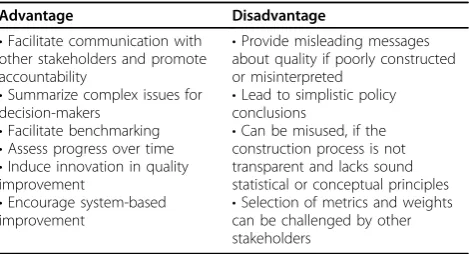
Composite indicators of quality combine multiple metrics of quality into an aggregate score. Table 1 (adapted from Nardo [15]) summarizes the advantages and disadvantages of using composite indicators, regard-less of field or purpose. We will discuss the advantages and disadvantages of composite indicators focusing on their two probable uses, benchmarking and quality improvement.
Composites for benchmarking
Benchmarking of providers based on only one or a few indicators of quality may be problematic for several rea-sons. First, benchmarking based upon a few indicators infers a strong correlation of performance across all dimensions of quality, whether measured or not. How-ever, this has not been found in the extant literature. Several articles have highlighted weak correlations among metrics of quality [16,17]. In other words, perfor-mance in one aspect of care quality is not necessarily
informative about performance in others. It is possible that composite indicators may be better suited to reflect an overall construct of quality.
A second benefit of composite indicators of quality is that they are communicable to diverse stakeholders and may be leveraged to induce competition on quality. Payers of healthcare increasingly employ these measure-ments to inform and direct patients’choice of providers through selective contracting. Patients may gain from transparent provider competition for quality and through the ability to make informed healthcare choices. While to date there is little evidence that benchmarking informa-tion affects patient choice of provider [18], consumer attitudes may change as the quality and dissemination formats of quality information improve. However, any benefit to patients is dependent on the accuracy of classi-fying providers as superior or inferior. Variation in meth-ods and quality of existing composites may lead to significant misclassification of providers as outliers [19].
Composite indicators are a simplified representation of the underlying quality of care construct. In fact, simplifi-cation is their main appeal. There is a danger, however, that overly simplistic policy messages derived from com-posites may be misleading or misused to support narrow agendas. If the providers being measured perceive the indicators to lack scientific soundness, transparency, or content validity, they are unlikely to produce desired improvements in patient health status. In addition, a summary score may inaccurately suggest that providers are average if good scores on one metric compensate for poor performance on other metrics. In fact, ‘average’ providers may be ‘poor’ providers for patients whose needs are within the low scoring performance areas. Some of these dangers can be countered by using disse-mination formats that convey results accurately while avoiding oversimplification (such as the ability to ‘drill down’into individual components of the composite), and by making the process of indicator development explicit and transparent to all stakeholders. In addition, statistical techniques such as multi-criterion analysis Table 1 Advantages and disadvantages of composite indicators
Advantage Disadvantage
•Facilitate communication with other stakeholders and promote accountability
•Summarize complex issues for decision-makers
•Facilitate benchmarking
•Assess progress over time
•Induce innovation in quality improvement
•Encourage system-based improvement
•Provide misleading messages about quality if poorly constructed or misinterpreted
•Lead to simplistic policy conclusions
•Can be misused, if the construction process is not transparent and lacks sound statistical or conceptual principles
mitigate the problem of performance averaging [15]. Nevertheless, it is likely that composites used for bench-marking will be subject to methodological and political challenge from providers disagreeing with results.
Composites for quality improvement
Composite indicators might support quality improve-ment in various ways. They may help providers translate a bewildering wealth of information into action and track effects throughout the care delivery system. To illustrate, the Vermont Oxford Network tracks the qual-ity of healthcare delivery of over 800 neonatal intensive care units worldwide, with clinically rich information available for many processes and care outcomes [20]. It may be difficult for neonatal intensive care providers to translate large volumes of data into effective quality improvement efforts.
A multi-dimensional approach to quality measurement via composite indicators may support such a multi-dimensional approach to quality improvement. Compo-site indicators and their individual components may identify specific areas for attention, for which specific evidence-based interventions are then developed. The success of improvement can then be cross-checked with the comprehensive measure set to ensure that this focus has not worsened quality of care in another area. How-ever, targeting individual quality metrics may lead to piecemeal rather than system-based efforts in quality improvement. Potentially, larger leaps in improvement may result from systems-based interventions that affect multiple areas of care simultaneously and have the potential to spread [21] throughout the care service and the institution. Improving safety attitudes among staff is an example of a system-based intervention that may improve outcomes and propagate throughout an institu-tion [22]. Whether composites are used to track improvement targeting individual or multiple metrics will depend on local resources, support systems, exper-tise, and institutional capacity. In either application, composites would allow tracking of overall improvement and their sub-components could alert users to potential concordant or discordant effects of improvement activ-ities on other measures of quality.
Thus, using composite indicators does not imply replacing the measurement of individual metrics of quality. Rather, composites merely summarize the infor-mation contained in the individual metrics and make that information more digestible. A synergistic approach of using both composites and individual metrics may permit harnessing the advantages of both.
Recognizing that there are numerous editorial choices in the development of composite indicators, and that quality of care can be defined in overly simplistic ways, we propose a composite-based approach to measuring
pediatric care quality by combining the JRC composite development methodology [15] and Profitet al.’s quality measurement framework [12].
Development of composite indicators
As do other organizations, the JRC has significant insti-tutional expertise in developing, applying, and evaluating composite indicators; it has, in fact, published guidelines for composite indicator development [15,23,24]. These guidelines have begun to be used in other settings of healthcare [25]. What differentiates the JRC’s approach from that of other organizations is its highly explicit, transparent, and evaluative approach to composite indi-cator development. Proposed methods promote internal and external statistical and methodological consistency and offer users choices of building blocks at each step in composite indicator construction, tailored to the task at hand.
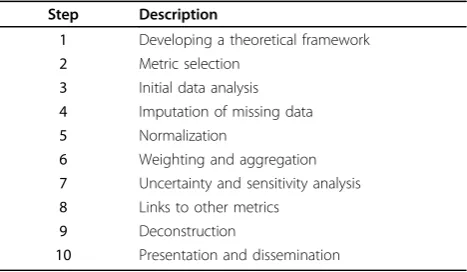
Table 2 shows the JRC’s ten step approach to compo-site indicators development [15]. We present here a brief summary of this approach along with a theoretical example of composite score development for pediatric intensive care unit (PICU) quality. We refer readers to the JRC handbook [15] for additional detail.
Example: developing a PICU quality composite indicator Step one: framework
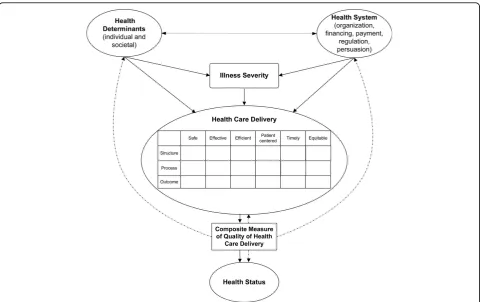
We base the framework for a PICU indicator on the work of Arah [26], Roberts [27], the Institute of Medi-cine (IOM) [28], and Donabedian [29] (see Figure 1). Details of this framework have been described elsewhere [12]. In brief, Figure 1 models a patient’s path through the healthcare system and highlights opportunities and challenges for measurement. The model emphasizes innate and external modifiers of health that determine baseline illness severity and that should be addressed via risk adjustment or risk stratification. Quality of health-care measurement combines the frameworks of the IOM and Donabedian, resulting in a quality matrix (see Table 3). Metrics within the matrix can be combined to
Table 2 Developing a composite indicator
Step Description
1 Developing a theoretical framework
2 Metric selection
3 Initial data analysis
4 Imputation of missing data
5 Normalization
6 Weighting and aggregation
7 Uncertainty and sensitivity analysis
8 Links to other metrics
9 Deconstruction
form a composite indicator of quality. The resulting composite would combine metrics of structure, process, and outcomes, a combination suggested by others [30], and be based on sub-pillars derived from the IOM domains of quality of care. Metrics within each pillar will correlate among each other and with those of other pillars. Ideally, one would expect moderately high corre-lations of metrics within pillars and low correcorre-lations between pillars. In the end, the composite can serve as an outcome measure, which can then be used to assess
the effect of new health policies or changes in medical care on long-term health outcomes.
Depending on the measurement purpose of the com-posite, we propose filling the quality matrix with dis-ease- or disease category-specific metrics of quality to create a balanced scorecard of overall quality of care and promote the goal of ensuring that providers are responsive to the quality expectations of all stakeholders, including payers and patients. In many areas of medi-cine, available metrics may span several domains of Figure 1Theoretical Framework for Measuring Quality of Care. Solid arrows indicate interactions; dotted arrows indicate potential use of composite indicator to measure healthcare delivery, predict health status and inform health policy at the health systems and societal level. (Adapted from Profit et al. [12]).
Table 3 Quality matrix for a pediatric intensive care unit quality index
Safe Effective Efficient Pt-centered Timely Equitable
Structure Nurse-to-patient ratio Intensivist in
house 24 hours a day
Process Medication Safety Practice, Central line infection prevention practice, VAP prevention practices
Review of unplanned readmissions
Pain assessment on admission, Periodic pain assessment
Time to receive antibiotics for sepsis
Outcome VAP rate, BSI rate, UTI rate, Unplanned extubation rate
SMR, Unplanned readmission rate
Severity adjusted LOS
Failed extubation rate
quality, may share a cell with other metrics, or may not exist for certain cells of the matrix; the latter measure-ment state clearly indicates the need for future metric development research. For example, the absence of equity metrics in Table 3’s matrix is of note and could be addressed through further research on equity reports [31].
Step two: metric selection
Given the high stakes involved with regard to compara-tive performance measurement, we think that the metric selection process is of cardinal importance to the com-posite indicator’s acceptability among users. Selection should therefore rely on a rigorous and explicit process so that each metric is appropriately vetted with regard to its strengths and weaknesses. Favourable metric char-acteristics include: importance (i.e., relevant domains of care); scientific acceptability, including validity (reflect-ing the desired measurement construct) and reliability (precision of point estimates); usability (inducing reason-able action plans); timeliness (improving the effect of feedback); and feasibility (data are available and easily retrievable) [32]. In our example, the Pediatric Data Quality Systems (Pedi-QS) Collaborative Measures Workgroup is a joint consensus panel formed by the National Association of Children’s Hospitals and Related Institutions, Child Health Corporation of America, and Medical Management Planning tasked with recommend-ing pediatric quality metrics to the Joint Commission [33] In 2005, the Work Group recommended eight pro-cess and outcome quality metrics for use in the PICU, which we have placed into the matrix (see Table 3). The selection of metrics may be informed by expert opinion or based on statistical methods. The use of expert opi-nion and a formal metric vetting process may enhance the composite index’ external validity and thus user acceptability. On the other hand, a statistical approach to metric selection may be less time consuming and result in a more parsimonious measure set but may lack external validity with users. Importantly, either approach should result in a measure set that clinically represents the underlying quality construct and balances external validity and parsimony. Future updates of the composite should incorporate user feedback and new scientific evi-dence, which may require changes to the existing mea-sure set. As mentioned above, metric selection and attribution to domains of care inform the structure of the composite with regard to its sub-pillars. We recom-mend a minimum of three measures per pillar, meaning that given the dearth of available data, a PICU compo-site would currently lack at least two domains (e.g., equity and efficiency). Whether a metric, such as sever-ity-adjusted length of stay, can be incorporated into the composite can be investigated by examining whether it statistically maps on another domain.
Step three: initial data analysis
In this step, the data are prepared for analysis. Consid-eration should be given to the exclusion of outlier data points, such that resulting performance ratings are not unduly influenced by extreme values. In addition, the data need to be uniform in their directionality. For example, a high ventilator-associated pneumonia (VAP) rate indicates poor quality, but a high level of compli-ance with VAP prevention practices indicates the oppo-site. Thus, in the composite, one of the metrics has to be reverse-coded.
Step four: missing data
Complete-case-analysis, which sidesteps imputation and missing-ness by use of missing case deletion (list-wise or pair-wise) will produce biased results when non-random missingness is present. Common imputation strategies, such as mean imputation, last observation carried for-ward, or mean difference imputation, will also introduce bias into results when missingness is non-random. A multiple imputation strategy, preserving the variance of a variable with missingness, will create multiple imputed values and weights to be combined in producing a con-sistent outcome estimator while accounting for errors in the imputation process itself [36,37]. Thus, a multiple imputation strategy carefully matched to the characteris-tics of the dataset containing missingness offers a‘best practice’solution.
Step five: normalization
From the selected metrics, a base case composite is con-structed using a combination of a priori agreed on methods. Metrics with different units and scales cannot be aggregated before being transformed to a common scale (normalization). Of the many existing choices for normalization, ranking and assignment to a categorical scale (e.g., star rating) are used most commonly; other choices (e.g., standardization; distance to a reference metric) should also be considered and evaluated with regard to their effect on hospital performance. The PICU composite may contain proportions (i.e. mortality rate, readmission rate) and continuous metrics (i.e. length of stay). These measures have to be normalized (e.g., to ranks or z-scores) to make them compatible for aggregation.
Step six: weighting and aggregation
This step is crucial in the development of a composite indicator, because decisions about the attribution of weights to metrics as well as metric aggregation may significantly influence performance assessment results. Weights must reflect the importance, validity, reliability, and malleability of individual metrics; metrics with con-tradictory quality signals (e.g., safe and effective, but not efficient) must be weighted to reflect clinical and policy priorities.
Weighting
The two basic methods used to arrive at metric weights are statistical (e.g., principal component analysis, factor analysis, multivariate techniques) and participatory meth-ods (variations on eliciting expert opinion). Note that equal weighting does not imply an absence of weights: under this approach each metric is given a weight of one. An equal weighting scheme may introduce an element of double counting if two metrics prove to be highly corre-lated (e.g., VAP rates and VAP prevention practices).
Benefits of the statistical approach to weighting include its relative fairness and its freedom from bias. In
contrast to the participatory approach, its primary disad-vantage is that resultant weights may lack face validity.
Equal weighting has the benefit of simplicity and has been found to result in comparable performance assess-ment when compared to differential weighting schemes unless differences in weights are very large [38]. This is especially true if the number of metrics included in the composite is large. Because weighting schemes are inherently controversial, they are likely subject to oppo-sition. One approach to addressing such concerns involves the use of data envelopment analysis, which allows each hospital to vary the weights to individual metrics such that the hospital can achieve its optimal position among its peers [39].
Aggregation
In this phase the metrics are combined to form the composite indicator. The primary decision involved in choosing an aggregation method hinges on whether pro-viders should be allowed to compensate for poor perfor-mance in one metric with superior perforperfor-mance in another. There are three principal choices: full compen-sation (additive), partial compencompen-sation (multiplicative), and no compensation (non-compensatory).
Because of its simplicity, the additive aggregation tech-nique is used widely. However, developers need to be cognizant that additive aggregation implies full compen-sability between metrics and may therefore result in a biased composite indicator, with an error of dimension and direction not easily determined.
Multiplicative aggregation allows for partial compensa-bility, which makes it more difficult to offset a bad indi-cator with a good one. This is in line with our concept of quality in which a quality performance metric is intended to foster superior quality throughout domains of care and not promote trade-offs between areas of strength and weakness.
particular approach is likely imprecise and may provide perverse incentives, such as promoting treatment irre-spective of how small the potential benefit and how great the patient burden or risk [41].
Step seven: uncertainty analysis
The effect of subjective choices and chance variation in the underlying data on provider performance can be modelled in higher order Monte Carlo experiments. The importance of uncertainty analysis cannot be overem-phasized. Composite indicators must be sufficiently robust in discriminating outliers on both extremes of performance in order to enhance their usefulness and engender provider trust. Thus, stability of results in uncertainty analysis provides an important quality check of the composite indicator as well as of the underlying framework and data [42].
Step eight: links to other metrics
If composite indicators of quality for related pediatric populations existed, these indicators could be linked to the PICU indicator. Composite indicators, if developed based on compatible methods, can thereby be extended to measure quality at a higher level, such as quality of care at the level of the hospital or the service region in a cross-sectional and longitudinal manner. For example, a composite indicator of quality of related specialties whose patients frequently require PICU care (e.g., pul-monology) could be combined with a PICU indicator, and thus provide a better image of quality for specific patient populations across disease episodes. In addition, a PICU indicator can be correlated with indirect mea-sures of quality (e.g., meamea-sures of patient safety culture [22]) for purposes of criterion validation of an inherently immeasurable construct.
Step nine: deconstruction
For presentation purposes, the composite indicator can be deconstructed to reveal contributions from individual metrics to overall performance. If a measure contributes little to the overall score, the developer may consider removing the variable from the composite for purposes of parsimony. This decision may be moderated by whether or not the measure to be removed is perceived to be of high clinical importance, so that its omission would compromise acceptability of the composite among users. A good example for such an indicator could be mortality. This outcome is generally uncom-mon and has been shown in the neonatal intensive care setting to be a poor discriminator of overall care quality [43]. Yet, given its clinical importance, most clinicians may prefer its inclusion in a composite.
Step ten: presentation and dissemination
Presentation formats can be user-friendly, such as charts that include metrics of uncertainty (e.g., confidence intervals). Electronic publications can link to further detail on individual metrics [44].
Pediatric aspects of composite indicator development
Developing a composite indicator of quality for pediatric care faces several challenges, including paucity of inter-actions with the healthcare system, paucity of critical health outcomes, and availability of quality of life and prevention metrics. These factors have various implica-tions for measurement that, when taken together, pre-sent unique challenges to composite development for pediatric care.
Paucity of interactions with the healthcare system
The number of yearly admissions for pediatric patients is smaller than that for adults, making sample size a sig-nificant issue [45]. Metric development may therefore require ongoing data collection over several years and across multiple institutions. The aggregation of several metrics into a composite indicator may alleviate this problem, in that information from multiple quality metrics can be combined and thereby increase the power to detect a quality signal; however, this is an empirical question and needs to be addressed in future research.
Paucity of critical health outcomes
As death is an uncommon outcome in children, mortal-ity in isolation is a poor discriminator of care qualmortal-ity [43]. Moreover, mortality does not always represent poor care quality but may reflect appropriate decisions by providers and parents to provide comfort care for children with irreversible and debilitating conditions. Attitudes towards comfort care are likely to vary among providers, regions, and parental caregivers, which further undermines the ability of mortality to discriminate hos-pital quality of care [46]. Nevertheless, mortality is an important balancing measure, which ensures that hospi-tals do not receive undue credit for measures that are sensitive to mortality (e.g., length of stay). We therefore recommend including mortality in composite indicators measuring the quality of acute care settings. However, its effect on provider performance should be subject to sensitivity analysis, as should be its weighting.
Quality of life metrics
strongly influenced by responder personal experience with health status [51] and may also reflect the availabil-ity and qualavailabil-ity of chronic care management and the degree of health system integration. In addition, studies by Saigal and colleagues suggest that patient utilities may not be stable over a patient’s life, even in light of stable chronic disease [52-55]. This suggests that the effect of patient preferences on provider performance on a composite indicator of quality should be assessed by allowing preferences to vary over a reasonable range in sensitivity analyses. Future research should try to address these important methodological gaps that remain in the measurement of health-related quality of life of young children [56]. Until such research is con-ducted, the uncertainty in quality of life ratings should be reflected in lower relative weightings, so as to not threaten the external validity of the composite indicator.
Prevention metrics
Much of the job of pediatric health professionals is to prevent illness or illness exacerbation. Therefore, metrics of primary prevention should be given particular consideration during the metric selection process. Child-hood illness may potentially lead to long-lasting, even devastating, adverse outcomes, permanently altering children’s developmental trajectories [57]. Thankfully, high quality rehabilitation and educational services can support children’s unique adaptation to injury, enabling them to reach full potential [58]. This implies that mea-surement of healthcare quality should emphasize longi-tudinal linkages to health outcomes over time, which will provide an opportunity for validation of the compo-site indicator and offer opportunities for further linkage to additional social well being outcomes to help assess the quality of larger societal systems, including social support and educational systems. Currently, few such metrics exist, and much research will be needed to develop them.
The importance of preventive care services in pedia-trics does not necessarily imply that this aspect of care should be attributed higher relative importance com-pared to measures of acute care in a composite indicator of pediatric healthcare quality. Measure developers will have to make decisions on weighting with regard to the purpose of the indicator, the underlying data, and clini-cal applicability. For example, measures of preventive care are likely to feature less prominently in a composite of pediatric intensive care than in a composite of ambu-latory care. In addition, developers may choose to apply differential weights among preventive care measures based on their value to public health in a given society (e.g., the prevention of obesity may be of greater value than administration of polio vaccine).
Summary
Composite indicators are being more widely used to measure healthcare provider performance and may have benchmarking or quality improvement purposes. How-ever, failure to adopt rigorous indicator development methods will undermine their ultimate usefulness in improving quality and instead encourage physician per-ception that performance measurement is unreliable and inaccurate [59-61]. Pediatric quality of care measure-ment presents unique challenges to researchers in this field, and much empirical work remains to create best practice in composite indicator development. However, the combination of JRC’s performance metric develop-ment methodology with Profitet al.’s quality matrix fra-mework may result in a unique approach for quality measurement that is fair, scientifically sound, and pro-motes the all-important provider buy-in. Future work should evaluate the feasibility and value of the proposed approach in helping make accurate benchmarking and quality improvement decisions.
Acknowledgements
This project is supported by NICHD K23 HD056298-01 (PI Jochen Profit, MD, MPH) and in part by the Houston VA Health Services Research &
Development (HSR&D) Center of Excellence (HFP90-020). Dr. Petersen is a recipient of the American Heart Association Established Investigator Award (Grant number 0540043N). Dr. Hysong is a recipient of a VA HSR&D Career Development Award (CD2-07-0181).
Author details
1Department of Pediatrics, Baylor College of Medicine, Texas Children’s Hospital, Houston, TX, USA.2Section of Health Services Research, Department of Medicine, Baylor College of Medicine, Houston, TX, USA.3Houston Veterans Affairs (VA) Health Services Research and Development Center of Excellence, Michael E. DeBakey VA Medical Center, Houston, TX, USA. 4University of Arizona Health Sciences Center, Department of Pediatrics,
Section of Pediatric Critical Care Medicine, Tucson, AZ, USA.5The University of Texas M. D. Anderson Cancer Center, Department of General Internal Medicine, Ambulatory Treatment and Emergency Care, Houston, TX, USA.
Authors’contributions
JP and LP led the conceptualization, design, writing, and revision of the manuscript. KT contributed to adaption of the content to the pediatric intensive care unit setting. MK contributed to the composition of a revised framework for composite indicator measurement and adaptation of the methods to the healthcare setting. KT, SH, LW, LP, and MK contributed to writing and revision of the manuscript. JP is guarantor of the paper. All authors read and approved the final manuscript.
Competing interests
The authors declare that they have no competing interests.
Received: 11 June 2009
Accepted: 9 February 2010 Published: 9 February 2010
References
1. Premier Hospital Quality Incentive Project.http://www.premierinc.com/ quality-safety/tools-services/p4p/hqi/index.jsp.
2. Schoen C, Davis K, How SKH, Schoenbaum SC:U.S. health system performance: a national scorecard.Health Aff2006, w457-w475. 3. Lindenauer PK, Remus D, Roman S, Rothberg MB, Benjamin EM, Ma A,
4. Jencks SF, Huff ED, Cuerdon T:Change in the quality of care delivered to Medicare beneficiaries, 1998-1999 to 2000-2001.JAMA2003,289:305-312. 5. Epstein AJ:Do cardiac surgery report cards reduce mortality? Assessing
the evidence.Med Care Res Rev2006,63:403-426.
6. Grossbart SR:What’s the return? Assessing the effect of“ pay-for-performance”initiatives on the quality of care delivery.Med Care Res Rev
2006,63:29S-48.
7. Petra E, Varughese P, Epifania L, Buneo L, Scarfone K:Use of quality index tracking to drive improvement in clinical outcomes.Nephrology News and Issues2006,20:67-83.
8. The annual health check 2008/09: assessing and rating the NHS.http:// www.cqc.org.uk/_db/_documents/
The_annual_health_check_2008_09_Assessing_and_rating_the_NHS.pdf. 9. Australian Institute of Health and Welfare:Key national indicators of
children’s health, development and wellbeing: indicator framework for A picture of Australia’s children 2009. Canberra2008.
10. Canadian Hospital Reporting Project.http://secure.cihi.ca/cihiweb/ dispPage.jsp?cw_page=indicators_chrp_e.
11. Petersen LA, Woodard LD, Urech T, Daw C, Sookanan S:Does pay-for-performance improve the quality of health care?.Ann Intern Med2006,
145:265-272.
12. Profit J, Zupancic JA, Gould JB, Petersen LA:Implementing pay-for-performance in the neonatal intensive care unit.Pediatrics2007,
119:975-982.
13. Profit J, Petersen LA:Pay for performance is growing up.Arch Pediatr Adolesc Med2007,161:713-714.
14. Jacobs R, Goddard M, Smith PC:How robust are hospital ranks based on composite performance measures?.Med Care2005,43:1177-1184. 15. Nardo M, Saisana M, Saltelli A, Tarantolo S, Hoffman A, Giovanini E:
Handbook on constructing composite indicators: methodology and user guide
Paris, France: OECD Publishing 2005.
16. Rosenthal GE:Weak associations between hospital mortality rates for individual diagnoses: implications for profiling hospital quality.Am J Public Health1997,87:429-433.
17. Wilson IB, Landon BE, Marsden PV, Hirschhorn LR, McInnes K, Ding L, Cleary PD:Correlations among measures of quality in HIV care in the United States: cross sectional study.BMJ2007,335:1085-1091. 18. Schauffler HH, Mordavsky JK:Consumer reports in health care: do they
make a difference?.Annual Review of Public Health2001,22:69-89. 19. Williams SC, Koss RG, Morton DJ, Loeb JM:Performance of top-ranked
heart care hospitals on evidence-based process measures.Circulation
2006,114:558-564.
20. The Vermont Oxford Network.http://www.vtoxford.org.
21. Asch SM, McGlynn EA, Hogan MM, Hayward RA, Shekelle P, Rubenstein L, Keesey J, Adams J, Kerr EA:Comparison of quality of care for patients in the Veterans Health Administration and patients in a national sample.
Ann Intern Med2004,141:938-945.
22. Sexton JB, Helmreich RL, Neilands TB, Rowan K, Vella K, Boyden J, Roberts PR, Thomas EJ:The Safety Attitudes Questionnaire: psychometric properties, benchmarking data, and emerging research.BMC Health Serv Res2006,6:44.
23. Health Care Quality Indicator Project - conceptual framework.http:// www.oecd.org/dataoecd/1/36/36262363.pdf.
24. Mattke S, Epstein AM, Leatherman S:The OECD Health Care Quality Indicators Project: history and background.Int J Qual Health Care2006,
18:1S-4.
25. Brand DA, Saisana M, Rynn LA, Pennoni F, Lowenfels AB:Comparative analysis of alcohol control policies in 30 countries.PLoS Medicine2007,4: e151.
26. Arah OA, Westert GP, Hurst J, Klazinga NS:A conceptual framework for the OECD Health Care Quality Indicators Project.Int J Qual Health Care
2006,18:5S-13.
27. Roberts MJ, Hsiao W, Berman P, Reich MR:Getting Health Reform Right: A Guide To Improving Performance And EquityOxford: Oxford University Press 2003.
28. Institute of Medicine:Crossing The Quality Chasm: A New Health System For The 21st CenturyWashington, DC: National Academy Press 2001. 29. Donabedian A:Evaluating the quality of medical care.Milbank Mem Fund
Q1966,44:166S-206.
30. Jha AK:Measuring hospital quality: what physicians do? How patients fare? Or both?.JAMA2006,296:95-97.
31. Creating equity reports: a guide for hospitals.http://www.rwjf.org/pr/ product.jsp?id=29173.
32. National Quality Forum. Candidate Consensus Standard Review. Measure Evaluation Criteria.http://qualityforum.org/uploadedFiles/Quality_Forum/ Measuring_Performance/Consensus_Development_Process%E2%80% 99s_Principle/EvalCriteria2008-08-28Final.pdf?n=4701.
33. National pediatric practices & measures: focus on PICU.http://www. childrenshospitals.net/AM/Template.cfm?Section=Site_Map3&Template=/ CM/ContentDisplay.cfm&ContentID=12514.
34. Brick JM, Kalton G:Handling missing data in survey research.Stat Methods Med Res1996,5:215-238.
35. Duffy ME:Handling missing data: a commonly encountered problem in quantitative research.Clin Nurse Spec2006,20:273-276.
36. Rubin DB:Multiple imputation after 18+ years.Journal of the American Statistical Association1996,91:473-489.
37. Rubin DB:Multiple Imputation for Nonresponse in SurveysNew York: John Wiley 1987.
38. Bobko P, Roth PL, Buster MA:The usefulness of unit weights in creating composite scores: a literature review, application to content validity, and meta-analysis.Organizational Research Methods2007,10:689-709. 39. Brand DA, Saisana M, Rynn LA, Pennoni F, Lowenfels AB:Comparative
analysis of alcohol control policies in 30 countries.PLoS Med2007,4: e151.
40. Nolan TP, Berwick DMM:All-or-none measurement raises the bar on performance.JAMA2006,295:1168-1170.
41. Hayward RA:All-or-nothing treatment targets make bad performance measures.Am J Manag Care2007,13:126-128.
42. Saisana M, Saltelli A, Tarantola S:Uncertainty and sensitivity analysis techniques as tools for the quality assessment of composite indicators.
Journal of the Royal Statistical Society Series A2005,168:307-323. 43. Parry GJ, Gould CR, McCabe CJ, Tarnow-Mordi WO:Annual league tables
of mortality in neonatal intensive care units: longitudinal study. International Neonatal Network and the Scottish Neonatal Consultants and Nurses Collaborative Study Group.BMJ1998,316:1931-1935. 44. Hysong SJ:Meta-analysis: audit and feedback features impact
effectiveness on care quality.Med Care2009,47:356-363.
45. Chien AT, Dudley RA:Pay-for-performance in pediatrics: proceed with caution.Pediatrics2007,120:186-188.
46. Peerzada JM, Richardson DK, Burns JP:Delivery room decision-making at the threshold of viability.The Journal of Pediatrics2004,145:492-498. 47. Varni JW, Limbers CA, Burwinkle TM:Parent proxy-report of their
children’s health-related quality of life: an analysis of 13,878 parents’ reliability and validity across age subgroups using the PedsQL 4.0 Generic Core Scales.Health Qual Life Outcomes2007,5:2.
48. Varni JW, Limbers CA, Burwinkle TM:How young can children reliably and validly self-report their health-related quality of life?: an analysis of 8,591 children across age subgroups with the PedsQL 4.0 Generic Core Scales.
Health Qual Life Outcomes2007,5:1.
49. Chesney M, Lindeke L, Johnson L, Jukkala A, Lynch S, Disch J, Densford KJ:
Comparison of child and parent satisfaction ratings of ambulatory pediatric subspecialty care.J Pediatr Health Care2005,19:221-229. 50. Gold MR, Siegel JE, Russell LB, Weinstein MC:Cost-Effectiveness In Health And
MedicineOxford, England: Oxford University Press 1996.
51. Streiner DL, Saigal S, Burrows E, Stoskopf B, Rosenbaum P:Attitudes of parents and health care professionals toward active treatment of extremely premature infants.Pediatrics2001,108:152-157.
52. Saigal S, Rosenbaum P, Stoskopf B, Hoult L, Furlong W, Feeny D, Burrows E, Torrance G:Comprehensive assessment of the health status of extremely low birth weight children at eight years of age: comparison with a reference group.J Pediatr1994,125:411-7.
53. Saigal S, Feeny D, Rosenbaum P, Furlong W, Burrows E, Stoskopf B: Self-perceived health status and health-related quality of life of extremely low-birth-weight infants at adolescence.JAMA1996,276:453-9. 54. Saigal S, Rosenbaum PL, Feeny D, Burrows E, Furlong W, Stoskopf BL,
Hoult L:Parental perspectives of the health status and health-related quality of life of teen-aged children who were extremely low birth weight and term controls.Pediatrics2000,105:569-574.
55. Saigal S, Stoskopf B, Boyle M, Paneth N, Pinelli J, Streiner D, Goddeeris J:
56. Zwicker JG, Harris SR:Quality of life of formerly preterm and very low birth weight infants from preschool age to adulthood: a systematic review.Pediatrics2008,121:e366-e376.
57. Halfon N, Hochstein M:Life course health development: an integrated framework for developing health, policy, and research.Milbank Q2002,
80:433-79.
58. McCormick MC, Brooks-Gunn J, Buka SL, Goldman J, Yu J, Salganik M, Scott DT, Bennett FC, Kay LL, Bernbaum JC,et al:Early intervention in low birth weight premature infants: results at 18 years of age for the Infant Health and Development Program.Pediatrics2006,117:771-780. 59. Casalino LP, Alexander GC, Jin L, Konetzka RT:General internists’views on
pay-for-performance and public reporting of quality scores: a national survey.Health Aff2007,26:492-499.
60. Beckman H, Suchman AL, Curtin K, Greene RA:Physician reactions to quantitative individual performance reports.Am J Med Qual2006,
21:192-199.
61. Young GJ, Meterko M, White B, Bokhour BG, Sautter KM, Berlowitz D, Burgess JF Jr:Physician attitudes toward pay-for-quality programs: perspectives from the front line.Med Care Res Rev2007,64:331-343. doi:10.1186/1748-5908-5-13
Cite this article as:Profitet al.:Improving benchmarking by using an explicit framework for the development of composite indicators: an example using pediatric
quality of care.Implementation Science20105:13.
Submit your next manuscript to BioMed Central and take full advantage of:
• Convenient online submission
• Thorough peer review
• No space constraints or color figure charges
• Immediate publication on acceptance
• Inclusion in PubMed, CAS, Scopus and Google Scholar • Research which is freely available for redistribution