P R O C E E D I N G S
Open Access
Secure distributed genome analysis for GWAS
and sequence comparison computation
Yihua Zhang
1*, Marina Blanton
1, Ghada Almashaqbeh
2From
4th iDASH Privacy Workshop
San Diego, CA, USA. 16 March 2015
Abstract
Background:The rapid increase in the availability and volume of genomic data makes significant advances in biomedical research possible, but sharing of genomic data poses challenges due to the highly sensitive nature of such data. To address the challenges, a competition for secure distributed processing of genomic data was organized by the iDASH research center.
Methods:In this work we propose techniques for securing computation with real-life genomic data for minor allele frequency and chi-squared statistics computation, as well as distance computation between two genomic sequences, as specified by the iDASH competition tasks. We put forward novel optimizations, including a generalization of a version of mergesort, which might be of independent interest.
Results:We provide implementation results of our techniques based on secret sharing that demonstrate practicality of the suggested protocols and also report on performance improvements due to our optimization techniques.
Conclusions:This work describes our techniques, findings, and experimental results developed and obtained as part of iDASH 2015 research competition to secure real-life genomic computations and shows feasibility of securely computing with genomic data in practice.
Background
Introduction
The iDASH (Integrating Data for Analysis, Anonymiza-tion and SHaring) research center at the University of California, San Diego hosts an annual competition, which in 2015 was dedicated to secure genome analysis. The two challenges corresponded to secure non-interactive analysis of genomic data based on homomorphic encryp-tion and secure interactive analysis using secure multi-party computation techniques. We focus on the second challenge and report our design and implementation of the competitions tasks, which consisted of distributed GWAS (Genome-Wide Association Study) computation and secure sequence comparisons in the form of the Hamming distance or edit distance. Here, GWAS is a
study of common genetic variants in different individuals using case and control groups to determine if any variant is associated with a specific trait or genetic conditions.
We utilize secure multi-party computation (SMC) techniques based on secret sharing with lightweight com-putational footprints. This requires that all computation carried out jointly by the parties (i.e., computation that cannot be performed locally by data owners) is data-oblivious, which means that all instructions and accessed memory locations must be independent of the data. While this does not pose a challenge for some simpler computational tasks, meeting this objective often involves using non-trivial techniques for more complex function-alities. In particular, computing both Hamming and edit distances of two genome sequences involves a form of aligning the input sequences which is not straightforward to achieve in secure setting. A logical tool to resort to is to utilize secure set intersection for computing chromo-some positions that appear in both input sequences, for * Correspondence: [email protected]
1
Department of Computer Science and Engineering, University of Notre Dame, Notre Dame, USA
Full list of author information is available at the end of the article
which both two-party and multi-party implementations are known. Due to the specifics of our setting, we rely on the ideas from [1] for computing the set of positions common to both sequences, which in turn utilize obliv-ious sorting. The fastest oblivobliv-ious sorting mechanism available to us at the time of competition preparation was sorting based on Batcher’s mergesort [2], which works only on input sets, the size of which is a power of 2. This posed a problem because padding an input set of a large size to have the size equal to a power of 2 often can result in a significant performance slowdown which we wanted to overcome. Thus, the most challenging component of distance computation was generalizing the mergesort (more precisely, the merging step as described later) component of the computation to work with inputs of arbitrary sizes, which might be of independent interest. This and other optimizations and design decisions con-stitute the main contribution of this work. We also report on performance of our algorithms on real genome data.
Tasks of the challenge
The challenge for secure multi-party computation based genomic data analysis had two tasks:
1 The first task was to develop secure distributed pro-tocols for GWAS computations. The input consists of the genotypes of two groups of individuals (one case and one control group) over a number of Single Nucleotide Polymorphisms (SNP) with each of them being a DNA sequence variation, where a single nucleotide (A, T, C, or G) in the genome differs between individuals. The input is horizontally parti-tioned among two sites (e.g., two institutions, medical facilities, etc.), where each site cannot reveal its input to other parties. The task consists of securely com-puting minor allele frequencies (MAF) and chi-squared statistics for each of the SNPs in the case and control groups distributed across the two input parties. We provide the details of the computation below.
2 The second task was to develop secure distributed protocols for genomic sequence comparisons. The input consists of two genomic datasets, one from each individual, which are organized as the genotypes over many SNPs across the whole human genome. Each genomic dataset belongs to a different entity, and the data owner cannot reveal any information about its data to other parties. The task consists of securely computing either the Hamming distance or edit distance between the two genomic datasets, and we concentrate on Hamming distance computation. The computation involved in the Hamming distance computation of two genomic datasets differs from the traditional formulation of the Hamming distance and
we describe the computation used in determining the distance later in this section.
Before we proceed with a detailed description of the tasks, we would like to note that the specification of the tasks, including all information about the participants’ datasets that should be treated as public (such as the number records in one’s dataset), was provided by the competition organizers. The goal was thus to pro-vide a secure evaluation of the specified functionality using at least the semi-honest security model (see below for detail), and the extent of the information about the other participant’s data that can be deduced from the output is beyond the scope of this work.
We next describe the computation involved in the first task in more detail. The input comes as a list of SNPs, where for each SNP a number of genotypes correspond-ing to the individuals from the case and control groups are given. Let P denote the number of SNPs in the input and Nc (Nt) denote the number of individuals in the case (resp., control) group, whose genomic data is provided for each SNP. For each SNP, a genotype corre-sponding to an individual consists of two nucleotides with three possible variations denoted by AA, AB, and BB, where A and B each represent a character from the set {A,T,C,G} and are alleles in our context.
For the purpose of MAF computation, there is no dis-tinction between case and control groups, and all indivi-duals in both groups are treated in the same way. We denote the total number of individuals byN=Nc+Nt. To determine MAF for a given SNP, one first needs to count the number of occurrences of alleles A and B as
nA = 2nAA + nAB and nB = 2nBB +nAB, respectively, where nAA, nAB, andnBBdenote the number of indivi-duals with genotypes AA, AB, and BB for the given SNP. For an allele A or B, we compute its frequency as
nA/2Nor nB/2N, respectively, where 2 is the length of each genotype. To simplify notation, we also letN’= 2N
(and Nc= 2Nc, Nt= 2Nt). The smaller frequency
corre-sponds to the minor allele and constitutes the output of MAF computation. We obtain the following:
Definition 1 Minor allele frequency (MAF) refers to the frequency at which the least common allele occurs in a given population and is computed as
MAF= min(nA,nB)/N
= min(2nAA+nAB, 2nBB+nAB)/N (1)
We can simplify the computation by directly obtaining
value ofnAin the case and control groups, respectively, and similarlyncBandntBrepresent the value ofnBin the case and control groups. Furthermore, in our case the data are partitioned among two different entities and thus each ofnAandnBneed to be computed as the sum of the corresponding values at the respective sites. If we let superscripts (1) and (2) represent the values present in the genotypes of the individuals at sites 1 and 2, respec-tively, we now obtain and nB=n(1)cB +n
(1)
tB +n
(2)
cB +n
(2)
tB .
Also, nowNcorresponds to the total number of indivi-duals in the data at both sites and in both case and control groups. Using notation similar to the above, we let
Nc=N
(1)
c +N
(2)
c andNt =N(1)t +N
(2)
t .
The chi-squared test is also performed for each SNP independently, but now the data of the individuals in the case and control groups play different roles.
Definition 2 Chi-squared (c2) test is a statistical test for comparing observed data with those expected accord-ing to a specific hypothesis and is represented as
χ2=m
i=1
(obsi−expi)2
expi for some setting-dependent m.
In our case (for a single dataset),m= 4 and the observed valuesobsi’s correspond to the observed allele counts for a SNP, namely, ncA, ncB, ntA, ntB. The corresponding expected allele counts expi’s are (ncA+ntA)Nc/N,
(ncA+ntA)Nc/N, (ncA+ntA)Nc/N, (ncB+ntB)Nt/N.
The resulting computation can be simplified to become
χ2= (ncAntB−ncBntA) 2
N NcNt(ncA+ntA)(ncB+ntB)
(2)
When the dataset is horizontally partitioned among two sites, the counts ncA, ntA, ncB , ntB, Nc, Nt, N become the sum of their respective values at both sites.
We can now proceed with the description of the com-putation involved in the second task, namely, the Ham-ming distance of two genomic datasets. In the traditional formulation of the Hamming distance, on input of two sequences of equal length, the distance is defined as the number of positions at which the corre-sponding symbols in the input sequences are different. This is not directly applicable to genomic sequences because they are not represented as perfectly aligned strings of the same length and thus the computation is more complex. Before we proceed with the details of the computation, we need to specify how the input (i.e., genomic datasets) are represented.
Genomic sequences are represented in the Variant Call Format (VCF), where each genomic sequence is a set of records. In each record, chromosome CHROM represents an identifier from the reference genome and position POS represents the reference position within the reference sequence CHROM. In other words, the
pair〈CHROM, POS〉represents the location of the data associated with this record in the genome. The fields REF and ALT represent the reference and alternate bases, respectively, expressed as a sequence of one or more nucleotides. The field SVTYPE represents the type of the record, which is one of SUB, SNP, DEL, or INS. Only records of type SUB and SNP are used in the com-putation of the Hamming distance. In records of type SNP, both REF and ALT fields are one character long, while in records of type SUB, both fields can be longer. We also found that in two different inputs records at the same location〈CHROM, POS〉may be represented using different types (SUB and SNP).
Algorithm 1HD(S1,S2)
1: create an empty mapMwith keys as pair〈CHROM, POS〉
2: dist = 0
3:foreach record R inS1do
4: if(R.SVTYPE = SUB or R.SVTYPE = SNP)then
5: M.put(〈R.CHROM, R.POS〉, R) 6: dist = dist + 1
7: end if
8:end for
9:foreach record R inS2do
10: if(R.SVTYPE = SUB or R.SVTYPE = SNP)then
11: if(M.containsKey(〈R.CHROM, R.POS〉) = false)
then
12: dist = dist + 1
13: else
14: dist = dist−1
15: if (M.get(〈R.CHROM, R.POS〉).REF = R.REF andM.get(〈R.CHROM, R.POS〉).ALT ≠R.ALT)then
16: dist = dist + 1
17: end if
18: end if
19: end if
20:end for
21:returndist
To compute the Hamming distance between two geno-mic datasets, we initially set the distance to 0. Then for all records in the datasets with type SUB or SNP, if a location
first dataset, the distance is incremented by 1 (lines 10-12). If, however, the location is present in both datasets, the distance is first decremented by 1 (line 14). The algorithm then compares the fields REF and ALT of the records from the two datasets with the same location. If the for-mer are equal and the latter differ, the distance is incre-mented by 1 (lines 15-17).
Additional information about the tasks, including examples that illustrate the computation, can be found on the competition web site [3] as well as in an article [4] being prepared by the competition organizers.
Secure multi-party computation background
Secure multi-party computation allows two or more par-ticipants to jointly evaluate a function on their private inputs without revealing any information about the pri-vate data other than the output of the agreed-upon func-tion. There are two standard security models used for secure function evaluation on private data that differ with respect to the types of adversaries they can tolerate. The first security model known as semi-honest (or hon-est-but-curious or passive) requires that all computation participants follow the computation as prescribed, but might save any information observed throughout the computation and compute with it with the goal to dis-cover additional information about private input values. A protocol is said to be secure if no coalition of semi-honest participants (adversaries) can learn any additional information about private inputs of other parties other than what they can already compute from their legitimate output. It also follows from the security properties that any outside party is unable to learn any information about the participants’data and protocol output corre-sponds to evaluating the correct function on the provided data. Security in presence of semi-honest participants was a minimum security requirement for this competition.
The second, stronger, security model permits malicious (also known as active) participants who can arbitrarily deviate from the prescribed computation (and coordinate their actions). Security in this model holds if the same data protection and output correctness properties are achieved as before. Known techniques for achieving security in this model typically involve substantially lar-ger overhead than in the semi-honest model, and we do not use it in our implementation.
There are a variety of available techniques on which secure multi-party computation protocols can be based. For the purposes of this competition, we utilize an (n, t)-threshold linear secret sharing scheme for repre-sentation of and secure computation over private values. With such a scheme, each private value is split into n
secret shares (using n computational parties each of whom receives a share), such that combiningtor fewer shares information-theoretically reveals no information
about the private value, but combining t+ 1 or more shares allows the value to be reconstructed exactly. All computation proceeds on secret shares, which means that before the computation commences each partici-pant distributes her private data amongncomputational parties and at the end of the computation reconstructs the result from the shares obtained from at least t+1 computation participants. We utilize Shamir’s secret sharing scheme [5] and a typical way of conducting computation using this scheme requires that t <n/2. Thus we use n= 3 computational parties and set t= 1 (i.e., the parties are assumed not to collude).
In both tasks of the challenge, there are two parties who contribute their input. They will play the role of computational parties together with another party who contributes no input. As mentioned above, each input provider produces secret shares of her data and distri-butes them among the participants and reconstructs the output at the end of the computation. We assume that the three computational parties are connected by pair-wise secure authenticated channels (that provide secrecy and authenticity) with each other, which can be achieved using standard means.
The underlying secret sharing scheme [5] requires that shares are represented as elements of a field, which means that the input needs to be provided in the form of integer values. With a linear secret sharing scheme, a linear combination of secret-shared values can be per-formed by each computational party locally, without any interaction. Multiplication of two secret-shared values, on the other hand, requires communication between all of them and is treated as an elementary building block of secure protocols (we assume the multiplication proto-col from [6]). These operations are typically used as the main building blocks in more complex computations, e. g., comparisons and divisions.
We utilize a number of efficient protocols for integer computation that have previously been shown secure in the standard security model. It is also known that by invoking the composition theorem [7], secure building blocks can be combined together to achieve security of the overall computation. The building blocks that will be used in the computation of the two tasks are listed next (as mentioned before, all correspond to integer computation). When performance of a building block depends on the size of the arguments provided into the function, the size is listed as a separate argument.
•[z] ¬ Mult([x], [y]) is a multiplication protocol that on input two secret-shared valuesx andy out-puts a secret-shared productz=xy.
•[b]¬ LT([x], [y],ℓ ) is a comparison protocol that on input two secret-shared values x and y of bitlength at most ℓoutputs a bitb which is set to 1 iff x<y.
• [z]¬Div([x], [y], f) is a division protocol that on input two secret-shared values xand y of bitlength at most f outputs a secret-shared quotient z that satisfiesz=⌊x/y⌋.
As shown above, each protocol takes shares of its input and produces shares of the output. It means that these protocols can be naturally and securely invoked as part of larger computation and we use them as steps in larger computation. In our implementation, we use Mult from [6], EQ and LT from [8], and Div from [9], and we refer the reader for the details of these protocols to the respective publications.
Performance of secure computation protocols is of a paramount importance for their practical use. In the case of techniques based on secret sharing, the compu-tation is normally lightweight and thus performance is measured in terms of two parameters: (i) the number of interactive operations (e.g., multiplications) necessary to perform the computation and (ii) the number of sequen-tial interactions, i.e., rounds. Our goal is to minimize both of these parameters for the computation performed for each task.
Before we conclude this section, we would like to say that other options for securely evaluating the functions of the competition tasks are possible. In particular, the garbled circuit evaluation approach [10] allows any func-tion to be securely evaluated in the two-party setting. Similarly, any function can be evaluated using homo-morphic encryption, or special-purpose building blocks such as private set intersection (e.g., [11]) can be used as the basis for building a custom solution for a task of the competition. Furthermore, secure computation com-pilers such as Fairplay [12], Sharemind [13], PICCO [14], etc. are able to produce secure implementations given function specification in a form of a program. This competition, however, allowed for custom solutions that can tune general building blocks to the needs of the tasks and result in improved performance. Because no secure implementations of the competition tasks were available to us prior to the competition, we are unable to directly compare performance of different approaches in this paper.
Methods
Secure distributed GWAS computation
In this section we describe our approach to securely computing the task of distributed GWAS computation, namely, computing minor allele frequencies and chi-squared statistics.
According to the task specification, the size of the input at each site, i.e., the number of SNPs and the number of individuals in the case and control groups, are treated as public and are not protected. This means that parametersP, N(1)c , N
(2)
c , N
(1)
t and N
(2)
t are known
to all computation participants. All remaining data (i.e., the genotypes themselves) are private.
In what follows, we first describe a basic version of our solution and then provide optimization techniques that improve the runtime of program execution.
Basic solution
For each SNP in the input, the computation is identical (and independent of other SNPs) and thus it suffices to describe the computation for a single SNP.
We divide the overall computation into three phases: input preparation, computation execution, and output reconstruction, which proceed as follows. Observe that each input siteican locally computen(cAi), ntA(i),n(cBi), n(tBi) for each SNP. This is what is done as part of input preparation, after which each input site secret shares each of its com-puted values and distributes the shares among all three computational parties. We use notation [a] to denote that the value ofais secret-shared among the computational parties (i.e., each party holds a different share ofa).
During computation execution, the computation proceeds on the shares to compute MAF and chi-squared statistics using equations 1 and 2 and secure building blocks from the previous section. We choose to perform only the private portion of the computation on secret shares, while postpon-ing the computation with public constants to the output reconstruction phase. This is done for performance reasons to reduce the size of values used in the computation.
To calculate the MAF for each SNP in parallel, the computation follows equation 1 with provisions to make the computation data-oblivious. That is, each computa-tional party performs the following steps: In this section we describe our approach to securely
1 [nA] = [n(1)cA] + [n(1)tA] + [n(2)cA] + [n(2)tA];
2 [nB] = [n(1)cB ] + [n
(1)
tB ] + [n
(2)
cB] + [n
(2)
tB ];
3 [b] = LT([nA], [nB],1);
4 [res1] = Mult([b], [nA]−[nB]) + [nB];
The first two steps that aggregate the input values are local to each computational party, but steps 3 and 4 that produce the minimum of nA and nBinvolve joint computation by all of them. We subsequently discuss the choice of the parameterℓ1.
To compute the chi-squared statistics for each SNP in parallel, we similarly follow the computation in equation 2 using the following steps:
1 [ncA] = [n(1)cA] + [n
(2)
cA];
2 [ntA] = [n(1)tA] + [n
(2)
3 [ncB] = [n(1)cB ] + [n
(2)
cB];
4 [ntB] = [n(1)tB ] + [n
(2)
tB ];
5 [a] = Mul([ncA], [ntB]); 6 [b] = Mul([ncB], [ntA]);
7 [c] = Mul([ncA] + [ntA], [ncB] + [ntB]); 8 [d] = Mul([a]−[b], [a]−[b]); 9 [res2] = Div(k· [d], [c],ℓ2);
Lines 5, 6, and 8 compute the numerator in equation 2 and line 7 its denominator (multiplication by publicN
, Nc, andNtis omitted). The numerator is then scaled up by a factor of kto ensure that using integer division will provide sufficient precision of the result. The bitlength ofk will be on the order of the precision of the answer in bits. We defer discussion of the choice of ℓ2 to the next section.
At the end of the computation, all computational par-ties send their shares of the result res1andres2for each SNP to one of the input sites who reconstruct the values. The output party then sets the result of MAF computation to res1/N’and the result of the chi-squared computation to (res2·N)/(kNcNt).
Optimizations
We applied several optimizations to the computation to improve its runtime.
1 The nature of the computation in this task allows all interactive operations to run in parallel in a single batch for all SNPs. That is, allPcomparisons corre-sponding to line 3 of MAF computation are executed simultaneously. The same applies to line 4 of MAF computation and lines 5-9 of chisquared computation. We can further reduce the number of rounds in chi-squared computation by running interactive inde-pendent operations at the same time. In particular, this means that lines 5-7 of the computation can be executed in a single round.
2 We modify chi-squared computation to use floating point instead of integer division after converting both operands dandcto floating point representation. This is primarily driven by the fact that performance of division we rely on (described in [15,9]) depends on the maximum of the bitlengths of its arguments and we can use substantially shorter values with float-ing point division compared to integer division (i.e., the bitlength can be comparable to that ofkinstead of the sum of the bitlengths ofdandk). The savings noticeably outweigh the cost of integer-to-floating point conversion, or normalization (to use floating point division we need to normalize two values, while integer division needs to compute normalization of one of its arguments). We additionally slightly opti-mize integer to floating point conversion and floating point division compared to those given in [9] using
information known aboutdandc(e.g., the fact that they are positive).
3 For performance reasons, we want to set parameters ℓ1andℓ2 (as well as the bitlength of secret shared values) to their minimum values that guarantee cor-rectness. When the bitlength of the arguments to both comparison and division differ, the larger value is to be used. In particular, forℓ1, the largest value ofnAornB in the LT protocol appears when only one nucleotide is present in all genotypes in both case and control groups (i.e., max(nA, nB) =N’and min(nA, nB) = 0), and we setℓ1=⌈logN’⌉(where the extra 1 is due to the specifics of the LT operation). Forℓ2, the largest value ofd orcappears whenncB=ntA = 0, which leads to ncA=Nc, ntB=Nt, and d= (Nc)2(Nt)2, and
we set ntB=Nt, and d= (Nc)2(Nt)2, and we set 2=
2(logNc+ logNt)
. For integer division, this value ofℓ2needs to be additionally incremented by the bitlength of precisionk, but fortunately after we switch to floating point representation, we can reduce the bitlength to the desired precision of the result because the values are represented in a normalized form.
Secure distributed genomic Hamming distance computation
We next concentrate on the second task of securely computing the Hamming distance between a pair of genomic datasets in a distributed setting.
According to the task specification, the number of records in each of the two datasets are known to all parties and we denote them asN1andN2, respectively. The con-tent of the records, however, is private (in particular, the values that fields CHROM, POS, REF, ALT, and SVTYPE take). Because only records with SVTYPE equal to SUB and SNP are relevant for the computation, for ease of notation we refer to them as SUB and SNP records, respectively.
At the time of competition preparation, Batcher’s mer-gesort was available to us as one of the best options for oblivious sorting (based on the overall amount work as well as its round complexity). It is particularly well suited to this task because it is a recursive algorithm that works by first sorting the first and the second half of its input set and then merging the sorted halves. In our setup this means that the input datasets can be pre-sorted by each input site locally and only the merge step needs to be run jointly. Unfortunately, Batcher’s mergesort (including the merge step) has the drawback that the number of ele-ments in the input set has to be a power of 2, which may unnecessarily increase the runtime.
In what follows, we start by describing in detail a basic solution in the first subsection and then discuss two optimizations in the two consecutive subsections.
Basic solution
As before, we divide the overall computation into three phases: input preparation, joint computation execution, and output reconstruction.
Input preparation. Each input site i extracts all SUB and SNP records from its dataset and pads them with dummy records to sizeNi + 1 (we require at least one dummy record). (If the combined fraction of SUB and SNP records is guaranteed to be within a certain frac-tiona< 1 of the total size for typical genomic datasets, then the datasets can be padded toaNi+ 1 records. For this competition,acould not be lower than 1.) Further-more, to meet Batcher’s mergesort requirements, the input parties additionally pad the sets with dummy records so that the combined size of the two datasets is 2q, where q =⌈log2(N1 + N2 + 2)⌉. We use this newly formed dataset as the input into the computation and refer to it as a“dataset”.
Next, the values in each record need to be converted to integers, which we accomplish as follows:
1 The location 〈CHROM, POS〉 is represented as
V1 = CHROM · L+ POS, where Lis the maximum length of any existing human chromosome. CHROM ranges from 1 to 24 (22 autosomes, plus × and Y), and for dummy records we set V1 = 25L + 1 to avoid overlap with real records.
2 REF and ALT fields are represented as strings of nucleotides in the input. To produce their numeric counterparts, we map each nucleotide value to a two-bit integer (e.g., A= 0,C= 1,G= 2, andT= 3) and concatenate two-bit integers from a string to form a single number. To hide information about the size of the fields, the values need to be repre-sented using the same bitlength for all records based on the maximum string length M. Because shorter strings need to be padded to the maximum size, we need to ensure that strings of different sizes will
always be different (i.e., the padding character can-not be one of 0-3).
Instead of introducing a separate padding character, which increases the bitlength of one character from 2 to 3 bits, we append the string length in bits at the end of the string and use 0 for padding. Thus, all strings are represented using 2M +logMbits. LetV2 and V3 denote numeric values of REF and ALT fields in a record.V2andV3are set to 0 for dummy records.
In our implementation withM = 100, we partition representation ofV2and V3into three blocks of size (2M+ log M )/3 each. This still requires comparing all 2M + logM bits when two such values need to be compared, but reduces the size of secret shared values and thus the cost of the corresponding arith-metic. WhenM is large, V2 and V3 can instead be set to the hash of REF and ALT strings. This would guarantee constant size representation regardless of the value ofM.
After computing a 3-tuple (V1,V2,V3) for each record in its dataset, an input siteisorts the records by theV1 field to form set Si, generates shares of all records inSi, and distributes them to the computational parties (we slightly abuse notation and use [Si] to denote shares of all values in Si). It also distributes shares of the number of dummy recordsdiinSi.
Computation execution. After receiving two sorted sets of ([V1], [V2], [V3]) triples from both input sites, the computational parties run oblivious merge using [V1] as the key. The algorithm is built using an input-indepen-dent sequence of compare-and-exchange operations. Each operation takes two integers and either swaps them or leaves them unchanged so that the first output (min) is always smaller than the second (max). In our framework, it is implemented as follows:
1 [c] = LT([a], [b],ℓ); 2 [min] = [c]([a]−[b]) + [b]; 3 [max] = [c]([b]−[a]) + [a];
Note that lines 2 and 3 involve only a single multipli-cation (i.e., first compute [c]([a] − [b]) and then set [min] and [max] with no additional interaction). When applying this operation to our setting, comparisons on line 1 are performed using [V1]’s, but the entire records ([V1], [V2], [V3]) are swapped (or left unchanged) using comparison results [c].
The computational parties next compute the Hamming distance as specified in Algorithm 2. SetsS1andS2 repre-sent sorted input triples of the input parties and para-metersℓ1andℓ2correspond to the bitlengths of fieldsV1 andV2(orV3), as discussed previously.
there will be at most two records with the sameV1 in the combined set. The algorithm works by looking at each pair of two consecutive elements in the combined sorted set and adds 1 to dist if this is the first time the location appears on the list (i.e., ai= 0 on line 4). The distance is incremented automatically for the first record (dist = 1 on line 2). Then, if a location appears for the second time (ai = 1 on line 4), the algorithm examines the values of V2 andV3 fields (lines 5-6) to determine whether the condition for incrementing the distance is satisfied (i.e.,bi = 1 andci = 0). If not (bi= 0 or ci= 1), dist is decremented by 1 to compensate for the fact that it was increased during previous loop iteration. All dummy records collectively contribute distance−d1−d2 +2 (i.e., 0 for the first two records and−1 for each addi-tional record) and this is why we adjust the computed distance at the end (line 9). We note that all loop itera-tions and all comparisons within a loop iteration can be carried out in parallel.
Algorithm 2SecureHD([S1], [S2], [d1], [d2]) 1: ([V1(i)], [V2(i)], [V3(i)])2i=1q = Merge([S1], [S2]) 2: dist = 1
3:fori= 2 to 2q do
4: [ai] = EQ([V1(i−1)], [V (i) 1 ],1) 5: [bi] = EQ([V2(i−1)], [V
(i) 2 ],2) 6: [ci] = EQ([V
(i−1)
3 ], [V
(i) 3 ],2)
7: dist = dist + (1−[ai]) + [ai]([bi](1−[ci]) −1) 8:end for
9: dist = dist + [d1] + [d2]−2 10:returndist
Output reconstructionis straightforward and consists only of receiving and combining shares of the computed Hamming distance.
Separating SUB and SNP records
As the first significant optimization, we separate compu-tation of the distance for SNP and SUB records and con-sequently reconstruct the overall distance from the two values. The main reason for this is to reduce the time comparisons ofV2andV3take. Recall that SNP records contain a single character in REF and ALT fields, while SUB records can contain longer strings. In the genomic datasets we worked with, a great majority of all records were SNP records that can be processed using 2-bit com-parisons forV2andV3(i.e.,ℓ2= 2). In the basic solution, however, the bitlength had to be unnecessarily increased by two orders of magnitude for most records to meet privacy requirements. Thus, the idea consists of extract-ing two sets from each input dataset: one consistextract-ing of SNP records and another consisting of SUB records. Then the distance for SUB records is computed sepa-rately from the distance for SNP records and the sum is returned as the result.
This strategy works well if all records with the same
〈CHROM, POS〉pair are always marked with the same type across all datasets. It is, however, possible for two datasets to contain SUB and SNP records corresponding to the same location. Because of the existence of such records, the Hamming distance will not be computed correctly if we simply add the two distances together. That is, if one record appears in the SUB set and another with the same location appears in the SNP set, they collectively will contribute 2 to the overall distance instead of correct 0 or 1 (depending on other attributes). To address this, we need to find all such pairs and com-pensate for the difference they introduced, which is the most subtle part of our solution. We next provide more detail about the solution and highlight the differences from the basic scheme.
Input preparation. Given a dataset, an input entity produces two subsets: one composed of SUB records and one composed of both SUB and SNP records from the dataset. As before, both sets need to be padded with dummy records to hide their number and make the size to be a power of 2 to the combined size of 2qs and 2q, where qs=⌈log(as(N1+N2) + 2)⌉andq=⌈log(a(N1+
N2) + 2⌉and as (a) denotes the maximum fraction of SUB (resp., SNP and SUB) records in genomic datasets (we were given a= 1 and as= 0.3). All records in the SUB set are converted to (V1, V2,V3) triples as before. For the SNP&SUB set, one-character REF and ALT fields in SNP or SUB records are represented using inte-gers 0-3, while these fields of longer length in SUB records are represented using integer 4 (i.e.,V2 andV3 fields are 3 bits long). This will guarantee that compari-son of a one-character long REF or ALT field in a SNP record with a longer REF or ALT field in a SUB record will result in their inequality. We also add another bin-ary attributeV4 to each record of the SNP&SUB set that indicates whether the record is of SUB type (V4= 0) or SNP type (V4= 1). We setV4= 0 in dummy records.
Each input entity now produces shares of (V1, V2, V3) in its SUB set and (V1, V2, V3, V4) in its SNP&SUB set (together with the number of dummy records in each set) and distributes them to the computational parties. We note that computation with SNP&SUB sets can be performed on shorter bitlengths, which results in faster arithmetic, and thus we setup two different instances of the secret sharing scheme and process SUB sets sepa-rately from SNP&SUB sets.
in the other dataset. Let N0 denote the number of records in the third category.
Algorithm 3SecureHD2([S1], [S2]) 1: ([V1(i)], [V2(i)], [V3(i)], [V4(i)])2q
i=1= Merge([S1], [S2]) 2: dist = [V4(1)]
3:fori= 2 to 2q do
4: [ai] = EQ([V1(i−1)], [V (i) 1 ]) 5: [bi] = EQ([V2(i−1)], [V
(i) 2 ]) 6: [ci] = EQ([V3(i−1)], [V
(i) 3 ]) 7: [di] = OR([V4(i−1)], [V
(i) 4 ]) 8: [ei] = XOR([V4(i−1)], [V
(i) 4 ])
9: dist+ = [di]((1−[ai])[V4(i)] + [ai]([bi](1−[ci])−[V4(i−1)]))−[ai][ei]
10:end for
11:returndist
The computational parties execute Algorithm 2 on two SUB datasets. This computes the distance corre-sponding to the records in category 1, but also intro-duces offsetN0. The parties then execute Algorithm 3 on two SNP&SUB sets that computes the distance cor-responding to categories 2 and 3 and additionally com-pensates for the offset. The output will then be the sum of the distances computed by both algorithms.
In Algorithm 3, when examining each pair of consecu-tive records, we only consider those that contain at least one SNP record within the pair (di = 1 on line 9). Furthermore, similar Algorithm 2, when observing a location for the first time, we add 1 to the Hamming distance, but only if it is a SNP record (V4(1)= 1 on line 2 and V4(i)= 1 on line 9). If a location appears for the second time, we undo the previous increment ifbi= 0 orci= 1 as before, but only if the record preceding the current one is of type SNP (i.e., V4(i−1)= 1 on line 9). By doing that, we are able compute the distance correspond-ing to records of second and third types without introdu-cing errors. The offsetN0is compensated by the last term
aieion line 9, that counts the number of pairs of consecu-tive records that have the same location (ai= 1), but dif-ferent types (ei= 1). OR([x], [y]) and XOR([x], [y]) are implemented as [x]+[y]−Mult([x], [y]) and [x]+[y]−2Mult ([x], [y]), respectively (computation ofdiandeireuses the same multiplication result).
Note that dummy records do not introduce any error in Algorithm 3. That is, di = 0 and ei = 0 when both records i andi − 1 are dummy and the expression on line 9 evaluates to 0. Similarly, when record i−1 is real while recordiis fake that expression also evaluates to 0 becauseai= 0 and V4(i)= 0.
After computing the distances corresponding to SUB and SNP&SUB sets, the parties need to convert shares of one of them into shares of the same value in the
secret sharing setup used by the other algorithm. Then the distances can be locally added to compute the over-all result.Output reconstructionis performed as before by exchanging the shares and recovering the result.
The performance gain achieved by this optimization highly depends on the values of public parametersas,a, andM. While the gain stems from using shorter values forV2 andV3with SNP&SUB sets, the total number of records processed using this solution (2q+ 2qs) is
greater than in the basic scheme (2q). Therefore, this optimization is recommended with relatively smallas and large M. In our experiments withas= 0.3, a = 1, and M = 100, we observed approximately 30% perfor-mance improvement compared to the basic scheme.
Reducing set size
Our second optimization is with respect to oblivious sort and removing the requirement that the input size has to be a power of 2 for the merge step of Batcher’s mergesort. To explain how our optimization works, we need to provide additional details about Batcher’s mer-gesort algorithm.
Recall that the merge step takes two sorted setsL1 = (a1,a2, ...,am) andL2 = (b1,b2,...,bn), wherem+n is a power of 2. It first combines them into a single sequence that first monotonically increases and then decreases asL= (a1,a2, ...,am, bn, ..., b2, b1), after which a sequence of compare-and-exchange operation is exe-cuted as specified by the following pseudo-code:
for (r= (m+n)/2;r>0;r=r/2) for (j= 0;j<m+n;j=j+ 2r) for (k=j;k<j+r;k=k+ 1)
compare - and - exchange(L[k],L[k+r])
After executing the first iteration of the outer loop, the first (second) half ofLwill contain (m +n)/2 smallest (resp., largest) elements ofLalthough they are not neces-sarily sorted. After its second iteration, theith quarter of
Lwill contain the ith quarter of elements in the final sorted list fori= 1, ..., 4. This process continues until each sublist contains one element andLbecomes sorted. Notice that the algorithm uses log(m+n) iterations of the outer loop, and in each iteration every element in the list is used in a compare-and-exchange operation, which is the reason for requiring the size of the list to be a power of 2.
iteration, we compare every pair of consecutive elements (3, 2), (5, 4), (6, 9), (12, 10), which results in the final sorted list (2, 3, 4, 5, 6, 9, 10, 12). If L2 = (2, 5) instead, after all iterations 2 will remain at the end of the list making it unsorted, as the element does not have any pair to use in a comparison.
We next proceed with describing our strategy for gen-eralizing the merge operation to work with inputs of arbitrary sizes, which might be of independent interest. There will be no need to pad the input in the beginning to make the overall input size to be a power of 2, but dummy records are now added throughout algorithm execution as needed. This means that earlier loop itera-tions use a smaller number of elements and are there-fore faster than in the original algorithm. In particular, at each loop iteration, if the size of a sublist is odd, we append a copy of its last element to the end. This will ensure that comparisons can be performed at the cur-rent level while still preserving the necessary properties of the (partially) sorted list. For example, suppose we want to merge (3, 6, 8) and (5, 7). Before the first itera-tion 5 will be added to the list (3, 6, 8, 7, 5) because the number of elements in it is odd, and we obtain (3, 5, 5, 7, 6, 8) at the end of that iteration. At the time of sec-ond iteration, the size of sublists (3, 5, 5) and (7, 6, 8) is also odd and they are modified to be (3, 5, 5, 5) and (7, 6, 8, 8). In the next iteration no additional padding is used and we obtain (3, 5, 5, 5, 6, 7, 8, 8) at the end of the algorithm.
In the context of Hamming distance computation, we similarly make a copy of the entire last record of a sub-set as needed during the merge step. More importantly, after having the list sorted, we need to ensure the Ham-ming distance is computed correctly because the intro-duction of repeated records creates inaccuracies in Algorithm 2. Now two consecutive records with the same location in the sorted set may correspond to (i) two records in the original datasets, (ii) two copied records, or (iii) one original and one copied record. Let
aiandajbe two different records with the same location in the original datasets. If they get copied during the merge as ai and aj, the relative order of these records in the sorted list can be arbitrary (e.g., (ai,ai,aj,aj),
(ai,aj,ai,aj), etc.) and they may contribute more than 1
to the computed distance.
We address the problem by modifying locations of records in the datasets so that (i) two records originally with the same location are assigned locations that differ by 1 and (ii) two records originally with different loca-tions are assigned localoca-tions that differ by more than 1. By doing that, a pair of consecutive records with the same location in the sorted set is guaranteed to corre-spond to either two copied records or one original record and its copy. In either case, the Hamming
distance should not get affected. We implement this change by setting the location to 4V1, whereV1 is the original location, for records from the first input site and to 4V1+ 1 for records from the second input site.
Algorithm 4SecureHD3([S1], [S2])
1: ([V1(i)], [V2(i)], [V3(i)])2i=1q = NewMerge([S1], [S2]) 2: dist = 1
3:fori= 2 to 2q do
4: [ai] = EQ([V1(i−1)], [V (i) 1 ]) 5: [bi] = EQ([V2(i−1)], [V
(i) 2 ]) 6: [ci] = EQ([V3(i−1)], [V
(i) 3 ]) 7: [di] = EQ([V1(i−1)] + 1, [V (i) 1 ])
8: dist+ = (1−[ai])(1−[di] + [di]([bi](1−[ci])−1))
9:end for
10:returndist
With this solution, the input sites prepare their input datasets as in the basic scheme, but pad a set to size
Ni + 1 instead of requiring the combined size to be a power of 2. The computational parties can locally mod-ifyV1’s in the input records run the improved merge and compute the Hamming distance as specified in Algorithm 4. The algorithm has two major differences compared to Algorithm 2: (i) when examining each pair of consecutive records, only pairs with different loca-tions can contribute to the distance (ai = 0 on line 8) and (ii) when locations of two consecutive records differ by 1 (di = 1 on line 8), they are treated as having the same location in Algorithm 2, and when the locations differ by neither 1 nor 0 (di= 0 andai= 0 on line 8), they are treated as having different locations in Algorithm 2.
Dummy records inserted by each input site into their input datasets do not affect correctness of the Hamming distance that uses this optimization (including the com-bined solution in Algorithm 5). This is because the first dummy record from the first input set will result in the distance incremented by 1, while the first dummy record from the second input set will result in the distance decre-mented by 1. All consecutive dummy records from the first or the second input datasets do not modify the dis-tance (because all records with the sameV1are ignored).
We recently became aware of a sorting algorithm [16] that generalizes Batcher’s bitonic sort to input sizes which are not a power of 2 without adding extra records during the sorting procedure. The algorithm results in the same asymptotic complexity as our solution, but performs fewer compare-and-exchange operations in each iteration (because dummy records are not added), which is expected to lead to better performance than our algorithm. We plan to provide both theoretical and empirical comparison of this algorithm with our solution as future work.
summarize it in Algorithm 5. We omit its explanation due to space considerations.
Algorithm 5SecureHD4([SSUB1 ], [S1SNP], [SSUB2 ], [SSNP2 ])
1: dist1 = SecureHD3 ([SSUB1 ], [SSUB2 ])
2:([V1(i)], [V (i) 2 ], [V
(i) 3 ], [V
(i)
4 ])2
q
i=1= NewMerge([SSNP1 ], [SSNP2 ])
3: dist2= [V4(0)] 4:fori= 2 to 2q do
5: [ai] = EQ([V1(i−1)], [V (i) 1 ]) 6: [bi] = EQ([V2(i−1)], [V
(i) 2 ]) 7: [ci] = EQ([V3(i−1)], [V
(i) 3 ]) 8: [di] = OR([V4(i−1)], [V
(i) 4 ]) 9: [ei] = XOR([V4(i−1)], [V
(i) 4 ]) 10: [gi] = EQ([V1(i−1)] + 1, [V
(i) 1 ])
11: dist2+ = (1−[ai])([di]((1−[gi])[V4(i)] + [gi]([bi](1−[ci])−V (i−1) 4 ))−[gi][ei]) 12:end for
13:returndist1+ Convert(dist2)
Results
In this section, we provide experimental results of securely computing GWAS statistics and the Hamming distance in a distributed setting. We ran experiments in LAN and WAN settings with three computational parties connected by pair-wise secure authenticated channels with each other. The LAN experiments were conducted using 2.4 GHz 6-core Red Hat Linux machines connected through 1 Gb/s Ethernet with pairwise round-trip times 0.3 msec. Our WAN experiments used two machines from the LAN setting and employed another 2.1 GHz 8-core machine from the GENI infrastructure [17] at a different geo-graphic location with Red Hat Linux. The pairwise round-trip times between these machines were 0.3 msec, 9.2 msec, and 9.2 msec. Each GWAS experiment was run 20 times and each Hamming distance experiment was run 5 times and the median over all runs is reported.
For GWAS computation, case and control groups consisted of genotypes of 200 individuals each (100 indi-viduals at each input site in each group). We measured the runtime of the MAF and chi-squared computation by varying the number of SNPs in the input. The results are given in Table 1. Modulus size (Mod) corresponds to the bitlength of secret shared values.
Our implementation incorporates all optimizations and uses parameters ℓ1 = 11 andℓ2 = 21 computed as described in the optimizations subsection of the secure GWAS computation section (ℓ 2 = 35 + |k| would be required for integer division, but a lower parameter is requested precision). We can see from the table that sufficient with floating point operation to obtain the the execution time is linear in the number of SNPs in both settings, and the overhead in WAN is almost three
times as large as that in LAN, which is primarily due to larger communication delays in WAN. Another observa-tion not present in the table is that division performed in chi-squared computation contributes almost the entire runtime (close to 99%) and thus any optimiza-tions applied to division can lead to direct improvement of chi-squared performance.
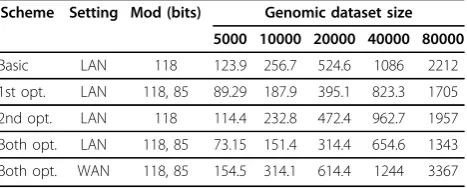
For the Hamming distance computation, we con-ducted four sets of experiments in the LAN setting, that correspond to the basic scheme (i) with no optimiza-tions, (ii) with the first optimization, (iii) with the sec-ond optimization, and (iv) with both optimizations. By comparing execution times of different schemes, we can see performance gains from different optimizations. In the WAN setting, we only report the timings of the best (last) scheme. For each set of experiments, we varied the number of records in the genomic dataset at each input site. The results are presented in Table 2.
We used two different secret sharing bitlengths for schemes that apply the first optimization (one for the computation with SUB records and another for the computation with SNP&SUB records). The complexity of the merge is O(nlog n) for combined sequences of sizen and computing the distance itself is linear in n
(with larger constants), which the runtimes in Table 2 follow. In the LAN setting, the two optimizations result in performance improvement up to 27.9% and 13.1% on our set of parameters when applied separately, and 40.9% when applied together. Performance gain of the first optimization heavily depends on parameters (a,as, and M ), while the gain of the second optimization
Table 1 Performance of GWAS computation in LAN and WAN settings (in seconds)
No. of SNPs Mod (bits) MAF Chi-squared test
LAN WAN LAN WAN
500 84 0.062 0.211 2.210 6.950
1000 84 0.121 0.376 4.456 12.03
2000 84 0.244 0.621 8.900 21.73
4000 84 0.496 1.200 17.98 39.59
8000 84 1.005 2.251 35.78 76.01
Table 2 Performance of Hamming distance computation in LAN and WAN settings (in seconds)
Scheme Setting Mod (bits) Genomic dataset size
5000 10000 20000 40000 80000
Basic LAN 118 123.9 256.7 524.6 1086 2212
1st opt. LAN 118, 85 89.29 187.9 395.1 823.3 1705
2nd opt. LAN 118 114.4 232.8 472.4 962.7 1957
Both opt. LAN 118, 85 73.15 151.4 314.4 654.6 1343
depends on the difference between the combined input sizeNand 2⌈logN⌉. The the smaller the difference is, the smaller improvement is expected.
Conclusions
In this work we report on our experience with participa-tion in the 2015 iDASH secure genomic computaparticipa-tion competition. We show how to securely compute MAF and chi-squared statistics in the context of GWAS com-putation and the Hamming distance between two geno-mic datasets and report on their performance results. We develop a number of novel optimizations, some of which may be of independent interest.
Competing interests
The authors declare that they have no competing interests.
Authors’contributions
Marina Blanton and Yihua Zhang designed the protocols for distributed GWAS computation and secure sequence comparison in the form of Hamming distance. Yihua Zhang and Ghada Almashaqbeh implemented the protocols and reported evaluation results. Marina Blanton and Yihua Zhang drafted the manuscript for publication. Ghada Almashaqbeh contributed to the work while at the University of Notre Dame.
Acknowledgements
This work was supported in part by grants CNS-1223699 and CNS-1319090 from the National Science Foundation and FA9550-13-1-0066 from the Air Force Office of Scientific Research. Any opinions, findings, and conclusions or recommendations expressed in this publication are those of the authors and do not necessarily reflect the views of the funding agencies. We also acknowledge the NSF-sponsored Global Environment for Network Innovations (GENI) test bed, which allowed us to run WAN experiments. This article has been published as part ofBMC Medical Informatics and Decision MakingVolume 15 Supplement 5, 2015: Proceedings of the 4th iDASH Privacy Workshop: Critical Assessment of Data Privacy and Protection (CADPP) challenge. The full contents of the supplement are available online at http://www.biomedcentral.com/1472-6947/15/S5.
Declarations
Publication funding for this supplement was supported by iDASH U54HL108460, iDASH linked R01HG007078 (Indiana University), NHGRI K99HG008175 and NLM R00LM011392.
Authors’details
1Department of Computer Science and Engineering, University of Notre Dame, Notre Dame, USA.2Department of Computer Science, Columbia University, New York, USA.
Published: 21 December 2015
References
1. Blanton M, Aguiar E:Private and oblivious set and multiset operations. ACM Symposium on Information, Computer and Communications Security (ASIACCS)2012.
2. Batcher K:Sorting networks and their applications.AFIPS Spring Joint Computer Conference1968, 307-314.
3. iDASH 2015 Secure Genome Analysis Competition: Competition Tasks.
[http://www.humangenomeprivacy.org/2015/competition-tasks.html]. 4. Tang H, Jiang X, Wang X, Wang S, Sofia H, Fox D, Lauter K, Malin B,
Telenti A, Xiong L, Ohno-Machado L:Protecting Genomic Data Analytics in the Cloud: State of the Art and Opportunities.
5. Shamir A:How to share a secret.Communications of the ACM1979,
22(11):612-613.
6. Gennaro R, Rabin M, Rabin T:Simplified VSS and fast-track multiparty computations with applications to threshold cryptography.ACM Symposium on Principles of Distributed Computing (PODC)1998, 101-111. 7. Canetti R:Security and composition of multiparty cryptographic
protocols.Journal of Cryptology2000,13(1):143-202.
8. Catrina O, de Hoogh S:Improved primitives for secure multiparty integer computation.Security and Cryptography for Networks (SCN)2010, 182-199. 9. Aliasgari M, Blanton M, Zhang Y, Steele A:Secure computation on floating
point numbers.Network and Distributed System Security Symposuim (NDSS)
2013.
10. Yao A:How to generate and exchange secrets.IEEE Symposium on Foundations of Computer Science1986, 162-167.
11. De Cristofaro E, Tsudik G:Practical private set intersection protocols with linear complexity.Financial Cryptography and Data Security (FC)2010, 143-159.
12. Malkhi D, Nisan N, Pinkas B, Sella Y:Fairplay - a secure two-party computation system.USENIX Security Symposium2004, 287-302. 13. Bogdanov D, Laur S, Willemson J:Sharemind: A framework for fast
privacy-preserving computations.European Symposium On Research In Computer Security (ESORICS)2008, 192-206.
14. Zhang Y, Steele A, Blanton M:PICCO: A general-purpose compiler for private distributed computation.ACM Conference on Computer and Communications Security (CCS)2013, 813-826.
15. Catrina O, Saxena A:Secure computation with fixed-point numbers. Financial Cryptography and Data Security (FC)2010, 35-50.
16. Bitonic Sorting Network fornNot a Power Of 2. [http://www.iti.fh-flensburg.de/lang/algorithmen/sortieren/bitonic/oddn.htm].
17. GENI: Global Environment for Network Innovations.[http://www.geni.net].
doi:10.1186/1472-6947-15-S5-S4
Cite this article as:Zhanget al.:Secure distributed genome analysis for GWAS and sequence comparison computation.BMC Medical Informatics and Decision Making201515(Suppl 5):S4.
Submit your next manuscript to BioMed Central and take full advantage of:
• Convenient online submission
• Thorough peer review
• No space constraints or color figure charges
• Immediate publication on acceptance
• Inclusion in PubMed, CAS, Scopus and Google Scholar
• Research which is freely available for redistribution