Developing A Foundation
For Integrated Care
Coordination
Part 1
Lead Authors:
Laura Davie, MA
Alison Rataj, MSW
University Of New Hampshire
Center On Aging And Community Living &
NH Alliance For Healthy Aging
Age Friendly Community
• Food • Safety
• Info about Services • Shelter/Warmth • Transportation
Fundamental needs are met
A broad range of living arrangements are available
• Planning & zoning • Resources available to
support living at home • Affordable
• Home modification options
Advocates for elder issues are effective
• Cultural view of elders is positive/realistic • Laws are elder friendly • Aging issues are a community
wide priority
Quality physical and mental wellbeing supports are in place
• Access to preventative care • Access to medical, mental
health and palliative care • Planning for end of life care
Equity Independence Dignity Person -Centered Respect Choice Support provided to caregivers and families
• Access to info on services and supports
• Caregiver education and training programs
• Flexible funding to meet the unique needs of caregivers
• More consistent pay for formal, paid caregivers
• Respite care
Social and civic engagement options are plentiful
• Meaningful connections with family, friends and neighbors
• Paid and volunteer work opportunities • Active engagement in social life • Cultural, religious activities
plentiful
Who We Are
The foundation for this brief is derived from work of the NH Alliance for Healthy Aging (NH AHA). NH AHA is a statewide coalition of stakeholders focused on addressing the needs of older people in NH. Stakeholders of NH AHA are a diverse group and include representation from the medical, social service, and informal care coordination systems. In 2015, the Alliance for Healthy Aging underwent an action planning process to establish the needs and priorities for creating communities across the state where older people are supported and provided dignity and choice. One of the highest priority strategies identified through this process was: “Improve care
coordination for older adults involving medical, mental health, social, community and oral health services”.
NH AHA has identified six key domain areas that are critical to the creation of age friendly communities and include: Living Arrangements, Family Caregivers, Social and Civic Engagement, Physical and Mental Well-being, Advocacy, and Fundamental Needs. AHA is utilizing a collective impact model, which brings participants from different sectors together to collaborate on a common agenda for solving a specific social problem.
• As our national population is aging this creates an opportunity to rethink how we coordinate the multitude of systems that touch our lives as we age. Almost all of us will require some form of medical and/or social service as we age, necessitating that these services be coordinated to avoid duplication, complications and inefficiencies.
• Care coordination does occur in our three major systems today but is often in silos of
the medical care and community social service, and informal support systems. There is
opportunity to build upon these care coordination models to create an integrated model of care coordination.
• The informal support system typically serves to bridge the medical and community social systems but does not have direct access to those systems.
• Functions and titles related to care coordination are inconsistent within and across the systems of care, understanding the differences will help us create a collective language upon which an integrated system can be built.
• Integrated, person-centered care coordination that crosses all three systems of care can
improve health.
• This brief, the first of a two-part series, describes current care coordination efforts in three major systems. The next brief will highlight best practices to advance quality person-centered and multi-system care coordination and provide recommendations to advance
these models in NH.
Key Messages:
The American population is changing, with people living longer now than ever before. This creates both challenges and opportunities for
us as a society. As people are living longer lives,
more people are experiencing a range of chronic
health issues as they age. With longevity, many
also experience financial challenges, social isolation and increased reliance on assistance from others. Opportunities exist in utilizing the collective knowledge of an aging society to build
a system that supports and coordinates the
range of needs experienced by all of us as we
age.5
While everyone’s natural process of aging is
different, most individuals will need some
form of assistance as they age. This might
Currently there are three main systems of care
that provide support to older people:
y Medical Care System: network of people, institutions, and resources that plan and
provide medical care for individuals.
y Community Social Service System: organizations and people that plan and
deliver human and social services for individuals.
y Informal Support System: partnership of an unpaid caregiver(s) (e.g., family, friend, volunteer) and the supported person, based on social relationships.
Navigating each of these systems individually can be a significant challenge; often times, individuals are accessing multiple systems at the same time. While access to specialty medical providers and pharmaceutical options in the
medical care system provides for good medical
care, the burden of multiple medical visits is taxing and can be confusing. The frequent need of multiple types of medical providers can also
result in disjointed care. Similarly, it is common
for many older adults to need multiple social services, such as transportation, meals, and social interaction simultaneously. In addition, both social needs and medical needs tend to be ongoing. For many, the unpaid caregiver or informal supports often act as a liaison, communicator, and memory bank for the care
recipient in the medical care and community social service system yet has no formal role in the medical treatment and social service decision
making.5
The existence and development of systems of care have grown substantially in the last century; however, they have grown in silos. One major problem is the lack of communication and coordination between the systems. People have needs from each system, but are left to navigate, manage, and track their own care across all of them. This lack of coordination and information sharing structures for each system often leaves
individuals, care partners, and providers feeling frustrated and lost.9
Currently there are three main systems of care that provide support to older people.
y Medical Care System: network of people, institutions, and resources
that plan and provide medical care for individuals.
y Community Social Service System: organizations and people that
plan and deliver human and social services for individuals.
y Informal Support System:
partnership of an unpaid
caregiver(s) (e.g., family, friend,
volunteer) and the supported
person, based on social relationships. Medical System Informal Support System Community Social Service System
Wilma is a 72-year-old woman who lives alone in a small town in New Hampshire. After a car accident when she was in her early 60’s, Wilma lost her vision. In addition to this, she has a number of other health conditions, including diabetes, chronic obstructive pulmonary disorder (COPD), and depression. Wilma does not feel comfortable going out in public alone. Since her husband’s death, she depends primarily on her sister, Shirley, to help with travel to appointments, shopping, house maintenance, and various other tasks.
Wilma can attend as many as six or seven medical appointments a month for her health conditions, seeing five different providers. Wilma is often unsure which provider is responsible for the different parts of her care. She has six active prescriptions, written by four different providers. Wilma uses a transportation service to get to medical appointments when her sister is unavailable. Because she has to rely on others for errands, she tries to reduce the number of trips she goes on and often buys groceries that can be preserved longer (e.g., pre-packaged, canned, or frozen), which contradicts a healthy diet for a person with diabetes. She also has been known to
cut her medications in half to make them last.
Wilma loves the small, rural town where she has lived for 35 years, but there are not many activities planned for seniors to interact. Wilma is dependent on Shirley and other infrequent visits from friends and family for social interaction. Shirley has other obligations, such as her immediate family and her job, so Wilma is often alone for days at a time. At times, Wilma has feelings of loneliness, isolation, and depression.
Shirley tries to help Wilma as much as she can but feels frustrated by the lack of communication and confusion between herself, Wilma, and the systems of care. For example, Wilma was recently having heart palpitations as a side effect of a new medication. Shirley was unaware of the new medication, because she was not at Wilma’s appointment in which the new medication was prescribed. The doctors did not communicate to Shirley that they prescribed the new drug with potential side effects and/or interactions. When Shirley called Wilma’s primary care doctor to find out the cause of the heart palpitations, the primary care doctor referred Shirley to Wilma’s specialty doctors without finding a resolution. Finally, Shirley called the pharmacist who identified which medication might be interacting with the others. Shirley and Wilma’s situation is not unique, with the role of the informal support system being what ties the individual to the other systems of care. However, this situation puts the responsibility of coordinating the systems on the individual or family caregiver, which introduces a great deal of stress and risk for error.
A Common Definition
In recent years, much attention has been
given to care coordination as a possible solution to improve health outcomes related
to a fragmented care system. There are many
successful care coordination models that
organizations, systems, or groups can draw from in developing new programs. However, there is still much work to be done to achieve a truly integrated approach, cutting across silos and putting the person in the center.
Across the spectrum of healthcare systems, community social service systems, and informal support systems, the concepts and
dialogue surrounding care coordination vary widely, with each system viewing the words “care coordination” differently. This lack of
consistency across models, rules, regulations, guidelines, and functions is a barrier to creating integrated care coordination systems. New Hampshire is not unlike other states in its lack of consistency in defining care coordination and in carrying out the functions and integrating across systems of care. There is no national consensus, nor do national organizations have common use
of terms.7
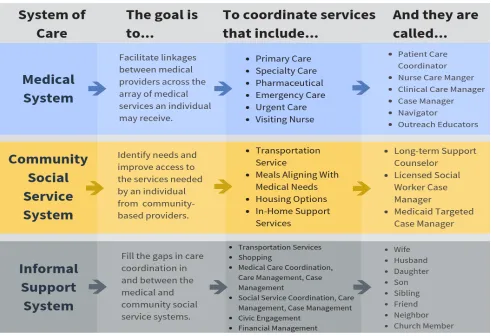
Figure 1 summarizes the key concepts of care coordination in each of three systems of care. This includes the overarching priorities for each system, the language used to describe the role, and a description of the functional role played. Examples of services in each system are also listed (but it is not an all-inclusive list).
Figure 1: Concepts of Care Coordination in the Three Systems of Care*
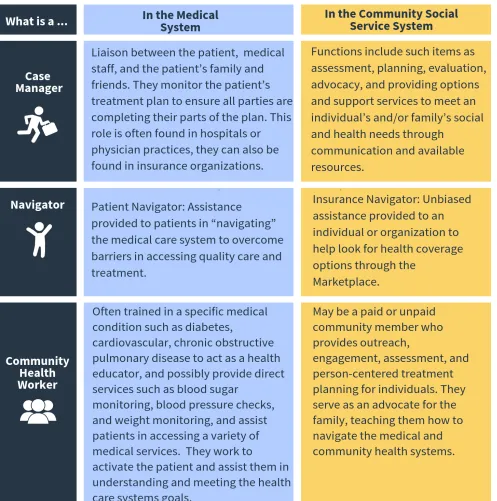
Figure 2: What’s in a name?
1, 2, 3, 4, 10As shown in Figure 1, there is duplication in the use of terms in the three systems, but the roles and responsibilities of people with these titles vary. Figure 2, provides specific examples of how the “same” roles differ in terms of job function, credentialing, and goals. Of course, the title given to the role is not the most important aspect of the function; the most
Taking this variation into consideration, the NH AHA Care Coordination Group focused efforts on developing a common definition for care coordination. The NH AHA Care
Coordination Group is a cross-disciplinary group of stakeholders who gathered for over a year
to champion change in our state among the
three systems of care. The group collectively agreed that a person-centered and a multi-system approach to care coordination efforts are
important to improving the care of individuals.
In the fall of 2016, this group of stakeholders
developed a definition of care coordination as a common ground to advance integrated efforts (See Figure 3).
The NH AHA definition of care coordination can be seen as a foundation for New Hampshire’s efforts to improve care coordination. While significant barriers, including payment restrictions and scope of practice regulations exist, the first step to achieving success is a shared understanding of the focus and function
that each system of care has created.
Creating An Integrated System That Works For All
“Care coordination is an individual and family centered, team-based partnership designed to assess and meet the needs of an individual to help them effectively and
efficiently access resources to meet the individual’s interrelated health, social, behavioral, informal supports financial, and functional needs in order to achieve optimal
health wellness, or end-of-life outcomes, according to individual preferences.”
The AHA Care Coordination Group focused on
the interrelated needs of individuals and the
need to integrate services to link those needs.
Research indicates an integrated system of care
would best serve older people with chronic conditions, functional limitations, and social
service needs. An integrated system of care
“actively solicit[s] the person’s needs, values and preferences for care by all providers, organizations, and delivery systems that serve him or her.”8 This would span the medical care
system, the community social service system,
and the informal support system. Within an
integrated system of care, care coordination would ensure that the care delivery pieces are specifically tailored for each individual.
This means that each person receives the
right services at the right time from the right
provider, the individual’s informal support system is informed and involved in care, and the individual’s needs, preferences, and values
are put first. The integrated system of care coordination has several important tenets that make it successful:9
Person-Centered Care Approach: Person-centered care puts individual values and preferences at the heart of care decisions
in a way that supports realistic and evolving
health and life goals.8 In the traditional healthcare model, there are two types of providers: “paternalistic” who aim to ensure that individuals receive what the provider thinks is best for them, and “informative” who provide information to the person but are non-directive.6 The person-centered care approach
incorporates in a third type of provider, “shared decision maker or interpreter” who help patients determine what they want, then suggest
methods to achieve that individual’s priorities in partnership with the individual.6 The
person-centered care approach also includes the needs of an individual across medical and
community-based social services.
Integrating Various Systems of Care: Integrated
care coordination includes an interdisciplinary
team of providers across all three systems of care to communicate and assist in care
coordination. The exchange of information
about an individual’s care preferences and status, across providers and sites, is critical to successful coordination.8
Standardized Assessment and Processes within
Care Coordination: Research indicates that
for an integrated system of care coordination model to be successful, it needs to include a standardized needs assessment tool across all three systems of care. Additionally, the integrated system would have a process in place for monitoring, tracking, and evaluating each individual’s progress on an ongoing basis.8
Identifying Outcomes of Care Coordination:
Another tenet of integrated care coordination
includes providers agreeing to outcomes on
an individualized level, and on a health system level. An example outcome at the individual level could be remaining at home, living
independently. An outcome at the health
system level could be a reduction in emergency department visits. Integrated care coordination would include agreement to work towards both
outcomes.8
Conclusion
Wilma, who lives with multiple chronic conditions and has interactions with all three of the systems of care, will need coordination across systems for the rest of her life. With person-centered, integrated care Wilma’s story would be a lot different. Wilma’s needs for transportation, appropriate meals, and socialization would be equally important as her medical needs. Wilma would not have to update her five different medical providers on her health status at every visit, because they would have information shared between them. Her medication would be
managed efficiently, addressing both health and financial aspects. Wilma would be supported in her decisions across medical and social systems to support maximizing her independence. Shirley would feel clarity around Wilma’s care. Finally, Wilma would feel confident living alone and would be able to access supports to reduce her feelings of isolation, because the systems for her medical, social, and informal support needs would be coordinated.
Rewriting the Story
As New Hampshire’s population continues to age, developing and implementing an
integrated, person-centered-approach to care
coordination within our state is vital to the work of building communities that support older adults and their families. The AHA definition of care coordination, an individual and family centered, team based partnership designed to assess and meet the needs of an individual to help them effectively and efficiently access resources to meet the individual’s interrelated health, social, behavioral, informal supports, financial, and functional needs in order to achieve optimal health wellness, or end-of-life
outcomes, according to individual preferences,
captures the essence of a truly integrated,
person-centered system of care. Improving care coordination for older people in our state starts with acknowledging the three systems of care, understanding the role and functions within the current systems, and establishing tenets to be applied in adjusting existing care coordination
models. A person-centered integrated care system puts the person’s needs, values and preferences at the center of his or her care, and
it is a model that can be beneficial to both the
person and the systems delivering services.
References
1. Area Health Education Center (AHEC). (2015). Community Health Workers in New Hampshire.
Retrieved from http://www.snhahec.org/Community-Health-Workers.cfm
2. Brown, D. (2018). What is a medical case manager? Retrieved from: http://work.chron.com/ medical-case-manager-10899.html
3. Case Management Society of America (2017). What is a case manager? Retrieved from: http:// www.cmsa.org/who-we-are/what-is-a-case-manager/
4. Centers for Medicare and Medicaid (2017). Navigator. Retrieved from: https://www.healthcare.
gov/glossary/navigator/
5. Craig, C., Eby, D., Whittington, J. (2011). Care coordination model: Better care at lower cost for people with multiple health and social needs. (Institute for Healthcare Improvement Innovation
Series White Paper). Retrieved from http://www.ihi.org/resources/pages/ihiwhitepapers/ ihicarecoordinationmodelwhitepaper.aspx
6. Gawande, A. (2014). Being mortal: medicine and what matters in the end. New York: Metropolitan Books, Henry Holt and Company.
7. Heslop, L., Power, R., & Cranwell, K. (2014). Building workforce capacity for complex care coordination: A function analysis of workflow activity. Human Resources for Health, 12(1). DOI: 10.1186/1478-4491-12-52
8. The Scan Foundation (2013). Care Coordination in an integrated, person-centered system of care. Retrieved from: http://www.thescanfoundation.org/sites/default/files/tsf-care_coordination_ working_paper-12-4-13.pdf
9. Traver, A. (2013, July). The promise of care coordination: Transforming health care delivery. (Families USA Issue Brief). Retrieved from http://familiesusa.org/sites/default/files/product_ documents/Care-Coordination.pdf.
Acknowledgements
This brief was written by Laura Davie, MA, and Alison Rataj, MSW (Center on Aging, University of New Hampshire).
The authors are grateful for the time and effort by many people to prepare this document. Thank you to:
y Members of the Alliance for Healthy Aging Care Coordination Strategic Workgroup y Katherine Cox, Institute for Health Policy and Practice, University of New Hampshire y Bridget Drake, Institute for Health Policy and Practice, University of New Hampshire y Laurie Harding, Upper Valley Community Nursing Project
y Renee Pepin, Dartmouth Centers for Health and Aging
y Jo Porter, Institute for Health Policy and Practice, University of New Hampshire
y Jennifer Rabalais, Center on Aging and Community Living, University of New Hampshire y Keliane Totten, Concord Regional Visiting Nurse Association