Volume 12, Issue 3 (March 2016), PP.59-63
Congestion Detection Approaches In Wireless Sensor
Networks: -A Comparative Study
N. Thrimoorthy
1and Dr. T .Anuradha
21
Assistant Professor, New Horizon College of Engineering, Bangalore, India. 2
Associate Professor, Dept. of Computer Science, Dravidian University, Kuppam, A.P., India.
Abstract:- Wireless Sensor Network (WSN) is a collection of sensor nodes for measuring different phenomena from the field that they have deployed. The different kinds of data sensed by sensors are aggregated at the special node called the base station or sink node. Due to this, traffic in wireless sensor networks (WSN) exhibits a many-to-one pattern in which multiple source nodes send sensing data to a single sink node. Also, the nodes have limited bandwidth, processor and memory; packet loss is common when a great deal of traffic rushes to sink. In case of event-driven applications, it is significant to report the detected events in the area, resulting in sudden bursts of traffic due to occurrence of spatially-correlated or multiple events, leads to congestion. Congestion results packet losses and retransmissions. To support Quality of Service (QoS) requirements for sensor applications, having a reliable and fair transport protocol or variant of MCA is necessary. One of the main objectives of the design of transport layer for WSNs is congestion control. Till now, in literature, Congestion control techniques are based on detection of congestion and control, but they cannot completely eliminate or prevent the occurrence of congestion. To mitigate congestion, either the available resources have to be increased (resource control) or the source transmission rate should be restricted (traffic control). Significant work on congestion control in WSNs has focused on traffic control. The problem of congestion in sensor networks remains largely open yet.
Keywords:- Wireless Sensor Network; Congestion Control; Resource Control; Quality of Service.
I.
INTRODUCTION
WSN is a group of specially distributed sensor nodes interconnected through wireless communication channels. A node in sensor network consists of elements of communication, sensing, and computing that react to events in an environment. Wireless sensor networks have variety of applications including habitat observation [1], [2], health monitoring [3], object tracking [4], [5], battlefield sensing, etc. Wireless networks are different from traditional in many aspects [6]. The main objectives of designing WSN for such applications are reliability in data dissemination, Energy conservation, congestion control, and security.
Due to the inherent fact that two communication hosts of a particular connection can have different time varying characteristics, such as capacity of communication and computation, node level congestion occurs when a sensor receives more data than it can handle forward; the excess data has to be buffered. On the other hand of two or more sensors tries to seize the wireless channel at the same time the radio collision results link-level congestion. Therefore, the main objective of transport and MAC layers is to provide suitable flow and congestion control service to coordinate transmission rates and collision between sensor nodes.
Rigorous work was reported in wired networks on end-to-end congestion control techniques [7]. Most of previous literature on congestion control in WSN mitigates congestion rate adjustments of source and intermediate nodes. In recent years there was a argument that rate adjustments is ineffective for some realistic sensor network applications [8, 9] because of the reasons: data being generated at time of congestion are very important, and must delivered to sink with higher rate, and availability of resources in WSNs it is easier to use more resources during congestion time to increase network lifetime [8].
Congestion control is a three step process: congestion detection, congestion notification and congestion mitigation [18]. Congestion detection: congestion detection step involves finding the occurrence of congestion and location at which node congestion has occurred [19]. Various congestion detection metrics are packet loss, queue length, channel load, channel busyness ratio, throughput measurement, packet service time, packet inter-arrival time, delay etc.. Congestion notification step: After detecting the congestion, that node must send information to neighboring nodes about congestion to control it. Congestion Mitigation step: after receiving the notification of congestion, node must take necessary actions to alleviate the congestion.
II.
REVIEW OF RELATED WORK
Till now, in literature, Congestion control techniques are based on detection of congestion and control, but they cannot completely eliminate or prevent the occurrence of congestion. To mitigate congestion, either the available resources have to be increased (resource control) or the source transmission rate should be restricted (traffic control). Significant work on congestion control in WSNs has focused on traffic control. The problem of congestion in sensor networks remains largely open yet.
So far Congestion control in wireless sensor networks done by using end-to-end approach or by using hop-by-hop approach [19]. Energy consumption and packet drop is less in hop-by-hop mechanism and it deals with congestion in less time than end-to-end mechanism.
Congestion Detection and Avoidance (CODA) (Wan et al.,2003), the earliest congestion control protocols that uses current buffer occupancy and wireless channel load to detect congestion[10]. If buffer occupancy or wireless channel load exceeds a threshold, it implies that congestion has occurred. The node that has detected congestion will then notify its upstream neighbor to reduce its rate, using an open-loop hop-by-hop backpressure. The upstream neighbor nodes trigger reduction of their output rate using methods such as AIMD. Finally, CODA regulates a multisource rate through a closed-loop end-to-end approach.
ESRT (Event-to-Sink Reliable Transport), which provides reliability and congestion control, belongs to the upstream reliability guarantee group [11]. It periodically computes a reliability figure, representing the rate of packets received successfully in a given time interval. ESRT then deduces the required sensor reporting frequency from the reliability figure. Finally, ESRT informs all sensors of the values with high power. ESRT uses an end-to-end approach to guarantee a desired reliability figure through adjusting the sensors‟ reporting frequency.
The Congestion Control and Fairness (CCF) distributed many-to-one routing scheme (Cheng and Bajcsy, 2004) uses packet service time based congestion detection mechanism. CCF controls congestion by measuring the available bandwidth and determining the size of subtrees and equally distributing the bandwidth into child nodes. Interference aware fair rate control (IFRC) (Rangwala et al., 2006) is a rate allocation technique which detects congestion based on queue length. Once congestion is detected, the rates of the flows are throttled on the interfering tree. When the average queue length exceeds the upper threshold, rates of the flows are adjusted using the AIMD scheme. Consequently, IFRC reduces the number of packets by reducing the throughput.
On the other hand, the Priority-based Congestion Control Protocol (PCCP) (Wang et al., 2006) uses a ratio between packet inter-arrival time and packet service time to determine the congestion level of a node. Congestion information is piggybacked in the header of data packets and broadcasted, and received by child nodes. However, both CCF and PCCP ignore queue utilization, hence leads to frequent buffer overflows. This results in increased retransmission and energy inefficiency.
III.
CONGESTION DETECTION STRATEGIES
A. Packet loss: This metric can be measured either at the sender or the receiver. Sender can detects packet loss by enabling the ACKs (Acknowledgements), whereas at the receiver through sequence numbers use. Further, not overhearing the parent‟s forwarding on the upstream link by a child node over the downstream link can be considered as an indication for packet loss [12]. The time to repair losses (if reliability ensured) is used in [13], while loss ratio is used in [14],[15]. The main limitation of this metric is that the wireless errors rather than packets collision also sometimes contributes for losses.
B. Queue Length: As every node in WSN has small buffer (queue); its length (size) can be used as a simple and good indication of congestion. The buffer size can be used as a threshold, like in [16],[17] and the congestion is signaled once the buffer length exceeds this threshold, or periodically the buffer size is tested at the beginning of each period and the congestion is signaled at this moment. The remaining buffer length is one other variant for congestion indication as well. If the link layer applies retransmissions, link contention will be reflected through buffer length.
C. Channel Load: It measures the channel condition caused by wireless transmissions. It uses the CCA like function, which responds with the value 1 if the channel is occupied or 0 if the channel is empty. The frequency level of busyness returned by the sampling of this function reflects the level of occupation of the wireless channel. Channel busyness ratio or channel load is the ratio of time intervals when the channel is busy (successful transmission or collision) to the total time. In case of increase in packets collision, and after several unsuccessful MAC (Medium Access Control) transmissions, packets are removed. Consequently, the decrease in buffer occupancy due to these drops may mislead to the inference of the absence of congestion.
D. Delay: It generally quantifies the necessary time since the packet generation, at the sender, until its successful reception at the next hop receiver or end point receiver. It can also be calculated as a part of the total delay, as in ATP14 (queuing delay). The one hop delay can be seen also as the packet Service Time, which is the time separating packet arrival at the MAC layer and its successful transmission, which is inversely proportional to the packet service rate. It covers packet waiting time, collision resolution, and packet transmission time at the MAC layer 15. This value changes according to the queue length and channel load. It can be regarded as another measure of them. In13, the end-to-end delay is calculated in a similar manner. But limitation to merely the service time may be misleading when the incoming traffic is not higher than the outgoing one through the overloaded channel. Another delay measurement is that of the ratio of packet service time and packet inter-arrival time (scheduling time). A scheduler between the network and MAC layer switches the packets from network queues to the MAC layer. The scheduling time quantifies the number of packets scheduled per time unit. This ratio indicates both node level and link level congestion.
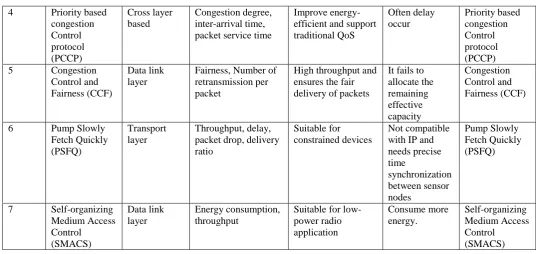
IV. COMPRESSION OF CONGESTION CONTROL PROTOCOLS:
S.NO Technique/Protocol Layer at Implemented Congestion Detection Mechanism Congestion Control Mechanism
Advantages Disadvantages
1 Congestion Detection and Avoidance (CODA) Cross layer based end-to-end delay, response time Backpressure and rate regulation mechanisms. Suitable for event driven networks and achieve better fairness along with congestion control Under heavy closed loop congestion, reliability is less with more delay and response time
2 Congestion Avoidance, Detection and Alleviation (CADA) Network layer Throughput, End-to-End delivery ra-tio, Energy consumption, Per hop de-lay
Reduces the network traffic and the chance of occurrence of congestion
Lead to inaccurate data and reduced throughtput
3 Event to Sink Reliable Transport
Transport layer
Throughput, delay, packet drop, energy consumption
Achieve reliable event detection with minimum energy expenditure and congestion resolution
ESRT affect the on-going data traffic due to the high power single hop channel
4 Priority based congestion Control protocol (PCCP) Cross layer based Congestion degree, inter-arrival time, packet service time
Improve energy-efficient and support traditional QoS Often delay occur Priority based congestion Control protocol (PCCP) 5 Congestion
Control and Fairness (CCF)
Data link layer
Fairness, Number of retransmission per packet
High throughput and ensures the fair delivery of packets
It fails to allocate the remaining effective capacity Congestion Control and Fairness (CCF)
6 Pump Slowly Fetch Quickly (PSFQ)
Transport layer
Throughput, delay, packet drop, delivery ratio
Suitable for
constrained devices
Not compatible with IP and needs precise time synchronization between sensor nodes Pump Slowly Fetch Quickly (PSFQ)
7 Self-organizing Medium Access Control (SMACS) Data link layer Energy consumption, throughput
Suitable for low-power radio application Consume more energy. Self-organizing Medium Access Control (SMACS)
V. CONCLUSION
The above techniques give show the best attempts to control congestion and improve the efficiency of the system to the best possible level. Several data link layer, network layer, transport layer and cross layer based congestion control techniques are studied. These analysis leads to the following conclusion: Cross layer design can make the network more specific and reliable. WSN should design protocols for cross-layer design methodology. A unified protocol that can handle both reliability and congestion control is needed. An integrated protocol that levers both the direction of flow, sensor-to-sink (upstream) and sink-to-sensors (downstream) would be preferred. Energy efficiency over transport protocols in future needs emphasized.
REFERENCES
[1]. A. Cerpa, j. Elson, d. Estrin, l. Girod, m. Hamilton, and j. Zhao, “habitat monitoring: application drive for wireless communications technology,” proc. Acm sigcomm workshop data comm. In latin am. And the caribbean, apr. 2001.
[2]. E. Biagioni and k. Bridges, “the applications of remote sensor technology to assist the recovery of rare and endangered species,” special issue on distributed sensor networks, April. 2003.
[3]. Schwiebert, s. Gupta, and j. Weinmann, “research challenges in wireless networks of biomedical sensors,” mobile computing and networking, pp. 151-165, 2001.
[4]. H.t. Kung and d. Vlah, “efficient location tracking using sensor networks,” proc. Ieee wireless comm. And networking conf.(wcnc), mar. 2003.
[5]. Chen and yang: congestion avoidance based on lightweight buffer management in sensor networks 945 fig. 16. Total source rate over time when the set of data sources is dynamic. Fig. 17. Packet drop over time when the set of data sources is dynamic. Fig. 18. Impact of failed overhearing.
[6]. R. Brooks, p. Ramanathan, and a. Sayeed, “distributed target classification and tracking in sensor networks,” proc. Ieee, vol. 91, no. 8, pp. 1163-1171, 2003.
[7]. I.f. Akyildiz, w. Su, y. Sankarasubramaniam, and e. Cayirci, “a survey on sensor networks,” ieee comm. Magazine, aug. 2002.
[8]. S. Jagannathan, “end to end congestion control in high-speed networks”, proc. Of the ieee lcn, pp. 547-556, 2002.
[9]. K. Jaewon, y. Zhang, and b. Nath, "analysis of resource increase and decrease algorithm in wireless sensor networks," in computers and Communications, 2006. Iscc '06. Proceedings. 11th ieee symposium on, 2006, pp. 585-590.
[10]. K. Jaewon, y. Zhang, and b. Nath, "tara: topology-aware resource adaptation to alleviate congestion in sensor networks," parallel and Distributed systems, ieee transactions on, vol. 18, pp. 919-931, 2007. [11]. C. Y. Wan, S. B. Eisenman, A. T. Campbell, „„CODA: Congestion Detection and Avoidance in Sensor
[12]. Y. Sankarasubramaniam, O. B. Akan, I. F. Akyidiz, „„ESRT: Event-to-Sink Reliable Transport in Wireless Sensor Networks,‟‟ Proceedings of the 4th ACM International Symposium on Mobile Ad Hoc Networking and Computing (MobiHoc‟03), Annapolis, MD, June 2003.
[13]. Woo, A., Culler, D.E.. A Transmission Control Scheme for Media Access in Sensor Networks. In: Proc. of ACM Mobicom. 2001, p. 221–235.
[14]. Sharif, A., Potdar, V., Rathnayaka, A.J.D.. Prioritizing Information for Achieving QoS Control in WSN. In: Proc. of 24th IEEE International Conference on Advanced Information Networking and Applications (AINA). 2010, p. 835–842.
[15]. Sundaresan, K., Anantharaman, V., Hsieh, H.Y., Sivakumar, R.. ATP: A Reliable Transport Protocol for Ad Hoc Networks. IEEE Transactions on Mobile Computing 2005;4(6):588–603.
[16]. Ee, C.T., Bajcsy, R.. Congestion control and fairness for many-to-one routing in sensor networks. In: ACM, SenSys. 2004, p. 148–161.
[17]. Hull, B., Jamieson, K., Balakrishnan, H.. Mitigating congestion in wireless sensor networks. In: Proc. of the 2nd international conference on Embedded networked sensor systems, SenSys. 2004, p. 134– 147.
[18]. Zgr, Y.S., Sankarasubramaniam, Y., Akan, O¨ .B., Akyildiz, I.F.. ESRT: Event-to-Sink Reliable Transport in Wireless Sensor Networks. In: Proc. 4th ACM international symposium on Mobile ad hoc networking and computing, Mobi Hoc. 2003, p. 177–188.
[19]. M. Kafi, D. Djenouri, J. Ben-Othman and N. Badache, “Congestion Control Protocols in Wireless Sensor Networks: A Survey”, Communications Surveys &Tutorials, IEEE, Vol.16, no. 3, 2014, pp. 1-22.