S.Afr.J.Libr.lnf.Sci .•1997.65( I)
Menials or managers? A decade of library and information science education
at the Cape Technikon
E.S. van Aswegen
Department of Library and Information Studies, School of Teacher Education, Cape Technikon, P.O. Box 652, Cape Town
8000 Republic of South Africa [email protected]
This article gives a survey of the first decade of education of library and information science workers at technikons in South Africa, with particular reference to the Cape Technikon. The development of a variety of qualifications is sketched, culminating in the introduction of degrees in 1996. The introduction of technikon library and information science qualifications at a time when rationalization of programmes at universities was introduced, as well as the uncertainty regarding the status of technikon diplomates is discussed. In conclusion, the impact of the National Commission on Higher Education policy, as well as the implementation of a National Qualifications Framework, is briefly addressed.
Hierdie artikel bied 'n oorsig van die eerste dekade van opleiding van biblioteek- en inligtingwerkers aan technikons in Suid-Afrika, met besondere verwysing na die Kaapse Technikon. Die ontwikkeling van 'n verskeidenheid kwalifikasies, wat gekulmineer het in die instelling van grade in 1996, word geskets. Die instelling van technikonbiblioteek- en inligtingkunde-kwalifikasies gedurende die tydperk van rasionalisasie van onderrigprogramme aan universiteite word aangeraak, sowel as die onsekerheid met betrekking tot die status van technikonafgestudeerdes. Ten slolte word die impak van die beleid van die Nasionale Kommissie oor Hoer Onderwys, sowel as die implementering van 'n Nasionale Kwalifikasieraamwerk, kortliks bespreek.
53
The education and training of librarians in South Africa was
initially undertaken by the South African Library Association
(SALA) in 1933, following the recommendations of the
Carnegie Corporation commissioners, Messrs Ferguson and
Pitt, in 1928. SALA followed the British model of
cor-respondence courses, which continued until 1962 (Musiker,
1986:91), when its courses were transferred to the University
of South Africa (Lessing, 1991: 124). At its Grahamstown
Conference, it was decided that the last examinations would
be conducted in December 1965. However, SALA would
continue to assist, inter alia, in the training of Non-White
library workers (Van Rooy, 1966; Lessing, 1987:285).1
University education and training
According to Musiker (1986:91), the University of Pretoria
was the first to offer training for librarians in 1938, followed
by the University of Cape Town in 1939. The University of
South Africa commenced its courses in 1955, followed by
Potchefstroom University for Christian Higher Education in
1956; the University of Stellenbosch and the University of the
Witwatersrand in 1958; the University of the Orange Free
State in 1964; Rhodes University in 1966; the Rand Afrikaans
University in 1968; and the University of Natal
(Pieter-maritzburg), the University of Fort Hare, the University of
Durban-Westville, the University of Zululand, the University
of the North, the University of the Western Cape and the
University of Transkei. in 1973. The South African Institute
for Librarianship and Information Science (the reconstituted SALA) continued its involvement in education through its
Standing Committee for Formal Education.
The university qualifications (excluding specialist
quali-fications for school librarians), were a two-year
post-matriculation Lower Diploma in Librarianship, a one-year
post-graduate Higher Diploma in Librarianship, or a
four-year professional bachelor's degree (the BABibl), later to
become the BBibl.
Professional, paraprofessional, semiprofessional,
clerical
The aim of the four-year university qualification was seen as
'preparation for professional duties in library and information
services' (Musiker, 1986:92), while that of the two-year
lower diploma was designated as the preparation of
para-professional or semiprofessional workers, namely
'prepara-tion for routine technical duties in library and information
services' (Musiker, 1986:92). In addition, libraries have
traditionally had numerous 'non-professional' posts, which in
practice have encompassed a wide variety of positions,
ranging from clerical and technical staff, to graduates in
possession of, for example, bachelors' degrees or teaching
qualifications. Various library activities and tasks were
de-fined as being either 'professional' or
'paraprofessional/semi-professional' (see Le Roux, 1985; South African Institute for
Library and Information Science [SAlLIS], 1987; Meijer et
al., 1988). In addition, the SAlLIS Committee for Formal Education has been active in devising guidelines for
under-graduate career training, in which a distinction is made
be-tween professional and paraprofessional qualifications. (See
Proposed guidelines for undergraduate career training,
SAlLIS, 1996:1179-1193.)
Technikon education and training
By the late 1970s and early 1980s the education of para- or
semiprofessionals by means of the university Lower Diploma
was phased out by most universities as being courses of
sub-degree standard (Kerkham, 1988:7). The demise of the
54
(LIS),2 and the subsequent development of the three-year National Diploma in Library and Information Services offered hy technikons, has been chronicled at length by Kerkham (1988:8-9). In the event, Port Elizabeth Technikon commenced with a group of part-time students in 1984, followed hy the Cape Technikon in 1985, Pretoria Technikon and M.L. Sultan Technikon in 1986, and for a brief period only, Natal Technikon in 1987. Technikon Southern Africa started a correspondence National Diploma aimed at re-cruiting LIS workers already employed in libraries but without any formal qualifications in 1992.
Bunting report
A subsequent factor affecting departments of library and in-formation science at universities was the attempt made by the Academic Planning Committee (APC) of the Committee of University Principals (CUP), to rationalize the offering of courses in librarianship and information science at ties. According to Bunting (1990:58), by 1987, 13 universi-ties were offering formal programmes in librarianship/ information science. In 1989 there were I I fully active departments, Rhodes and Durban-Westville having closed. The next 'casualty' was to be the University of the Witwaters-rand in the early 1990s.
The review committee formulated the following con-clusions:
- that librarianship programmes are not cost effective; - that unnecessary duplication exists in the teaching of
librarianship in universities;
- that librarianship programmes in the residential universi-ties are underutilized; and
- that the overall quality of librarianship programmes is not good (Bunting, 1990:63).
The review committee's view was that librarianship programmes could be rationalized as follows:
- by closing specific departments of librarianship;
- hy placing a ceiling or limit on the formal qualifications that departments of librarianship may offer;
- by intra-university co-operation (e.g. by linking the de-partments of librarianship with other academic depart-ments and service units such as central libraries);
- by merging or amalgamating departments of librarianship with other departments or academic units;
- by placing a limit on the specialized fields in which departments of librarianship may operate; and
- by interuniversity co-operation (e.g. by the sharing be-tween universities of courses and of academic staff memhers) (Bunting, 1990:65).
Not all universities heeded the recommendations of the Bunting report (inter alia that lower diplomas should be phased out by universities and offered by technikons). However the University of Stellenbosch consequently phased out post-graduate degrees after honours level.
The four-year BBibl is currently offered by the University of the Orange Free State, the University of Pretoria, the University of Stellenbosch. the University of Fort Hare, the
S.Afr.Tydskr.Bibl.lnligtingk., 1997,65( I)
University of the North, the University of the Western Cape, the University of Zululand, Potchefstroom University for C.H.E., the Rand Afrikaans University and the University of South Africa.
The Postgraduate Diploma/Higher Diploma in Library and Information Science (nomenclature varies) is offered at the University of Cape Town, Rand Afrikaans University, the University of Natal, the University of the North and the University of Zululand.
Problems regarding the status of technikon
grad-uates
The National Diploma in Library and Information Services at technikons was in its infancy at the height of the Bunting
debacle, resulting in recriminations from universities whose
departments of LIS were threatened with closure. From its very inception, there had been problems regarding the status of technikon 'diplomates'. Although the National Diploma in Library and Information Services was evaluated by the Human Sciences Research Council as 'Senior Certificate plus three years' training in Library and Information Services' (Kerkham, 1988:9), and consequently
'recognized as being on a par with any other National Diploma ... diplomates ... therefore appointed on the same rank and salary scale as other technicians with National Diplomas in art, horticulture, chemistry, engineering, etc',
most libraries had no separately designated post descriptions for LIS technikon diplomates, and technikon-educated employees found themselves working 'below stairs' as it were, on a par with library assistants in possession of a senior certificate, with one or two salary notches to compensate for three years training, and few prospects of promotion beyond that of senior library assistant. However in 1986, two new Technikon Port Elizabeth graduates (admittedly with library experience),' were appointed to professional posts as heads of special libraries in the Western Cape. By and large, however, technikon diplomates found themselves too highly qualified for most of the fairly menial and routine tasks which they were allocated, but not qualified enough to be appointed full professionals. An alumni survey done by the Department of Library and Information Studies at the Cape Technikon of 1987-1991 graduates (with 23 alumni responding), revealed the following information (see Table I).
S.Afr.J.Libr.InfSci .•1997.65( I)
Table 1 Departmental
questionnaire to alumni 1987-1991
With regard to your experience in the work situation. rate the Na-tional Diploma in Library and In-formation Services (academic and co-operative education) on a scale of I to 5 (5 =excellent; 3= aver-age; I=useless).
Rating Respondents
5 3
4 II
3 7
2
o
of Iraining), were considered the sacrosanct bailiwick of the professional librarian.
Term 'paraprofessionalism'
A further problem arose with the termparaprojessionalism as
'an alternative career direclion, not an inferior career
direction ... aparallel career direction; ... notper sea step in the direction of professionalism' (Kerkham, 1988:8).
The well-worn analogies of doctors versus nurses, radio-graphers, medical technicians, social workers and pharma-cists, not to mention ophthalmologists and optometrists, dentists and dental technicians, engineers and engineering technicians did not operate in the South African library and information environment. Furthermore, the designation 'library technician', although well established in the USA and Canada. was alien to the South African LIS community, conjuring up an invasion of grease-stained 'rude mechanic-als', who were qualified only to operate the photocopier! A further complication was the confusion in the public mind bctween technikons (institutions providing vocational educa-tion at tertiary level up to 6 years post-matric) and technical colleges (providing technical/vocational education and train-ing (N-courses) from Std 8 up to one year's post-matric).
Professional status
To obtain 'professional' positions in most libraries, technikon diplomates. therefore. had no option but to enrol for a BBibl, or BA plus post-graduate diploma at a university. Although most universities were willing to give some credits in the case of professional library and information subjects, the full number of extra professional credits for a first degree still had to be completed. The much vaunted possibilities of 'articu-lation' or mobility betwecn technikons and universities, a major talking point during the early days of technikon
55
education (Shippey, 1983/84; ALISER, 1992) had not come to fruition. In a study of the development of higher education in California during the last 25 years, Prof T.e. Shippey (1983/84: 19), Rector of the Cape Technikon, wrote as follows:
'Another essential element which is strongly present in California but is lacking in South Africa is student mobility and accreditation from one higher education sector to another. In California careful provision is made for articulation relating to accreditation and many students move freely from CCS (the junior colleges, now known as community colleges) to the UC (the University of California) or CSU (the California State University) systems. As long as they have complied with accreditation requirements which are set out in detail, then they can gain all or partial accreditation at all DC or CSU institutions for certain courses which they have completed at a CC or similar institution.
In South Africa limited accreditation (up to 50% generally) is the norm between universities, and university students moving to technikons can easily obtain a good measure of credit for completed courses. However, technikon or college of education students are given very few credits and some uni-versities do not allow any accreditation from such institutions. Thus student mobility is greatly reduced and there is little inducement for technikon or college of education students to study further at a university. If such articulation and accreditation is possible among the far greater number of higher education institutions in California, then surely South Africa could attempt to bring about adjustments in its tertiary sector and break down some of the rigidity which exists.'
There are several examples of technikon diplomates who have spent seven years of study to achieve 'professional' qualifications (and in many cases acquitting themselves very well in their degree studies). Some students enrolled at universities with a view to obtaining a professional LIS qualification, but were diverted into other (more lucrative) professions, such as teaching, psychological counselling or even secretarial work. Figure I (Cape Technikon. 1995) disconcertingly depicts alumni in the fields of library and information science and education (the Department of Library and Information Studies resides under the School of Teacher Education at the Cape Technikon) as the lowest earners in all 11 Cape Technikon disciplines.
SAlLIS and SERTEC
S.Afr.Tydskr.Bibl.lnligtingk.,1997 ,65( I)
SCHOOL:
Figure 1Alumni survey 1995: annual salary plus fringe benefits -alumni who graduated since 1992
reports to SAlLIS regarding the status of the teaching department, had not been revised to make provision for technikon structures. Some examples: technikon departments of LIS are not autonomous, like their university counterparts; the technikon's compulsory component of experiential
training is much longer and more structured than the universities' tield work components.
Some impetus towards the recognition of technikon diplomates as professionals was gained by SAlLIS's revision of its conditions for professional membership (at the Esselen Park national conference in 1994). At the same time, tech-nikons were under intense scrutiny by the Certification Council for Technikon Education (SERTEC), with evaluation and accreditation of the technikons' co-operative education (experiential training) LIS programmes being evaluated in
1991 and 1995, and the formal teaching LIS programmes in 1993.
National Higher Certificate: Library and Information Studies
Library and Information Practice II Information Retrieval II
Library and Information Technology II Literature Studies I
Psychology in Organizations I Library Promotion I
Cape Technikon curricula
The revised curricula for Library and Information Studies at the Cape Technikon (technikons follow the same basic cur-ricula with options to meet local LIS needs and conditions) comprise the following:
National Certificate: Library and Information Studies
Library and Information Practice I
Information Retrieval I
Library and Information Technology I End-User Computing I
Human Studies
Two of the II ofticial languages, of which one must be English or Afrikaans.
National Diploma M
+
3National Higher Diploma M +4 Master's Diploma in Technology M +5 Laureatus in Technology M
+
6was therefore replaced by the Baccalallrells Technologiae
(BTech): Library and Information Studies degree, followed by Master's and Doctoral degrees. Since its inception. the National Diploma in Library and Information Services had undergone radical recurriculation, with the revised National Di'ploma in Library and Information Practice superseding the National Diploma in Library and Information Services in 1992. 1996 saw the implementation of the National Diploma in Library and Information Studies (the second change in nomenclature since the inception of the diploma).
The current technikon hierarchy of qualifications is there-fore:
- National Certificate: Library and Information Studies
(M+ I)
- National Higher Certificate: Library and Information Studies (M +2)
- National Diploma: Library and Information Studies
(M
+
3)- BTech: Library and Information Studies (M +4) - MTech: Library and Information Studies (M +5) - DTech: Library and Information Studies (M +6).
National Diploma: Library and Information Studies
Library and Information Practice III Information Retrieval III
Experiential training (six months' employment in a library)
17~
.~
II~
'I'
,~
II~.~
II~17~
,~
.~
,~
II~
,,~
.~
,.~
,~
.~
."
'"<R2S 000 >R7S 000
nON HOTEL
Degrees at technikons
Technikons in South Africa, like their British and Australian counterparts. the polytechnics, were changing to degree granting institutions (the British polytechnics having become the new universities in the early 1990s). Technikon degrees were instituted in the early 1990s, and in January 1996 certain technikons were granted permission by SERTEC to offer the following additional LIS qualifications:
BTech: Library and Information Studies
MTech: Library and Information Studies
DTeeh: Library and Information Studies.
This once again involved radical recurriculation, with some technikons, given the large intake of students from previously disadvantaged communities, opting to offer the preliminary National Certificate (M + I) and National Higher Certificate (M +2) also.
The original hierarchy of technikon qualifications, namely
un
CIVIL
ARell ELEC
fDlIC '"
BUS
POrnl
S.Afr.J.Libr.lnf.Sci., 1997,65( I)
BTech: Library and Information Studies
Library and Information Practice IV Information Retrieval IV
Research Methodology Children's Library Practic Book Conservation
Information Management
Readership Service to Semi-Literates
Philosophy of Library and Information Science
Students are allowed to choose three subjects out of the last five subjects.
MTech: Library and Information Studies - advanced research
DTech: Library and Information Studies- advanced research
Candidates therefore have the option of exiting with a semi/ paraprofessional qualification after one, two or three years of study. The Cape Technikon has opted not to offer the National Certificate and National Higher Certificate, but the National Diploma: Library and Information Studies and BTech: Libra-ry and Information Studies. Admission requirements for the BTech at the Cape Technikon are a minimum of 60% in each of the major final-year National Diploma subjects. The Cape Technikon has also been granted permission by SERTEC to offer the MTech: Library and Information Studies, as well as the DTech. No candidates are as yet registered for the higher research degrees.
Current status of Cape Technikon alumni
By the 1990s, Cape Technikon diplomates were employed in a wide variety of library and information service positions, in some cases as heads of special libraries or small public libraries. However, only a few libraries (inter alia the University of Stellenbosch Library Services and the South African Library) had pro-actively instituted special post de-signations such as Assistant Librarian and Professional Assistant to accommodate technikon graduates.
Kerkham (1988: 10) correctly identifies professional libra-rians, to date, as having performed many routine technical tasks in user and technical services.
'However, with the increasing availability of trained library technicians, it should be possible for such tasks to be expertly performed by the paraprofes-sional. This will free the professional librarian to concentrate on professional aspects which require conceptual development and content analysis, such as building up collections, investigation of inform-ation needs, design and development of information systems, and evaluation of systems and services. In conclusion, it can be said that the advent of well-trained library technicians will be of great benefit to libraries and information services. Work of a tech-nical nature will be expertly handled, and profes-sional librarians will at last be freed to perform truly
57
professional functions. Library technicians have an attractive career option with possibilities of advance-ment to supervisory appointadvance-ments' .
The rosy future envisaged by Kerkham, has not been fulfilled. With the exception of corporate and special libraries, where technikon graduates with their superior computer and office
management skills have found an expert niche, and some academic and national libraries, technikon graduates have, up to now, been forced to travel the long and expensive road of
're-education' at a university to obtain true professional status.
In spite of negativity and apathy on the part of much of the
'establishment' LIS community (Van Vuren [1995:723], in her seminal work, notes that 'werkgewers moet attent gemaak word daarop dat postestrukture aangepas behoort te word'),4 recent alumni surveys of LIS graduates (see Appendix A)5 at
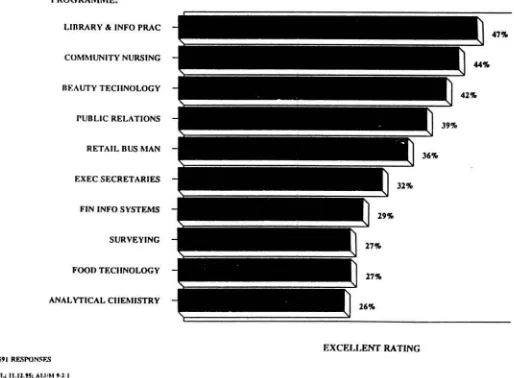
the Cape Technikon have been positive (Cape Technikon, 1995). The Department of Library and Information Studies
was rated as one of the ten top performers at the Cape
Technikon in the fields of experiential training (traditionally known as 'field work' at university departments of LIS), applicability of course content, overall experience of the
technikon and technikon contribution to skills (see Figures
2-5 [CapeTechnikon, 1995]). The same survey (Cape Tech-nikon, 1995), indicated that 76% of graduating students had found employment (Figure 6). However this survey was
based only on questionnaire responses. A more accurate picture is obtained from an informal departmental survey of
the 1995 NO: Library and Information Practice graduates, which revealed that by July 1996, 78.5% of all graduates of
the class of 1995 had found employment in libraries. Altogether 22 students registered for the BTech: Library and
Information Studies at the beginning of 1996 (offered part-time over two years); of these 22 students, only one is not employed in a library. One student in possession of a BBibl
PROGRAMME:
LIBRARY&.INFO PRAC
COMMUNITY NURSING
R~:AVTVTECllNOlOGY
rUDLIC RELATIONS
RETAIL BUS MAN
EXEC SECRETARIES
FIN INFO SYSTF..MS
SURVEYING
rOOf) TECIINOLOGY
ANALYTICAL (IIEMISTRY
EXCELI.ENT RATING
JJI.:ll.U.HIAIJIM'.JI
Figure 2 Alumni survey 1995: experiental training - ten best per-formers
58
PROGRAMME:
SUlTrY TECllNOLOGY
POST SCHOOL [DUC
COMMUNITY NURSING
COMMUCEEDUCATION
I.IBRAMY •••.INFO 'RAe
CtOTllING I'KOUUCTION
IIVTERNAL AUDITING
BUSINESS COMPlfflNG
PERSONNEL MANAGltht[NT
EXEC S[CkETAkIES
EXCEI.I.ENT HATING
Figure 3 Alumni survey 1995: applicability of course content - ten
best performers
l'IUH;HAI\lf\IE:
C1.C)TIIING l'IUlUut.illlN
COMI\lERCF. F.IlUCATION
J.:X[C SIo:CRfo;rARIES
TOWN rLANNING
ENVlH,ONMEl'ITAI.IIEALTII
EX(:t;I.I.F.NT HATlNe;
"
.•
50••
S.Afr.Tydskr.8ibl.Inligtingk.,1997,65( I)
PROGRAMME:
COMMUNITY NURSING
LIBRARY"" INFO SYST
ENVIRONMENTAL IIEALTII
UECur SECRETARIES
BEAlffYTEOINOLOGY
OFFICE ADMIN
BUSINESS l:OMPlITING
pERSONNEL MANAGEMENT
Rl."TAIL BUS MAN
PUBLIC MANfADMIN
LARGE CONTRI8UTION
"IftlUSPOI'GU
.Ml.tILU,"'Alml"
Figure 5 Alumni survey 1995: Technikon's contribution to skills -ten best performers
PROGRAMME,
NHD POST -SCHOOL EDUC
ND COMMER.CIAL EDUC
LIBRARY &:INFO PRAC SCIlOOL
TECIL"'flKON
"RESPONSES
"
.•
UNEMPLOYED WORKING IT
Figure 4 Alumni survey 1995: overall experience of Technikon -ten best performers
has enrolled for the subject Research Methodology, with a
view to enrolling for an MTech in 1997.
Conclusion
Over the past few decades attempts have been made to review
the tertiary education scene in South Africa and to plan for
the future. The Main Report of the Commission of Inquiry into
Universities under the chairmanship of Mr Justice van Wyk
de Vries, and the Human Sciences Research CounciL (HSRC)
Report attempted to provide some framework for education
for the end of the twentieth century. It is hoped that the
National Commission of Higher Education's proposals for a
new system of higher education, inter aLia'the development
of a single co-ordinated system of higher education
en-compassing universities, technikons, colleges and private
providers' (South Africa, National Commission on Higher
Education, 1996:9) will facilitate mobility and accreditation.
Figure 6 Alumni survey 1995: employment status - School of Teacher Education
The current debate in education circles regarding National
Vocational Qualifications (NVQ's)fi will no doubt add a
further dimension to the education and training of LIS
workers in South Africa. However, it is hoped that the
im-plementation of degrees at technikons, and SAlLIS' guarded
acknowledgement of technikon degree programmes as
admis-sion to professional positions (SAlLIS, 1996: 1180) will
herald a less conservative and more innovative approach to
the education and training of LIS workers in South Africa.
Disclaimer
The views expressed in this article reflect the experiences of
the author as Associate Director, Department of Library and
Information Studies, at the Cape Technikon. Opinions and
vIews expressed do not, therefore, necessarily reflect the
views and experiences of other South African technikons
S.Afr.J.Libr.Inf.Sci., 1997,65( I)
Notes
1. The author recalls tutoring Black library workers enrolled
for SALA qualifications in 1969/1 970.
2. The Lower Diploma in LIS is still offered by the
University of the Western Cape (a three-year course), and
the University of Fort Hare (a two-year course).
3. Personal correspondence with Ms Annemarie Greyling,
Librarian, South African Cultural History Museum, Cape
Town, and Ms Naomi Haasbroek, Senior Librarian,
Scientitic and Technical Library, National Accelerator
Centre, Faure.
4. In a Delphi study, library and information managers were
consistently more careful and conservative in their
re-sponses than mentors (middle managers) who completed
the same questionnaire.
5. The questionnaire was mailed to all graduates of the class of 1995.
6. NYQ's are well established in the United Kingdom,
especially in the hospitality trade. Their relevance to the
LIS sector was addressed at the 1995 SAlLIS Conference
by Walker (1995) and at an address given to the SAlLIS
(Western Cape) Branch by Robert and Margaret Oldroyd
(Oldroyd &Oldroyd, 1996).
References
ASSOCIATION FOR LIBRARY AND INFORMATION SCIENCE EDUCATION AND RESEARCH (ALISER). 1992. 'Bye Baby Bunting': papers delivered at a workshop on co-operation between library and information science educational institutions in the Western Cape in the Post-Bunting era, Wednesday 17 June
1992, Cape Town: Cape Technikon. (Unpublished).
BUNTING, LA. 1990. Librarianship and the rationalisation of South African universities. In Nassimbeni, M.&De Jager, K. (eds). The future of library and information science: social, technological
and educational challenges. Proceedings of the 50th Anniversary
Symposium of the School of Librarianship, 20-2 I November
/989. Cape Town: University of Cape Town:53-66.
CAPE TECHNIKON. 1995. Profiles of the Cape Technikon. Cape Town: Cape Technikon.
KERKHAM, A.S. 1988. The education of library technicians in South Africa. South African journal (~flibrary and information
science, 56( 1):7-10.
59
LE ROUX, H.S. 1985.Guidelines for distinguishing between
profes-sional and non-profesprofes-sional work and staff in library and
inform-ation services. Pretoria: South African Institute for Librarianship
and Information Science, Committee for Education and Research.
LESSING, C.1.H. 1987. Die Suid-Afrikaanse Biblioteekvereniging en biblioteekopleiding in Suid-Afrika. Suid-Afrikaanse tydskr!f
vir biblioteek- en inligtingkunde, 55(4):277-289.
LESSING, C.1.H. 1991. Bydrae van die Suid-Afrikaanse Biblio-teekvereniging (1930-1980) tot biblioteekontwikkeling in Suid-Afrika. Suid-Afrikaanse tydskrifvir biblioteek- en inligtingkunde, 59(2): 123- 134.
MEIJER, J.G., BURGER, lE, DU PREEZ, M.&HAAG, D.E.
1988. Kurrikuleringsbeplanning vir biblioteek en in/igtingkunde
in Suid-Afrika. Verslag B/N-2. Pretoria: Raad vir
Geestesweten-skaplike Navorsing.
MUSIKER, R. 1986.Companion to South African libraries. Craig-hall: Ad Donker.
OLDROYD, R.&OLDROYD, M. 1996. National vocational quali-fications in information and library services: the UK experience. Papers delivered at a SAlLIS (Western Cape) Branch Meeting on Thursday, 4July 1996, at the University of Cape Town.
(Unpublished).
SHIPPEY, T.e. 1983/84. Higher education in California. Cape
Technikon yearbook:5- 19.
SOUTH AFRICA. NATIONAL COMMISSION ON HIGHER EDUCATION. 1996.An overview of a new policy framework for
higher education transformation, 22 August 1996. (Press copy).
SOUTH AFRICAN INSTITUTE FOR LIBRARIANSHIP AND INFORMATION SCIENCE (SAlLIS). 1987.Standards for
education for library and information science. Updated edition.
s.I.: The Institute.
SOUTH AFRICAN INSTITUTE FOR LIBRARIANSHIP AND INFORMATION SCIENCE (SAlLIS). 1996.Proposed
guidelines for undergraduate career training. Attachment to
Notice of SAlLIS Council Meeting, I September 1996: 1179-1193.
VAN ROOY, H.e. 1966. Die Suid-Afrikaanse Biblioteekvercniging en die toekoms. Suid-Afrikaanse biblioteke, 34(2):62-69. VAN VUREN, A.1. 1995. Kwalifikasiestruktuur vir
technikonoplei-ding in biblioteek- en inligtingkunde deur middel van afstands-onderrig. Johannesburg: Randse Afrikaanse Universiteit. (Ongepubliseerde D Bibl-proefskrif).
APPENDIX A Omkring of merk asseblief die antwoord van u keusi. All. antwoord. sal streng vertroulik behandel word. PI.as. circl. or mark your choice of response. All responses will b. treated in confidence. 1. Hoe tevrede is u met die onderrig wat u aan die Kaapse rechnikon ontvang hetl How satisfied are you with the instruction you received at the Cape Technikonl Highly dissatisfied Baie ontavrede