Empirical Analysis of Effects of Learning
Styles In E-Learning Environment
Mohamed Salim Trigui1, Syed Hamid Hasan2, Anser Ghazzaal Ali Alquraishee3
INTRODUCTION
With the advent of the new era, great new opportunities are being unearthed both for the learners and the educators through the mediums of networks, intranet and internet. We have seen a really fast growth in the computer networks witnessed rapid improvement in the PC processing power. Additionally, the WWW (World Wide Web) and internet have transformed the PC into a dynamic force in the field of distance education, which means it is a new medium of reaching learners spread over time & distance (Wagschal, 1998). E-learning (Electronic learning) is a rapidly changing, dynamic and evolving educational opportunity which is a result of the advancement in IT. E-learning essentially means knowledge and skill transfer that is enabled by network (Anon, 2006). We all know the internet to be the most powerful and the biggest information technology networks that exists. It is connected to millions of computers and devices across the globe that utilizes as many IP addresses. With the increasing number of individuals, companies, secondary and elementary schools universities and colleges being connected to the internet the possibilities for distance education, that transcend the limitations of distance and time, increase manifolds. Anywhere, anytime availability
1 Information Security Research Group Faculty of Computing and Information Technology, Department of Information
Systems King Abdulaziz University, Kingdom of Saudi Arabia
2 Information Security Research Group Faculty of Computing and Information Technology, Department of Information
Systems King Abdulaziz University, Kingdom of Saudi Arabia
3 Information Security Research Group Faculty of Computing and Information Technology, Department of Information DOI: http://dx.doi.org/10.21172/1.73.518
e-ISSN:2278-621X
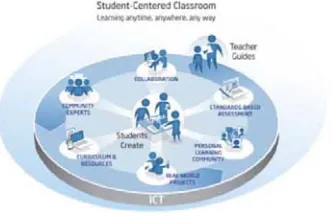
of knowledge on any subject becomes a reality with the use of internet in education. As seen in the Fig 1 we clearly see the essentials of e-learning sources.
Fig 1. E-Learning Sources
It was not long ago when instructor led courses constituted 70% of the learning delivered in 1997, and of the total knowledge sharing by pioneering firms 21% was done with the use of Technology (Van Buren & Bassi 1998). This percentage share of technologies like e-learning and internet in learning delivery has grown ever since and it is projected to grow exponentially here on as well. It will not be long wherein e-learning would be a major player in the field of primary, middle school and higher education; With e-learning being the primary mode of education in the non-formal sector (Zenaida, 2004).
LEARNING & E-LEARNING?
If the term "e-learning" is typed into any if the web search engines we find that it has been generally used to identify system that are computer based and not essentially aimed at achieving the objectives of "learning."
It has been widely believed by researchers that the primary reason for introduction of –E-learning into the field of education and learning was to radically change the process if Learning. This could be achieved by either presentation of opportunities to the students and teachers that were non-existent before or by facilitating the learners and instructors in the everyday challenges faced by them.
WHAT IS E-LEARNING?
Even though “e-learning” as a term is in frequent use from the year 2000 around the world, yet people have various definitions for the term and different literature has prescribed different meaning of the term “e-learning”. When electronic application and process is utilized to impart learning it is called E-learning. Digital collaboration, virtual classrooms, computer based and web based learning’s constitute the E-learning processes and applications. Multi-Media CD-ROM, Satellite TV, extranet, intranet and Internet are the modes of content delivery (ISP, 2004).
necessary to secure interaction between learners and those who provide the contents. The term interaction used here refers to practices in which learners are given opportunities to participate according to their own intentions and timely provided appropriate instructions to carry forward learning by people and/or computers.”
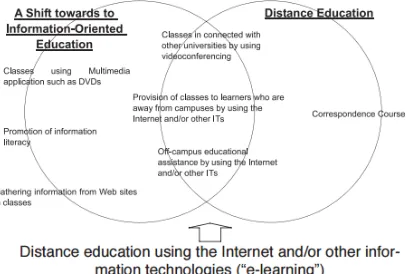
Just putting computer inside classrooms cannot be called technology. E-learning has been divided into 2 types instructor-led or synchronous and self-paced or asynchronous as categorized by (Lovelace, 1999). Degree of expense, sophistication and interactivity varies with each type. We cannot term traditional CBL (Computer Based Learning) as E-learning and we do not have content download to local drives, instead content is accessed over the web browser from the server, unlike the CBL. The only requirement for E-learning is an ISP subscription to access content over the Internet and network connection for local Intranet. The term e-learning is sometimes used inter changeably with Distance Education, however Fig 2 describes the relationship between distance education, e-learning and technology.
Fig 2. E-learning and Education relation.
For an e-learning environment, hyperlinks to content may be created for the students. E.g. we can create a link to Wall Street with additional guidelines from the instructor for delivering courseware on Stock Trade. Since the source of information in E-learning is Internet, there is no cap on amount of information available, whereas CBL has limited information availability. Since no matter how big the storage media for CBL courseware is, it will always have a capacity limitation. E-learning can accommodate different learning style, and is up-to-date, platform independent, secure, low maintenance and accessible worldwide. Students and educators are utilizing the internet for enhancing the learning and teaching experience in a number of ways. Individualized content can be imparted to students through E-learning.
STYLES OF LEARNING
students along with knowledge accession process. It was indicated by Hiltz in 1993 that for any communication medium to be studied for education delivery, the primary aim is to identify its impact on the leanings. It may be beneficial even for the students if they are able to identify their style of learning and thus adopting knowledge acquisition accordingly (Cowley et al., 2002).
Even though content cannot be modified based on every student’s learning style, yet providing options in learning is important (McIsaac and Tu, 2002). We expect higher level of information system’s user acceptance whenever there is increased effectiveness of learning.
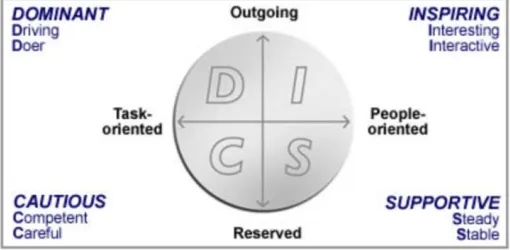
It has been believed that the learning behavior of the individual can be predicted by his learning styles (Sein, Olfman and Bostrom, 1993). When the teaching style and learning style match the satisfaction and achievement levels of the students increases (Lindsay, 1999), as illustrated Fig 3 by the picture below.
Fig 3. Personality traits and Learning Styles
However, in 1999 Hajizainuddin, claimed that there is no correlation between performance and the learning styles. Additionally he also claimed that there is no direct relationship between attitude, organizational structure of hypermedia and learning style as well. Desai who stated that subject learning is not greatly influenced by the learning styles supported his reporting in 1996.
Even though there is a lot of research in the field of styles of learning, yet there seems to be a lack of consensus on any specific theories (Conlan and Bruen, 2002). Additionally, all the researchers do not agree upon models of learning styles. A critical study (Coffield et al., 2004) of all the theories on learning style models was done by the “Learning and Skills Research Center”. It worked on the implications, validity and reliability of the learning styles. Furthermore, conclusions arrived by the learning styles in Kolb model along with the use of these models in research were criticized and critically observed. The study asserted that use of LSI (Leaning Style Inventory) by Kolb “should not be used for individual selection”. On the topic of LSI reliability and validity the research concluded that there is an ongoing dispute over the reliability and validity of LSI. The paper also stated that matching of the delivery and learning styles has any positive impact on the performance of the students and that findings supporting a positive impact need to be questioned for their consistency.
In 2004, Markham suggested that there is further research required on learning styles and we need to dig deeper than simply pointing that there is disagreement on the subject to ascertain a definite outcome on learning.
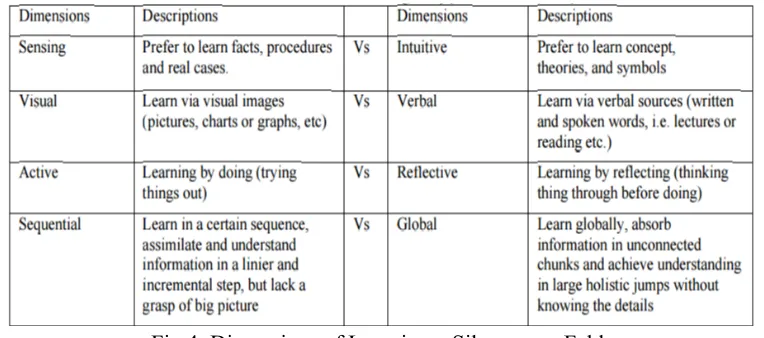
Fig 4: Dimensions of Learning – Silverman - Felder WHY THIS STUDY?
Despite the fact that we see e-learning has a great impact on the success of learning and its importance being acknowledged across the world we see limited research being done to harness the power of e-learning in order to achieved overall improvement in the efficiency and quality of learning. We see a discernable impact on development, training and teaching by E-learning. Three is an increasing number of students and online courses offered in colleges (Chang, 2001). Training programs have a future in e-learning as believed by a number of leaders in corporate training (Barron, 1999). Yet, there is lack of sound evidence in the field that proves that individual learning is impacted greatly by e-learning methodology. E.g. Dwyer in 1998 suggested that studying of the learning styles prove that improvement in learning process can be achieved through consideration of the personality attributes while delivering and designing of content. Dicheva and Aroyo (2004) highlight concerns of a number of education system researchers over movement of research to an intelligible space of scattered intelligent to collaborative intelligence. We have a small number of practical researches available for studying the impact of these methodologies on student knowledge and learning, if his learning style is considered.
In the current paper we have empirically studied the influence of styles of learning & e-learning on the knowledge level of the students. Additionally, we also attempt in providing evidence that students with a particular style of learning are comparatively more benefited by e-learning than others. We compared the results Vis-à-vis the instructor led traditional course formats. We aim at providing better insight to content designers and educators to help them develop effective and efficient delivery methods of learning on the basis of learning styles of the students. It could also aid the centers for learning and training in deciding upon effective and efficient methodologies for keeping pace with the growing training demand, along with upgrading the employees to acquire the skillset required on the basis of styles of learning.
RESEARCH WORKGROUP
INSTRUMENTATION
Learning styles were measured using the Kolb LSI. Kolb has categorized learning style into 4 levels that are Converger, Accommodator, Assimilator and Diverger as shown in Fig. 5
Style
Accommodator Converger Assimilator Diverger
Preferred
Method
Feeling & doing
Thinking &
doing
Thinking &
watching
Feeling &
watching
FIg 5. Learning style LevelsAcademia and business organizations use LSI as a respected model. LSI measures the inclination degree of an individual towards a style of learning, based on theory of experiential learning. This model has a requirement of tension resolution between active-reflective and abstract-concrete orientations, by the students. Thus, the participating students have to rank the preferences in an order. We hoped that behavior would be predicted by the learning style measures that are in consistency with the experiential learning theory (Kolb et al., 1974). Independent measures were comprised of the LSI in unification with the strategy of teaching. The level of knowledge acquired by students of each method at the end of the semester was investigated as a dependent performance measure.
The students described their learning styles through a 12 question test (LSI test) 3 weeks prior to the final exam at the end of the semester which was a knowledge based test.
ANALYSIS OF DATA
A storage medium was used to store the data after it was converted into database file of ASCII. SPSS v10.0 was used to analyze the data. The results of the post learning test and the LSI were analyzed through tests of independent variables and ANOVA (Analysis Of Variance) technique for identifying student knowledge base and dependent variables as per his learning style
In order to identify the difference between learning of the sections, if any, the result of the semester end exam was analyzed for the students.
DEPENDENT VARIABLE (SEMESTER END EXAM)
Fig 6. Subject Knowledge Test Distribution.
RESULTS
Two independent variable were involved in a 2-way procedure (ANOVA). The Variables were namely Learning methods and category of learning styles by Kolb. Kolb has categorized learning style into 4 levels that are Converged, Accommodator, Assimilator and Diverge. Learning methods
constituted of CBL(traditional) and e-learning. 4/2 ANOVA was used for analyzing knowledge of the students.
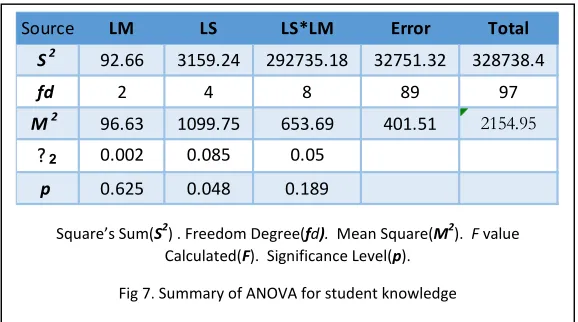
The summary of 2 way ANOVA is provided in Fig 7, which shows 3 Fs. The 3 Fs are connected to the questions in the research. The questions that were asked are as follows, these questions were asked in reference to the increase in the student knowledge and the instruction methodology utilized during the period. Additionally, effect of interaction between the styles of learning of the students and the learning methodology on the dependent variable was examined.
1. Does the learning method and learning style have any substantial interaction statistically? 2. Does the learning method have a substantial main effect statistically?
3. Does the learning style have a substantial main effect statistically?
The questions assess the interaction effect and main effects of the learning method and style and handle the learning method and learning styles simultaneously.
Source LM LS LS*LM Error Total
S2 92.66 3159.24 292735.18 32751.32 328738.4
fd 2 4 8 89 97
M2 96.63 1099.75 653.69 401.51 2154.95
?2 0.002 0.085 0.05
p 0.625 0.048 0.189
Square’s Sum(S2) . Freedom Degree(fd). Mean Square(M2). F value Calculated(F). Significance Level(p).
The main effect of the Learning style is covered by the first F values. We identified substantial main effect on the learning styles after a 2 way ANOVA on the knowledge gained (students score) after being correctly identified as dependent variables. {p = 0.048, F (3,86) = 2.74, where p < 0.05}. Which is a clear indication that main effects of learning styles are substantial statistically on the grade measuring the student’s knowledge. Thus after analysis of the data gathered and analyzed we identify a major difference in the level of knowledge acquired by the students on the basis of learning style between the instructor led vis a vis the web based methodology (shown in Fig 8). While for the other sources i.e. learning methods & learning style interaction, & learning methodology doesn’t amount to be that great since F’s more than 0.05 i.e(0.05<p).
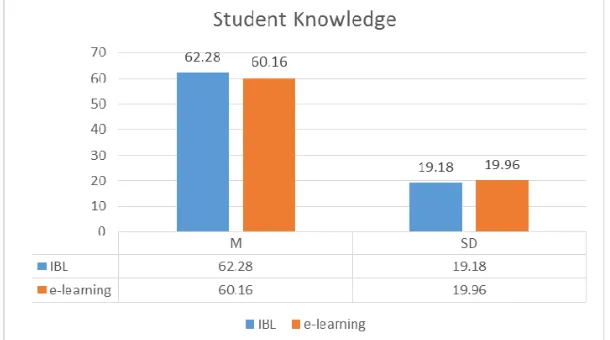
We are able to ascertain that the E-learning’s mean is 60.16 while Standard Deviation 19.96 and mean for Instructor Based Learning 62.28 with Standard Deviation at 19.18 as shown in see Table 3. We can clearly see that the Deviation and Mean for both the groups were in close range with each other, showcasing that population represented is the same. This is in cohesion with earlier deductions of delivery methodology not having substantial impact on level of student knowledge. Based on the above, we must base the inclusion of e-learning methodologies on other factor. We did not see major interaction between the teaching methodologies and learning style, however, a larger sample base or size could yield different results.
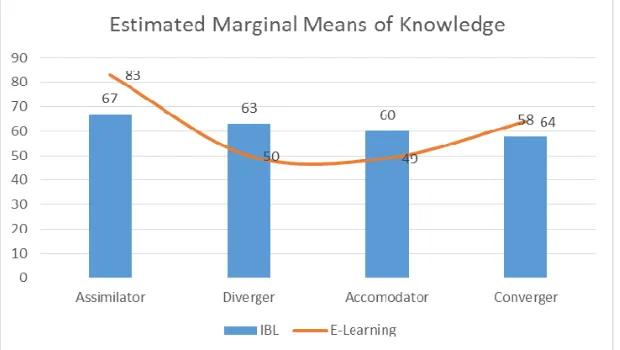
We can see in Fig 8 that Accommodator and Diverger learning styles are better suited for IBL while Converger and Assimilator styles show better results with e-learning.
Fig 9. Interaction effect of learning methods & learning styles on student’s knowledge
CONCLUSIONS
In this paper we have statistically seen that the learning styles of students have a substantial impact on the learning of the students. This finding is in agreement with the earlier deductions about the significance of learning styles in learning environment. We found that Learning style did not have such a great impact for the traditional IBL while, the impact was substantial for the e-learning methodology. We can safely conclude that students with the Converged (that learn better via observations, laboratories and field work) and Assimilator (that learn better via, analogies, papers and lecture) fared better when the delivery methodology was Web-Based (e-learning). It means that learners and students that prefer to gain knowledge via thinking & doing and thinking & watching have a better change of learning with the web-based (e-learning) employed for delivery. Additionally, Diverger (that learn better via logs and brainstorming) and Accommodator (that learn better via case study and simulations) styles of learning are better favored by the standard & Traditional IBL methodology of content delivery.
Alternatively put, Converged and Assimilator learning style showed a minimal improvement in scores when the delivery methodology for the content was altered. Thus, we can say that Corporate leaders and people involved in content development & design, should be encouraging their associated learners to adopt the e-learning methodology of training/content delivery as a formal mode. Results of this research can be specifically of interest to training institutes and educational foundations; specially those are which contemplating transferring of their traditional IBL courses onto the web interface of e-Learning.
REFERENCE
Quality Assurance of Universities Providing Education across Boarders (2004) : Aiming to Global Development of Universities and to Globalized Educational Opportunity
Advanced Learning Infrastructure Consortium (ALIC), ed. White Paper on E−Learning for 2003/2004], Ohmsha, 2003
Zenaida, T. D. (2004) ‘Present-day Profiles, Prospects and Challenges on the use of ICT for Education in South East Asia’.
Anon (2006) ‘Learning in the New Economy’.
Bassi, L. J. and Van Buren, M. E. (1998) ‘The 1998 ASTD of the Industry Report’. Barron, T. (1999) ‘Harnessing online learning’.
Bostrom, R. P., Olfman, L. and Sein, M. K. (1993) ‘Learning styles and end-user training: A first step’.
Felder, R. M. (1993). Reaching the Second Tier: Learning and Teaching Styles in Engineering Education. Engineering Education, 78(7), 674-681.
Canavan, J. (2004) ‘Personalized e-learning through learning style aware adaptive systems’.
Bruen, C. and Conlan, O. (2002) ‘Adoptive ICT support for learning styles – A development framework for re-usable learning resources for different learning styles & requirements’.
Chang, C. C. (2001) ‘Construction and evaluation of a web-based learning portfolio system: An electronic assessment tool’.
Coffield, F., Moseley, D., Hall, E. and Ecclestone, K. (2004) ‘Should we be using learning styles? What research has to say to practice’.
Cowley, J., Chanley, S., Downes, S., Holstrom, L., Ressel, D.,Siemens, G. and Weisburgh, M. (2002) www.elearnspace.org/Articles/Preparingstudents.htm.
Desai, M. S. (1996) ‘Longitudinal study to assess the impact of instructor-based training versus computer-based training on user performance: A field experiment’.
Dwyer, K. K. (1998) ‘Communication Apprehension and Learning Style Performance: Correlation and Implications for Teaching’.
Hajizainuddin, A. M. (1999) ‘A study of learning styles and hypermedia’s organizational structures in a Web-based instructional program designed for trainee teachers at the international Islamic University Malaysia’.
Hiltz, S. R. (1993) , Norwood, N J: Ablex.
ISP (2004) ‘Getting started with e-learning ’, isp.webopedia.com/TERM/E/e_learning.html.
Jugon, A. (2003) ‘What is E-Learning ?’ www.enpc.fr/enseignements/Legait/projet/MQTM-2003/ G8/definition.htm.
Kolb, D. A., Rubin, I. M. and McIntyre, J. M. (1974) ‘Learning and problem solving: On the management and the learning process’.
Lindsay, E. K. (1999) ‘An analysis of matches of teaching styles learning styles and the uses of educational technology’.
Lovelace, P. (1999) ‘CUNA explores web-based learning’.
Markham, S. (2004) ‘Learning styles measurement: a cause for concern’, cerg.csse.monash.edu.au/ techreps/learning_styles_review.pdf.
Tu, C. H. and McIsaac, M. S. (2002) ‘An examination of social presence to increase interaction in online classes’.