376 | International Journal of Computer Systems, ISSN-(2394-1065), Vol. 03, Issue 05, May, 2016 Available at http://www.ijcsonline.com/
Optimization of DEEC Routing Protocol using Genetic Algorithm
Amandeep Kaur, Mandeep Kaur
Department of ECE, Baba Banda Singh Bahadur Engineering College Fatehgarh Sahib, India
Abstract
Due to the advancements in wireless communication, information technologies and electronics field, in recent years the WSN have gained so much attention. They consist of large no. Of sensor node that are usually deployed randomly over an area to be observed, collects data from sensor field and transmit data to base station. Because node sensors are energy limited so to increase network lifetime is important factor. Energy saving is also an important design issue in the WSNs routing design. Distance between the nodes and BS and distance between nodes they are the factors that cause energy dissipation. Applying genetic algorithms (GAs) in finding energy efficient shortest route for WSNs is emerging as an important field. GA could be very helpful in providing optimized solution to energy efficient shortest path problem in WSN. Distributed Energy Efficient Clustering (DEEC) can be defined as a clustering based algorithm in which cluster head is preferred on the behalf of probability of ratio of residual energy and average energy of the network. In this paper genetic algorithm is applied on DEEC routing protocol to enhance network lifetime.
Keywords: Wireless Sensor Networks, Stability period, Energy efficiency, SEP protocol, DEEC protocol, Genetic Algorithm (GA).
I. INTRODUCTION
A large range of sensing element nodes that are unit densely deployed over a large geographical region and networked through wireless links are used for the making of wireless sensor networks. Each sensor node in WSN has capability to communicate with each other and base station is used for the data integration and circulation. In WSN each and every node can become transmitter and receiver [12]. Energy-efficient protocols should be designed for the characteristic of WSN to extend the network lifetime. In order to reduce the energy consumption, sensor nodes are efficiently organized into clusters. On the basis of clustering structure, many energy-efficient routing protocols are designed. The clustering techniques are helpful for performing data aggregation, which combines the data from source nodes into a little set of significant information. The fewer messages are transmitted under the circumstance of achieving enough data rate specified by applications for increasing energy saving. [7]
For processing, sensor networks include a many data for an end-user. Therefore, there is a requirement of automated methods for combining or aggregatingthe data into a little set of significant information. [18]
Once the network is established, it start sensing the information and the energy of the nodes goes on dissipating whenever they obtain a little information and send it to other nodes or BS. The nodes can be made more energy efficient by using routing protocols. [2]
Fig .1 Wireless sensors network
Clustering Hierarchy
In WSN nodes are not invariably same they could be heterogeneous that increase network complexness. To increase stability and reduce the energy consumption cluster is essential technique in WSN.
In [1] compression of SEP and DEEC protocols has been analysis in which DEEC found best in compression with SEP routing protocols. So in this work DEEC protocols is going to be optimized using genetic algorithm to improve energy efficiency.
II. REVIEW OF CLUSTERING ALGORITHMS FOR WIRELESS SENSOR NETWORK
A. SEP (Stable Election Protocol)
A Stable Election Protocol (SEP) is for clustered heterogeneous wireless sensor networks. Heterogeneous WSN Nodes have different energy levels. In SEP, many of the elevated energy nodes are referred to as advanced nodes and the chance to become CHs is more in advanced nodes as compared to non-advanced nodes. In advanced nodes, extra energy is taken off by SEP. [15]
Fig3. Flow chart of CH selection in SEP protocol Advantage:
SEP is scalable and dynamic, even normal node can be selected.
In SEP, no universal knowledge is required at every round.
No earlier distribution is assumed of energy levels.
Limitations:
The drawback of SEP method is that the election of the cluster heads is not dynamic among the two types of nodes, which results that the nodes will die first that are far away from the powerful nodes.
B. DEEC (Distributed Energy Efficient)
DEEC use the residual and initial energy level of the nodes to select the cluster-heads. At every election round, DEEC does not require any universal knowledge of energy.
Distributed Energy Efficient Clustering (DEEC) can be defined as a clustering based algorithm in which cluster head is preferred on the behalf of probability of ratio of residual energy and average energy of the network. The routing time in number of round is different according to its residual and initial energy for each node. In this algorithm, the nodes with low-energy will have lesser chances to be the cluster heads as compared to the high Initial and residual energy nodes. In a two-level heterogeneous network, where there are two types of nodes, m.N advanced nodes with initial energy equal to Eo.(1+a) and (1 − m). N normal nodes, in which the initial energy is equal to Eo. Where a and m are two variable which manage the nodes percentage types (advanced or normal) and the total initial energy in the network Etotal [7].
•The value of Total Energy is given as
Etotal = N.(1−m).Eo+N.m.Eo.(1+a) (1) •The average energy of rth round is set as follows
E(r)=1/NEtotal(1−R) (2)
R denotes the total rounds of the network lifetime and is defined as
R=Etotal/ERound (3)
Advantages:
At every election round, DEEC does not want any universal knowledge of energy.
DEEC can perform multi-level heterogeneous wireless network.
Limitations:
Advanced nodes always punish in the DEEC, particularly once their residual energy reduced and become in the variety of the normal nodes. In this position, the advanced nodes die rapidly
than the others.
C. Genetic Algorithm
Genetic Algorithm is used to make cluster member, cluster head and next cluster dynamically, which is used to calculate average fitness and increase life time of the network. [3]
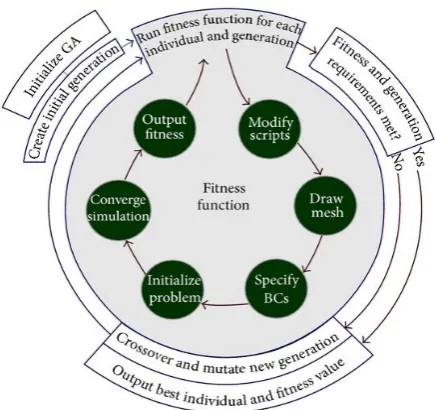
1. Population: A population is gathering of numerous chromosomes and the best chromosome is working to come up with next population. Initially the GA starts with a population of predefined variety of chromosomes and randomly selected cluster heads. Each chromosome is evaluated by GA by calculate its fitness. GA selects best suitable chromosome after the evaluation of fitness and then applies crossover and mutation. [3]
2. Fitness Calculation: The fitness function is designed to increase the network lifetime, which evaluates whether, a particular chromosome increases network lifetime or not. The algorithm conserve the historically obtained most excellent chromosome, that is, with the highest fitness value, called elitism. The fitness of each chromosome is considered by
where di denotes the distance between the (i+1)the node (or, gene) and the ith node denotes the data gathering chain. A longer data gathering chain is indicated by higher value of the chromosome energy and which means to be an inferior solution. [15]
3.Selection
The process of determining in which two chromosomes will assistant to form a new chromosome is known as selection.
The chromosomes with higher fitness values have more chances to of matting. [11]
4. Crossover
Crossover is a binary genetic process useful on two chromosomes. It recombines the genetic materials of two parent chromosomes to create a child chromosome. The results of the crossover are depending on the selection procedure.
Fig 5. General scheme of GA mechanism.
5 Mutation
The mutation is an exploration process which transforms genes to overcome the limitation of the crossover.
In this paper, this operation enables the search for optimal chromosome by transforming a cluster-head to a cluster member and a cluster member and a cluster-head, with a small probability. The probability of transforming from cluster member to cluster-head is set higher than that of the opposite case for preventing abnormal increase of cluster-heads., clusters should be reconstituted after executing the crossover and mutation, since the cluster-heads’ positions could have been shifted. [4]
Fig 7. Flow chart of implemented scheme of GA
Fitness Parameters
The fitness of a chromosome is designed to increase the network life time and to reduce the energy consumption. Some of fitness parameters are described in this segment.
1) Direct Distance (DD) to Base Station:It is defined as the sum of all distances from sensor nodes to the base station. Therefore this distance is defined as follows:
(4)
Where dis is the distance between node i and BS node s. For a longer network, this distance should be minimized; otherwise, the energy will be wasted of most of the nodes .However, for a smaller network, direct transfer to BS is to be fine.
2) Cluster Distance (C):The cluster distance, C can be defined as the sum of the distances from the nodes to the cluster head and the distance between head and BS. For a cluster having k member nodes, the cluster space C is defined as follows:
(5) Where dih is the distance between nodes i and cluster head h and dhs is the distance between cluster head h and BS node s. For a cluster having large number of
widely-spaced nodes, the cluster distance is high and thus the energy consumption will also be higher. C should not be too large for reducing energy consumption. Size of the clusters will be controlled by this metric.
3) Cluster Distance - Standard Deviation (SD): The variation in the cluster distances should not be large for uniform spatial allocation of sensor nodes, where nodes are uniformly placed. However, for non-uniform spatial distribution, the cluster distances must not be necessarily the same where nodes are randomly placed. According to the deployment information the variation in cluster distances should be tuned. Variation in cluster distances will show poor network configuration if the deployment is uniform and must be tuned to get uniform clusters. [14] The cluster distances, SD, with a deviation μ can be considered as follows:
(6)
(7)
III. SIMULATION RESULT
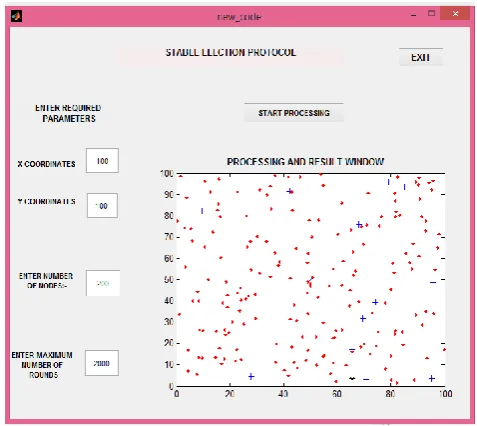
A. Transmitted data SEP :
(1)Count of Cluster heads SEP:
The figure shows the count of cluster heads in SEP.
(2)Dead Nodes:
The figure shows that in SEP, dead nodes start from 1000.
(3) Packets to Cluster Heads:
This figure shows that the packets to cluster heads is constant upto 1000 rounds and decreases after 1000 rounds due to dead nodes.
B (1) DEEC Clusters:
This figure shows the DEEC clusters and represents dead nodes, alive nodes and sink.
(2)Dead nodes:
This figure shows the dead nodes of DEEC and dead nodes start from 1500 rounds.
(3)Alive nodes:
( C) Gentic alogrithm:
GA is implemented on DEEC protocols and results are shown below:
(1) Dead nodes:
This figure shows the dead nodes of GA on DEEC start from 2111 rounds.
(2) Alive nodes:
This figure represents alive nodes of GA on DEEC in which all nodes are alive up to 2111 rounds and dead nodes starts afterward.
(D )Comprsion of sep, deec & GA on DEEC
(1) Dead Nodes:
Figure D(1) shows the comparison of SEP , DEEC & GA Dead nodes in which dead nodes of SEP starts from 1000 and of DEEC starts from 1300& GA on DEEC starts from 2111.
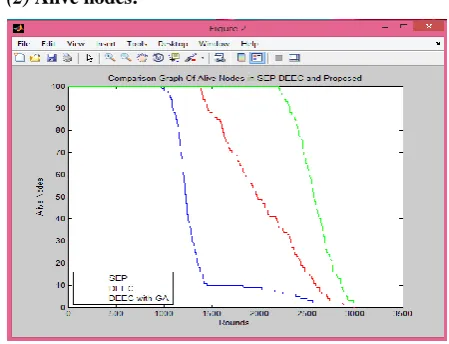
(2) Alive nodes:
This figure show the comparison of alive nodes of SEP, DEEC & GA .In which nodes are alive up to 1000 of SEP and up to 1300 rounds of DEEC & GA on DEEC starts from 2111.
IV. CONCLUSION
The main motive of designing energy efficiency protocol is to increase the network lifetime and improve the energy efficiency of the wireless network. The proposed work is based on the comparison between the conventional DEEC protocol and the optimized DEEC using GA. The nodes are deployed in the network and the performance parameters of the network are evaluated after applying Genetic Algorithm on DEEC protocol. Genetic Algorithm is helpful in searching energy-efficient clusters for sensor networks. Total energy consumption is concerned with the number of cluster-heads and their position. It is clear after comparison that optimized DEEC using GA is better and improving the network lifetime.
REFERENCES
[1] Amandeep kaur, Mandeep kaur “Performance Comparative of SEP and DEEC Protocol in Wireless Sensor Network”IETE,April 2016,pp 70
[2] F. Akyidiz, Y. Sankarasubramaniam W. Su,and E. Cayirci, "A survey on sensor networks",IEEE Commun, August 2002. [3] Ali Norouzi and A. Halim Zaim “Genetic Algorithm Application in
Optimization of Wireless Sensor Networks” the Scientific World Journal Volume 2014, pp 15.
[4] A. Zahmatkesh and M. H. Yaghmaee “A Genetic Algorithm-Based Approach for Energy- Efficient Clustering of Wireless Sensor Networks” International Journal of Information and Electronics Engineering, Vol. 2, No. 2, March 2012
[5] G. Smaragdakis, I. Matta, A. Bestavros, "SEP: A Stable Election Protocol for clustered heterogeneous wireless sensor networks", Second International Workshop on Sensor and Actor Network Protocols and Applications (SANPA 2004), 2004.
[7] L. Qing, Q. Zhu, M. Wang, "Design of a distributed energy-efficient clustering algorithm for heterogeneous wireless sensor networks". ELSEVIER,Computer Communications 29, pp 2230-2237, 2006.
[8] Manjeshwar A, Grawal DP. “TEEN: A protocol for enhanced efficiency in wireless sensor networks”. In Proc. of the 15th Parallel and Distributed Processing Symp. San Francisco: 2001. vol. 3, pp.30189a
[9] M. Handy, M. Haase ,and D.Timmermann, Low energy adaptive clustering hierarchy with deterministic cluster – head selection , in proceeding of IEEE, International Conference on Mobile and wirless Communications networks, Stockholm, Sweden,2002, pp. 368-372
[10] Ming Yu, Leung, K.K. and Malvankar, A. “A dynamic clustering and energy efficient routing technique for sensor networks”. IEEE on Wireless Communications, Vol: 6(8): pp3069-3079, August 2007.
[11] Mohammed Abo-Zahhad, Sabah M. Ahmed1, Nabil Sabor1 and Shigenobu Sasaki “ A New Energy-Efficient Adaptive Clustering Protocol Based on Genetic Algorithm for Improving the Life time and the Stable Period of Wireless Sensor Networks” International Journal of Energy, Information and Communications Vol.5, pp.47-72. 3 (2014) .
[12] Monica R Mundada (2012), “A Study on Energy Efficient Routing Protocols in Wireless Sensor Networks “International Journal of Distributed and Parallel Systems (IJDPS) Vol.3, No.3,Pp 311-330. [13] P. Krishna, N.H. Vaidya, M. Chatterjee, D. Pradhan, A
cluster-based approach for routing in dynamic networks, ACM SIGCOMM Computer Communication Review 27 (2) (1997) 49–65.
[14] Sajid Hussain, Abdul Wasey Matin, Obidul Islam “Genetic Algorithm for Hierarchical Wireless Sensor Networks” Journal of networks, VOL. 2, No. 5, September 2007.
[15] Sharma T,Kumar B,Tomar G.S “Performance Comparision of LEACH, SEP and DEEC Protocol in Wireless Sensor Network” Proc. of the Intl. Conf. on Advances in Computer Science and Electronics Engineering ,2012
[16] V. Mhatre, C. Rosenberg, D. Kofman, R. Mazumdar, N. Shroff, Design of surveillance sensor grids with a lifetime constraint, in: 1st European Workshop on Wireless Sensor Networks (EWSN), Berlin, January 2004.
[17] Vinay Kumar Singh, Vidushi Sharma “Elitist Genetic algorithm based energy efficient routing scheme for wireless sensors networks” International Journal Of Advanced Smart Sensor Network Systems ( IJASSN ), Vol 2, No.2, April 2012.