Content Based Image Retrieval Using Combined
Gabor and Image Features
1
Monika Soni,
2Dr. Parvinder Singh
1,2Dept. of Computer Science & Engineering, DCRUST Murthal, Sonepat, Haryana, India
Abstract
The rapid growth of image data on the internet has spurred the
demand for methods and tools for efficient search and retrieval. Content Based Image Retrieval (CBIR) is a technique that uses visual contents such as color, shape, texture, and other image features to retrieve similar images from a large repository against a given query image. This has become an active research area with the advent of the digital media in all most all applications. Although many researchers have been done in the field of image search and retrieval, there are still many challenging problems to be solved. As the semantic gap is considered to be the main issue, recent works have focused on semantic-based image retrieval. Most of the proposed approaches learn image semantics by extracting low-level features from entire image. However, such approaches fail to take into consideration the semantic concepts that occur in the images. In this paper, we focus on the SVM based Classification Model for CBIR Process by combining various image Features.
Keywords
Content Based Image Retrieval (CBIR), Texture, Gabor Transform (GT), Feature Extraction, SVM
I. Introduction
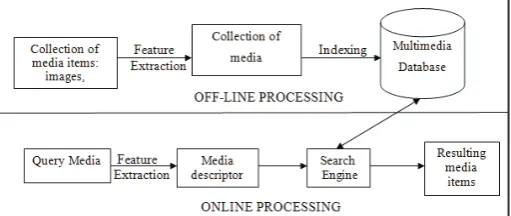
Content-based retrieval [1-2]uses the contents of pictures to embody and admission the images. A normal content-based retrieval arrangement is tear into off-line feature extraction and online picture retrieval. In off-line period, the arrangement automatically extracts discernible qualities (color, form, sense, and spatial information) of every single picture in the database established on its pixel benefits and stores them in a disparate database inside the arrangement shouted a feature database. The feature data (also recognized as picture signature) for every single of the discernible qualities of every single picture is extremely far tinier in size contrasted to the picture data, therefore the feature database encompasses an abstraction (compact form) of the pictures in the picture database. One supremacy of a signature above the early pixel benefits is the momentous compression of picture representation. Though, an extra vital reason for employing the signature is to gain an enhanced correlation amid picture representation and discernible semantics.
In on-line picture retrieval, the user can present a query example to the retrieval arrangement in finding of wanted images. The arrangement embodies this example alongside a feature vector. The distances (i.e., similarities) amid the feature vectors of the query example and those of the mass media in the feature database are next computed and ranked. Retrieval is led by requesting an indexing scheme to furnish an effectual method of hunting the picture database. Finally, the arrangement locations the find aftermath and next returns the aftermath that are most comparable to the query examples. If the user is not gratified alongside the find aftermath, he can furnish relevance feedback to the retrieval arrangement that encompasses a mechanism to discover the user’s data needs.
Fig. 1: A Conceptual Framework for Content-Based Image Retrieval is Illustrated
The believed behind content-based retrieval is to retrieve [3], from a database, mass media that are relevant to a given query. Relevancy is arbitrated established on the content of mass media items. Countless steps are demanded for this. First, the features from the mass media items are removed and their benefits and indices are saved in the database. Next the index construction is utilized to ideally filter out all irrelevant items by checking qualities alongside the user’s query. Finally, qualities of the relevant items are contrasted according to a little similarity compute to the qualities of the query and retrieved items are ranked in order of similarity.
II. Fields of Application
Image retrieval established on content is tremendously functional in a plethora of requests such as publishing and publicizing, past scutiny, style and graphic design, architectural and engineering design, offense prevention, health diagnosis, geographical data and remote detecting arrangements, etc. A normal picture retrieval request example is a design builder who needs to find his association database for design undertakings comparable to that needed by his clients, or the police pursuing to confirm the face of a distrusted convict amid faces in the database of renowned criminals. In the transactions department, beforehand trademark is in the end agreed for use, there is demand to find out if such or comparable one’s ever existed. In hospitals, a little ailments need the health practitioner to find and study comparable X-rays or scanned pictures of a patient beforehand proffering a solution. The most vital request, though, is the Web, as large fraction of it is devoted to pictures, and hunting for a specific picture is indeed a daunting task. Countless business and experimental CBIR arrangements are nowadays obtainable, and countless web find engines are nowadays outfitted alongside CBIR abilities, as for example Alta Vista, Yahoo and Google [4].
There is a colossal class of methods and arrangements aimed •
at browsing across a colossal set of pictures from unspecified sources. Users of find by association at the onset have no specific target supplementary than find interesting things. Find by association frequently implies iterative refinement of the find, the similarity or the examples alongside that the find was started. Arrangements in this group normally are exceedingly interactive, whereas the specification could by draft or by example images. The oldest realistic example of such an arrangement is probably. The consequence of the find can be manipulated interactively by relevance feedback. To prop the quest for relevant aftermath, supplementary origins than pictures are additionally employed.
Another class of users targets the find at a specific image. •
The find could be for a precise duplicate of the picture in mind, as in hunting fine art catalogues, e.g., Target find could additionally be for one more picture of the alike object the user has an picture of. This is target find by example. Target find could additionally be requested after the user has a specific picture in mind and the target is interactively enumerated as comparable to a cluster of given examples, for instance. These arrangements are suited to find for stamps, fine art, manufacturing constituents, and catalogues, in general. The third class of requests, group find, aims at reclaiming an •
arbitrary picture representative of a specific class. It could be the case that the user has an example and the find is for supplementary agents of the alike class. Groups could be derived from labels or appear from the database. In group find, the user could have obtainable a cluster of pictures and the find is for supplementary pictures of the alike class. A normal request of group find is catalogues of varieties. Arrangements are projected for categorizing trademarks. Arrangements in this group are normally interactive alongside an area specific meaning of similarity.
The three kinds of uses are not the finished story. A discover of journalists recognized five normal outlines of use: hunts for one specific picture, finished browsing to make an interactive choice, hunts for a picture to go alongside a colossal report, hunts to illuminate a document, and hunts for fill-ins merely on the esthetic worth of the picture. An endeavor to devise a finished categorization of user demands for yet and advancing pictures are discovered in. This and comparable studies expose that the scope of queries is wider than just reclaiming pictures established on the attendance or nonexistence of objects of easy discernible characteristics.
III. Issues with CBIR
The biggest subject for CBIR [5] system is to incorporate flexible methods so as to procedure pictures of diversified characteristics and categories. Countless methods for processing of low level cues are discriminated by the characteristics of domain-images. The presentation of these methods is challenged by assorted factors like picture resolution, intra-image illumination variations, non-homogeneity of intra-region and inter-region textures, several and occluded objects etc. The supplementary main difficulty, delineated as semantic-gap in the works, is a gap amid inferred understanding / semantics by pixel area processing employing low level cues and human perceptions of discernible cues of given image. In supplementary words, there exists a gap amid mapping of removed features and human observed semantics. The dimensionality of the difficulty becomes adverse because of subjectivity in the
visually observed semantics, making picture content description a subjective phenomenon of human understanding, described by human psychology, emotions, and imaginations. The picture retrieval arrangement embodies of several inter-dependent tasks gave by assorted phases. Inter-tuning of all these periods of the retrieval arrangement is inevitable for above all good results. The diversity in the pictures and semantic-gap usually impose parameter tuning & threshold-value specification suiting to the requirements. For progress of a real period CBIR arrangement, feature processing period and query reply period ought to be optimized. A larger presentation can be attained if feature-dimensionality and space intricacy of the algorithms are optimized. Specific subjects, pertaining to request areas are to be addressed for encounter application-specific requirements. Choice of methods, parameters and threshold-values are countless a periodsrequest area specific e.g. a set of methods and parameters producing good aftermath on an picture database of usual pictures could not produce equally good aftermath for health or microbiological pictures.
IV. Proposed Work
As Feature extraction is one of the most vital constituents in a content-based retrieval system. As a human is normally arbitrating the aftermath of the query, removed features ought to imitate the human discernible understanding as far as possible. In colossal sense, features could be tear into low-level features (such as color, sense, form, and spatial layout) and high-level semantics (such as thoughts and keywords). Use of merely low-level features could not always give satisfactory aftermath, and consequently, high-level semantics ought to be added to enhance the query whenever possible. High-level semantics can be whichever annotated manually or crafted automatically from low-level features. In this serving the discernible features are that are selected for counseled work delineated.
A. Color Moments
Color moments[6]have been prosperously utilized in countless retrieval arrangements (like QBIC, exceptionally after the picture encompasses merely objects. The early order (mean), the subsequent (variance) and the third order (skewness) color moments have been proved to be effectual and competent in representing color allocations of images. Mathematically, the early three moments are described as:
Where fij is the value of the i-th color component of the image pixel j, and N is the number of pixels in the image.
of every single picture, color moments are extremely compact representations contrasted to supplementary color features. Due to this compactness, they could additionally lower the discrimination power. Usually, color moments can be utilized as the early bypass to slim down the find space beforehand supplementary urbane color features are utilized for retrieval.
B. Color Histogram
The color histogram [7] serves as an competent representation of the color content of an picture if the color outline is exceptional contrasted alongside the rest of the data set. The color histogram is facile to compute and competent in describing both the globe and innate allocations of colors in an image. In supplement, it is robust to translation and rotation concerning the thinking axis and adjustments merely sluggishly alongside the scale, occlusion and thinking slant.
Since each pixel in the picture can be delineated by three constituents in a precise color space (for instance, red, green, and blue constituents in RGB space, or hue, saturation, and worth in HSV space), a histogram, i.e., the allocation of the number of pixels for every single quantized bin, can be described for every single component [8]. Clearly, the extra bins a color histogram encompasses, the extra discrimination manipulation it has. Though, a histogram alongside a colossal number of bins will not merely rise the computational price, but will additionally be improper for constructing effectual indexes for picture databases.
C. Color Correlogram
The color correlogram[9]was counseled to describe not merely the color allocations of pixels, but additionally the spatial correlation of pairs of colors. The early and the subsequent dimension of the three-dimensional histogram are the colors of each pixel pair and the third dimension is their spatial distance. A color correlogram is a table indexed by color pairs, whereas the k-th entry for (i, j) specifies the probability of discovering a pixel of color j at a distance k from a pixel of color i in the image. Allow I embody the whole set of picture pixels and I(c(i)) embody the set of pixels whose colors are c(i). Then, the color correlogram is described as:
Where i, j {l, 2, ... , N}, k {l, 2, ... , d}, and |Pl-P2| is the distance between pixels P1 and P2. If we consider all the possible combinations of color pairs the size of the color correlogram will be very large (O(N2 d), therefore a clear edition shouted the color
auto correlogram is frequently utilized instead. The color auto correlogram merely arrests the spatial correlation amid identical colors and therefore reduces the dimension to O(Nd).
Compared to the color histogram and CCV, the color auto correlogram provides the best retrieval aftermath, but is additionally the most computational luxurious due to its elevated dimensionality.
IV. Wavelet Features
Similar to the Gabor filtering [10], the wavelet transform [11] provides a multi-resolution approach to texture analysis and classification. Wavelet transforms decompose a signal with a family of basic functions Ψmn (x) obtained through translation and dilation of a mother wavelet Ψ(x), i.e.,
Where m and n are dilation and translation parameters. A signal f(x) can be represented as:
The computation of the wavelet transforms of a 2D gesture involves recursive filtering and sub-sampling. At every single level, the gesture is decomposed into four frequency sub-bands, LL, LH, HL, and HH, whereas L denotes low frequency and H denotes elevated frequency. Two main kinds of wavelet transforms utilized for sense scutiny are the pyramid-structured wavelet change (PWT) and the tree-structured wavelet transforms (TW1). The PWT recursively decomposes the LL band. Though, for a little textures the most vital data frequently appears inthe middle frequency channels. To vanquish this drawback, the TWT decomposes supplementary groups such as LH, HL or HH after demanded.
E. Gabor Filter Features
The Gabor filter has been extensively utilized to remove picture features, exceptionally sense features. It is optimal in words of minimizing the combined uncertainty in space and frequency, and is frequently utilized as an orientation and scale tunable frontier and line (bar) detector. There have been countless ways counseled to describe textures of pictures established on Gabor filters. The frank believed of employing Gabor filters to remove sense features is as follows.
A two dimensional Gabor purpose g(x, y) is described as:
Where, σX and σy are the standard deviations of the Guassian envelopes along the x and y direction.
Then a set of Gabor filters can be obtained by appropriate dilations and rotations of g(x, y):
where a >1, θ= nπ/K, n = 0,1, ... , K-1, and m = 0,1, ... , S-1. K and S are the number of orientations and scales. The scale factor a^(-m) is to ensure that energy is independent of m.
Given an image I(x, y), its Gabor transform is defined as:
Where * indicates the complex conjugate. Then the mean μmn and
the standard deviation σmn of the magnitude of Wmn (x, y), i.e.,f = [12] can be used to represent the texture feature of a homogenous texture region.
V. Support Vector Machines For Classification
SVMs fit in to the finished group of kernel methods. A kernel method is an algorithm that depends on the data merely across dot-products. After this is the case, the spot product can be substituted by a kernel purpose that computes a spot product in a little perhaps elevated dimensional feature space. This has two advantages: First, the skill to produce non-linear decision borders employing methods projected for linear classifiers. Second, the use of kernel purposes permits the user to apply a classifier to data that have no seeming fixed-dimensional vector space representation. The prime examples of such data in bioinformatics are sequence, whichever DNA or protein, and protein structure.
Using SVMs efficiently needs an understanding of how they work. After training an SVM the practitioner needs to make a number of decisions: how to preprocess the data, what kernel to use, and in the end, setting the parameters of the SVM and the kernel. Uninformed choices could consequence in harshly decreased performance. We target to furnish the user alongside an intuitive understanding of these choices and furnish finished custom guidelines. All the examples shown were generated employing the PyML contraption discovering nature, that focuses on kernel methods and SVMs, and is obtainable at http://pyml.sourceforge.net.
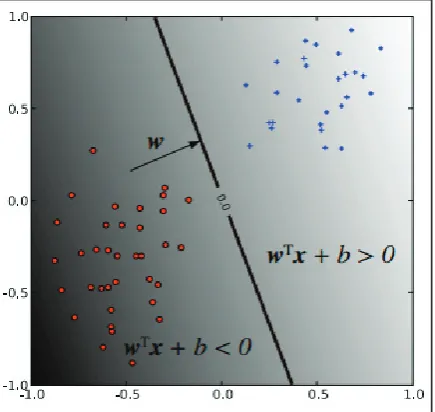
Fig. 2: A Linear Classifier the Decision Boundary (Point x such
that wtx + b = 0) divides the plane into two sets depending on
the sign of wtx + b.
PyML is just one of countless multimedia packages that furnish SVM training methods; an incomplete tabulating of these is endowed in Serving 9.
Linear Classifiers Prop vector mechanisms are an example of a linear two-class classifier. This serving explains what that means. The data for a two class discovering setback consists of objects labeled alongside one of two labels corresponding to the two classes; for ease we accept the labels are +1 (positive examples) or 1 (negative examples). In what follows boldface x denotes a vector alongside constituents xi . The notation xi will denote the ith vector in a dataset f(xi,yi )g n i=1 , whereas y i is the label associated alongside xi . The objects xiare shouted outlines or examples. We accept the examples fit in to a little set X. Primarily we accept the examples are vectors, but after we familiarize kernels this assumption will be relaxed, at that point they might be each continuous/discrete object (e.g. a protein/DNA sequence or protein structure). A key believed needed for delineating a linear classifier is the spot product amid two vectors, additionally denoted to as an inner product or scalar product, defined as wtx = ∑w x. A linear
classifier is based on a linear discriminant function of the form f(x) = wtx + b
he vector w is known as the weight vector, and b is called the bias. Consider the case b = 0 First. The set of points x such that wtx
= 0 are all points that are perpendicular to w and go through the origin a line in two dimensions, a plane in three dimensions, and more generally, a hyperplane. The bias b translates the hyperplane away from the origin. The hyperplane
{x: f(x) = wtx + b = 0 }
divides the space into two: the signal of the discriminant purpose f (x) denotes the side of the hyperplane a point is on (see 1). The frontier amid spans categorized as affirmative and negative 2is shouted the decision frontier of the classifier. The decision frontier described by a hyperplane is said to be linear because it is linear in the input examples (c.f. Equation 1). A classifier alongside a linear decision frontier is shouted a linear classifier. Conversely, after the decision frontier of a classifier depends on the data in a non-linear method (see Figure 4 for example) the classifier is said to be non-linear.
L-2 norm for Marching
In the proposed methodology for CBIR, the L1-norm and the L2-norm are used [14]. L1-norm is also known as least absolute deviations (LAD) or least absolute errors (LAE). It is basically minimizing the sum of the absolute differences (S) between the target value (Yi) and the estimated values (f(xi)):
L2-norm is also known as least squares. It is basically minimizing the sum of the square of the differences (S) between the target value (Yi) and the estimated values (f(xi):
L1-norm and L2 norms are utilized for analogy of removed feature of IFAD dataset and query feature set. The contrasted features are sorted. The distance amid query features and IFAD dataset features are computed for period estimation.
VI. Results and Analysis
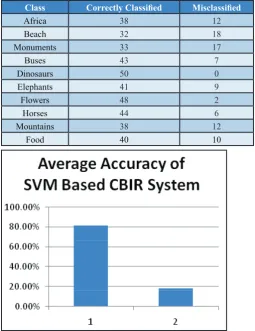
Fig. 3: Bar Graph Showing the Overall Accuracy Per Class of the Dataset
Fig. 4: Bar Graph Showing Number Of Images Correctly Classified and Incorrectly Classified
Table 3: Number of Images Correctly Classified and Incorrectly Classified
Class Correctly Classified Misclassified
Africa 38 12
Beach 32 18
Monuments 33 17
Buses 43 7
Dinosaurs 50 0
Elephants 41 9
Flowers 48 2
Horses 44 6
Mountains 38 12
Food 40 10
Fig. 5: Average Accuracy of SVM Based CBIR System
To assess the retrieval presentation of the counseled method, the precision-recall graph is shown for the picture span textures from the database. Precision is the fraction of retrieved pictures that are relevant, and recall is the fraction of relevant pictures that are retrieved. Every single span alongside its recognized Gabor, curvelet mixture of Gabor and curvelet alongside fitted polynomial Curvelet and Counseled mixture of Gabor wavelet, Color Moments, Wavelet, Auto Correlogram and HSV Histogram. A example picture from database was utilized as a query, and its precisions were computed at 10 levels of recall percentages. The average precisions for all spans at every single recall level, and for all tested methods are plotted in Fig.. This figure displays that counseled work outperforms the supplementary methods.
Table 3: Average Retrieval Results from Database for Different Methods 10 Levels
No. of
images Proposed System Gabor & CF Curvelet Gabor wavelet Statistical
10 87 85 80 88 83
20 86 80 75 70 75
30 72 75 60 55 60
40 66 65 50 45 43
50 61 60 46 35 32
60 53 50 30 25 22
70 47 45 25 20 18
80 35 30 22 18 17
90 34 20 20 17 13
100 26 17 12 10 8
On an average the retrieval result of the proposed system that is using various collection of featured vector along with that SVM classifier will generate good precision results.
Fig 6: Average retrieval results from database for different
methods
Table 4: Description of all the Methods
Proposed System Fusion of Gabor wavelet, CM,Wavelet,CAC& HSV4 Gabor and Curvelet
Fusion Fusion of Gabor and Curvelet with fitted polynomial Curvelet Only curvelet with fitted polynomial
Gabor wavelet Only Gabor wavelet with fitted polynomial
References
[1] Smeulders, AWM, Marcel Worring, SantiniS, Gupta A, et al.,"Content-based image retrieval at the end of the early years." IEEE Transactions on pattern analysis and machine intelligence 22, No. 12, pp. 1349-1380, 2000.
[2] Lew, M S., Sebe N., Djeraba C., Jain R.,"Content-based multimedia information retrieval: State of the art and challenges," ACM Transactions on Multimedia Computing, Communications, and Applications (TOMM) Vol. 2, No. 1, pp. 1-19, 2006.
[3] Casey, Michael A., Veltkamp R., MasatakaGoto, Marc Leman, Christophe Rhodes, Malcolm Slaney,"Content-based music information retrieval: Current directions and future challenges", Proceedings of the IEEE 96, No. 4, pp. 668-696, 2008.
[4] Bhamare, Devyani P., Swati A. Abhang,"Content Based Image Retrieval: A Review." International Journal of Computer Science and Applications 8, No. 2, 2015.
[5] Thakore, Darshak G., A. I. Trivedi,"Content based image retrieval techniques–Issues, analysis and the state of the art", BVM Engineering College, Gujarat, 2010.
[6] Huang, Zhi-Chun, Patrick PK Chan, Wing WY Ng, Daniel S. Yeung,"Content-based image retrieval using color moment and Gabor texture feature", International Conference on Machine Learning and Cybernetics, IEEE, Vol. 2, 2010, pp. 719-724.
[7] Suhasini, P. S., KrishnaK., Krishna M.,"CBIR USING COLOR HISTOGRAM PROCESSING." Journal of Theoretical & Applied Information Technology, Vol. 6, No. 1, 2009.
[8] Chun, Young Deok, Nam Chul Kim, Ick HoJang, "Content-based image retrieval using multiresolution color and texture features", IEEE Transactions on Multimedia, Vol. 10, No. 6, pp. 1073-1084, 2008.
[9] Chhikara S., Singh P.,"SBHCS: Spike Based Histogram Comparison Steganalysis Technique”, International Journal of Computer Applications, Vol. 75, No. 5, August 2013. [10] Huang, Zhi-Chun, Patrick PK Chan, Wing WY Ng, Daniel S.
Yeung.,"Content-based image retrieval using color moment and Gabor texture feature", International Conference on Machine Learning and Cybernetics, Vol. 2, IEEE, pp. 719-724., 2010.
[11] Sumana, Ishrat Jahan, Md Monirul Islam, Dengsheng Zhang, Guojun Lu,"Content based image retrieval using curvelet transform," In Multimedia Signal Processing, 2008 IEEE 10th Workshop, pp. 11-16. IEEE, 2008.
[12] Jalab, Hamid A.,"Image retrieval system based on color layout descriptor and Gabor filters", In Open Systems (ICOS), 2011 IEEE Conference on, pp. 32-36. IEEE, 2011.
[13] Noble, William S.,"What is a support vector machine?", Nature Biotechnology 24, No. 12, pp. 1565-1567, 2006. [14] Tao, Dacheng, Xiaoou Tang, Xuelong Li, Xindong Wu.
"Asymmetric bagging and random subspace for support vector machines-based relevance feedback in image retrieval", IEEE transactions on pattern analysis and machine intelligence 28, No. 7, pp. 1088-1099, 2006.
[15] Kwak, Nojun,"Principal component analysis based on L1-norm maximization", IEEE transactions on pattern analysis and machine intelligence 30, No. 9, pp. 1672-1680, 2008.