Art Practice as Research: A Global Perspective
Judith A. BriggsIllinois State University Nicole DeLosa
Hornsby Girls’ High School
ABSTRACT
This case study explored how seven New South Wales (NSW) tenth grade students, following their art teacher’s prompts, engaged in art practice as research. They analyzed their creative process, researched artists’ forms and concepts, and conceptualized ideas to make critical interdisciplinary connections. They linked this research to their own knowledge and experiences to create and reflect upon artworks that had personal
meaning and led to personal discoveries. Students used visual arts process diaries as research texts to record and communicate in both written and visual forms, revisit and plan ideas, reflect, and come to new conclusions. Students employed NSW Syllabi language as a metacognitive tool to recognize their approaches to research and art making. Students made metaphorical and symbolic connections, engaged in social critique, asked questions, and told their stories in this learning process.
KEYWORDS: art practice as research; visual arts process diaries; metacognition
AUTHOR NOTE: Nicole DeLosa is now in the Art Department of Pymble Ladies’ College.
This research was supported in part by an Illinois State University Mills Grant. Correspondence concerning this article should be addressed to Judith Briggs, School of Art, Illinois State University, Normal, IL 61790-5620 E-mail: [email protected]
While there is no consensus theorizing art practice, art practice as research (APR) can be a site for knowledge construction and meaning making, situated in global systems, communities, and cultures. These global systems are not homogenous but represent diverse and sometimes conflicting viewpoints that reflect the experiences of people from various regions and backgrounds who have different degrees of access to opportunities and privileges (Manifold, Willis, & Zimmerman, 2016). APR is a form of qualitative research that moves beyond an aim for explanations and leads to interdisciplinary, in-between spaces of diverse ways of knowing that challenge, illuminate, and pose further questions (Rolling, 2013; Siegesmund, 1998; Sullivan, 2010). APR involves documentation, analysis,
14 weeks of student research, reflection, and art making around a concept of their choice. The study examined the students’ engagement with the following characteristics of APR: research, documentation, interdisciplinarity, analysis, conceptual reflection, metacognition, and learning gained from student art making, research, and reflection. New South Wales Syllabi: A System for Art Practice as Research
NSW visual arts educators create curriculum, teach, and assess according to a system outlined by the NSW Visual Arts Syllabi that is meant to facilitate interdisciplinary conceptual investigation, contextual understanding, reflection, and dialogue within an APR process. The following section outlines the theoretical framework that is the basis of NSW objectives (standards) and outcomes, course sequences, expectations, the required visual art process journal, and the twelfth-grade body of work and final exam.
The Syllabi Years 7-10 and Years 11-12 provide its visual arts educators with a theoretical framework for investigating artists’ practice using philosophical beliefs and reflexive commentary that exist within an artworld context. This framework, called the frames, employs different theoretical lenses – subjective (investigates emotion, intuition, and imagination), structural (uses semiotics, formalist aesthetics, and material practice as interpretive lenses), cultural (analyzes politics, ideology, race, socioeconomics, gender, and power relations) and postmodern (uses recontextualization, irony, and appropriation to disrupt existing structures) – to act as metacognitive vehicles for artwork creation, analysis, and interpretation. NSW visual arts educators use the frames to ask questions about artwork, and students use the frames as a common language for interpreting different positions taken when viewing or making artwork. The frames are not intended to be exhaustive nor final, but rather are redefined and unfold over time (NSW Education Standards Authority, 2003). The Syllabi’s conceptual framework – the artwork, the artist, the world, and the audience – guides this investigation to illuminate artworld relationships. Educators and students also investigate artists’ practice as part of Syllabi requirements (Brown, 1992, 2015; NSW Education Standards Authority, 2016). Syllabi objectives (standards), outcomes, and assessments ask that students make and interpret artwork and artist practice using the language of the frames and the conceptual framework (NSW Education Standards Authority, 2003). Students are required to record investigations in visual arts process diaries (VAPDs), using both images and reflective text, that serve to communicate their intentions to their teachers and peers (NSW Education Standards Authority, 2003). Visual journals as a part of art practice as research combine images with text to “make sense of ideas and takes in the perspectives of others that provide a structure for
reference and review (Sullivan, 2010). APR results in products that interpret the human condition (Rolling, 2010, 2013). APR in schools stresses conceptual skills, is student motivated and teacher guided, uses student artwork as a basis of learning, explores interdisciplinary concepts through question creation and written reflection, and promotes metacognition (Marshall & D’Adamo, 2011).
Art educator Julia Marshall and U.S. high school teacher Kimberley D’Adamo (2011) have directed International Baccalaureatepractice to reflect APR within required research workbooks and finished work. Their system asks students to “describe, analyze, reflect, and connect” as they research artists’ and their own ideas (p. 15). With this model, which promotes metacognition, D’Adamo and Marshall found that students came to see themselves as motivated, self-directed artist researchers who made discoveries and connections to other disciplines that went beyond their expectations. Their study focused on one student, Claire, who linked the concept of the grid to both portraiture and textiles, particularly quilts, through annotated images and extensive text within her research workbook. Claire’s research culminated in paintings that referenced Chuck Close, Rene Magritte, and Japanese quilts, and questioned how we come to know art history. D’Adamo and Marshall’s APR format is similar to the APR format of the state of New South Wales (NSW), Australia APR in that it guides students in their research and provides tools for analysis and reflection.
The U.S. two-year International Baccalaureate® (IB) Diploma Program in the Visual Arts in which students conduct research around a central idea and create an externally assessed body of artwork and research workbook is an APR model used in some U.S. schools. Schools pay a fee to participate in the IB system (International Baccalaureate, 2016). It is somewhat comparable to Marshall’s and D’Adamo’s program for art education, but is not directly intentional with its models for research skill development (Marshall, 2015). The NSW APR model, likewise, is similar to the IB global model of art education, but is a state-sponsored program. It offers guidance to students in developing their research practice through an understanding of theoretical underpinnings using constructs called the frames and conceptual frameworks. Both Marshall and D’Adamo and NSW visual arts educators have built upon a global model of art education to inform teaching and students’ APR.
While forms of APR occur within global settings (Leavy, 2009; Marshall, 2015; Marshall & D’Adamo, 2011), this case study
number of schools, including some with majority low socioeconomic levels (Diane, personal communication, July 16, 2015).
This single case study’s research question asked, “How did tenth grade New South Wales (NSW), Australian students choose to interpret a NSW APR model to create, reflect upon, and speak about their artwork?”
Diane shared and explained curriculum materials for the 14-week unit, “A Mini Body of Work,” that incorporated two different media, student research, reflection, and artmaking around a concept of their choice. Seven of the 14 students in the class assented to allow me to photograph their VAPDs, their artwork, and their artist statements, and interview them over a week-long period in the school art rooms to discern how their art making reflected and interpreted the APR process. I asked the following questions:
· How did you devise ideas for making your mini body of work?
· How did the work change and evolve while you made it? · How did you relate your work to what you were studying? · How did you use the frames and the conceptual framework
in the art making process?
When analyzing student VAPDs documentation, finished work, artist statements, and interviews, I used categorical aggregation to note the following characteristics of APR: research, documentation, interdisciplinarity, analyses, conceptual reflection, metacognition, and learning gained from student art making, research, and reflection (Creswell, 1994).
As a U.S. educator who trained future U.S. art educators, I wanted to know how NSW high school students responded to the APR model to create, record, and reflect upon meaningful artwork. I was interested in copying the techniques of the NSW visual arts educator and her students in my own U.S. university art education classroom. I wanted to train future U.S. art educators to present art practice as a form research.
Task Structure for the Tenth-Grade Mini Body of Work Diane recognized that students needed to organize their learning process and research, and thus structured four scaffolded learning tasks that linked material and conceptual practices with student interests and choice. Using Hausman’s (1976) idea of creative variance, Diane asked that students’ mini bodies of work consist of two art forms, one chosen by Diane and the other chosen by the student.
and concepts” while making them visible to others (Scott Shields, 2016, p. 13).
In NSW, visual arts is mandatory in grades seven and eight, and elective in grades nine and ten. Students in grades eleven and twelve elect to take a two-year Visual Arts Higher School Certificate (HSC), sit for a state-wide written exam, and produce a body of work that is assessed by state-selected master visual arts educators (NSW Education Standards Authority, 2016). The Syllabi mandate that students in grades seven and eight spend 30% of their time engaged in teacher-developed and directed study of art history/contemporary art and art criticism. This percentage increases to 40% in grades nine and ten and culminates in 50% study in grades eleven and twelve (NSW Education Standards Authority, 2003). This mandate sets the stage for research, documentation, interdisciplinarity, analysis, dialogue, learning, and reflection. Although visual arts teaching may be more directive in grades seven and eight, the Syllabi ask that students move towards greater autonomy in later years. The visual arts educator’s knowledge and ability to engage students with the artworld and the world is crucial to the students’ development as artists (Thomas, 2015).
The tenth-grade students of this study were about to make the decision to take the two-year HSC course that spanned the eleventh and twelfth grades. The HSC course would entail engagement with five artist case studies and an entire year of research, reflection, and extended artmaking that included the development of several artworks beginning in the fourth term of the eleventh grade. The following study outlined how the visual art teacher used the “Mini Body of Work” assignment to give her students a small sampling of the processes involved within the HSC. The visual art teacher self-named the project “Mini Body of Work” because, unlike the HSC body of work, which would take the equivalent of one school year to develop, this assignment would only encompass 14 weeks or a little over a quarter of one school year. The assignment would result in the development of a smaller number of artworks that incorporated two different media.
Methodology
and sensitivity in making and resolving a selection of works using a variety of media and techniques.
· Demonstrate a degree of autonomy in creating interesting solutions to artmaking problems with a range of forms, thus making mostly informed choices about their artwork. · Present an accomplished application of conceptual
knowl-edge and understanding of medium as communicated via the artist statement.1
While Diane valued technical skills in her students’ work, through class interaction and curriculum documents she stressed to the students that research, the creative process, artistic thinking, and creation of concept were the final goals of their art classroom endeavors – all of which are factors found in APR (Marshall &
D’Adamo, 2011). I did not have access to Diane’s student assessments. Diane displayed final student work and statements for other students and educators to see.
APR in Students’ Work
The following sections provide narratives of each student’s APR practice. Within each narrative I will illustrate instances of students’ research, documentation, interdisciplinarity, analyses, conceptual reflection, metacognition, and learning gained from student art making, research, and reflection. This evidence manifested in an amalgam of diverse forms: in annotations and images within student VAPDs, interviews, artist statements, and student artwork. All these forms are essential to APR, which relies upon documentation, analyses, conceptualization, dialogue, and reflection (Sullivan, 2010). Sue
Sue’s art forms combined photography and design. After listening to the TED talks on creativity Sue wrote, “When stuck or out of ideas, immerse yourself in the work of others or simply play with materials, instead of doing nothing” (Sue, student journal entry, 2015). In her interview, she revealed that she spent time researching blogs, the Internet, and Pinterest sites for examples of graphic design and photography. She then filled a diary page with stream of consciousness notes concerning pressures and responsibilities before highlighting the words “memories and childhood” and “pressure” to begin her conceptual reflection. Sue’s VAPD contained a mind map of associative words, annotations, and images of artists’ work relating to memories and childhood (see Figure 1). She analyzed the compositions of several cutouts of advertisements for form and meaning, pointing out things like color repetition, division of space, 1 The rubrics contained levels that ranged from creating simple to out-standing work and writing.
In Task One, Diane asked students to consider ideas for themes, concepts, and art forms by reviewing and recording in their VAPDs previous Higher School Certificate student artwork and artist
statements that could be found on the Artexpress website. Artexpress is a national, yearly state-sponsored exhibition of top scoring student HSC bodies of work. Diane asked students to identify two ideas they were interested in pursuing and to collect and annotate images of artists’ work and concepts that interested them. Students researched and cited two artists’ work and put them into context; they provided artists’ and critics’ quotes and defined artists’ conceptual and material practices. Diane provided a Pinterest Board that contained thousands of contemporary artists’ works as potential inspiration should students need them.
In Task Two, students listened to three TED talks about creativity and reflected in writing on their own creative inspiration. In Task Three, Diane modelled research methods by creating three artist case studies revolving around the work of Lindy Lee, Chris Jordan, and Simone Bianchi, contemporary artists whose experiences and/or art forms she thought would resonate with her students. The case study handouts included artists’ and critics’ statements, contextual information, and images and citations. Students highlighted the words and phrases that they found pertinent within the material during class discussion. The students wrote summaries of the information to analyze and explain how the artists’ art forms were informed by content that related to the artists’ personal experiences. Diane’s handouts used the Syllabi language of the frames and the conceptual framework as well as artist practice.
Task Four asked students to build upon the previous artist research and case study tasks, along with their knowledge of their own creative process, to develop and communicate ideas for their mini bodies of work, using both text and images, within their VAPDs. Students then experimented, recorded their processes, created artwork, wrote artist statements, and completed an end of unit essay that asked them to compare the art practices of the units’ artists including their own that they used within their mini body of work. Using Years 7-10 Syllabus Outcomes as a guide, Diane assessed students on their diary research, their final works, and a written essay that compared the works of several artists with their own (NSW Education Standards Authority, 2003). Diane’s rubrics for an above average artwork asked that students do the following things:
· Create accomplished artworks with very good understanding of how the frames can be implemented to represent concepts and ideas’ meanings.
Figure 2. Sue’s VAPD Advertisement Notations. Photo: Judith Briggs type size, and style. She connected this analysis to possible audience
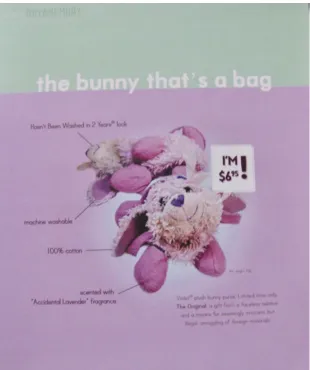
associations and metaphors by noting proximity of faces with products and faded images with memories. She wrote in her VAPD that a uniformity of poster size would metaphorically represent mass production. Her VAPD contained several annotated sketches of objects that she could use in her ads and the personal connotations they had (see Figure 2). Her visual journal contained a documentation of her thinking that became a creative form of self-study. She turned her ideas into three carefully planned and printed advertisements of childhood objects, complete with prices and notations about their origins and meanings (see Figure 3).
When asked about the ideas behind her work she stated that personal experiences were her impetus. She said, “I think that this one is about memories and how easily they’re being commodified in the modern day …how your memories can be easily boxed and sold like a commercial product” (Sue, personal communication, July 21, 2015). Although she stated that a specific artist did not influence her, she noted in her VAPD the ads that influenced her aesthetic. Her work evolved through an accident when her USB broke and her original plan to print images of photographs and graphics and stitch them together was no longer possible. She decided to retake images and then merge them with text as a graphic design piece.
When asked which frames or lenses for viewing influenced her, Sue replied:
For the frames, the structural frame. I looked at a lot of
advertisements and how they were laid out. So, I incorporated the formatting and the fonts into my photo media part, and in terms of subjective [frame], it was also largely subjective because I was using personal objects and memories from my own childhood and turning them into those advertisements. (Sue, student journal entry, 2015) She made notes in her VAPD about the effects of compositions, the meanings of symbols, and her personal connections with objects. She linked the conceptual framework (artist, artwork, world, audience) to the commercialized world where “Everything is being sold and bought nowadays. Instead of people looking at the real value of things, they are only valued for their prices like material value” (Sue, student journal entry, 2015.; see Figure 3).
Sue said that she liked “turning your concepts into something that you can show other people” (Sue, personal communication, July 21, 2015). Her ability to identify the frames that she used to develop her work led me to believe that she was cognizant of her self- reflective process, was aware of her audience, made metaphorical connections, and could communicate this. Her inquiry spawned revelations as she wrote that memories can be deceptive and that we can come to question them. Sue’s conclusions about her changing memories as well as her need to change course due to a USB malfunction illustrate how APR is not meant to generate firm answers and reflects the changing nature of the creative act (Sullivan, 2010).
Kim
through the use of unusual forms and painter William Robinson’s portrayal of clouds. Kim searched the words “art and clouds” and found paper-cutting artist called Nahoko Kojima who created large-scale sculptures of animals. Kim related her artwork’s concept to her experience of being in a plane landing in Shanghai with an oncoming typhoon. The contrast of black clouds with the sunset below was startling, and she felt like she was being swallowed by the blackness that was eating up the clouds. She described that it was like “being swallowed up I guess by this animal. When our plane was descending through the cloud, it was quite an amazing experience” (Kim, personal communication, July 16, 2015). She made a video and hanging paper cut sculpture of a white bird with a black tiger behind it, ready to pounce, representing clouds as animals with temperaments.
Kim wrote in her artist statement that she looked at BBC animal documentaries to create three different stop-motion videos that used her hand-drawn sky drawings to illustrate the changing sky as related to animal predatory behavior. She stated that she used sticky notes for the drawings to illustrate the inner child’s range of daily emotions. She emulated an incoming storm’s sounds by rubbing hands, clicking fingers, patting the lap, and jumping to imitate thunder’s roar. Through her research, Kim made obvious interdisciplinary connections to analyze animals’ movements and metaphorically associate them with movements of clouds.
Kim stated that her art making process was a transformative experience as it evolved over time, and she made connections with her subject matter and her life. “I think in high school learning about the artist and the way they think, it really influences I guess how I look at the world as well, how I interpret things as well as how I think” (Kim, personal communication, July 16, 2015). Her VAPD revealed more than twenty pages of detailed notes and images that investigated forms, stated problems, possible solutions, and emotional reactions to artwork, revealing layers of thinking that went into the final product (see Figures 4, 5, & 6). According to Scott Shields (2016), visual journals can provide daily records to be revisited to reveal layers of thinking within the creative process. Kim was cognizant of her processes and of her intentions and made new metaphorical and interdisciplinary connections. As the artist, she said that she wanted to convey her experience in the world and have “audiences think about childhood memories” (Kim, personal communication, July 16, 2015). Engaging in APR, she incorporated poetic non-verbal ways of interpreting a subject that involved “ambiguity, complexity, emotion, intuition, lived experience, and the celebration of personal interpretation of subjectivity” (Marshall & D’Adamo, 2011, p. 12).
an art form using a medium (see Figures 4 & 5). She originally wanted to explore how the city encroached on nature, but Diane’s handout that correlated the frames (subjective, structural, cultural, and postmodern) with influences on artmaking made her realize that her subjective experiences in imagining her artwork were the strongest.
We were given a statement of intent, like a scaffold as well as asking us cultural influences, postmodern, and subjective and sculptural frames, all the frames that can shape our idea, and my idea was about the transient nature of the sky and the clouds, and, I guess, giving a life to the clouds, comparing them with animals, I guess…the metaphor of an animal, of the clouds as an animal and how different types of weather changes the attitude. So you have like today the bad weather, you have the thunder, you have the lightening so like anger in the animal that’s eating kind of the sky up. (Kim, personal communication, July 16, 2015)
Kim revealed that she gazed into the sky when she walked home and noted how the clouds created shapes and shadows and made conceptual connections with other personal experiences.
When asked how she used the frames in her artmaking process Kim provided a lengthy, well-reasoned self-reflection, a portion of which is provided below:
Structurally, I wanted in my initial idea to contrast the skyscrapers…. Your lines, your horizontal, your vertical emphasis contrasting to the to the clouds, which are so free flowing, but because the idea was very complicated to do in such a short period I stuck with the idea of just the free-flowing clouds, and then I chose to do black and white instead of incorporating color to emphasize the simplicity of it, yet also the complexity in the image itself. Subjective is very subjective for me because it was based on personal experiences. It was emotions as well…. emotions at the time of I guess stress as well of how you’re encompassed by this blackness when you’re stressed. Culturally wasn’t that strong, I guess. Postmodern… this appropriation of this idea of naturally occurring [scientific] thing [water molecules in the sky] with something that is very much in the fantasy, kind of like combining realistic and unrealistic. (Kim, student journal entry, 2015)
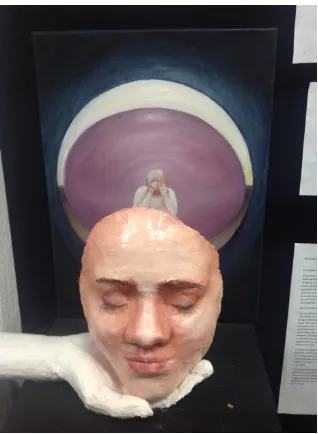
communication, July 16, 2015). Purposefully hidden behind the mask was a painting of a hermaphrodite whose hands were covering their eyes, distorted within a fisheye lens (see Figures 7 & 8). Carol wrote in her artist statement that binary definitions are restricting and can cause a loss of self. She stated, “The work is about the confusion that being born into an era of mass consumerism and unified ideals of beauty can instill” (Carol, personal communication, July 16, 2015). Carol found that Diane’s resources helped her to “see how different artists conveyed their ideas.” She stressed, “The concepts that you want to convey have to be reflected by the materials choice” (Carol, personal communication, July 16, 2015). Through her analysis, she determined that the connotations of a cast mask would create deeper meaning than a carved one. Although Carol did not link a frame with her artmaking, she was metacognitively aware that artists’ practices went beyond personal expression and proposed broader ideas to a wider audience. She stated:
The fact that you have to go through all of this conceptual work really brings out the fun in artmaking. You have three days of conceptual thinking about all of these different artists and their practices and then when you actually get to do it it’s so much better. (Carol, personal communication, July 16, 2015).
Carol knew that knowledge gained from research would help deepen her thinking. APR is less about creating aesthetic products and more about exploring an idea and responding intellectually and emotionally to it, and Carol’s statements were evidence of this (Marshall & D’Adamo, 2011).
Figure 7. Carol’s mask and painting. Photo: Judith Briggs Figure 6. Kim’s Artwork. Photo: Judith Briggs
Carol
I did not have access to Carol’s VAPD, but gained data through an interview, her artwork, and artist statement. Carol’s chosen art forms were sculpture and painting. Through her research, she discovered the work of Ron Mueck and was impressed with his outsized sculptures of awkward human bodies. She stated that she wanted to explore how Mueck created his work, which led her to investigate the concept of people struggling to find their identity, “to explore the human condition…You know you’re born with one body, and you have to be restricted to one gender. There are so many barriers in society that don’t allow you to be who you are” (Carol, personal communication, July 16, 2015). She said in the interview that there are people who question their sexuality and “the fact that they can’t explore is something that needs to be projected to an audience” (Carol, personal communication, July 16, 2015).
“meeting the fluidity of who you are.”
Karen explored the art forms of printmaking (see Figure 9) and graphic design, and after researching artists’ works, became intrigued by a book on Pinterest that one could view at 360 degrees. Karen adapted the form to her own work whose central idea was “the shortness of our lives.” She revealed in interview that she didn’t usually “think of weird things like that, but I took the cause” (Karen, personal communication, July 16, 2016). Her research and brainstorming had enabled her to explore new concepts, a characteristic of APR (Marshall & D’Adamo, 2011). Within her VAPD Karen outlined her art making process:
1. Gather inspiration. Create concept of idea 2. Sketch out the base
3. Employ chosen media wood carving 4. Test Inking
5. Adjust as needed 6. Final ink roll and press
Karen combined this process with graphic design by printing a single image of a Greek sphinx and using digital media to replicate it on a black background. She acknowledged that she used the postmodern and cultural frames to recontextualize the riddle “man lives and dies once a day” into a contemporary digital format. After trial and error, she printed several pages and assembled them into a book of sphinx images that opened 360 degrees, ringed by a circle of human figures of varying sizes interacting with each other. She stitched the book together with red string to represent peoples’ ties to each other (see Figure 10). Within her artist statement Karen wrote:
My work is the insignificance of our relations when compared to in the eyes of greater beings, and in its early stages of conceptual practice, was inspired by the cartoon-like featureless and child-like figures of Kathy Temin’s work Troubled Times. Her ability to visually depict uneasy moments in life was a great inspiration to this piece, with this idea of an unidentifiable person having their personal problems downplayed and dismissed is echoed in my theme... Sometimes I find myself wondering whether I will completely lose ties with people I don’t contact anymore, and this artwork means to me to hold onto your friends and family tightly and live up to every second with them since at the end of the day, they are your story and your ties. (Karen, student journal entry, 2015)
Figure 8. Carol’s painting. Photo: Judith Briggs Karen
Figure 9. A Page from Karen’s VAPD. Photo: Judith Briggs Karen further metaphorically connected her images with concept as
she made the figures grow and decrease according to the number of times they were attached to or isolated from each other. She wrote that the sphinx’s eye was constantly blinking, “embodying the phrase ‘in the blink of an eye,’” referring to the tenuousness of life (Karen, student journal entry, 2015).
Karen was aware of her approach to her artwork and artistic process. When asked about her use of the frames to plan her work, Karen replied:
I felt like I used a lot more of the postmodern framework and the cultural framework in my work than most traditional works because in the postmodern frame I have included
recontextualization, like you know the riddle and everything, and also the use of new media, which is, you know, digital manipulation, as well as unique questioning of how a book is meant to be formed. Like most books are meant to just open in a 180-degree angle, but in my work I chose to have it like in a 360 degree so it can’t be opened, can’t be closed. So I thought that it was very interesting to reflect that life goes around in circles, I guess. (Karen, personal communication, July 16, 2015)
and asked beside the sketches “Are these women powerful? Must we substitute physical power for social power? Why is the woman nude more prevalent in art history and accepted?” (Andrea, student journal entry, 2015). Andrea’s work generated more questions rather than answers, a characteristic of APR (Sullivan, 2010). Andrea documented and analyzed in what position to present her ceramic women to convey a sense of both strength and sexuality. Besides researching and reviewing Jennie Saville’s work, Andrea also linked her ideas with ancient fertility goddesses, Cut Piece by Yoko Ono, and Julie Rrap’s photography, performance, and sculpture of female bodies. Andrea said, “It was kind of showing how women are bound to this image that society has given her, and then in our English curriculum, because we kind of cross over sometimes, we always look at representations of women in our text” (Andrea, personal communication, July 16, 2015). Andrea talked about the objectification of women shown in sexual positions. She made three small ceramic figurines of women in reclining sexual poses and put clearance price tags on them (see Figure 11). She linked her ceramic figures to historical artifacts that were sold off in art auction houses for purposes other than those for which they were made, and, although she didn’t link her work to the frames, she stated that she was really conscious about the idea of the world and wondered how different audiences would view her work.
When asked about her use of the frames, Andrea replied: Well, you don’t really think about the frames…. it’s kind of in your background. I think it’s more ingrained in our minds since Year 7 to think in this way, so structurally this would show this. So, women being in sexual positions was meant to show the literal objectification of them…and it wasn’t a conscious decision, it was more subconscious decisions. And then afterwards when you looked at it when you had to write your artist statement about it you’re like ‘Oh, from this frame I could see it that way’ and that kind of stuff. Conceptually, I was actually really conscious about the idea of the world and the different [historical] times. (Andrea, personal communication, July 16, 2015)
Andrea was more cognizant of using the conceptual framework (artist, artwork, world, and audience) while developing her artwork and concept. She was still aware of the concepts she was presenting and why she was presenting them.
Andrea’s second art form was graphics. Her images changed as she taught herself how to digitally draw. She created a poster advertising Figure 10. Karen’s Artwork. Photo: Judith Briggs
Andrea
Andrea stated that she was a strong feminist, having been influenced by her older sister. Andrea chose the art forms ceramics and graphics and had not worked in those media before. She said that she saw this as a chance to connect ideas from various disciplines and form her own questions. Andrea stated:
I really liked that kind of concept of women, how they saw themselves and how [they had] the need to get rid of all this fat and all this heavy baggage…I saw a lot of paintings which were these nude portraits of a really obese lady, and I really liked fat ripples… and looking at the portrayal of these fat ripples and how those fat ripples kind of define the woman. And it was actually quite beautiful, at the same time quite disgusting because you’re not supposed to be that fat as a healthy human being. So it was kind of this contradicting idea of whether fat is beauty and should we accept that or should we accept the normal body, but what is the normal body? (Andrea, personal communication, July 16, 2015)
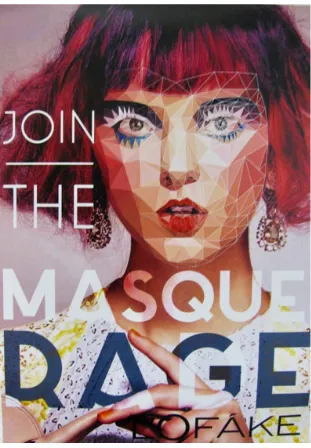
Figure 12. Andrea’s Poster 1. Photo: Judith Briggs “Fat Stripper New Formula Naturopathetic: Ever Wish You Could
Just Take It Off?” that included an image of a woman seen from the rear, stripping her flesh away from the waist to the shoulders, revealing a skeleton underneath (see Figure 12). A second poster included a Photoshopped model’s face, broken into faces, overlaid by the text “Join the Masque Rage of Face” (see Figure 13). Andrea used APR as a way to visually manifest her own investigation of women’s body image and to metaphorically develop her own social critique and ask more questions. According to Leavy (2009), “the power of the image and its role in society cannot be underestimated” (p. 215).
Disney. She was interested in artists who appropriated and critiqued popular culture. She researched a Los Angeles artist who designed and made mermaid tails, an Australian underwater photographer, photographer David Parise who placed Ken and Barbie dolls into cheeky scenarios, and photographer Dina Goldstein’s dark and distressed Disney princes and princesses. Goldstein’s idea of remaking the Disney fairytales inspired Lydia to create her own social commentary.
When I came up with the idea of making a tail and having a mermaid under water I also wanted to make it a bit different, not just the tail, make it sort of out of rubbish as well, because I thought it would be an interesting metaphor for the destruction of marine life at the moment with pollution. So the meaning was sort of on two levels, one the destruction of marine life, and, two, the destruction of sort of believing in things such as mermaids that comes when growing up. (Lydia, personal communication, July 16, 2015) Like Goldstein, Lydia had linked her mermaid with personal and social concerns, making interdisciplinary connections in the art making process, an aspect of APR (Marshall & D’Adamo, 2011). Lydia had worked collaboratively with another student who also engaged in underwater photography. She mentioned that her art making practice was full of trial and error that also helped her to deepen her thought process. She first had to learn how to sew, then had difficulty sewing the fabric. She did extensive research on materials to find one that was suitably waterproof and cheap enough to use. During filming, the rubbish that she had attached to the fabric became unglued and floated around the swimming pool. Lydia decided that this mistake added to the end effect. She analyzed her artmaking process in the following manner (see Figure 14):
Well, the original idea obviously came from the mermaids because I always liked that concept, but the deeper concept was created as I made it through the process. I had a base idea, but it was really simplistic. And slowly, as I started making the tail and sewing, I sort of thought more about it, and I guess that helped in the progression of its concept. It was sort of a step-by-step thing, and it changed over the course of the project. (Lydia, personal communication, July 16, 2015)
Previous classwork with performance art and installation and her interest in video influenced her ideas. She did not connect Figure 13. Andrea’s Poster 2. Photo: Judith Briggs
Lydia
Tina
Tina stated that she investigated universal themes of spirituality, life, and death in relation to her family. An elder member had fallen ill and had passed away. She stated that she used her work to compare her Chinese family’s Buddhist and Christian views of mortality through the lens of the cultural frame, and used the structural, subjective and postmodern frames to create video and soundscapes that transformed ideas of familiar objects into objects of reflection and remembrance. When asked about her use of the frames, Tina replied:
But for the frames…cultural was mainly myself, my heritage as an immigrant from Hong Kong and China. That’s where I come from, family background and that is a very traditional religion like Buddhist, and so there’s a lot of things with that religion. And then my family, we’re Christian, and so that has elements, and they kind of clash in terms of the ideas of life and death. Also we’ve got the media and our current perception of life and death. As a teenager you’ve got all these different things, so that was my cultural influence. (Tina, personal communication, July 16, 2015)
In further conversation Tina connected the structural frame with symbolic motifs and images that she used – swings, bicycles, and wheelchairs – that represented people she knew. She said that she picked these everyday objects because they would be easier for the audience to relate to; they may have seen or connected to these things before. Tina stated, “My whole theme was life and death, so that was my subjective [frame].” She reasoned that her artistic process fit with the postmodern frame. She explained,, “I did use some of the traditional techniques, like maybe fire, but it’s not really used in traditional painting or anything; my whole process was postmodern.” (Tina, personal communication, July 16, 2015)
Mircea Cantor’s and Cai Guo-Oiang’s use of gunpowder and fire, along with Bill Viola’s videos, as evidenced through her VAPD research documentation, inspired Tina to nail contours of a wheelchair, a chair, and a bicycle to pieces of board, connect them with waxed string, and set them on fire while recording the process. She wrote in her artist statement:
Fire is a universal symbol of life and death, beautiful and bright yet transitory and destructive. The flames in the smaller pictures became a metaphor for life and death. In the work, each image was created with one long string of wax dipped twine, symbolic of a her explanations to the frames or the conceptual framework,
but explained that her study of art and art history helped her to understand the world. She stated, “I like how art and art history sort of work together in that sense if it’s documenting everything that
Discussion
I conducted seven interviews, reviewed seven artists’ statements and artwork, and five VAPDs, to discern “How do tenth grade New South Wales (NSW), Australian students choose to interpret a NSW APR model to create, reflect upon, and speak about their artwork?” Within the data I noted the following characteristics of the students’ use of APR: research, conceptual reflection, interdisciplinarity, new knowledge gained from student art making, research, and reflection, documentation, metacognition, and analysis.
Research, Conceptual Reflection, and Interdisciplinarity
The students began their APR by following Diane’s tasks to analyze their own creative process, research artistic forms and artists’ work and ideas, and brainstorm concepts through which they could explore subject matter. This subject matter included interdisciplinary connections to consumerism, animal behavior and mythology, hermaphroditism and body image, ancient riddles and relationships, feminist critique of body image, environmental concerns, and memory and spirituality. VAPDs revealed page-long illustrated research and explanations of graphic design, video, sculpture, printmaking, and photomedia. Students cut out images of Higher School Certificate and artists’ work and analyzed their forms and meanings in notes beside it. For example, in Figure 8 Karen wrote beside a landscape image of vibrantly red earth and trees, backed by a yellow sky layered with white clouds:
This work is made by Isela Leal and was created through woodcut printing. Her colour palette is muted and earthy, reflecting her work as a landscape artist. The horizontal colour distinction between the off-white and the ruddy red is the defining line of the horizon, bringing a calm and undisturbed atmosphere to the work. (Karen, student journal entry, 2015)
Ultimately, Karen’s analysis of formal qualities’ creation of concept would reveal itself in her three-dimensional book of figures. Karen’s artist statement noted that she was influenced by the cartoon-like, featureless, and childlike figures of Kathy Temin; Karen’s circle of figures of various sizes implied the insignificance of relationships during life’s travels.
New Knowledge
Students made connections that led to the conceptual and metaphorical exploration that conveyed powerful meanings and person’s lifespan. (Tina, student journal entry, 2015)
Tina accompanied the finished piece with a soundscape of a family outing (see Figure 15). According to Tina, “It was a lot of trialing, and, you know, I did one and then made a new one, and then until I got one that worked” (Tina, personal communication, July 16, 2015). The testing, including an analysis of her artmaking process of making the material form, matches the concept that she had envisioned.
Tina shared with me that every artist she had researched had a complex view of life and death, religion, and personal values, like her own. She felt that she needed to create a work about the simple and concrete things about life and death and came to the following conclusion:
I was talking about the transient nature of life, removing distractions. We should cherish other people because even though they’re here right now, [I am] pretty sure they won’t be here forever, and we don’t know when they’re going to stay. (Tina, personal communication, July 16, 2015)
Tina said that her family was religious, and she had used her work to sort through her feelings and to connect with an audience who may have gone through the same circumstances. Tina used her APR practice to reflect and to make her own diverse, interdisciplinary, metaphorical connections in order to aesthetically convey conceptual ideas to a wider audience (Marshall, 2015).
and deeply subjective, as was Sue’s graphic connections to childhood memories. In VAPD entries, Sue analyzed print graphics and the symbolic qualities of her own possessions, along with strategies to create posters that questioned commodification and memory. Andrea linked her fertility goddess and graphics to the structural frame, stating that female symbolism was her main concern. She was less conscious of the frames, but used the conceptual framework idea of the audience to guide her thinking about the work. Carol and Lydia, while not mentioning the frames, stated in interviews that they were aware of their thought process when making material choices that affected their work’s content.
Analysis
Within their VAPDs the students analyzed artists’ material choices, compositions, and practices, and linked them with concepts. The case studies and students’ analyses of these artists’ work, as evidenced in their VAPDs, may have planted seeds concerning concepts, but students searched for their own influences to make personal statements. All seven students researched artists and artforms to connect their work to bigger world issues and ideas that they relayed to an audience. Taking in the perspective of others provides a structure for reference and review within the APR process (Sullivan, 2010). Students reflected upon personal experiences to connect with artists’ conceptual and material practices that helped them visualize their own. Students other than Kim did not directly reference the case study artist Lindy Lee, whose work dealt with childhood memories, the Chinese Australian immigrant experience, and the universal connectedness found in Buddhist teachings. Carol, influenced by Ron Mueck’s distorted figures, questioned the social masks that people wear as they deal with gender expectations and social relations. Case study artist Chris Jordan questioned the roles that individuals play as numbers in a consumer society. His 2008 work, Barbie Dolls, may have indirectly inspired Lydia’s deconstruction of Disney and Andrea’s critique of female body image expectations. Students analyzed and reflected upon their material processes – their own and those of other artists – as they tried to make their artistic forms match the content that they had envisioned.
Sue, Kim, and Tina were the only students who referred to the analysis of their own creative process within their artmaking. Sue stated that she delved into more research when creatively stuck, which resulted in collection of graphic images. Kim wanted to give herself permission to make mistakes. Her VAPD images reflected her many attempts to create three-dimensional cloud forms. Tina, who worked with fire, a difficult medium to control, wrote that imperfection inspired her creativity.
asked further questions, such as: Why do we commodify our memories? How can we make audiences think about childhood memories? In what ways do restrictive gender roles diminish self-worth? How do we connect to others? Why is the woman nude more prevalent in art history and accepted? How can we appreciate the transient nature of life? Students subsequently linked this research to their own knowledge and experiences to create and reflect upon artworks that had personal meaning and that led to personal discoveries as referenced above (Sullivan, 2010). Kim, Carol, and Lydia specifically mentioned that studying art helped them think about and know the world in different ways, a result of APR’s transformative capabilities (Sullivan, 2010).
Documentation
The VAPD created a brainstorming and problem-solving space in which students could communicate their ideas to themselves and to others in both written and visual forms. This documentation allowed them to revisit and plan ideas, to reflect, and to come to new conclusions (Scott Shields, 2016). Some students’ VAPDs were more comprehensive than others. APR views art making as research that constructively creates new knowledge as a result of practice, and the students documented in their VAPDs and spoke about the many versions of their work as it made its way to the final product. Using VAPDs in APR fashion, students chronicled their artwork as part of a process that produced a research text, similar to that of Marshall and D’Adamo’s (2011) students. According to Scott Shields (2016), visual journals are a form of creative self-study.
Metacognition
use the frames (subjective, structural, cultural, and postmodern), the conceptual framework (artist, artwork, world, and audience) as metacognitive devices for making and reflection. Within educator-created artist case studies, Diane provided samples of artists’ and critics’ thinking and writing, connected artists’ forms and practice with concepts, and put these into context. Diane used artists’ and critics’ writing and practice as models for students’ subsequent artist research, reflection, art making, and written critical analysis. Students linked this research to their own experiences. She created a rigorous APR model that linked conceptual, material, and personal practice and emphasized metacognition, reflection, interdisciplinarity, and discovery. Students followed this model and made diverse connections through their work to link concept with form, ask questions, and tell their stories, each in a slightly different manner. Students’ work entered into a conversation with their audience and the world. Students employed strategies of thought, lines of inquiry, and critical understanding within their art making, all characteristics of an APR model (Ambrose et al., 2010; Marshall, 2006). By moving beyond a sole focus on a final product or definitive answers, the APR process allowed students to take in perspectives of other makers and thinkers, link to other disciplines, and critically examine beliefs and actions while relating to their own lives and those of others in a substantial way.
Borrowing ideas from Diane, I ask art teacher candidates to research artists, their material practices and concepts, artists’ statements, and critics’ reviews to create artist case studies that explore big ideas and make interdisciplinary connections. Candidates use the frames and the conceptual framework as metacognitive tools to create questions and analyze artists’ work and their own. They document their research in VAPDs, connecting this with their own experiences and insights, to create artwork for the lesson units that they design to begin to guide their own students’ in the APR process within their clinical placements. The use of this NSW APR method in my university classroom is still evolving. The analysis of my former students’ use of this model in their art classroom is another site for further research.
A version of Diane’s structured APR model could result in similar actions in any art education curriculum and could deepen student studio practices by adding research, conceptual reflection, interdisciplinarity, metacognition, analyses, and learning that results from art making, research, and reflection. The students, through their evidence of writing, VAPDs, dialogue, and art making, demonstrated that they meaningfully and reflectively engaged with the APR process to create philosophical dialogues situated in communities and cultures that questioned world views and could globally and humanly connect.
Conclusion
The 10th grade NSW students interpreted a NSW APR model to create, reflect upon, and speak about their artwork in the following ways: (1) Students began the creative process by researching artistic forms, contemporary artists, and NSW students’ HSC artwork, noting processes and ideas in order to reflect upon and subsequently develop concepts for their own work. This subject matter made interdisciplinary connections to issues and philosophical ideas. (2) These connections led to students’ conceptual and metaphorical exploration that conveyed powerful meanings and asked further questions. Students linked their art making research to their own knowledge and experience to make personal discoveries and see the world in new ways. (3) Using annotated images and written reflection, students documented their art making process in VAPDs that were brainstorming and problem-solving spaces acting as points of visual and written communication. Within the VAPDs students revisited and planned ideas, reflected, and came to new conclusions. (4) Students used the frames as metacognitive devices to become aware of the lenses through which they viewed their work. They used the conceptual framework as a reminder of the world’s influences on their artwork and of the audience who would view it. (5) Within teacher case study handouts and their artist research, students analyzed artists’ material choices, compositions, and practices and linked them to concepts. Students analyzed and reflected upon their own material practices and decisions, documenting them in their VAPDs and summarizing them in their artist statements.
It became apparent to me that, using a structured APR model, students linked diverse material and conceptual investigations to convey personal beliefs to an audience, critiquing society’s mores through art making. Students grasped concepts, used their artwork to reflect on their lives and society, explored interdisciplinary ideas ranging from spirituality to ecology, were aware of their processes, and came to new realizations, all attributes of APR. Students learned about artistic processes along the way.
Like art educator Julia Marshall and U.S. high school teacher Kimberley D’Adamo (2011), Diane knew that students needed to be guided through this research process and provided the tools. Within their research workbooks, D’Adamo asked students to DARC: (1) describe artworks, (2) analyze artworks’ meaning, context, and form, (3) reflect upon the artworks’ meanings and connect it to students’ experiences, (4) connect artworks to reveal themes, and connect these themes to students’ artworks.
xxxgirh.schools.nsw.edu.au/documents/16558986/16565065/2015_ annual_report.pdf
NSW Education Standards Authority. (2003). Visual arts Years 7-10 syllabus. Retrieved from http://www.boardofstudies.nsw.edu.au/syllabus_sc/ visual-arts.html
NSW Education Standards Authority. (2016). Visual arts stage 6 syllabus. Retrieved from http://www.boardofstudies.nsw.edu.au/syllabus_hsc/pdf_doc/ visual-arts-st6-syl-amended-2016.pdf
Rolling, J. H. (2010). A paradigm analysis of arts-based research and implications for education. Studies in Art Education, 51(2), 102-114.
Rolling, J. H. (2013). Arts-based research primer. New York, NY: Peter Lang Publisher.
Rrap, J. (2017). Julie Rrap. Retrieved from http://www.julierrap.com/
Saatchi Gallery. (2017). Jenny Saville. Retrieved from http://www.saatchigallery. com/artists/jenny_saville.htm
Scott Shields, S. (2016). How I learned to swim: The visual journal as a companion to creative inquiry. International Journal of Education & the Arts, 17(8). Retrieved from http://www.ijea.org/v17n8/.
Siegesmund, R. (1998). Why do we teach art today? Conceptions of art education and their justification. Studies in Art Education, 39(3), 197-214.
Sullivan, G. (2010). Art practice as research (2nd ed). Los Angeles, CA: Sage.
Thomas, K. (2015). Misrecognized collaboration by students and educators in the creative making of art. In F. Bastos & E. Zimmerman (Eds.), Connecting creative research and practice in art education: Foundations, pedagogies, and contemporary issues (pp. 116122). Alexandria, VA: National Art Education Association.
Viola, B. (2017). Bill Viola. Retrieved from http://www.billviola.com/ References
Ambrose, S., Bridges, M., DiPietro, M., Lovett, M., & Norman, M. (2010). How learning works: 7 research-based principles for smart teaching. San Francisco, CA: Jossey-Bass.
Anna Swartz Gallery. (2017). Kathy Temin. Retrieved from http:// annaschwartzgallery.com/artists/kathy-temin/
Art21. (2005). Cai Guo-Qiang. Retrieved from https://art21.org/artist/cai-guo-qiang/
Artexpress. (2017). Retrieved from http://artexpress.artsunit.nsw.edu.au/
Australian Galleries. (2017). William Robinson. Retrieved from https:// australiangalleries.com.au/artists/william-robinson/
Bianchi, S. (2017). Simone Bianchi. Retrieved from http://www.simonebianchi. com/
Brown, N. C. M. (1992). Art education curriculum praxis: a time for collaboration. In A. Weate & P. McKeon (Eds.), Papers: Occasional seminars in art education 4. Art education curriculum praxis: A time for collaboration (pp. 57-67). Sydney: The University of New South Wales College of Fine Arts School of Art Education.
Brown, N. C. M. (2015). The Frames: The difference between knowing and existence in art education. Paper presented at the Visual Arts and Design Educators Association Conference, University of New South Wales College of Fine Arts, Sydney.
Cantor, M. (Producer). (2012). Sic transit Gloria mundi [Video]. Retrieved from https://www.artsy.net/artwork/mircea-cantor-sic-transit-gloria-mundi-video-still
Colless, E. (2003). The many faces of Lindy Lee. Australian Art Collector, 26, 54-57. Creswell, J. (1994). Research design: Qualitative and quantitative approaches. Thousand
Oaks, CA: SAGE Publications, Inc.
Framebridge. (n.d.). Artist David Parise frames Barbie and Ken [Web log post]. Retrieved from http://blog.framebridge.com/framebridge/artists-story-david-parise
Goldstein, D. (2017). Dina Goldstein. Retrieved from https://www.dinagoldstein. com/
Hausman, C. (1976). Creativity and rationality. In A. Rothenberg & C. Hausman (Eds.), The creativity question (pp. 343-351) Durham, NC: Duke University Press.
Jordan, C. (2017). Chris Jordan photographic arts. Retrieved from http://www. chrisjordan.com/gallery/rtn/#silent-spring
Kojima, N. (2017). Papercut sculpture: Washi. Retrieved from http://www. nahokokojima.com/
Leavy, P. (2009). Method meets art: Arts-based research practice. New York, NY: Guilford Press.
Manifold, M., Willis, S., & Zimmerman, E. (Eds.). Culturally sensitive art education in a global world. Alexandria, VA: National Art Education Association. Marshall, J. (2015). Creativity for understanding: Art-based research in the
classroom. In F. Bastos & E. Zimmerman (Eds.), Connecting creativity research and practice in art education: Foundations, pedagogies, and
contemporary issues (pp. 221-228). Alexandria, VA: National Art Education Association.
Marshall, J., & D’Adamo, K. (2011). Art practice as research in the classroom. Art Education 64(5), 12-18.
MoMA Learning. (n.d.). Cut piece, Yoko Ono. Retrieved from https://www.moma. org/learn/moma_learning/yoko-ono-cut-piece-1964