DIMENSIONS OF TRAINING AND DEVELOPMENT AT SELECT
ORGANIZATIONS OF BANGALORE –A STUDY
Prof Archana.H Asst Professor of Commerce Govt First Grade College – Devenahalli
Abstract:
The research program has carved out three important objectives. First objective was to identify
the factors involved in training programs of sample organizations concerning the sectors
information technology, automobile, pharmaceuticals, banking, and electronics. The second
objective is concerned with identification of employees training and development programs and
the third to analyzing the training and development programs critically and to arrive at
constructive suggestions for the sample organizations.
In this chapter there are three parts. Part –A analyses the general information of the
respondents. Part-B analyses the employee respondents’ data information on the topic training
and development. And part-C analysis the data pertains to top-management and functional
executive respondents of the sample company including hypotheses testing results.
Key words: Training, Organisation, Companies Programs,Samples.
Introduction:
To know the effectiveness of training and development practices in the Indian context, sample
respondents from different spectrum of industries were considered. Accordingly, the
benchmarking of best practices in training and development programs prevailing in
pharmaceuticals, automobile, information technology, electronics and hospitality sectors were
taken into consideration. The well- structured questionnaire and semi-structured interview were
conducted. The respondents are drawn from different levels of management incorporating
executives, employees, top management, supervisors, raters and other HR consultants attached
to the sample firms. 50 Sample respondents were chosen from each firm and thus 250 total
The unanswered, wrongly marked and other response errors were made good by talking to the
respondents personally, through the use of telephonic conversation and online mechanism.
Thus, 250 questionnaires for each respondent have been administered and made to answer in
total.
Sample Units
INFERENCE
The training and development programs ultimately aim at individual employee development
and rewarding the best performances. The need for Individual development is known only when
individual goals are aligned with corporate objectives. Training and development programs
obviously is more pronounced in Information technology sector in view of the fact that the
sector is subject to evolutionary and revolutionary changes, individualistic nature of the job, the
requirement of firm-specific knowledge and skill set, time period within which a project has to
moderately pronounced in health and hospitality industry. In respect of automobile and
electronic firms, the training and development programs is gaining momentum.
Gender of Respondents
SL.No. Gender No. of Respondents Percentage
1 Male 172 68.8
2 Female 78 31.2
Total 250 100
(Source: Primary Data)
ANALYSIS
The total number of respondents considered for the present research programme is 250. Out of
which 68.8 percent are males and 31.2 percent are from female category. The proportion of
male to female category is based on the availability of women employees and executives in the
total workforce strength.
INFERENCE
In so far as the relationship between gender and training and development programs is
concerned, the male employees individual need ascertainment and filling the gap can easily be
achieved rather than female employee need ascertainment and filling up of gap for individual
performance and organizational performance. In the Indian context, on account of culture,
women have to play multiple roles, even if performance deficiencies are identified, the training
for them requires lot of time space which majority of them is unable to comply with.
Further, the difference in the individual development differs from industry to industry. In IT
industry women employees prefer the challenging job and they are ready to undergo training.
This is not so in case of electronic, automobile and banking sector. Whereas in advanced
countries, the study reveals that the women employees are preferred to undergo training and
fulfill their job performance gap irrespective of the nature of industries in which they are
concluded that training and development programs and individual development based on gender
varies from country to country.
Age Group
SL.No. Age group No. of Respondents Percentage
1 18-25 43 17
2 26-35 87 35
3 36-45 75 30
4 46-55 30 12
5 55 Above 15 06
Total 250 100
(Source: Primary Data)
ANALYSIS
It could be observed that the young employees in the sample organizations aged between 18 to
25, 26 to 35 and 36 to 45 are more pronounced. In sample multinational corporations, the
average age of the employees ranges from 25 to 27. These category of employees fall under
demographic dividend of our country. The young professionals in IT, automobile, and banking
sectors are the segments which are shown then growth path, deficiencies and training needs for
their individual development. Interestingly, there are the sample employees respondents, who
have crossed mid forty, have shown keen interest in learning, updating and transcending from
the existing positions.
INFERENCE
Age of employees and training and development programs are positively correlated. The young
employees are ready for challenging jobs and also to undergo training for their individual
development (35 percent). The middle aged employees possess the necessary job experience
and the course of their future action is well determined (30 percent). The aged employees have
saturated with the current jobs and therefore, do resent with the further training or learning. The
it can be concluded that performance appraisal, individual development of employees and the
age are positively related.
ANALYSIS
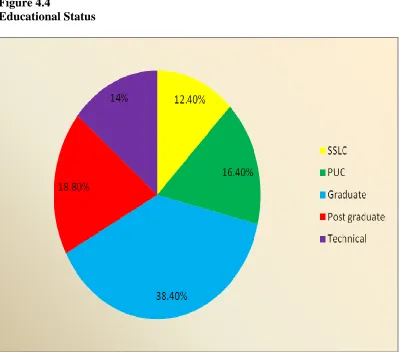
From the study, it has been found that a majority of sample respondents working in sample
firms possess graduation, post graduation with different specialization and add- on course as
well. A large chunk of 38 percent is from graduation stream. This is followed by 18.8 percent of
respondents from post graduation stream. However, employees with technical qualification
under the study constitute 14 percent. The qualification plays crucial role for employee
performance, competency mapping and individual development. The strong fundamental
qualification is the foundation for further building blocks and improvements in respect of
employees. This is taken care of by training and development programs.
Figure 4.4
INFERENCE
Competency of an employee to a great extent depends on his or her individual characteristics
and educational qualification as well. The latter will provide inputs to learn more in the chosen
occupation or profession. The training and development programs in the sample companies
considers educational qualification to take up the current and the future tasks of the
organizations. The knowledge and conceptual understanding of the employees are transformed
into practical phenomenon by executing the assigned tasks. The knowledge possession from
learning and education will act as the lubricant for attaining the desired objectives of the firms.
Hence, educational qualification is an integral input of training and development programs.
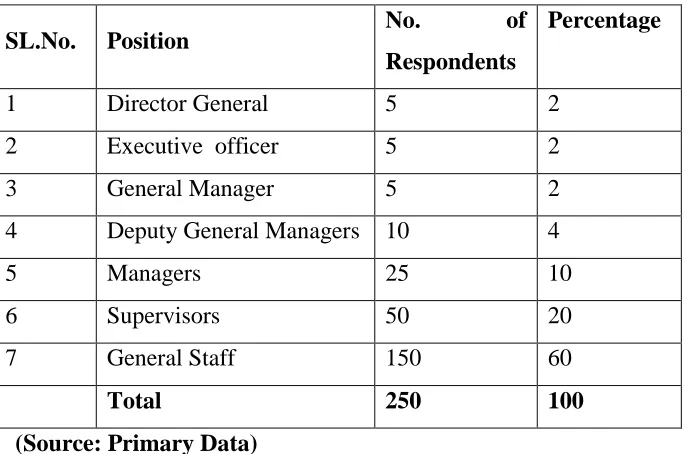
Table 4.5
Respondents’ Job Position
SL.No. Position No. of
Respondents
Percentage
1 Director General 5 2
2 Executive officer 5 2
3 General Manager 5 2
4 Deputy General Managers 10 4
5 Managers 25 10
6 Supervisors 50 20
7 General Staff 150 60
Total 250 100
(Source: Primary Data)
ANALYSIS
The sample respondents have been chosen from different levels of hierarchy in the
organizations structures of sample multi-national companies. 10 percent of the sample
respondents are from top management consisting of director general, CEOs, General Managers
respondents are chosen who are by and large raters or assessors under training and
development programs. The remaining 60 percent of the respondents are from employee
category from different departments of the organizations. The scalar chain principle of
authority and responsibility flow is well considered under the study.
TO IDENTIFY THE EMPLOYEES AND EXECUTIVES TRAINING AND DEVELOPMENT PROGRAMS IN THE SAMPLE ORGANIZATIONS.
Number of Training and Development Programs
Sl No Frequency
Employee Responses (n=250)
Number Percent
1 One 64 25.6
2 Two 26 10.4
3 Three 36 14.4
4 More than three 134 53.6
Total 250 100
(Source: Primary data)
ANALYSIS
More than one-fourth of the sample respondents indicated that they have been provided one
training program per annum. There are companies which provide two training programs per
annum (10.4%). Certain other companies provide three and above training programs on
account of stiff competition (53.6%).
INFERENCE
Training is an investment on the human capital. Higher the frequency of training, higher will
be the capability improvement, competency enhancement which is leading to increased
productivity and profitability. The sample MNC companies are facing lots of environmental
the training programs in banking and pharmaceutical sector happens once in a year or once in
two years.
Methods of Training and Development
Sl.
No. Methods of training
Employee Response(n=25)
Yes No
N % N %
1 On-the-job training 78/250 31.2 142/250 68.8
2 Off-the-job training 116/250 46.4 134/250 53.6
3
Both on and Off-the-job
training
42/250 16.8 208/250 83.2
4 Learning 128/250 51.2 122/250 48.8
5 Education 121/250 48.4 129/250 51.6
6 Coaching 71/250 28.4 179/250 71.6
(Source: Primary Data)
ANALYSIS
Under the study, the respondents have indicated that they have been provided with hands -on
experience in the form of On-the-job training (31.2%). To provide theoretical and practical
exposure to employees on leadership, motivation, communication, interpersonal, behavioral and
job requirements Off-the-job training were given to enhance their competencies in the said
parameters (46.4%). Nearly 17 % of the respondents received both On-the-job and Off-the-job
training. Learning, education, and coaching were integral part of the training program given to
INFERENCE
The sample firms are multinational and global giants and therefore an array of multiple training
programs have been provided to employees. The various types of training provided under the
study denote that the companies desire to improve the employee confidence, competency,
ability, and cognitive development, attitudinal and behavioral changes.
Authority to Set Goals and Objectives of Training
Sl No Authority
Employee Responses (n=250)
Number Percent
1 Top-Management 23 9.2
2 HR Manager 144 57.6
3 Departmental heads 21 8.4
4 Trainers 31 12.4
5 Committee 31 12.4
Total 250 100
(Source: Primary data)
ANALYSIS
The respondents were asked to indicate as to who is fixing the requirements of training for the
employees in their organizations. In other words who is deciding the goals and objectives of
training given to the employees in the sample firms. It has been found that, HR manager in the
respective company is entrusted with the task of setting the goals and objectives of the training
program. This is followed by 12.4% each of the training committee and the trainers
respectively.
INFERENCE
Four-fifth of the sample firms moved away from human resource management practices to
strategic human resource management in that training objectives are linked to human resource
instructions to chief executive officers to look into the training and development programs. The
concerned CEOs in consultation with the HR managers will set the goals and objectives of the
training programs of the firms. This has yielded a good measure of treasure. This also enabled
the firms to compete effectively with their rival firms on account of their enlightened human
capital and willing workforce.
ent and convergent skills, competency based HR skills, knowledge articulation skills, innovative
skills, creativity skills, networking competencies, integration of internal and external
capabilities and resources skills, experimental product prototype and strategic alliance skills,
time paced transition process skills, development of customized solutions, fast and professional
execution skills, business environmental factors sensing skills, etc
A) INFORMATION TECHNOLOGY
The specific skills, knowledge, abilities and competencies imparted in information technology
firms are Core IT competencies - central applications, sales and marketing, supplemental IT
IT consultants, institutional social function, enabling IT
competencies-institutional social function, development of software application and delivering a range of
services to customers, scripting and storyboarding, computer aided systems engineering, Hard
IT competencies-Macromedia, adobe, multi-media, soft it competencies-visual programming,
developers’ communication skills, scripting and storyboard competencies, design competencies,
and innovative competencies.
Functional competencies are stakeholder relationship skills, maintaining favorable asset position
skills, developing software application skills, multimedia ANALYSIS and design technique
skills, ability to integrate a diverse range of hardware and software technologies across all the
business processes, delivering a range of services to customers, building partnerships and strong
working relationships with IT vendors, etc.
B) PHARMACEUTICAL
The specific skills, knowledge, abilities and competencies imparted in pharmaceutical firms are
capital, IFRS skills, US GAAP Skills, international accounting standards skills, Indian
accounting standard skills, taxation skills, financial management skills, comprising acquiring,
employing and appreciation of funds, chemical dyestuff operation skills, fermentation skills,
antibiotic action skills, dyestuff skills, product-synthetic antibiotics, generic drugs, the soil
screening and drug design skills, chemical’s and chemical compounds skills.
Further, biotechnology and organic chemistry, laboratory skills, knowledge of nerves system,
technological competence, diagnostic skills, interferon technology, marketing and promotion,
skills for influencing the physician, development of selling competencies, first-to-market skills,
salesmanship skills, marketing competence, CRM competencies, drugs based on knowledge of
how the body system operated, skills to identify new drug compounds, skills needed to develop
antibiotics, therapeutic skills, knowledge of diseases, cognitive abilities to manage change,
competency based HR functions skills, innovative skills, ethical drug research, knowledge of
medical culture of different countries, patented drugs, R&D skills, knowledge of patented drugs,
clinical research skills, ability to effectively cope with regulatory agencies, WTO patent pharma
patent rules, compulsory licensing of life saving drugs.
C) ELECTRONICS
The specific skills, knowledge, abilities and competencies imparted in electronics firms are
business outsourcing skills, analogue circuit design, electrical design and simulation skills,
analogue design skills, domain technologies, engineering and business solutions skills, high
speed digital boards making skills, processing of analogue signals skills, digital domain skills,
digital electronic devices making skills, semiconductor technology skills, VLSI skills,
adaptability of technology skills, block circuit, wireless communication skills, custom circuit
layout skills, marketing strategic skills, market research, E-marketing skills, M-marketing skills,
advertising skills, custom relationship skills, multi-media application skills, channel
management skills.
Further, competency based HR functions skills, design services skills, HR outsourcing skills,
design engineers, electronics engineers, instrumentation skills, knowledge of senators , analogue
skills, electronics and communication skills, integrated electronic skills, micro electronics skills,
analogue circuit skills, mixed signal skills, analogue engineering skills, innovations skills,
intellectual property development skills, product development skills, skills for cutting-edge
technology, inductive and deductive skills.
D) BANKING
Interest rate, exchange rate, inflation risk and money value, working capital management skills,
liquidity, profitability and solvency positioning skills, management of NPA, management of
bank assets skills, management of liability skills, financial engineering skills, corporate finance
skills, international financial reporting standards skills, board business understanding skills,
work ethics, innovative banks products offering skills, banking products management skills,
banking product design skills, investment products skills, E-banking skills, tele - banking skills,
accounting writing skills are crucial, credit analysis and lending skills, foreign exchange
derivatives skills, capital market skills.
Core banking system skills, ICT enabled services skills, brand building skills, advertising skills,
marketing and salesmanship skills, customer-orientation skills, market segmentation skills,
know your customer skills, customer relationship banking skills, interactive skills, people skills,
communication skills, foreign language skills, cross cultural diversity skills, knowledge of
country specific banking habits of the people, analytical skills, ability to synthesize skills,
initiative skills, mentoring skills, competency based HR functions skills, innovative skills,
creative ability skills, international banking laws, compliance with central bank/reserve bank of
TO EVALUATE THE TRAINING AND DEVELOPMENT PROGRAMS
CRITICALLY AND TO ARRIVE AT CONSTRUCTIVE SUGGESTIONS FOR THE
SAMPLE ORGANIZATIONS.
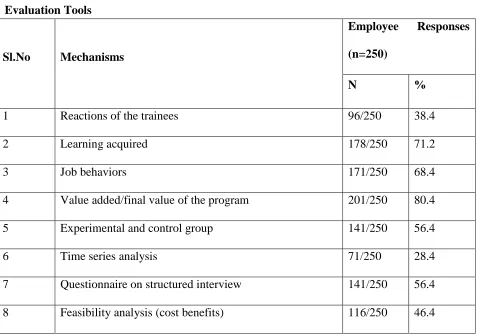
Table 4.28 Evaluation Tools
Sl.No Mechanisms
Employee Responses
(n=250)
N %
1 Reactions of the trainees 96/250 38.4
2 Learning acquired 178/250 71.2
3 Job behaviors 171/250 68.4
4 Value added/final value of the program 201/250 80.4
5 Experimental and control group 141/250 56.4
6 Time series analysis 71/250 28.4
7 Questionnaire on structured interview 141/250 56.4
8 Feasibility analysis (cost benefits) 116/250 46.4
(Source: Primary data)
ANALYSIS
The training output have been measured and monitored through established yardsticks. They
are reactions of the trainees after the training (38.4%), learning acquired (71.2%), job behavior
(68.4%) value addition, (80.4 %), flexibility (46.4%) and so on.
INFERENCE
There are various mechanisms available to measure the training effectiveness under the study.
The sample firms compared the training effectiveness before and after the training given to the
employees, the learning acquired, job performance and behavior, value addition to him or
herself and the value addition to the organizational performance. It also measured the human
capital addition and enhancement. Any training should have moved the employee from rigidity
to flexibility and that is seen empirically in the sample companies.
Term of Training Programs
Sl.No Whether your training programs
focused at
Employee Responses
(n=250)
Yes No
N % N %
1 Short run only 121 48.4 129 51.6
2 Long run only 116 46.4 134 53.6
3 Both short and long run 151 60.4 99 39.6
(Source: Primary data)
ANALYSIS
The term of the training programs varied from short run to long run depending upon the training
needs and requirements. In the sample firm 48.4 percent of the employee respondents received
short term trainings and correspondingly 46.4 percent of the respondents long term trainings.
Further, 60.4 percent of the respondents under the study received both short and long run
training requirements.
INFERENCE
Short run training are meant for imparting certain specific skills On-the-job training are the new
skill to do a specific job whereas long run training program is a comprehensive one which
encompasses knowledge, skill and abilities. The purpose of long term training is to provide job,
knowledge, as well as attitude and behavioral pattern change
Measuring the Effects of Training Programs
Sl.No
When the training and development effects
are measured?
Employee
Responses (n=250)
N %
1 After one month 91/250 36.4
2 After three month 116/250 46.4
3 Immediately after training 81/250 32.4
4 Intermittently 61/250 24.4
Total 250 100
(Source: Primary data)
Conclusion
In regard to measuring of training effectiveness what is the time gap allowed by the sample
company after the completion of training by the employee respondents. 36.4 percent of the
employee respondent indicated that they are measured on their training program participation
effectiveness after one month of the completion of the prescribed training program. 46.4
percent of the respondent indicated that they are measured on the effectiveness of training only
after three months from the completion of training. Two-fifth of the sample firms measured the
training effectiveness immediately after the training received by the employees. Nearly
one-fourth of the employees under the study (n=250) indicated that they are measured intermittently
by the top, department, HOD and immediate supervisor on the performance and behavior
arising out of training provided to them. The training imparted to the employees bear fruit only
after certain time space. Therefore, two-fifth of the employers measure the effectiveness of
training imparted to the employees only after three months period of observation. Further, a
sample firm measures the training effectiveness after one month of training impartation.
Another sample firm measured training effectiveness frequently. The time space given for
measurement will have telling effect on the performance of the employees. Any positive and
negative impact will serve as the precedent for the future assignment of training programs to a
References
Alan Coetzer, Janice Redmond, Jalleh Sharafizad, (2012) "Decision making regarding
access to training and development in medium-sized enterprises: An exploratory study
using the Critical Incident Technique", European Journal of Training and Development,
Alexandre Ardichvili, (2012) "Sustainability or limitless expansion: paradigm shift in
HRD practice and teaching", European Journal of Training and Development,
Allan A. Gibb (1997) in his article 'Small Firms' Training and Competitiveness.
Building Upon the Small business as a Learning Organization'
Ann Valentin Kvist, (2012) "Immigrant groups, vocational training, and employment",
European Journal of Training and Development,
Anne Bartlett-Bragg, (2009) "Reframing practice: creating social learning networks",
Development and Learning in Organizations,
Carl James, Ian Roffe, (2000) "The evaluation of goal and goal-free training
innovation", Journal of European Industrial Training,
Daugherty, Jill D.; Blake, Sarah C.; Kohler, Susan S.; Culler, Steven D.; Hawley,
Jonathan N.; Rask, Kimberly J.(2013)0
David Devins, Steve Johnson, John Sutherland, (2004) "Employer characteristics and
employee training outcomes in UK SMEs: a multivariate analysis", Journal of Small
Business and Enterprise Development,
Denny Hall (2013) The Training Within Industry Approach Resurges in the U.S.
Workforce (See document information page 30)
Johannes Moskaliuk, Joachim Kimmerle, (2009) "Using wikis for organizational
learning: functional and psycho-social principles", Development and Learning in
Organizations, Vol. 23 Iss: 4, pp.21 - 24
Justin Arneson, William J. Rothwell, Jennifer Naughton (2013)Training and
Development Competencies Redefined to Create Competitive Advantage (See document
information page 47)
Khalil M. Dirani, (2012) "Professional training as a strategy for staff development: A
study in training transfer in the Lebanese context", European Journal of Training and
Khawaja Fawad Latif, (2012) "An integrated model of training effectiveness and
satisfaction with employee development interventions", Industrial and Commercial