(PLATES
83-88)
PAUSANIAS
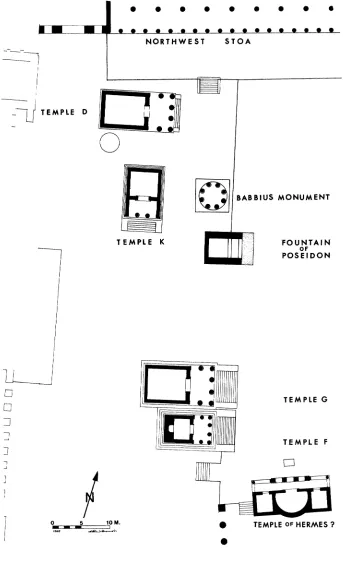
SAW A TEMPLE OF TYCHE near other shrines in the forum at
Corinth.' One of the foundations at the west end of the forum should belong to that
temple, since the congregation of buildings there forms the only architectural complex ap-
propriate to Pausanias' description (Fig.
1).2A fountain with a statue of Poseidon which
Pausanias mentions is identified with remains approximately in the center of the west end.3
If we take the fountain as a fixed point and assume that Pausanias mentions the surround-
ing monuments in the order in which he saw them, determining the location of the shrines is
partly a matter of deciding his direction of movement. Scranton, who assumed that Pausa-
nias moved in a clockwise direction through the forum, identified Temple F in the south-
west corner as Tyche's.4 Because the central block of a tympanum associated with Temple F
carries the inscription V]ENERI, Scranton suggested (p. 68) that the Venus worshiped in
the temple was "Venus Victrix in such a form as to resemble Fortuna or Tyche." Williams
reads Pausanias' movement in a counterclockwise
direction and identifies Temple D at the
northwest corner as Tyche's.5 He points out that sculpture related to Tyche was found near
1 2.2.7. My thanks go to Charles K. Williams, II for permission to study the Corinth material and for his thoughtful criticisms and encouragement. Nancy Bookidis, Evelyn Harrison, and Brunilde Ridgway gave me many helpful suggestions.
Works frequently cited are abbreviated as follows:
Ameling = W. Ameling, Herodes Atticus II, Hildesheim 1983
Corinth IX = F. P. Johnson, Corinth, IX, [i], Sculpture 1896-1923, Cambridge, Mass. 1931
*Despinis = G. Despinis, 1v1(3oAj a-Tr MEXE'T? TroVi E'pyov rov 'AyopaKpirov, Athens 1971
Harrison = E. B. Harrison, "Early Classical Sculpture: The Bold Style," in Greek Art, Archaic into Classical, C. G. Boulter, ed., Leiden 1985, pp. 40-65
Hornbostel = W. Hornbostel, Sarapis, Leiden 1973
Kent = J. H. Kent, Corinth, VIII, iii, The Inscriptions, 1926-1950, Princeton 1966
Schweitzer = B. Schweitzer, "Dea Nemesis Regina," JdI 46, 1931, pp. 175-246
Scranton = R. L. Scranton, Corinth, I, iii, Monuments in the Lower Agora and North of the Archaic
Temple, Princeton 1951
Smith = D. E. Smith, "The Egyptian Cults of Corinth," HThR 70, 1977, pp. 201-231
Tran Tam Tinh = V. Tran Tam Tinh, Serapis debout, Leiden 1983
Williams, 1974 = C. K. Williams, II and J. E. Fisher, "Corinth 1974: Forum Southwest," Hesperia 44, 1975, pp. 1-50
Williams, 1982 = C. K. Williams, II, "Zeus and Other Deities: Notes on Two Archaistic Piers," in Hes- peria, Suppl. XX, Studies in Athenian Architecture, Sculpture and Topography,
Princeton 1982, pp. 175-181
2 Scranton, pp. 3-73. For further discussion see J. Wiseman, "Corinth and Rome I: 228 B.C.-A.D. 267," in ANRW VII, i, Berlin 1979 (pp. 438-548), pp. 528-529.
3 Scranton, pp. 32-36.
4 Scranton (p. 70) states that the two temples H and J were built over the foundations of the Fountain of
Poseidon after Pausanias' visit. The identifications, dates, and reconstructions of these buildings are presently being restudied by C. K. Williams, II. For the collected evidence see Wiseman (footnote 2 above), pp. 528-529.
5Williams, 1974, pp. 25-29. Temple F is left to Venus, and Pausanias mentions a statue of Aphrodite by Hermogenes of Kythera in a sequence which could imply an association with Temple F.
American School of Classical Studies at Athens is collaborating with JSTOR to digitize, preserve, and extend access to
Hesperia
* * * 2 * o 0 a t
NO RT HW E ST S TOQA
- TEMPLE D
Q
E
BABBIUS MONUMENT
TEMPLE K FOUNTAIN
oF
POSEIDON
L~~~~
TEMPLE G
--' >g14 . T~~~~~~~~TEMPL E F
I
0 5 10 M. TEMPLE OF HERMCES ?
Temple D, even though the contexts of the finds are late. These sculptures provide the best
means of elucidating the character and cult of Tyche at Corinth.
The most easily identifiable sculpture of Tyche is a fragmentary, over life-size head
with a mural crown (P1. 83:a).6 The head is composed of three joining fragments, the largest
of which preserves most of the left side of the face, the forehead and front hair, and the right
side of a mural crown. The fragment had been built into a Byzantine wall in the center of
the west end of the forum, twenty meters east of the Fountain of Poseidon. An additional
fragment of the mural crown came from the west end of the Northwest Shops, close to
Temple D. No findspot is recorded for the fragment with the nostrils, mouth, and chin. The
curving sides of the forehead and the loose waves of hair parted in the middle delineating a
high, triangular area are related to works of the first quarter of the 4th century
B.C.,al-
though we can not associate the head with any known type.7 The lack of drill work between
the waves of hair over the forehead, the smooth finish of the surface with only traces of rasp
work, and the soft lips separated by a drilled channel suggest a date for the Corinth head in
the second half of the 1 st century or early in the 2nd century after Christ.
In 1902 at the western end of the Northwest Stoa, ten meters north of the east end of
Temple D, was found a statue of a draped female figure preserved from the upper thighs
down (P1.
84).8She has long been recognized as a replica of a Classical statue known
through five copies and called the Torlonia-Hierapytna type (P1. 83:c).9 In a recent study
Susan Kane suggested that the original was an Attic work of
ca.440
B.C.,although she
6 S 802. Corinth IX, pp. 46-47, no. 54. For the mural crown as indicative of the city personification see
F. Allegre, Etude sur la deesse grecque Tyche, Paris 1889, pp. 187-192; Die Sammlung Sabouroff I, A. Furtwangler, ed., Berlin 1883-1887, commentary to pl. XXV. In art the mural crown is worn by other great goddesses as well, particularly Kybele. It is the findspot of the Corinth head in the forum which gives us confidence in the identification as Tyche. Pausanias mentions a sanctuary of Kybele on the road to Acrocorinth (2.4.7). That probably was a good distance from the forum, not far from the sanctuary of Demeter and Kore.
While noting the many iconographic parallels to representations of Tyche, Johnson (Corinth IX, p. 47) preferred to see the head as Kybele. He was led to this conclusion by a cutting on the underside of the head which he interpreted as for the back of a throne of a seated figure. That is surely wrong. The lower surface runs diagonally downwards from below the ears to about 0.05 m. behind the chin, where the surface is broken. That this surface did not extend to the back of the head is certain since at its upper extreme, below the ears, it angles back and down. The purpose of this cutting is hard to explain; it may be from a repair or from re-use. At any rate, it contributes no information to the identity of the figure. A representation of Tyche is the obvious interpretation, and both Scranton (p. 69) and Williams (1974, p. 27) named her so.
I Compare copies of the Leda: A. Rieche, "Die Kopien der 'Leda der Timotheos'," AntP XVII, Berlin 1978, pp. 21-55, ills. 14,15. A striking similarity in the pattern of the waves of hair which fall from the central part is found in the head of the Petworth copy of the Mattei Amazon: M. Weber, "Der Kopf der Amazone Mattei," JdI 93, 1978, pp. 175-183, ill. 6. For the 4th-century B.c. date of the prototype see E. Harrison, "Two Pheidian Heads: Nike and Amazon," in The Eye of Greece, D. Kurtz and B. Sparkes, edd., Cambridge 1982 (pp. 53-88), pp. 75-76. Among Roman examples a similar arrangement occurs on a head of Tyche from Cyrene, dated to the Antonine period: E. Paribeni, Catalogo delle sculture di Cirene, Rome 1959, p. 147, pl. 184.
8 S 427. Corinth IX, pp. 12-14, no. 6. The Northwest Stoa in 1902 went by the earlier designation "South Stoa."
found no conclusive evidence for the name of the goddess.
10 The identity of the Corinth copy
is suggested by the fragmentary remains of a wheel beside the right foot.
The wheel belongs to the goddess Nemesis, as many examples show. An inscribed relief
dated to the 2nd century after Christ, from the Piraeus and today in the Louvre, depicts a
winged goddess holding a four-spoked wheel at her right and cradling a measuring stick in
her left arm (P1. 85:a).II She stands on the back of a prostrate male figure, the
V4p"o-nTf'T2A coiled snake raises its bearded head beside the goddess' left leg. The inscription reads:
ELIAL guv), zs E'oopas, N4,LEo-tL /uEpo7wcv aVOpc7wcv, dV7rTEpOS, BavaaTa, KVKAOV cxovoa 7r1Aov.
7rwTw/.aL b'Vaa KO1OLOV a&E 7TOAVy?)OEL OV/.LW, 83EpKo/.Euva OvaTWv 4fVAov aEt ycEvEr
aAAa /LE -cTE,Los av?)p TEv?4S oo4p S 'ApTEqLW8(POS
0TT?TEV E7rT EVXwAalSt AavifOulGL TV7rOl.
The attributes of Nemesis on the Louvre relief are standard for her iconography in the
Roman period. The measuring stick, by which she assesses the correct limits of human
behavior, may derive from the cult statues of the double Nemeseis in the sanctuary estab-
lished by Alexander the Great at
Smyrna.13The pose of trampling the transgressor is
thought to have originated in Alexandria as part of the characterization of an Erinys-
Nemesis.14 The snake may also derive from Egypt and emphasizes the chthonian powers of
the goddess. 15
The earliest literary references to the wheel of Nemesis are from the first half of the 2nd
century after Christ. Mesomedes in his Hymn to Nemesis refers to the wheel as the instru-
ment by which good luck is overturned.16
Markellos of Sidon is more specific, saying the
10 Kane, loc. cit. The copy from Hierapytna is identified by the quiver as Artemis; the copy in Cyrene is named Kore in the inscription on the base. E. Schmidt ("Zwei Vorlauferinnen der Sappho Albani," in Antike Plastik, Festschrift Amelung, Berlin/Leipzig 1928 [pp. 222-227], p. 224) identified the original as Aphrodite. Harrison (p. 58, note 26) suggests that the original represented Artemis.
l MA 749. P. Perdrizet, "Reliefs grecs votifs: Nemesis," BCH 22, 1898, pp. 599-602; F. Baratte, "Une statue de Nem'sis dans les collections du Louvre," RLouvre 31, 1981 (pp. 171-178), pp. 174, 176.
12 Perdrizet, op. cit., p. 600; idem, "Nemesis," BCH 36, 1912 (pp. 248-274), pp. 250-255.
13 For the interpretation of the measuring stick see Anth. Plan. 4.223, 224. For the measuring stick as an attribute of the statues at Smyrna see RE XVI, 1935, s.v. Nemesis (cols. 2338-2380), col. 2375 (H. Herter); R. Fleischer, "Eine neue Darstellung der doppelten Nemesis von Smyrna," in Hommages a Maarten J. Ver- maseren, Leiden 1978, pp. 392-396; P. Gercke, "Erwerbungen der Staatlichen Kunstsammlungen Kassel, Antikenabteilung 1972-1982," AA (JdI 98) 1983 (pp. 479-538), pp. 528-529, no. 71.
14 Schweitzer, p. 210.
15 H. Volkmann, "Studien zum Nemesiskult," ArchR W 26, 1928 (pp. 294-321), p. 311, note 1.
avenging wheel itself, pojuos0a
a-TrWp,punishes the evildoer.-7 In the 4th and 5th cen-
turies Claudian and Nonnus speak of Nemesis' avenging wheel by means of which the
proud are brought low.
18The wheel identifies the Corinth copy of the Torlonia-Hierapytna
type as Nemesis; moreover, it is easy to associate the statue with the Temple of Tyche
because Nemesis and Tyche share cults and iconography in the Roman period.19
But if we
look a little further into the question of attributes, the relationship between the two god-
desses at Corinth becomes even closer.
Tyche's oldest attributes are the cornucopia and the steering oar.20 The cornucopia
illustrates her power to bestow prosperity, the oar to guide the lives of men.21 These at-
tributes were combined in the late Hellenistic period to create a significant image which
endured throughout the Roman Empire.22 In the Imperial period, Tyche's oar sometimes
after Christ: Roscher, I, p. 1528, s.v. Fortuna (R. Peter); Schweitzer, pp. 189-191, ill. 2. Even though literary references to Fortune's wheel appear earlier than those to Nemesis' wheel, most scholars agree that the at- tribute was taken by Tyche/Fortuna from Nemesis.
17 IG XIV, 1389, ii, line 34.
18 Claudian, de bello Gothico 631-632; Nonnus, Dionysiaca 48.375-381. Ammianus Marcellinus
(14.11.25-26) describes Nemesis in terms which suggest a Panthea, who controls good and bad twists of fate, rather than the punitive goddess. At any rate his interpretation of the wheel as symbolic of Nemesis' facility at travel is unique. Perhaps it was influenced by personifications of Roman roads, who often recline against wheels.
The avenging Nemesis may be represented in the earliest depiction of Nemesis with the wheel known to me. In the medallion of a late Hellenistic silver bowl from Novocherkassk on the Black Sea, Psyche with a torch is depicted torturing an unarmed Eros: S. I. Kaposhina, "A Sarmatian Royal Burial at Novocherkassk," Antiquity 37, 1963, pp. 256-258, pl. XXX; Baratte (footnote 11 above), p. 174. The little god, tied to a col- umn, looks back to the left, perhaps begging mercy from a statue of Nemesis. The goddess holds a wheel in her right hand and makes the apotropaic gesture of spitting on her chest. For this gesture see Furtwangler (foot- note 6 above), II, Einleitung, p. 17; H. Posnansky, Nemesis und Adrasteia (Breslauer Philologische Ab- handlungen 5, Heft 2), Breslau 1890, pp. 104-107. The bowl is one of a pair. Its companion shows Erotes torturing Psyche in the same way. The presence of Nemesis on the first bowl indicates Psyche's revenge. For other representations of a bound Eros and Nemesis, sometimes with a wheel, see L. Curtius, "Poenitentia," in Festschrift fur James Loeb, Munich 1930, pp. 53-62.
The punitive meaning may have derived from the use of the wheel in antiquity as an instrument of torture, a kind of rack for criminals. See E. Roos, "Das Rad als Folter- und Hinrichtungswerkzeug in Alter- tum," OpArch 7,1952, pp. 87-104. Citing Roos's study, E. Simon ("Ixion und die Schlangen," OJh 42, 1955 [pp. 5-26], p. 21) denies the connection between wheels as they might have been used for real torture and the magical, winged wheel to which Ixion was strapped. Simon's distinction of the manner in which pain was inflicted on the one being punished according to how the attachment to the wheel was accomplished is perhaps a little too gruesomely literal. Certainly the myth of Ixion established the wheel as an old and familiar symbol of punishment for hubris. Note also an Archaic votive wheel found beside the sanctuary of Nemesis at Rham- nous: "Epyov 1984, p. 55, fig. 77.
19 Herter (footnote 13 above), cols. 2379-2380; Posnansky (footnote 18 above), pp. 52-56. For early asso- ciations of Nemesis and Tyche see A. Shapiro, "The Origins of Allegory in Greek Art," Boreas 9, 1986 (pp. 4-23), pp. 11-14.
20 Pausanias (4.30.4) says that in Smyrna, Bupalos of Chios, a 6th-century sculptor, created an image of Tyche wearing a polos and carrying the horn of Amalthea. For Tyche with the oar see Aischylos, Agamemnon 661-666. The earliest preserved representation of Tyche with the steering oar is on a proxenos decree from Tegea, IG V 2,1, 4th century B.C.
21 Dio Chrysostom, Or. 63.
rests on a globe, the universal sphere.23 The globe beneath the steering oar extends the
meaning of Tyche from a power over man's fate to an ordering principle of the cosmos. A
statue in the Vatican (P1. 85:b)24 and a lamp in Corinth (P1. 83:b)25 are good examples of
the use of all three attributes.
In the 2nd century after Christ, twin statues of draped females holding oars resting on
wheels were placed at either side of the entrance to the stadium at Olympia (P1. 85:c).26 In
their left hands they hold measuring sticks. The combination of Tyche's oar and Nemesis'
wheel led the excavator to call these figures Nemesis-Tyche. It is likely that the Corinth
copy of the Torlonia-Hierapytna type depicted the same combination. On the right side of
the statue, at the level of the knee, 0.46 m. from the top of the plinth, are the remains of a
square strut (P1. 84:c). Johnson explained the strut as an attachment "doubtless for the
upper part of the wheel." But the diameter of the wheel can be restored as 0.35 m., so that
the upper rim would reach only to the middle of the calf, 0.15 m. below the lower edge of the
strut.27
The square attachment was for another attribute, and on analogy with the Olympia
statues this object is likely to have been an oar. One can envision the attributes along the
(44 B.C.); p. 184, no. 1126 (40 B.c.) and I. Kajanto, "Fortuna," in ANRWXVII, i, Berlin 1981 (pp. 502-558), pp.518-521.
23 The earliest examples of Tyche/Fortuna's oar resting on a globe belong to the Roman period. See
H. Mattingly, Coins of the Roman Empire II, London 1930, no. 114, coin of A.D. 70-71, Fortuna Redux;
K. Schefold, Die Wande Pompejis, Berlin 1957, p. 115; S. Reinach, Repertoire des peintures grecques et ro-
maines, Paris 1922, p. 97, no. 6. For the symbolism of the globe see 0. Brendel, "Symbolik der Kugel," RM 51, 1936, pp. 1-95. To Dio (Or. 63) the sphere beside Fortuna suggested the ever-changing nature of the goddess. One might guess that he is attributing to the sphere the meaning of Fortune's wheel.
24 See most recently 0. Palagia, "A Colossal Statue of a Personification from the Agora of Athens," Hespe- ria 51, 1982 (pp. 99-113), p. 102, pl. 32:a. A fragmentary statuette from Corinth shows the lower half of a female figure with a globe at the right: Corinth IX, p. 50, no. 62. Johnson suggested that the object might be a helmet, but it is clearly a globe. A broken surface on top of the globe was probably for Tyche's oar.
25 T 1916. Found March 11,1930 at Cheliotomylos in Columbarium I, 0.30 m. below the third niche from
the north in the east wall of chamber 1. L. 0.101, W. 0.087, H. 0.033 m. Complete. Buff clay, Munsell no. 7.5YR 7/4. Discus: Tyche standing with weight on right leg. Head turned slightly to her right. Hair parted and braided, wound around head. She wears a belted chiton and a himation draped over the left shoul- der and across the hips. In her left hand she holds a cornucopia. In her lowered right hand she holds a steering oar which rests on a globe. Air-hole in right background. Framing ring. Rim: band of small ovolo; well-raised side panels and nozzle. Handle: pierced and totally grooved. Base: circle, inscribed OKTABEIOY.
For the form of the lamp compare 0. Broneer, Corinth, IV, ii, Terracotta Lamps, Cambridge, Mass. 1930, no. 600, p. 193, pl. XII; for the signature see no. 752, p. 210. Broneer type XXVII, Group 3; 2nd century after Christ.
The hair style of the Tyche suggests a date around the middle of the 2nd century after Christ and that the image may have derived from an imperial portrait. Compare a statue of Claudia lusta as Fortuna, Capitoline
Museum no. 933: K. Fittschen and P. Zanker, Katalog der romischen Portrats in den Capitolinischen Museen und den anderen kommunalen Sammlungen der Stadt Rom III, Mainz 1983, p. 56, no. 73, pl. 91, dated late
Trajanic-early Hadrianic. See also a statue of Faustina Major as Concordia, Capitoline Museum no. 48: ibid., pp. 16-17, no. 16, pl. 20, dated to the middle Antonine period, in the 160's after Christ.
26 G. Treu, Olympia, III, Bildwerke von Olympia, Berlin 1897, pp. 237-239, pl. LIX:2, 3; R. Kabus-Jahn, "Die Grimanische Figurengruppe im Venedig," AntP XI, Berlin 1972, p. 48, ills. 13, 14.
lines of those of the Vatican Tyche (P1. 85:b), where a square strut for the oar appears at the
level of the knee.28
The association of Nemesis and Tyche lasts for a long time in Greek religion and art.
An inscription from Epidauros may suggest an assimilation of the two goddesses as early as
the 4th century
B.C.,although Hesychios is the first writer to make a flat identification.29
She was worshiped as Nemesis Fortuna in Dacia in the 3rd century after Christ.30 It is
unlikely that she had both names at Corinth, since Pausanias and the epigraphical evidence
refer to her simply as Tyche.31 But the restoration of the attributes suggests that the Tyche
of Corinth could be visually identified with Nemesis. This fact helps us find a home for a
fragment of the upper part of a torso found in 1934 in a Byzantine wall in the southwest
forum (P1. 86).32
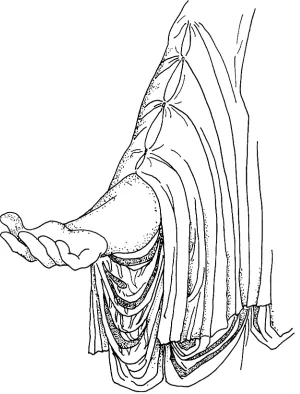
The fragment preserves heavy drapery falling over a woman's upper right arm (Fig. 2).
The forearm was attached separately by means of a pin for which the hole is still visible.
Below and left of the hole is a bit of the attachment surface, roughened with a point. Below,
drapery falls in heavy pouches separated by shallow drillwork and textured with lightly
chiseled flame patterns. On the right side, long, sharp-edged folds fall vertically in jagged
patterns. These folds are part of the overfall of the "sleeve"
of a very rich chiton. At the left,
the edge of the overfall is clear. Beneath it, three looped folds run from the right and con-
verge under the foremost fold of the overfall. These patterns identify the fragment. They are
found together on only one statue type, that of the Nemesis of Rhamnous by Agorakritos.33
The size of the fragment indicates that it comes from a statue approximately the size of
copies in Copenhagen, Athens (P1. 85:d), and Butrinto.34 Despinis includes these three,
which are about three-quarters the size of the original, in a group which is stylistically the
most faithful to Agorakritos' work.35 Comparison between fragments of the original statue
and the Corinth piece, particularly the folds on the left, show how the copyist has deviated
from the exquisite linearity of the original in favor of substance and irregularity of pat-
tern.36 The long vertical folds of the overfall on the right side of the Corinth fragment are
28 The Hierapytna Artemis (P1. 83:c) also had an attribute on her right side. Traces of two struts are pre- served on her leg, one at midcalf and one at midthigh. Schmidt's suggestion that a deer was the missing at- tribute (footnote 10 above) seems reasonable. The animal would have stood on its hind legs, and the goddess would have grasped its horns in her extended right hand. For the possibility that the animal belonged to the original composition see Harrison, p. 58, note 26.
29 IG JV2, 311: TvtXas, [NEu]EoEo9. Hesychios, s.v. 'AyaO-q TVX-1. For a possible assimilation of Fortuna and Nemesis in the late 1st century B.C., see a carved base in Isernia: S. Diebner, Aesernia-Venafrum, Rome 1979, pp. 136-139, no. Is 27, pl. 19, ill. 27:a-c.
30 CIL III, 1125.
31 Kent, no. 128, pp. 59-60.
32 S 1804. Found May 30, 1934. Pres. H. 0.432 m. Fine-grained white marble with many larger calcite
crystals. 33 Despinis.
34 Despinis: Copenhagen, p. 28, no. 1, pls. 35-40; Athens, N.M. 3949, pp. 28-29, no. 2, pls. 41, 42:1 and 2; Butrinto, pp. 29-30, no. 3, pl. 43:1 and 2.
35 Despinis, pp. 33-39.
FIG. 2. Corinth S 1804, reconstruction (author's drawing)
worked with irregular strokes of the chisel which achieve a crisp look not unlike that of the
Copenhagen copy, although there is more variation in the heights of the ridges on the
Corinth copy. The pattern of the pouches that fall below the socket for the arm is the same
as on the Athens copy, although again the individual folds are heavier and more plastic.
That part of the original is not preserved, but it is possible that the Corinth fragment more
faithfully copies it than does the dry copy in Athens. Similar pouches of cloth with vertical
crinkle folds occur on some originals of the late 5th
century.37Among the copies of the
Nemesis the closest stylistic parallels are found in examples in Athens and Naples, both
dated by Despinis to the Antonine period.38
The chiseled lines used to represent texture also
find good parallels on statues from the Hadrianic and Antonine periods.39 Although it is
hard to be precise when so little remains of the statue, a late Hadrianic or early Antonine
date seems reasonable for the Corinth copy.
No other fragments of the Corinth statue have survived. Even so, the size and quality of
the piece show that a large and impressive copy of the Nemesis of Rhamnous once stood in
the Corinthian forum. It is logical to connect it with the other Nemesis, the copy of the
Torlonia-Hierapytna type, and to associate both with the Temple of Tyche.
A copy of the Nemesis of Rhamnous from Messene represents a priestess of the cult of
Artemis Orthia and stood in that goddess' sanctuary.40
That at least one portrait also stood
in Tyche's sanctuary at Corinth is confirmed by an inscribed statue base found in 1935 in
the southwest forum (P1. 87:a).41 The statue was given by Herodes Atticus and depicted his
wife Regilla. The Boule of the city set it up before the sanctuary of Tyche "as if hailing you,
Tyche."42
There is no way to know what Regilla's portrait looked like, but it is tempting to
think that she was represented in the guise of the Nemesis of Rhamnous, since both she and
her husband were special devotees of that cult.43 The date proposed for the Corinth frag-
ment S 1804 is appropriate for such a portrait, and the figure as reconstructed
fits the size of
the base.44
38 Despinis, pp. 39-40.
39 Compare the chiseled folds on the pouches of drapery that fall below the left arm of the statue of Kybele
from Levadia in the Chaironeia Museum, dated by Despinis to the Hadrianic period: Despinis, pp. 112-115, pl. 103:2. Cf. also fragments from the Athenian Agora of a copy of the Mattei Amazon, dated by Harrison to the Hadrianic or early Antonine period: Harrison (footnote 7 above), p. 73, pl. 19:e.
40 A. K. Orlandos, <<NEW'repaL f`pEvvat Ev MEor1jvnp>, in Neue Forschungen in griechischen Heiligtiumern,
Tubingen 1976 (pp. 9-38), p. 33, ill. 22; Despinis, p. 31, no. 8, pl. 49:2.
41 11658. Kent, no. 128, pp. 59-60, pl. 12; Ameling, no. 100, pp. 120-121. Found near the foundations of Temple F. See Kent, p. 22, note 15, where the author discounts the relevance of the findspot as topographi- cally significant.
42 The last two lines of the inscription have been restored by Kent (p. 59) to read as follows:
['PrqyLX]Aa, j &3ovAXj GEr TvX?,v Cs eLAaaTKov4Ta, [d,cova 7rjpQo) Tef'EvL o-T?TaTo XaiveE7v.
The language of the inscription indicates that the statue was erected during Regilla's lifetime; see footnote 44 below. The choice of setting for Regilla's portrait was appropriate since she was the first priestess of Agathe Tyche in Athens. For Regilla as priestess of Agathe Tyche see IG 112, 3607 and P. Graindor, Herode Atticus et safamille, Cairo 1930, p. 84.
43 On Regilla's property outside Rome a temple was dedicated to the Eleusinian goddesses, Athena, and the Nemesis of Rhamnous. In the Triopion inscription (IG XIV, 1389; Ameling, no. 146), Nemesis of Rhamnous and Athena are given special charge of protecting the sanctuary. Other dedications by Herodes at Rhamnous:
IG 112, 3960 and 13208.
A copy of a seated Sarapis, preserved from the lap down, was discovered in 1908 a few
meters from the findspot of the statue of the Torlonia-Hierapytna type (Pl. 87:c,
d).45The
figure is draped in a himation, the folds of which stretch diagonally from the extended right
leg to the retracted left. The feet rest on a low footstool placed at an angle to the front of the
throne. At right are the legs of a standing animal, presumably Kerberos, who appears in
many copies. The dog identifies the god as a deity of the underworld.46
Carved on both sides
of the throne are two stalks of wheat (P1. 87:d).47 Johnson convincingly attributed to the
statue a fragmentary cornucopia found near by.48
Although the cornucopia and wheat are unusual attributes for a seated Sarapis, many
scholars identify the statue as a representation of the Egyptian god. Scranton's reading of
Pausanias' movement through the forum suggested the identification as Zeus Chthonios,
but the argument is weakened by Williams' more plausible interpretation of the tour.49
If we read the findspot of the statue as implying a relationship with the sanctuary of
Tyche, the god could be Agathos Daimon, who often carries a cornucopia and is sometimes
can be restored to approximately 0.90 m. But the width of the Athens copy of the Nemesis of Rhamnous is also approximately 0.70 m. The Rhamnous type is a better candidate for a portrait of Regilla because we know it was used for portrait statues. In addition to the copy in Messene, see the example in Istanbul from Crete: Despinis, p. 30, no. 5, pls. 45, 46:1 and 2.
Oscar Broneer thought that a peplophoros from the southwest forum (S 1818) should be identified as Nemesis-Tyche because of a certain similarity to the figures from the entrance to the stadium at Olympia: "Excavations in Corinth, 1934," AJA 39, 1935 (pp. 53-75), p. 67, pl. 20. He restored the statue's attributes as a phiale in the right hand and a cornucopia in the left. The left arm was added separately. A hollow area with holes at intervals shows that the arm was lowered and slightly bent. As Broneer pointed out, the higher left breast and shoulder suggest that she held some heavy object in this arm, as does the lower edge of the overfall, which rises to the left. A cornucopia would fulfill the requirements, although no further evidence for such an attribute exists. A heavy, matronly figure would not be inappropriate for Tyche, but certainly the statue could be a number of other deities as well. It is best to leave the peplophoros without a name, but at the same time recognize Tyche as a good possibility. See most recently B. S. Ridgway, "Sculpture from Corinth,' Hesperia 50, 1981 (pp. 422-448), p. 440, note 74.
45 S 908. Corinth IX, no. 23, pp. 30-31; Hornbostel, pp. 350-351, note 7; Smith, pp. 218-221.
46 See Plutarch, de Is. et Os. 28, for the story of the colossal statue of Pluton with Kerberos and snakes as attributes. The statue was brought by Ptolemy Soter from Sinope to Alexandria, where it was interpreted as Sarapis. On the form of the animal see Hornbostel, pp. 91-95.
47 Johnson (Corinth IX, p. 31) considered the wheat unique in representations of Sarapis. Hornbostel
(pp. 350-351, note 7) points to an Alexandrian mold representing Sarapis lying in a wheat field. At any rate, the sculptor of the Corinth statue must have considered the wheat a significant attribute since he changed Ker- beros' usual seated position to a standing one, thereby making the stalks on the left visible.
48 S 906. Corinth IX, no. 214, p. 100; accepted by Smith, p. 219. The marble appears to be the same as that of the statue, and attached to the back of the cornucopia is a curved fragment, probably the shoulder of a figure. The backs of the cornucopia and the shoulder are rough, with many marks of a small flat chisel visible. This rough surface can be explained if the throne extended behind the cornucopia.
A cornucopia belongs primarily to the standing Sarapis type: see Tran Tam Tinh, pp. 54-61, 149-164. See, however, a terracotta statuette of a seated god from the Fouquet Collection: P. Perdrizet, Les terres cuites grecques d'Egypte de la Collection Fouquet, Paris 1951, no. 184, p. 78, pl. 48. The god is accompanied by Harpokrates and holds a cornucopia in his left hand. Hornbostel (p. 480, ill. 359) labels the statuette Agathos Daimon, but the presence of Harpokrates identifies the figure as Sarapis.
associated with wheat, although he apparently is never depicted with Kerberos.50
On the
other hand, in Asia Minor and on the Greek mainland Sarapis is not infrequently found be-
side Tyche instead of his traditional companion Isis. A relief from Xanthos (P1. 87:b) de-
picts male and female statues within a naiskos.51 The female is Tyche, identified by her
mural crown, her steering oar, and her heavy cornucopia. The male wears a kalathos and
also holds a large cornucopia in his left arm. In 1885 Michaelis argued that the male figure
represented Sarapis because he thought the two horns at the top of the cornucopia referred
to Apis.52 This interpretation has been accepted by the majority of scholars studying the ico-
nography of Sarapis.53
An oval gem once in Florence depicted Sarapis and Tyche flanking
the statue of the Ephesian Artemis, and a coin of Gordianus III from Ephesos shows Tyche
holding a statue of Sarapis.54
An Aurelian coin from Aigion and a Severan coin from Myti-
lene both show Sarapis standing with Tyche.55
When considering the possibility that Tyche at Corinth could be associated with a male
deity, one is reminded of the principal figure on each of the two archaistic piers found in the
southwest forum (P1. 88:a, b).56 Williams has presented evidence for the identification of the
pair as Zeus Chthonios and Ge Chthonia. The arguments for Zeus are that in the company
of a group of deities the most prominent should be Zeus, that the cornucopia should empha-
size his chthonian nature, and that Pausanias saw a statue of Zeus Chthonios in the Corin-
thian forum not far from the findspot of the pier.57 The identification is reinforced by the
presence of Demeter and Kore on the sides of the pier, since Zeus Chthonios was worshiped
with Demeter in Boiotia. Williams names the female figure Ge Chthonia. He points out
that a
lex sacradated 200
B.C.from Mykonos stipulates an offering of black sheep for Zeus
50 M. P. Nilsson, Geschichte der griechischen Religion II (HdA, Abt. 5, 2), Munich 1961, pp. 213-218,
F. Dunand (LIMC I, 1981, pp. 277-282, s.v. Agathodaimon) suggests that Agathos Daimon took the wheat from Isis Thermouthis as a symbol of his role as guarantor of fertility.
51 See most recently Tran Tam Tinh, p. 151, no. III 4, fig. 93.
52A. Michaelis, "Sarapis Standing on a Xanthian Marble in the British Museum," JHS 6, 1885, pp. 287-318.
s G. Lippold ("Sarapis und Bryaxis," in Festschrift Paul Arndt, Munich 1925 [pp. 115-127], pp. 118- 119) discounted the significance of the horns as unparalleled on known images of Sarapis, while emphasizing that Tyche lacks any attributes that would associate her with Isis. He considered Agathos Daimon the more likely identification.
54 Gem: F. Hblbl, Zeugnisse agyptischer Religionsvorstellungen fur Ephesus, Leiden 1978, p. 77, pl. 16; Tran Tam Tinh, pp. 138-139, no. II 7, fig. 82. Coin: Tran Tam Tinh, p. 210, no. IVB 108. The imagery may derive from 2nd- and 3rd-century Alexandrian coins which show a standing Tyche of the city holding a bust of Sarapis: LIMC 1, 1981, p. 491, nos. 52-59, s.v. Alexandria (M.-O. Jentel).
5 F. Dunand, Le culte d'Isis dans le bassin oriental de la Mediterranee II, Leiden 1973, p. 160; F. Imhoof-
Blumer and P. Gardner, Ancient Coins Illustrating Lost Masterpieces of Greek Art, Chicago 1964, p. 88; D. Magie, "Egyptian Deities in Asia Minor in Inscriptions and on Coins," AJA 57, 1953 (pp. 163-187), p. 175. Some scholars have called the goddess in these examples Isis-Tyche. The appellation depends on the association with Sarapis, since the figures themselves have none of the attributes of Isis. It is more likely that the goddesses are the Tychai of their cities, the association with Sarapis having derived from the Alexandrian cult where the Tyche of Alexandria was sometimes conflated with Isis. See footnote 54 above, esp. Jentel, p. 494.
56 Williams, 1982: S-74-27 and S-1979-6.
Chthonios and Ge Chthonia.58
Unfortunately we know virtually nothing about the iconog-
raphy of Ge Chthonia. On the other hand, the goddess on the pier finds parallels in ar-
chaistic representations of Tyche dressed in a long mantle with overfall, wearing a kalathos,
and carrying a cornucopia.59
Accompanying the goddess on either side of the pier are Dionysos and Athena (P1. 88:c).
As gods of vegetation and abundance Dionysos and Tyche are appropriate companions, and
in art they are sometimes shown together.60
Williams noted that "Athena ... does not have
an obvious role among the agrarian deities," and indeed the emphasis is on her bellicose
nature.61 She wears her helmet, in contrast to the more traditional archaistic Athena, who
carries it. She supports a shield on her left arm, so that the suggestion that she carried a
spear in her right hand has merit. Athena is sometimes associated with Tyche, and Fortuna
is frequently linked with Minerva.62 A striking example is found on the base of the Jupiter
column in Mainz, dated to the mid-lst century after Christ.63 On one side of the square
base, Minerva sprinkles incense over an altar while Fortuna with cornucopia and steering
oar watches. Whatever the exact meaning of the scene, the combination of Minerva, the
custos urbis, and Fortuna strikes a militant note. Athena's presence on the left side of the
Corinth pier and Dionysos' on the right might suggest the range of activities over which
Tyche watches, military as well as agrarian.
At present we can not be sure where the two archaistic piers stood, although it is likely
that they belonged to a building in the southwest forum.64
If the identification of the goddess
58 SIG3 1024; F. Sokolowski, Lois sacrees des cites grecques, Paris 1969, no. 96, pp. 185-186; Williams, 1982, p. 177.
59 See R. Heidenreich, "Bupalos und Pergamon," AA (JdI 50) 1935, cols. 668-701. E. B. Harrison, The Athenian Agora, XI, Archaic and Archaistic Sculpture, Princeton 1965, nos. 119 and 120, p. 72. Particularly close to the Corinth figure are depictions of Tyche on coins of Imperial date from Pergamon and Smyrna: Heidenreich, op. cit., ills. 10 and 11. A similar goddess, either Tyche or Isis, on a late Hellenistic relief from Delos holds an oinochoe in her right hand. She and a similarly dressed male deity, Agathos Daimon or Sara- pis, who holds a phiale, flank a large snake with a bearded head. Possibly the figure on the Corinth pier held a pitcher. For the relief see Dunand (footnote 50 above), p. 278, no. 3.
60 LIMC III, 1986, p. 474, no. 607, s.v. Dionysos (C. Gasparri). See also Pausanias, 5.17.3; 9.26.8.
61 Williams, 1982, p. 178.
62 RE XV, 1932, s.v. Minerva (cols. 1774-1802), col. 1784 (F. Altheim). For Tyche and Athena see Al-
legre (footnote 6 above), p. 156; also an unfinished statuette in the Akropolis Museum at Athens, possibly of the 2nd century after Christ, in which Athena holds the cornucopia of Tyche: P. Karanastassis, "Unter- suchungen zur kaiserzeitlichen Plastik in Griechenland. II: Kopien, Varianten und Umbildungen nach Athena-Typen des 5. Jhs. v.Chr.," AM 102, 1987 (pp. 323-428), p. 358, no. B III 4 and note 156, pp. 421- 422, pl. 48:3-6.
63 G. Bauchhenss and P. Noelke, Die Iupitersaulen in den germanischen Provinzen (BJbb Beiheft 41),
Cologne/Bonn 1981, pp. 162-163, nos. 272-275, pl. 31:1; LIMC II, 1984, p. 1102, no. 396, s.v. Athena/ Minerva (F. Canciani). For additional representations of Minerva and Fortuna together see LIMC II, pp. 1097-1098, nos. 333 and 334; also a sarcophagus lid in Mantua on which Fortuna and Minerva stand to- gether among other deities: LIMC II, p. 1094, no. 283.
on the second pier as Tyche is correct, she would be associated visually with Zeus Chthonios
as companion and counterpart. One is therefore tempted to return to Scranton's identifi-
cation of the statue of the seated god as Zeus Chthonios, since the findspot suggests a rela-
tionship to the Temple of Tyche in the northwest forum. The sculptor would have taken a
well-known type of Sarapis and by the addition of attributes, wheat and cornucopia,
transformed it into a related deity. The same process occurred in the transformation of the
Classical goddess into Nemesis-Tyche. Indeed it is possible that the copy of the Torlonia-
Hierapytna type and the seated god were set up together. The marble of the two statues looks
the same. The ridges of drapery folds rising abruptly from smooth untextured surfaces, the
economical use of the drill and lack of significant undercutting, and the rough chisel marks
that finish the tops and sides of the plinths all indicate contemporaneity
and at least suggest
products of a single workshop. It is the proximity of the findspots and the parallels listed
above which led us to consider whether the god and goddess were to be viewed as a pair.65
We shall probably never know for certain the identity of the seated god. But whether he
is Sarapis or Zeus Chthonios, he would be an appropriate companion to Tyche. If the two
statues in question form a group, his underworld connections, made evident by Kerberos,
would reinforce the impression that Tyche at Corinth is not simply the city personification
but a goddess of the nether world, beneficent but reckoning and retributive. It is this charac-
terization as a motivating force in the universe and an ethical judge which unites Tyche and
Nemesis and is signaled in the statues at Corinth.66 It reminds us of the two Fortunes in
iconography celebrates the deities of the forum of Roman Corinth and need not refer to the Greek city. That in turn implies that the reliefs were carved for their setting at Corinth.
The relationship between Roman sculpture at Corinth and known centers of marble carving is complex. M. C. Sturgeon (Corinth, IX, ii, Sculpture. The Reliefs from the Theater, Princeton 1977, p. 137) and B. S. Ridgway ([footnote 44 above] pp. 435, 437, and 444) suggest that the numerous large-scale architectural projects requiring decorative sculpture at Corinth justify the notion of local workshops. Ridgway (p. 442, note 79) found a certain amount of stylistic coherence among the copies of Greek sculpture at Corinth, which differs from the technical and stylistic features of "Italic and North African/Asiatic workshops." The few pieces of unfinished sculpture and the lack of an area which can be identified as a marble-sculptor's workshop at Corinth are discouraging to attempts to identify and evaluate any Corinthian sculptural style. On the other hand, C. C. Mattusch, in her study of Corinthian metalworking, notes that "the lack of substantial archaeolog- ical evidence for a large-scale production in the Forum Area obviously must not be interpreted as meaning that Corinthian metalworkers did not make many large-scale bronzes. Rather, it is reasonable to assume that most Corinthian foundries and smithies were located outside the civic center of the city" ("Corinthian Metalworking: The Forum Area," Hesperia 46, 1977 [pp. 380-389], p. 389). The same should be true for marble-sculptors' workshops. Until further physical evidence appears, we can at least begin to appreciate the relationship between the meaning of the individual pieces and their religious and topographical contexts. In some cases, e.g., the archaistic piers, the seated god, and the statues of Tyche, this relationship seems to be specific and implies that the works were created for their Corinthian setting and were not just generally suitable.
65 Late Hellenistic votive reliefs from Rhodes often use the formula of seated god and standing goddess. The figural types derive from Hellenistic sculpture in the round. See L. Laurenzi, "Rilievi e statue d'arte Rodia," RM 54, 1939, pp. 42-65. The formula itself may also derive from a prototypical group. In this connection see an Attic lamp of the mid-3rd century after Christ in the Athenian Agora on which a seated Sarapis and stand- ing Isis are shown in their temple: J. Perlzweig, The Athenian Agora, VII, Lamps of the Roman Period, Princeton 1961, no. 805, pp. 121-122, pl. 18.
Book 1 1 of Apuleius' Metamorphoses: at Kenchreai the hero Lucius has his vision, and
harsh Fortune, caeca and nefaria, is replaced by the shining love of Isis, the Fortune "who
illuminates the other gods too with the radiance of her light."67
CHARLES M. EDWARDS
UNIVERSITY OF TEXAS AT AUSTIN Department of Art
Austin, TX 78712
the Torlonia-Hierapytna type (S 427) belongs to the 2nd century. The copy of the Nemesis of Rhamnous (S 1804) is also from the 2nd century, probably in the Antonine period. Although it would be wrong to draw firm conclusions from such fragmentary evidence, this chronology at least corresponds with the numismatic evidence, which suggests that the iconographic identification of Nemesis and Tyche began in a significant way in the 2nd century after Christ. In this respect, an inscription of the 2nd century at Corinth to Nemesis Augus- ta may be meaningful: A. B. West, Corinth, VIII, ii, Latin Inscriptions 1896-1926, Cambridge, Mass. 1931, no. 10, pp. 9-10. Nemesis Augusta, a particular favorite of the military, is the name given to Tyche when she is assimilated to Nemesis: L. R. Dean, "Latin Inscriptions from Corinth," AJA 26, 1922 (pp. 451-476), pp. 457-458; Schweitzer, pp. 178-179. The dedication at Corinth was made by Aurelius Nestor, who served in the 1111 Flavia Felix, a legion stationed in provinces in the area of the Danube. Might the iconographic as- similation of Tyche and Nemesis at Corinth have been encouraged by soldiers returning from campaigns in Dacia? For officials at Corinth who had served in Dacia see Kent, nos. 125, 135, and 170. See J. Toutain, Les cultes paWens dans l'Empire romain I, Paris 1905, pp. 392-399, and Schweitzer, p. 178, note 5 and p. 179, note 1, for dedications to Nemesis-Fortuna and Nemesis Augusta in Dacia.
-4
a. Head of Tyche, Corinth S 802
c. Artemis from Hierapytna (photo DAI Athens, neg. no. 73/735)
b. Lamp, Corinth T 1916 (1:2)
A *. 4- . .
a. Nemesis-Tyche, Corinth S 427, front b. Corinth S 427, back
t 1' .
c. Corinth S 427, right side d. Corinth S 427, left side
a. Dedication to Nemesis, Louvre b. Tyche, Vatican, Braccio Nuovo MA 749 (photo Louvre) 2244 (photo Musei Vaticani, Ar-
chivio fotografico XXXIV.16.76)
4,~~~~~~~~~~#
d. Copy of Nemesis of Rham- nous, Athen N.M1 349
a.Deiaint Nemesis,-ovr Vatia(htoDI .Tyche, Dsicni, Braci Nuov
Athens, neg. no. 01. 2125)
_ I~~~~~~~~~~~~~~~~~~~~~~~~~~~~~~~~~~~~~~~~~~~~~~~~~~~~T
a. Fragment of copy of Nemesis of Rhamnous, Corinth S 1804, right side b. Corinth S 1804, left side
-
a
~~~~~~~~~~~~~~~~~~~~~~~~~~~~~~~~~~~~~~~~~~~~~~~or
xXU
IA La. Base of statue of Regilla, Corinth 1 1658 b. Relief of Sarapis and Tyche, British Museum,
Lycian Room no. 173 (Tran Tam Tinh, fig. 93)
d. Corinth S 908, detail of left side
c. Seated god, Corinth 8 908
a. Zeus Chthonios, Corinth S 74-27 (front of b. Tyche, Corinth S-1979-6 (front of archaistic pier) c. Athena, Corinth S-1979-6 (left side of archaistic
archaistic pier) pier)