Research Article
Fault tolerant load balancing in vehicular communication
using distributed spanning tree
J.Amudhavel
*1, LSS Reddy
1, P. Dhavachelvan
2*1 Department of Computer Science and Engineering, KL University, Andhra Pradesh, India. 2 Department of Computer Science, Pondicherry University, Pondicherry, India.
Abstract
VANET information dissemination among vehicle to infrastructure and infrastructure to the vehicle is necessarily more important. Sharing resources between vehicles such as safety messages, weather reports, multimedia applications, traffic information’s, alert message without any failures is still an issue in VANET.A Lot of improvements needed for resource sharing by proper load balancing. Distributed Spanning Tree is similar to broadcast algorithm. The broadcast algorithms are used to send the messages. To analyze the function of Load balancing which is an unsolved problem in vehicular networks due to the movement of vehicles. Distributed Spanning Tree structure is proposed to frame the fault-tolerant load balancing in VANET. The main aim of load balancing is to distribute resources for increasing the performance and to minimize the delay. This fault-tolerant load balancing is achieved by Distributed Spanning Tree (DST). Intelligent transportation system makes communication more robust and safe between the vehicles. Vehicular Ad-Hoc Network is gaining popularity in the research field due to increase in safer communication between vehicles. Load balancing in vehicular networks is more critical due to mobility of vehicles. Discovery of services in VANET which ensures good QoS (Quality of Service) is very essential.
Keywords: VANET, Load Balancing, Distributed Spanning Tree, Fault Tolerance.
Received on 04 March 2018, accepted on 02 June 2018, published on 19 June 2018
Copyright © 2018J.Amudhavelet al., licensed to EAI. This is an open access article distributed under the terms of the Creative Commons Attribution licence (http://creativecommons.org/licenses/by/3.0/), which permits unlimited use, distribution and reproduction in any medium so long as the original work is properly cited.
doi: 10.4108/eai.19-6-2018.154827
1. Introduction
Nowadays, due to adverse development within the transportation field, the recent research in Vehicular Ad-Hoc Network has been increasing. Vehicular Ad-Hoc Network is a wireless network which is used to provide communication between vehicles. Intelligent information sharing between vehicles is possible using this VANET. There are different types of applications available for vehicular networks such as safety, comfort, entertainment applications. In the field of vehicular networks various types of issues are concerned such as collision, security, congestion, link failures, etc. Among the several issues the main issue faced in the vehicular network is link failure, communication failure, Lack of load balancing. To overcome these above issues
fault tolerant load balancing using distributed spanning tree is proposed. VANET-Vehicular Ad-Hoc Network is considered as a novel ad-hoc network which acts as an intelligent medium in the wireless network for transportation field. One of the most important problems in VANET is resource sharing among the vehicles. Load balancing in vehicular networks is more critical due to mobility of vehicles. A Lot of improvements needed for resource sharing by proper load balancing. The resources such as video, audio should be delivered to vehicles without any delay and loss by achieving the fault tolerance load distribution.
achieved by Distributed Spanning Tree (DST). Bottleneck problem does not occur in (DST) Distributed Spanning Tree because the message load is shared across all the vehicles. Overloading is avoided by balancing the load among the vehicles and RSU (Road Side Unit). Road Side Unit provides connection to vehicles near to the range of RSU. Both load balancing, and Fault tolerance is analyzed in this paper. Section II describes the related works related to load balancing; section III describes the proposed work; section IVexplains the proposed work; section V discussed about the algorithm; section VI simulation tools and finally concludes the paper.
2. Related works
Only few routing protocols to have been proposed in VANET related to load balancing. G.G.Md.NawazAli et al [10, 11, 12] proposes an approach which increases the number of RSU called as Cooperative Load Balancing. Workload is distributed among all the RSUs so overload can be transferred from one RSU to nearby RSU. More RSUs are deployed in this approach. The transfer during the load process was analyzed by delay, workload and vehicle direction and location. KaoutherAbrougui et al [19, 20, 21] describes QoS aware location-based service discovery protocol. This protocol provides load balancing by identifying efficient route paths from the request send by service requester and receive the reply from the service provider based on their location. Discovery of services in VANET which ensures good QoS (Quality of Service) is very essential. Even though there are more requests to servers the discovery of services should be efficient enough by satisfying the load balancing on providers who compensate the services. A new protocol is proposed called as QoS (Quality of Service) related location-based service discovery protocol in the vehicular ad-hoc network. Load balancing is achieved using this protocol. Still this protocol has drawbacks that QoS requirements are not satisfied. KaoutherAbrouguiet al [9]proposes a protocol FTLocVSDP. It is a fault-tolerant location-based vehicular service discovery protocol used to identify failures of routers located in the road side. Failures such as router, communication, service providers are discussed. Fault tolerance was handled in this protocol. Jhang MF et al [1] proxy-based vehicle to RSU access is proposed to act some vehicles as proxies. The vehicles which are out of range can communicate using these proxy vehicles. Zhang Y et al [2] proposes a scheduling scheme for maintaining the storage in the RSU. RSU maintains the upload queue and download queue, which is used to balance both the queues. RSU act as a buffer.
3. Proposed work
Distributed Spanning Tree structure is proposed to frame the fault-tolerant load balancing in VANET. DST is used to distribute the root node vehicle across its group. Here groups are considered as clusters. Each vehicle act as a root
vehicle so load is balanced equally among the vehicles. This is the first structure applied in Vehicular Ad-Hoc Network. In DST, the selection of vehicles is done by identifying the root vehicle. The vehicles which come within the range of RSU are selected. Among the group of vehicles, one vehicle act as a root vehicle and this vehicle is linked with other vehicles. Now overload occurs in that vehicle [16,17,18]. To overcome this problem DST distributes the root node across the network that is each mobile node act as a root node. Distributed Spanning Tree is similar to broadcast algorithm. In broadcasting algorithm the root vehicle initiates by sending the message to its neighbor vehicle then other vehicle act as a root vehicle and communicate with the nearby vehicles. DST disseminates the communication load and information’s between the vehicles.
3.1 Distributed Spanning Tree
Distributed Spanning tree structure distributes the root node across the entire network. This structure reduces the total number of communications requests. More requests are handled easily using this structure because it balances the load efficiently and prevents the root node from overloading. Bottlenecks are greatly reduced using this DST, and it is more scalable. In this paper, this structure is utilized in Vehicular Ad-Hoc Network for proper load balancing and to provide fault tolerant communication between the vehicles[3, 12].
3.2 Connection Manager
Connection Manager manages the overall connection between the vehicles. Vehicle starting position, starting time and speed of the vehicles is monitored by this connection manager. Connection manager checks, whether the vehicles are within the communication range to connect and out of range to disconnect[4, 13].
3.3 Obstacle control
It checks whether the obstacles block the radio transmission, and if there is obstruction, the vehicle gets the transmission power from nearby vehicles[5]. Radio transmission power for vehicles becomes zero if they cross the obstacles such as a polygon. If any obstacle found the obstacle control alerts the vehicles to change the direction.
3.4 TraCI Scenario Manager
Traffic control interface scenario manager reports the active state of the vehicles[6]. TraCI server maintains the server to manage all the vehicle information. Vehicle departure time, parking of vehicles is reported by TraCI.
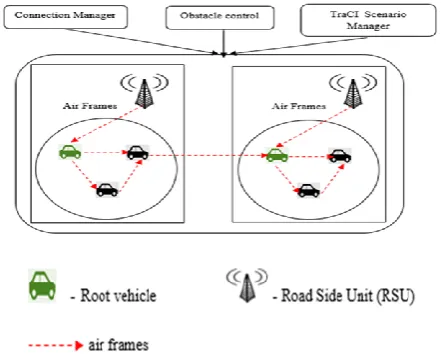
RSU acts as the database; it contains all the resources needed for vehicles and drivers. If a vehicle request for any data or resource nearby RSU will send the resource back to the vehicles[7]. Beacon messages are sent periodically from RSU to moving vehicles to assure the wireless communication. Proposed DST:The vehicles were grouped together using the DST structure. The DST structure initiates any node as the root node. Likewise, in the VANET scenario, the RSU sends air frames to one cluster, and one vehicle initiates as a root vehicle. This vehicle sends air frames to other vehicles to identify the neighbor and to forward data to vehicles. RSU forms the clustering using DST structure8. One cluster can communicate with the other
clusters as shown in figure.1. The air frame messages consist of beacons and data. The beacon message is used to identify the vehicle speed, vehicle direction and vehicle position. The data message contains the vehicle needed resources.
Figure 1. Architecture Diagram
3.6 Working Process of Proposed System
Figure 2. Workflow Diagram
The proposed system works as follows using the following steps as shown in figure.2
3.7 Selection of vehicles
There are many RSU (Road Side Unit) placed in road sides. When the vehicles come within the range of RSU that vehicles are selected. The neighboring vehicles are selected by sending air frames. Air frame is sent along the nearby vehicles, then they can easily identify the neighbor vehicles. The vehicles are grouped together to form a cluster. To form a cluster the vehicles send air frames to other vehicles to identify the neighbor vehicles.
3.8 Providing transmission power to vehicles
After the selection of vehicles, the vehicles need to communicate with other vehicles and with the road side unit for that they need transmission power. From the road side unit, the radio transmission power is provided for vehicles. The vehicle provides transmission power to other neighboring vehicles. The transmission power is provided to vehicles for transferring resources from the RSU.
3.9 Clustering of vehicles
The vehicles are selected for clustering the vehicles are grouped together to form a cluster. From the figure 3 RSU, the vehicles are selected and that vehicles communicate with each other. Any vehicle can initiate as a root vehicle in a cluster using the DST structure.
Figure 3.Clustering of vehicles
is distributed across the cluster, if a root vehicle wants to dispatch a message to the neighbor vehicle; it elects one of the vehicles and sends the message to other vehicles. Then complete cluster is formed, and the complete cluster is called as the root cluster.
3.10 Communication among vehicles
Efficient communication is achieved; fault tolerant
communication is possible by minimizing the
communication failure and link failure. Every vehicle act as a root vehicle. If link failure occurs in one vehicle, the other vehicle takes care for the avoidance communication link failures. Communication between the clusters is done by initiating the root vehicle. The root vehicle sends air frames to other vehicles and sends the data along with them. Distributed Spanning tree has a property to attain fault tolerance.
3.11
Dissemination of resources
DST distributes the workload equally among all the vehicles. It reduces the number of queries for searching the resources. Resources such as emergency messages, safety messages are distributed equally between vehicles.
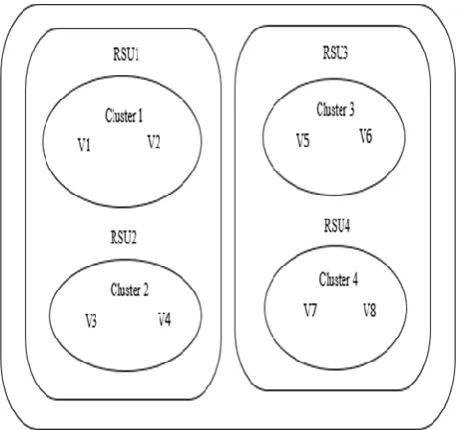
Figure 4. RSU cluster formation for dissemination of
resources
The vehicles are represented by V1, V2, V3, V4, V5, V6, V7, and V8. DST groups the vehicles as clusters each cluster communicated using the RSU (Road Side Unit).From the figure 4 The RSU1 communicates with clusters such as cluster1 and RSU2 communicates with cluster2. The RSU3 communicates with cluster3, and RSU4 communicates with cluster4. DST distributes the load
equally across the clusters. Fault tolerant and load balancing is achieved using this DST structure
3.12
Load Balancing among vehicles
Distributed spanning tree disseminates resources equally across the whole network. By increasing more number of RSUs load is distributed between the vehicles the RSU communicates with clusters based upon the vehicle request the RSU provide resources such as multimedia information’s, weather reports, traffic information’s etc. RSU provides resources such as multimedia information, road traffic conditions, warning messages, safety alerts to drivers, advertisements about nearby location’s etc.
3.13
Algorithm
Algorithm for load balancing of vehicle
Input: Number of vehicles Nv, Vehicle V, Road Side Unit RSU(V), Beacon Message bm, Data Message Dm
Output : Load Balancing LB Algorithm Load balancing (V) Selection of vehicle
function selection (V, RSU(V)) // vehicles are selected by RSU
for (RSU(V) = 1; RSU(V) <Nv; RSU(V)++)
if (RSU(V) == out of range) // road side unit identifies which vehicle is out of range
disconnect(V) break
endif
else if (RSU(V) == within range)// within range is identified connect(V)
endelseif
call position(Vbm)// beacon messages are sent to identify the vehicle position
Return RSU (V) end for
Beacon Message
function Position (BoolVbm)
vehicle position, speed is identified using the beacon messages
if(Vbm == true)
vehicle position is identified return 1
endif else
unable to identify the vehicle position return 1
endfunction
Distributed Spanning Tree
function DST(RV) // it initiates the root vehicle for (RSU (V) = 1; RSU(V) <Nv; RSU++) if (RSU(V) == RV)
RV <— root vehicle
endif Return RV else
nRV<— non root vehicle
function broadcast( level, RV, Dm)
Assumption: if level is 0 then choose vehicle as root vehicle if (RV==0) then
airframe data messages sent to neighbor vehicles endif
else
for all non Root Vehicle RSU(V) do RSU(V) —> broadcast (level+1,RV,Dm) end for
return LB end algorithm
3.14
Algorithm Explanation
The vehicles are selected within the range of Road Side Unit (RSU). When the vehicle comes within the range, it gets connected out of range are disconnected. Beacon messages are sent periodically to vehicles if the vehicles are connected by RSU. Beacon messages are used to identify the vehicle position and speed. Distributed Spanning Tree is used to initiate the root vehicle if the root vehicle is identified data messages are sent to root vehicle from RSU. The root vehicle then distributes the data messages to other child vehicles. Data messages contain the vehicle resources. The resources then send periodically to all vehicles so load is balanced equally among the vehicles. The Time Complexity of the algorithm is O(nlogn). Best Case, Average Case, Worst Case of an algorithm are O(n), O(nlogn), O(nlogn). The time complexities are listed in table 1 as follows.
Table 3 Time complexity
Best Case
Average Case Worst Case
O(n)
O(nlogn) O(nlogn)
4. Experimental Evaluation and Analysis
The simulation tools from figure 5 used for the proposed system are OMNET++, SUMO, VEINS. OMNET++ is an Object Oriented modular discrete event network simulator. This simulator provides both wireless and wired communication. It is based on two simulators such as OMNET++ and SUMO. OMNET++ is a network simulator, and SUMO is a traffic simulator. Intelligent Vehicular Communication (IVC) is possible using this simulator. The OSM can be imported including traffic lights, turn affects, buildings, routes, etc.
Figure 5. Integration of OMNeT, SUMO and Vein
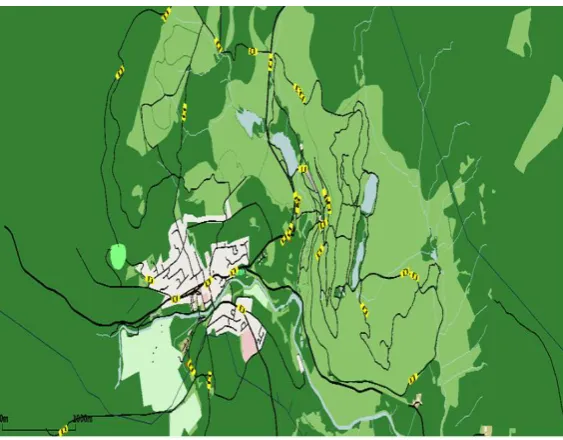
Figure 6. Open Street map in SUMO
V8 V7
Figure 7.Open Street map in OMNET and VEIN
The figure 6 shows the opens treet map view in sumo and figure 7 shows the open street map view in omnet which shows the communication among the vehicles. The rsu sends the data such as vehicle resources.
Figure 8.Vehicle Posx
Figure 9.Vehicle Posy
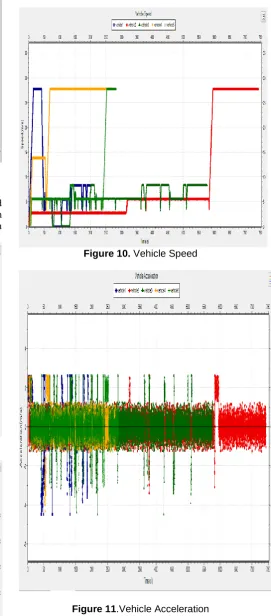
Figure 10. Vehicle Speed
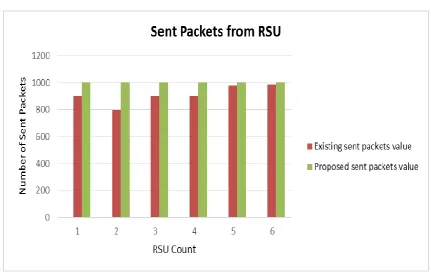
Figure 12. Sent Packets from vehicles
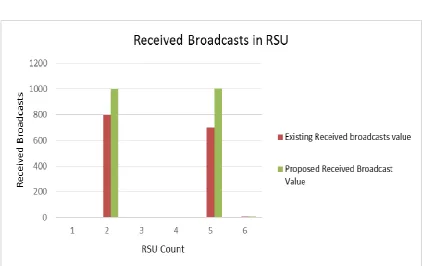
Figure 14. Received Broadcasts in vehicles
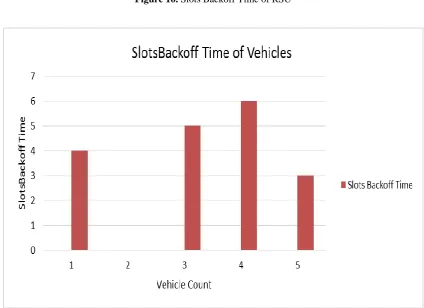
Figure 16. Slots Backoff Time of RSU
Figure 18. Total Time of Vehicles
Figure 19.Total Distance Travelled by vehicles
The vehicle Position x is plotted in the above graph as shown in figure 8. The movement of vehicles in x direction is plotted for five vehicles from the beginning till the end of the simulation. The vehicle Position y is plotted in the above graph as shown in figure 9. The movement of vehicles in y direction is plotted for five vehicles from the beginning to till the end of the simulation.The vehicle speed is calculated for five vehicles as shown in figure 10. The speed of the vehicle is calculated in (m/s). The vehicle acceleration is plotted in
5. Conclusion
VANET can be applied in vehicular communication, but the problem arises in vehicular communication due to improper load balancing. In this paper, we propose a Distributed spanning tree (DST) structure, which improves the fault-tolerant mechanism. Load is balanced efficiently using our proposed Distributed Spanning Tree. This structure minimizes both the failures such as communication and link failures between the vehicle to infrastructure, infrastructure to vehicle and vehicle to the vehicle. Quality of Service is enhanced by minimizing the end-to-end delay using our proposed approach. Fault tolerant load balancing is achieved using our proposed work. Our proposed DST serves the best solution in the vehicular network for systematic message delivery and communication between the vehicles. Fault tolerant load balancing in vehicular communication by applying DST will act as a framework for future VANET studies.Using the simulation tools such as OMNET, SUMO and Vein it provides better results.
References
[1] Jhang MF, Liao W. (2008) On cooperative and opportunistic channel access for vehicle to roadside (v2r) communications. IEEE global telecommunications conference, 1–5.
[2] Zhang Y, Zhao J, Cao G. (2010) Service scheduling of vehicle-roadside data access. Journal on Mob Netw Appl volume: 15(1), 83–96.
[3] Liren Zhang, Abderrahmane Lakas, Hesham El-Sayed, Ezedin Barka. (2013) Mobility analysis in vehicular adhoc network (VANET), Journal of Network and Computer Applicationvolume: 36(3), 1050-1056.
[4] Ashraph Sulaiman, Kasmir Raja, S.V. Sung Han Park. (2013) Improving scalability in vehicular communication using one-way hash chain method, Ad Hoc Networks volume: 11(8), 2526-2540.
[5] Sherazi, H.H.R. Raza, I. Chaudary, M.H. Hussain, S.A. Raza. M.H. (2014) Multi-radio over Fiber Architecture for Road Vehicle Communication in VANETs. Procedia Computer Science.volume: 32, 1022-1029.
[6] Omar Abdel Wahab, Hadi Otrok, Azzam Mourad. (2013) VANET QoS-OLSR: QoS-based clustering protocol for Vehicular Ad hoc Networks. Computer Communications volume: 36(13), 1422-1435.
[7] Chenn-Jung Huang, Yu-Wu Wang, Heng-Ming Chen, Ai-Lin Cheng, Jui-Jiun Jian, Han-Wen Tsai, Jia-Jian Liao. (2013) An adaptive multimedia streaming dissemination system for vehicular networks. Applied Soft Computing volume: 13(12), 4508-4518.
[8] Sylvain Dahan, Laurent Philippe, and Jean-Marc Nicod. (2009) The Distributed Spanning Tree Structure. IEEE Transactions on Parallel and Distributed Systemsvolume:
20(12).
[9] Kaouther Abrougui, Azzedine Boukerche, Hussam Ramadan. (2012) Performance evaluation of an efficient fault tolerant service discovery protocol for vehicular
networks, Journal of Network and Computer Applications, volume: 35(5), 1424-1435.
[10] Md.NawazAli, G.G.Edward Chan Wenzhong Li. (2013) On scheduling data access with cooperative load balancing in vehicular adhoc networks (VANETs). Springer. [11] Patricia Ruiz, Bernabé Dorronsoro, Pascal Bouvry,
Lorenzo Tardón. (2012) Information dissemination in VANETs based upon a tree topology, AdHoc Networks volume: 10(1), 111-127.
[12] Sherali Zeadally , Ray Hunt , Yuh-Shyan Chen , Angela Irwin , Aamir Hassan. (2010) Vehicular adhoc networks (VANETS): status, results, and challenges. Springer. [13] Saif Al-Sultan, Moath M. Al-Doori, Ali H. Al-Bayatti,
Hussien Zedan. (2014) A comprehensive survey on vehicular AdHoc network, Journal of Network and Computer Applicationsvolume: 37, 380-392.
[14] Richard Gilles Engoulou, Martine Bellaïche, Samuel Pierre, Alejandro Quintero. (2014) VANET security surveys, Computer Communicationsvolume: 44, 1-13. [15] Zhao J, Cao GV. (2008) Vehicle-assisted data delivery in
vehicular adhoc networks. IEEE Transaction Vehicular Technology.
[16] Wisitpongphan, N. Tonguz, O. Parikh, J. Mudalige, P. Bai, F. Sadekar, V. (2007) Broadcast storm mitigation techniques in vehicular adhoc networks, IEEE Wireless Communications.
[17] Niu, Z. Yao, W. Ni, Q. Song, Y. DeReq. (2007) A QoS routing algorithm for multimedia communications in vehicular adhoc networks, International Conference on Wireless Communications and Mobile Computing, ACM. [18] Hartenstein, H. Laberteaux, K.P.A. (2008) Tutorial survey
on vehicular adhoc networks. IEEE Communications Magazine.
[19] Baraa T. Sharef, Raed A. Alsaqour, Mahamod Ismail, Sardar M. Bilal. (2013) A Comparison of Various Vehicular Adhoc Routing Protocols Based on Communication Environments, ACM, ICUIMC(IMCOM). [20] Josiane Nzouonta, Neeraj Rajgure, Guiling (Grace) Wang.
(2009) VANET Routing on City Roads Using Real-Time Vehicular Traffic Information, IEEE Transactions On Vehicular Technologyvolume: 58(7).