EAI Endorsed Transactions on Energy Web 01 - 12 2014 | Volume 1 | Issue 2 | e3
Research Article
1
Consensus-based distributed control for economic
dispatch problem with comprehensive constraints in a
smart grid
J. Cao
1,*, M. Yu
1and L. J. Tung
11
Department of Electrical and Computer Engineering, Florida State University, Tallahassee, FL 32304
Abstract
Economic dispatch problem (EDP) has become more complex and challenging in power systems due to the introduction of smart grids. In a smart grid, it’s expensive and unreliable for the existing centralized controller to achieve a minimum cost when generating a certain amount of power. In this work, we define a quadratic cost function and comprehensive constraints to improve the consensus algorithm. We propose a distributed control approach based on the improved consensus algorithm to solve the EDP in a smart grid. Different from the centralized approach, the proposed approach enables each generator to collect the mismatch between power demands and generations in a distributed manner. The mismatch in power is used as a feedback for each generator to adjust its power generation. The incremental cost of the generator is selected as the consensus quantity that converges to a common value eventually. Simulation results of different case studies are provided to demonstrate the effectiveness of the proposed algorithm. The comparisons between the proposed approach and the existing ones are also presented.
Keywords: consensus algorithm, convergence, distributed control, economic dispatch problem, incremental cost, smart grid. Received on 25 July 2014, accepted on 23 September 2014, published on 02 December 2014
Copyright © 2014 J. Cao et al., licensed to ICST. This is an open access article distributed under the terms of the Creative Commons Attribution licence (http://creativecommons.org/licenses/by/3.0/), which permits unlimited use, distribution and reproduction in any medium so long as the original work is properly cited.
doi: 10.4108/ew.1.2.e3
*Corresponding author. Email:[email protected].
1. Introduction
Economic dispatch problem (EDP) is one of the essential problems in power system operation. Fundamentally, the EDP is an optimization problem aiming to reduce the total cost of power generators within certain constraints. Various mathematical methods and optimization techniques have been employed to solve the EDP. The existing methods include the lambda-iteration method [1], Lagrangian relaxation method [2], gradient projection method [3], interior point method [4], and dynamic programming [5]. In these methods, the EDPs are assumed to have a convex cost function. In order to handle a non-convex cost function, many optimization methods are developed, mainly including evolutionary programming [6], differential evolution [7], particle swarm optimization [8], genetic algorithm [9], simulated annealing [10], and tabu search [11].
The existing methods require global information via a centralized controller to achieve an optimal power generation and a minimum cost [12]. However, the centralized algorithm may cause a few problems in smart grids. First of all, the centralized controller requires a high level of connectivity, which may be impaired due to failures and modelling errors [13]. Secondly, the topologies of a smart grid and its communication network are likely to be variable. A small change in the smart grid may lead to reconfiguring the centralized algorithm [14]. Thirdly, collecting global information from all the generators may cause extra cost. Thus, the centralized controller is not suitable to solve the EDP in a smart grid.
Therefore, we investigate distributed control algorithms that can be used to solve EDP in the smart grid. Compared to the centralized algorithms, the distributed ones have significant advantages in information collection, robustness, and scalability. More specifically, no centralized controller or global information is needed by the distributed algorithms. Moreover, the distributed algorithms are adaptable to the changes of topologies. Therefore, the
plug-on Energy Web
and-play characteristic of smart grids can be accommodated by the distributed algorithms. However, the key to the distributed algorithms in smart grids is for all the generators to reach a consensus [15].
Consensus algorithms have been studied widely for the past two decades. The applications of the algorithms can be found in the area of system and control [16-17]. The main problem in a consensus algorithm is to reach an agreement regarding certain quantity of interest by using local information exchange [17]. Lately, the consensus algorithms have been used in smart grids related problems [18-19]. For example, a consensus-based algorithm is applied to solve the EDP in a smart grid [18]. The incremental cost of each generator is chosen as the consensus variable in order to meet the optimization requirement. To satisfy the power balance, the mismatch between the demand and total generations is fed back to the consensus algorithm so that the incremental cost will converge to the optimal value. The communication topology of the generators is assumed to be undirected and the information exchange is bidirectional. However, the assumption is not practical since the communication may not be symmetric in real-world situations [12]. Moreover, the algorithm is not completely distributed since a leader has to be selected to collect the power output from each generator in order to calculate the power mismatch.
Recently, a decentralized algorithm is proposed to solve the EDP in a smart grid, in which self-organized dynamic agents are equipped with the consensus protocol [19]. The effectiveness of the proposed algorithm is proved on 118 bus and 300 bus IEEE test networks. However, the generator dynamics is not considered in evaluating the convergence rate.
There are also other methods to solve the EDP in smart grids. For example, a heterogeneous wireless network architecture is presented to improve convergence speed in smart grids [23]. An intelligent quantum inspired evolutionary algorithm is proposed to perform the intelligent economic scheduling and dispatching [24]. A simultaneous perturbation technique is proposed to deal with equality and inequality constraints [25].
In this paper, we use the incremental cost as the consensus variable. The equal incremental cost criterion is also adopted to achieve the optimal dispatch. Compared to [15], in our study, each generator is not required to know the cost function parameters of other generators. It estimates the mismatch between the demand and generation in a collective manner. With a proper initialization, the local estimate of the mismatch may not be equal to the actual one. But the summation of all the local mismatches is exactly equal to the actual one. In our model, the leader generator is not needed to collect all the power output of each generator. The local estimate of the mismatch is used to adjust the power generation as if it is the actual mismatch. The incremental cost converges to an optimal value in our algorithm. Different from [15], the communication among power generators can be unidirectional.
We extend the cost function by adding comprehensive generator constraints in order to study the transients of the proposed algorithm. The generator’s dynamics is included in our simulation model. We study the performance of the consensus-based distributed control algorithm under different communication topologies. We also compare the performance to that of the conventional EDP methods. The results are illustrated in different case studies. As compared to the existing consensus-based algorithms, the proposed approach avoids prohibited operation zones, considers transmission line power flow limits, and improves the accuracy of the optimal solution by applying power loss into the cost function of the consensus algorithm.
The paper is organized as follows. In Section II, we define our cost function with comprehensive constraints. In Section III, the fundamental graph theory and the improved consensus algorithm are presented. Simulation results of different case studies are shown in Section IV. Comparisons between the consensus algorithm and the conventional ones are carried out in Section V. Section VI concludes the paper.
2. Definition of economic dispatch
problem
In this section, we explain the EDP with transmission losses and generator constraints in a smart grid.
2.1. EDP cost function
The objective of the EDP is to minimize the total cost of power generation. A quadratic cost function of i-th generator is given as follows:
i i i i i i
i
P
P
P
C
(
)
2
(1)where Pi is the output power of generator i, αi, βi, γi are the cost coefficients of generator i. Then the total cost of operation for all generators is calculated as:
i i i i i m
i i i
t
C
P
P
P
C
2
1
)
(
(2)where m is the number of power generators.
2.2. Transmission loss
The total transmission loss is a function of the generator power outputs, which can be represented using B
coefficients as follows [20]:
m im
j
m
i i i j
ij i
l
P
B
P
B
P
B
P
1 1 1
00
0 (3)
EAI Endorsed Transactions on Energy Web 01 - 12 2014 | Volume 1 | Issue 2 | e3
Consensus-based distributed control for economic dispatch problem with comprehensive constraints in a smart grid
3
2.3. Practical constraints of generator
Power balance
l d m
i
i
P
P
P
1
(4)
where Pd and Pl are the power demand and loss, respectively.
Ramp rate limit
As in [8], we assume that the constraints of ramp rate limits for generation changes are given.
When generation increases,
i i
i
P
UR
P
0
(5)and when generation decreases,
i i
i
P
DR
P
0
(6)where Pi and Pi0are the current and previous output power, respectively. URi and DRi are the up ramp and down ramp limits of the i-th generator, respectively.
Generation limit
Each generator has to satisfy its own generation limits, that is,
max min
i i
i
P
P
P
(7)where Pimin and Pimax are the minimum and maximum output of the i-th generator, respectively.
Prohibited operation zone
A typical thermal unit with many valve points can generate prohibited operation zones. In practice, a generator has to avoid operating in the prohibited zones. The expression of the operation zones can be found as follows:
l i i
i
P
P
P
min
,1l j i i u
j
i
P
P
P
, 1
,max
, i i
u n
i
P
P
P
, j = 2, 3, … , n (8) where n is the number of prohibited zones of generator i. , , , and are the sectional operation limits of generator i.Line flow constraint
The power flow of a transmission line should remain less than the maximum capacity of the power that can be carried by the line, i.e.,
max , ,k Linek
Line
P
P
(9)where PLine,k is the power flow of line k, and
max ,k Line
P
is the maximum capacity of line k.3. Consensus algorithm
In this section, we introduce the basic graph theory and our improved consensus algorithm to solve the EDP.
3.1. Graph theory
A graph G is used to model the power system components and the way they exchange information based on communication theory [14]. Let G = (V, E, A), where V is a set of elements called nodes, E is a set of pairs of distinct nodes called edges, and A = [aij] Rn×nis the adjacency matrix. A directed graph is a graph where the edges have directions associated with them. In a smart grid, nodes represent the buses of the power system, the edges represent the transmission lines between the buses, and the adjacency matrix represents the edge weights. A directed edge from i
to j is denoted by a pair (i, j) E. The pair (i, j) means that generator j can receive information from generator i. The
in-neighbor of the i-th generator is denoted by
N
i= {j V | (j, i) E}. Likewise, the out-neighbor of the i-th generatoris denoted by
N
i = {j
V | (i, j) E}. Practically, a generator can receive information from its in-neighbor, and send information to its neighbor. The in-degree andout-degree of node i is denoted as
d
i
N
i andd
i
N
i ,respectively. A directed graph is strongly connected if there exists a connection between any pair of two nodes. It’s noted that
d
i
0
and
0
i
d
in a strongly connected graph.3.2. Consensus algorithm
Two matrices P, Q Rn×n, where P = {pi,j}, and Q = {qi,j}, associated with a strongly connected graph G = (V, E, A) can be defined as:
V j i otherwise
N j d
p i
i j
i
,
0 1
, (10)
V j i otherwise
N j d
q i
i j
i
,
0 1
, (11)
It’s noted that the summation of row elements of P is equal to unit, and the summation of column elements of Q is equal to unit. The i-th row of P represents the weights of in-neighbors of node i. Likewise, the i-th column of Q
i N j j j i i(
k
1
)
p
,
(
k
)
(12)
i N j j j ii
(
k
1
)
q
(
k
)
' ,
'
(13)where ξi(k) and ξi’(k) are the state variables associated with node i in graph G at time step k. In a smart grid, the state variable represents a physical quantity such as the output power, incremental cost, or power mismatch, etc. Equations (12) and (13) have the same structures but with two different sets of weights. In Eqn. (12), all state variables converge to a common value. In Eqn. (13), all state variables do not converge to a common value, but the summation of all state variables is constant [12]. That is:
k
k
n i n i ii
1(
)
1(
0
)
,
''
(14)3.3. Solution to the EDP
The incremental cost of the i-th generator is derived as:
i i i i i i i
P
dP
P
dC
(
)
2
(15)According to the incremental cost criterion, when all the generators operate at the optimal point, the incremental costs are equal to the optimal value, that is:
i i i
i
P
*
*
2
(16)Therefore, the optimal output of the i-th generator can be obtained from (16):
i i i i
P
2
* *
(17)Let us denote by λi(k) the estimation of the optimal incremental cost of the i-th generator, Pi(k) the estimated optimal power output of the i-th generator, and ΔPi(k) the estimated local power mismatch between the power demand and total power generations.
The main process for the consensus algorithm is stated as follows:
i N j i j j ii
(
k
1
)
p
,
(
k
)
P
(
k
)
(18)i i
i
i
k
k
P
(
1
)
(
(
1
)
)
/
2
/
(19)
i N j i i j j ii
k
q
P
k
P
k
P
k
P
(
1
)
,(
)
(
(
1
)
(
))
(20)where ε is a small positive constant, and k is the time step. The initializations of λi(0), Pi(0), and ΔPi(0) are selected as feasible constant values.
It’s noted that Eqns. (18), (19), and (20) are iterative and only need local information to be updated. For generator i, it only requires information from its in-neighbors. Therefore, the iteration process is a distributed algorithm.
The algorithm is stable if the constant ε is small enough. All the state variables converge to the optimal values, that is,
V
i
k
for
,
0
)
(
,
)
(
,
)
(
k
*P
ik
P
i*
P
ik
i
(21)4. Simulation results
In this section, four case studies are carried out to evaluate the performance of the proposed consensus-based distributed algorithm. A smart grid of five generators is developed using Matlab/Simulink in discrete time step, as shown in Fig. 1.
The simulation models can be divided into three main layers: power layer, communication layer, and control layer. The system of five generators is modelled in the power layer. A simplified synchronous generator block in Matlab is used to model the generator dynamics in this layer. The start-up dynamic is modelled by this block that represents the excitation and server inertia.
The power mismatch is fed back to the power layer in order to guarantee the convergence of the algorithm. A communication network is built in the communication layer. A unit communication is assumed in this layer. The communication delay is also considered in this layer. The proposed consensus algorithm is implemented in the control layer. The implementation of the consensus is based on Eqns. (18), (19), and (20). Each generator is connected to other generators by power transmission lines and communication signals.
The five-unit smart grid is shown in Fig. 1. The communication topology is shown in Fig. 2.
Based on Fig. 2, the matrices P and Q can be derived from Eqns. (10) and (11):
EAI Endorsed Transactions on Energy Web 01 - 12 2014 | Volume 1 | Issue 2 | e3
Consensus-based distributed control for economic dispatch problem with comprehensive constraints in a smart grid
5
It’s apparent that P and Q are row- and column- unit-summation, respectively.
The parameters of the five generators are shown in Table I. The constraints are listed in Table II. The load power demand is 850 MW.
4.1. Case study 1: without generator
constraints
In this case, no generator constraint or transmission line loss is considered. The convergence rate ε is equal to 0.0005. A small convergence rate will guarantee the stability of the algorithm. The simulation is carried out at a discrete time step of 0.001s. The generator output, incremental cost, and total power generation are plotted in the following figures.
Consensus-based Control algorithm G1
G2 G3
G4 G5
Communication layer
Control layer G1
G2
G3
G4
G5
Power layer Power
Mismatch
Incremental Cost
Figure 1. The simulation model of a five-generator smart grid, in which three main layers are indicated,
five generators are modelled in power layer; communication topology is represented in communication layer; and the consensus algorithm is
implemented in control layer.
G1
G2
G5
G3
G4
Figure 2. Communication topology of five generators: star topology.
Table 1. Parameters of the five generators
Gen.
1 50 200 561 7.92 0.00156
2 200 500 310 7.85 0.00194
3 50 200 78 7.97 0.00482
4 50 300 561 7.92 0.00156
5 50 200 78 7.97 0.00482
Figure 3. Case 1: the incremental cost of the five generators.
Figure 4. Case 1: the power generations and demand.
0 0.01 0.02 0.03 0.04 0.05 8
8.2 8.4 8.6 8.8 9
Incremental Cost
Time (S)
Inc
re
m
ent
al
C
os
t
($/
M
W
h)
Table 2. Constraints of generators
Gen. UR DR Prohibited zones
1 100 120 [90110]
2 100 120 [350380]
3 100 120 [90110]
4 100 120 [90110]
5 100 120 [90110]
Figure 3 shows that the incremental costs of the five generators all converge to the optimal value, i.e., . The corresponding power outputs of the generators are 243.9MW, 214.4MW, 73.86MW, 243.9MW, and 73.86MW, respectively. The comparison between power demand and total power generation is given in Fig. 4. It can be seen that the optimal power generation is achieved at 0.04s.
4.2. Case study 2: with generator constraints
In this case, the generator’s constraints and transmission line loss are considered for a more practical situation. For example, the generator should satisfy its operation constraints such as the operation limits, UR/DR rates, and prohibited zones. The incremental costs and power generations are presented in Figs. 5 and 6, respectively. It can be seen that generation 1 reaches its limit at 0.007 sec. Its incremental cost settles at λ1 = 8.545$/MWh. However, in order to satisfy power balance, the other four generators have to generate more power. The corresponding incremental cost will increase as indicated by Fig. 5. The new optimal incremental cost for the four generators is λ* = 8.752$/MWh. The optimal power outputs are 200MW, 232.5MW, 81.12MW, 266.3MW, and 81.12MW, respectively. The power generation and power loss are 861.04MW and 11.04MW, respectively.
Figure 5. Case study 2: the incremental cost of the five generators.
Figure 6. Case study 2: the power generation, power loss, and power demand.
4.3. Case study 3: with a different
communication topology
In this case, a different communication topology is presented in order to test the capability of the proposed algorithm. Different from the star topology in Fig. 2, a loop topology is shown in Fig. 7.
G1
G2 G5
G3 G4
Figure 7. Communication topology of five generators: loop connection.
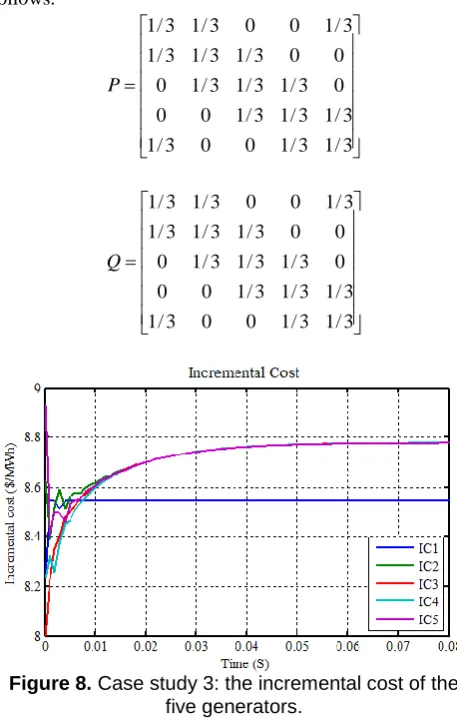
It’s observed that this topology has a slightly higher incremental cost than the star topology in case 1.
EAI Endorsed Transactions on Energy Web 01 - 12 2014 | Volume 1 | Issue 2 | e3
Consensus-based distributed control for economic dispatch problem with comprehensive constraints in a smart grid
7
Compared to case 2, it takes slightly more time for the generators in case study 3 to reach the optimal generations. It also requires more generations from the generators. The power outputs of five generators are: 200MW, 239.2MW, 83.86MW, 274.8MW, and 83.81MW, respectively. The corresponding power generation and power loss are 881.67MW and 31.67MW, respectively.
The corresponding matrices P and Q are derived as follows.
3 / 1 3 / 1 0 0 3 / 1
3 / 1 3 / 1 3 / 1 0 0
0 3 / 1 3 / 1 3 / 1 0
0 0 3 / 1 3 / 1 3 / 1
3 / 1 0 0 3 / 1 3 / 1
P
3 / 1 3 / 1 0 0 3 / 1
3 / 1 3 / 1 3 / 1 0 0
0 3 / 1 3 / 1 3 / 1 0
0 0 3 / 1 3 / 1 3 / 1
3 / 1 0 0 3 / 1 3 / 1
Q
Figure 8. Case study 3: the incremental cost of the five generators.
It can be concluded that different topologies can have different convergence speeds on the consensus algorithm.
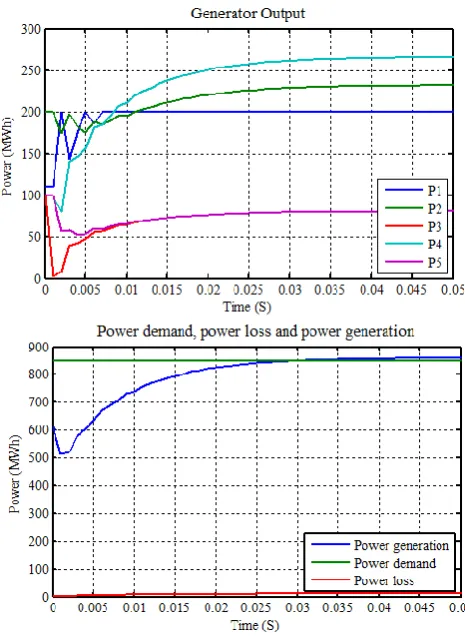
4.4. Case study 4: with generator dynamics
In this case, the dynamics of generators are considered. The characteristics of the generators are modelled using the simplified synchronous generator from Matlab/Simulink. The simulation results are shown in the following figures.
It’s noted that it takes a longer time for the generators to reach a consensus due to the inertia of the generators. After about 2s, the generators reach the same consensus as in case 2. Similar dynamics are exhibited in the power generations. The generator power outputs are presented in Fig. 11. The power balance is validated in Fig. 12.
Figure 9. Case study 3: the power generation, power loss and power demand.
Figure 10. Case study 4: the incremental cost for the five generators.
Figure 12. Case study 4: the power generation, power loss and power demand.
5. Comparison with conventional
algorithms
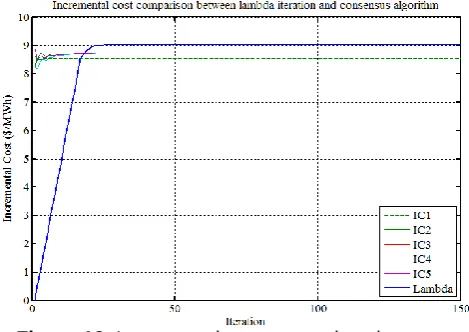
In this section, the performance of proposed consensus algorithm is compared to the conventional EDP solutions. Lambda iteration and particle swarm optimization (PSO) are chosen as examples to compare with the consensus-based distributed algorithm. The scenario in case study 2 is used for the comparison. The results of the incremental cost and total cost are listed in the following figure, respectively.
Figure 13. Incremental cost comparison between lambda iteration and consensus algorithm.
Compared to the lambda iteration, the consensus-based algorithm has a smaller optimal incremental cost. It takes less time for the consensus algorithm to reach its optimal point. In terms of the total cost, the consensus algorithm has a similar cost to the lambda iteration. Among the three algorithms, the PSO has the largest total cost. It needs more iterations to reach the optimal point. In summary, the proposed consensus algorithm has better performance than the lambda iteration and PSO methods.
Figure 14. Cost comparison between lambda iteration, PSO and consensus algorithm.
6. Conclusion
A consensus-based distributed algorithm is proposed in this paper to solve the EDP in smart grids. The convex cost function with comprehensive constraints is defined to improve the solution to the EDP. An improved consensus algorithm is proposed for the generators to obtain the power mismatch in a distributed manner. The locally estimated power mismatch is then used to calculate the power generation of each generator. As illustrated by the simulation results, all generators converge to the optimal generations that are subject to the generator constraints and power balance. Different communication topologies have different effects on the convergence rate of the consensus algorithm. The dynamics of generators may also increase the convergence time of consensus algorithm. The simulation results are presented in several case studies.
The effect of communication topology on the iteration speed of the consensus algorithm is not critical. A large convergence constant may cause system instability. The dynamic of motors is a key factor that affects the iteration speed of consensus algorithm.
The consensus-based algorithm has a lower cost and fewer iterations as compared to the conventional methods including the lambda iteration and PSO methods.
EAI Endorsed Transactions on Energy Web 01 - 12 2014 | Volume 1 | Issue 2 | e3
Consensus-based distributed control for economic dispatch problem with comprehensive constraints in a smart grid
9
References
[1] Dike, D. O., Adinfono, M. I., and Ogu, G. (2013) Economic dispatch of generated power using modified lambda-iteration method. IOSR Journal of Electrical and Electronics Engineering 7(1): 49-54.
[2] Lee, F. N. and Breipohl, A. M. (1993) Reserve constraints economic dispatch with prohibited operating zones. IEEE Trans. Power Syst. 8(1): 246-254.
[3] Wood, A. J., Wollenberg, B. F. (1996) Power generation, operation, and control, 2nd ed. (India: Wiley).
[4] Han, X. S. and Gooi, H. B. (2007) Effective economic dispatch model and algorithm. International Journal of Electrical Power and Energy Systems 29(2): 113-120. [5] Tashiro, T., Tamura, K., and Yasuda, K. (2011) Modeling
and optimal operation of distributed energy systems via dynamic programming. In Proceedings of IEEE Int. Conf. SMC, Anchorage, AK, USA, Oct. 9 (IEEE), 808-813. [6] Sinha, N., Chakrabarti, R., and Chattopadhyay, P. K. (2003)
Evolutionary programming techniques for economic load dispatch. IEEE Trans. Evolutionary Computation 7(1): 83-94. [7] Balamurugan, B. and Subramanian, R. (2008) An improved differential evolution based dynamic economic dispatch with nonsmooth fuel cost function. Journal of Electrical Systems
3(8): 828-843.
[8] Gaing, Z. L. (2003) Particle swarm optimization to solving the economic dispatch considering the generator constraints. IEEE Trans. Power Systems 18(3): 1187-1195.
[9] Biswas, S. D. and Debbarma, A. (2012) Optimal operation of large power system by GA method. Journal of Emerging Trends in Engineering and Applied Sciences 3(1): 1-7. [10] Panigrahi, C. K., Chattopadhyay, P. K., Chakrabarti, R. N.,
and Basu, M. (2006) Simulated annealing technique for dynamic economic dispatch. Electric Power Components and Systems 34: 577-586.
[11] Pothiya, S., Ngamroo, I., and Kongprawechmon, W. (2007) Application of multiple tabu search algorithm to solve dynamic economic dispatch considering generator constraints. Elsevier on Energy Conversion and Management
49(4): 506-516.
[12] Yang, S., Tan, S., and Xu, J. (2013) Consensus based approach for economic dispatch problem in a smart grid. IEEE Trans. Power Systems 28(4): 4416-4426.
[13]Binetti, G., Davoudi, A., Naso, D., Turchiano, G., and Lewis, F. L. (2014) A distributed auction-based algorithm for the nonconvex economic dispatch problem. IEEE Trans. Industrial Informatics 10(2): 1124-1132.
[14]Binetti, G., Davoudi, A., Lewis, F. L., Naso, D., and Turchiano, B. (2014) Distributed consensus-based economic dispatch with transmission losses IEEE Trans. Power Systems
29(4): 1711-1720.
[15]Zhang, Z. and Chow M. Y. (2012) Convergence analysis of the incremental cost consensus algorithm under different communication network topologies in a smart grid. IEEE Trans. Power Systems 27(4): 1761-1768.
[16]Olfati-Saber, R. and Murray, R. M. (2004) Consensus problems in networks of agents with switching topology and time-delays. IEEE Trans. Automatic Control 49(9): 1520-1533, Sep. 2004.
[17]Wei, R., Beard, R. W., and Atkins, E. M. (2005) A survey of consensus problems in multi-agent coordination. In Proceedings of American Control Conference, June 8 (IEEE), 1859-1864.
[18]Zhang, Z. and Chow, M. Y. (2011) Incremental cost consensus algorithm in a smart grid environment. In Proceedings of IEEE Power and Energy Society General Meeting, San Diego, CA, Jul. 2011 (IEEE), 1-6.
[19]Loia, V., and Vaccaro, A. (2014) Decentralized economic dispatch in smart grids by self-organizing dynamic agents. IEEE Trans. Systems, Man, and Cybernetics: Systems 44(4): 397-408.
[20]Glover, J. D., Sarma, M. S., and Overbye, T. J. (2012). Power System Analysis and Design, 5th ed. (Cengage Learning).
[21]Dogra, R., Gupta, N., and Saroa, H. (2014) Economic load dispatch problem and Matlab programming of different methods. In Proceedings of International Conf. of Advanced Research and Innovation, Jan. 10, (ICARI), 202-207.
[22]Chen, C. L., Jan, R. M., Lee, T. Y., and Chen, C. H. (2009) A novel particle swarm optimization algorithm solution of economic dispatch with valve point loading. Journal of Marine Science and Technology 19(1): 43-51.
[23] Liang, H., Choi, B. J., Abdrabou, A., Zhuang, W., and Shen, X. (2012) Decentralized economic dispatch in microgrids via heterogeneous wireless networks. IEEE Journal on Selected Areas in Communications 30(6): 1061-1074.
[24] Chakraborty, S., Ito, T., Senjyu, T., and Saber, A. Y. (2013) Intelligent economic operation of smart-grid facilitating fuzzy advanced quantum evolutionary method. IEEE Trans. On Sustainable Energy 4(4): 905-916.