Defoiling Foiled Image Captions
Pranava Madhyastha, Josiah Wang and Lucia Specia Department of Computer Science
University of Sheffield, UK
{p.madhyastha, j.k.wang, l.specia}@sheffield.ac.uk
Abstract
We address the task of detecting foiled im-age captions, i.e. identifying whether a cap-tion contains a word that has been deliber-ately replaced by a semantically similar word, thus rendering it inaccurate with respect to the image being described. Solving this problem should in principle require a fine-grained un-derstanding of images to detect linguistically valid perturbations in captions. In such con-texts, encoding sufficiently descriptive image information becomes a key challenge. In this paper, we demonstrate that it is possible to solve this task using simple, interpretable yet powerful representations based on explicit ob-ject information. Our models achieve state-of-the-art performance on a standard dataset, with scores exceeding those achieved by hu-mans on the task. We also measure the upper-bound performance of our models using gold standard annotations. Our analysis reveals that the simpler model performs well even without image information, suggesting that the dataset contains strong linguistic bias.
1 Introduction
Models tackling vision-to-language (V2L) tasks, for example Image Captioning (IC) and Visual Question Answering (VQA), have demonstrated impressive results in recent years in terms of au-tomatic metric scores. However, whether or not these models are actually learning to address the tasks they are designed for is questionable. For ex-ample, Hodosh and Hockenmaier (2016) showed that IC models do not understand images suffi-ciently, as reflected by the generated captions. As a consequence, in the last few years many diagnos-tic tasks and datasets have been proposed aiming at investigating the capabilities of such models in more detail to determine whether and how these models are capable of exploiting visual and/or lin-guistic information (Shekhar et al.,2017b;
John-son et al., 2017; Antol et al., 2015;Chen et al.,
2015;Gao et al.,2015;Yu et al.,2015;Zhu et al.,
2016).
FOIL (Shekhar et al., 2017b) is one such dataset. It was proposed to evaluate the ability of V2L models in understanding the interplay of ob-jects and their attributes in the images and their relations in an image captioning framework. This is done by replacing a word in MSCOCO (Lin et al., 2014) captions with a ‘foiled’ word that is semantically similar or related to the original word (substitutingdogwithcat), thus rendering the im-age caption unfaithful to the imim-age content, while yet linguistically valid. Shekhar et al.(2017b) re-port poor performance for V2L models in classi-fying captions as foiled (or not). They suggested that their models (using image embeddings as in-put) are very poor at encoding structured visual-linguistic information to spot the mismatch be-tween a foiled caption and the corresponding con-tent depicted in the image.
In this paper, we focus on the foiled captions classification task (Section2), and propose the use ofexplicit object detectionsas salient image cues for solving the task. In contrast to methods from previous work that make use of word based in-formation extracted from captions (Heuer et al.,
2016;Yao et al., 2016; Wu et al., 2018), we use explicit object category information directly ex-tracted from the images. More specifically, we use an interpretablebag of objectsas image represen-tation for the classifier. Our hypothesis is that, to truly ‘understand’ the image, V2L models should exploit information about objects and their rela-tions in the image and not just global, low-level image embeddings as used by most V2L models.
Our main contributions are:
1. A model (Section3) for foiled captions clas-sification using a simple and interpretable
object-based representation, which leads to the best performance in the task (Section4);
2. Insights on upper-bound performance for foiled captions classification using gold stan-dard object annotations (Section4);
3. An analysis of the models, providing insights into the reasons for their strong performance (Section5).
Our results reveal that the FOIL dataset has a very strong linguistic bias, and that the proposed simple object-based models are capable of finding salient patterns to solve the task.
2 Background
In this section we describe the foiled caption clas-sification task and dataset.
We combine the tasks and data from Shekhar et al. (2017b) andShekhar et al. (2017a). Given an image and a caption, in both cases the task is to learn a model that can distinguish between a REAL caption that describes the image, and a FOILed caption where a word from the original caption is swapped such that it no longer describes the image accurately. There are several sets of ‘foiled captions’ where words from specific parts of speech are swapped:
• Foiled Noun:In this case a noun word in the original caption is replaced with another sim-ilar noun, such that the resultant caption is not the correct description for the image. The foiled noun is obtained from list of object an-notations from MSCOCO (Lin et al., 2014) and nouns are constrained to the same super-category;
• Foiled Verb:Here, verb is foiled with a sim-ilar verb. The simsim-ilar verb is extracted using external resources;
• Foiled Adjective and Adverb: Adjectives and adverbs are replaced with similar adjec-tives and adverbs. Here, the notion of similar-ity again is obtained from external resources;
• Foiled Preposition:Prepositions are directly replaced with functionally similar preposi-tions.
The Verb, Adjective, Adverb and Preposition subsets were obtained using a slightly different
methodology (seeShekhar et al.(2017a)) than that used for Nouns (Shekhar et al.,2017b). Therefore, we evaluate these two groups separately.
3 Proposed Model
For the foiled caption classification task (Sec-tion 3.1), our proposed model uses information from explicit object detections as an object-based image representation along with textual represen-tations (Section 3.2) as input to several different classifiers (Section3.3).
3.1 Model definition
Let y ∈ {REAL, FOIL} denote binary class
la-bels. The objective is to learn a model that com-putesP(y|I;C), whereI andCcorrespond to the
image and caption respectively. Our model seeks to maximize a scoring functionθ:
y= arg maxθ(I;C) (1)
3.2 Representations
Our scoring function θ takes in image features
and text features (from captions) and concatenates them. We experiment with various types of fea-tures.
For the image side, we propose a bag of ob-jectsrepresentation for 80 pre-defined MSCOCO categories. We consider two variants: (a)Object Mention: A binary vector where we encode the presence/absence of instances of each object cate-gory for a given image; (b)Object Frequency: A histogram vector where we encode thenumberof instances of each object category in a given image. For both features, we useGoldMSCOCO ob-ject annotations as well asPredicted object detec-tions using YOLO (Redmon and Farhadi, 2017) pre-trained on MSCOCO to detect instances of the 80 categories.
As comparison, we also compute a stan-dard CNN-based image representation, using the POOL5 layer of a ResNet-152 (He et al., 2016) CNN pre-trained on ImageNet. We posit that our object-based representation will better capture se-mantic information corresponding to the text com-pared to the CNN embeddings used directly as a feature by most V2L models.
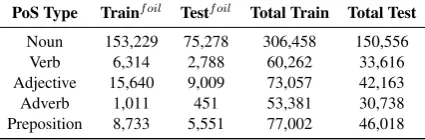
PoS Type Trainf oil Testf oil Total Train Total Test Noun 153,229 75,278 306,458 150,556
Verb 6,314 2,788 60,262 33,616
Adjective 15,640 9,009 73,057 42,163
Adverb 1,011 451 53,381 30,738
[image:3.595.75.288.64.134.2]Preposition 8,733 5,551 77,002 46,018
Table 1: Dataset statistics for different foiled parts of speech. The superscriptf oilindicates the number of
foiled captions.
Our intuition is that an image descrip-tion/caption is essentially a result of the interac-tion between important objects in the image (this includes spatial relations, co-occurrences, etc.). Thus, representations explicitly encoding object-level information are better suited for the foiled caption classification task.
3.3 Classifiers
Three types of classifiers are explored: (a) Mul-tilayer Perceptron (MLP): For BOW-based text representations, a two 100-dimensional hidden
layer MLP with ReLU activation function is used with cross-entropy loss, and is optimized with Adam (learning rate 0.001); (b) LSTM Classifier: For LSTM-based text representa-tions, a uni-directional LSTM classifier is used with 100-dimensional word embeddings and 200-dimensional hidden representations. We train it using cross-entropy loss and optimize it using Adam (learning rate 0.001). Image representa-tions are appended to the final hidden state of the LSTM; (c)Multimodal LSTM (MM-LSTM) Classifier: As above, except that we initialize the LSTM with the image representation instead of appending it to its output. This can also be seen as am image grounded LSTM based classifier.
4 Experiments
Data: We use the dataset for nouns from
Shekhar et al.(2017b)1 and the datasets for other parts of speech from Shekhar et al. (2017a) 2. Statistics about the dataset are given in Table 1. The evaluation metric is accuracy per class and the average (overall) accuracy over the two classes.
Performance on nouns: The results of our ex-periments with foiled nouns are summarized in Ta-ble2. First, we note that the models that useGold
1https://foilunitn.github.io/
2The authors have kindly provided us the datasets.
Feats Overall Real Foil Blind (LSTM only)† 55.62 86.20 25.04
HieCoAtt† 64.14 91.89 36.38
CNN + BOW MLP 88.42 86.89 89.97 Predict Mention + BOW MLP 94.94 95.68 94.23 Predict Freq + BOW MLP 95.14 95.82 94.48 Gold Mention + BOW MLP 95.83 96.30 95.36 Gold Freq + BOW MLP 96.45 96.04 96.85 CNN + LSTM 87.45 86.78 88.14 Predict Freq + LSTM 85.99 85.17 86.81 Gold Freq + LSTM 87.38 86.62 88.18 Predict Freq + MM-LSTM 87.90 86.73 88.95 Gold Freq + MM-LSTM 89.02 88.35 89.72 Human (majority)† 92.89 91.24 94.52
Table 2: Accuracy on Nouns dataset. † are taken di-rectly from Shekhar et al. (2017b). HieCoAtt is the state of the art reported in the paper.
bag of objects information are the best performing models across classifiers. We also note that the performance is better than human performance. We hypothesize the following reasons for this: (a) human responses were crowd-sourced, which could have resulted in some noisy annotations; (b) our gold object-based features closely resembles the information used for data-generation as de-scribed inShekhar et al.(2017b) for the foil noun dataset. The models using Predicted bag of ob-jects from a detector are very close to the perfor-mance ofGold. The performance of models us-ing simple bag of words (BOW) sentence repre-sentations and anMLPis better than that of mod-els that use LSTMs. Also, the accuracy of the bag of objects model with Frequency counts is higher than with the binaryMentionvector, which only encodes the presence of objects. The Multi-modal LSTM (MM-LSTM) has a slightly better performance thanLSTMclassifiers. In all cases, we observe that the performance is on par with human-level accuracy. Our overall accuracy is substantially higher than that reported inShekhar et al. (2017b). Interestingly, our implementation ofCNN+LSTMproduced better results than their equivalent model (they reported 61.07% vs. our 87.45%). We investigate this further in Section5.
Classifier Overall Real Foil
VB
Gold Freq + BOW MLP 84.03 97.38 70.68 Gold Freq + MM-LSTM 87.90 99.48 76.32
HieCoAtt† 81.79 - 57.94
ADJ
Gold Freq + BOW MLP 87.74 96.96 78.52 Gold Freq + MM-LSTM 92.29 85.82 98.77
HieCoAtt† 86.00 - 80.05
AD
V Gold Freq + BOW MLP 54.99 98.49 11.48 Gold Freq + MM-LSTM 56.55 99.45 13.65
HieCoAtt† 53.40 - 14.73
PREP
Gold Freq + BOW MLP 75.53 92.61 58.45 Gold Freq + MM-LSTM 89.74 95.59 83.89
[image:4.595.75.289.63.229.2]HieCoAtt† 74.91 - 61.92
Table 3: Accuracy on Verb, Adjective, Adverb and Preposition datasets, usingGold Frequencyas the im-age representation. † is the best performing model as reported inShekhar et al.(2017a).
model does not use gold object information and may thus not be directly comparable – we how-ever recall that only a slight drop in accuracy was found for our models when using predicted object detections rather than gold ones. Our findings are summarized in Table3. The classification perfor-mance is not as high as it was for the nouns dataset. Noteworthy is the performance on adverbs, which is significantly lower than the performance across other parts of speech. We hypothesize that this is because of the imbalanced distribution of foiled and real captions in the dataset. We also found that the performance ofLSTM-based models on other parts of speech datasets are almost always better thanBOW-based models, indicating the necessity of more sophisticated features.
5 Analysis
In this section, we attempt to better understand why our models achieve such a high accuracy.
5.1 Ablation Analysis
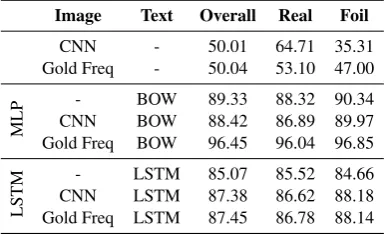
We first perform ablation experiments with our proposed models over the Nouns dataset (FOIL). We compute image-only models (CNN or Gold Frequency) and text-only models (BOW or LSTM), and investigate which components of our model (text or image/objects) contribute to the strong classification performance (Table4). As ex-pected, we cannot classify foiled captions given only image information (global or object-level), resulting in chance-level performance.
On the other hand, text-only models achieve a
very high accuracy. This is a central finding, sug-gesting that foiled captions are easy to detect even without image information. We also observe that the performance ofBOWimproves by adding ob-jectFrequencyimage information, but notCNN image embeddings. We posit that this is because there is a tighter correspondence between the bag of objects and bag of word models. In the case of LSTMs, adding either image information helps slightly. The accuracy of our models is substan-tially higher than that reported in Shekhar et al.
(2017b), even for equivalent models.
We note, however, that while the trends of im-age information is similar for other parts of speech datasets, the performance ofBOW based models are lower than the performance of LSTM based models. The anomaly of improved performance ofBOWbased models seems heavily pronounced in the nouns dataset. Thus, we further analyze our model in the next section to shed light on whether the high performance is due to the models or the dataset itself.
Image Text Overall Real Foil
CNN - 50.01 64.71 35.31
Gold Freq - 50.04 53.10 47.00
MLP
- BOW 89.33 88.32 90.34 CNN BOW 88.42 86.89 89.97 Gold Freq BOW 96.45 96.04 96.85
LSTM
- LSTM 85.07 85.52 84.66 CNN LSTM 87.38 86.62 88.18 Gold Freq LSTM 87.45 86.78 88.14
Table 4: Ablation study on FOIL (Nouns).
5.2 Feature Importance Analysis
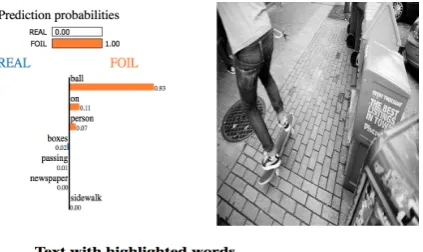
[image:4.595.320.514.370.487.2]Figure 1: Classifier’s prediction for the foiled caption: The classifier is able to correctly classify the foiled cap-tion and uses the foiled word as the trigger for classifi-cation.
the claim inShekhar et al.(2017b) that special at-tention was paid to avoid linguistic biases in the dataset.3 We note that we were not able to de-tect the linguistic bias in the other parts of speech datasets.
6 Conclusions
We presented an object-based image representa-tion derived from explicit object detectors/gold an-notations to tackle the task of classifying foiled captions. The hypothesis was that such mod-els provide the necessary semantic information for the task, while this informaiton is not ex-plicitly present in CNN image embeddings com-monly used in V2L tasks. We achieved state-of-the-art performance on the task, and also pro-vided a strong upper-bound using gold annota-tions. A significant finding is that our simple models, especially for the foiled noun dataset, perform well even without image information. This could be partly due to the strong linguis-tic bias in the foiled noun dataset, which was revealed by our analysis on our interpretable object-based models. We release our analysis and source code at https://github.com/
sheffieldnlp/foildataset.git.
Acknowledgments
This work is supported by the MultiMT project (H2020 ERC Starting Grant No. 678017). The au-thors also thank the anonymous reviewers for their valuable feedback on an earlier draft of the paper.
3Shekhar et al.(2017b) have acknowledged about the bias in our personal communications and are currently working on a fix
References
Stanislaw Antol, Aishwarya Agrawal, Jiasen Lu, Mar-garet Mitchell, Dhruv Batra, C. Lawrence Zitnick, and Devi Parikh. 2015. VQA: Visual question answering. In Proceedings of the IEEE Inter-national Conference on Computer Vision (ICCV), pages 2425–2433. IEEE.
Jianfu Chen, Polina Kuznetsova, David Warren, and Yejin Choi. 2015. D´ej`a image-captions: A corpus of expressive descriptions in repetition. In Proceed-ings of the North American Chapter of the Associ-ation for ComputAssoci-ational Linguistics: Human Lan-guage Technologies (NAACL-HLT), pages 504–514. Association for Computational Linguistics.
Haoyuan Gao, Junhua Mao, Jie Zhou, Zhiheng Huang, Lei Wang, and Wei Xu. 2015. Are you talking to a machine? Dataset and methods for multilingual image question. In C. Cortes, N. D. Lawrence, D. D. Lee, M. Sugiyama, and R. Garnett, editors, Advances in Neural Information Processing Systems 28, pages 2296–2304. Curran Associates, Inc.
Kaiming He, Xiangyu Zhang, Shaoqing Ren, and Jian Sun. 2016. Deep residual learning for image recog-nition. InProceedings of the IEEE Conference on Computer Vision & Pattern Recognition (CVPR), pages 770–778. IEEE.
Hendrik Heuer, Christof Monz, and Arnold W. M. Smeulders. 2016. Generating captions without look-ing beyond objects. InECCV Workshop on Story-telling with Images and Videos.
Micah Hodosh and Julia Hockenmaier. 2016. Focused evaluation for image description with binary forced-choice tasks. InProceedings of the 5th Workshop on Vision and Language, pages 19–28. Association for Computational Linguistics.
Justin Johnson, Bharath Hariharan, Laurens van der Maaten, Li Fei-Fei, C. Lawrence Zitnick, and Ross Girshick. 2017. CLEVR: A diagnostic dataset for compositional language and elementary visual rea-soning. In Proceedings of the IEEE Conference on Computer Vision & Pattern Recognition (CVPR), pages 1988–1997. IEEE.
Tsung-Yi Lin, Michael Maire, Serge Belongie, James Hays, Pietro Perona, Deva Ramanan, Piotr Doll´ar, and C. Lawrence Zitnick. 2014. Microsoft COCO: Common objects in context. InProceedings of the European Conference on Computer Vision (ECCV), pages 740–755. Springer International Publishing. Joseph Redmon and Ali Farhadi. 2017. YOLO9000:
Better, Faster, Stronger. InProceedings of the IEEE Conference on Computer Vision & Pattern Recogni-tion (CVPR), pages 6517–6525. IEEE.
on Knowledge Discovery and Data Mining, KDD ’16, pages 1135–1144. ACM.
Ravi Shekhar, Sandro Pezzelle, Aurelie Herbelot, Moin Nabi, Enver Sangineto, and Raffaella Bernardi. 2017a. Vision and language integration: Moving be-yond objects. InProceedings of International Con-ference on Computational Semantics (IWCS).
Ravi Shekhar, Sandro Pezzelle, Yauhen Klimovich, Aur´elie Herbelot, Moin Nabi, Enver Sangineto, and Raffaella Bernardi. 2017b. FOIL it! Find One mis-match between Image and Language caption. In Proceedings of the Association for Computational Linguistics (ACL), pages 255–265. Association for Computational Linguistics.
Qi Wu, Chunhua Shen, Peng Wang, Anthony Dick, and Anton van den Hengel. 2018. Image captioning and visual question answering based on attributes and external knowledge. Transactions on Pattern Anal-ysis and Machine Intelligence.
Li Yao, Nicolas Ballas, Kyunghyun Cho, John R. Smith, and Bengio Yoshua. 2016. Oracle perfor-mance for visual captioning. InProceedings of the British Machine Vision Conference (BMVC), pages 141.1–141.13. BMVA Press.
Licheng Yu, Eunbyung Park, Alexander C. Berg, and Tamara L. Berg. 2015. Visual Madlibs: Fill in the blank description generation and question answer-ing. InProceedings of the IEEE International Con-ference on Computer Vision (ICCV), pages 2461– 2469. IEEE.