
ORIGINAL ARTICLE DOI 10.1007/s10086-002-0479-5
Yi Min Wei · Bunichiro Tomita · Yasushi Hiramatsu Atsushi Miyatake · Tsuyoshi Fujii · Tomoyuki Fujii Shuichiro Yoshinaga
Hydration behavior and compressive strength of cement mixed with
exploded wood fiber strand obtained by the water-vapor explosion process
Received: April 15, 2002 / Accepted: July 15, 2002
Abstract Poor compatibility was found between exploded wood fiber strand (WFS) and cement due to the excessive presence of water-soluble degraded polysaccharides in ex-tractives of exploded WFS obtained from weathered wood waste treated by the water-vapor explosion process (WVEP). This study presents some comparative results from a continuing investigation on the compressive strengths of exploded WFS–cement mixtures. Based on re-sults previously obtained with the hydration test, the rela-tion between hydrarela-tion behavior and compressive strength of the mixture was explored. In addition, the effect of the curing age on compressive strength development of the mixture with selected additive chemicals was examined. The results supported the results of early studies with hy-dration tests indicating that adding MgCl2 to the mixtures of
exploded WFS mixed with quick-curing cement or ordinary Portland cement and a composite of MgCl2⫹ CaO added to
the mixture of exploded WFS and furnace-slag cement ef-fectively improved the hydration behaviors; it greatly en-hanced the compressive strengths of mixtures as well. Compressive strengths were strongly correlated to maxi-mum hydration temperatures (Tmax) of wood–cement
mix-tures influenced by the cement type, wood wastes (treated or not with WVEP), additive chemicals, and their content levels. The results also indicated that adding selected chemicals had no significant effect on compressive strength among the mixtures of exploded WFS mixed, respectively, with three types of cement at a curing age of 180 days. X-ray
Y. Wei (*) · B. Tomita
Institute of Agricultural and Forest Engineering, University of Tsukuba, Tsukuba, Ibaraki 305-8572, Japan
Tel. ⫹81-29-853-4578; Fax ⫹81-29-855-2203 e-mail: [email protected]
Y. Hiramatsu · A. Miyatake · T. Fujii · T. Fujii · S. Yoshinaga Forestry and Forest Products Research Institute (FFPRI), Tsukuba 305-8687, Japan
Part of this report was presented at the 52nd Annual Meeting of the Japan Wood Research Society, Gifu, April 2002
diffraction, scanning electron microscopy, and energy dis-persive X-ray spectroscopy were used to identify the hydra-tion products and to probe the element distribuhydra-tion of the mixture in the wood–cement interface zone from a frac-tured surface.
Key words Wood–cement mixture · Compressive strength · Cement hydration reaction · Additive chemical · Water-vapor explosion of wood
Introduction
The utilization of wood wastes (forest wastes, construction wastes) when developing new wood-based products has become of paramount importance in recent years as one of the potential ways to overcome resource reduction and en-vironmental problems. Wood–cement mixtures (WCMs) have the potential and well-known advantages of providing diversified products for building applications using a wide range of recycled wood wastes. The value-added and poten-tial application of these products could be further improved through a better understanding of the hydration behaviors and mechanical properties of WCM.1–3
The water-vapor explosion process (WVEP) is a valu-able method for separating wood wastes into wood fiber strands (WFS), which subsequently can be used in many areas such as the production of wood-based panels and composites. This pretreatment is conducted under severe conditions of high temperatures and high pressures, so some chemical reactions take place in the main components of the wood. The cellulose, hemicellulose, and pectin are partially degraded to low-molecular-weight and water-soluble polysaccharides.4–6
evalu-ated the hydration behaviors of exploded WFS–cement mixtures led to the main conclusions that: (1) the degraded polysaccharides in the extractives of exploded WFS seri-ously inhibited cement hydration and hence caused the least compatibility between exploded WFS and cement; and (2) with addition of suitable additive chemicals and additive contents, the hydration behaviors of exploded WFS–ce-ment mixtures could be significantly improved.7
In this study, based on the results obtained with the hydration tests, compressive strength tests paralleling the hydration tests were designed. Thus, the focus shifted to an investigation of the influence of hydration behavior on the mechanical performance of the mixture that would benefit such mixtures so they become acceptable engineered build-ing materials.
The work outlined herein had four main objectives: (1) to investigate the influence of cement types, wood wastes (treated or not treated with WVEP), additive chemicals, and additive contents on the compressive strength of mix-tures; (2) to correlate the relation between the hydration characteristics and the compressive strength of the mixture; (3) to examine the compressive strength development of the mixture at various curing ages; and (4) to characterize the hydration products and the chemical element distribution at the interface of the wood and cement using X-ray dif-fraction (XRD), scanning electron microscopy (SEM), and energy dispersive X-ray spectroscopy (EDS), as these char-acteristics are assumed to be directly related to wood– cement bonding and to the mechanical performances of the wood–cement mixtures.
Materials and methods
Materials
Weathered wood wastes were used in this study: sugi (Cryptomerica japonica D. Don) with various moisture con-tents (MCs) in air-dried (MC 15%–20%) and water-soaked (MC 150%–200%) conditions and with dimensions of 900 mm (L), 150 mm (W), and 25 mm (T). They were treated by WVEP under explosion conditions: temperature 300°C; pressure 2.5 MPa; time 4.0 min. The actions of high tem-perature and high pressure caused the weathered wood wastes in a specially designed hot press to collapse and soften. Then, after sudden decompression followed by rapid expansion of water vapor (explosion), the weathered wood wastes were exploded into fibers and fiber strands (WFSs) with irregular lengths (100–250 mm) and diameters (f 1– 4 mm). In a previous study, the exploded WFSs proved to be extremely inhibitory to cement hydration owing to the ex-cessive presence of water-soluble degraded polysaccharides in its extractives.4,7,8
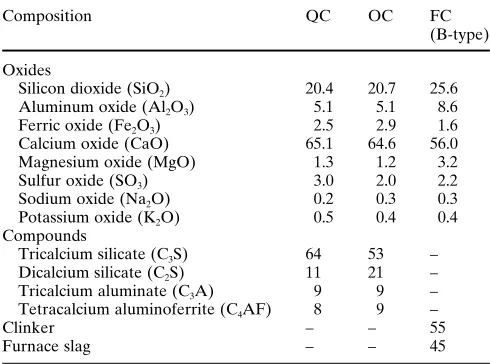
Three commercial cements were used throughout this study: quick-curing cement (QC), ordinary Portland cement (OC), and B-type furnace-slag cement (FC) (Taiheiyo Cement). Their main compositions are given in Table 1. Six additive chemicals (AlCl3, CaCl2, MgCl2, Al2(SO4)3,
Na2SiO3, CaO) were selected either as a single or a
com-posite accelerator to determine the greatest potential for enhancing the compatibility and compressive strength of exploded WFS–cement mixtures.
Sample preparation and the hydration test
The apparatus and method used for measuring hydration characteristics [maximum hydration temperature (Tmax) and
time (tmax) required to reach Tmax] were described in a
previ-ous study.7
The exploded WFS and unexploded wood (weathered wood waste) were reduced to wood powders (20–40 mesh), dried, and then stored in polyethylene bags to avoid quality changes due to moisture problems. All samples were mixed with a mass ratio of cement (200 g)/ wood (15 g, oven-dried)/distilled water (100 ml, including the water in wood powder).
Three groups (A–C) of samples were designed for the hydration test. Group A was prepared to investigate the retarding influence of exploded WFS on cement hydration. Group B was used to assess six additive chemicals with respect to the hydration behavior of the mixture at 4% additive content based on cement weight. Group C was prepared to determine the influence of the content of the selected additive chemicals on the hydration characteristics of the mixtures. Based on comparisons in group B, the contents of the selected additive chemicals were examined at six levels (1%–6%). Three replications for each sample were prepared. The ambient temperature was 20°–23°C throughout the experiment.
Sample preparation and measurement of compressive strength test
The compression test was designed to parallel the hydration test, investigating the effect of hydration behavior on the Table 1. Main compositions of the cements used in this study
Composition QC OC FC
(B-type) Oxides
Silicon dioxide (SiO2) 20.4 20.7 25.6
Aluminum oxide (Al2O3) 5.1 5.1 8.6
Ferric oxide (Fe2O3) 2.5 2.9 1.6
Calcium oxide (CaO) 65.1 64.6 56.0
Magnesium oxide (MgO) 1.3 1.2 3.2
Sulfur oxide (SO3) 3.0 2.0 2.2
Sodium oxide (Na2O) 0.2 0.3 0.3
Potassium oxide (K2O) 0.5 0.4 0.4
Compounds
Tricalcium silicate (C3S) 64 53 –
Dicalcium silicate (C2S) 11 21 –
Tricalcium aluminate (C3A) 9 9 –
Tetracalcium aluminoferrite (C4AF) 8 9 –
Clinker – – 55
Furnace slag – – 45
Results are given as the weight (percent)
mechanical performance of the mixture and the relations between the hydration characteristics and the compressive strength of the mixtures. Samples (groups A–C) for the compression tests were prepared with the same mass ratios and set up like those used for the hydration test. In addition, group D was designed to examine the compressive strength development of the mixtures as a function of curing age when suitable chemicals were added to the mixtures as well as the additive content levels, which were based on the results of the hydration tests in groups B and C. In group D, the samples were prepared using the same mass ratios and were set up similar to the samples in groups A–C.
After the cement and wood powder were mixed, the mixtures were tamped into a cylinder mold with dimensions of 80 mm height and 56 mm diameter. After curing for 24 h, the molded samples were carefully removed from the molds. The group A–C samples were cured at an ambi-ent temperature of 20°–23°C for 28 days; group D samples were cured at ambient temperature for 3, 7, 14, 28, 90, and 180 days. The cured samples were tested in compres-sion (loading speed 1.0 mm/min) at the desired curing age. The compressive strength was calculated from the maximum loads and the cross-sectional areas of the cylin-drical samples. Three replications were prepared for each sample.
Sample preparation for X-ray diffraction, scanning electronic microscopy, and energy-dispersive spectroscopy
The samples for XRD, SEM, and EDS analyses were se-lected from fractured parts of four mixtures (neat OC, OC
⫹ unexploded wood, OC ⫹ exploded WFS, and OC ⫹ exploded WFS ⫹ 4% MgCl2). To obtain a significant and
distinct interface between wood and cement for SEM and EDS analysis, the samples were prepared using short fiber strands of exploded WFS (sugi, water-soaked) and wood strands of unexploded wood (sugi, water-soaked) instead of wood powder mixed with cement. The exploded WFS and unexploded wood were reduced to short fiber strands or wood strands (f 1.0–3.5 mm diameter, 20 mm length), dried, and stored in polyethylene bags. The samples were mixed with the same mass ratios as for the hydration and compres-sion tests and then were cured at an ambient temperature for 28 days.
The fractured portions of the samples (cured at 28 days) were subcarbonized in an oven at certain treatment condi-tions (temperature 200°C; time 60 min; gas flow nitrogen) with which the mixture could be easily broken to obtain a smooth surface (cross section) that included the interface zone of the cement and the adjacent wood tissue, which is good for SEM observation and EDS spectrum and mapping.9,10
The XRD analysis was carried out in a JEOL JDX 8200 X-ray diffractometer with Cu-Kα radiation and 2θ scanning ranging between 10° and 60°. A JEOL model JXA-840A SEM equipped with a JEOL model JED-2110 EDS ana-lyzer was used.
Calculations and data analysis
Duncan’s new multiple comparison procedure and analysis of variance (ANOVA) was conducted on the means at the 5% significance level. Linear regressions were also fitted to the data for evaluating the variation in compressive strength with the hydration characteristics of the mixtures.11
Results and discussion
Correlation between compressive strength and maximum hydration temperature of WCMs mixed with wood wastes (treated or not with WVEP)
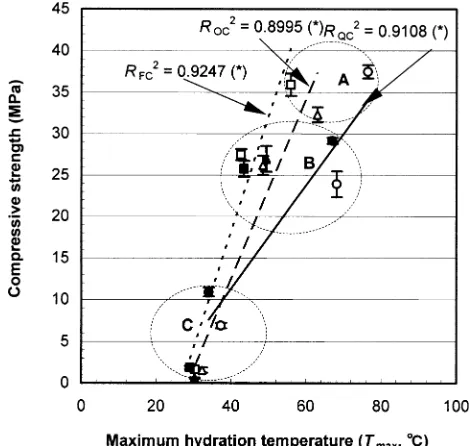
With respect to the three types of cement, a comparison of the effect of wood (before and after WVEP treatment) on the compressive strength, and the relation between the compressive strength and maximum hydration temperature (Tmax) of mixtures without addition of chemicals are shown
in Fig. 1. The strength values could be distinctly divided into three groups representing the compressive strength of neat cement (group A), cement ⫹ unexploded wood (air-dried or water-soaked) (group B), and cement ⫹ exploded WFS (air-dried or water-soaked) (group C).
Fig. 1. Relation between compressive strength and maximum hydra-tion temperature (Tmax) of a wood–cement mixture without additive
The mixtures of different types of cements (QC, OC, FC) mixed with unexploded wood (water-soaked), for ex-ample, produced relatively high compressive strengths that reached, respectively, about 80%, 83%, and 75% those of neat QC, OC, and FC even though there were no additive chemicals in the mixtures. However, the exploded WFS obtained by WVEP demonstrated a strong retarding influ-ence on cement hydration and resulted in the least com-patibility when mixed with cement; the presence of excessive low-molecular-weight and water-soluble de-graded polysaccharides in its extractives, reported in previ-ous report, was confirmed.7
It became evident that there was a violent reduction in compressive strength of the mix-tures after addition of exploded WFS (air-dried or water-soaked). It could therefore be concluded that without pretreatment with suitable additive chemicals to increase the compatibility with cement mixtures of exploded WFS could not be used as an acceptable reinforcement material in WCMs for building applications. In addition, when QC was mixed with unexploded wood (air-dried or soaked) or exploded WFS wood (air-dried or
water-soaked), relatively larger differences in the compressive strength of the mixtures were found in groups B and C, respectively. This might be attributed to the fact that the compressive strengths of the mixtures appeared to be more sensitive to the amounts and compositions of extractable inhibitory components of the wood, probably due to a higher C3S content in QC than in OC and FC.
Furthermore, good linear correlations between compres-sive strength and the Tmax of mixtures were observed owing
to the fact that the compressive strength reductions were proportional to the reductions in Tmax of mixtures
corre-sponding to the three cements (QC, OC, FC).
Effects of additive chemicals and additive contents on compressive strengths and hydration characteristics of exploded WFS–cement mixtures
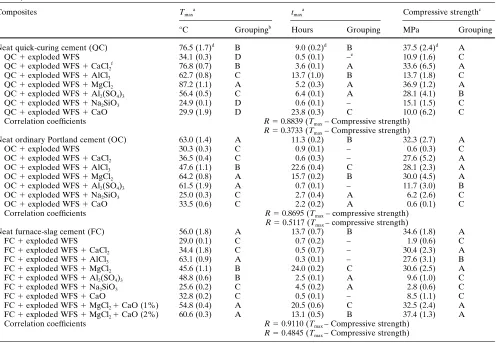
Using three types of cement (QC, OC, FC), six additive chemicals were respectively added to the exploded WFS– cement mixtures to investigate their ability to enhance the compressive strength. Table 2 summarizes the influence of
Table 2. Effects of additive chemicals on hydration characteristics and compressive strength of cement mixed with exploded WFS (sugi, water-soaked)
Composites Tmax
a t
max
a Compressive strengthc
°C Groupingb Hours Grouping MPa Grouping
Neat quick-curing cement (QC) 76.5 (1.7)d B 9.0 (0.2)d B 37.5 (2.4)d A
QC ⫹ exploded WFS 34.1 (0.3) D 0.5 (0.1) –e 10.9 (1.6) C
QC ⫹ exploded WFS ⫹ CaCl2
f 76.8 (0.7) B 3.6 (0.1) A 33.6 (6.5) A
QC ⫹ exploded WFS ⫹ AlCl3 62.7 (0.8) C 13.7 (1.0) B 13.7 (1.8) C
QC ⫹ exploded WFS ⫹ MgCl2 87.2 (1.1) A 5.2 (0.3) A 36.9 (1.2) A
QC ⫹ exploded WFS ⫹ Al2(SO4)3 56.4 (0.5) C 6.4 (0.1) A 28.1 (4.1) B
QC ⫹ exploded WFS ⫹ Na2SiO3 24.9 (0.1) D 0.6 (0.1) – 15.1 (1.5) C
QC ⫹ exploded WFS ⫹ CaO 29.9 (1.9) D 23.8 (0.3) C 10.0 (6.2) C
Correlation coefficients R ⫽ 0.8839 (Tmax – Compressive strength)
R ⫽ 0.3733 (Tmax – Compressive strength)
Neat ordinary Portland cement (OC) 63.0 (1.4) A 11.3 (0.2) B 32.3 (2.7) A
OC ⫹ exploded WFS 30.3 (0.3) C 0.9 (0.1) – 0.6 (0.3) C
OC ⫹ exploded WFS ⫹ CaCl2 36.5 (0.4) C 0.6 (0.3) – 27.6 (5.2) A
OC ⫹ exploded WFS ⫹ AlCl3 47.6 (1.1) B 22.6 (0.4) C 28.1 (2.3) A
OC ⫹ exploded WFS ⫹ MgCl2 64.2 (0.8) A 15.7 (0.2) B 30.0 (4.5) A
OC ⫹ exploded WFS ⫹ Al2(SO4)3 61.5 (1.9) A 0.7 (0.1) – 11.7 (3.0) B
OC ⫹ exploded WFS ⫹ Na2SiO3 25.0 (0.3) C 2.7 (0.4) A 6.2 (2.6) C
OC ⫹ exploded WFS ⫹ CaO 33.5 (0.6) C 2.2 (0.2) A 0.6 (0.1) C
Correlation coefficients R ⫽ 0.8695 (Tmax – compressive strength)
R ⫽ 0.5117 (Tmax – compressive strength)
Neat furnace-slag cement (FC) 56.0 (1.8) A 13.7 (0.7) B 34.6 (1.8) A
FC ⫹ exploded WFS 29.0 (0.1) C 0.7 (0.2) – 1.9 (0.6) C
FC ⫹ exploded WFS ⫹ CaCl2 34.4 (1.8) C 0.5 (0.7) – 30.4 (2.3) A
FC ⫹ exploded WFS ⫹ AlCl3 63.1 (0.9) A 0.3 (0.1) – 27.6 (3.1) B
FC ⫹ exploded WFS ⫹ MgCl2 45.6 (1.1) B 24.0 (0.2) C 30.6 (2.5) A
FC ⫹ exploded WFS ⫹ Al2(SO4)3 48.8 (0.6) B 2.5 (0.1) A 9.6 (1.0) C
FC ⫹ exploded WFS ⫹ Na2SiO3 25.6 (0.2) C 4.5 (0.2) A 2.8 (0.6) C
FC ⫹ exploded WFS ⫹ CaO 32.8 (0.2) C 0.5 (0.1) – 8.5 (1.1) C
FC ⫹ exploded WFS ⫹ MgCl2 ⫹ CaO (1%) 54.8 (0.4) A 20.5 (0.6) C 32.5 (2.4) A
FC ⫹ exploded WFS ⫹ MgCl2 ⫹ CaO (2%) 60.6 (0.3) A 13.1 (0.5) B 37.4 (1.3) A
Correlation coefficients R ⫽ 0.9110 (Tmax – Compressive strength)
R ⫽ 0.4845 (Tmax – Compressive strength) aEach value is the average of three replications
bMeans with the same capital letter are not significantly different at the 5% significance level (based on a Duncan grouping analysis) cCompressive strengths of mixtures were measured after curing for 28 days
dData in parentheses are standard deviations
eOnly one peak appeared within 1 h during a 24-h observation period
these additives on the compressive strength and hydration characteristics of the mixtures. The results indicated that these chemicals were considerably different in terms of their ability to improve the compressive strength or the hydration characteristics (Tmax and tmax) of exploded WFS–
cement mixtures.
Three additives [CaCl2, MgCl2, Al2(SO4)3] exerted a
strong influence on increasing the compressive strength of the QC–exploded WFS mixtures. Among them, MgCl2 was
considered the best because of its high strength value and proper tmax. Lower compressive strength was found after
adding 4% AlCl3 to the mixture. The AlCl3 reacted
vio-lently with cement and resulted in rapid loss of the fluidity and workability of the mixture, making it difficult to obtain a perfect cylindrical sample for a strength test. Na2SiO3 and
CaO did not show any significant positive effect on the compressive strength of mixtures.
For the OC–exploded WFS mixtures, there were no sig-nificant differences in compressive strength when CaCl2,
MgCl2, or AlCl3 was added. Among them, MgCl2 appeared
to be the most effective, with a highest strength and an appropriate tmax value. Addition of Al2(SO4)3, Na2SiO3, or
CaO was not effective, and consequently the compressive strengths of the mixtures were low.
Although adding CaCl2, MgCl2, or AlCl3 to the FC–
exploded WFS mixture produced relatively high strength values, the tmax of the mixtures was considered undesirable
because the hydration of C3S was markedly delayed. In fact,
with the addition of CaCl2 or AlCl3, the tmax of mixtures
appeared, respectively, at 34.5 and 40.2 h (based on the results of duplicate experiments). Al2(SO4)3,Na2SiO3, and
CaO showed lower strength values. The highest compres-sive strength (35.6 MPa) of a mixture was achieved after adding 4% MgCl2⫹ 2% CaO as a composite to the mixture.
The tmax was also adjusted to 13.1 h, which was considered
appropriate compared with that of neat FC. A mixture of Portland cement clinker and furnace slag, FC has latent hydraulic reactivity. The activation of furnace slag is mainly
based on the generation of calcium hydroxide [Ca(OH)2].
The calcium hydroxide, liberated mostly during hydration of tricalcium silicate, provides hydroxyl ions, which attack slag grain surfaces. However, the quantity of calcium hy-droxide, being produced in the furnace slag cement, is rela-tively decreased because of the lesser amount of clinker, compared to that in OC. A small addition of CaO might provide more hydroxyl ions to accelerate the hydration re-action and form more hydration products, which improve the early-stage strength of FC.
Thus, after adding available chemicals, the compressive strengths of the three cement–exploded WFS mixtures were, respectively, close to those of neat cement and could be grouped into the same group (A) based on Duncan’s grouping analysis. Moreover, using correlation analysis, high coefficients (R value) were found between compres-sive strength and the Tmax of exploded WFS–cement
mix-tures corresponding to the three types of cement. However, low correlations between compressive strength and tmax
were found with the lower coefficients. These results were consistent with those from previous studies and indicated that either mechanical properties or the Tmax of mixtures
could, at a certain content, be used to evaluate the compat-ibility of mixtures with different wood properties.12–14
In accordance with the comparisons conducted on hy-dration characteristics (Tmax, tmax) and the compressive
strength of mixtures, a single additive (MgCl2) for QC and
OC and a composite additive (MgCl2 ⫹ CaO) for FC were
selected as suitable additive chemicals. The results indi-cated that with modification of these selected additives the compatibility and the compressive strength of exploded WFS–cement mixtures could be improved, and the ex-ploded WFS could be considered acceptable wood material in WCMs.
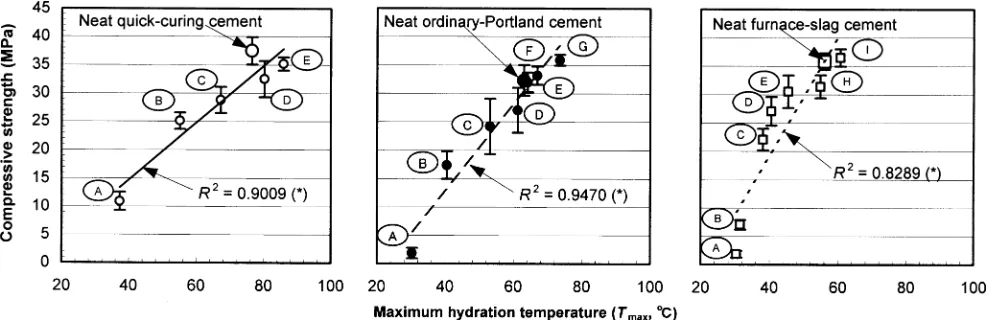
The influence of the content of the selected additive chemicals on the compressive strength of mixtures was also examined. As shown in Fig. 2, the compressive strength of exploded WFS–QC mixtures was enhanced with increasing
Fig. 2. Influence of selected additive chemicals on compressive strength and maximum hydration temperature (Tmax) of cement mixed
with exploded wood fiber strand (WFS) (sugi, water-soaked). A, 0% MgCl2; B, 1% MgCl2; C, 2% MgCl2; D, 3% MgCl2; E, 4% MgCl2; F, 5%
MgCl2; G, 6% MgCl2; H, 4% MgCl2⫹ % CaO; I, 4% MgCl2⫹ 2%
MgCl2 content (ranging from 1% to 4%). With 2%–3%
additive content, the compressive strength of mixtures, re-spectively, reached 28.8 and 32.5 MPa, which corresponds to about 77% and 87% compared to that of neat QC. They therefore were considered acceptable additive contents. The determination of an available additive’s content would not only depend on the strength value but also on a consid-eration of the workability of mixtures, as more chemical added to the mixtures would lead to a rapid reduction in fluidity, causing incremental operational difficulties during the manufacture of products. Similarly, 4%–5% additive content was appropriate for OC. The compressive strength of mixtures reached 32.0 and 32.2 MPa, which were, respec-tively, about 96% and 105% of that of the neat OC. In the case of FC, by adding 4% MgCl2⫹ 2% CaO as a composite
the compressive strength of mixtures reached 36.5 MPa, which was about 101% that of neat FC.
By increasing the additive content, the compressive strength of mixtures was linearly proportional to the Tmax
with the high coefficients (R value) shown in Fig. 2. In addition, ANOVA revealed that the differences in com-pressive strength of mixtures were statistically significant at the 5% level.
Influence of curing age on compressive strength development of exploded WFS–cement mixtures
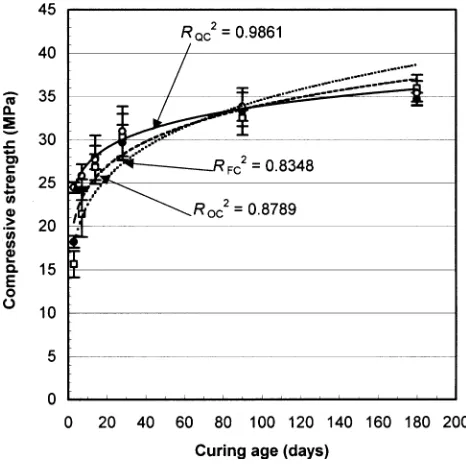
Understanding the pattern of strength development would be beneficial to the product design, production, and applica-tion of exploded WFS–cement mixtures. In Fig. 3 are three curves representing the changes in compressive strength development of three types of cement (QC, OC, FC) and
exploded WFS mixtures. The additive chemicals and their contents in these mixtures were 2% MgCl2 (QC), and 4%
MgCl2 (OC), and 4% MgCl2 ⫹ 2% CaO (FC), which were
considered acceptable and suitable based on the results of hydration and compressive strength tests.7
Continuous cur-ing and increascur-ing compressive strength (up to 180 days) of the mixtures were observed throughout the experiment. Several conclusions could be drawn. There are two stages of strength development during the 180-day period. During the first stage the strength development of mixtures pro-gressed rapidly (up to about 28 days), although the strength development of mixtures with different types of cement were significantly different. The mixtures containing QC showed higher early strength because QC has a higher con-tent of C3S than OC or FC. The mixtures with FC that
contained furnace slag and a lower content of clinker than QC and OC showed the lowest early strength at this stage. It was also noted especially that with the relatively high rates of strength development, the compressive strengths of exploded WFS–cement mixtures (cured at 28 days) reached about 91% (QC), 87% (OC), and 85% (FC) compared with the 180-day values. Thereafter, during the second stage, the growth in strength gradually slowed. When approaching 180 days, the increase in compressive strength toward stabiliza-tion was evident. Furthermore, by adding selected chemi-cals the QC–exploded WFS mixture had higher early-stage compressive strength at curing ages of 3, 7, and 14 days. It was also evident that although the FC–exploded WFS mix-ture had lower early-stage compressive strength at curing ages of 3, 7, and 14 days it had a considerably high compres-sive strength at 90 and 180 days, although these figures were not significantly different from those of mixtures of ex-ploded WFS and QC or OC.12,15
X-ray diffraction analysis results
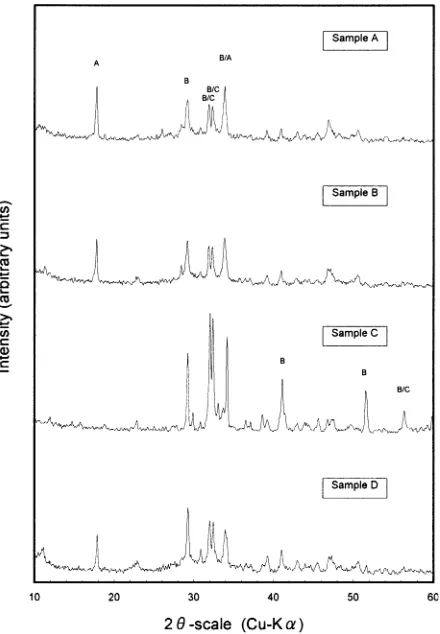
Some comparative results from XRD analysis of WCM with respect to the different compositions (samples A–D, cured at 28 days) are shown in Fig. 4. The neat cement (OC, sample A) provided a typical diffraction pattern of well-hydrated cement in which several major characterized peaks could be detected and used to evaluate cement hydra-tion. The peak corresponding to cement hydration product CH [Ca(OH)2] appeared at d (Å) ⫽ 4.900 (2θ ⫽ 17.8°), and
the peaks corresponding to C3S (3CaO·SiO2) and C2S
(2CaO·SiO2), located respectively at d (Å) ⫽ 3.022, 2.776,
2.764, 2.602, 2.185, 1.771, and 1.632 (2θ⫽ 29.2°, 32.3°, 32.7°, 34.5°, 41.1°, 51.5°, and 56.4°), are discussed in this study. Among them, the most prominent peaks that appeared at 2θ ⫽ 32.3°, 32.7°, and 34.5° conformed with the amount of unhydrated cement clinker according to previous stud-ies.15–17 Note that with the addition of unexploded wood (sample B) the mixture presented an XRD pattern that was similar to that of neat cement. Although a small decrease in the CH peak was detected, the unexploded wood proved to be least inhibitory to cement hydration.7 However, in the case of a mixture with exploded WFS (sample C), the CH peak could not be detected, whereas the C3S and C2S peaks
Fig. 3. Effect of curing age on compressive strength development of cement mixed with exploded WFS (sugi, water-soaked). Open circles, exploded WFS–QC mixture with added MgCl2 (2%); filled circles,
ex-ploded WFS–OC mixture with added MgCl2 (4%); Squares, exploded
at 2θ⫽ 29.2°, 32.3°, 32.7°, and 34.5° had greatly increased. Moreover, some characterized peaks of C3S and C2S at 2θ⫽
41.1°, 51.5°, and 56.4° were also observed. The results were attributed to the fact that the strong retarding influence of degraded polysaccharides in the extractives of exploded WFS caused an incomplete cement hydration process, and a considerable amount of unhydrated cement clinker re-mained in the cured mixtures. It resulted in the least com-patibility and poor strength performance of the mixture. However, it was also obvious that by adding 4% MgCl2
to the exploded WFS–cement mixture (sample D) the in-tensity of the CH peak significantly increased, and that of the peaks representing C3S and C2S decreased, even
disappearing.
These results from diffractograms were in good agree-ment with our previous results obtained with the hydration and strength tests. It was believed that the compatibility and strength development of mixtures were directly related to the amount of hydration product and unhydrated cement clinker that remained in the cured mixtures.16,17
SEM observations
To gain a better understanding of cement hydration and the morphology of the hydration products affected by the dif-ferent mixture compositions, SEM observations were un-dertaken. The results are shown in Fig. 5. Figure 5A shows an SEM micrograph of the fractured surface of neat cement (OC), in which the typically well-developed crystals of hy-dration products, including mainly the large laminated hex-agonal plates of calcium hydroxide (CH) and bloom-shaped structures of calcium silicate hydrate (CSH), could be iden-tified. Similar crystalline structures of CH and CSH, as well as a few needle-like crystals of ettringite (ET), were ob-served in the unexploded wood–cement mixture (Fig. 5B) as well. In addition, the growth of CH crystals appeared to be hindered, as relatively fewer CH crystals were detected in comparison with the neat cement. Figure 5C revealed a completely different crystalline state and poor hydration products in the mixture corresponding to the presence of exploded WFS. The unhydrated cement particles seemed to be covered with a smooth, film-like layer; and the conven-tional crystalline structures of CH and CSH were not found. Furthermore, some small, rod-like crystals were observed in the fractured surface. These crystals were probably incom-plete ET crystals that were initially formed during hydra-tion of C3A (3CaO·Al2O3) but the growth ceased due to
rapid inhibition during the hydration process.18,19
This anomalous crystalline state appeared to make no contribu-tion to strength development and could be related to the low strength of the exploded WFS–cement mixtures.
With addition of 4% MgCl2 to the exploded WFS–
cement mixture, as shown in Fig. 5D, the crystalline state of the products formed during cement hydration significantly improved, as indicated by the reappearance of a well-developed CH and CSH crystalline structure; thus, faster strength development of the mixture was achieved. In this case, few ET crystals were found, probably due to the fact that during the late stage of the accelerated hydration reac-tion, accompanied by consumption of gypsum (CaSO4) and
reduction of SO4
2⫺ ions, the ET partially transformed to
monosulfoalminate (AFm), which resulted in the formation of denser crystalline structures.
Energy-dispersive spectroscopy analysis
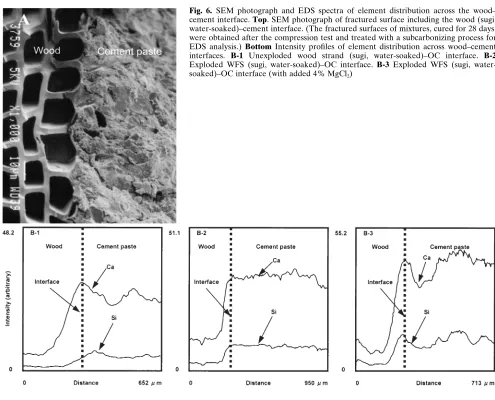
To identify the element distribution at the wood–cement interface from a fractured surface of the mixture, EDS analysis was performed in this microregion (Fig. 6A). The results (Fig. 6, B1 to B3) indicated that in this microregion the intensity profiles of element distribution across the in-terface from cement paste to wood surface varied, influ-enced by the composition of the WCM. Examining the fractured surface of the unexploded wood and cement mix-ture (Fig. 6, B1) showed that elements such as Ca and Si were detected at the wood surface. This phenomenon im-plies that there was a gradient increase in deposits of the main hydration products (e.g., CH, CSH, and ET crystals) close to the wood surface.20–22
The local increases of these Fig. 4. Comparison on results of X-ray diffraction (XRD) analysis of
wood–cement mixtures with various compositions (the fractured sur-faces of mixtures, cured for 28 days, obtained after the compression test). A, CH [Ca(OH)2]; B, C3S (3CaO·SiO2); C, C2S (2CaO·SiO2).
crystals near the wood surface may be attributed to the fact that there was a large capacity for water attraction on the wood surface, resulting in a strong water flow and better mobility of ions such as Ca2⫹ and Si4⫹ toward the wood surface in a desirable hydration environment. The presence of these crystals could be expected to produce higher wood– cement bonding strength due to the formation of more mechanical interlocking on the porous wood surface.23,24
In the presence of exploded WFS in the mixture, how-ever, there were no similar high concentrations of these elements near the wood surface (Fig. 6, B2). This could be due to existence of excessive polysaccharides, resulting in an incomplete cement hydration process, consequently hin-dering the crystallization of hydration products. In contrast, with the acceleration of cement hydration by the addition of 4% MgCl2 to the exploded WFS–cement mixture, a higher
concentration of these elements close to the wood surface appeared in their distribution profiles (Fig. 6, B3).
The results obtained in the EDS analysis were appar-ently consistent with the results of the XRD, SEM analysis, and strength tests. These results led to the conclusion that the characteristics of the wood–cement interface are
influ-enced by the composition of the mixtures and are thus directly related to wood–cement bonding and the mechani-cal performance of the mixture.
Conclusions
The exploded WFS obtained by the WVEP had a strong inhibitory effect on cement hydration, resulting in poor compressive strength of the exploded WFS–cement mix-ture. Without addition of a suitable chemical, it could not be considered an acceptable wood reinforcement material. MgCl2 proved to be a suitable additive chemical. By adding
2%–3% and 4%–5% of MgCl2 as the single additive in
mixtures with QC and OC, respectively, and 4% of MgCl2⫹
2% of CaO as the composite additive in mixtures with FC, the compressive strength could be greatly enhanced. Good correlations were found between Tmax and the compressive
strength of WCMs of various fiber–cement compositions. However, the correlations were low between tmax and the
compressive strength. Fig. 5. Scanning electron microscopic (SEM) photographs of fractured
surfaces of wood–cement mixtures in various compositions. CH, cal-cium hydroxide; CSH, calcal-cium silicate hydrate; ET, Ettringite. A Neat ordinary Portland cement (OC). B OC–unexploded wood mixture
With the addition of the selected chemicals, the ex-ploded WFS–QC mixture showed higher early-stage com-pressive strength than exploded WFS mixed, respectively, with OC or FC at curing ages of 3, 7, or 14 days. However, there were no significant differences in the compressive strength among the QC, OC, and FC mixtures with ex-ploded WFS at curing ages of 180 days.
According to the results of XRD analysis, the poor for-mation of hydration products and the existence of large quantities of unhydrated cement clinker were thought to be the main causes of the low compatibility and low compres-sive strength of the exploded WFS–cement mixtures. The results of SEM revealed that the crystalline state of the hydration products was significantly influenced by the mix-tures’ compositions. The exploded WFS seriously hindered the formation of CH and CSH crystals and had a significant negative impact on the strength performance of the mix-ture. The EDS analysis performed at the wood–cement in-terface from a fractured surface showed that the element distributions near the wood surface appeared to be influ-enced by the mixture’s composition and were related to the strength performance of the mixture as well.
Fig. 6. SEM photograph and EDS spectra of element distribution across the wood– cement interface. Top. SEM photograph of fractured surface including the wood (sugi, water-soaked)–cement interface. (The fractured surfaces of mixtures, cured for 28 days, were obtained after the compression test and treated with a subcarbonizing process for EDS analysis.) Bottom Intensity profiles of element distribution across wood–cement interfaces. B-1 Unexploded wood strand (sugi, water-soaked)–OC interface. B-2 Exploded WFS (sugi, soaked)–OC interface. B-3 Exploded WFS (sugi, water-soaked)–OC interface (with added 4% MgCl2)
Acknowledgments The authors are grateful to Dr. Youichi Tomimura, a researcher at the Forestry and Forest Products Research Institute (FFPRI), Tsukuba, Japan, for assistance with sample preparation for SEM and EDS observations. We also thank the Taiheiyo Cement Corporation, Japan, for providing the data on cement composition.
References
1. Moslemi AA (1988) Inorganically bonded wood composites. Chemtech 18:504–510
2. Rashwan MS, Hatzinikolas M, Zmavc R (1992) Development of a lightweight, low-cost concrete blocks using wood residue. For Prod J 42(5):57–64
3. Wolfe RW, Gjinolli A (1999) Durability and strength of cement-bonded wood particle composites made from construction waste. For Prod J 49(2):24–31
4. Fujii T (2000) Explosively-split fragments obtained by water-vapor explosion of wooden source materials, wooden material containing such fragments as its aggregate, their manufacturing methods and machines. European patent no. 1033212 A1
6. Avellar BK, Glasser WG (1998) Steam-assisted biomass fraction-ation. I. Process considerations and economic evalufraction-ation. Biomass Bioenergy 14:205–218
7. Wei YM, Tomita B, Hiramatsu Y, Miyatake A, Fujii T (2002) Study of hydration behaviors of wood-cement mixtures: the compatibility of cement mixed with wood fiber strand obtained in the water-vapor explosion process. J Wood Sci 48:365–373 8. Hiramatsu Y, Miyatake A, Fujii T, Wei YM, Tomita B (2001)
Wood elements obtained by water vapor explosion of wood mate-rials. In: Proceedings of the symposium on utilization of agricul-tural and forest residues, Nanjing, China, pp 152–158
9. Fujii T, Miyatake A, Fujii T (1998) Manufacturing and property of cement-strand slab (CSS). II. Microscopic observation on interface of sugi strand and cement (in Japanese). In: Proceedings of the 48th annual meeting of the Japan Wood Research Society, Shizuoka, Japan, p 273
10. Fujii T (2000) Scanning electron microscope (in Japanese). Kanto branch of the Japanese Society of Electron Microscopy. Kyoritsu Publication, Tokyo, pp 397–402
11. Lyman OTT (1977) An introduction to statistical methods and data analysis. Belmont Duxbury, North Scituate, MA, pp 392–398 12. Lee AWC, Hong ZL (1986) Compressive strength of cylindrical samples as an indicator of wood-cement compatibility. For Prod J 36(11/12):87–90
13. Miller DP, Moslemi AA (1991) Wood-cement composites: species and heartwood-sapwood effects on hydration and tensile strength. For Prod J 41(3):9–14
14. Ma LF, Kuroki Y, Nagadomi W, Subiiyanto B, Kawai S, Sasaki H (1997) Manufacture of bamboo-cement composites ii. Effects of additives on hydration characteristics of bamboo-cement mixtures (in Japanese). Mokuzai Gakkaishi 43:754–761
15. Lea FM (1970) The chemistry of cement and concrete, 3rd edn. Glasgow, Bell and Bain, UK, pp 171–337
16. Nagadomi W, Kuroki Y, Eusebio DA, Ma LF, Kawai S, Sasaki H (1996) Rapid curing of cement-bonded particleboards. II. Curing mechanism of cement with sodium hydrogen carbonate during steam injection pressing (in Japanese). Mokuzai Gakkaishi 42:659– 667
17. Tachi M, Nagadomi W, Tange J, Yasuda S, Terashima N (1987) Manufacture of wood-cement boards. I. Influence on cement-hardening inhibition by the extractives from Western recedar heartwood. Mokuzai Gakkaishi 33:879–883
18. Suzuki S, Nishi S (1959) The influence of saccharides and other organic materials on the hydration of Portland cement (in Japanese). Semento Gijutsu Nenpo 13:160–170
19. Ma LF, Kuroki Y, Eusubio DA, Nagadomi W, Kawai S, Sasaki H (1996) Manufacture of bamboo-cement composites I. Hydration characteristics of bamboo-cement mixtures (in Japanese). Mokuzai Gakkaishi 42:34–42
20. Holmer S Jr, Vahan A (1992) Transition zone of hardened cement paste and vegetable fibers. In: Proceedings of the 4th international symposium of fiber reinforced cement and concrete. E and FN Spon, London, pp 1110–1119
21. Bentur A, Akers ASA (1989) The microstructure and ageing of cellulose fiber reinforced cement composites cured in a normal environment. Int J Cement Composites Lightweight Concrete 11(2):99–109
22. Holmer S Jr, Vahan A (1999) Transition zone studies of vegetable fiber-cement paste composites. Cement Concrete Composites 21:49–57
23. Ahn WY, Moslemi AA (1980) SEM examination of wood-Portland cement bonds. Wood Sci 13(2):77–82

![[LVIC LIMSI]: Using Syntactic Features and Multi polarity Words for Sentiment Analysis in Twitter](data:image/gif;base64,R0lGODlhAQABAIAAAP///wAAACH5BAEAAAAALAAAAAABAAEAAAICRAEAOw==)