ORIGINAL ARTICLE
Nan Ling · Naruhito Hori · Akio Takemura
Effect of postcure conditions on the dynamic mechanical behavior of
water-based polymer–isocyanate adhesive for wood
Abstract To study the effect of postcure conditions on the viscoelastic behavior of water-based polymer isocyanate adhesives for wood (API adhesive), dynamic mechanical analysis (DMA) was performed for a simplifi ed model of API adhesives under various postcure conditions. These conditions were achieved by storing the samples at room temperature or by heating them in an oven. Fourier trans-form infrared (FT-IR) spectroscopy was pertrans-formed to test for residual isocyanate groups (NCO) and isocyanate deriv-atives to elucidate the reaction mechanism under the post-cure conditions. DMA revealed that the postpost-cure conditions led to wide variations in the viscoelastic behaviors of API fi lms. FT-IR analysis confi rmed the decrease of residual isocyanate during postcure treatments. However, the complete consumption of isocyanate could not be achieved under the postcure conditions. A good correlation was found between the DMA result and the chemical changes in the API samples heated above 140°C. However, no cor-relation was observed in the case of the samples heated at temperatures less than 140°C. This implies that postcure conditions led to a difference in the reaction chemistry of API.
Key words Water based · Isocyanate adhesive · Postcure · Dynamic mechanical analysis
Introduction
Water-based polymer–isocyanate adhesives, also referred to as aqueous polymer isocyanate (API) adhesives, are
N. Ling · N. Hori · A. Takemura (*)
Department of Biomaterial Sciences, Graduate School of Agricultural and Life Sciences, The University of Tokyo, 1-1-1 Yayoi, Bunkyo-ku, Tokyo 113-8657, Japan
Tel. +81-3-5841-5268; Fax +81-3-5684-0299 e-mail: [email protected]
Part of this article was presented at the 55th Annual Meeting of the Japan Wood Research Society, Kyoto, March 2005
widely used in timber processing and plywood manufactur-ing.1–4 These adhesives are composed of a water-based polymer mixture and an isocyanate crosslinker. The isocya-nate group (NCO) of the crosslinker allows reaction with the components of the water-based polymer mixture and a wood substrate during API preparation and application.5 Many studies have been conducted on the fundamental reactions and operating performance of these adhesives and on the possible improvements in the adhesive properties.6–9 It is known that the major NCO reactions in this adhesive system are those with water or a hydroxyl group to form urea or urethane. Allophanate and biuret groups are possi-ble by-products; however, such reactions are rare.7,8
It has been established that the complete consumption of the isocyanate group in the API takes a long time in practical applications. The consumption of these residual isocyanate groups occurs during certain postcuring treat-ments such as storage and heat treatment.7–10 The changes in the properties of API during the postcuring treatment have been the focus of many investigations conducted over the past several years, because it is important to design the treatment conditions in order to optimize the mechanical properties of the API adhesives.7–12
However, in these investigations, (1) the effect of the heat treatment has not been taken into account; (2) because relatively simple types of API samples were considered, the postcuring mechanism of these adhesives has not been completely understood; and (3) the data obtained is not suffi cient to reveal the correla-tion between the adhesive properties and the details of the reaction mechanism in a solid state. In order to obtain some insight into the reaction mechanism and the formation of a crosslinking structure during postcure, a systematic study is necessary.
Dynamic mechanical analysis (DMA) is a useful method for evaluating the viscoelastic behavior of polymer materi-als. In the study of API adhesives, DMA is mainly used to investigate density changes in the crosslinking structure.13,14 Taki et al.15 reported correlation between the DMA results and the strength of an API sample. Umemura et al.16
per-formed the DMA measurement of a reaction product of emulsion isocyanate (EMDI) and water to study the
378
curing process of isocyanate and water. The purpose of the present study was to investigate the effect of the postcuring conditions on the DMA spectra of a simplifi ed model of API. Because the dispersion of the crosslinker in the API and the curing process are strongly related to the species and properties of the base mixture, we selected a model compound similar to practical applications for understand-ing the postcurunderstand-ing process of the API adhesives. Fourier transform infrared (FT-IR) spectroscopy was employed to investigate the change in the chemical structure of the API fi lms.
Experimental
Materials
Poly(vinyl alcohol) (PVOH; Sigma-Aldrich, Tokyo, Japan) used in this experiment was 99+% hydrolyzed, and its molecular weight was in the range of 89 000–98 000. It was gradually added to water and stirred at 80°C for 1 h to obtain a 15% (w/w) solution and subsequently was stored at room temperature and stirred for 1 day.
Styrene–butadiene copolymer latex (SBR) was specially synthesized by Nippon A&L (Osaka, Japan) and was used as received. It had a solid content of 51.9%, viscosity of 180 mPa·s (at 25°C), pH of 6.4, and styrene/butadiene ratio of 60/40 (by weight).
Polymeric diphenylmethane diisocyanate (pMDI), referred to as Milionate MR200 (Nippon Polyurethane Industry, Tokyo, Japan), was used as received. It was mainly composed of 4,4′-MDI oligomers and did not contain sol-vents such as toluene or xylene. It had a viscosity of 163 mPa·s (at 25°C), an isocyanate molar concentration of 7.27 mmol/g (i.e., an isocyanate content of 31.0% w/w), and a specifi c gravity of 1.23 (at 25°C).
Water used in the experiment was purifi ed by using an Elix 5 water purifi cation system (Millipore Japan, Tokyo, Japan) and its specifi c electrical conductivity was main-tained to be less than 0.5 μS/cm.
Sample preparation
A water-based polymer mixture was prepared by mixing the PVOH solution and SBR with the same weight ratio. It was mixed for 1 min and degassed for 20 s using a HM-500 hybrid mixer (Keyence, Tokyo, Japan). Fifteen parts of pMDI was added to the base mixture, and they were mixed together for 1 min and degassed for 30 s. The mixed glue (simplifi ed API) was cast onto a smooth Tefl on sheet and stored at 23°C and 50% relative humidity for 4 days to yield fi lms. The obtained fi lms averaged ca. 0.15 mm in thickness. Thereafter, the fi lms were subjected to the following three different postcuring conditions: (1) storage at room tem-perature for various periods, (2) storage at room tempera-ture for 4 days and heating at various temperatempera-tures up to 200°C for 2 h, and (3) storage at room temperature for 4 days and heating at various temperatures for 10 min. For
comparison, PVOH and SBR fi lms were also prepared by casting and were stored at room temperature for 4 days and annealed at 100°C for 2 h before the measurements.
Measurements
DMA was performed on a DVA-200 dynamic viscoelas-tometer (ITK, Kyoto, Japan). The tests were performed using extension mode at a frequency of 5 Hz and a heating rate of 2°C/min with the temperature ranging from −50° to 250°C under a nitrogen atmosphere.
FT-IR spectra were measured with a Magna-IR 860 spectrometer (Nicolet, Tokyo, Japan) using the KBr tablet method. Each sample was scanned 128 times with a resolu-tion of 4 cm−1 between 400 and 4000 cm−1. The obtained spectra were normalized with the peak height of the C-H stretching band at approximately 2920 cm−1
.
Results and discussion
DMA results
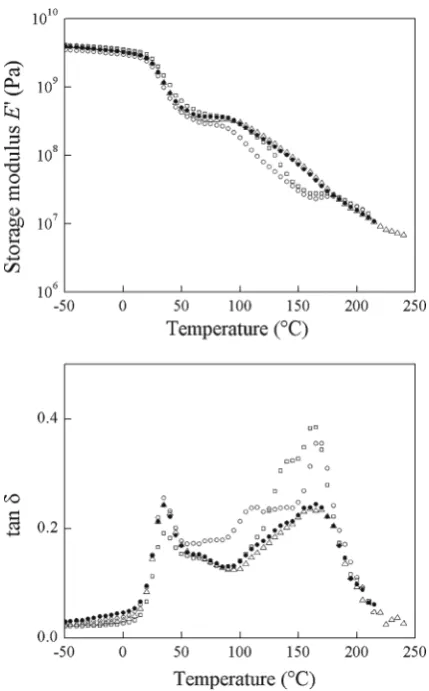
Figure 1 illustrates the temperature dependence of the storage modulus (E′) and loss factor (tan d) of the API, SBR, and PVOH fi lms. The API fi lm was stored for 4 days without heating. E′ is a measurement of the material stiff-ness. The loss tangent tan d represents the ratio of energy dissipated to the energy stored per cycle. The SBR and PVOH fi lms clearly exhibit a tan d peak at around 30° and 70°C, respectively, that are attributed to the relaxations due to their glass transitions. Meanwhile, in the tan d curve of the API fi lm, four peaks are observed at around 30°, 70°, 110°, and 170°C. The peaks at 30° and 70°C are attributed to the glass transitions of the SBR and PVOH fi lms, respec-tively, that are smaller than the peaks observed in the SBR and PVOH spectra. This is because their relative concentra-tion is low in the fi lm, and because the molecular moconcentra-tion in the main chain is restricted by a crosslinking structure pro-duced by an isocyanate reaction.
The E′ spectrum of the API adhesive exhibits two drops starting at 30° and 110°C and also a small peak at approxi-mately 170°C. The relaxation at 170°C could be attributed to a residual isocyanate reaction during the DMA measure-ment. A possible reason is that the crosslinking structures produced by the isocyanate reaction could lead to an increase in the E′ value. Thereafter, E′ decreases again with an increase in the measurement temperature. The peak of E′ has also been observed by other researchers in the DMA spectra for incompletely cured API adhesives.14 The IR spectroscopy of the fi lms will provide further evidence for the interpretation of this observation.
and the peak at 170°C is related to the reaction of the residual isocyanate. The peak at 110°C cannot be explained. This peak shifts to 140°C for the fi lm stored for 12 days. For the fi lms stored for 25 and 60 days, this peak disappears or converges with the peak related to the residual isocyanate reaction and forms a single peak at 170°C. A corresponding increase in E′ in the range of 100° to 150°C is observed simultaneously. Several studies reported that the predomi-nant postcuring process of an API adhesive for storing at room temperature is due to the forming of a urea linkage, while urethane, allophanate, and biuret will also permit.7,8 The increase in these chemical linkages can enhance the properties of the API adhesives, such as strength, modulus, and thermal stability. Here, we have assumed that the shift in the tan d peak at 110°C is mainly due to the increase in the number of chemical structures produced during the storage process.
As the isocyanate groups were consumed and the number of chemical structures increased during the storage process, the fi lms became stable in both mechanical and chemical properties. As a result, no signifi cant difference in the E′ of the samples stored for 25 and 60 days was observed. Cor-respondingly, only one transition of tan d was observed in
the hightemperature region above 100°C, and no signifi -cant changes in the peak shape could be observed. This data also indicated that API was not stable at storage times less than 25 days at ambient temperature.
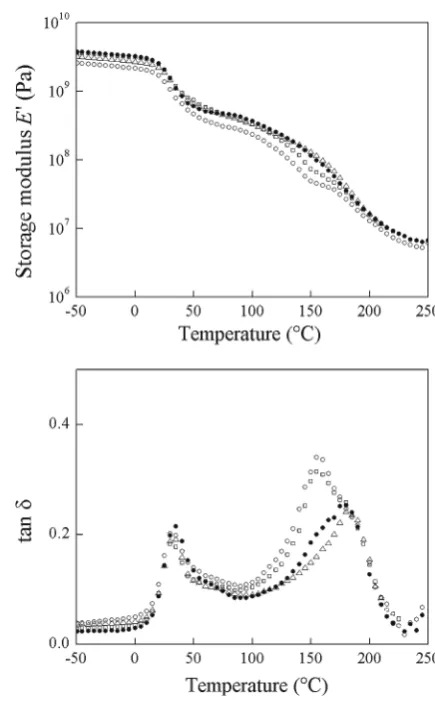
Figure 3 illustrates the DMA spectra of the API fi lms heated at various temperatures for 2 h. The most distin-guished feature of the DMA spectra is that for the samples treated at 140°C, the E′ peak at 170°C attributed to the residual isocyanate reaction disappears. This indicates that the corresponding reaction can be promoted by a heat treat-ment at 140°C. For the samples heated below 140°C, the value of E′ increases with the temperature in the range of 100° to 150°C. This behavior is similar to that observed in the spectra of the samples stored at room temperature for less than 25 days (Fig. 2). During the heat treatment, the reaction between the water-based polymer mixture and the residual isocyanate may easily occur because of the increase in the molecular motion. Referring to the abovementioned discussion, the increase in E′ could be due to the chemical structures produced during the heat treatment. The E′ value for the samples treated at 180°C was higher than that of samples treated at 140°C in the high-temperature region above 100°C. This indicates that the heat treatment at 180°C Fig. 1. Dynamic mechanical analysis (DMA) plots of
styrene–butadi-ene copolymer latex (SBR), aqueous polymer isocyanate (API), and poly(vinyl alcohol) (PVOH) fi lms (100°C, 2 h). Upper, storage modulus
E′; lower, loss factor tan d; squares, SBR latex; open circles, API;
triangles, PVOH
Fig. 2. DMA plots of API for different conditioning durations. Upper,
storage modulus E′; lower, loss factor tan d; open circles, stored 4 days;
squares, stored 12 days; fi lled circles, stored 25 days; triangles, stored
380
promotes further isocyanate consumption from that con-sumed at 140°C.
In order to elucidate the temperature dependence of the viscoelastic behavior of the API adhesives, it is necessary to consider the infl uence of heating time. Figure 4 presents the DMA spectra of the API adhesive heated at various temperatures for 10 min. Observing in the temperature range between 100° and 150°C, E′ increases with the curing temperature for samples treated below 140°C. Simultane-ously, the E′ peak at 170°C observed for the samples treated at 100° and 120°C disappears for the samples treated at 140° and 180°C. This result indicates that the heat treatment at 140°C is effective in promoting the isocyanate reaction and increasing E′. In contrast, it should be noted that no signifi -cant increase in E′ can be observed in the samples heated in an oven at 180°C for 2 h (Fig. 3). This difference indicates that the change in E′ depends not only on the heating tem-perature but also on the heating time.
FT-IR spectra
FT-IR analysis was employed to investigate the change in the chemical structure of the API fi lms under the different
postcuring conditions. In the previous studies of the FT-IR spectra of isocyanate adhesives, the curing degree was eval-uated from the intensity of the band at 2270 cm−1
that was assigned to an asymmetric isocyanate stretching; the pres-ence of the isocyanate derivatives has been usually detected due to the presence of absorption bands in the C=O stretch-ing region from 1740 to 1620 cm−1
.7,8
In the present API sample, quantitative analysis of the NCO derivatives is challenging because of the overlapping of the C=O groups of urea, urethane, and various second-ary products. Therefore, we discuss only the change in the relative intensity of the bands in the C=O region.
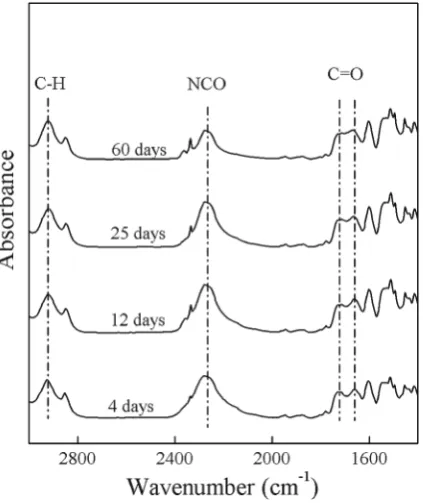
Figure 5 illustrates the FT-IR spectra of the API fi lms stored for different periods at room temperature. The intensity of the isocyanate band at 2270 cm−1
decreased gradually with an increase in the storage period, indicating that the residual isocyanate reacted continuously during storage. The band of the isocyanate absorption at 2270 cm−1 was still detected in the spectrum of a sample stored for 60 days. This indicated that complete consumption of the residual isocyanate in the API samples was diffi cult when stored at room temperature. This result agrees with those of previous studies.7,8
It is believed that the isocyanate group can react quickly with water molecules in the atmosphere Fig. 3. DMA plots of API for different treatment temperatures with
duration of 2 h. Upper, storage modulus E′; lower, loss factor tan d;
open circles, not heated (4 days, same sample as in Fig. 2); squares,
120°C; fi lled circles, 140°C; triangles, 180°C
Fig. 4. DMA plots of API for thermal treatment for 10 min. Upper,
to form an amine structure. This amine can then react with another isocyanate group to yield a urea linkage. The incomplete consumption of the residual isocyanate indi-cated that water vapor from the atmosphere could not easily react with the residual isocyanate group. It could have been because water vapor diffusion was obstructed due to the increase in the number of chemical structures in the fi lm. In other words, the residual isocyanate reaction in the fi lm depends on the diffusion of water vapor into the fi lm. This reaction mechanism can be observed in the mois-ture curing of polyurethane adhesive.17 In this case, the fi lm thickness and the humidity in the environment might play an important role in the curing process. Taki12
has reported that the consumption of the residual isocyanate in an adhe-sive applied to a wood sample is faster than that in a fi lm. This could also be due to the difference in the reaction environments of the residual isocyanate.
In the C=O region, two major peaks were observed at 1660 and 1720 cm−1. These peaks exhibited a slight change in shape with an increase in the storage period. This change is insignifi cant for discussion of the relationship between chemical change and storage time.
The effect of the heating temperature on the FT-IR spectra of the API fi lm is shown in Fig. 6. A decrease in the characteristic absorption peak of the isocyanate groups at 2270 cm−1
was observed with an increase in the treatment temperature, supporting the observation that the increase in temperature promotes the residual isocyanate reaction. This peak was still detected after heating the sample at 180°C for 2 h. This result indicates that the complete con-sumption of the residual isocyanate in the API sample could not be achieved easily even at high temperature. This phe-nomenon observed in the case of API adhesives has not
been thoroughly discussed in other studies. The reason for this is similar to the crosslinking reaction of thermoset systems such as epoxy and phenolic resin.18,19 An increase in the temperature causes the fi lm to soften and promotes a continuous reaction between the residual isocyanate and the functional groups in the adhesive system. As the reac-tion proceeds, the resulting chemical structures can lead to an increase in the viscosity of the fi lm; thus, the reactions are highly restricted. In this situation, the reaction is gov-erned by a reduction in molecular mobility. For a continu-ous reaction, additional thermal energy is required to soften the chemical structures.
Inspection of the C=O stretching regions reveals a dif-ference between the spectra of the samples treated at 140° and 120°C. In the FT-IR spectrum of the sample treated at 120°C, the intensity of the band at 1720 cm−1
is weaker than that of the band at 1660 cm−1
. In contrast, for samples treated above 140°C, the intensity of the band at 1720 cm−1 is stronger than that of the band at 1660 cm−1, indicating that a specifi c chemical change had occurred. The change in the C=O region of this API sample is mainly related to the isocyanate derivatives. Although the details of the chemical structure cannot be comprehended, this result indicates that a specifi c reaction of the residual isocyanate did occur in the case of the samples treated above 140°C. The products of this reaction might have caused the signifi cant increase in E′ of the fi lms treated above 140°C.
Figure 7 shows the FT-IR spectra of the API fi lm heated at various temperatures for 10 min. In the samples treated at temperatures above 140°C, the intensity of the band at 1720 cm−1 is stronger than that of the band at 1660 cm−1. This tendency is similar to that for the samples heated for 2 h (Fig. 6), indicating that a corresponding chemical change Fig. 5. Fourier transform infrared (FT-IR) spectra of API for different
conditioning times
Fig. 6. FT-IR spectra of API for different treatment temperatures with
382
had rapidly occurred in the API fi lms when the temperature exceeded 140°C. These results indicate that this chemical change is dependent on the temperature. This temperature dependency corresponds to that of the increase in E′ from 100° to 150°C for API fi lms treated above 140°C (Fig. 4). Therefore, this proves that the increase in E′ of the API fi lms treated at high temperatures (above 140°C) is related to the change in their chemical structures. Although the mechanism responsible for the reactions above 140°C is not fully understood, it is possible that phase transfer of the base polymer leads to softening of the system and promo-tion of the reacpromo-tion.
These results support the observation that various post-curing conditions can lead to different reaction mechanisms and products. Therefore, when conducting DMA of API adhesives, the infl uence of reaction degree and postcure conditions must be taken into consideration.
Conclusions
The effect of different postcuring conditions on the dynamic mechanical behavior of API samples has been investigated. The results indicate that the complete consumption of the residual isocyanate is diffi cult to achieve even under high-temperature conditions. Various treatment conditions lead to different reaction mechanisms and produce different crosslinking structures. The change in the DMA spectra is related to the residual isocyanate reaction in the fi lm. When the treatment temperature exceeds 140°C, the samples exhibit a rapid increase in E′ in the high-temperature region, with a corresponding signifi cant change in their chemical structures.
Acknowledgments The authors thank Nihon A&L Co. Ltd. (Osaka,
Japan) for supplying SBR emulsions and for their fi nancial support. The authors are also indebted to Dr. Hirokuni Ono for helpful discussions.
References
1. Tanaka T, Inoue T, Kuwako N (1996) Water based polymer-isocyanate adhesive for wood (in Japanese). Nippon Kagaku Kaishi 1–7
2. Mototani Y, Nakano T, Hasegawa Y, Hirabayashi Y (1996) Adhe-sive properties of laminated woods composed of softwood and hardwood (in Japanese). Mokuzai Gakkaishi 42:140–148
3. Shima S, Kimura M (2004) Water based polymer-isocyanate adhe-sives for wood (in Japanese). Mokuzai Kogyo 48:539–544 4. Hu HJ, Liu H, Zhao JJ, Li J (2006) Investigation of adhesion
per-formance of aqueous polymer latex modifi ed by polymeric methy-lene diisocyanate. J Adhes 82:93–114
5. Japanese Industrial Standards Committee (1985) JIS K 6806. Water based polymer-isocyanate adhesives for wood. Japanese Industrial Standards, Tokyo
6. Miyazaki J, Nakano T (2002) Effects of wood preservatives on adhesive properties. Part III. Curing of aqueous vinyl polymer solution-isocyanate adhesive with preservatives (in Japanese). Mokuzai Gakkaishi 48:184–190
7. Hori N (2006) The chemical structure of water based polymer-isocyanate adhesives for wood (in Japanese). Mokuzai Kogyo 61:190–194
8. Taki K, Tomita B, Mizumachi H (1983) Studies on aqueous vinyl polymer solution-isocyanate adhesives. Part III. Reaction mecha-nism of the isocyanate group (in Japanese). Mokuzai Gakkaishi 29:145–152
9. Taki K, Yamagishi Y (1984) Application of radio frequency heating to wood bonding with aqueous vinyl polymer solution-isocyanate adhesives. Bond quality of four API adhesives (in Japanese). Mokuzai Gakkaishi 30:727–734
10. Taki K (1985) Studies on aqueous vinyl polymer solution-isocyanate adhesives. Part IV. Adhesion of woods with solution-isocyanate compounds (in Japanese). Mokuzai Gakkaishi 31:573–578 11. Taki K, Yagi S, Yamagishi Y (1980) Bond quality of
PVA-isocyanate reactive resin adhesives. Part III. Properties of cured resin fi lms (in Japanese). Mokuzai Gakkaishi 26:81–86
12. Taki K (1994) The base of aqueous polymer isocyanate (API) adhesives (in Japanese). Proceedings of the 15th Symposium on Wood Adhesion. Research Group on Wood Adhesion, Japan Wood Research Society, pp 1–8
13. Taki K, Mizumachi H, Yamagishi Y (1978) Bond quality of PVA-isocyanate reactive resin adhesives. Part I. Relation between the cross-linking density and the adhesive strength (in Japanese). Mokuzai Gakkaishi 24:237–242
14. Taki K, Tomita B, Mizumachi H (1982) Studies on aqueous vinyl polymer solution-isocyanate adhesives. Part I. Mechanical proper-ties of base polymers and bond strength over a wide temperature range (in Japanese). Mokuzai Gakkaishi 28:143–149
15. Taki K, Tomita B, Mizumachi H (1982) Studies on aqueous vinyl polymer solution-isocyanate adhesives. Part II. Dependence of mechanical properties and bond strength on the concentration of crosslinks in cured adhesives over a wide temperature range (in Japanese). Mokuzai Gakkaishi 28:150–155
16. Umemura K, Takahashi A, Kawai S (1998) Durability of isocya-nate resin adhesives for wood. Part I. Thermal properties of iso-cyanate resin cured with water. J Wood Sci 44:204–210
17. Chattopadhyay DK, Sreedhar B, Raju KVSN (2006) The phase mixing studies on moisture cured polyurethane-ureas during cure. Polymer 47:3814–3825
18. Follensbee RA, Koutsky JA, Christiansen AW, Myers GE, Geimer RL (1993) Development of dynamic mechanical methods to char-acterize the cure state of phenolic resole resins. J Appl Polym Sci 47:1481–1496
19. Prime RB (1997) Thermosets. In: Turi EA (ed) Thermal charac-terization of polymeric materials. Academic, London, pp 1381– 1387
Fig. 7. FT-IR spectra of API after thermal treatment for 10 min at