WIRELESS ELECTRONIC DISPLAY BOARD USING
GSM TECHNOLOGY
Bhupesh Aneja
1, Chhavi Srivastav
2, Kartavya Farashwal
3, Ajey Aditya
41
Assistant Professor, Instrumentation & Control Department, JSSATE,
2,3,4
Student, Instrumentation and Control Engineering Department, JSSATE, Noida
ABSTRACT
This paper carries out a detailed review of the various techniques employed in the recent years in GSM
technology. It discusses the current innovations in technology, and within this context, the operation of wireless
electronic display boards using GSM technology has been reviewed.The important techniques used in past are
also tabulated. Various technical papers and articles on wireless technology have been analyzed. The paper
takes an inquisitive approach to the proposals and prototypes of an electronic display board obtained using
GSM, which can be used in public areas for information dissemination.
Although this review paper cannot be all-inclusive, it may serve as a reference for further analysis in the
domain of GSM and its application in wireless notice boards.
Keywords: GSM, LED Display, Microcontroller
I. INTRODUCTION
Communication devices such as mobile handsets and similar wireless innovations have become ubiquitous. Multipledomains in the field of Communication and Embedded devices are being increasingly explored. The use of cell phones has witnessed a rapid increase. Developments in communication technologies have led tothe growth of dense networks.
As a means of communication, notice boards are widely popular, with its applications ranging from schools, colleges, hospitals to major organizations. Notice boards effectively tackle the global problem of deforestation by conveying messages at large without the use of paper. Such innovative measures will go a long way in regulating the damage to the environment. GSM technology aims toreduce the complexity in sending a message by incorporating SMS (Short Message Service) technology.
This technology can be put to use in public areas such as hospitals, schools, multiplexes and buildings to enhance the security system and also to spread awareness in an emergency.
II. EXPERIMENTAL SETUP
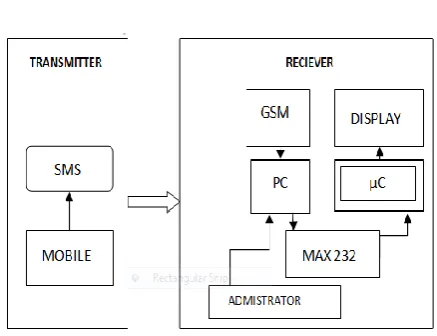
This system usesa microcontroller and a GSM Modem for analyzingthe obtained message and performing the corresponding action. Serial communication is accomplished using RS-232 standards.Various AT commands would be employed for the synchronization betweenmicrocontroller and the GSM module.
III. HARDWARE DESCRIPTION
Components required for the project are: GSM Modem
SIM Module Power Supply LED Array Microcontroller Level Shifter Voltage Regulators
Figure 1 : Block Diagram for the System
A. GSM Modem
Using a SIM, a GSM Module can operate as a mobile handset equipped with its distinct mobile number. The benefit of using a GSM modem is that the RS232 port can be used to serially communicate with the system. The modem can be used to make or receive calls, or to send and receive messages.
B. SIM
SIM is the abbreviation for Subscriber Identity Module. It is an on chip card which consists of the owner‟s detailsandcontact list. Users may change their operator using the same device. In dual SIM handset, two operators can be used on the same handset.
C. Microcontroller
D. Voltage Level Shifter
MAX232 is the IC which changes signals from RS-232 serial port to corresponding output fit for use in digitallogic circuits. The MAX232 converts the RX, TX, CTS and RTS signals.
E. Power supply
Power Supply is an essential constituent of a circuit. It supplies the required voltage to the several components in the circuit.
F. Voltage regulator
Voltage regulator provides a voltage output of predefined magnitude that stays constant, irrespective of the any changes in the input voltages and initial conditions.
G. LED Array
LED Array is a matrix of LEDs connected, such that the cathode is common for all. The connections in the matrix are via the anode and cathode openings. Different colors of LED lights depict distinct waveforms of the constituent light.
IV. SOFTWARE DESCRIPTION
KEIL and EAGLE are the softwares used for editing,compiling, linking and debugging the system. Various AT Commands are also employed for interfacing the microcontroller, GSM modem andthe display.
A. AT Commands
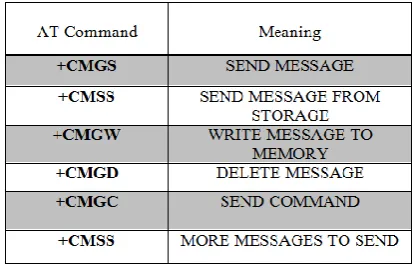
AT commandisthe software instructions used to operate a modem. AT stands for „Attention‟. Each of the commands starts with "AT" or "at". The various AT Commands have been listed in Table 1.
Figure 2: Block Diagram for Experimental Setup
V. OVERVIEW OF CONTRIBUTIONS
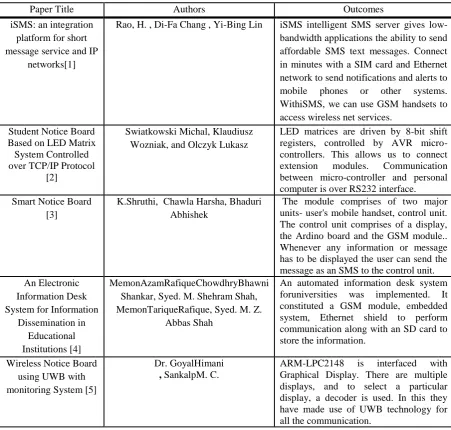
Table 2: List of Contributions by various Authors
Paper Title Authors Outcomes
iSMS: an integration platform for short message service and IP
networks[1]
Rao, H. , Di-Fa Chang , Yi-Bing Lin iSMS intelligent SMS server gives low-bandwidth applications the ability to send affordable SMS text messages. Connect in minutes with a SIM card and Ethernet network to send notifications and alerts to mobile phones or other systems. WithiSMS, we can use GSM handsets to access wireless net services.
Student Notice Board Based on LED Matrix System Controlled over TCP/IP Protocol
[2]
Swiatkowski Michal, Klaudiusz Wozniak, and Olczyk Lukasz
LED matrices are driven by 8-bit shift registers, controlled by AVR micro-controllers. This allows us to connect extension modules. Communication between micro-controller and personal computer is over RS232 interface. Smart Notice Board
[3]
K.Shruthi, Chawla Harsha, Bhaduri Abhishek
The module comprises of two major units- user's mobile handset, control unit. The control unit comprises of a display, the Ardino board and the GSM module.. Whenever any information or message has to be displayed the user can send the message as an SMS to the control unit.
An Electronic Information Desk System for Information
Dissemination in Educational Institutions [4]
MemonAzamRafiqueChowdhryBhawni Shankar, Syed. M. Shehram Shah, MemonTariqueRafique, Syed. M. Z.
Abbas Shah
An automated information desk system foruniversities was implemented. It constituted a GSM module, embedded system, Ethernet shield to perform communication along with an SD card to store the information.
Wireless Notice Board using UWB with monitoring System [5]
Dr. GoyalHimani , SankalpM. C.
An Internet Based Wireless Home Automation System for
Multifunctional Devices [6]
ZiyaAlkarAli Design and implementation of a low cost
but yet flexible and secure internet based home automation system. The communication between the devices is wireless. The protocol between the units in the design is enhanced to be suitable for most of the appliances.
Design and Implementation of Multiple LED Notice
Boards by Using ZIGBEE Technology[7]
DeshmukhVishal S., TitreSaurabh M., ChavhanSalim A.,.BawankarShyam D
The proposed system, LED‟sare arranged in rectangular box and connected with various IC‟s. ZigBee is used at transmitter and receiver.
GSM based e-Notice Board: Wireless Communication [8]
KumarPawan, BhardwajVikas, PalKiran, SinghNarayan, MishraAmit
The paper explains how GSM based e-notice board which can be widely used for multiple applications in different institutes.. SMS-based Remote Computer Supervisory Control System Design [9]
Xin-kan Mu, Yong-hong Chen It talks about designing and realizing a remote computer system which supervises all the given work using SMS communication.
Secure Method of Updating Digital Notice Board Through
Sms With Pc Monitoring System
[10]
BhoyarMayur R., ChavhanSuraj, JaiswalVaidehi
AT89c52 is interfaced with GSM modem using MAX232 level converter. There is also a 64K EPROM chip AT24C64. Microcontroller is coded using Embedded C and Kiel.
SMS Based Wireless E-Notice Board [11]
Smt.BabyM., HariniP.
It uses microcontroller interfaced via MAX232 level convertorwhich converts voltage levels to TTL voltage levels and vice versa. The hardware also has a 64K EEPROM chip AT24C64.
Multiuser Short Message Service Based Wireless Electronic Notice Board[12] Gowtham.R, Kavipriya.K, Kesavaraj.G, Natheena.A, Mr.
MaragatharaSJ
The hardware board contains microcontroller AT89c52 interfaced with GSM Modem via MAX232 level convertor. Microcontroller coding will be done using Embedded C and Kiel. Keyboard Driven
Electronic Notice Board [13]
Km. SinghRitu, ManzoorSamrah, Shukla Reena , AlungAnamika,
AggarwalPankaj
Received information can be displayed by entering the message through the keyboard. The hardware also contains flash memory EEPROM 24c02, to store the messagesand 5X7 LED dot matrix for display.
GSM Based LED Scrolling Display
Board [14]
GuptaHardik, ShuklaPuja, NagwekarAnkita
VII. CONCLUSION
Various papers have been analyzed,and the prototype of the GSM based display device has been effectively studied. A comparative evaluation of the papers and their proposed technologies has been tabulated, and the outcomes, advantages and shortcomings of each paper have been drawn out. GSM technology is a vast field, and provides immense opportunity for innovation and development. Wireless notice boards using GSM eliminates the shortcomings of paper based conventional systems. A typical board consists of an embedded system, which communicates with the GSM modem, and displays the message on a display. This notice board would be highly effective in spreading information, and due to the low cost and wide range of GSM, the device can be installed and operated from anywhere. Further modifications and prototypes in this technology would be immensely fruitful.
REFERENCES
[1] Rao, H.Di-Fa Chang , Yi-Bing Lin, “iSMS: an integration platform for short message service and IP networks” in Network IEEE Volume No. 15, Issue No. 2, August 2002, pp.48-55
[2] Swiatkowski Michal,Klaudiusz Wozniak‟ and Olczyk Lukasz, “Student Notice Board Based on LED Matrix System Controlled over TCP/IP Protocol”, in International Students and Young Scientists Workshop ,Photonics and Microsystems IEEE, 2006 pp.59-60
[3] Shruthi K., “Smart Notice Board”, in Research & Technology in the Coming Decades (CRT 2013),
National Conference on Challenges, IET, 27-28 Sept. 2013, pp. 1-4
[4] MemonAzamRafique, ChowdhryBhawni Shankar, Syed. M. Shehram Shah, Memon
[5] TariqueRafique,Syed. M. Z. Abbas Shah “An Electronic Information Desk System for Information Dissemination in Educational Institutions”, computing for Sustainable Global Development (INDIACom), 2015 2nd International Conference, 11-13 March 2015, pp.1275-1280.
[6] Dr. HimaniGoyal et al, “Wireless Notice Board using UWB with monitoring System” in International Journal Of Advance Research In Computer Science and Management Studies , Volume 2, Issue 11, November 2014, pp.390-395.
[7] ZiyaAlkar Ali, “An Internet Based Wireless Home Automation System for Multifunctional Devices” in
IEEE TRANSATIONS ON Consumer Electronics, Volume No. 51, Issue No. 4, November 2005, pp.
1169-1174
[8] Vishal S. Deshmukhet al, “Design and Implementation of Multiple LED Notice Boards by Using ZIGBEE
Technology”, in International Journal Of Engineering and Computer Science, Volume No. 4, Issue No. 2,
February 2015, pp. 10282-10285
[9] KumarPawan, BhardwajVikas, PalKiran, Singh Narayan, MishraAmit, “GSM based e-Notice Board: Wireless Communication”, in International Journal of Soft Computing and Engineering, Volume No. 2,
Issue No. 3, July 2012, pp. 601-605
[11]Mayur R. Bhoyar, SurajChavhan, “Secure Method of Updating Digital Notice Board through SMS with Pc
Monitoring System”, in IOSR Journal of Computer Science, e-ISSN:2278-0661, 2014, pp. 24-29.
[12]Smt.M.Baby,P.Harini, “SMS Based Wireless E-Notice Board” in ,International Journal of Emerging
Technology and Advanced Engineering, Volume No. 3, Issue No. 3, March 2013, pp. 181-185.
[13] Gowtham.Ret al, “Multiuser Short Message Service Based Wireless Electronic Notice Board” in International Journal of Engineering and Computer Science, Volume No. 2, Issue No. 4, April 2013, pp. 1035-1041.
[14]Km. SinghRituet al, “Keyboard Driven Electronic Notice Board” in International Journal of Advanced Technology in Engineering and Science, Volume No. 3, Issue No. 4, April 2015, pp. 46-50
[15]Gupta Hardik, Shukla Puja, NagwekarAnkita,”GSM Based LED Scrolling Display Board” International Journal of Students Research in Technology and Management, Volume No. 1(3), May 2013, pp. 278-291.
[16]Jeff Brown, “SMS: The Short Message Service”, in IEEE Computer Society, December 2007, pp.106-111.