2316
DESIGN AND IMPLEMENTATION OF MODIFIED
LOCAL LINK REPAIR MULTICAST ROUTING
PROTOCOL FOR MANETS
Ankur Goyal, Dr. Vivek Kumar Sharma
Abstract: Multicasting in mobile ad hoc networks (MANETs) is a technique to transfer data to the group of destinations from single or group of source nodes. However, the devices in the MANETs move randomly in the network leading to frequent topology changes. The link breakages occurring due to constant changing topology reduce the performance of the network. This paper presents a multicasting routing protocol that focuses on repairing the local links in an energy efficient way. The proposed Modified Local Link Repair (MLLR) multicasting routing protocol rebuilds the link from the uplink node to the node next to the downlink node. The performance of the procedure has been compared based on routing overhead, throughput, packet delivery ratio and remaining energy of the network. It shows improvement in Energy consumption and throughput with the existing algorithm. Proposed algorithm is showing to reduce 34.78% average End to End Delay and decreasing 83.52% routing overhead with comparison to existing algorithm The proposed protocol has shown improvement over the existing EOD-LLR multicasting routing protocol.
Keywords: MANETs, Multicasting, MLLR, Packet delivery ratio, link breakages, End to End Delay, throughput, Routing overhead.
——————————◆——————————
1. INTRODUCTION
MANET is the gathering of nodes of mobile contributing a wireless channel with lack in any centralized control or recognized message backbone. They have no permanent routers with all nodes skilled of movement. Nodes also perform as both routers and also end systems at the similar time. When acting as routers, they find out and preserve routes to other nodes in the network. This method of the ad hoc network lay on the broadcast power of the nodes and the location of the mobile nodes, which may vary from time to time [1]. MANET is self-configuring and active network. MANET has partial reliable and efficient resources MANETs cooperate a major role in communication and every time communication is not available. In addition, MANETs have found a variety of applications in medical field, social activities battlefield communications, adversity recovery, crisis organization forces, education setups, and conference halls. Regardless of the attractive purposes of MANETs, these structures carry on to experience many difficulties and limitations that entail more exploration proceeding to the extensive commercial employment of Mobile Adhoc NetworksThe major limitations that are related to MANET area are under: (1) the restricted power and duration of the battery, (2) quality of service (3) infrastructure-less or autonomous arrangement, (4) active network lay out, (5) the mobile activity of devices, (6) wireless connection dependability, (7) deviation in device ability, (8) multi-hop routing expandability, and (9) protection fear. Thus, routing algorithms play a major position in the MANET , and around this stay a extensive need to believe the above constraints of Mobile adhoc networks in the growth of fresh procedures for routing to facilitate the capable transfer of packets over a wireless standard, largely when the origin and target are
non-neighbouring devices. The core and head point of a Mobile adhoc networks routing protocols is to make a constant, tough and energy-efficient route among the resource and target nodes for declining the mean end-to-end delay and data sufferers. MANET Multicasting can be stated as broadcast of data from source node to several receiver nodes side by side .Multicasting is a well-organized method to support group communication using possibly fewer network resources. Multicast routing protocol is essential for shrinking the excess of assets[2].Because of natural limitations of MANETs, making as well as managing proficient routing protocol in multicast surroundings is significant for this type of wireless networks[3,4]. Routing processes administer information communication in MANET, which stringently, should be in outstanding agreement with the movement of the devices in dynamic lay out of the arrangement [5]. A vital issue in a multicast network is to pass on packages reliably from the source to all the destinations. The profit of multicast routing procedures is the potential to shrink the transmission costs and reduction in the network assets by imitation of the packet over a shared network [6]. The case of multicasting in MANETs is dissimilar as the multicast routing algorithms have to make service of in short supply resources like bandwidth, time and device resources (battery life, processing speed and memory capability) powerfully in the extremely dynamic area [7].
2. RELATED WORK
In [8] the researcher concentrated on building up a vitality effective multicast algorithm for MANETs. The contemplation in this proposed arrangement is that the packets of datum transmitted by a hub from the source to the network goals and these hubs are focused on the course with higher effectiveness of remaining battery power and dispatched limits. The other objective of the proposition was to diminish the overhead procedure so as to choose conceivable multi-cast courses among source and target point. In such manner, the model had demonstrated closed the courses from goal to source, which is novel in findings with other contemporary models. Contrasted with other benchmarking structures, for example, EACNS, EDCMRA,
____________________________________
• Ankur goyal: research scholar, jagannath University
Jaipur [email protected]
• Dr Vivek Kumar Sharma: professor, jagannath
HSPMA, and MC-TRACE, the outcomes obtained for these measurements from the multicast course shown by EELAM. These measurements were likewise differentiated between the multicast courses made with the unique number of hubs that EELAM found so as to exhibit the versatility and viability of the projected system. Bits of knowledge from this system have spurred us to reclassify the Adaptive Genetic Algorithm, with the goal that the wellness capacity can utilize fluffy thinking to gauge the wellness of the given multicast courseIn [9], the authors outlined a ODMRP based multicast routing protocol. The protocol shows dependable transfer node on (LSF).A network of multicast route among multicast source and destinations has been familiar to nodes with a maximum LSF. The aim of the algorithm is finest disagreement count that can be estimated with the assessment of arriving strength of signal. This algorithm has five phases: (1) link stability factor result, (2) purpose of limit LSF value, (3) pruning neighbouring devices, (4) formation of a mesh that hold many steady forwarding devices, and (5) A mobile network formation in which no device remains remote. In [10] the scholar broke down the productivity of multicast transmission postpones dependent on a general two-hop transmit algorithm with supportive probability p where a similar parcel can convey all things considered particular transfer hubs, and afterward these relay hubs can pass the bundle to its goal hubs. generally, with supportive probability p, the goal hubs can likewise advance the parcel to one another. Here the researcher established a Markov anchor model to catch the involved procedure of parcel dissemination under the MANETs general two-hop impart calculation. Utilizing the hypothetical model, at that point determine an exact articulation for the assessed postponement in conveyance of multicast. In [11] authors presented an competent fuzzy reasoning based multicast routing technique to adaptively direct the system belongings without any former information about system transfer. Each source device self-organizes the multicast forum with mean end to end delay and PDR values in order to vigorously turn its own transmission rate. The outlined technique in this work was a new framework for multicast forces such that it can be organized by both tree-based and multicast routing protocols based on mesh as well an outlined process takes a cross-layer method to powerfully run the jamming. The output in this work taught a very great development in provisions of amount of the retransmissions calculation, delays and overhead compared to the live multicast techniques. In [12] authors projected Trust value updating algorithm for cluster head so as to choose the current cluster head as the devices are constantly affecting. The efficiency of this planned technique in contrast with Power Aware On-demand .Multicast Routing technique is shown with imitation The presented in contrast to prior technique improves the energy utilization as well as give delay reduction . In [13] authors measured the inner harass, namely Multicast Announcement Packet Fabrication Attack on PUMA (Protocol for Unified Multicasting through Announcements). Authors presented the defence method to perceive the attacks as multicast activity-based overhearing method, i.e., traffic analysis-based exposure process with a single key charge the examination of performance, provides an enhanced network presentation of projected method over PUMA. This paper [14] gives an
2318
based sending hubs. Utilizing hubs with maximum LSF, a work of multicast courses between Multicast source and goals was created. The fundamental theme under this convention is the ideal check of contention that can be resolved with the assistance of the acquired signal strength. The recommended convention incorporates the following steps: (1) Calculation of the Link Stability Factor (2) Determination of the absolute LSF value (3) Pruning of neighboring hubs (4) Creation of a work comprising of progressively secure sending hubs (5) Creation of a portable network in which no hub remains segregated, just as hubs confronting less contention. On a current mesh-based multicast steering convention, ODMRP, the proposed convention has been illustrated. Exata/Cyber test system re-enactments are directed and the obtained outcomes are compared with ODMRP. The relative investigation reveals that the convention is increasingly effective as far as execution parameters, for example, packet delivery ratio (PDR), Average End-to-End Latency and Average Route Lifetime are contrasted with ODMRP, LSMRP, and MMRNS. This paper additionally focused on the impact on PDR, defer and lag of the minimum and maximum check of contentionIn [18], the authors represented a (SLMRP) scheduled-links multicast routing protocol based on forecast of mobility. Scheduled-links multicast routing protocol made number of listed paths between multicast sources as well as destinations. SLMRP scheduled paths are issued to dependability as well as QOS need in load-balance strategy. Multiple loop-free and node-disjoint paths are made for each source–receiver pair during route emerging procedure. For managing the triggering and de triggering of these paths, authors made multicast routing activation timer and path timeout timer . MRAT and PTT are measured with the route finishing time for the deposit of the emerging paths. Show contrast results reveal the presented protocol shows Protocol for unified multicasting through announcement, Multicast AODV, and PMRP. The authors in [19] presented a fresh route retrieval process which chains to determine an unusual route based on localization when a link breakage takes place in the network. The presented process may reduce the control packet overhead, delay and increment the throughput.
3. PROPOSED WORK
To repair the route locally without causing a lot of overhead and energy consumption, the proposed MLLR (Modified Local Link Repair) multicast routing procedure has been proposed. This algorithm is a modification to existing EOD-LLR [19] routing protocol. In the existing protocol, when a link breaks away, the uplink node broadcasts RREQ packet in the network to form a new route to multicast group. However, the proposed MLLR routing protocol offers to not build an entire route, but just repair the part of the route that has been broken.
3.1 MLLR Multicast Routing Protocol: The proposed protocol works in the following fashion:
a) Route discovery stage: When the source device has data intended for any component of the multicast cluster or for the leader of the multicast group itself, it first checks its cache memory for any available route. If the route is not found, then similar to AODV or DSR, it launches broadcasting process to find fresh route to multicast group.
In this process, the source node forwards the RREQ packets to its neighbouring nodes. The neighbouring nodes upon receiving the RREQ packet follow the same process and rebroadcast the received packet until the route to any group member or the route to the leader of the multicast group is found.
b) Route Reply stage: Once the RREQ packet reaches the multicast group, the devices reply to the source device by unicasting the Route Reply (RREP) message. This message can be unicasted by any component of the multicast cluster or by the leader of the cluster also. c) Data Transmission: Once the source device accepts the RREP message, it chooses the shortest pathway as the optimum path and forwards the data to the intended destination node.
d) Modified Local Route Repair Mechanism: During the data transmission, if any node in the path finds that the link to the downlink node has broken then it starts the route repair mechanism. The uplink device transmits the RREQ packet again to find the route to the next device in the path (the node next to the downlink node). For example, if a path consists of Source-a-b-c-d-destination. If the link a-b breaks away, the node ‘a’ broadcasts the RREQ packet to find a route to the node ‘c’ instead of broadcasting till destination node.
b d Source a c Dest
Figure 3.1: Route Repair mechanism
In the above figure, it is shown that the node ‘a’ finds a route to node ‘c’ in case the link ‘a-b’ breaks. Thus, the broadcasting all the way to the destination node reduces the overhead as well as energy consumption of the nodes.
3.2 Pseudo Code:
Suppose N is the total number of devices in the system M is the number of multicast members
Nei is the nodes in the neighbour set Proc: Route Discovery
• Route found =0
• While (Route found = = 0) • for i=1:N
• Source ‘S’ finds neighbours in the communication range.
• For j=1: Nei • For k=1: M
• If Neighbour(j) == Multicast member(k) • Route found = = 1
• Execute RREP() • Else
• Broadcast Route Request to the neighbours • End if
• End for • End for • End for • End While Proc: Route Reply
• Formulate all the routes from multicast group to the source device
• Unicast RREP to the source device Proc: Data Transmission
Suppose P is the set of paths formulated • For i=1:P
• If Path (i) == shortest
• Transfer data to the multicast group • End if
• End for
• Check for Link Breakage • If Link Breakage found • Execute Route Repair • Else
• Continue Data Transmission • End if
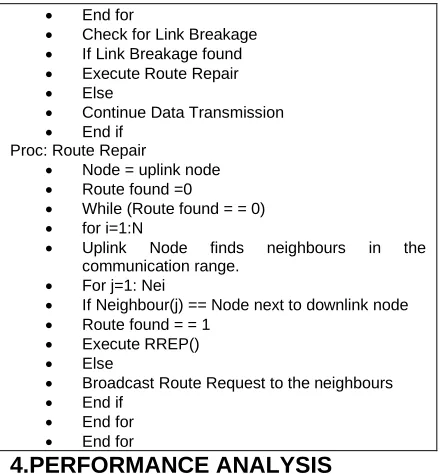
Proc: Route Repair
• Node = uplink node • Route found =0
• While (Route found = = 0) • for i=1:N
• Uplink Node finds neighbours in the communication range.
• For j=1: Nei
• If Neighbour(j) == Node next to downlink node • Route found = = 1
• Execute RREP() • Else
• Broadcast Route Request to the neighbours • End if
• End for • End for
4.PERFORMANCE ANALYSIS
For the simulation of the proposed as well as existing protocols, network simulator 2.35 was used. For the simulation of the network, following parameters were used:
Table 4.1 Simulation Parameters
Parameter Value
Channel Wireless
Mac 802.11
Antenna Omni Directional Mobility model Random way point
Number of nodes 60
Number of multicast group members
5
Initial Energy 100 Joules Propagation Model Two Ray Ground
Connection Type UDP
Traffic Type CBR
Routing procedure AODV
Queue Drop Tail
The parameters which are applying to check the performance of the system are remaining energy, routing overhead, packet delivery ratio, throughput and average end to end delay. The graphs below show the values obtained for these parameters for both the protocols.
Figure 4.1: Remaining Energy comparison
Initially the network was supplied with energy of 100 Joules. At the end of the simulation time (40 seconds) the remaining power of the network under existing protocol was 77.11 Joules and under the MLLR protocol was 84.22 Joules. This shows that the existing scheme consumed more energy than proposed scheme. This is because less amount of RREQ packages is transmitted in the system while repairing the route under the proposed MLLR protocol. This leads to less transmission energy consumption by the nodes which indicates better network lifetime.
Figure 4.2: Average E2E Delay comparison
2320
protocol. This shows that the proposed protocol is quick in repairing the local link breakages and takes less time. The more value of delay for the existing scheme is also because of the more number of packets used in route repairing mechanism.
Figure 4.3: Throughput comparison
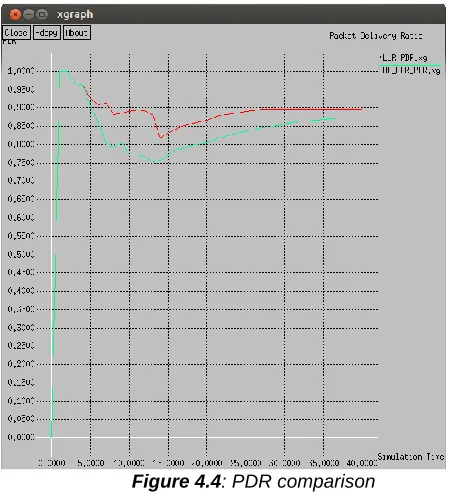
This figure shows the value of throughput for both the protocols. The throughput is the amount of information received by the nodes in the multicast cluster. The value of throughput obtained was 327 Kbps for the existing protocol and 348 Kbps for the proposed protocol. The quick formation of the new route or quick repairing of the path allows the nodes to send more information to the multicast cluster which increases the value of throughput of the network. This indicates better network performance. The figure 4.4 below shows the value of packet delivery ratio obtained for both the schemes. It can be defined in the ratio of received messages in the system to the sent messages. The value of PDR for the proposed protocol was 0.89 and for the existing protocol was 0.87. This indicates better reception of the packets in the network for the projected procedure.
Figure 4.4: PDR comparison
The figure 4.5 below shows the assessment of the routing overhead for both the schemes, the value of routing overhead for the proposed protocol was 1.4 and for the existing protocol were 8.5. It is computed as ratio of number of control packages sent in the system for repairing the route to the number of packages received in the network. Clearly, the less value of routing overhead for the proposed scheme shows less RREQ messages sent in the network to repair the route.
Figure 4.5: Routing Overhead comparison
V. CONCLUSION
systems of the whole network get consumed. The parameter namely throughput, packet delivery ratio, routing overhead, average end to end delay and remaining energy of the network have shown better values when compared against the EOD-LLR. This confirms the better show of the proposed protocol. Proposed algorithm (MLLR) is showing to reduce 34.78% average End to End Delay and decreasing 83.52% routing overhead with comparison to existing algorithm (EOD-LLR). Furthermore, the path has been selected based on the least hop count. In future, path optimization can be done to further improve the performance of the network.
REFERENCES
[1] Mrunal Gavhale, Pranay D.Saraf, “Survey on Algorithms for Efficient Cluster Formation and Cluster Head Selection in MANET”, Procedia Computer Science, Volume, 2016.
[2] Amir Tavizi, Ali Ghaffari, “Tree-based reliable and energy-aware multicast routing protocol for mobile ad hoc networks”, The Journal of Supercomputing, 2018. [3] Rajadurai SJG, Veerappan J, Ramasamy K,
“Optimization of multicast ad hoc on-demand routing protocol based on genetic algorithm with backup paths in MANET”, Wireless Pers Communication 94:2095–2124, 2017.
[4] Ghasemnezhad S, Ghaffari A, “Fuzzy logic based reliable and real-time routing protocol for mobile ad hoc networks”, Wireless Pers Communication 98:593–611, 2018.
[5] Vrince Vimal; Madhav J Nigam ; Harvinder Verma, “Route Assortment Procedure for Mobile Ad Hoc Networks using a Novel Modified Mobility Factor”, 2017 14th IEEE India Council International Conference (INDICON).
[6] K. U. Adhvaryu, Performance Comparison between Multicast Routing Protocols in MANET, 2017 4th IEEE Uttar Pradesh Section International Conference on Electrical, Computer and Electronics (UPCON) GLA University, Mathura, Oct 26-28, 2017
[7] P Lavanya, V Siva Kumar Reddy, “Research and Survey on Multicast Routing Protocols for MANETs”, 2017 Second International Conference on Electrical, Computer and Communication Technologies (ICECCT).
[8] Papanna N, Reddy ARM, Seetha M, “EELAM: energy efficient lifetime aware multicast routeselection for mobile ad hoc networks”, Applied Computing and Informatics, Volume 15, Issue 2, July 2019, Pages 120-128.
[9] Singal G, Laxmi V, Gaur M, Todi S, Rao V, Tripathi M, “Multi-constraints link stablemulticast routing protocol in MANETs”, Ad Hoc Netw, 63:115–128, 2017.
[10] Bin Yang, Zhenqiang Wu ; Yulong Shen ; Yuanyuan Fan,“Multicast Delivery Delay in General Two-Hop Relay MANETs”,Publisher: IEEE,2017
[11] Shafigh AS, Veiga BL, Glisic S (2018) Cross layer scheme for quality of service aware multicast routing in mobile ad hoc networks. Wireless Network 24:329– 343.
[12]Sapna B. Kulkarni ; B. N. Yuvaraju, Trust value updation algorithm for multicast routing algorithm for cluster based MANET, IEEE2017.
[13] Divyanshu Wagh ; Neelu Pareek ; Upendra Singh, Elimination of internal attacksfor PUMA in MANET Publisher: IEEE,2017
[14] Jabbar, W. A., Ismail, M., Nordin, R., & Arif, Power-efficient routing schemes for MANETs: a survey and open issues. Wireless Networks,2016.
[15] Bin Yang, ZhenqiangWu, YulongShen xiaohongJiang , Packet delivery ratio and energy consumption in multicast delay tolerant MANETs with power control, Computer Networks Volume 161, 9 October 2019, Pages 150-161
[16] Y. Cai, Y. Fan, D. Wen, An incentive-compatible routing protocol for two-hop delay-tolerant networks, IEEE Trans. Veh. Technol. 65 (1) (2016) 266–277. [17] Gaurav Singal, Vijay Laxmi, M.S. Gaur, SwatiTodi,
VijayRao, “Multi-constraints link stable multicast routing protocol in MANETs”, August 2017, Pages 115-128. [18]HasanAbdulwahi, BinDai, BenxiongHuang, ZijingChen,
“Scheduled-links multicast routing protocol in MANETs”, Journal of Network and Computer Applications , Volume 63, March 2016, Pages 56-67. [19] Deepika Vodnala, S. Phani Kumar and Srinivas