IJEDR1901005 International Journal of Engineering Development and Research (www.ijedr.org) 20
Energy Efficient Routing in Internet of Things
Based on Link Quality and Clustering Algorithm
1Roshna Raveendran C P, 2Dr. Sangeetha Jose, 3Vigilkumar V V 1MTech Scholar, 2Assistant Professor, 3Assistant Professor
APJ Abdul Kalam Technological University Government Engineering College Idukki,India
_____________________________________________________________________________________________________ Abstract— Internet of Things (IoT) allows people and things to be connected anything, anytime, anyplace and anyone ideally by using network. In IoT environment the massive devices makes the forwarding of data from source to sink is more critical. So packets should be routed efficiently in the network by reducing congestion, packet loss and delay rate. The redundant deployment of network equipment reduces the network utilization, which will degrade the energy efficiency of networks. In many of the IoT applications, often involves battery powered nodes which are active for a long period, without any human control after the initial deployment. The improper use of routing techniques is the common reasons of drain out the battery within few days. So there is a need to develop some new energy efficient routing algorithms and protocols. This paper focuses on the energy efficient routing mechanism using link quality based clustering algorithm. The proposed method provides reduced energy consumption, maximizing the network coverage, less packet loss and reduced delay rate.
Keywords:Internet of Things, Routing in IoT, Clustering Algorithm, Link Quality.
_____________________________________________________________________________________________________
I.INTRODUCTION
Internet of Things (IoT) incorporates the concepts from pervasive computing and enables interconnections of everyday objects equipped with ubiquitous intelligence. IoT has gained much attention from practitioners and researchers around the world, and spawned a wide variety of smart automated systems, such as smart buildings, smart homes, smart factories, and so on. Generally Internet of things means anything, any object which can connected to the internet and these things can be accessed anywhere from the world at any time.
In Internet of Things most of the devices are battery powered. These battery powered nodes are active for a long period, without any human control after the initial deployment. Due to the absence of energy efficient techniques, a node would drain its battery within few days. Even in communication, large amount of energy is wasted in states, such as collision, control packet overhead, interference etc.
Hence in order to minimize energy consumption and enhancing the network lifetime, many routing protocols are already designed. There are three types of routing methods on the basis of network structure. They are Location based routing, Flat based routing and hierarchical based routing. Energy Efficiency depends on some factors which can be used to evaluate the performance of the routing protocols. They are energy per packet, network lifetime, average energy dissipated, low energy consumption, average packet delay, packet delivery ratio, idle listening, packet size, and distance between the sender and receiver.
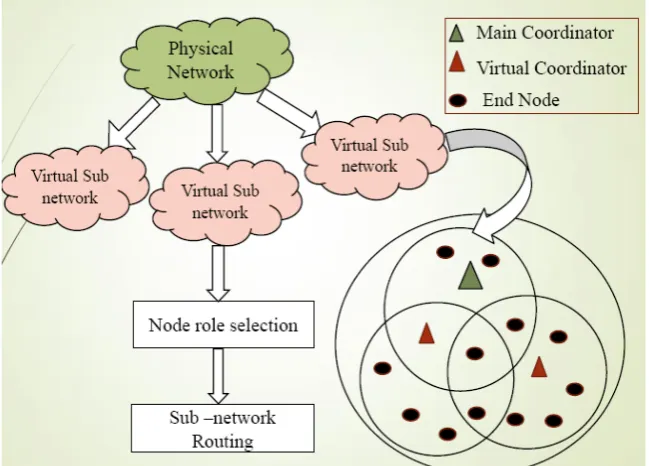
So for enhancing the energy efficiency there should be an energy efficient routing in internet of things based on link quality and clustering algorithm. This method focuses on an idea that every node will decide its role either as virtual coordinator or as an End Node on the basis of its link quality with respect to network’s main coordinator. The terms Main Coordinator, Virtual Coordinator and End Node are similar to Base Station, Cluster Head and Cluster member in the basic clustering concept respectively. The node role decision will change dynamically by executing sub- network reconfiguration whenever the node moves to the dead condition or any problem causes in the network.
Session2 briefly describing about Related Works done in the energy efficient routing. The detailed description of system architecture of the proposed approach and methods based on different parameters is in Session3. Session4 is the performance evaluation. Session 5 presents the conclusion and future scope of the work.
II.RELATED WORKS
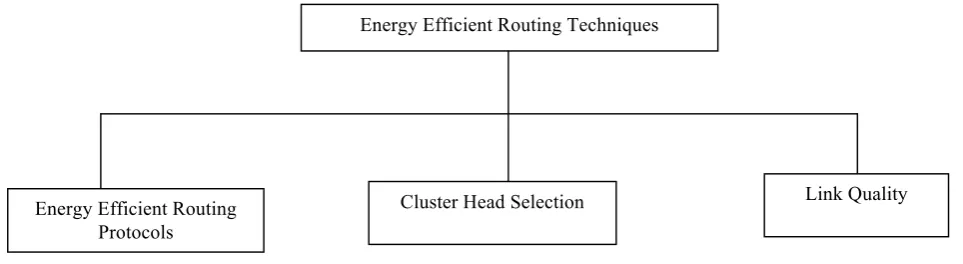
In this section we are dealing with the works which are referred to get a clear cut on energy efficient routing protocols, cluster head selection and link quality.
IJEDR1901005 International Journal of Engineering Development and Research (www.ijedr.org) 21 2.1Energy efficient routing protocols
Some of the energy efficient routing protocols based on network structures are given below. 2.1.1 Location Based Routing
Location based routes [1],[2],[4],[8],[18] are set by node locations. The space is divided into quadrants. Each node knows its position in space. All in all, just about all the sensor network localization algorithms impart principally three basic stages. They are distance estimation, position computation and localization algorithm. In location based protocols, sensor nodes are simply addressed by their means of locations. In a network, location information for nodes is necessary. To estimate energy consumption, all the routing protocols should calculate the distance between two particular nodes.
2.1.2 Flat based routing
In flat network routing [2],[3],[6],[7], nodes communicate in an ad-hoc way and they reach the base station (BS) by multi-hop routing. If a far node tries to reach the sink it needs to find an optimal or efficient (context routing) path. Information/ Data are centralized at the BS.
2.1.3 Hierarchical based routing
Hierarchical based routing [2], [3], [9], [10], [11], [12], [13], [14],[15],[19] is the process of arranging all routers in a hierarchical manner.
2.2 Cluster Head Selection NO
Routing Classification
Advantages Disadvantages
1
Location Based
[1], [2],
[4],[5],[8],[18]
1. Reduces Energy consumption 2.Intermediate network lifetime
1.Time Consuming 2.Data Overhead 3.Lack of scalability
2 Flat Based
[3],[2],[6],[7]
1.Better Energy Efficiency
2. Increased Network Lifetime
1.Lack of scalability 2.Chances of Collisions 3.High Overhead 4.Require Latency 3
Hierarchical based
[3],[2],[9],[10] [11],[12],[13], [14],[15],[19]
1. High Energy Efficiency 2. Scalability
3. Collisions avoided 4. Less latency 5. Less overhead 6. Increased network lifetime
High time complexity Energy Efficient Routing Techniques
Energy Efficient Routing Protocols
Cluster Head Selection Link Quality
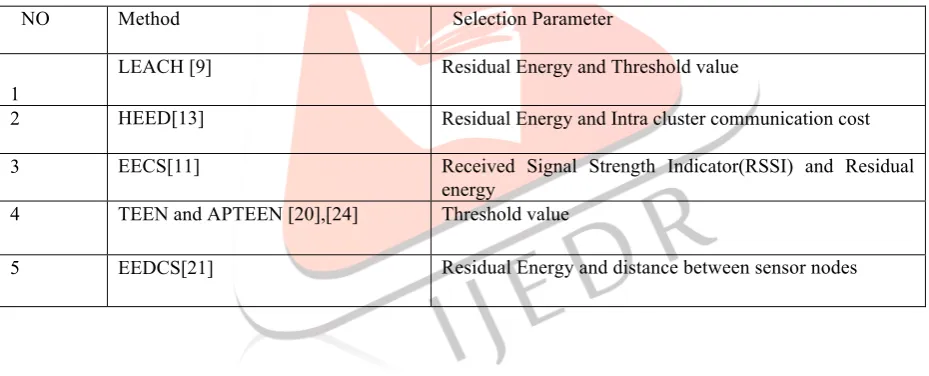
IJEDR1901005 International Journal of Engineering Development and Research (www.ijedr.org) 22 Cluster head selection is one of the main criteria in the aspects of energy efficient routing in internet of things. The selection is depends on some energy related parameters.
Low-Energy Adaptive Clustering Hierarchy (LEACH) [9] facilitates the nodes with more residual energy have more chances to be selected as cluster head. To extend the lifetime of the whole network, the energy load must be distributed among all sensor nodes so that the energy will not be drained out quickly. It reduces the energy significantly. The LEACH protocol forms clusters in the sensor networks and randomly selects the Cluster-heads for each cluster. Non cluster-head nodes sense the data and transmit to the cluster-heads. The cluster-heads aggregate the received data and forward the data to the sink. Basically LEACH assigns overall energy utilization of the network uniformly to each sensor node through selecting different nodes as cluster-head. This makes the survival time of nodes close to the lifetime of network. Thus, the energy consumption can be reduced and the lifetime of the entire network can be prolonged.
In Energy Efficient Clustering Scheme (EECS) protocol [11] cluster head selection is on the basis of residual energy and received signal strength. In this case, several cluster heads are electd. Node become a CANDIDATE node with a probability of T and then broadcast the COMPETE HEAD MSGs within its radio range Rcompete to advertise their will. Each CANDIDATE node will checks whether there is a CANDIDATE node with more residual energy within the radius Rcompete. Once the CANDIDATE node becomes a more powerful CANDIDATE node, it will give up the competition without receiving sub sequential COMPETE HEAD MSGs. Otherwise, it will be elected as HEAD in the end.
In Hybrid Energy Efficient Distributed Clustering Protocol [13], Cluster head selection is primarily based on the residual energy of each node. Energy consumed for sensing, processing, and communication is typically known, and hence residual energy can be estimated. In Intra cluster communication, cost is considered as the secondary parameter to break the ties. A tie is meant by that a node might fall within the range of more than one cluster head.
TEEN[20] and APTEEN[24]protocol has been developed specifically for time critical networks. Here in the cluster head selection is on the basis of Threshold value. However, if the thresholds are not reached, the user cannot determine the state of the network, making it inadequate for applications that require periodic data from the network. In this scheme, at every cluster change time, in addition to the attributes, the cluster head broadcast Hard Threshold and Soft Threshold messages to its members.
2.3 Link Quality
Link quality means it is the quality of a link for transmitting the packets through the link between source and destination. Data transmission over high quality link improves network throughput and network lifetime by reducing packet loss and frequency of route reconstruction process. In order to maintain a stable network performance, topology control protocols can use link quality information to constructs initial network topology. Some factors affecting link quality are path type, number of hops, noise and interference.
NO Method Selection Parameter
1
LEACH [9] Residual Energy and Threshold value
2 HEED[13] Residual Energy and Intra cluster communication cost
3 EECS[11] Received Signal Strength Indicator(RSSI) and Residual energy
4 TEEN and APTEEN [20],[24] Threshold value
5 EEDCS[21] Residual Energy and distance between sensor nodes
IJEDR1901005 International Journal of Engineering Development and Research (www.ijedr.org) 23 Reliable Routing Algorithm on Wireless Sensor Network [27] uses a routing algorithm called Cumulative Link Quality Routing Algorithm (CLQR), which leverages LQI to provide a better routing scheme. Unlike other routing schemes, CLQR does not use probe packets to measure the link quality. Instead of it uses cumulative link quality as a metric to choose better routing path. This algorithm can hold a high throughput and improves path efficiency. CLQR can balance network load and extend the network lifetime. CLQR uses CLQ as a metric to choose the next hop. CLQ is the probability that packets can be successfully received in the receiver. for computing new CLQ, value of Packet reception ratio(PRR) is used. The node which has high value of CLQ, will become the next hop node. Maximum CLQ indicates the chosen path can maximize the throughput. But this method has some problem ie, HOT-POINT problem. Which indicates that some nodes with high PRR which will continuously transmitting plenty of data. The more data packets, they transmit the more power will consume and faster they will die..
K´assio Machad et al [23] describes a routing protocol based on Routing by Energy and Link quality (REL)
for Internet of Things applications. In order to increase reliability and energy-efficiency, REL selects routes on the basis of proposed end-to-end link quality estimator mechanism. REL proposes the use of WeakLinks. If the LQI for a given link is less than LQI threshold, the link is considered as weak and the WeakLinks counter is incremented. The WeakLinks contains RREQ and RREP messages, and updates each hop during the route discovery process. By receiving the RREQ or RREP message, a node updates its LQI value. According to this, the node must calculate whether the LQI is lower than LQIth, and update the WeakLinks if necessary.
Link Quality and Local Load Balancing Routing Mechanisms [25] describes a simple way to improve reliability and efficiency of the LQI based on routing. Here includes some route selection criteria such as remaining energy level and sensor proximity with respect to BS. In this paper define three LQI based metrics: AvgLQI, MaxLQI and MinLQI. The AvgLQI metric is the average value calculated from the LQI values of all the links between the node and its neighbors and AvgLQI values give a characterization of sensors throughout their respective coverage quality. This metric might be useful in the context of the WSN deployed in a warehouse which hosts a large number of pallets, one upon the other. Such an environment is proned to high unreliability of wireless links. the MaxLQI metric is the maximum LQIvalue which matches to the standard definition of the LQI used in the MultiHopLQI routing algorithm. As for the MinLQI, it is the minimum value beyond the given LQI threshold. As the LQI decreases ,when the distance between the nodes increases. The average path length is more large for MaxLQI than MinLQI. This is why MinLQI is more energy efficient than MaxLQI.
A new link quality estimation mechanism based on LQI [26] describes a new Link Quality Indicator based link quality estimation mechanism, which takes the lost packets and error packets into account. The error packets means, after the recipient has received the packets from the sender, the packets does not pass the Cyclic Redundancy Check and dropped by the recipient. So there is a need for analyzing the error packets. By keeping the error packets information, we can obtain more accurate assessment about link quality. Obtain the link quality like, good or bad, thus the routing table can choose the best link quality to translate data packets which will enhance the stability of the network. Also energy consumption is decreases.
Link quality and path based clustering in IEEE 802.15.4 networks [22] formation of the separate sub-groups is adapted to the network density and the node selection metric is based on the link quality indicator. Link quality approach to a clustering algorithm is described as high density networks are prone to increase packet drops which in turn have a negative impact on network reliability. Therefore, Minimal Configuration does not perform as expected when the network density exceeds a certain threshold. The network nodes simultaneously transmit both application data and control packets in broadcast mode, thus increasing the interference among the nodes. To overcome this limitation, the algorithm is adjusted accordingly and runs an application specific management model, which improves network performance under high traffic conditions. The Clustering Algorithm divides the network into clusters and coordinates the communication within such a cluster group. Moreover the algorithm reduces the number of broadcast control packets that are now defined by the ”keep alive” packets. Here the link quality is evaluated by using discrete values 1,2 and 3. That essentially categories the LQI as provided by the inherent function.
NO Paper Computation Technique Advantages Disadvantages
1 Reliable Routing
Algorithm on Wireless Sensor Network [27]
Cumulative Link Quality Routing Algorithm 1.High throughput 2.Increased network lifetime 3.Better path efficiency
1. Not flexible to accommodate multi metrics
2.HOT-POINT problem 2 A Routing Protocol
Based on Energy and Link Quality for Internet of Things applications[23]
Residual energy of nodes 1.Increased network lifetime
2.High Energy efficiency
Overhead
IJEDR1901005 International Journal of Engineering Development and Research (www.ijedr.org) 24 Load Balancing
Routing Mechanisms [25]
Indicator(LQI) loss
2.Increased network lifetime
2. Collision of packets
4 A new link quality estimation mechanism based on LQI [26]
LQI with lost packets and error packets
1.Less packet loss rate 2.Increased network lifetime
3.High reliability 4.High Energy efficiency
Time consuming
5 Link quality and path based clustering in
IEEE 802.15.4
networks [22]
Link quality among nodes
and Network density 1.Reduction in dead nodes 2.Increased network lifetime
3.High Energy efficiency
1.High density increases packet drops 2.Interference
2.4 Observations
Based on the analysis of different routing methods, it is observed that
• Hierarchical based techniques are better in terms of network life time and low energy consumption. The role selection mechanism is the main criteria in hierarchical clustering methods.
• Some parameters for selecting these roles are location of nodes, residual energy, link quality, path length and network life time.
• From the analysis of cluster head selection, they received signal strength indicator value for the cluster head selection. • From the analysis of link quality it is observed that, due to high quality links, which increases network lifetime and
network throughput, less packet loss and minimum number of retransmissions.
• Link quality affects the topology stability and high quality links are long lived. So to minimize the energy consumption in internet of things there is a need of designing an efficient routing method by using link quality and clustering methods.
After studying these different energy efficient routing protocols, cluster head selection methods and link quality we identified the problems with the existing approaches and to alleviate these problems we are planning to implement an efficient routing protocol.
III.PROPOSED WORK
We design an energy efficient routing based on link quality and clustering algorithm. 4.1 SYSTEM DESIGN
The system architecture consists of a physical network, which is further divided into one or more virtual sub- network based on link quality and clustering concept. Each virtual sub- network consists of one virtual coordinator and some end nodes, also there is a main coordinator known as network root for controlling these virtual coordinator and end node. Functionally MC is same as the role of base station.
IJEDR1901005 International Journal of Engineering Development and Research (www.ijedr.org) 25 In the clustering concept these virtual coordinator and end node act as a cluster head and cluster member respectively. After virtual sub-network creation next step node role selection and sub-network routing process. Each virtualsub-network is identified with a virtual identification (vID), which is specific for each virtual sub-network.
4.2. Virtual Sub-network Creation and Node Role Decision
For the virtual sub network creation as shown in the fig:2, the physical network is divided into one or more virtual sub network based on “Dynamic Clustering Algorithm (DCA)” which incorporate energy parameter and link quality. The working of virtual sub-network creation is describes below.
First step is to deploy N number of nodes with one Main Coordinator (MC), which is same as base station in the clustering concept. Then each nodes will send an Association Request to decide whether it has to be act as a Virtual Coordinator (VC) or an End Node (EN) .Along with this ASSOCIATION REQUEST nodes will pass the information about its energy and position. Then MC will reply back with an ASSOCIATION REPLY message to the nodes where ever it got a request message. According to the distance from MC each node will calculate its Link Quality based on below given equation [32],
Link Quality Indicator = (1)
Here β is the Link Quality Indicator based on ZigBee Standard and its value ranging from 50- 110. Ψ is the Link Quality Indicator based on IEEE 802.15.4 standard and its value ranging from 0 to 255. γi j is the reciprocal of d(i, j) where d(i, j) is the distance separating node j from node i. The γimin is the Min (γi j) which is equal to the reciprocal of Maximum Distance from Node j and Node i. Also the γimax is the Max (γi j) means the reciprocal of Minimum Distance from Node j and Node I.Here maximum distance from node j and node i is taken as the maximum transmission range and the minimum distance from node j and node i is the minimum transmission range and its user defined values are 1000 unit and 400 unit respectively.
Based on this equation two user defined threshold values are defined. First one is THBaselevel and THRole. The values of these two thresholds are 50 and 110 respectively based on the least and highest LQI calculation. So each node will determine its LQI value after getting the ASSOCIATION REPLY message. The role of a node will determine itself. If the LQI value of a node is above THBaselevel and below THRole , then that node itself act as a Virtual Coordinator, consider from that point in advance the QoS will worsen even more, ie virtually it will act as the role of Main Coordinator for those who are far away from the the controlling range of MC.
Because some nodes may be below the THBaselevel so it cannot connects directly with MC.Therefore intermediate node will imitate as MC that is known as Virtual Coordinator. If the LQI value of a node is above THBaselevel and THRole , then that node
IJEDR1901005 International Journal of Engineering Development and Research (www.ijedr.org) 26 will act as an End Node, due to the good QoS of the link. If some nodes are remaining without connecting to any VC or to MC, then it will continuously broadcast ASSOCIATION REQUEST message. Suppose if there is five unconnected nodes remaining and if it is near to some VCs, then that VCs will reply for the request message. That means VCs will send an ASSOCIATION REPLY message to that nodes. Then that node will determine its link quality indicator value and decide its role according to the threshold values.
Another situation is if a node got an ASSOCIATION REPLY message from MC and VC , in response to ASSOCIATION REQUEST message and the node’s LQI value between MC is lesser than LQI value between VC, then that node will definitely make a connection with VC. That means nodes with highest LQI value will be assigned with high priority.
4.2.2Sub-network Routing
When a node decides itself as VC then it will send an ASSOCIATION V_ID REQUEST message to its VC or to MC. Then that VC will send this request to Main Coordinator for granting permission. So the Main Coordinator will respond with an ASSOCIATION V_ID REQUEST ACK message. Then the Virtual Coordinator will assign an appropriate ID with ASSOCIATION V_ID ASSIGN message to the new node. For this message the new node will reply back with an ASSOCIATION V_ID ASSIGN ACK message.
If a node decides itself as EN then it will send an ASSOCIATION REPLY ACK message to the main coordinator or Virtual coordinator. If it is connected to the virtual coordinator then the Virtual Coordinator will send an ASSOCIATION INFORM message to the Main Coordinator and the Main Coordinator will return back an ASSOCIATION INFORM ACK to the virtual Coordinator.
4.2.3 Sub-Network Reconfiguration
For checking the connection and node status each node will send a KEEP_ALIVE REQUEST message to its connected nodes and vice versa. That means End Node will checks its connection with Virtual Coordinator or Main Coordinator, and Virtual Coordinator and Main Coordinator will check its connection with all its End Nodes. Then alive nodes will respond with KEEP_ALIVE REQUEST ACK message. After sending each message, every node will decrement its battery value by 0.5 mAh (This value is user defined). So depends upon number of messages send by a node it can be die after a particular time. So there is a chance for dying a node and the link between the neighboring nodes will not exit.
If the End Node is a dead node then virtual Coordinator will inform this information to Main Coordinator by sending a PURGE REQUEST. And the Main Coordinator will return back with a PURGE REQUEST ACK message to the corresponding Virtual Coordinator. Or if the dead node is a Virtual Coordinator then each End Node connected this Virtual Coordinator will search for another Virtual Coordinator by broadcasting an ASSOCIATION REQUEST and make a connection with new Virtual Coordinator. After getting a new connection the End Node will inform about its new Virtual Coordinator to the Main Coordinator through this new node. This is the procedure for network reconfiguration.
Simulation
In this section, we simulate a set of nodes and evaluate the behavior of DCA and measure the energy consumption in Smart City scenarios. The initial positions of 50 static nodes are generated as random variables over a square field. The simulation have been performed with OMNeT++,a well-known c++ discrete simulator. As OMNeT++ is not focused on wireless networks, it is necessary the use of a framework, as inet. As DARAL is an IEEE 802.15.4-based routing algorithm, the communication band used is the ISM band of 2.4 GHz. Two important threshold values are THBaselevel and THRole. During this tune phase, Talive and energy decrementing showed a strong influence in the performance of the protocol, in terms of the node existence and reconfiguration of sub network.
No
Parameters Value
1 Carrier Frequency (GHz) 2.4
2 Carrier Sense Sensitivity (dBm) -85
3 Transmit Power (mW) 1.0
4 Talive (s) 15
5 THbaselevel 50
6 THrole 110
IJEDR1901005 International Journal of Engineering Development and Research (www.ijedr.org) 27
7 Payload size(Bytes) 70
In a Smart City scenario there are different possibilities of networks so it is necessary to define different workloads in terms of area and number of nodes. So there is a need for modification of these parameters makes possible to work with different number of nodes as reference. For this work ,here five different node scenarios are considered: 5,10,15,20 and 25. Along with this after sending each messages the battery level of corresponding nodes will be decremented by 0.5mAh and also the node status will be checked in every 15s.
IV.
Results & Performance Evaluation
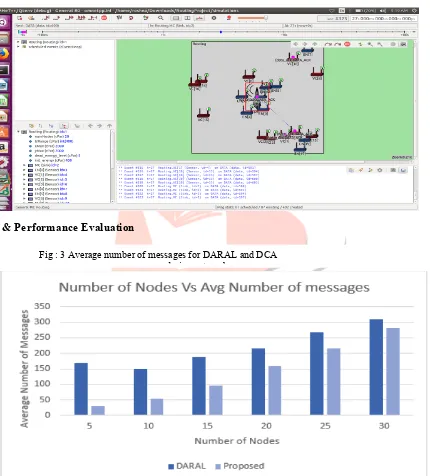
Here in both cases the number of nodes with average number of messages are compared and analyze that average number of messages is high in case of DARAL as compared to proposed DCA during setup phase.
Fig : 3 Average number of messages for DARAL and DCA during setup phase
IJEDR1901005 International Journal of Engineering Development and Research (www.ijedr.org) 28 The
Average
energy consumption during setup phase is measured by the energy spent in clustering with number of nodes deployed and analyzed that DARAL takes more energy than proposed DCA.
VI. CONCLUSION AND FUTURESCOPE
IoT consists of large number of devices, physical objects sensors actuators etc, which can be connected to the internet and can be access anywhere from the world at any time. Mostof these device are battery powered devices and which requires proper energy efficient routing techniques for processing data otherwise it may leads to drain out of energy. Hence energy efficient routing of data from source to destination have great impact in the communication. By comparing all the routing methods hierarchical based clustering methods are more energy efficient than others. Because of instantaneous movement of devices in the IoT environment dynamic clustering is very critical. Our proposed method for energy efficient routing is a Dynamic Clustering algorithm (DCA) based on link quality which provides reduced energy consumption, maximizing the network coverage , less packet loss and reduced delay rate.
Future Scope
This work addresses only few problems related to energy efficient routing such as drain out of energy, bad link quality and retransmission of messages. Some of the problems can be further explored are as follows. Energy efficiency can be enhanced by introducing new route cache management and power aware data transmission schemes.
REFERENCES
[1] G.V Rama Lakshmi and V. Srikanth , April 2015.Location-Based Routing Protocol in Wireless Sensor Network. International
Journal of Advanced Research in Computer Science , Volume 5, Issue 4,pp.663-667.
[2] Ramesh Patil and Dr.Vinayadatt V. Kohir, Dec 2016.Energy Efficient Flat and Hierarchical Routing Protocols in Wireless Sensor Networks. IOSR Journal of Electronics and Communication Engineering (IOSR-JECE) ,Vol 11, Issue 6, pp.24-32. [3] Zhen Hong, Rui Wang and Xile Li, January 2016.A Clustering-tree Topology Control Based on the Energy Forecast for Heterogeneous Wireless Sensor Networks.IEEE/CAA Journal of automatica sinica, Vol. 3, no. 1,pp.68-77.
[4] Ya Xu and John Heidemann, July 2001.Geography informed Energy Conservation for Ad Hoc Routing.ACM/IEEE International Conference on Mobile Computing and Networking(ACM Mobicom),Italy,pp.16-21.
[5] Yan Yu, Ramesh Govindan, and Deborah Estrin, October 2001.Geographical and Energy Aware Routing:a recursive data dissemination protocol for wireless sensor networks. IEEE/RSJ International Conference on Intelligent Robots and Systems
(IROS),pp.1-11.
[6] Benjie Chen and Kyle Jamieson,July 2001.Span: An Energy Efficient Coordination Algorithm for Topology maintenance in
Ad Hoc Networks. International Conference on Mobile Computing and Networking (MOBICOM), Rome, Italy,pp.205-236.
IJEDR1901005 International Journal of Engineering Development and Research (www.ijedr.org) 29 [8] Kunal M Pattani and Palak J Chauhan, April 2015.Security for Wireless Sensor Network with Spin Protocol.International Journal of Innovative Research in Computer and Communication Engineering , Vol. 3, Issue 4,pp.3566-3572.
[9] Chalermek Intanagonwiwat, Ramesh Govindan, Deborah Estfin and John Heidemann, February 2003. Directed Diffusion for
Wireless Sensor Networking. IEEE/ACM Transactions On Networking, Vol. L1, No. 1,pp.2-16.
[10] David Braginsky and Deborah Estrin, September 2002 Rumor Routing Algorithm For Sensor networks. WSNA’02,pp.22-30.
[11] Jbed Faruque, Konstantinos Psounis, and Ahmed Helmy,2005. Analysis of Gradient-Based Routing Protocols in Sensor Networks.Springer-Verlag Berlin Heidelberg, pp. 258–275.
[12] Shio Kumar Singh, M P Singh and D K Singh, November 2010. Routing Protocols in Wireless Sensor Networks-A Survey.International Journal of Computer Science & Engineering Survey (IJCSES), Vol.1,No.2, pp.63-83.
[13] Backhyun Kim and Iksoo Kim, January 2006.Energy Aware Routing Protocol in Wireless Sensor Networks. IJCSNS International Journal of Computer Science and Network Security, VOL.6 No.1,pp.201-207.
[14] Ravneet Kaur, Deepika Sharma and Navdeep Kaur,2013.Comparative Analysis Of Leach And Its Descendant Protocols In
Wireless Sensor Network.International Journal of P2P Network Trends and Technology- Volume3,Issue1,pp.51-55. [15] Stephanie Lmdsey and Cauligi S.Ragh,avendra, September 29,2001.PEGASIS: Power-Efficient Gathering in Sensor Information Systems Information Systems. IEEE , pp.1125- 1130.
[16] Arati Manjeshwar and Dharma P. Agrawal,2001. TEEN: A Routing Protocol for Enhanced Efficiency in Wireless Sensor Networks.IEEE,pp.1-7.
[17] Arati Manjeshwar and Dharma P. Agrawal,2001. APTEEN: A Hybrid Protocol for Efficient Routing and Comprehensive Information Retrieval in Wireless Sensor Networks. International Parallel and Distributed Processing Symposium
(IPDPS.02),pp.1-8.
[18] Mao Ye, Chengfa Li, Guihai Chen and Jie Wu, 21 April 2006. EECS: An Energy Efficient Clustering Scheme in Wireless Sensor Networks. AdHoc & Sensor Wireless Networks,pp.99-119.
[19] Harneet Kour and Ajay K. Sharma, July 2010. Hybrid Energy Efficient Distributed Protocol for Heterogeneous Wireless Sensor Network,” International Journal of Computer Applications ,Volume 4 – No.6,pp.1-5.
[20] Jamal n. Al-karaki and ahmed e Kamal, December 2014. Routing techniques in wireless sensor networks. IEEE wireless communications,pp.6-28.
[21] Shalli Rani and Syed Hassan Ahme,2015.A Novel Scheme for an Energy Efficient Internet of Things Based on Wireless Sensor Networks.Sensors,pp.28603-28627.
[22] Trang Tran and Thi Thy,2002. Routing protocols in Internet of Things. IEEE Transaction, vol.1, no. 4,pp.660-670. [23] Jun-jun Liang, Zhen-Wu Yuna, Jian-Jun lei and Gu-In (2012) Reliable Routing Algorithm on Wireless Sensor Network,International Journal of Engineering & Computer Science IJECS-IJENS Vol:12 No:06.
[24] K´assio Machado , Denis Ros´ario , Eduardo Cerqueira and Antonio A. F. Loureiro(2013) A Routing Protocol Based on Energy and Link Quality for Internet of Things Applications, Sensors 2013, 13, 1942-1964.
[25] Chérif Diallo, Michel Marot, Monique Becker(2010), Link Quality and Local Load Balancing Routing Mechanisms in Wireless Sensor Networks, Sixth Advanced International Conference on Telecommunications, 978-0-7695-4021-4.
[26] Jian Luo, Liu Yu, Dafang Zhang,Zhen Xia and Wei chen(2013), A New link Quality Estimation Mechanism Based on LQI
in Wireless Sensor Networks, Information Technology Journal ,ISSN 1812-5638.
IJEDR1901005 International Journal of Engineering Development and Research (www.ijedr.org) 30 IEEE 802.15.4-2015 TSCH Networks, IEEE Symposium on Computers and Communications (ISCC), 978-1-5386-16291.
[28] Francisco José Estévez , Peter Glösekötter and Jesús González (2016), DARAL: A Dynamic and Adaptive Routing Algorithm for Wireless Sensor Networks, Sensors,16, 960; doi:10.3390/s16070960.
[29] F.J. Estévez, G. Rebel, J. González and P. Gloesekoetter(2014), DARP: dynamic and adaptive radio protocol for wireless sensor networks, 16th January,Vol. 50 No. 2 pp. 122–123.
[30] V. Cagri Gungor, Chellury Sastry, Zhen Song and Ryan Integlia (2007), Resource-Aware and Link Quality Based Routing
Metric for Wireless Sensor and Actor Networks, IEEE Communications Society subject matter experts for publication in the
ICC proceedings.
[31] Gregor Gaertner and Eamnn O'Nuallain Link Quality Prediction in Mobile Ad-Hoc Networks, School of Computer Science
and Statistics,Trinity College Dublin,Ireland
[32] Manisha1, Vijay Kumar (2016),Zone Adaptive Virtual Coordinate Selection Approach for WSN Optimization , International
Journal of Advanced Research in Computer and Communication Engineering Vol. 5, Issue 6, June .
[33] Pichatorn Eak-Une and Chotipat Pornavalai (2015),Unequal Initial Energy Assignment in Wireless Sensor Networks, 12th
International Joint Conference on Computer Science and Software Engineering (JCSSE).