AN EFFICIENT CAR POOLING SYSTEM FOR
INTELLIGENT MANAGEMENT OF
TRANSPORTATION PROBLEMS
Damini Nanaware
1, Pradnya Mahajan
2, Sopan Yadav
3Jobanpreet Singh
41,2,3,4
Sinhgad College of Engineering, Pune
(India)ABSTRACT
In large cities approximately 40 percent of fuel consumption is related to transportation. A noticeable amount
of fuel is wasted due to traffic congestion in peak hours. Transportation planners look for policies to reduce
congestion to save fuel and increase energy efficiency. Thus traffic congestion has been a serious problem in
many urban areas around the world. One of the effective solutions to traffic congestion is carpooling that
emphasizes on a shared use of private cars. In this paper, an advanced carpool system is described in detail,
which provides carpoolers the use of the carpool services via a smart application anywhere and at any time.
The main aim of the system is to develop a web based application that enables people to use the facility of
carpooling effectively. With the help of application, people can share the journey expense; make new
connections by finding other people travelling through same desired route.
Keywords: Carpooling, Car-owner, Global Positioning System (GPS)
I.
INTRODUCTION
The continuous rising of car use deriving from urban sprawl and car ownership growth is still making traffic congestion more frequent in urban areas. The majority of trips are single occupant vehicle trips resulting in more
cars for the same number of persons. A rapid industrial growth and recent economic development in urban areas have resulted in increase in the number of vehicles on roadways and, thus, serious traffic congestion problems
have evolved in large cities around the world. Traffic congestion further results into time loss, air pollution, and increased fuel consumption [1]-[3]. Though public transportation systems have the capacity to decrease traffic
congestion but it offer less flexibility, comfort, and freedom as compared to personal vehicles. So many people prefer personal vehicles to commute. However, each personal car usually transports just one or two individuals,
resulting in many empty seats.
Carpooling is a relatively environmentally sound system of transportation in which empty seats are offered to
additional passengers and has been found to be one of the best solutions to traffic congestion [4], [5]. Drivers share their cars with one or more people who have similar transportation routes. By reducing the number of
empty seats in these vehicles, occupancy rates are significantly increased. Consequently, fewer vehicles would be required to transport the same quantity of commuters to their respective destinations, resulting in substantially fewer cars on the road. Other carpooling benefits include reductions in travel cost, energy consumption, and vehicle emissions. Carpooling consists of sharing one’s personal vehicles with one or several passengers in
service is the prior agreement or connection between the car owner and the other passengers having same journey route.
II. EXISTING SYSTEM
There are many existing systems or applications that make use of car pooling concept to increase the efficiency of transportation facility. Here we have discussed some of the existing systems.
The paper [6], proposes a system that provides an automatic service for matching commuting trips. Candidate carpoolers register their personal profile and a set of periodically recurring trips. The system advise the
registered candidates on how to combine their commuting trips by using the concept carpooling. The system discussed in this paper works on nodes in a graph. The paper “A novel trust based algorithm for carpooling
transportation systems” [7], have proposed to use the concept of car pooling to handle problems such as increased air pollution, noise pollution, excessive fuel consumption and many more. The increasing number of
cars on road has led to higher congestion problems and heavy traffic in urban areas. Also to increase trust between two people, a trust based algorithm is proposed in this paper because generally people do not offer a lift
to strangers. In paper [8], the proposed system is designed for private vehicle owners who commute individually from the workplace to home. The system makes use of pre registration method, by which only identified people get into the carpool vehicles so that crime can be reduced.
III.
PROPOSED
SYSTEM
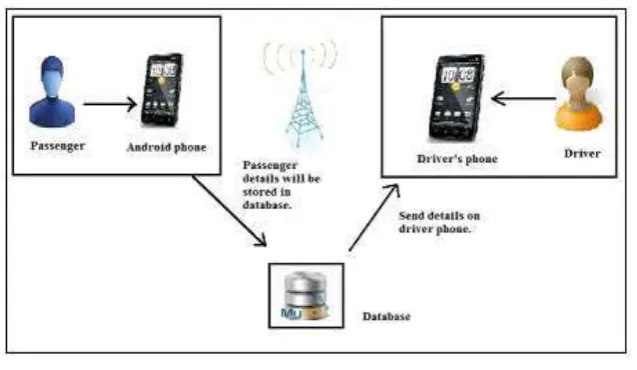
Figure 1. System Architecture
In above figure 1, the architecture of proposed system is shown. The application will be running on passenger’s android phone from where the passenger can request for the car service. During the request, passenger has to
mention the pick-up point, and drop point, date, time, number of seats, etc. The details of the passenger will be stored in the database. The passenger details are send to car owner. The passenger can view details such as per
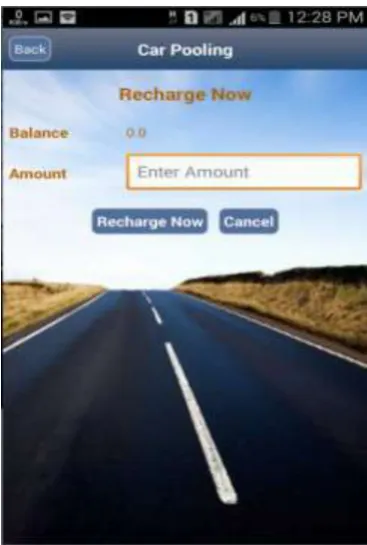
head charge of the journey, number of available seats, midway stop points, route of the journey. The car owner can add the car to the system. All the users are provided with the services such as recharge an account, view pool
Following are some of the screen shots of the application which we have implemented.
(1) (2)
Fig. 2. Screen Showing Menu Fig.3. Service – “Pool A Car”
For The Application (For Car Seeker)
(3) (4)
Figure 4. Service For Car Owner Figure 5. Service – “Join The Trip”
Figure 6. Service – “Recharge Now”
V.
CONCLUSION
In this paper, the overall architecture of the carpooling system is explained, which provides an environment in which car-owners and other passengers can easily find carpool matches at any time and in any place.
Ride-sharing i.e. making the use of carpool facility on the daily home-work-home commute can result in lower consumption of fuels and other car-related costs. It also reduces traffic and pollution in the city. The developed
Carpool system would enable its user a safe and secure way to share cars. This could include both short daily journeys such as going to workplace within the city and also long inter-city trips.
REFERENCES
[1] B. T. Morris, C. Tran, G. Scora, M. M. Trivedi, and M. J. Barth, “Real-time video-based traffic
measurement and visualization system for energy/emissions,” IEEE, Dec. 2012.
[2] F. Terroso-Saenz, M. Valdes-Vela, C. Sotomayor-Martinez, R. Toledo-Moreo, and A. F. Gomez-Skarmeta, “A cooperative approach to traffic congestion detection with complex event processing and VANET,”
IEEE, Jun. 2012.
[3] V.Milanes, J. Godoy, J. Villagra, and J. Perez, “Automated on-ramp merging system for congested traffic situations,” IEEE, Jun. 2011.
[4] S. Hartwig and M. Buchmann, “Empty Seats Traveling,” Nokia Research Center, Bochum, Germany, Feb.
2007.
[5] R. Fagin and J. H. Williams, “A fair carpool scheduling algorithm,” IBM J. Res. Develop., Mar. 1983.
[7] Collotta, Giovanni Pau, Valerio Mario Salerno, Gianfranco Scat`a, Kore University of Enna, ” A novel trust based algorithm for carpooling transportation systems”, Italy, 2012.