IJEDR1702103
International Journal of Engineering Development and Research (www.ijedr.org)593
Parametric Optimization of Wire Cut Electro-
Discharge Machining Process for Surface Finish
and Kerf Width for H-31 Tools Steel
1
Punam DDhamat,
2Himanshu D. Patel,
3Khodu M Dhameliya
1
P G Student,2Assistant Professor,3Lecturer 1,2,3
Mechanical Engineering Depart ment, 1,2
Hasmukh Goswami Co llege of Engineering, Ahmedabad,India 3Dr J N Mehta Govern ment Polytechnic, A mreli, India
Abstract - Wire electrical discharge machining (WEDM) is one of the i mpor tant non- traditional machi ning pr ocesses. This is used for machining of difficult to machine materials and intricate pr ofiles. Wire electrical discharge machini ng (WEDM) is exte nsively used in machi ning of c onduc ti ve materials when precision is of prime i mportance . Wire electrical discharge machi ning (WEDM) allowe d success in the pr oduction of ne wer materials, es pecially for the aeros pace and me dic al industries. This process employe d for the par ts de mandi ng higher accur ac y le vels with var ying har dness or complex shapes. The main objec ti ves of this study investigate and e valuate the effect of different input process par ameters (pulse on time , pulse off ti me, ser vo vol tage) on kerf wi dth and surface roughness as response parame ters have be en considered for Each Experiment. Experimentation was planned as per Taguchi’s L9 Orthogonal array during machining of H – 31 tool steel work material. Brass wire electrode wi th 0.25 mm Diame ter was use d as tool in the Experi ments. By analyzing the Gre y relational gr ade we find the opti mum parame ters. Confir mation test has been c onduc te d to vali date the optimize d parame ter.
IndexTerms -Wire electrical discharge machining, KERF Wi dth, surface r oughness, Taguchi method.
I. INTRODUCTION
Non-traditional machin ing processes are most common ly used for machin ing of high strength material in industries & increase in the availability and use of difficult-to- machine materials. Electrica l Discharge Machining (EDM) is one such process which is wide ly used to machine e lectrica lly conductive materials. EDM is a thermo -e lectric process in which materia l re moval ta kes place through the process of controlled spark generation. EDM has achieved a status of being nearly indispensable in the industry because of its ability to mach ine any electrically conductive material irrespective of its mechanical strength[1]
Basically, there are two different types of EDM: 1) Die-sinking EDM & 2) Wire-cut EDM. In the Sinke r EDM Machining process, two metal parts submerged in an insulating liquid are connected to a source of current which is switched on and off automatically depending on the parameters set on the controller. While wire EDM Machining (also known as Spark EDM) is an electro thermal p roduction process in which a thin single -strand metal wire (usually brass) in conjunction with de-ionized wa ter (used to conduct electricity) allows the wire to cut through metal by the use of heat from e lectrical sparks.[2,3]
A series of electrical pulses generated by pulse generator unit is applied between the work- piece and travelling wire electrode spark discharge, the dielectric fluid gets ionized and there is flow of current across the wire e lectrode - work piece gap. Negatively charged particles (electrons) break fro m the cathode surface and move towards the anode surface under the influence of electric fie ld forces. During this movement in inter -e lectrode gap, the electrons collide with the neutral mo lecules of d ielect ric, which is injected fro m a nozzle in the machining area. As a result, intensity of ionization becomes so high that a very narrow channel of continuous conductivity is established. Their kinetic energy of charge particles is converted into heat energy, resulting in heating of anode due to the bombard ment of electrons and heating of cathode due to the bombardment of ions. Energy contained in tiny spark discharge removes a fraction of work materia l. La rge number of such time spaced tiny discharges between the work p iece and wire e lectrode cause the electro-erosion of work piece materia l.
II. KEY TERMS IN DOE
1. Factors
These are variables that have direct influence on the performance of the product or process under investigation. Factors are of two types:
IJEDR1702103
International Journal of Engineering Development and Research (www.ijedr.org)594
2. Levels
This is the values or descriptions that define the condition of the factor held wh ile performing the e xperiments
III. INPUT PARAMET ERS
Factor A: Pulse On Time(μs)
Factor B: Pulse Off Time(μs)
Factor C: Servo Vo ltage(volt)IV. FACTORS WITH LEV ELS VALUE
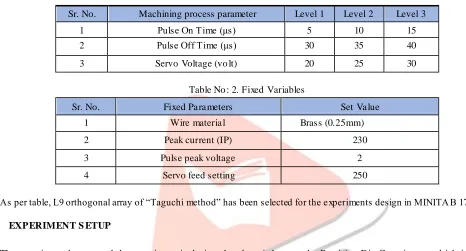
Table No : 1. Input Variables with Levels value
Sr. No. Machining process parameter Level 1 Level 2 Level 3
1 Pulse On Time (μs) 5 10 15
2 Pulse Off Time (μs) 30 35 40
3 Servo Voltage (vo lt) 20 25 30
Table No : 2. Fixed Variables
Sr. No. Fixed Pa ra meters Set Va lue
1 Wire materia l Brass (0.25mm)
2 Peak current (IP) 230
3 Pulse peak voltage 2
4 Servo feed setting 250
As per table, L9 orthogonal array of “Taguchi method” has been selected for the experiments design in MINITA B 17.
V. EXPERIMENT S ETUP
The e xperimental setup and the experiment is designed and carried out at the Prec ision Die Cut wire cut wh ich is placed at Odhav, Ahmedabad .the primary goal of the dissertation work is to predict the surface roughness and kerf width the work is carried out in sprint cut wire cut electro discharge machine of HCHCR materia l by varying machining para meters. Figure: 1 a nd Figure : 2 shows WEDM mach ines work table and Control Cab inet respectively.
Surface roughness values of finished work pieces were measured by Mahr Gmb H Pocket Surf Ps 1 Surface Roughness Tester by a proper procedure. The Mahr GmbH Pocket Surf Ps 1 Surface Roughness Tester is an instrument that works by gently dragging a mechanical stylus across a Surface. Surface Roughness Tester acquires data by moving the sample beneath the dia mond tipped stylus. Vert ical move ments of the stylus are sensed by an LVDT, digita lized, and stored in the instrume nts me mo ry. Its output is a digital display of measured Surface roughness value Ra and other features. Surface Roughness Standard ISO was used for measurement. The temperature of environ ment was 32 ± 1◦C. In this present study we have taken Ra for measuring Surface Roughness.
For present experiments kerf width has been measured using Nikon profile pro jector model 6C ava ilab le in HGCE which is placed at Vahela l, Ah medabad. Kerf width is denoted by KW.
IJEDR1702103
International Journal of Engineering Development and Research (www.ijedr.org)595
VI. MATERIAL S ELECTION
The material selected for this dissertation work is H-31 TOOL STEEL. Che mical co mposition of this materia l is shown in Table No: 5.2. H-31 has the wide applications in stamping dies, metal cutting tools or any other industries because of its high strength and heavy weight. In general the edge temperature under e xpected use is an imp ortant determine of both composition and required heat treatment.
H-31 Tool steel has high melt ing point of about 2625°c. So tool wea r is less compare to copper wire and brass wire.
Table No : 3. COMPOSITION OF MATERIA L
CHEMICA L REQUIRED VA LUES OBTAINED VA LUES
Carbon 0.90-1.20 1.020
Silicon 0.10-0.35 0.220
Manganese 0.30-0.75 0.440
Phosphorus 0.050 ma x 0.050
Sulphur 0.050 ma x 0.050
Chro miu m 1.00-1.60 1.150
Nic ke l 0.100 ma x 0.100
Moly 1.00-1.20 0.023 Fig 3 Tested Specimen
VII. RES ULTS AND DISCUSS ION
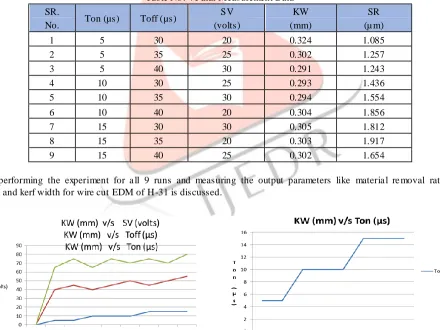
Table No : 4 Final Measurement Data
SR.
No. Ton (µs) Toff (µs)
SV (volts)
KW (mm)
SR (µm)
1 5 30 20 0.324 1.085
2 5 35 25 0.302 1.257
3 5 40 30 0.291 1.243
4 10 30 25 0.293 1.436
5 10 35 30 0.294 1.554
6 10 40 20 0.304 1.856
7 15 30 30 0.305 1.812
8 15 35 20 0.303 1.917
9 15 40 25 0.302 1.654
After performing the experiment for a ll 9 runs and measuring the output parameters like materia l re moval rate, surface roughness and kerf width for wire cut EDM of H -31 is discussed.
IJEDR1702103
International Journal of Engineering Development and Research (www.ijedr.org)596
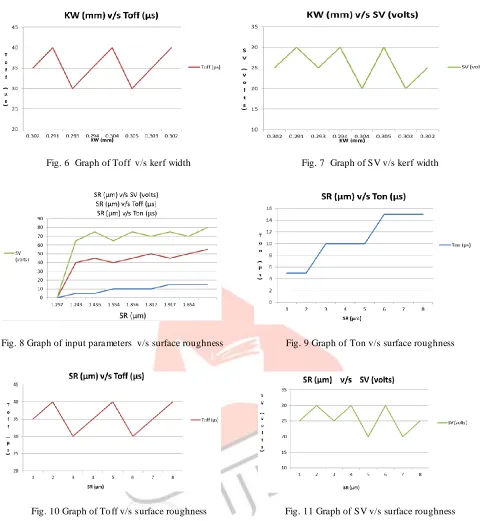
Above this fig. 9, Surface roughness increases surface finish decreases with increase in peak current and pulse on timebut decrease with pulse off time .VIII. CONCLUS ION
In this study, effect of process parameters such as peak current, pulse on time and pulse off time on response parameters name ly materia l re moval rate, surface roughness and kerf width has been studied WEDM. The main conclusions of this study is given as follows
• Surface roughness increases surface fin ish decreases with increase in peak current and pulse on time but decrease with
pulse off time.
• Kerf width increases with inc reases in peak current and pulse on time but decrease with pulse off t ime.
• Surface fin ish is higher in EDM as co mpared to WEDM.
IX. REFERENCES
[1] V.Vikra mReddy,M.Jawahar. “Mult i-objective optimization of para meters during edm of alu miniu m a lloy 6082 using grey relational analysis”.
Fig. 6 Graph of Toff v/s kerf width Fig. 7 Graph of SV v/s kerf width
Fig. 8 Graph of input para meters v/s surface roughness Fig. 9 Graph of Ton v/s surface roughness
IJEDR1702103
International Journal of Engineering Development and Research (www.ijedr.org)597
[2] Dr.V.Ch ittaranjan Das, Dr.C.Srinivas “Optimization of mu ltip le response characteristics on edm using the taguchimethod and grey relational analysis”
[3] Vishal Pa rashar, A. Reh man, J.L. Bhagoria, Y.M. Pu ri, “Investigation and Optimization of Surface Rough ness for Wire Cut Electro Discharge Machining of SS 304L using Taguchi Dynamic Experiments” , International Journal of Engineering Studies, Volu me 1, pp.257–267.
[4] Te xt book of machine tool engineeringby G.R. Nagpal, khannapublication [5] Te xt book of production engineering by p.c. Sharma, s..chand and companyltd. [6] Te xt book of production engineering byR.k.ja in
[7] www.sciencedirect.co m [8] www.astm.org