The Ability And Factors Affecting The Students To
Use English Gerund
Arham R
Abstract: This research actually provides a description about the ability of the Second year students of Senior High School Tamalatea Makassar to Use-ing from as gerund. The problem statement of this research refers to the students' ability to use-ing form as gerund and the factors that affect the students to learning form as gerund. The writer applied a descriptive method in verifying the arguments of this thesis. The objective of this research is to find out the ability of the Second Year students of Senior High School Tamalatea Makassar to use-ing form as Gerund and the factors affecting them to learning form as Gerund. In collecting the data the writer used two kinds of instruments namely-, test (objective test) that is used to know the students' ability to use English Gerund and questionnaire which is used to know the factors that affect the students to learn English gerund. The data obtained from the test were firstly tabulated and then analized into percentage and mean score analysis. Finally, the writer inferred the conclusion. Based on the test result, it discovered that the Second year students of Senior High School Tamalatea Makassar have low mastery in using-ing form as gerund. The factor that may affect them are: lack of motivation, low frequency of practice or exercise, lack of literature that support them to learn and the teacher's method in teaching is not acceptable by students.
Keywords: Aability, students of Senior High School, English Gerund
————————————————————
1.
INTRODUCTION
As an international language, English language plays a very important role in the world of communication today. This position makes it most widely used in all aspects of human life. In Indonesia, English plays the role in the development of education, economy, technology, politics, tourism, and it is even one of the resources in developing Bahasa Indonesia. As a foreign language English is taught as compulsory subject in secondary school for academic purposes and as a means of communication with foreigners. It is reasonable that the study and the mastery of English should be given priority in order to be competent in English. There are many things to learn when we learn a new language. One of the important aspects to be competent with the language is grammar. It is extremely important because the mastery of English is not perfect without dealing with the grammar very well. By having sufficient knowledge of grammar, the students can get increasing in learning English (Sudrajat,1986 ). Further more, learning English grammar is important because knowledge of language is much determined by the mastery of its vocabulary as much of its grammar (Walkin,1974 ). Grammar can help students to improve the use of formal English. Thus, it helps them to feel confidents when they speak and write. On the other hand, the mastery of English Grammar especially gerund, is most influenced by the teacher. Devis (1990) writes that beside what to do with each class, organize the activities and make a simple lesson plan, than you will be in central of the students learning progress. Try to guess what learning difficulties might occur during the lesson, and think about how you might solve those possible problems. In addition, Atmodarsono (1984 ) as in Musliah (1994) states that advocates and followers of each method claim to have achieved great success with their method.
It is possible for this reason that some language teaching especially do not advocate anyone method, instead they propose a method which forces the successful elements of the various methods that have been develop for teaching. Harmer (1983) states that without some understanding of grammar, students would not be able to do anything more than utter separate item of language for separate function. The expression of functional language is possible taught as the use of the grammar of the language. He also states that people who learn language encounter a number of problems, especially with the grammar of the language that can be complicated and confusing. Corder in Latief (1991) says to master English well the elements of the language such as vocabulary, grammatical structure, and sound systems must be taught to the students as the prerequisite knowledge towards the English language use and skill, because language is characterized by these elements. There are some problems faced by the students in learning English grammar, such as the confusion about grammar. It arises because of the mismatch between form and function. Another problem are about the differences between English and the students' mother tongue, and also many exceptions to grammar rules can be the reason why English seem difficult for speakers of other language. In order to answer the problem stated above, the writer did a research to some students at Senior High School Tamalatea about their ability in using English Gerund. The problem statements of this research are formulated into the following questions : To what extent do the Second year students of Senior High School Tamalatea Makassar master the English Gerunds?. What factors hamper the Second year students of Senior high School Tamalatea Makassar to learn English Gerunds?
Objectives of the Research This research aims at finding out:
1. The ability of the Second year students of Senior High School Tamalatea to use "ing" form as gerund accurately. 2. The factors affecting the Second year students of Senior
High School Tamalatea Makassar to use "ing" form as a gerund.
_____________________________
Arham R: English Study Program, Graduate Program, University of Hasanuddin Indonesia.
2.
RESEARCH METHOD
The method of the research.
In doing this research, the writer used a descriptive method that aims at describing the ability of the second year students of Senior High School Tamalatea Makassar to use-"ing" form as gerund, as well as factors that hamper them to use "ing" form.
Population and Sample.
1. Population
The population of this research was the Second year students of Senior High School Tamalatea Makassar in Academic Year 2006. It consists of two classes that have thirty students who have studied English Gerund when they were in the first grade.
2. Sample.
The research used total sampling. This is because of the total students in the second year are only thirty students, then all the students are taken as respondents.
Instrument of the research
In order to get the data from the students, the writer used a descriptive method and administered two kinds of instruments, namely: test and questionnaire.
1.
TestThis instrument was used to know the ability of the students to use English Gerund. The test used in this research was objective test where the students were expected to choose the correct answer among the alternatives given. The score is one for the correct answer.
2.
Questionnaire.This instrument was used to find out the factors influencing the ability of the students to use-"ing" form as a gerund. It consists of 15 items where all are close-ended items that there are some options that can be chosen by the students.
Technique of the data analysis.
All the data collected through the instruments were analyzed by using a descriptive analysis. The data's collected through the test were firstly tabulated, then analyzed in percentage in order to know the students achievement in using-"ing" form. In
order to know the mean score of the test, the writer applied the following formula:
x=
Where:
X : The mean score
X : The student's total score N : The number of students (Gey L.R. 1987)
In order to know the students ability in using English gerund in this research, the writer classified the result of the research based on the following scores.
9,6-10 is classified as excellent 8,6-9,5 is classified as very good 7,6-8,5 is classified as good 6,6-7,5 is classified as fairly good 5,6-6,5 is classified as fair 4,6-5,4 is classified as poor 0-4,5 is classified as very poor (Depdikbud, 1985)
The data collected through the questionnaire were analyzed in percentage. This is to describe the factors influencing the ability of the students to use-"ing" form as gerund. The raw scores of the students to use-"ing" form as gerund. The raw scores of the students were tabulated and can be seen in appendixes.
3.
RESULT
Data Analysis
Data analysis of the objective test and questionnaire. The objective test was actually used to measure the students' ability to use English Gerund, while the questionnaire was used to identify the factors affecting the students to learn English Gerund.
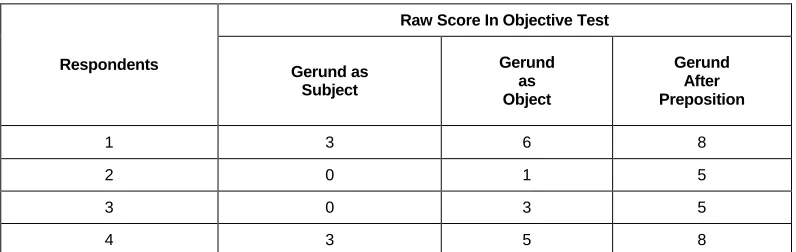
1. Analysis of data collected from the objective test. The following table presents the raw scores, which obtained by the respondents. The total number of the objective test is 40 items of multiple choices, which are divided into eleven questions of gerund as subject, fourteen questions of gerund as object and fifteen questions of gerund after preposition.
Table 1. The Students Raw Score In Objective Test
Respondents
Raw Score In Objective Test
Gerund as Subject
Gerund as Object
Gerund After Preposition
1 3 6 8
2 0 1 5
3 0 3 5
5 3 6 9
6 3 3 3
7 4 8 12
8 3 4 5
9 3 5 7
10 3 6 8
11 6 13 14
12 4 5 8
13 4 8 10
14 4 13 14
15 3 2 6
16 3 9 9
17 3 5 9
18 3 4 4
19 4 2 3
20 3 1 7
21 3 10 11
22 5 2 6
23 11 14 15
24 4 12 13
25 2 9 7
26 2 10 6
27 2 4 4
28 3 4 7
29 3 11 11
30 11 14 14
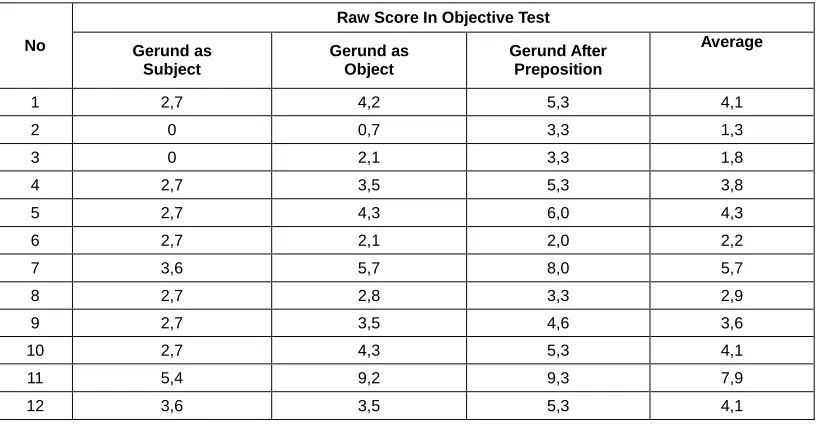
The next table shows the students final score obtained through the objectives test.
Table 2. The Students End Score Obtained In Objective Test
No
Raw Score In Objective Test
Gerund as Subject
Gerund as Object
Gerund After Preposition
Average
1 2,7 4,2 5,3 4,1
2 0 0,7 3,3 1,3
3 0 2,1 3,3 1,8
4 2,7 3,5 5,3 3,8
5 2,7 4,3 6,0 4,3
6 2,7 2,1 2,0 2,2
7 3,6 5,7 8,0 5,7
8 2,7 2,8 3,3 2,9
9 2,7 3,5 4,6 3,6
10 2,7 4,3 5,3 4,1
11 5,4 9,2 9,3 7,9
13 3,6 5,7 6,6 5,3
14 3,6 9,2 9,3 7,4
15 2,7 1,4 4,0 2,7
16 2,7 6,4 6,0 6,0
17 2,7 3,5 6,0 4,1
18 2,7 2,8 2,6 2,7
19 3,6 1,4 4,0 3,3
20 2,7 0,7 4,6 2,7
21 2,7 7,1 7,3 5,7
22 4,5 1,4 4,0 3,3
23 10,0 10,0 10,0 10,0
24 3,6 8,5 8,6 6,9
25 1,8 6,4 4,6 4,2
26 1,8 7,1 4,0 4,3
27 1,8 2,8 2,6 3,1
28 2,7 4,2 5,3 4,1
29 2,7 7,8 7,3 5,7
30 10,0 10,0 9,3 9,7
X1 = 9,74 X2 = 140,9 X3 = 164 4 = 134,5
1.
The mean score of the students in gerund as subject, such as :x= = 97,4/30 = 3,3
2.
The mean score of the students in gerund as object, such as-1'X2x=
= 140,9/30 = 4,7
3.
The mean score of the students in gerund after preposition, such as:x= = 164/30 = 5,5
Based on the data above, it can be seen that the most difficult item is about gerund as subject. All the data above are then analyzed into the percentage rate as seen in the following tables:
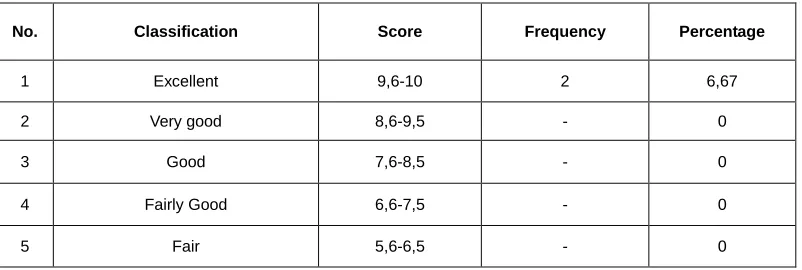
Table 3. Rate Percentage Of The Students In Gerund As Subject
No. Classification Score Frequency Percentage
1 Excellent 9,6-10 2 6,67
2 Very good 8,6-9,5 - 0
3 Good 7,6-8,5 - 0
4 Fairly Good 6,6-7,5 - 0
6 Poor 4,6-5,5 1 3,33
7 Very Poor 0-4,5 27 90
Total 30 100
Table 3 above shows that 93,3 % (28 out of 30) of the respondents had low score, while only 6,67 % (2 out of 30) of them got high score. The average score of the respondents in gerunds as subject is 3,3.
Table 4. Rate Percentage Of The Students In Gerund As Object
No. Classification Score Frequency Percentage
1 Excellent 9,6-10 2 6,67
2 Very good 8,6-9,5 2 6,67
3 Good 7,6-8,5 2 6,67
4 Fairly Good 6,6-7,5 2 6,67
5 Fair 5,6-6,5 4 13,34
6 Poor 4,6-5,5 - 0
7 Very Poor 0-4,5 18 60
Total 30 100
Table 4 above illustrates that 26,7 % (8 out of 30) of the respondents acquire high score and 13,33 % (4 out of 30) got the score above the average. The rest 60 % (18 out of 30) got the score below the average. The average score of the respondents in gerund as object is 4,7.
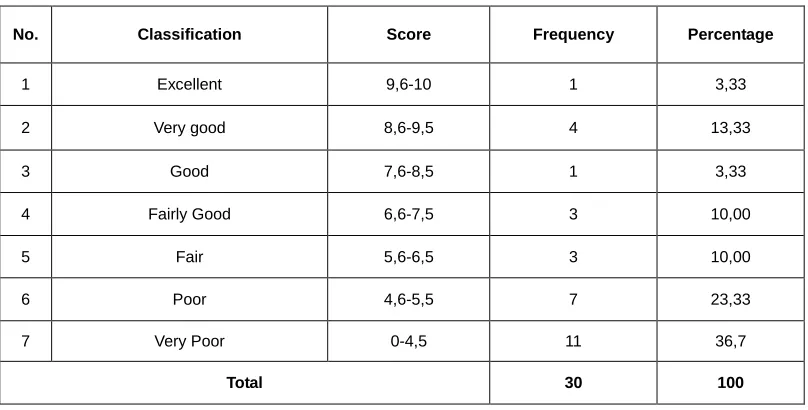
Table 5. Rate Percentage Of The Students In Gerund After Preposition
No. Classification Score Frequency Percentage
1 Excellent 9,6-10 1 3,33
2 Very good 8,6-9,5 4 13,33
3 Good 7,6-8,5 1 3,33
4 Fairly Good 6,6-7,5 3 10,00
5 Fair 5,6-6,5 3 10,00
6 Poor 4,6-5,5 7 23,33
7 Very Poor 0-4,5 11 36,7
Total 30 100
The table 5 above describes that 30 % (9 out of 30) of the respondents acquire high score, while the rest 70 % (21 out of 30) got the score very low. The average score of the respondents in gerund after preposition is 5,5.
4.
Analysis of Data Collected trough the Questionnaire
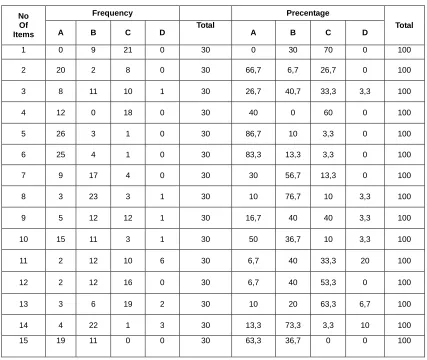
Table 6. Analysis of Data Obtained through the Questionnaire
No Of Items
Frequency Precentage
Total
A B C D Total A B C D
1 0 9 21 0 30 0 30 70 0 100
2 20 2 8 0 30 66,7 6,7 26,7 0 100
3 8 11 10 1 30 26,7 40,7 33,3 3,3 100
4 12 0 18 0 30 40 0 60 0 100
5 26 3 1 0 30 86,7 10 3,3 0 100
6 25 4 1 0 30 83,3 13,3 3,3 0 100
7 9 17 4 0 30 30 56,7 13,3 0 100
8 3 23 3 1 30 10 76,7 10 3,3 100
9 5 12 12 1 30 16,7 40 40 3,3 100
10 15 11 3 1 30 50 36,7 10 3,3 100
11 2 12 10 6 30 6,7 40 33,3 20 100
12 2 12 16 0 30 6,7 40 53,3 0 100
13 3 6 19 2 30 10 20 63,3 6,7 100
14 4 22 1 3 30 13,3 73,3 3,3 10 100
15 19 11 0 0 30 63,3 36,7 0 0 100
Based on the table above, the description of items is presented as follows:
Item 1:
About the students' opinion in learning English. The data indicates there are 70 % (21 out of 30) of the respondents found difficult to learn English while the rest 30 % (9 out of 30) of them said that it was easy to learn English.
Item 2:
About the students' interest to learn English structure. The data indicates that 66,7 % (20 out of 30) of them were interested, 6,7 % (2 out of 30) of them were less interested, 26,7 % (8 out of 30) of them were very interested and there were no one who were not interested in learning English structure.
Item 3:
About the students assignment that was given by their English teacher when they were in the second grade. The data indicates that 26,7 % (8 out of 30) of the respondents always got assignment, 40,67% (2 out of 30) of them often got assignment, and 33,3 % (10 out of 30) and 3,3 % (1 out of 30) of them never got any assignment.
Item 4:
About the students opinion on gerund formation in English language. The data indicates that 40% (12 out of 30) of the
respondents said that it was very important while 60 % (18 out of 30) felt not too important.
Item 5:
About the students activity during the teaching of English language. The data indicates that 86,7 (26 about of 30) of the respondents were listening, attention and writing down, 10 % (3 out of 30) of them were listening and taking note and 3,3 % (1 out of 30) of them pfft only listening.
Item 6:
About the students' respond to their English teacher to teach again the explanation if they could not understand what the teacher said. The data indicates that 83,3 % (25 out of 30) of them was always,13,3 % (4 out of 30) was seldom and the rest 3,3% (out of 30) of them was very seldom.
Item 7:
About their English teacher's method of teaching in the class room. The data indicates that 30 % (9 out of 30) of the respondents quickly understand the materials, 56,7 % (17 out of 30) of them did not understand very quickly and 13,3 % (4 out of 30) of them were less to understand the material.
Item 8:
were always practice, 76,7 % (23 out of 30) of them were seldom to practice, 10 %( 3 out of 30) of them were less to practice and 3,3 % (1 out of 30) were never practice.
Item 9:
About their school library that discussing the use of gerund. The data indicates that 16,7 % (5 out of 30) of the respondents said their school library were more complete, 40 % (12 out of 30) said that it were seldom, 40 % (12 out of 30) of them said it were less complete and 3,3 % (1 out of 30) of the respondents said it were not complete.
Item 10:
About their English teacher attention to remind the students about the model of gerund. The data indicates that 50 % (15 our of 30) of the respondents said that the teacher always reminded them, 36,7 %(11 out of 30) said it often, 10 % (3 out of 30) said it seldom and 3,3% (1 out of 30) said that the teacher were never reminded them about the models of gerund.
Item 11:
About the students' books discussing the use of gerund. The data indicates that 6,7 % (2 out of 30) of the respondents said that it were most complete, 40 % (12 out of 30) of them said enough, 33,3 % (10 out of 30) said less complete and only 20 % (6 out of 30) of them said were not complete.
Item 12:
About the students difficulties to get the form of gerund in the passage. The data indicates that 6,7 % (2 out of 30) of them said it is easy very much, 40 % (12 out of 30) of them said it is easy, 53,3 (16 out of 30) of them said it is difficult.
Item 13:
About the students' frequency to read English structure discussing gerund in their test time. The data indicates that 10 % (3 out of 30) of the respondents always read, 20% (6 out of 30) of them often read, 63,3% (19 out of 30) of them seldom read while only 6,7% (2 out of 30) of the respondents were never read.
Item 14:
About the causes of students mistakes in using gerund. The data indicates that 13,3% (4 out of 30) of the respondents said it were very difficult to use, 73,3% (22 out of 30) of them could not differentiate a gerund form to another, and 3,3% (1 out of 30) out them never practice; to use.
Item 15:
About the corrected paper back from their English teacher. The data indicates that there was 63,3% (19 out of 30) of the respondents always got corrected paper back, and 36,7% (11 out of 30) of them often got corrected paper back.
4.
DISCUSSION
1. The Ability of the Second year Students of Senior High School Tamalate Makassar in Using English gerund.
In this research, the students are derived directly from three different kinds of Gerund as subject, gerund as object and gerund after preposition.
a. The ability of the Second year students of Senior High School Tamalate Makassar in gerund as subject. If we pay attention to the table 3, it is clear that the respondent's achievement in gerund as subject exercises is very poor. Their average score is 3,3. It means that they are not successful in learning gerund as subject, because their mean score is below the passing standard.
b. The ability of the Second year students of Senior High School Tamalatea Makassar in gerund as object. By looking at table 4, it is clear that the result is not too different from the test of gerund subject. The mean score is still below the passing standard even it is more better than gerund as subject. The mean score is 4,7 and it is categorized as poor score.
2. The Ability of the Second Year Students of Senior High School Tamalate Makassar in Using Gerund after Preposition.
Based on the table 5, it is obviously explained that the respondents score in using gerund after preposition is still very low. The average score is 5,5. It means that it is better than the score of gerund as subject and gerund as object. This score is categorized as poor.
3. Factors Affecting the Second Year Students of Senior High School Tamalatea in Learning English gerund. The result of data analysis shows that the Second year students of Senior High School Tamalatea Makassar have high interest in learning English (item 2), although most of them find difficult to learn it (item 1). They are interested in learning English because most of them (60%) say that it is important to learn English language (item 4).
5. CONCLUSION
Based on the description of the previous chapter, the writer draws the conclusion as follows:
a. The ability of the Second year students of Senior High School Tamalatea Makassar in using English gerund is very poor because the mean score is 4,5. It means that they are not successful in learning English structure especially English gerund.
b. There are many factors affecting the third year students of Senior High School Tamalatea Makassar in learning English gerund. They are lack of motivation, low frequency of practice or exercise, lack of literature and the teacher's method in teaching are not very effective.
REFERENCES
[1] Depdikbud, 1985. Departemen Pendidikan dan kebudayaan. 1985. Petunjuk Pelaksanaan Proses Belajar mengajar dan Petunjuk Pelaksanaan Sistem Penilaian. Jakarta -. DEPDIKBUD.
[2] Gordan B. Davis, 1990. Management Information System Conceptual Foundations, Structure and Development.
[3] Gay, L.R. 1987. Educational Research. New York: Merrill and Macmillan Pub. and Co.
[4] Harmer, Jeremy: 1986. Teaching and Learning Grammar. London Longman Inc.