IJEDR1904074 International Journal of Engineering Development and Research (www.ijedr.org) 414
Study On The Influence Of Terrazyme As
Stregthening Agent For Black Cotton Soil
1Challa Datta Karthik, 2Gottumukkala Rajeev Kumar 1Student, 2Student
St Martins Engineering College
_____________________________________________________________________________________________________
Abstract - Stabilization of Black Cotton Soil is studied by using terrazyme. Black Cotton soils are highly clayey soils
nature (montmorillonite clay mineral). The moisture changes in Black Cotton Soils, compressibility and last- plasticity nature can be greatly improved with the addition of terrazyme. This paper includes the evaluation of soil properties like optimum moisture content, dry density and strength parameter (California bearing ratio valve). Different quantities of terrazyme (% weight) are added to the BC soil and the experiments conducted on these soil mixes. The results show that the use of terrazyme has increased the CBR values i.e., the strength of soil to a great extent.
keywords - Black Cotton Soil, California Bearing Ratio(CBR), Compaction Factor, Soil Stabilization, Terrazyme
_____________________________________________________________________________________________________
I. INTRODUCTION
For every Civil Engineering Structure, the load from super structure is to be transferred to the soil. In case of Expansive soils, which are generally problematic by nature. It possesses swelling and shrinkage properties which results in bruises for the structure in the form of cracking, undulations and differences in settlements etc., These are generally experienced by roads, canal, buildings etc. Therefore, our attempt is to improve the strength and stabilize the soil by using the terrazyme. Therefore, these soils should be properly treated to avoid such practical serious problems.
Therefore, one of the most popular techniques is Soil Stabilization. In simple words, Soil Stabilization could be defined as, “The process which involves the enhancement of the Soil’s physical properties like shear strength, durability etc., and minimizing the pessimistic properties like shrinkage, swelling and water absorption by addition of few additives, and thus helping for the improvement of the Load Bearing capacity of the sub-grade of the soil, which helps for the construction of pavements, structures etc.,”
Black cotton soil is one of the most commonly occurring soils in India covering an area of about 3 lakhs sq.kms spreading over 6 states. It is an inorganic clay with a standard of medium to high compressibility. It possesses a high percentage of clay which is predominately Montmorillonite in structure. And occurs in black or blackish grey in color. Having high swelling and shrinkage characteristics, Black Cotton soil has always been a major face-off for Constructions. This soil holds a very peculiar property of becoming very hard when dry conditions, also losing its strength completely in wet condition. And the Black Cotton Soil used for our study is been collected from Basuregadi village in Northern Telangana.
The additive used to strengthen and stabilize this Black Cotton Soil for our study is Terrazyme. It is a liquid enzyme which is organic in nature and it is formulated from vegetative and fruits extract. it improves the deficit properties of soil like its quality, California Bearing Ratio, Durability and decreases the abundant and pessimistic properties like Optimum Moisture Content and Plasticity Index of soil.
II. OBJECTIVES OF THE STUDY
The main objectives for this study are as follows:
1. To determine the essential Geotechnical properties of Black cotton soil. 2. To evaluate the effect of Terrazyme on the basic Properties of soil.
3. To determine the effects of addition of this enzyme to BC Soil on its crucial properties like consistency limit, CBR, swell test, and unconfined compressive strength.
4. To observe whether the soil is good in compressive strength and possesses essential tensile strength. 5. To analyze that up to what extent the unsolicited properties of BC Soil are surpassed using Terrazyme. III. MATERIALS USED
IJEDR1904074 International Journal of Engineering Development and Research (www.ijedr.org) 415 Black Cotton Soil is one of the major soil deposits in India. This soil is also popularly termed as Regur Soil. It exhibits high scale of Swelling and shrinkage because of high percentage of montmorillonite content and is capable of holding more content of water. This is the reason that favors the growth of only Cotton. For our study, we have selected BC Soil from an agricultural land in Basuregadi Village as shown in Figure:1 and the soil is collected after a depth of 2 feet from Ground Level and is properly sealed and transported to our laboratory and proceeded for the experimentations.
Fig: 1 Black Cotton Soil Sample Collected From Basuregadi Village
2. Terrazyme:
Terrazyme is a chemical which can be used as stabilizing agent for soil process, as specified in Figure:2. It is capable of increasing the durability of pavement also reducing the unwanted swelling properties of soil. Terrazyme is found to enhance the weather resistance and improves load bearing capacity of soils.
Fig: 2 Terrazyme Chemical IV. METHODOLOGY
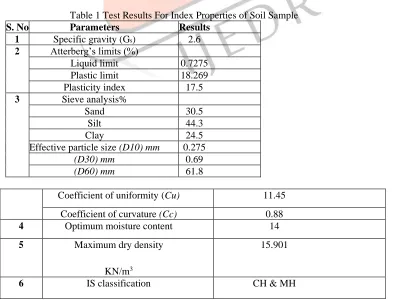
Initially, the few important laboratory tests were carried, as mentioned below, on the samples of black cotton soil without terrazyme later other major tests are been carried out after its addition to the soil samples. Those test results are presented in Table:1 and Graphs and 2 respectively.
Table 1 Test Results For Index Properties of Soil Sample
S. No Parameters Results
1 Specific gravity (Gs) 2.6
2 Atterberg’s limits (%)
Liquid limit 0.7275
Plastic limit 18.269
Plasticity index 17.5 3 Sieve analysis%
Sand 30.5
Silt 44.3
Clay 24.5
Effective particle size (D10) mm 0.275
(D30) mm 0.69
(D60) mm 61.8
Coefficient of uniformity (Cu) 11.45
Coefficient of curvature (Cc) 0.88
4 Optimum moisture content 14
5 Maximum dry density
KN/m3
15.901
IJEDR1904074 International Journal of Engineering Development and Research (www.ijedr.org) 416 Graph 1 Sieve Analysis of Soil Sample
Graph 2 : Compaction Test of Soil Sample V. RESULTS AND DISCUSSIONS
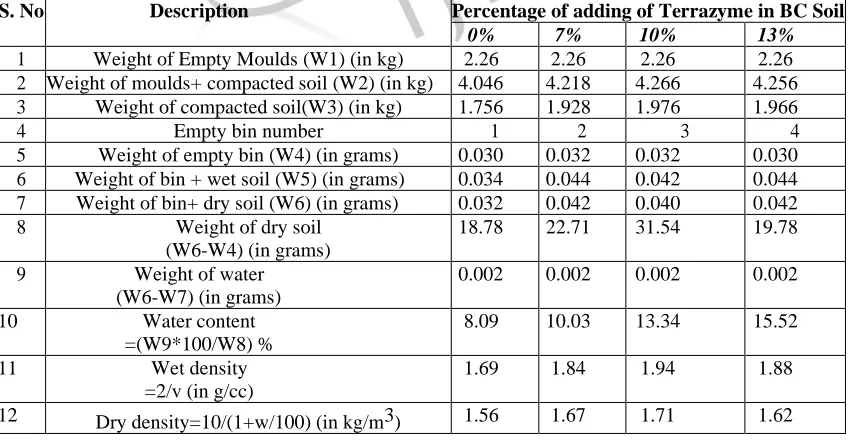
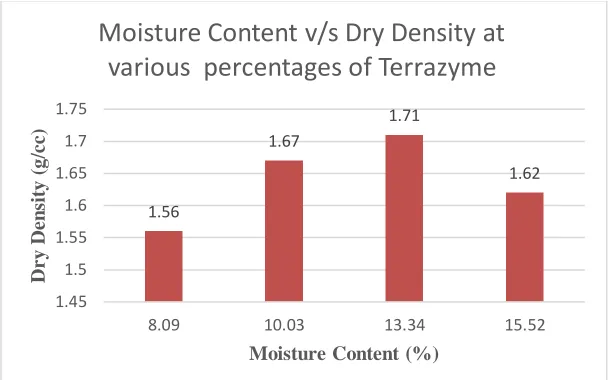
To analyze the influence of Terrazyme admixture on the strength of BC Soil, Compaction Test and CBR Test are carried. The results are displayed in Tables 2, 3, 4 and 5 and in Graph:3, 4 and 5 respectively.
Table 2: Test Results for Compaction Test At Various Percentages Of Terrazyme
S. No Description Percentage of adding of Terrazyme in BC Soil
0% 7% 10% 13%
1 Weight of Empty Moulds (W1) (in kg) 2.26 2.26 2.26 2.26
2 Weight of moulds+ compacted soil (W2) (in kg) 4.046 4.218 4.266 4.256 3 Weight of compacted soil(W3) (in kg) 1.756 1.928 1.976 1.966
4 Empty bin number 1 2 3 4
5 Weight of empty bin (W4) (in grams) 0.030 0.032 0.032 0.030 6 Weight of bin + wet soil (W5) (in grams) 0.034 0.044 0.042 0.044 7 Weight of bin+ dry soil (W6) (in grams) 0.032 0.042 0.040 0.042
8 Weight of dry soil
(W6-W4) (in grams)
18.78 22.71 31.54 19.78
9 Weight of water
(W6-W7) (in grams)
0.002 0.002 0.002 0.002
10 Water content
=(W9*100/W8) %
8.09 10.03 13.34 15.52
11 Wet density
=2/v (in g/cc)
1.69 1.84 1.94 1.88
12 Dry density=10/(1+w/100) (in kg/m3) 1.56 1.67 1.71 1.62
IJEDR1904074 International Journal of Engineering Development and Research (www.ijedr.org) 417 Graph: 3: Moisture Content V/S Dry Density At Various Percentages Of Terrazyme
Result:
Optimum moisture content = 13.34% Maximum dry density = 1.71 g/cc.
Fig: 3 Black Cotton Soil with Terrazyme
Table 3 CBR Test Results On BC Soil Sample S. No Penetration (in mm) Load (in kg)
1 0 0
2 0.5 21.80
3 1 39.32
4 1.5 46.16
5 2 48.30
6 2.5 51.29
7 3 56.89
8 3.5 61.20
9 4 64.22
10 4.5 65.94
11 5 69.25
12 5.5 71.39
13 6 73.10
14 6.5 75.23
15 7 78.23
16 7.5 82.93
17 8 85.92
18 8.5 89.34
1.56
1.67
1.71
1.62
1.45 1.5 1.55 1.6 1.65 1.7 1.75
8.09 10.03 13.34 15.52
D
ry
D
en
sit
y
(
g/
cc
)
Moisture Content (%)
IJEDR1904074 International Journal of Engineering Development and Research (www.ijedr.org) 418 Result:
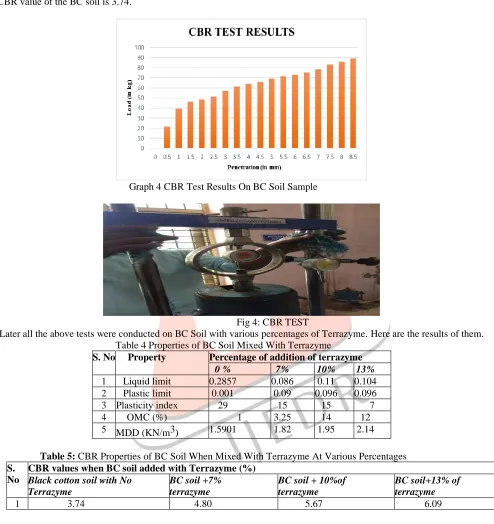
1. CBR value of soil at 2.50 mm penetration = (× 100) = 3.74 2. CBR value of soil at 5 mm penetration = (× 100) = 3.36 ... CBR value of the BC soil is 3.74.
Graph 4 CBR Test Results On BC Soil Sample
Fig 4: CBR TEST
Later all the above tests were conducted on BC Soil with various percentages of Terrazyme. Here are the results of them. Table 4 Properties of BC Soil Mixed With Terrazyme
S. No Property Percentage of addition of terrazyme
0 % 7% 10% 13%
1 Liquid limit 0.2857 0.086 0.11 0.104
2 Plastic limit 0.001 0.09 0.096 0.096
3 Plasticity index 29 15 15 7
4 OMC (%) 1 3.25 14 12
5 MDD (KN/m3) 1.5901 1.82 1.95 2.14
Table 5: CBR Properties of BC Soil When Mixed With Terrazyme At Various Percentages S.
No
CBR values when BC soil added with Terrazyme (%) Black cotton soil with No
Terrazyme
BC soil +7% terrazyme
BC soil + 10%of terrazyme
BC soil+13% of terrazyme
IJEDR1904074 International Journal of Engineering Development and Research (www.ijedr.org) 419 Graph 5 : Variations In CBR Value By Adding Terrazyme At Various Percentages To BC Soil
VI. CONCLUSIONS
• From the above results, it is evident that, the BC soil has CBR Value of just 3.74% and Max. Dry Density and Optimum Moisture Contents as 15.901 and 14 respectively, which are not satisfactory.
• Upon the increase of the amount of Terrazyme, there has been gradual increase in CBR Value of Soil.
• But at 10% addition of Terrazyme, it was found that we have got highest and satisfactory optimum moisture content and max. dry density for the BC Soil as 14% and 1.95KN/m3
• At this percentage we have got the CBR Value as 5.67% which is reasonable.
• In simple words, Terrazyme material is capable of stabilizing the BC Soil up to good extent. Because it is a natural product, this process is eco-friendly.
• Soil Stabilization using Terrazyme could be achieved economically and with good viability.
VII. REFERENCES
[1] G. Eason, B. Noble, and I.N. Sneddon, “On certain integrals of Lipschitz-Hankel type involving products of Bessel functions,” Phil. Trans. Roy. Soc. London, vol. A247, pp. 529-551, April 1955. (references)
[2] J. Clerk Maxwell, A Treatise on Electricity and Magnetism, 3rd ed., Vol. 2. Oxford: Clarendon, 1892, pp.68-73. [3] I.S. Jacobs and C.P. Bean, “Fine particles, thin films and exchange anisotropy,” in Magnetism, vol. III, G.T. Rado and H.
Suhl, Eds. New York: Academic, 1963, pp. 271-350.
[4] Y. Yorozu, M. Hirano, K. Oka, and Y. Tagawa, “Electron spectroscopy studies on magneto-optical media and plastic [5] substrate interface,” IEEE Transl. J. Magn. Japan, vol. 2, pp. 740-741, August 1987 [Digests 9th Annual Conf. Magnetics
Japan, p. 301, 1982].
[6] M. Young, The Technical Writer’s Handbook. Mill Valley, CA: University Science, 1989. VIII. ACKNOWLEDGEMENT