www.orientjchem.org
An International Open Free Access, Peer Reviewed Research Journal
2016, Vol. 32, No. (1): Pg. 47-57
Chemically stabilized δ-Bi
2O
3phase:
Raman scattering and X-ray diffraction studies
L. LOUBBIdI
1*, M. NAJI
2, B. ORAYECH
3, A. CHAgRAOUI
1, J. M. IgARTUA
4,
A. MOUSSAOUI
1, A. TAIRI
1and O. AIT SIdI AHMEd
11Laboratoire de Chimie Analytique et Physico-Chimie des Matériaux,
Faculté des Sciences Ben M’Sik - Université Hassan II Casablanca, Maroc.
2European Comission, Joint research center, Institute for Transuranium Elements (ITU),
Postfach 2340, 76125 Karlsruhe, Germany.
3Departamento de Fisica de la Materia Condensada, Universidad del Pais Vasco,
P.O.Box 644, Bilbao 48080, Spain.
4CIC Energigune, Parque Tecnológico, C/ Albert Einstein, 48, 01510 Miñano (Álava), Spain.
*Corresponding author E-mail: [email protected] http://dx.doi.org/10.13005/ojc/320105
(Received: December 07, 2015; Accepted: March 20, 2016)
ABSTRACT
Thanks to its peculiar structural properties, the high temperature ä-phase of Bi2O3 is
considered as the best oxide ion conductor. Many efforts to stabilize this structure at room temperature have been deployed. In the present study, we have successfully stabilized the ä-phase by chemically introducing tetra- Te4+ and pentavalent Ta5+ cations into the structure. A series of compounds with
different percentage of Te4+/ Ta5+ were obtained. Their structural and vibrational properties were
investigated. From the Rietveld refinement of X Ray diffraction pattern we show that the composition x = 0.2 crystallizes in the cubic symmetry, space group Fm 3m (ITA No. 225) with a lattice parameter a =5.49 Å. The reliability factors are: RF =2.151 % and RBragg=2.545 % confirm the goodness of the refinement. From the evolution of Raman bands, we confirm the existence of the solid solution features. Furthermore, comparing the spectra of ä-Bi2O3 with the alpha phase, we comfortably suggest that the decrease of the number of Raman bands is a consequence of an increase in the lattice symmetry. Similarly to other fluorite compounds, we show that the structure presents oxygen defects clearly identified in the Raman spectra.
Key words: Bi2O3, Ta2O5, TeO2, X-Ray diffraction, Raman spectroscopy, δ-Bi2O3.
INTROdUCTION
Although the importance of Bi2O3 in several industrial applications i.e, catalysis1, multiferroics2,
ferroelectrics3, fuel cells4, 5, it is only recently that
atomic-ordering transition in Bi2O3 during the heating and cooling cycle. It has been shown that Bi2O3 exists under various isomorphous phases that are: á-, â-, c- and δ-Bi2O36-8. At room temperature and up
to 730°C, Bi2O3 exists in a monoclinic á-phase1-3.
Above this temperature, Bi2O3 turns into a d-phase and melts at approximately 825°C. During the cooling process, it transforms into tetragonal â- or c- cubic phases between 630°C and 650°C depending on the experimental conditions. At about 550°C, it usually transforms back into á-phase. If the sample is not heated over 748°C, it will revert back into á-phase directly after a hysteresis at about 700°C6.
Interestingly, the high temperature cubic polymorph d-phase of Bi2O3 presents peculiar conductive properties. It has the highest ionic conductivity among all the studied oxygen ion conductors [9]. This exceptional high conductivity is due to the hypo-stoichiometry of this material. The stoichiometry of the material requires 25% of the oxygen sublattice to be vacant9, 10.
Aliovalent and isovalent doping are not only used to increase the ionic conductivity of a system, but in the case of Bi2O3 it is used to stabilize the high temperature d-Bi2O3 phase, as shown by Takahashi et al:9,10. The d-Bi
2O3 can be obtained at
room temperature by doping with some transition metal (Nb, Ta, V and W) and rare earth (Sm-Lu). It is also possible to use combination of oxides, so called double doping11.
Recently, we have been aware of an original and a very sophisticated work12, which
aims of stabilizing the d-Bi2O3 using highly coherent interfaces of alternating layers of Er2O3-stabilized d-Bi2O3 and Gd2O3-doped CeO2. The authors in Ref.12
demonstrate that the obtained layered material shows an exceptional high chemical stability in reducing conditions and redox cycles at high temperature, usually unattainable for Bi2O3-based materials. This suggests a need of pursuing research in this topic and exploring new designed materials that could be good candidates as the d-Bi2O3.
Here, by introducing Ta5+/ Te4+ ions we have
successfully stabilized the d-Bi2O3 phase at room
temperature. We have shown that this structure is also stable even with pentavalent-tetravalent cations. We provided for the first time a complete Raman spectroscopy study and combined it X-Ray diffraction. Thus, concrete structural information about the nature of the atomic ordering and the oxygen defect structure is obtained.
EXPERIMENTAL PROCEdURE
Powder synthesis
The powder samples were prepared using high purity commercial materials Bi2O3, TeO2 and Ta2O5 of analytical grade MERCK, SCHARLAU and ALFA AESAR 99 % respectively. The batches of suitable proportions of starting products were mixed in an agate mortar and then heated at successively higher temperatures (700, 800 and 850°C for 24h each treatment) in air with several intermediate grindings and followed by quenching. All of them are quenched to room temperature. The positions of the chemical compositions under study inside the system Bi2O3-Ta2O5-TeO2 are shown in Fig. 1.
X-ray diffraction
The final products have been monitored by X-ray powder diffraction (XRD) using a Philips XPert PRO diffractometer and CuKá=1.5406 Å radiation. The structural refinements were undertaken from the powder data13. The patterns were scanned
through steps of 0.02° (2è), between 10° and 100° (2è) with a fixed time counting of 100s. The study of the structure is conducted by analyzing the profile of X-ray diffraction diagrams of powder with the program Fullprof14 using the pseudo-Voigt function.
Raman spectroscopy
The Raman measurements were performed on Jobin Yvon T64000 spectrometer; coupled with an optical microscope (x100 objective) and a CCD detector in a backscattering geometry. The ë = 532.5 nm line was used as excitation source. Rejection of the elastic peak was achieved using a holographic notchlter, which resulted in a cutting of the scattered signal below 100 cm-1. The laser power
RESULTS ANd dISCUSSIONS
Crystal structure analysis of Bi0.8Ta0.1Te0.1O1.65 composition, type d-Bi2O3
The delta phase of bismuth oxide d-Bi2O3 regarded as an anion deficient fluorite structure, where bismuth occupies the fcc sites, having a defect oxygen sublattice11. The structure of this oxygen
sublattice has caused controversy.
In Ref 15, Sillen reported on a primitive cubic
phase, space group Pm m, obtained by quenching Bi2O3. This cubic structure is related to the fluorite structure but has ordered defects in the oxygen sublattice in the11 direction. Each Bi3+ ion has six
oxygen neighbours arranged at six corners of a cube; two oxygens at diagonally opposite corners of the cube are missing15. The study by Gattow and
Schröder into the d-Bi2O3 system supposed that the cations occupied the 4a site and the oxygen atoms the 8c site with an average occupancy of 75% and a random distribution of vacancies16. The
high oxide ion conductivity exhibited by d-Bi2O3 is consistent with a structural model in which the oxide ion sites are 75% occupied in a statistical fashion11, 16.
Willis also proposed a model where the six oxygen atoms are randomly distributed along four of the11
directions from the regular tetrahedral sites towards the central octahedral vacant site, 32f, of the Fmm space group17.
From analysis of neutron diffraction, Boyapati et al: concluded that the vacancies in doped Bi2O3 order11 and10 direction18. They showed
that the oxygen atoms are displaced from 8c to the 32f sites. All three models are inconsistent with the observed experimental results, and consequently need modification to explain the complex structural changes.
Studies performed by Battle et al:19 show the
anion sublattice is a combination of the Gattow and Willis models (i.e., occupancy of both the 8c and 32f sites) and suggest the tendency for vacant oxygen sites to be arranged in the direction11 configuration
around the Bi atoms, as the formation of vacancy string is a well known feature of anion deficient fluorite materials. Based on neutron data, this latter is the consistent result (O(1) and O(2) occupied the sites 8c and 32f respectively) that we have adopted in our study for the structural resolution.
The doping of Bi2O3 by 5% Ta2O5 and 5% TeO2 (A: x=0.1) then by 10% TeO2 and 10%
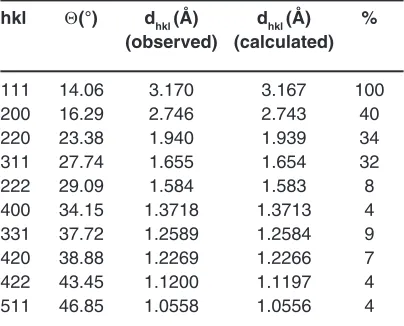
Ta2O5 (B: x=0.2) allowed us to stabilize the delta phase of bismuth oxide d-Bi2O3. Indexing of X-ray powder diffraction pattern for the composition B was performed by means of the computer program DICVOL [20] and TREOR21. These computations
give rather satisfactory results, showing that the XRD patterns can be fully indexed in a cubic system, Fmm (ITA No. 225) space group, with lattice parameter a=5.4853(1) Å, V = 165.05(1) Å3.
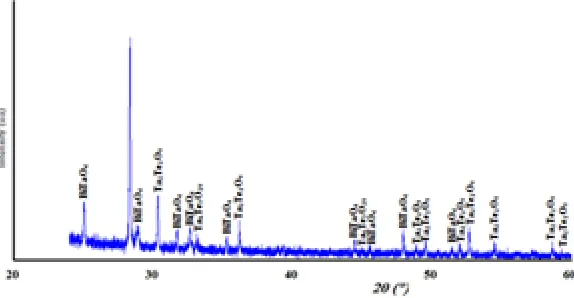
The X-ray diffraction spectra of the composition C(x=0.3) reveals that it’s a biphasic mixtures of the d-Bi2O3 and Bi3TaO7 (Fig. 2). While the compositions D(x=0.6) (Fig. 3) and E(x=0.9) (Fig. 4) show the existence of the same mixture, Ta2Te2O9, Ta6Te7O29 and BiTaO4.
The structural refinement of the composition B (x=0.2) was carried out by means of the Rietveld
method using the Fullprof program [14] integrated in WinPlotr pack, in a field angle 10d”2d”99.99° with a step of 0.01°/min. All the structural parameters and the vesting conditions are summarized in Table 2. Rietveld refinements of X-ray powder diffraction data indicate that the atomics positions are: Bi, Ta and Te in (4a). O occupied the sites 8c and 32f respectively. The reliability factors are: Rf =2.27%, RBragg=3.03% and Rwp=18.8%.
The calculation of the sum of the bond-valence (BVS) appears to indicate that the atoms (Bi, Ta, Te) occupying the same site (4a) are 8 coordinated.
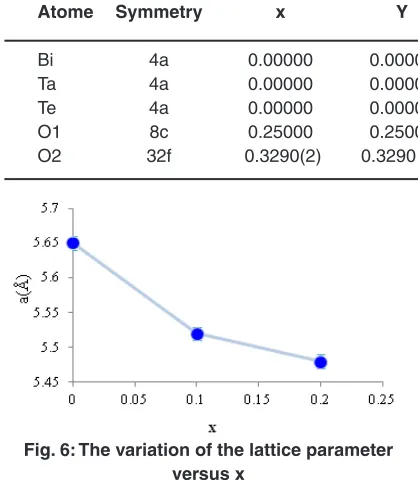
The variation with the addition of small amount of Ta2O5 and TeO2 in the matrix (BiO1,5 )1-x(TaO2,5)x/2(TeO2)x/2 (x=0, x=0.1, x=0.2) shows a decrease of the lattice parameter a (Fig. 6). These
Fig. 2: X-ray diffraction spectra of the composition C(x=0.3)
Table 1: Indexed powder X-ray diffraction of the Bi0.8Ta0.1Te0.1O1.65 composition, type δ-Bi2O3
hkl Θ(°) dhkl (Å) dhkl (Å) % (observed) (calculated)
111 14.06 3.170 3.167 100 200 16.29 2.746 2.743 40 220 23.38 1.940 1.939 34 311 27.74 1.655 1.654 32
222 29.09 1.584 1.583 8
400 34.15 1.3718 1.3713 4 331 37.72 1.2589 1.2584 9 420 38.88 1.2269 1.2266 7 422 43.45 1.1200 1.1197 4 511 46.85 1.0558 1.0556 4
Fig. 4: X-ray diffraction spectra of the composition E(x=0.9)
Fig. 5: Final Rietveld plots of the Bi0.8Ta0.1Te0.1O1.65 composition, type ä-Bi2O3.
results are justified by the difference of size between the ions Bi3+ (1.03 Å) Te4+ (0.97 Å) and Ta5+ (0.74
Å).
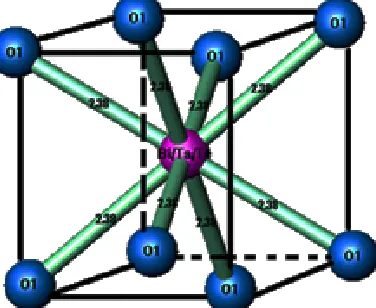
The atoms of bismuth, tantalum and tellurium are surrounded by eight oxygen atoms type 1 at a distance of 2.38 Å (Fig. 7), forming a regular cubic environment (Fig. 8). This distance is close to the sum of the radii (1.42+1.17) Å proposed by Shannon [22]. The oxygen atoms (O2) are displaced from ideal (8c) wyckoff position to 32f.
Table 2: Experimental details and crystallographic data for Bi0.8Ta0.1Te0.1O1.65 composition, type δ-Bi2O3
gE a (Å) angular Step of Number of Rp Rwp Rexp RB (%) X2(%) R F (%)
range measure refined parameters
Fm-3m 5.4854 10°<2θ 0.01° 91 19.4 18.8 15.83 3.033 1.38 2.275 (2) < 99.99° /min
Table 3: Atomic positions and thermal factors agitation of the Bi0.8Ta0.1Te0.1O1.65 composition, type δ-Bi2O3
Atome Symmetry x Y z Biso Occ
Bi 4a 0.00000 0.00000 0.00000 2.9823 (3) 0.700(3) Ta 4a 0.00000 0.00000 0.00000 2.9823 (3) 0.02500 Te 4a 0.00000 0.00000 0.00000 2.9823 (3) 0.02500 O1 8c 0.25000 0.25000 0.25000 0.20000 0.25000 O2 32f 0.3290(2) 0.3290 (2) 0.3290 (2) 0.20000 0.25000
Fig. 6: The variation of the lattice parameter versus x
displacements arise to accommodate the crystallo-chemical imbalance resulting from the unoccupied sites (vacancies).
Raman spectroscopy
Prior to compare the Raman spectra of different compositions, we would like to draw a couple of remarks concerning the room temperature alpha-phase. The d-Bi2O3 crystal structure has P21/c space group with two Bi atoms located at two independent 4e Wyckoff sites and three O atoms located at three independent 4e Wyckoff sites23. The Bi has
two different coordination numbers: Bi1 has five-fold coordination and Bi2 has six-five-fold coordination. The Bi1 polyhedron is a distorted pyramid with Bi-O
bond lengths varying from 2.07 to 2.63Å, while the Bi2 polyhedron is much distorted octahedron with Bi-O bonds varying from 2.13 to 2.79Å. The factor group analysis predicts that d-Bi2O3 crystal with four molecules per unit cell has 57 optical vibrations at the centre of the Brillouin zone (k=0).
Ã(q = 0) = 15Ag + 15Bg + 15Au + 15Bu ...(1) With A and B are non-degenerate modes, the subscripts g and u represent the symmetric and antisymmetric modes with respect to the centre of inversion. Symmetry exclusion rules predicts that there are thirty Raman-active modes (15Ag+15Bg), twenty-seven infrared-active (IR) modes (14Au+13Bu) and three acoustic modes (Au+2Bu).
As it can be observed in Fig. 9, the Raman spectrum is characterized by two different vibrational modes, narrow below 200 cm-1 and broad above 200
cm-1. The origin of this broadening is a matter of a
longue debate24, 25. It was attributed by Betsch and
White to atomic disorder resulting from the random orientation of the lone-pair orbitals of Bi atoms24; on
Tab
le4:
Main interatomic distances (Å),
angles (°) and bond v
alences in the Bi
0.8 Ta0.1 Te0.1 O1.65 composition, type δ -Bi 2 O3 Bi/T a/T e O1 (1) O2 (1) O3 (1) O4 (1) O5 (1) O6 (1) O7 (1) O8 (1) V alence O1 (1) 2.37527(3) 3.87880 (5) 3.87880 (5) 3.87880(5) 4.75054 (5) 2.74273(5) 2.74273(5) 2.74273 (5) 0.468 O2 (1) 109.471(2) 2.37527(3) 3.87880 (5) 3.87880(5) 2.74273 (5) 4.75054(5) 2.74273(5) 2.74273 (5) 0.468 O3 (1) 109.471(2)
109.471 (2)
2.37527(3) 3.87880(5) 2.74273 (5) 2.74273(5) 4.75054(5) 2.74273 (5) 0.468 O4 (1) 109.471(2) 109.471 (2) 109.471 (2) 2.37527(3) 2.74273 (5) 2.74273(5) 2.74273(5) 4.75054 (5) 0.468 O5 (1) 180.000(3) 70.5288(16) 70.5288(2) 70.5288(2) 2.37527(3) 3.87880(5) 3.87880(5) 3.87880 (5) 0.468 O6 (1) 70.5288(2) 180.000 (3) 70.5288(2) 70.5288(2) 109.471 (2) 2.37527(3) 3.87880(5) 3.87880 (5) 0.468 O7 (1) 70.5288(2) 70.5288(2) 180.000(3) 70.5288(2) 109.471 (2) 109.471(2) 2.37527(3) 3.87880(5) 0.468 O8 (1) 70.5288(2) 70.5288(2) 70.5288(16) 180.000 (3) 109.471 (2) 109.471(2) 109.471(2) 2.37527(3) 0.468 Σ vij 3.744
model to account for the phonon-phonon interaction and the temperature phonon life-time in the above Raman scattering, one would suggest that observed broadening is very likely due to the former hypothesis. This does not exclude the anharmonic contribution to the phonon broadening, but at this temperature we suggest that this effect is very weak comparable to the positional disorder. Consequently, the hopelessness to perform polarized Raman on the crystalline powder of d-Bi2O3 and the overlapping of different modes that are caused mainly by high frequency broadening, explain the drop of the permitted Raman bands from 30 to 18 observed modes.
A sum of Lorentzian band profile was applied to recalculate the Raman spectrum of d-Bi2O3, with ù (cm-1), c (cm-1), stands for phonon
frequencies, and damping coefficient, respectively. Frequencies and damping coefficient, compared to those calculated from ref26 respectively with their
attribution are regrouped in Table 5. It is worth to notice that reconstituting the spectra with a sum of Voigt (combination of Lorentz and Gaussian) bands, with a fixed Gaussian band-width that take into account the experimental broadening, do not bring further information on the spectral profiles and the vibrational properties of the phonon. As shown in table 5, our data agreed well with those reported in literature. Moreover, as one can see, the coupling of the experimental results from powder and crystal to the calculated one obtained by molecular dynamics, all of the 30 Raman active modes can be observed.
As predicted with the factor group analysis, all of the allowed Raman modes belong either to Ag or Bg symmetry. Whereas, the atomic displacement for each mode is very complex to describe. One can suggest that the low frequency modes probably describe the translational and vibrational motion of the Bi atoms, while those at high frequency could reflect the displacement of O atoms. Authors in Ref27
found that the total density of states obtained from inelastic scattering measurements contains intense signatures at 59, 218, 344, 424, and 532 (cm-1), and
weak shoulders at 102, 123, 165, and 195 (cm-1).
Comparing these results to those obtained in Ref25
Fig. 7: Structure of the Bi0.8Ta0.1Te0.1O1.65 composition, type δ-Bi2O3
Fig. 8: View of Bi/Ta/Te anionic coordination
Fig. 9: Raman spectrum of the a- Bi2O3 monoclinic phase. Power at the surface of the
sample is 2 mW.
Raman scattering can be successfully approached. The Bi atoms participate mainly in vibrations below 120 (cm-1) mainly translational modes, while modes
above 150 (cm-1) are due to displacements of the O
atoms and can thus be attributed to bending modes. Modes in the range 120-150 (cm-1) are defined by
the displacements of both Bi and O atoms and accordingly we attribute them to Bi-O stretching vibration in both coordination polyhedra. Very likely those between 200 and 400 (cm-1) correspond to
stretching vibration in six fold coordination while those above 400 (cm-1) correspond to internal
vibration in five-fold coordination. Fig. 10 shows Raman spectra of the compositions (x=0, 0.1, 0.2 and 0.3) recorded at room temperature.
The spectra are displayed in same the spectral range from 95 to 1000 cm-1 where most
of the first order Raman active modes are present. Spectra show tremendous changes and differences upon the addition of Te4+ and Ta5+ ions. All the spectra
show similar profile characterized with bands at 131, 328, 594, 719, 826 cm-1. The intense low and
disappear and only one intense band is present at low wavenumber with four other weak and large bands in the high frequency side of the Raman spectrum.
Furthermore, the decrease of the number of Raman bands is a strong hint for a smoothing out of vibrational modes. This latter is a consequence of an increase in the lattice symmetry. Concretely, the spectra present a wavenumber dependence on the dopant content. The intense band at 131cm-1 is
slightly blue shifting marking a well-defined shoulder at x= 0.3. The strong and asymmetric signal at 100 cm-1 is non-Raman and it is a result of the filter cut-off.
Also the mode at 719 cm-1 for x=0.1 shifts to higher
wavenumber and its amplitude increases significantly with the x concentration. The same increase in intensity is present in the large band centered at 328cm-1 (x=0). Fluorescence at low wavenumber is
also observed to persist with increasing the amount of Te4+ and Ta5+. In the absence of an absorption
spectrum of this compound, it is difficult to come up with an absorption mechanism that describes this fluorescence. But, one could speculate two possible scenarios that could lead to fluorescence in the Raman spectrum. First, concerns the existence of defects in the structure and second, could rise from a reduction of the energy band gap, i.e; as the laser excitation energy is constant (2.54 eV), the addition of Te4+ and Ta5+ could somehow reduce the energy
gap between the electronic ground state (E0) and the first electronic excited state (E*). Consequently, the incident line excite the molecule from E0àE* and upon desexcitation it release a photon in the same probed energy range. Increase of Te4+
and Ta5+ amount shift the fluorescence to higher
wavenumber.
Structural refinement based on X-ray diffraction data (presented above) shows that the lattice symmetry adopts a cubic d-Bi2O3 type structure. Applying the group theory analysis by taking into account the space group and the occupied site symmetries, the fundamental modes in the à point are distributed in terms of the irreducible representations of the factor group as:
à (q = 0) = A1g + A2u + Eu + Eg + T2u + 3T2g +
4T1u + T1g ...(2)
Where T1u is acoustic mode, 3 T1u are Infrared active and vibrations belonging to A1g + Eg + 3T2g are Raman active modes. A2u + Eu + T2u + 3T1u are Hyper-Raman active modes.
Raman active vibrations per set of ions are: Bi, Te, Ta: none
O(8c): T2g
Bi/Ta/Te(4a): no modes O(32f): A1g + Eg + 3T2g
We can see from the group theory analysis made in this paper that the cations do not contribute to the allowed fundamental transition, so doping with Te4+/Ta5+ ions on the Bi3+ site will not directly
influence the Raman spectra. Only the oxygen sublattice is contributing to the Raman spectrum and the high energy part of Density of states DOS spectrum is dominated by the oxygen density of states. Accordingly, an increase or a decrease of the intensity of a couple of bands reflects a change in the order-disorder of the oxygen sub-lattice.
In order to get a comparative view on the evolution of the vibrational signature of the oxygen sub-lattice, first all the spectra have their intensity corrected.
Correction was made by subtracting a second order polynomial _t to the base- line for the high wavenumber region [850-1000 cm-1]
where no Raman signatures are observed and extrapolating it to the low wavenumber region. This method guarantees reproducible spectra with low uncertainty on the Raman intensities and assume that fluorescence is mostly originated from electronic transition28. Second, Raman spectra were normalized
to the band at 635 cm-1 (Fig. 11). In Fig. 11, besides
the Raman shift of bands at 265, 502, and 719 cm-1,
the relative Raman intensity increases from x= 0.1-0.3 for the large bands at 250-400 cm-1 and the mode
at 719 cm-1 while it decreases for the one at 502 cm-1.
doped and undoped Bi2O3 originates very likely from a temperature effect.
In the absence of a real simulation of oxygen sub-lattice vibration, assignment of all the above modes seems to be impossible; although some observation can be made. The temperature Raman spectra of the á à d transition, shows clearly the persistence of the A1g mode at 450 cm-1 with
temperature in d-Bi2O3. This mode is observed as a large band in d-Bi2O3 at a frequency 510 cm-1.
Since temperature induces a red shift of the Raman spectrum, we argue that the large band at 594 cm-1 presents the same A1g symmetry. The high
temperature d-Bi2O3 shows the absence of the peak 719 cm-1. We observed that the intensity of this peak
relative to the one at 600 cm-1 increases significantly
with x. We suggest that this mode at 719 cm-1 is
related to oxygen defects in the structure. Similar behavior has been observed in fluorite structure having punctual defects29-31, i.e. interstitial oxygens
as in case of UO2+x31 or oxygen vacancies as in UO 2
doped trivalent metals29, 30.
CONCLUSION
The d-Bi2O3 is a stable polymorph of bismuth sesquioxide only at high T. Here we have successfully stabilized this structure at room temperature through a chemical doping process. In addition to what is suggested in literature we show that this structure is not only stable in presence of trivalent metals but also with tetra- and pentavalent metals. The crystal structure was determined by means of the X-ray diffraction and micro-Raman scattering. The cations Bi3+ / Ta5+ / Te4+ occupy the
same site (4a), while Oxygens occupied the sites 8c and 32f, respectively. The results of Raman spectroscopy analysis confirms the existence of the solid solution (BiO1.5)1-x(TaO2.5)x/2( TeO2)x/2 (with 0<x<0.2), type d-Bi2O3. Comparing the spectra of
δ-Bi2O3 with the alpha phase, we comfortably suggest that the decrease of the number of Raman bands is a strong hint for a smoothing out of vibrational modes. This latter is a consequence of an increase in the lattice symmetry. Equally to other fluorite compounds, we show that the structure presents oxygen defects clearly identified in the Raman spectra.
REFERENCES
1. Gurunathan, K.; Int. J. Hydrog. Energy. 2003,
29, 933-940.
2. Wang, J.; Neaton, J. B.; Zheng, H.; Nagarajan, V.; Ogale, S. B.; Liu, B.; Viehland, D.; Vaithyanathan, V.; Schlom, D. G.; Waghmare, U. V.; Spaldin, N. A.; Rabe, K. M.; Wuttig, M.; Ramesh, R. Science.2003, 299, 1719-1722.
3. Park, B. H.; Kang, B. S.; Bu, S. D.; Noh, T. W.; Lee, J.; Jo, W. Nature. 1999, 401, 682-684. 4. Wachsman, E. D., Lee, K. T. Science. 2011,
334, 935-939
5. Azad, A. M.; Larose, S.; Akbar, S. A. J. Mater. Sci. 1994, 29, 4135-4151.
6. Levin, E.M.; and Roth, R.S. J. Res. Nat. Bur. Stand.-A Phys. Chem.1964, 68A, 189-206. 7. Harwig H.A.; and Gerards, A.G. J. Solid State
Chem.1978, 26, 265-274.
8. Gattow, G.; and Schröder, H. Z. Anorg. Allg. Chemie. 1962, 318, 176-189.
9. Takahashi, T.; Iwahara, H.; Nagai, Y. J. Applied Electrochem. 1972,2, 97-104.
10. Takahashi, T.; Iwahara, H.; Arao, T. J. Applied Electrochem. 1975,5, 187-194.
11. Harwig, H. A. Z. Anorg. Chem. 1978, 444, 151-166.
12. Sanna, S.; Esposito, V.; Andreasen, J.W.; Hjelm. J.; Zhang, W.; Kasama, T.; Simonsen S.B.; Christensen, M.; Linderoth S.; Pryds N.
Nature Mat. 2015,14, 500-504.
13. Yashima, M.; Ishimura, D. Chemical Physics Letters. 2003, 378, 395-399.
14. Programme Full Prof.2k (Version 5.30 - Mar2012-ILL JRC).
15. Sillen, L. G. Ark. Kemi Mineral. Geol. 1937,
12A, 1-15.
16. Gattow, G.; Schutze, D. Z. Anorg. Allg. Chem.
1964,328, 44-68.
17. Willis, B. T. M. Acta. Cryst. 1965,18, 75-76. 18. Boyapati, S.; Wachsman, E. D.; and
Chakoumakos, B. C. Solid State Ionics, 2001,
138, 293-304.
L561-L566.
20. Programme DICVOL04, BOULTIF, A. LOUER, D. J. APPL. CRYST.2004, 37, 724-731. 21. Programme TREOR90, Université de
STOCKHOLM (SWEDEN). 1990.
22. Shannon, R.D.; Acta Crystallogr, 1976,A32, 751-767.
23. Malmros, G.; Acta Chemica Scandinavica
1970, 24, 384-396.
24. Betsch, R. J.; and White, W. B. Spectrochimica Acta Part A, 1978,34, 505-514.
25. Denisov, V N.; Ivlev A N.; Lipin A S.; Mavrin, B N.; and Orlov V G. 1997J. Phys.: Condens. Matter, 9,4967-4978.
26. Chouinard, C.; and Desgreniers, S.; 2000
Solid State Commun, 113, 125-129.
27. Pereira, A L J.; Gomis, O.; Sans, J A.;
Pellicer-Porres, J.; Manjón, F J.; Beltran, A.; Rodríguez-Hernández, P.; and A Muoz. J. Phys.: Condens. Matter. 2014, 26, 225401 (15pp).
28. Naji, M.; Piazza, F. ; Guimbretière, G. ; Canizarès, A.; Vaills, Y. J. Phys. Chem. B,
2013,117, 5757-5764.
29. Talip, Z.; Wiss, T.; Raison, P. E.; Paillier, J.; Manara, D.; Somers, J.; and Konings, R. J.M.
Journal of the American Ceramic Society,
2015, 98, 2278–2285.
30. Naji, M.; Colle, J-Y.; Beneš, O.; Sierig, M.;
Rautio, J.; Lajarge, P.; and Manara, D. J. Raman Spectrosc. 2015, 46, 750–756. 31. Desgranges, L.; Baldinozzi, G.; Simon, P.;