Students’ Use of Language Expressions During A Group Discussion
Anis Maesin (Academy of Language Studies, Universiti of Teknologi MARA Perlis, Malaysia)
Mahani Mansor (Academy of Language Studies,Universiti of Teknologi MARA Perlis,, Malaysia)
Surina Nayan (Academy of Language Studies,Universiti of Teknologi MARA Perlis,, Malaysia)
Nazira Osman (Academy of Language Studies, Universiti of Teknologi MARA Perlis, Malaysia)
Latisha Asmaak Shafie (Academy of Language Studies,Universiti of Teknologi MARA Perlis,Malaysia)
124 Introduction
The well-known old saying goes, ‘don’t judge a book by its cover’. Even so, the reality is, the first impression that one gets of an individual’s language proficiency is the moment one hears he or she speaks the language. Speaking can be a grueling and
stressful task for some language learners. Unlike writing, speaking requires learners to produce utterances, and sometimes provide responses, almost immediately. When asked what is the biggest problem that they face when speaking, learners generally admit that they have a great difficulty in trying to express what they want to say as they cannot think of the words that they need to use to do so (Howarth, 2006). This frequently resulted
Students’ Use of Language Expressions During A Group Discussion
Abstract
Author (S)
Anis Maesin
Academy of Language Studies, Universiti of Teknologi MARA Perlis, Malaysia.
E-mail: [email protected]
Mahani Mansor Academy of Language
Studies,Universiti of Teknologi MARA Perlis,, Malaysia.
E-mail: [email protected] Surina Nayan Academy of Language Studies, Universiti of Teknologi MARA Perlis,, Malaysia.
E-mail: [email protected]
Nazira Osman Academy of Language Studies, Universiti of Teknologi MARA Perlis, Malaysia.
E-mail: [email protected]
Latisha Asmaak Shafie Academy of Language Studies, Universiti of Teknologi MARA Perlis,Malaysia.
E-mail: [email protected]
Even after years of learning English in both primary and secondary levels, many university students are still rather weak when it comes to speaking in English, including performing discussions in the language. Many are not confident and afraid to use English in public. Thus this study attempts to investigate whether students are using appropriate language strategies as they take part in a group discussion. Data was gathered through group observations of part three Civil Engineering diploma students of University Teknologi MARA Perlis. The findings reveal that the students were able to employ varying language forms that were introduced to them, in assisting them to communicate their ideas effectively while performing a group discussion.
.
125
in learners not saying much or even tries to make any attempt to speak.
There are a few components of
communicative ability; linguistic
competence, pragmatic competence,
discourse competence, strategic competence and fluency (Hedge, 2001). In the light of this problem, it is therefore suggested that language learners are trained to use these strategies so that they can be employed when learners interact with others. Learners need to be introduced to the different expressions for varying social contexts so that they can express their intentions clearly according to appropriate social conventions. Furthermore,
learners should be taught to use
communication strategies so that they can express their ideas using different means of expressions. They also need to be exposed to useful language strategies, such as, expressions for initiating, interrupting, checking and confirming that are commonly used in conversations so that they can use these to express their own ideas clearly. In other words, this component consists of the use of communicative strategies whereby learners use these when they cannot express what they want to say due to lack of resources to do so.
Since the language that students mostly hear in classrooms is associated with directives, teachers need to teach forms and functions explicitly (Cable, 2005).
Literature review
According to Caudery (1999), “The term strategies, in the second language learning sense, has come to be applied to the conscious moves by second language speakers intended to be useful in either learning or using the second language. Strategies can be very different in nature, ranging from planning the organization of one’s learning (a metacognitive learning strategy) through using mnemonic devices to learn vocabulary (cognitive learning strategies) and rehearsing what one expects to say ( a performance strategy) to bolstering one’s self confidence for a language task by mean of “self-talk” (an affective strategy)”.
In general, Malaysian tertiary students need to have good communicative skills in order to be able to face educational challenges as they go through their period of study. Even though many of them realize the importance of mastering the English language, Jamali (1991) as cited by Zuraidah (2007) reveals that some studies on Malaysia ESL learners found that they were reluctant to speak in English. There are some factors that contribute to this problem, such as learners’ socioeconomic background, peer pressure and lack of exposure to the target language. Yong (2010) attributed Malaysian students’ reluctance towards speaking out to their cultural background, perceptual learning preferences, and attitudes toward oracy skills. Their limited engagement in class discussions, oral presentations and oral
argumentation is said to be the result of certain perceptual
learning preferences.
Some students have problems contributing to group discussions since they experience communication apprehension. According to
McCroskey (n.d.), communication
apprehension does affect children in schools and therefore, help is needed to overcome this problem faced by these students. From his research findings, he also reveals that 10 to 20% of his samples from Michigan State University students and Illinois State University students suffer from extreme communication apprehension and this directly affects their communicative behavior. In another case, Shafiq, Irma, Ahmad Hifzurrahman and Wan NorHaizar (2008) in their research, figure out that there is a significant positive correlation between
fear of negative evaluation and
communication apprehension whereby the higher the fear of a person, the higher
communication anxiety would be
experienced by a learner. Therefore, students are afraid to contribute and express their ideas in discussions which indeed at the end will affect their learning.
126
fluent in the second language. Cable (2005) states that “the language that learners need in order to develop their knowledge and understanding and participate fully in learning in classroom contexts is much more demanding and complex..pupils are expected to be able to use and reproduce a range of language forms and function for different purposes”. Learners who face difficulties when speaking will usually adopt several strategies to cope with the situation. One of them is to employ avoidance behavior. According to Maniruzzaman (2008), “When speaking or writing in a second language, the learner is often found to try to avoid using difficult words or structures and use some simpler words or structures instead.” This is an evidence that shows learners use their own strategy in learning their second language. By avoiding using difficult words either in their writing or speaking, they are more confident and comfortable in their learning, as well as they can contribute their ideas well.
According to Ghaleb Rabab’ah (2005), “Another strategy used by L2 in their communication is they may try to avoid particular language or grammatical items: paraphrase when they don’t have the appropriate form or construction, ask the interlocutor for the correct form, use gestures to convey meaning, insert a word or a phrase from their first language, apply L2 morphology and/or phonology to L1 lexical items, translate literally or they may use word coinage which produces items that don’t exist in the target language to achieve their communicative goals.”
In their study, Nazira, Surina, Mahani, Anis & Latisha (2010) find that collaborative learning activities do help students to enhance their spoken skills and reduce their apprehension towards speaking in a group discussion or any speaking activities inside their classroom. From their finding, it also reveals that the students are familiar and feel comfortable working in groups (as in many collaborative activities) rather than speaking face-to-face to a new person or to be involved in personal interaction.
Kamprasertwong (2010) studied 15 Dutch,
Thai and Chinese native speakers’
willingness to communicate (WTC) in English to their personality, cultural and situational traits. The results show there was a significant relationship between the situational trait and willingness to
communicate in English. However
willingness to communicate in English was not influenced by personality and cultural traits. Other factors like the choice of topics, tiredness, and self-perceived language proficiency affected the subjects’ willingness to communicate in English.
Liu (2007) investigates anxiety in oral English classrooms using a survey and reflective journals in a Chinese university. The study reveals that anxiety was experienced by students when speaking English in class and giving presentations. The students were anxious as they had poor vocabulary and low English proficiency.
Chen and Short (2010) revealed that all in their study of 35 Chinese students at UTAS employed compensation strategies to solve their communicative problems. These strategies discouraged students to improve their level of competency in English. In addition, the study reveals that cultural and educational backgrounds affected students’ adjustment which helped them with their
English oral proficiency. Chinese
international students need to improve their oral proficiency in a natural environment by using English with native speakers.
127 Methodology
The purpose of this of this survey is to find out the types of language forms that students use to express their ideas in different situations (i.e. functions) that they encounter during a group discussion, and the frequency of use. The subjects were two groups of Part Three Civil Engineering students of Universiti Teknologi MARA (UiTM) Perlis, taking the third semester English course, English for Academic Purposes. These 107 students were chosen because they have been introduced to group discussion skills and have also been assessed on it during their first and second semester of English language course in this institution. Hence, they are not new to this kind of classroom activity.
At the beginning of their third semester, the students were introduced to a list of language forms that were grouped based on their functions. There are 9 functions in the list: to express an opinion, give a suggestion, signal a main point, solicit response from others, express agreement and each function consists of varying number of forms, ranging from 3 to 17. They had also practised using them in group discussions before the data collection session. The students also practised the procedure that they were required to do to assist in collecting the data. This is to ensure that they knew exactly what to do. During the first half of the data collection session, half of the students in each group formed groups of three to four students, while the other half became observers. One student was assigned to observe one of the students of a group. As the group performed a discussion, the observer was responsible to tick the forms that were on the list given each time they were used by the student that was being observed. When the discussion was over, the students changed role. The student observers then took their turn to discuss, and the rest became observers in this second session of discussion. In this way, each student’s use of the language forms was able to be systematically recorded.
Results and Discussion
The following is result from the observations carried out in identifying the language forms used by the students during a group discussion session.
As illustrated in Table 1, to express an opinion, it has been found that students used “I think” (101 times) most frequently. It is followed by “In my opinion” (83times), “I believe” (30 times), “My opinion is” (23 times) and “As far as I can see” (17 times). The sixth language form most frequently used was “From/In my point of view’ (14 times), followed by “My view/point of view is” (11 times), “Personally, I think/feel that” (9 times) and “I am convinced that” (9 times). The least used was “If you asked me” (5 times).
Table 2 illustrates that when giving a suggestion, it was found that students used “I think/suggest/recommend/propose that” most often (55 times). The second was “What about..?” (28 times) and the third was “My suggestion/recommendation is that” (19 times). These are followed by “It would be a good idea to” fourth (10 times), “We should/ought to/ need to” fifth (7 times) and “One solution would be” sixth (3 times). The least used form was “An alternative to this problem is” (2 times).
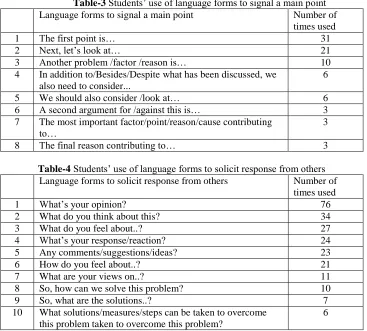
In signaling a main point, it is evident in Table 3 that the most used form was “The first point is” (31 times), followed by “Next, let’s look at” (21 times). “Another problem/factor/reason is” (10 times) was third most commonly used form, followed by “In addition to/ Besides/Despite what has been discussed, we also need to consider” (6 times) and “We should also consider/look at” (6 times). The three least used forms were “A second argument for/against this is” (3
times), “The most contributing
factor/point/reason/cause contributing to” (3 times) and “The final reason contributing to” (3 times).
128
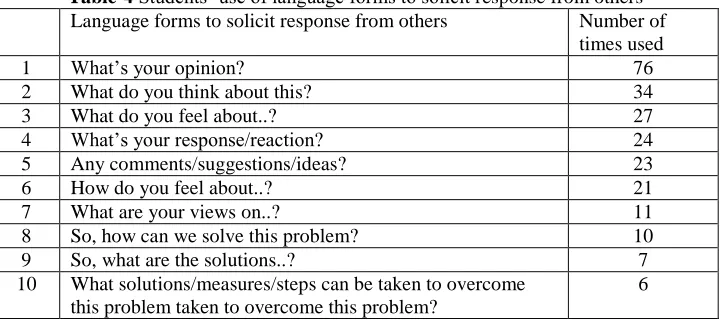
think about this?”(34 times), “What do you feel about” (27 times), “What’s your response/reaction” (24 times), “Any comments/suggestions/ideas?” (23 times) and “How do you feel about” (21 times). The forms that are used less are “What are your views on” (11 times), “So, how can we solve this problem?” (10 times), “So, what are the solutions” (7 times) and the least is “What solutions/ measures/ steps can be taken to overcome this problem?” (6 times).
Table 5 indicates that the students used “I
agree completely/absolutely” most
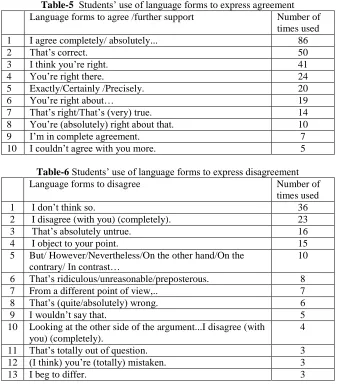
frequently (86 times), followed by “”That’s correct” (50 times), “I think you are right” (41 times), “You’re right there” (24 times) and “Exactly/Certainly/Precisely” (20 times). “You’re right about” (19 times), “That’s right/That’s (very) true” (14 times), “You’re (absolutely) right about that” (10 times), “I’m in complete agreement” (7 times) and “I couldn’t agree with you more” (5 times) were used less.
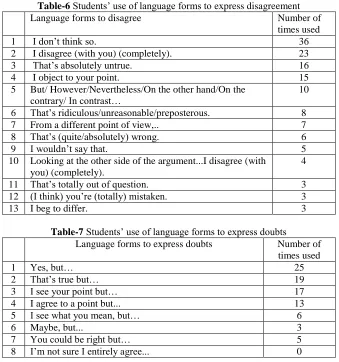
Students’ use of language forms to express disagreement is illustrated in Table 6. The most used form is “I don’t think so” (36 times). This is followed by “I disagree (with you) (completely)” (23 times), “That’s absolutely untrue” (16 times), “I object to
your point” (15 times), “But/
However/Nevertheless/On the other hand/On the contrary/In contrast” (10 times), “That’s ridiculous/unreasonable/preposterous” (8 times), “From a different point of view” (7 times), “That’s (quite/absolutely) wrong” (6 times) and “I wouldn’t say that” (5 times). The lesser used forms are “Looking at the other side of the argument..I disagree (with you) (completely)” (4 times), “Looking at the other side of the argument…I disagree (with you) (completely)” (3 times), “(I think) you’re (totally) mistaken” (3 times) and “I beg to differ” (3 times).
In expressing doubts, it is clear from Table 7 that students used “Yes, but” most (25 times). This is followed by “That’s true but” (19 times), “I see your point but” (17 times), “I agree to a point but” (13 times), “I see what you mean, but” (6 times), and the least is “Maybe, but” (5 times), and the least is
“You could be right but” (3 times). “I’m not sure I entirely agree” was not used at all (0 times).
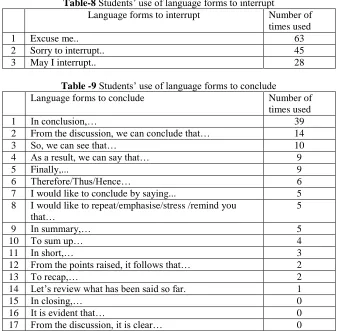
Only three forms of interruption were taught. Table 8 shows that the most used is “Excuse me” (63 times), followed by “Sorry to interrupt” (45 times), and “May I interrupt” (28 times).
The last group of forms taught is the ones that can be used to conclude a discussion. As can be seen from Table 9, students used “In conclusion” most often (39 times), followed by “From the discussion, we can conclude that” ( 14 times), “So, we can see that” (10 times), “As a result, we can say that” (9
times) and “Finally” ( 9 times).
“Therefore/Thus/Hence” (6 times), “I would like to conclude by saying” (5 times), “I would like to repeat/emphasise/stress/remind you that” ( 5 times), “In summary” (5 times), “To sum up” (4 times), “In short” (3 times), “From the points raised, it follows that” (2 times), “To recap” (2 times)and “Let’s review what has been said so far” (1 time) are the less used forms. Three forms were not used; “In closing”, “It is evident that” and “From the discussion, it is clear”.
Conclusion
From the results, we can see that explicit teaching of language forms and functions, followed by practice in class, will expose students to the correct language expressions that are useful for them to use when they are discussing in a group. The outcome of these is evident as the students have proved this by using the varying forms that were taught to them by their respective instructor. For most of the functions, all of the forms that were taught were used by the students during their group discussion.
129
students not using three of the seventeen forms that were introduced to them. It is interesting to note that the forms that were not used at all are not necessarily those that consist of a lot of words. As we can see, there is a case whereby a form that consists of two words was also unused. This finding contradicts Maniruzzaman’s claim (2008) about second language learners’ strategy of avoiding difficult words or structures.
Recommendation
To help students manage group discussion
effectively and easily, language
teachers/instructors are recommended to teach the language that students may use in their discussion. By doing this, their level of anxiety will be reduced because they are provided with the information on common functional language that they will probably use during their group discussion. Students’ cognitive and linguistic development can further be strengthened if functional language which is the sub-skill is taught explicitly (Gibbons, P. , 2002). In addition, speaking strategies should also be taught to learners who have lack of confidence to participate in oral interaction. One of the ways is to make them aware of the expressions that are commonly used in different situations in oral communication. (The National Capital Language Resource Center, 2004). Research found one of the factors that helps learners in their second language acquisition is by exposing them
with such language at the time when they need it and in a meaningful context.
Josephina & Sujatha (2005) suggest to teach interaction strategies to learners together with the instructional of essential vocabulary. They further state that by having enough language support, learners will feel more confident to contribute ideas in group discussions. In addition, in their study on “Developing speaking skills through interaction strategy training”, they have included strategies such as expressing agreement, expressing disagreement, seeking clarification, clarifying and directing interaction with the group. Cooperative learning and peer support are also needed besides equipping themselves with the strategies needed to ensure successful discussions. In the end, during the discussion, these learners are able to clarify themselves and at the same time are also able to contribute more to the discussion.
In summary, there are many advantages that students can get if they are able to actively participate in group discussion. Besides attaining good grades for subjects that need them to perform group discussion, they are also able to communicate effectively in their daily lives. In addition, they are also able to acquire the communicative ability (which is lacking in many of our graduates) to manage social interaction in an effective manner in the work place (Yong, 2010).
Table -1 Students’ use of language forms to express an opinion
Language forms to express an opinion Number of
times used
1 I think… 101
2 In my opinion... 83
3 I believe… 30
4 My opinion is… 23
5 As far as I can see... 17
6 From/In my point of view… 14
7 My view / point of view is... 11
8 Personally, I think / feel that ... 9
9 I am convinced that… 9
130 Table -2 Students’ use of language forms to give a suggestion
Language forms to give a suggestion Number of
times used
1 I suggest/recommend/propose that… 55
2 What about…? 28
3 My suggestion/recommendation is that… 19
4 Perhaps we should… 12
5 It would be a good idea to… 10
6 We should/ought to/need to... 7
7 One solution would be… 3
8 An alternative to this problem is... 2
Table-3 Students’ use of language forms to signal a main point
Language forms to signal a main point Number of
times used
1 The first point is… 31
2 Next, let’s look at… 21
3 Another problem /factor /reason is… 10
4 In addition to/Besides/Despite what has been discussed, we also need to consider...
6
5 We should also consider /look at… 6
6 A second argument for /against this is… 3
7 The most important factor/point/reason/cause contributing to…
3
8 The final reason contributing to… 3
Table-4 Students’ use of language forms to solicit response from others
Language forms to solicit response from others Number of
times used
1 What’s your opinion? 76
2 What do you think about this? 34
3 What do you feel about..? 27
4 What’s your response/reaction? 24
5 Any comments/suggestions/ideas? 23
6 How do you feel about..? 21
7 What are your views on..? 11
8 So, how can we solve this problem? 10
9 So, what are the solutions..? 7
10 What solutions/measures/steps can be taken to overcome this problem taken to overcome this problem?
131 Table-5 Students’ use of language forms to express agreement
Language forms to agree /further support Number of
times used
1 I agree completely/ absolutely... 86
2 That’s correct. 50
3 I think you’re right. 41
4 You’re right there. 24
5 Exactly/Certainly /Precisely. 20
6 You’re right about… 19
7 That’s right/That’s (very) true. 14
8 You’re (absolutely) right about that. 10
9 I’m in complete agreement. 7
10 I couldn’t agree with you more. 5
Table-6 Students’ use of language forms to express disagreement
Language forms to disagree Number of
times used
1 I don’t think so. 36
2 I disagree (with you) (completely). 23
3 That’s absolutely untrue. 16
4 I object to your point. 15
5 But/ However/Nevertheless/On the other hand/On the contrary/ In contrast…
10
6 That’s ridiculous/unreasonable/preposterous. 8
7 From a different point of view,.. 7
8 That’s (quite/absolutely) wrong. 6
9 I wouldn’t say that. 5
10 Looking at the other side of the argument...I disagree (with you) (completely).
4
11 That’s totally out of question. 3
12 (I think) you’re (totally) mistaken. 3
13 I beg to differ. 3
Table -7 Students’ use of language forms to express doubts
Language forms to express doubts Number of
times used
1 Yes, but… 25
2 That’s true but… 19
3 I see your point but… 17
4 I agree to a point but... 13
5 I see what you mean, but… 6
6 Maybe, but... 3
7 You could be right but… 5
132 Table-8 Students’ use of language forms to interrupt
Language forms to interrupt Number of
times used
1 Excuse me.. 63
2 Sorry to interrupt.. 45
3 May I interrupt.. 28
Table-9 Students’ use of language forms to conclude
Language forms to conclude Number of
times used
1 In conclusion,… 39
2 From the discussion, we can conclude that… 14
3 So, we can see that… 10
4 As a result, we can say that… 9
5 Finally,... 9
6 Therefore/Thus/Hence… 6
7 I would like to conclude by saying... 5
8 I would like to repeat/emphasise/stress /remind you that…
5
9 In summary,… 5
10 To sum up… 4
11 In short,… 3
12 From the points raised, it follows that… 2
13 To recap,… 2
14 Let’s review what has been said so far. 1
15 In closing,… 0
16 It is evident that… 0
17 From the discussion, it is clear… 0
References
Cable, C. (2005), Spoken language. [Online] Available:
http://www.naldic.org.uk/ITTSEAL2/teachin g/SpokenLanguage.cfm (June 23, 2010)
Chen,Y. and Short, M. (2010) “Oral English, culture, and strategies: propellers and roadblockers in learning for Chinese international students” [Online] Available http://www.utas.edu.au/teachingmatters/2010 /Papers/Chen.pdf (January 6, 2011)
Fung, L.Y. (2010) “A study on the cultural values, perceptual learning styles, and attitudes toward oracy skills of Malaysian tertiary students” European Journal of Social Sciences Vol.13, No.3, pp. 478-492.
Ghaleb Rabab’ah. (2005) “Communication problems facing Arab learners of English. Journal of Language Teaching and Learning” Vol.3, No.1, pp.180-197.
Gibbons, P. (2002) Scaffolding language, scaffolding learning: teaching second language
learners in the mainstream classroom, Portsmouth Heinemann: Portsmouth.
Hedge, T. (2001) Teaching and learning in the language classroom. Oxford University Press:UK
Howarth, P. (2006) “Increasing student interaction” Retrieved June 23, 2010 from http://www.teachingenglish.org.uk/think/arti cles/increasing-student-interaction
Josephine L. and Sujatha M. (2005)
“Developing speaking skills through interaction strategy training” The English
Teacher Vol.XXXIV, pp.1-18.
133
University of Groningen. Retrieved January
6, 2011 from
http://scripties.let.eldoc.ub.rug.nl/FILES/root /Master/DoorstroomMasters/ToegepasteTaal wetens/2010/Kamprasertwong/MA_1700820 _T_Kamprasertwong.pdf
Liu, M. (2007) “Anxiety in Oral English Classrooms: a Case Study in China’. Indonesian Journal of English Language Teaching Vol.3, No.1, pp.119-137. Retrieved
January 6, 2011 from
indonesianjelt.org/com_download.php?file= pdf_20.pdf
Maniruzzaman, M. (2008) “Avoidance behavior in EFL learning: A study of undergraduates”
Retrieved July 16, 2010 from
http://www.streetdirectory.com.travel_guide/ 106631/languages/avoidance_behaviour...
McCroskey , J.C. (n.d.) “The effects of communication apprehension on non-verbal behavior”
Retrieved August 9, 2010, from
http://www.jamescmccroskey.com/publicatio ns/65.htm
Nazira, Surina, Mahani, Anis and Latisha.
(2010) “Spoken skills, communication
apprehension and collaborative learning” Cross Cultural Communication Vol.6, No.2, pp.117-124.
Shafiq Hizwari, Irma Ahmad, Ahmad Hifzurrahman and Wan NorHaizar.
(2008) “Second Language anxiety among Diploma students in Technical University (Universiti Malaysia Perlis)”. Retrieved
August 9, 2010, from
http://dspace.unimap.edu.my/dspace/bitstrea m/123456789/5831/1/SECOND%20LANG UAGE%20ANXIETY%20AMONG%20DIP LOMA%20STUDENTS%20IN%20TECHN ICAL%20UNIVERSITY.pdf
Zuraidah Ali. (2007) “Willing learners yet unwilling speakers in ESL classrooms” Asian Journal
of University Education Vol.3, No.2, pp.57-74.
Appendix
Table-1 Students’ use of language forms to express an opinion
Language forms to express an opinion Number of
times used
1 I think… 101
2 In my opinion... 83
3 I believe… 30
4 My opinion is… 23
5 As far as I can see... 17
6 From/In my point of view… 14
7 My view / point of view is... 11
8 Personally, I think / feel that ... 9
9 I am convinced that… 9
134 Table -2 Students’ use of language forms to give a suggestion
Language forms to give a suggestion Number of
times used
1 I suggest/recommend/propose that… 55
2 What about…? 28
3 My suggestion/recommendation is that… 19
4 Perhaps we should… 12
5 It would be a good idea to… 10
6 We should/ought to/need to... 7
7 One solution would be… 3
8 An alternative to this problem is... 2
Table -3 Students’ use of language forms to signal a main point
Language forms to signal a main point Number of
times used
1 The first point is… 31
2 Next, let’s look at… 21
3 Another problem /factor /reason is… 10
4 In addition to/Besides/Despite what has been discussed, we also need to consider...
6
5 We should also consider /look at… 6
6 A second argument for /against this is… 3
7 The most important factor/point/reason/cause contributing to…
3
8 The final reason contributing to… 3
Table-4 Students’ use of language forms to solicit response from others
Language forms to solicit response from others Number of
times used
1 What’s your opinion? 76
2 What do you think about this? 34
3 What do you feel about..? 27
4 What’s your response/reaction? 24
5 Any comments/suggestions/ideas? 23
6 How do you feel about..? 21
7 What are your views on..? 11
8 So, how can we solve this problem? 10
9 So, what are the solutions..? 7
10 What solutions/measures/steps can be taken to overcome this problem taken to overcome this problem?
135 Table -5 Students’ use of language forms to express agreement
Language forms to agree /further support Number of
times used
1 I agree completely/ absolutely... 86
2 That’s correct. 50
3 I think you’re right. 41
4 You’re right there. 24
5 Exactly/Certainly /Precisely. 20
6 You’re right about… 19
7 That’s right/That’s (very) true. 14
8 You’re (absolutely) right about that. 10
9 I’m in complete agreement. 7
10 I couldn’t agree with you more. 5
Table-6 Students’ use of language forms to express disagreement
Language forms to disagree Number of
times used
1 I don’t think so. 36
2 I disagree (with you) (completely). 23
3 That’s absolutely untrue. 16
4 I object to your point. 15
5 But/ However/Nevertheless/On the other hand/On the contrary/ In contrast…
10
6 That’s ridiculous/unreasonable/preposterous. 8
7 From a different point of view,.. 7
8 That’s (quite/absolutely) wrong. 6
9 I wouldn’t say that. 5
10 Looking at the other side of the argument...I disagree (with you) (completely).
4
11 That’s totally out of question. 3
12 (I think) you’re (totally) mistaken. 3
13 I beg to differ. 3
Table-7 Students’ use of language forms to express doubts
Language forms to express doubts Number of
times used
1 Yes, but… 25
2 That’s true but… 19
3 I see your point but… 17
4 I agree to a point but... 13
5 I see what you mean, but… 6
6 Maybe, but... 3
7 You could be right but… 5
136 Table-8 Students’ use of language forms to interrupt
Language forms to interrupt Number of
times used
1 Excuse me.. 63
2 Sorry to interrupt.. 45
3 May I interrupt.. 28
Table -9 Students’ use of language forms to conclude
Language forms to conclude Number of
times used
1 In conclusion,… 39
2 From the discussion, we can conclude that… 14
3 So, we can see that… 10
4 As a result, we can say that… 9
5 Finally,... 9
6 Therefore/Thus/Hence… 6
7 I would like to conclude by saying... 5
8 I would like to repeat/emphasise/stress /remind you that…
5
9 In summary,… 5
10 To sum up… 4
11 In short,… 3
12 From the points raised, it follows that… 2
13 To recap,… 2
14 Let’s review what has been said so far. 1
15 In closing,… 0
16 It is evident that… 0