OPTIMAL PLACEMENT TECHNIQUE FOR
DISTRIBUTED GENERATION
USING CLOUD
COMPUTING- A THEORETICAL APPROACH
Puneet Chawla
1, Saruti Arya
21
Asstt. Prof. Electrical Engg. Dept.,
2Programmer, Computer Sc. & Engg. Dept.,
Ch. Devi Lal State Institute of Engg. & Tech., Panniwala Mota (Sirsa)
ABSTRACT
India has made impressive progress in the field of electricity generation since independence. In terms, of
generation, while new capacity has been added, by and large the gap between demand and supply had
increased. Due to India’s economic rise, the demand for energy has grown at an average of 3.6% per annum
over the last 30 years. Our installed power generation capacity stands at 274.818 GW while our total demand
for electricity is expected to cross 950,000MW by 2030. In order to meet India’s need for rural electrification
and to meet peak power demand, new areas of power generation had to develop as soon as possible. Since the
electrical power is transmitted through the transmission systems from the central generating stations to end
users using a series of distribution transformers and lines. As the electric utility industry continues to
restructure, there is a renewed interest in small-scale electricity generation known as Distributed generation
Small-scale generation is commonly called as Distributed generation (DG), embedded generation or
decentralized generation. This paper presents general background, objectives, constraints and solution
algorithm for the optimal placement of distributed generation (DG) and tried to implement the cloud computing
technique in the field of electrical power generation.
Keywords: Distributed Generation, Micro-Turbines, Doubly-fed Induction Generator Wind
Turbine, Squirrel Cage Induction Generator wind Turbine, Newton Raphson’s Method, Optimal
Allocation, Distributed Network Operator, Optimal DG Placement (ODGP).
I. INTRODUCTION
Distributed generation, defined as small scale (1kW to 50MW) electricity generation, is fairly a new concept in
the economic literature about electricity market, but the idea behind it is not new at all. In the early days of
electricity generation, DG was the rule, not the exception. The first power plants only supplied electricity to
consumers to the closed neighbourhood of the generation plant. The first grids were DC based and so, the
supply voltage was limited, as was the distance that could be used between generators and consumer. Balancing
demand and supply partially done using local storage, i.e. batteries, which could be directly coupled with the DC
hospitals, campuses, commercial buildings and department stores. Most of these back-up units are used to
provide emergency power during time when grid connected power is unavailable.
Distributed Generation (DG) or embedded generation (the European form) refers to generation applied at the
distribution level. EPRI (1998) defines distributed generation as the ―utilization of small (0 to 5MW), modular power generation technologies dispersed throughout a utility’s distribution system in order to reduce T&D
loading or load growth and thereby defer the upgrade of T&D facilities, reduce system losses, improve power
quality and reliability [1]. A draft IEEE CIGRE standard (IEEE P1547-D11-2003) applies to generation under
10MW. Distribution substation generation is normally considered as distributed generation as DG. Related
terms used are non-utility generation (NUG) and independent power producer (IPP)-refer to independent
generation. A distributed resources (DR) encompasses distributed generation, back-up generation, energy
storage and demand side management (DSM) technologies. Smaller-sized generators continue to improve in
cost and efficiency, moving closer and closer to the performance of large power plants. At the same time,
utilities face significant obstacles when building large utilities-both power plants and transmission lines.
Utilities or end users can install modular distributed generation quickly. Distributed generation can allow
utilities to defer large-scale utility projects. Also, DG reduces losses and improves voltage. With the right
configuration, distributed generation can also improve customer reliability and power quality. Distributed
generation includes the application of small generators utilizing the traditional power generation paradigms-
diesel, combustion turbines, combined cycle turbine, low-head hydro or other rotating machines, but in addition,
DH also includes methods such as wind, solar, fuel cell and renewable energy generators are often lumped into
the DG category because their small sizes makes them convenient to connect to the lower voltage (distribution)
levels of the electrical power system. The plant efficiency of modern exiting large central power units is in the
range of 28% to 35%. By contrast, the efficiencies of 40% to 55% are attributed to small fuel cells and to
various hi-technology gas turbine and combined cycle plants suitable for DG applications. Distributed
generators are most cost effective if the customer has used for
Cogeneration- Using the generator waste heat locally significantly improves the economics of many
applications, such as steam, heating water, running air conditioners, facility heat etc.
Reliability- Many locations need backup generation for reliability purposes, such as for peak loads.
Utilities most need local generation with the following areas such as
Overloaded circuits- Distributed generation can delay infrastructure upgrades for the utility and end uses
purposes.
Generation shortages- If a utility needs generation anywhere it can get it, the utility or end users can
quickly install distributed generation.
Applying generation closer to the load benefits, the transmission and distribution infrastructure, local generation
can relieve overburdened transmission and distribution facilities as well as reduce losses and voltage drop.
While entering benefits and opportunities, generation is not always easy to integrate into existing distribution
system [2]. Distributed systems were never designed to include generation, whereas they were designed for
one-way power flow, from utility power generation to end users. One of the most critical situations is that a
distribution interrupter may isolate a section of circuit, and the generator might continue supplying the load on
II. DG INTERCONNECTION TECHNOLOGIES BENEFITS & DRAWBACKS
Benefits: Distributed Generation technologies continue to advance cost comes down, performance improves.
The idea behind connection of DG is to increase the reliability of supply of power to the end users and reduction
losses in transmission and distribution systems. DG can also serve the growing demand for higher power quality
than the one provided by the grid. Thus, DG is playing a vital and important role in electric power generation.
The connection of DG to the power system improves voltage profile, power quality and support the voltage
stability, allows the system to withstand higher loading conditions.
Projections of penetration of distributed generation into the electrical system vary widely. Since natural gas
delivers energy at a cost that is roughly one fourth of the cost of the electric energy, if an efficient low-capital
cost, and low-maintenance distributed generator becomes available. Compared to the conventional power plants
DG has a shorter construction time and payback period. Some DG technologies are very flexible in operation,
size and expandability.
Drawbacks: DG technologies have some negative impact on the environment as well as economic aspects.
Wind turbines have visual, acoustic and bird-life impacts. Wind farms & PV systems need a large area compare
to conventional technologies. Small hydro, tidal and wave power plants may influence the ecosystem and
fishery. Biomass may produce unpleasant emissions in case of bad combustion. Bad planning may lead to
deforestation or conflict over using land & water resources.
Small scale generators have a few direct cost disadvantages. First, the smaller generators cost more per kilowatt
to build than large central power plants due to economy of scale. Second, the retail market prices of fuel
delivery are normally higher compare to the whole sale price for central generation.
III. DISTRIBUTION GENERATION (DG) TECHNOLOGIES [3]
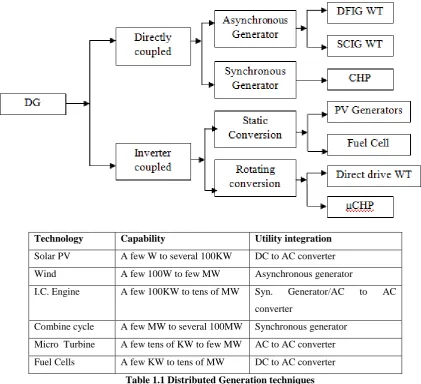
This section presents energy sources drive distributed generators including a table 1.1 listing different
technologies in the distributed generation.
Reciprocating engines.
Combustion turbines.
Micro-turbines.
Wind turbines (Doubly-Fed induction generator, Squirrel cage induction generators)
Fuel Cells.
Photovolatics.
Technology Capability Utility integration
Solar PV A few W to several 100KW DC to AC converter
Wind A few 100W to few MW Asynchronous generator
I.C. Engine A few 100KW to tens of MW Syn. Generator/AC to AC
converter
Combine cycle A few MW to several 100MW Synchronous generator
Micro Turbine A few tens of KW to few MW AC to AC converter
Fuel Cells A few KW to tens of MW DC to AC converter
Table 1.1 Distributed Generation techniques
Implementation of the different DG technologies is covering a wide range of applications according to load
requirements, which is discussed as below:-
Standby: DG can be considered as standby to supply the required power to sensitive load, such as process
industries and hospitals during grid outages.
Stand-alone: Usually isolated areas utilize DGs as a power provider instead of connecting to the grid.
These areas have geographical obstacles, which make is more expensive to be connected to the grid.
Peak load sharing: The electric power cost varies according to the load demand curves and the
corresponding available generation at the same time. Hence, the DGs can be used to supply some loads at
the peak periods.
Rural and remote locations: DG can provide required power by the stand-alone remote applications.
These applications include lighting, heating, cooling, communication and small industrial processes.
Base load: Utility owned DGs are usually used as a based load to provide part the main required power and
support the grid by enhancing the system voltage profile, reducing power losses and improving the system
Three power converters convert the power output of the energy source to interface with standard 50 or 60Hz
systems [4].
Synchronous generator.
Induction generator.
Inverter.
Normally reciprocating engines and combustion turbines interface through synchronous generators.
Micro-turbines and wind Micro-turbines, fuel cells and photovoltaics interface through inverters.
Three factors are considerations for the energy source: the stability of the power source, the ability to follow
change in load and the reliability (availability) of the source. In the reciprocating engines, combustion turbines
and micro-turbines, the burn rate of the fuel-air mixture controls the power output. These combustion based
generation are normally very stable sources. Wind turbines and photovoltaics produce variable output that is
normally not controllable. One of the main concerns of wind turbines on distribution systems is the possibility
of voltage controlling due to pulsating output due to blades of the wind turbines. Sunshine variability also
causes variation to solar panel outputs, but the changes are normally slow enough to limit the flicker problems.
Neither of these methods can follow load. Fuel cells have load-following capability, but it is significantly slower
than combustion generators. Fuel cells and photovoltaics have no natural provision to provide the short-time
overloads. DG capacities are not restrictedly defined as they depend on the user type and the used applications.
Furthermore, the output electric power can be either direct or alternating. Fuel cell (FC), PV and batteries
produce direct current. However, micro turbines, doubly-fed induction generators, squirrel cage induction
generator wind turbines, provide an alternating current.
IV. DG PLACEMENT [5]
In literature, various objective functions have been considered and optimized, subject to different operating
constraints, using conventional methods, intelligent searches and fuzzy set application for the placement of DG.
A detailed study of the literature on DG placement (DGP) is summarized by the objective function model,
mathematical algorithms to solve these objectives.
DG
Micro
(~1W to 5kW)
Medium
(5MW to < 50MW)
Small
(~5kW to < 5MW)
Large
Objective and Constraint Functions In the DGP deals with the optimal allocation of distributed generation for
minimizing the total real power loss in the system using second order method based on Newton Raphson’s
method. The basic formulation is that a sum of all nodal injections of power in a network represents losses, the
impact of DG in power transfer capacity and voltage stability of power network. Thus overall impact is studied
due to active power injection due to distributed generation and minimization of losses. The objective of optimal
allocation of Distributed generation has been taken as maximization of DG capacity for constant load.
The objective is to maximize the amount of energy that can be harvested from DG by making best use of
existing assets and available energy resources. To obtain most appropriate DG location, price variation at each
bus and line loss sensitivity has been utilized in economical and operational criteria. The objective function is to
minimize the fuel cost of conventional and DG sources as well as minimize the line losses of the network. In the
maximum DG capacity has been determined by modelling DG as generators with negative cost coefficients. By
minimizing the cost of these generators, the DG capacity benefits are maximized. In the problem is formulated
with two distinct objective functions namely social welfare maximization and profit maximization.
In this, authors have considered the composite the total load sharing by switching the load to another DG system
with appropriate overloading and with maximum utilization of DGs and optimized to reduce the voltage and
frequency deviation.
4.1 Mathematical Algorithms
Analytical Methods: An analytical method, based on the exact loss formula, is proposed for a single DG
optimal location and sizing. Analytical expressions for finding optimal size and power factor of different types
of DGs are suggested in. An analytical method using a loss sensitivity factor that is based upon the equivalent
current injection is developed in for find optimum size and location of a single DG. Two analytical methods for
determining the optimal location of a fixed size DG is proposed in first method is applicable to radial and the
second is to meshed power systems.
Conventional Optimization methods: An exhaustic search based method is proposed in evaluating DG
placement for optimal power losses and reliability and a multi-objective performance index, taking into account
the time-varying demand of supply. A discrete generation based model is reduced in deterministic model
considering all possible conditions solved by Mixed Integer Non Linear Programming (MNLP) for optimal
allocating either only one wind DG unit or other types of DG units. The optimal DG placement (ODGP) is
formulated as a multi-period of optimal power flow. Optimal DG placement of various technologies considering
electricity market price fluctuations employing MNLP is proposed. An integrated distribution planning model,
containing optimal DG placement as an alternative option, is solved by MNLP. Power electronic devices
interfaced with DG units are considered with an objective of improving the voltage stability margin for the
placement and size of DG units. Dynamic programming based optimal DG placement model is proposed with
maximizes the profit of the distribution network operator considering the nature and requirement of loads.
Intelligent Search based method [6]: The algorithm presented in uses artificial intelligent technique such as
Genetic Algorithm (GA) as a technique to solve the problem of static planning of distribution system expansion
considering possible commissioning of new feeders and distributors, substations. GA is used to solve the
optimal DG placement requirement that considers variable power concentrated models, distributed loads and
maximizes the profit of the Distributed Network operator. A GA methodology is implemented to optimally
allocate the DG units in distribution networks to maximize the worth of local distribution system as well as
customers connected to the system. A value-based approach considering the benefits and costs of DGs is
developed and solved with GA that finds number, type, location and size of DGs. A GA-based method allocates
simultaneously DGs and remote controlled switches for operation of DGs with power system operation in
distribution systems. A hybrid GA and fuzzy logic based programming is proposed for optimal DG
placement. A fuzzy GA is employed to solve a weighted multi-objective optimal DG placement
requirement model. A hybrid GA reduced the programming methodology and maximize the profit of the
distributed network operator. Placing a single DG based on the ranking of the power losses in the network or
energy shutdown in the network lines. Heuristic methods for sizing wind farms based on modes of voltage
stability and frequency deviations are proposed. A heuristic cost-benefit approach for optimal DG placement to
serve peak demands is introduced. A heuristic value-based approach determines the optimum location of a
single DG by minimizing the system reliability cost. So, a heuristic search technique is developed for that
optimizes the objective function and maximizes the potential benefit by optimal DG placement. A heuristic
approach calculates the regions of higher probability for location of DG plants in distribution network. The
ODGP model for small distribution is solved by this method.
V. CLOUD COMPUTING TECHNIQUES [7]
―Cloud‖ computing – a relatively recent term, defines the paths ahead in computer science world. Being built on
decades of research it utilizes all recent achievements in various fields. Cloud Computing has become a scalable
services consumption and delivery platform in the field of Services Computing.. Cloud computing can help
facilitate easier access and distribution of information among the various medical professionals who may come
in contact with each individual patient. The name comes from the use of a cloud-shaped symbol as an
abstraction for the complex infrastructure it contains in system diagrams.
Cloud computing means that instead of all the computer hardware and software you're using sitting on your
desktop, or somewhere inside your company's network, it's provided for you as a service by another company
and accessed over the Internet, usually in a completely seamless way. Exactly where the hardware and software
is located and how it all works doesn't matter to you, the user—it's just somewhere up in the nebulous "cloud"
that the Internet represents. Cloud computing is a buzzword that means different things to different people. For
some, it's just another way of describing IT (information technology) "outsourcing"; others use it to mean any
computing service provided over the Internet or a similar network; and some define it as any bought-in
computer service you use that sits outside your firewall. However we define cloud computing, there's no doubt it
makes most sense when we stop talking about abstract definitions and look at some simple, real examples—so
let's do just that.
Simple examples of cloud computing Most of us use cloud computing all day long without realizing it. When
you sit at your PC and type a query into Google, the computer on your desk isn't playing much part in finding
the answers you need: it's no more than a messenger. The same applies to Web-based email. Once upon a time,
email was something you could only send and receive using a program running on your PC (sometimes called a
Preparing documents over the Net is a newer example of cloud computing. Simply log on to a web-based
service such as Google Documents and you can create a document, spreadsheet, presentation, or whatever you
like using Web-based software. Instead of typing your words into a program like Microsoft Word or
OpenOffice, running on your computer, you're using similar software running on a PC at one of Google's
world-wide data centres. Like an email drafted on Hotmail, the document you produce is stored remotely, on a Web
server, so you can access it from any Internet-connected computer, anywhere in the world, any time you like.
Using a Web-based service like this means you are "contracting out" or "outsourcing" some of your computing
needs to a company such as Google: they pay the cost of developing the software and keeping it up-to-date.
Types of cloud computing IT people talk about three different kinds of cloud computing, where different
services are being provided for you. Note that there's a certain amount of vagueness about how these things are
defined and some overlap between them.
Infrastructure as a Service (IaaS) means you're buying access to raw computing hardware over the Net,
such as servers or storage. Since you buy what you need and pay-as-you-go, this is often referred to as
utility computing.
Software as a Service (SaaS) means you use a complete application running on someone else's system.
Web-based email and Google Documents are perhaps the best-known examples.
Platform as a Service (PaaS) means you develop applications using Web-based tools so they run on
systems software and hardware provided by another company. So, for example, you might develop your
own ecommerce website but have the whole thing, including the shopping cart, checkout, and payment
mechanism running on a merchant's server. Force.com and the Google App Engine are examples of PaaS.
Advantages of Cloud Computing If used properly and to the extent necessary, working with data in the cloud
can vastly benefit all types of businesses:
Cost Efficient Cloud computing is probably the most cost efficient method to use, maintain and upgrade.
Traditional desktop software costs companies a lot in terms of finance. Adding up the licensing fees for
multiple users can prove to be very expensive for the establishment concerned. The cloud, on the other
hand, is available at much cheaper rates and hence, can significantly lower the company’s IT expenses.
Almost Unlimited Storage Storing information in the cloud gives you almost unlimited storage capacity.
Hence, you no more need to worry about running out of storage space or increasing your current storage
space availability.
Backup and Recovery Since all your data is stored in the cloud, backing it up and restoring the same is
relatively much easier than storing the same on a physical device. Furthermore, most cloud service
providers are usually competent enough to handle recovery of information. Hence, this makes the entire
process of backup and recovery much simpler than other traditional methods of data storage.
Automatic Software Integration In the cloud, software integration is usually something that occurs
automatically. This means that you do not need to take additional efforts to customize and integrate your
applications as per your preferences. This aspect usually takes care of itself.
Easy Access to Information Once you register yourself in the cloud, you can access the information
from anywhere, where there is an Internet connection. This convenient feature lets you move beyond time
Quick Deployment Lastly and most importantly, cloud computing gives you the advantage of quick
deployment. Once you opt for this method of functioning, your entire system can be fully functional in a
matter of a few minutes. Of course, the amount of time taken here will depend on the exact kind of
technology that you need for your business.
Disadvantages of Cloud Computing In spite of its many benefits, as mentioned above, cloud computing also
has its disadvantages. Businesses, especially smaller ones, need to be aware of these cons before going in for
this technology.
5.1 The Risks Involved in Cloud Computing
Technical Issues Though it is true that information and data on the cloud can be accessed anytime and
from anywhere at all, there are times when this system can have some serious dysfunction. You should be
aware of the fact that this technology is always prone to outages and other technical issues. Even the best
cloud service providers run into this kind of trouble, in spite of keeping up high standards of maintenance.
Besides, you will need a very good Internet connection to be logged onto the server at all times. You will
invariably be stuck in case of network and connectivity problems.
Security in the Cloud The other major issue while in the cloud is that of security issues. Before adopting
this technology, you should know that you will be surrendering all your company’s sensitive information
to a third-party cloud service provider. This could potentially put your company to great risk. Hence, you
need to make absolutely sure that you choose the most reliable service provider, who will keep your
information totally secure.
Prone to Attack Storing information in the cloud could make your company vulnerable to external hack
attacks and threats. As you are well aware, nothing on the Internet is completely secure and hence, there is
always the lurking possibility of stealth of sensitive data.
Use of Cloud Computing in various Fields [8] Cloud Computing has become a scalable services consumption
and delivery platform in the field of Services Computing. Cloud computing is the use of computing resources
(hardware and software) that are delivered as a service over a network (typically the Internet). Cloud computing
entrusts remote services with a user's data, software and computation. The technical foundations of Cloud
Computing include Service-Oriented Architecture (SOA) and Virtualizations of hardware and software. The
goal of Cloud Computing is to share resources among the cloud service consumers, cloud partners, and cloud
vendors in the cloud value chain. The resource sharing at various levels results in various cloud offerings such
as infrastructure cloud (e.g. hardware, IT infrastructure management), software cloud, application cloud and
business cloud (e.g. business process as a service).
Cloud Computing in Business
Speed up Development in Cloud
Cloud Computing in Medical Fields
Cloud Computing in Education
Marketing Companies
Online Gaming
Online Personal media Store
Online Media playback
Information technology
Finance and Banking
Telecommunication
Security
Data ProtectionVI. PROBLEM FORMULATION & ANALYSIS
The DG planning is basically a non-linear mixed integer optimization problem which finds the optimal DG
placement and sizing that are to be located into the distribution networks subjected to various network operation
constraints, DH operating constraints etc. The objective function may be single or multi-objective in order to
maximize the benefit of DG satisfying various network constraints.
Objectives: The main objective functions that are being considered as:
Minimization of Power losses:
Min
where Pk is the power injection at kth node and n is total no. of buses in the distribution system.
Maximizing the reliability: Network reliability assessment contains two types of indices: load point and
distribution network. Load point factor is calculated at each point of load connection and are used for the
evaluation of distribution system performance. The distribution system factor that can be considered for
reliability evaluation. These indices are System Average Interruption Frequency Index (SAIFI) and System
Average Interruption Duration Index (SAIDI).
SAIDI = Ʃ uk x Nk
_________
SAIFI = Ʃ rk x Nk
_________
Min. W1 (SAIDI)DG /( SAIDI)base + W2 (SAIFI)DG /( SAIFI)base
where Nk is number of consumers at the load point, uk is outage time and rk is the failure time. The smaller the
values of reliability index, the higher is the system reliability.
Maximization of DG capacity:
Max
Maximizing the profit and social welfare: Social welfare is defined as the difference between the total
benefits to consumers minus total cost of production. The objective function for maximizing the social welfare
is as defined:
Max
where, Bk(PDk) is the cost function for buyers of electricity, Ck(PDk) is the cost function of seller (centralized
generating plants) and C(PDGk) is the cost function supplied for DG owner.
The profit maximization formulation is as follows:
Max
where, k is total no. of nodes in the system, P(DGk) is the DG size at the node, λk is locational marginal price and
C(PDGk) is the cost characteristics of DG owner.
Maximizing the voltage stability margin:
Vl = (VP with DG) / (VP base)
Max
where n is total no. of nodes in the distribution system, VP with DG and VP base are voltage profile of system with
DG and without DG. The highest value of voltage index implies the best location of DG in terms of improving
the stability of the system.
Constraints: The main objective constraints in DG placement problem are as under:
Power Flow equality equations:
Pk = PGk – PDk =
Qk = QGk – QDk =
where, n is the total number of nodes in system. Pk and Qk are the real and reactive power injections in the
system at any bus, k. Vk is voltage magnitude of node, k. δk is the phase angle of complex power of node k. θkq
is the angle of the k-qth element and Ykq is k-qth element admittance.
Bus Voltage limitations:
Vkmin ≤ Vk ≤ Vkmax
where min. and maximum limits of voltage of bus at distribution system is maintained.
DG generation limitation:
PDGkmin ≤ PDGk ≤ PDGkmax
QDGkmin ≤ QDGk ≤ QDGkmax
where minimum and maximum limits of DG power are required to be decided for each distribution network.
Feeder power Level:
Sk ≤ Sk
rated
The power carrying capacity of the distribution feeder is represented by MVA limits and it must be well within
the limits and within the maximum thermal capacity of the lines.
Short Circuit power level:
A short circuit calculation is carried out to ensure that fault current with DG should not be increase rated
SCLDG ≤ SCLrated
Design variables: There are three main design variables i.e. D.G. and load variables alongwith the proper
computation of placement:-
DG variables that are generally considered are location, size, type, number of DGs, location is fixed.
Load profile of distribution network feeders as static load and time-varying loads which are considered as
load variables.
DG placement techniques are to be allocated in order to achieve the maximum utilization of feeder strength
and DG capacity using various techniques including the current technique of Cloud Computing.
VII. SOLUTION TECHNIQUES INCLUDING CLOUD COMPUTING
The solution techniques for DG placement have been evolving an number of approaches have been developed,
each with its particular mathematical and computational characteristics. The most of techniques discussed are
classified into three categories:
Analytical methods
Conventional methods
Intelligent search based methods
The conventional analytical methods include Linear Programming (LP), Non-Linear Programming (NLP) like
Newton’s Raphson Method, AC optimal power flow and continuous power flow method. The intelligent
search-based methods include Simulated Annealing (SA), Evolutionary Algorithms (EAs), Particle Swarm
Optimization (PSO), Genetic Algorithm (GA), Hybrid Fuzzy and Genetic Algorithm model approaches with
VIII. CONCLUSION
Thus, the author started from the observed renewed interest in small scale electricity generation. Various DG
Technologies are described and major benefits, issues of DG are discussed.
Small scale generation is commonly called as distributed generation and noted down various aspects. So,
Distributed generation has implications for the control of voltage levels across the network. Various issues and
methodologies have been discussed for the implementation of DG technologies for a potential increase in
generation levels without the need of reinforcement. The objectives, constraints and solution algorithm
alongwith the techniques for the optimal allocation of Distributed Generation (DG) have also been discussed in
this paper. The objectives have been classified as single-objective or multi-objective functions and constraints.
Interesting aspects of conventional and artificial intelligent methods alongwith heuristic optimization techniques
and most importantly Fuzzy set theory to model the uncertainties in objective functions, load, generation,
electricity price and constraints for better solutions using optimal placement, location and operation of
distributed generation using Cloud Computing techniques.
REFERENCES
[1]. T.A. Short, ―Electric Power Distribution Handbook‖, CRC press, page no. 711-712, Edition 2004.
[2]. Barker and De Mello, ―Power Distribution System‖, 2000 CEA 128 D767, 1994, EPRI 1000419, 2000.
[3]. Paresh Ravindra Modha & Hardik Vinodkumar Rupareliya, ―Distributed Generation-Definition,
Benefits, Major Issues & Voltage Profile‖, Journal Electrical India, Edition February, 2011.
[4]. Ritula Thakur & Puneet Chawla, ― Distributed Generation- Scope, major Issues & Voltage profile
improvement, International Journal of Engineering, Technology, Management and Applied Sciences,
Volume 3, Issue 2, February, 2015.
[5]. Dr. S.N. Singh, P. Paavni, ―Optimal Placement techniques for Distributed Generation‖ Journal Electrical
India, Edition February, 2015.
[6]. M. Jegadeesan & V. Keerthana, ―Optimal sizing & placement of Distributed Generation in Radial
distribution feeders using analytical approach‖, International Conference on Innovations in Engineering
& Technology, International Journal of Innovative Research in Science, Engineering & Technology,
Volume 3, Special Issue 2, March, 2014.
[7]. Christopher Barnatt. Constable and Robinson, ―A Brief Guide to Cloud Computing: An Essential
Introduction to the Next Revolution in Computing‖, Edition 2010 and updated by Chris Woodford in
March, 2015.
[8]. Manoj Chopra, Jai Mungi & Kulbhushan Chopra, ― A Survey on Use of Cloud Computing in various
fields‖, International Journal of Science, Engineering and Technology, Research, Volume 2, Issue 2,