1535-9778/05/$08.00⫹0 doi:10.1128/EC.4.6.1102–1115.2005
Copyright © 2005, American Society for Microbiology. All Rights Reserved.
Contribution of Horizontal Gene Transfer to the Evolution
of
Saccharomyces cerevisiae
†
Charles Hall,
1Sophie Brachat,
2and Fred S. Dietrich
1*
Department of Molecular Genetics and Microbiology, Duke University Medical Center, Durham, North Carolina,1and Biozentrum der Universita¨t Basel, CH-4056 Basel, Switzerland2
Received 17 November 2004/Accepted 17 March 2005
The genomes of the hemiascomycetes Saccharomyces cerevisiae and Ashbya gossypii have been completely
sequenced, allowing a comparative analysis of these two genomes, which reveals that a small number of genes appear to have entered these genomes as a result of horizontal gene transfer from bacterial sources. One
potential case of horizontal gene transfer inA. gossypiiand 10 potential cases inS. cerevisiaewere identified,
of which two were investigated further. One gene, encoding the enzyme dihydroorotate dehydrogenase (DHOD), is potentially a case of horizontal gene transfer, as shown by sequencing of this gene from additional bacterial and fungal species to generate sufficient data to construct a well-supported phylogeny. The
DHOD-encoding gene found inS. cerevisiae,URA1(YKL216W), appears to have entered theSaccharomycetaceaeafter
the divergence of theS. cerevisiaelineage from theCandida albicanslineage and possibly since the divergence
from the A. gossypii lineage. This gene appears to have come from the Lactobacillales, and following its
acquisition the endogenous eukaryotic DHOD gene was lost. It was also shown that the bacterially derived
horizontally transferred DHOD is required for anaerobic synthesis of uracil inS. cerevisiae.The other gene
discussed in detail isBDS1, an aryl- and alkyl-sulfatase gene of bacterial origin that we have shown allows
utilization of sulfate from several organic sources. Among the eukaryotes, this gene is found inS. cerevisiaeand
Saccharomyces bayanusand appears to derive from the alpha-proteobacteria.
In eukaryotes, a few examples of horizontal gene transfer have been well documented. Eukaryote-to-eukaryote horizon-tal transfer of mitochondrial genes has been recently reported between parasitic plants and their plant hosts (33). Two exam-ples of interkingdom horizontal transfer from prokaryotes to eukaryotes are also well known: the transfer of genetic infor-mation by Agrobacterium tumefaciens into its plant symbiont (59) and the transfer of genetic information from mitochondria and chloroplasts to the nuclear genome (19). Beyond these two special cases, however, the frequency of transfer of genetic information from bacteria into eukaryotes, though postulated in a number of cases, is still a matter of debate. Prokaryotic genomic sequencing has revealed horizontal gene transfer as an important evolutionary mechanism among these organisms (30, 37). As the number of available sequenced eukaryotic genomes increases, these data can be used to determine the existence and/or frequency of horizontal gene transfer in spe-cific lineages. Several cases of horizontal gene transfer from prokaryotes to microbial eukaryotes have been previously pos-tulated including the 3-hydroxy-3-methylglutaryl–coenzyme A class 2 reductase found in Giardia (6), iron hydrogenase found inNyctotherus(20), and the fungal catalases (see refer-ences 24 and 27 for reviews). A recent report by Dujon et al. (13) suggests that eight genes from Yarrowia lipolytica, five genes fromKluyveromyces lactis, and one gene from Debaryo-myces hanseniiare horizontally transferred. The phylogeny of horizontally transferred genes is characteristically different
from the species phylogeny; these phylogenetic differences can also arise by means other than horizontal gene transfer such as accelerated gene evolution, gene loss, or horizontal transfer from a eukaryote to a prokaryote. Differences can also result from species misassignment of sequences due to DNA con-tamination. Cases of accelerated gene evolution in Saccharo-myces cerevisiae, such as the gene for kinesin (31), and of gene loss (7) have been documented. Thus, to demonstrate that a gene has entered the S. cerevisiae orA. gossypii lineages by horizontal gene transfer, it is necessary to construct an exten-sive gene phylogeny to rule out potential alternative explana-tions such as those listed above.
In order to determine a broader estimate of horizontal gene transfer in a specific eukaryotic lineage, we employed a ge-nome-wide comparative screen to determine the extent of hor-izontal gene transfer in the S. cerevisiaeand A. gossypii lin-eages. This comparison allows us to identify potential cases of horizontal gene transfer since the divergence of these species; we expect these recent transfer events to be more readily identified and more easily experimentally supported than more ancient events.
In addition to being the best-studied eukaryotic model sys-tem, S. cerevisiae is the first eukaryote whose genome was completely sequenced (16). TheS. cerevisiaegenome encodes about 5,570 proteins (56) and is an ideal system in which to try to detect horizontal gene transfer from prokaryotes to eu-karyotes. For comparative purposes a fungal genome sequence separated from S. cerevisiae by an appropriate evolutionary distance is needed. Closely relatedSaccharomycesspecies such as theSaccharomycessensu stricto species (10, 26) contain a very similar gene set to that ofS. cerevisiae, whereas in more distantly related fungi such asNeurospora crassa(15)
homo-* Corresponding author. Mailing address: 289 CARL Building, Box 3568, DUMC, Durham, NC 27710. Phone: (919) 684-2857. Fax: (919) 681-9193. E-mail: [email protected].
† Supplemental material for this article may be found at http://ec .asm.org/.
1102
on September 8, 2020 by guest
http://ec.asm.org/
logues of only around 50% ofS. cerevisiaegenes can be iden-tified. More useful evolutionary distances are represented by the recently publishedA. gossypii(11) andKluyveromyces waltii
(25) genomes, where approximately 95% of the genes have identifiable homologs withS. cerevisiae. Genes horizontally transferred since the divergence of these species withS. cere-visiae are to be found among the remaining 5% of genes lacking homologs between these species. In this work we fo-cused on identifying genes horizontally transferred since the divergence of theS. cerevisiaeandA. gossypiilineages, as we expect more recent transfer events to be more clearly identi-fiable. The work of Gojkovic et al. (17) has previously shown thatURA1(GenPept accession no. P28272) is of bacterial or-igin. We show additional evidence supporting this claim and also that theBDS1(GenPept Q08347) gene ofS.cerevisiaeis of bacterial origin.URA1is the best-supported horizontal gene candidate inS. cerevisiae, andura1⌬cells present an identifi-able phenotype. Previous work by Nara et al. speculated that
URA1might be horizontally transferred (36); asURA1 from
S. cerevisiaewas the only fungal sequence included in their analysis insufficient data were provided to support this specu-lation. Further supporting evidence for a bacterial origin of
URA1has been reported based on sequences from Saccharo-myces kluyveri(17, 58).URA1encodes the 315-amino-acid pro-tein dihydroorotate dehydrogenase (DHOD) (46). This en-zyme catalyzes the conversion of dihydroorotate to orotate, the fourth step of the de novo pyrimidine biosynthetic pathway (22, 35). DHOD enzymes are grouped into families 1a, 1b, and 2. These groupings are based on nucleotide and biochemical characteristics (22). Eukaryotes typically have the family 2 DHOD enzyme. In this work we demonstrate that the family 2 DHOD fromA. gossypiican complement the uracil auxotrophy of aS. cerevisiae ura1⌬; however, it is unable to do so under anaerobic conditions.
BDS1is a 1,941-bp open reading frame located in a subte-lomeric position on chromosome XV. Though previously of unknown function, BDS1 has high sequence identity at the protein level to bacterial alkyl-sulfatases. Sulfatases catalyze hydrolytic cleavage of sulfate ester bonds, liberating sulfate and the corresponding alcohol (41). They are present in a wide variety of species, ranging from bacteria to humans. Sulfatases are involved in a wide range of lineage-specific biological ac-tivities. In mammals, sulfatases are involved in the desulfation of sulfated glycolipids, glycosaminoglycans, and steroids. The aryl-sulfatase genears-1ofN. crassahas been extensively stud-ied (39). InN. crassa aryl-sulfatase is up regulated by sulfur starvation and appears to function as a mechanism for sulfur scavenging. The primary roles of bacterial sulfatases are in assimilation of sulfur and in the provision of carbon (23, 41). Alkyl-sulfatases hydrolyze organic sulfate esters of primary or secondary alkyl alcohols. Most of the work on alkyl-sulfa-tases has been carried out with bacterial species, particularly of the genusPseudomonas. In this work we show that theBDS1
gene ofS. cerevisiaeis a gene of bacterial origin encoding a sulfatase with a broad substrate range, including primary alkyl-sulfates and aryl-alkyl-sulfates. Wild-typeS. cerevisiaecells are ca-pable of utilizing the alkyl-sulfates sodium dodecyl sulfate (SDS) and sodium octyl sulfate as sources of sulfur. A disrup-tion of theBDS1 open reading frame abolishes this activity. The same result was obtained using an aryl-sulfate as a sole
sulfur source. A photometric assay for aryl-sulfatase activity shows thatBDS1is the primary aryl-sulfatase ofS. cerevisiae.
These findings clearly demonstrate that the horizontal trans-fer of a DHOD from a lactic acid bacterial lineage and a sulfatase from␣-proteobacteria contributed to the evolution of theS. cerevisiaelineage. The bacterially derived DHOD facil-itates anaerobic growth ofS. cerevisiae, and the bacterial sul-fatase allows for the utilization of organic sulfur compounds previously not available to the lineage ofS. cerevisiae.
MATERIALS AND METHODS
Identification of potentially horizontally transferred genes.TheS. cerevisiae
protein set (16),A. gossypiiprotein set (11), and a database of all available bacterial protein sequences were compared to each other by tFASTA (40). To determine whetherS. cerevisiaegenes with better alignments to bacterial genes thanA. gossypiigenes were present in other eukaryotes, allS. cerevisiaegenes with better alignments to bacterial genes were compared by BLAST (1) to general and fungal databases as described in Results. BLAST results were eval-uated by comparison of relative E values with a minimal E-value cutoff of⫺10. Strains.Strains used in this analysis wereA. gossypiiATCC 10895,Candida albicansMMRL2010, Candida glabrataCBS138,Enterococcus faecalisATCC 6055, K. lactisCBS6003,Kluyveromyces marxianusNRRL Y-8281,Lactococcus lactissubsp.cremorisNCK436,Lactococcus lactissubsp.hordniaeATCC 29071,
Leuconostoc mesenteroidesLA81,Saccharomyces bayanusCBS424, Saccharomy-ces castelliiY-12630,S. cerevisiaeS288C and BY4741,Saccharomyces kluyverii
CBS3082,Saccharomyces kudriavzeviiIFO1802,Saccharomyces mikataeIFO1815, andSaccharomyces paradoxusCBS2980.
Phylogenetic methods.Accession numbers for all sequences used in this anal-ysis can be found in Table S1 in the supplemental material. Ribosomal small-subunit ribosomal (SSU) DNA sequences used in this analysis were acquired from the European database on small-subunit rRNA (57).
Ribosomal SSU sequences were aligned by primary structure using ClustalX (51). Amino acid sequences for dihydroorotate dehydrogenase (DHOD) and sulfatase proteins were aligned by primary structure using ClustalX. Alignments were manually refined. All alignments used in this analysis have been submitted to TreeBASE (32). Coding DNA sequences of DHOD and sulfatase genes were aligned from protein alignments. Estimates of phylogenetic relatedness among species were determined using neighbor-joining (NJ) (47) analysis of SSU se-quences. NJ trees were constructed in ClustalX using the IUB matrix. NJ trees were bootstrapped in ClustalX using 1,000 replicates.
Estimates of phylogenetic relatedness among DHOD and sulfatase genes were determined using NJ and Bayesian analyses of protein sequences and maximum likelihood (ML) analysis of coding DNA sequences for DHOD genes. NJ trees were constructed in ClustalX using the method of Saitu and Nei (47) and the Gonnet matrix (18). NJ trees were bootstrapped in ClustalX using 1,000 repli-cates.
Bayesian analyses were performed with MRBAYES 3.0 (21). The Whelan– Goldman protein matrix was used as a substitution model (54). Markov-chain Monte Carlo chain length was 1,000,000 generations run with four chains, with every 100th tree saved. The first 1,000 trees were discarded as “burn-in.” The remaining trees were used to construct a majority-rule consensus tree.
ML trees were constructed in PAUP* 4.0b (50). Likelihood settings were estimated using Modeltest (42). A general time reversible model of sequence evolution was used with the gamma distribution with invariants in all cases. Tree searching was performed using 100 random-addition-sequence replicates. ML tree searches for DHOD-coding genes were carried out both unconstrained and with a constraint forcing all fungal sequences to be monophyletic in the resulting trees. To assess the significance of the difference in likelihood between the constrained and unconstrained ML trees, the Shimodaira-Hasegawa test (48) was implemented in PAUP* 4.0b, using 1,000 bootstrap replicates.
Sequencing of DHOD-encoding genes. Total DNA was isolated, and the DHOD-encoding gene was amplified by standard or degenerate PCR using standard methods (34). The amplified DNA was sequenced using ABI dye terminator chemistry on an ABI 310 genetic analyzer using standard methods.
Genetic transformation.A PCR-generated (2, 55) deletion strategy was used to replaceURA1from its start to stop codon with a KanMX module whose expression confers resistance to G418 toS. cerevisiae(53). The deletion “cas-sette” was constructed using PCR. Replacement was conducted by homologous recombination using lithium acetate-mediated transformation by standard meth-ods (2). Successful homologous recombination was confirmed by PCR. We
VOL. 4, 2005 HORIZONTAL GENE TRANSFER IN S. CEREVISIAE 1103
on September 8, 2020 by guest
http://ec.asm.org/
transformedura1⌬strains with anS. cerevisiaeshuttle vector, pRS416 (49), containing DNA from anA. gossypiigenomic library covering the DHOD gene. Transformed cells were plated on medium lacking uracil to confirm the presence ofA. gossypiiDHOD.
A PCR-generated disruption strategy was used to insert a KanMX module into the coding region ofBDS1inS. cerevisiaeby homologous recombination using lithium acetate-mediated transformation. Successful disruption was confirmed by PCR.
Determination thatURA1is required for anaerobic biosynthesis of uracil. Plates of synthetic minimal medium (8), yeast nitrogen base lacking uracil, were plated withS. cerevisiae ura1⌬, S. cerevisiae ura1⌬plusA. gossypiipAG, and the wild type (S288C). Plates were incubated either in atmospheric air or in a Mitsubishi Gas Chemical Company AnaeroPack rectangular jar using ascorbic acid gas generators to catalytically remove oxygen.
Assay for alkyl-sulfatase activity.Cells ofK. lactis,S. kluyveri,C. glabrata,S. bayanus,S. kudriavzevii,S. mikatae,S. paradoxus, andS. cerevisiaewere grown overnight at 30°C in yeast-peptone-dextrose medium. The total cell number for each culture was determined by counting in a hemocytometer, and each culture diluted to 200,000 cells/l. Cells were washed twice and suspended in high-purity water. Five microliters of culture was spotted onto B medium (a sulfur-free minimal medium) (9) plates (20% agarose) supplemented with 0.3 mM SDS. Plates were incubated at 25°C.
To test whether thebds1::KanMXstrain shows a growth defect on SDS media, wild-type and mutant cells were inoculated in a total volume of 300l in five 96-well plates (four experiments per plate) in B medium supplemented with SDS with a concentration range of 0.3 M to 30 nM. Cells were grown with agitation at 30°C for 48 h. Cell growth was determined by measuring the optical density at 600 nm.
To test whether thebds1::KanMXstrain shows a growth defect in octyl sulfate media, wild-type and mutant cells were inoculated in a total volume of 2 ml in B medium supplemented with sodium octyl sulfate with a concentration range of 0.3 M to 30 nM. Cells were grown with agitation at 30°C for 60 h. Cell growth was determined by measuring the optical density at 600 nm.
To verify that the alkyl-sulfate metabolism defect demonstrated by the
bds1::KanMXstrain is linked to the mutation,bds1::KanMXMAT␣cells were mated to strain BY4741 (MATahis3 leu2 met15 ura3). Diploids were sporulated, and 11 tetrads dissected. Spores were replica plated onto yeast-peptone-dextrose plus G418, synthetic defined (SD)-histidine, leucine, methionine, SD-uracil, and B medium plus 0.3 mM SDS.
Assay for aryl-sulfatase activity.To test whetherS. cerevisiaealso possesses an
BDS1-dependent aryl-sulfatase activity, cells were grown using 4-nitrocatechol sulfate as a sole source of sulfur. Wild-type and mutant cells were inoculated in a total volume of 2 ml in B medium supplemented with 4-nitrocatechol sulfate with a concentration range of 0.3 M to 30 nM. Cells were grown with agitation at 30°C for 60 h. Cell growth was determined by measuring the optical density at 600 nm. As we were unable to acquire high purity 4-nitrocatechol sulfate, initial growth experiments produced very high background growth of wild-type and mutant cells (data not shown). In order to limit the background, contaminating sulfur was exhausted biologically. Mutant cells were grown in 2⫻B medium
supplemented with 4-nitrocatechol sulfate for 60 h. The medium was then fil-tered, reinoculated with wild-type or mutant cells, and incubated as described above.
Aryl-sulfatase activity was assayed photometrically as release of 4-nitrocat-echol from 4-nitrocat4-nitrocat-echol sulfate (44). After 60 h of growth, the medium was diluted 1/10 in water and the relative level of 4-nitrocatechol was determined by measuring the optical density at 516 nm.
RESULTS
Identification of horizontal gene transfer candidates. The
tFASTA program (40) was used to compare theS. cerevisiae
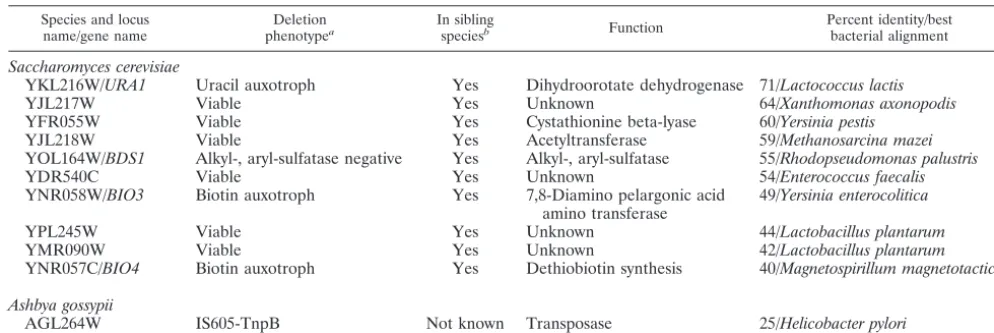
andA. gossypiiprotein sets both to the genomic DNA of each other and also to the complete set of bacterial sequences found in GenBank (3) as of October 2001.S. cerevisiaegenes with homologs in bacteria but notA. gossypiiandA. gossypiigenes with homologs in bacteria but notS. cerevisiaewere identified as putative horizontally transferred genes. The approximately 100 genes that satisfied these criteria were then compared to other available fungal sequences, and genes with homologs in other fungal species were eliminated, as these genes most likely represent cases of gene loss and not horizontal gene transfer. The 10S. cerevisiaegenes and the 1A. gossypiigene identified as potential horizontal gene transfer candidates are shown in Table 1. TheURA1andBDS1genes were selected for further study in the work reported here. These genes were chosen because of their high sequence identity to bacterial genes (Table 1) and their phylogenetic relationships to pro-karyotic and eupro-karyotic homologs, both of which support hor-izontal gene transfer. Both genes present an identifiable phe-notype when mutated, and URA1 was chosen because of previous reports that it might be horizontally transferred.
URA1gene phylogeny is consistent with horizontal transfer
from lactic acid bacteria.TheS. cerevisiae URA1gene appears
to be much more similar to bacterial homologs than to any gene present in theA. gossypiigenome. Further examination of available sequence data confirmed that theURA1gene has an unexpected phylogeny. The topology of the DHOD eny appears to be quite similar to the ribosomal DNA phylog-eny with the exception of S. cerevisiae and related species. Horizontal gene transfer into the S. cerevisiae lineage could
TABLE 1. Gene candidates for horizontal transfer inS. cerevisiaeandA. gossypii
Species and locus name/gene name
Deletion phenotypea
In sibling
speciesb Function
Percent identity/best bacterial alignment
Saccharomyces cerevisiae
YKL216W/URA1 Uracil auxotroph Yes Dihydroorotate dehydrogenase 71/Lactococcus lactis
YJL217W Viable Yes Unknown 64/Xanthomonas axonopodis
YFR055W Viable Yes Cystathionine beta-lyase 60/Yersinia pestis
YJL218W Viable Yes Acetyltransferase 59/Methanosarcina mazei
YOL164W/BDS1 Alkyl-, aryl-sulfatase negative Yes Alkyl-, aryl-sulfatase 55/Rhodopseudomonas palustris
YDR540C Viable Yes Unknown 54/Enterococcus faecalis
YNR058W/BIO3 Biotin auxotroph Yes 7,8-Diamino pelargonic acid amino transferase
49/Yersinia enterocolitica
YPL245W Viable Yes Unknown 44/Lactobacillus plantarum
YMR090W Viable Yes Unknown 42/Lactobacillus plantarum
YNR057C/BIO4 Biotin auxotroph Yes Dethiobiotin synthesis 40/Magnetospirillum magnetotacticum
Ashbya gossypii
AGL264W IS605-TnpB Not known Transposase 25/Helicobacter pylori
a
Results of open reading frame deletion by theSaccharomycesGenome Deletion Project (55). b
Saccharomycessensu stricto species (10, 26) except where indicated.
on September 8, 2020 by guest
http://ec.asm.org/
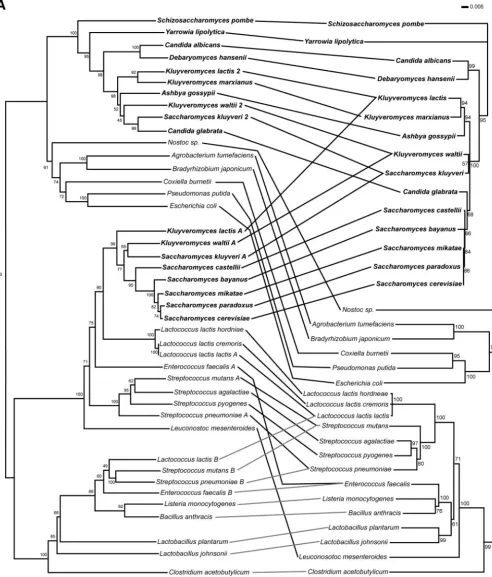
FIG. 1. The phylogeny of dihydroorotate dehydrogenase supports horizontal gene transfer from bacteria to fungi. (A) Phylogenetic tree constructed from the DHOD amino acid sequence (on left) shows a topology generally similar to a tree constructed from small-subunit (SSU) rRNA (on right). The main exception is that the DHOD (URA1) gene of members of theSaccharomycetaceaeclusters with the DHOD sequences fromLactobacillales. Fungal species are shown in bold. Lines connect taxa between trees. On the DHOD phylogeny, 2 indicates type 2 DHOD,
Aindicates type 1a DHOD, andBindicates type 1b DHOD.K. lactis,K. waltii, andS. kluyverihave both a bacterially derived family 1a and a eukaryotic family 2 DHOD. A complete genome sequence ofK. marxianusis not yet available, and thus it is possible this species may have a type 1a DHOD as well. Type 1a DHOD genes are shown fromL. lactissubsp.hordniae,L. lactissubsp.cremoris, andL. mesenteroides; no attempt was
VOL. 4, 2005 HORIZONTAL GENE TRANSFER IN S. CEREVISIAE 1105
on September 8, 2020 by guest
http://ec.asm.org/
explain these results, though other explanations are also fea-sible, such as sequence contamination or species misassign-ment, selective evolutionary rates, gene loss, or horizontal transfer from fungi to bacteria. To rule these out, the DHOD gene was sequenced fromE. faecalis(GenPept AAP04498), L.
mesenteroides (GenPept AAQ01774), L. lactis subsp. cremoris
(GenPept AAQ01776), andL. lactissubsp.hordniae(GenPept AAQ01775). In order to rule out possible species misassign-ment or sequence contamination, we resequenced the DHOD gene based on several publicly available sequences, including
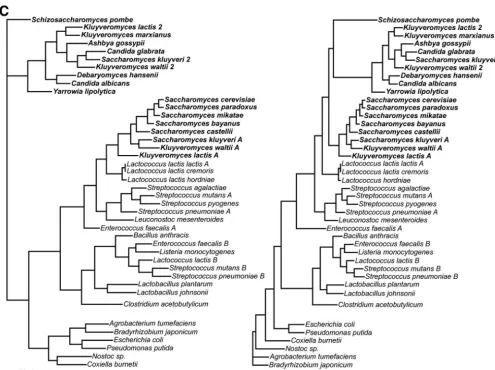
made to identify type 1b DHOD genes in these species. Based on complete genome sequences,B. anthracis,L. plantarum, andL. johnsoniigenomes carry type 1b but not type 1a DHOD genes andS. agalactiaeandS. pyogenescarry type 1a but not type 1b DHOD genes. Both trees constructed with neighbor joining (47) in ClustalX (51). Numbers indicate bootstrap support for nodes from 1,000 NJ bootstrap replicates. Scale bar, changes per amino acid or nucleotide. (B) Bayesian tree phylogeny of dihydroorotate dehydrogenase (DHOD) proteins. Majority-rule consensus tree of 9,000 Bayesian trees. Numbers above branches represent the posterior probability of each clade. Tree searching done with MrBayes3 (45). Consensus trees and posterior probabilities were determined in PAUP* 4.0b (50). Fungal species are shown in bold. (C) Maximum likelihood phylogenetic analyses of dihydroorotate dehydrogenase (DHOD) coding regions. Trees were constructed in PAUP* 4.0b (50). Likelihood settings were estimated from a previously generated NJ tree. A general time-reversible model of sequence evolution was used with the gamma distribution with invariants. ML tree searches were carried out both unconstrained and with a constraint forcing all fungal sequences to be monophyletic in the resulting trees. To assess the significance of the difference in likelihood between the constrained and unconstrained ML trees, the Shimodaira-Hasegawa (SH) test (48) was implemented in PAUP* 4.0b. Tree scores (⫺lnL) are 29,424.7 for the unconstrained tree, and 29,646.8 for the constrained tree, giving a⌬Lof 194 and aPvalue of⬍0.0001 for the SH test. Fungal species are shown in bold.
on September 8, 2020 by guest
http://ec.asm.org/
those fromC. albicans(GenPept AAP39962), S. bayanus (Gen-Pept AAQ01777), S. castellii(GenPept AAQ57200), S. kluyveri
(GenPept AAQ01779 [URA1], GenPept AAQ57201 [URA9]), S. mikatae(GenPept AAQ01778), andS. paradoxus(GenPept AAQ01780), confirming their sequence and including them in this analysis. Partial sequences from C. glabrata (GenPept AAR17523), K. lactis(GenPept AAR1773), andK. marxianus
(GenPept AAQ017522) were sequenced for the full length of the gene and included in the analysis. A phylogeny was then constructed on this expanded set of DHOD genes by NJ (47), Bayesian (21), and ML methods (14) (Fig. 1). Trees con-structed by all three methods showed a similar topology. By all three methods theS. cerevisiaetype 1a DHOD sequence and those of closely related fungal species are a branch within a larger type 1a DHOD tree consisting of bacterial sequences. Closely related Saccharomyces species including S. bayanus,
S. paradoxus, and S. castelliihave the type 1a gene, whereas
K. marxianusandC. glabratahave the type 2 enzyme andK. lactis,K. waltii, andS. kluyverihave both family 1- and family 2-type enzymes. This more complete data support the horizon-tal transfer hypothesis. Using a constraint of eukaryotic mono-phyly, the constrained ML search results in a tree that is less likely than that resulting from an unconstrained ML search
(Fig. 1C). To assess the significance of the difference in like-lihood between the constrained and unconstrained ML trees, the Shimodaira-Hasegawa likelihood ratio test (SH) was per-formed as implemented in PAUP* 4.0b. The SH test rejected the constrained topology with aPvalue⬍0.0001.
Analysis of gene order.The presence of two DHOD genes in
K. lactis,K. waltii, andS. kluyverisupports the argument that
URA1is horizontally transferred and suggests that an ancestor of S. cerevisiaehad both DHOD genes. It is likely that the family 2 DHOD was lost at some time after the divergence ofC. glabrataandS. cerevisiae. An alignment of the family 2 DHOD regions ofA. gossypii, S. kluyveri, andS. cerevisiaeand the family 1a regions inS. kluyveriandS. cerevisiaeis shown in Fig. 2. InA. gossypiiandS. kluyverithe family 2 DHOD and its flanking genes show a conserved gene order. Local synteny is also preserved inS. cerevisiae, except this region is lacking the family 2 DHOD. No evidence or residual trace of the ancestral type 2 DHOD gene could be identified at this location, nor could it be found elsewhere in the genome. TheURA1gene is at a different position in the genome. This is consistent with loss of the family 2 DHOD from the lineage ofS. cerevisiae.
It is interesting that theURA1gene inS. cerevisiaeis located near the chromosome XI telomere. Recent work (10, 26) has
FIG. 1—Continued.
VOL. 4, 2005 HORIZONTAL GENE TRANSFER IN S. CEREVISIAE 1107
on September 8, 2020 by guest
http://ec.asm.org/
shown that among the Saccharomyces sensu stricto species most of the genes that differ between species are located near telomeres. This location of theS. cerevisiae URA1gene may thus be a reflection of its recent acquisition. Of the 10 S. cerevisiaegenes proposed to have been acquired by horizontal gene transfer, all except YMR090W are located near telo-meres.
Growth in anaerobic conditions.As the horizontally
trans-ferredURA1gene replicated a function already present in the host organism, the family 1a enzyme probably provided some selective advantage to become fixed in the population. Based upon the biochemical characteristics of family 1a and family 2
enzymes (family 1a enzymes do not require oxygen as an elec-tron acceptor as is the case with family 2 [22]), we hypothesized that possession of a family 1a-type enzyme may facilitate growth in anaerobic environments. In order to test this hypoth-esis, aura1⌬S. cerevisiaestrain was constructed by disrupting
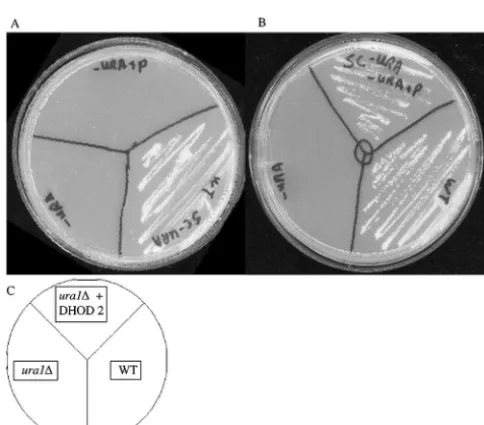
URA1by homologous recombination (2). This strain was trans-formed with a plasmid containing a genomic fragment fromA. gossypiiincluding the DHOD gene. This strain was grown in parallel anaerobic and aerobic conditions; the results are shown in Fig. 3. TheA. gossypii DHOD gene fully comple-ments the uracil auxotrophy of theS. cerevisiae ura1⌬strain. TheA. gossypiiDHOD gene was however unable to comple-ment the uracil auxotrophy under anaerobic conditions. This is consistent with horizontal transfer of a bacterial family 1a-type DHOD gene into theS. cerevisiaelineage. It is possible that such a transfer facilitated the exploitation of anaerobic envi-ronments. Similar experiments carried out by Gojkovic et al. and Zameitat et al. using the family 1a and 2 DHOD enzymes fromS. kluyveri(17, 58) showed similar results indicating that the failure of theA. gossypiifamily 2 DHOD to complement under anaerobic conditions is not species specific.A. gossypiiis unable to grow under anaerobic conditions even when supple-mented with uracil (data not shown), indicating that while the type 1a DHOD gene is necessary for anaerobic growth in the absence of uracil it is only one of a number of modifications necessary for anaerobic growth. The majority of fungal species are restricted to aerobic growth (52), and the acquisition of the bacterially derived URA1 gene could have been one of the adaptations necessary for anaerobic growth.
The BDS1 gene phylogeny is consistent with horizontal
transfer from␣-proteobacteria.TheS. cerevisiaeBDS1 protein
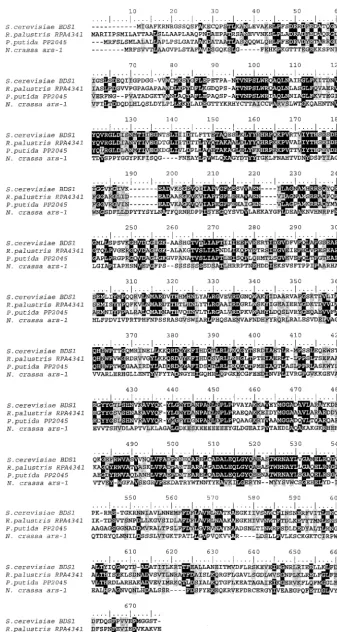
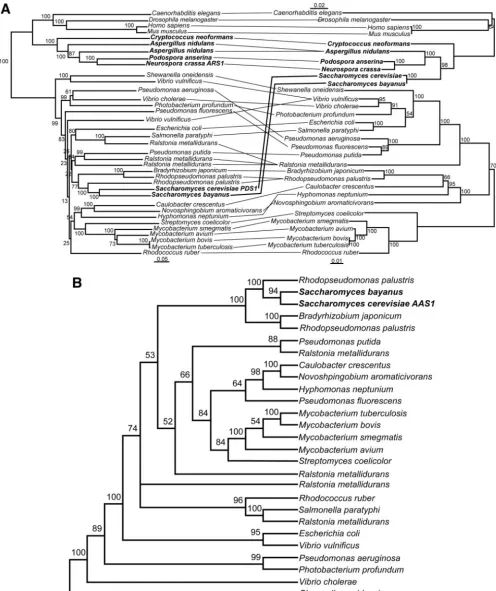
has higher sequence identity to a family of bacterial sulfatases than to any genes found in eukaryotes. Further examination of available sequence data confirmed that BDS1 is a member of a family of bacterial alkyl-sulfatase (Fig. 4). A sulfatase phy-logeny was constructed including bacterial and eukaryotic alkyl- and aryl-sulfatase genes by NJ and Bayesian methods (Fig. 5). Trees constructed by all methods showed a similar topology. By both methods theS. cerevisiae BDS1 sequence
FIG. 2. Synteny identifies the location from which the family 2 DHOD gene was lost in theSaccharomyces cerevisiaelineage. (A) Synteny is conserved in the region of the family 2 DHOD inA. gossypiiandS. kluyveri. DHOD genes are shown as solid arrows; adjacent genes are shown with dashed arrows. Vertical bars indicate homologues. InS. cerevisiaethe region containing the family 2 DHOD is conserved, though the DHOD gene is not present, as indicated by the dashed line. This is consistent with a deletion of the family 2 DHOD in the lineage leading toS. cerevisiae. (B) Synteny in the region of the family 1a DHOD genes, indicated by hollow arrows, is not conserved betweenS. kluyveriandS. cerevisiae, possibly due to genomic rearrangements since the divergence of these two species.
FIG. 3. TheAshbya gossypiitype 2 DHOD gene is unable to fully complement aSaccharomyces cerevisiae ura1⌬strain under anaerobic conditions. Plasmid pAG containing theA. gossypiiDHOD gene fails to complementS. cerevisiae ura1⌬under anaerobic conditions (A) but complements under aerobic conditions (B). (C) Arrangement of strains on plates; all plates contained synthetic complete medium with-out uracil (8).
on September 8, 2020 by guest
http://ec.asm.org/
FIG. 4. Alignment of BDS1 ofS. cerevisiaeandS. bayanuswith sulfatases fromRhodopseudomonas palustris,Pseudomonas putida, and thears-1
gene productof N. crassa. For all species, the full length of the protein is shown.
VOL. 4, 2005 HORIZONTAL GENE TRANSFER IN S. CEREVISIAE 1109
on September 8, 2020 by guest
http://ec.asm.org/
FIG. 5. A phylogeny of bacterial and eukaryotic sulfatases supports horizontal gene transfer from bacteria to fungi. (A) Phylogenetic tree constructed from alkyl- and aryl-sulfatase amino acid sequences (on left) shows a topology generally similar to a tree constructed from small-subunit (SSU) rRNA (on right). TheBDS1genes ofS. cerevisiaeandS. bayanusare members of a family of bacterial sulfatase genes and not closely related to the aryl-sulfatase genes of eukaryotes. Fungal species are shown in bold. Lines connect taxa between trees. Both trees constructed with neighbor joining (47) in ClustalX (51). Numbers indicate bootstrap support for nodes from 1,000 NJ bootstrap replicates. Scale bar, changes per amino acid or nucleotide. (B) Bayesian tree phylogeny of sulfatase proteins. Majority-rule consensus tree of 9,000 Bayesian trees. Numbers above branches represent the posterior probability of each clade. Tree searching done with MrBayes3 (45). Consensus trees and posterior probabilities were determined in PAUP* 4.0b (50). Fungal species are shown in bold.
1110
on September 8, 2020 by guest
and that ofS. bayanus are a branch within a larger tree con-sisting of bacterial alkyl-sulfatase gene sequences. TheS. cere-visiae BDS1gene does not appear to share homology with the
ars-1 gene of N. crassa nor to any other known eukaryotic aryl-sulfatase gene.
BDS1 is an alkyl-sulfatase.Alkyl-sulfatases similar to BDS1,
particularly fromPseudomonas spp., are capable of cleaving SDS. The products of this reaction are dodecanol and sulfate. The genomes of theA. gossypii,D. hansenii,K. lactis,K. waltii,
S. kluyveri, C. albicans,C. glabrata,S. bayanus,S. mikatae,S.
paradoxus, and Y. lipolytica have been sequenced and were examined for the presence of aBDS1homolog. Of these, only
S. bayanushas aBDS1gene homologous to that ofS. cerevisiae.
K. lactis, S. kluyveri, C. glabrata, S. bayanus, S. kudriavzevii, S. mi-katae, S. paradoxus, andS. cerevisiaewere plated on sulfur-free minimal medium supplemented with 0.3 mM SDS. OnlyS. cer-evisiae and S. bayanus grew vigorously, strongly indicating alkyl-sulfatase activity (Fig. 6). All species grew well on sulfur-free minimal medium supplemented with 0.3 mM ammonium sulfate (data not shown). AsBDS1is the only gene in theS. cerevisiaegenome with significant homology to alkyl-sulfatase genes, we hypothesized thatBDS1is the gene responsible for the observed alkyl-sulfatase activity. In order to test this hy-pothesis, abds1 S. cerevisiaestrain was constructed by inserting a G418 resistance marker into theBDS1open reading frame by homologous recombination (2).
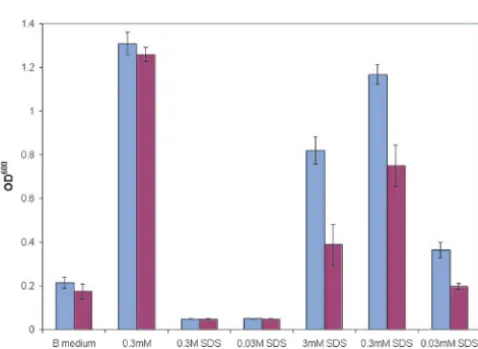
Mutantbds1::KanMXcells and the wild type were grown in liquid B medium supplemented with SDS (Fig. 7). Wild-typeS. cerevisiae grows significantly better than the bds1::KanMX
strain. The same result was achieved with growth on octyl sulfate (Fig. 8), indicating a substrate range of compounds with 8 to 12 carbon atoms, with higher activity for 8-carbon com-pounds.
To verify that the alkyl-sulfate metabolism defect demon-strated by thebds1::KanMX strain is linked to the mutation,
bds1::KanMXMAT␣cells were mated to strain BY4741. In the progeny resulting from this cross, loss of the ability to metab-olize SDS cosegregated with the marked deletion (Fig. 9).
BDS1 is an aryl-sulfatase. In 1974 J. Reiss observed
aryl-sulfatase activity inS. cerevisiaecells by cytochemical methods (43).S. cerevisiae has no gene in its genome with significant homology to known eukaryotic aryl-sulfatase genes. We hy-pothesized that BDS1 may be a dual-function enzyme with alkyl- and aryl-sulfatase activity encoded by the gene respon-sible for the aryl-sulfatase activity reported by Reiss. Cells were grown using 4-nitrocatechol sulfate as a sole source of sulfur to
FIG. 6.S. cerevisiaeandS. bayanuspossess alkyl-sulfatase activity Cells ofK. lactis,S. kluyveri,C. glabrata,S. bayanus,S. kudriavzevii,
S. mikatae, andS. paradoxusplated on sulfur-free medium supple-mented with 0.3 mM SDS. OnlyS. cerevisiae and S. bayanusgrew vigorously, strongly indicating alkyl-sulfatase activity. Trees show evo-lutionary relationships between species (29).
FIG. 7. Growth on SDS. Mutantbds1::KanMXcells (red bars) and the wild type (blue bars) were grown in liquid B medium supplemented with SDS. Columns represent averages of 21 measurements. Experi-mental condition is plotted versus optical density at 600 nm (OD600).
B medium, unsupplemented B medium (9). Error bars represent one standard deviation. B medium unsupplemented is sulfur-free medium with no added sulfur (negative control). The positive control is 0.3 mM ammonium sulfate.
FIG. 8. Growth on octyl sulfate. Mutantbds1::KanMX cells (red bars) and the wild type (blue bars) were grown in liquid B medium supplemented with octyl sulfate. Experimental condition is plotted versus optical density at 600 nm (OD600). B medium unsupplemented
is sulfur-free medium with no added sulfur (negative control). The positive control is 0.3 mM ammonium sulfate.
VOL. 4, 2005 HORIZONTAL GENE TRANSFER IN S. CEREVISIAE 1111
on September 8, 2020 by guest
http://ec.asm.org/
test this possibility. Wild-type and mutant cells were inoculated in a total volume of 2 ml in B medium supplemented with 4-nitrocatechol sulfate. Cell growth was determined by mea-suring the optical density at 600 nm. As shown in Fig. 10, wild-typeS. cerevisiaecells grow more vigorously with the aryl-sulfate 4-nitorcatechol aryl-sulfate as a sulfur source than do mu-tant cells. Aryl-sulfatase activity was also assayed photometri-cally for release of 4-nitrocatechol from 4-nitrocatechol sulfate (Fig. 11). The supernatant of wild-type cells contains over 10 times the level of 4-nitrocatechol than that of mutant cells or controls, indicating that mutant cells lacking functionalBDS1
are negative for aryl-sulfatase activity.
DISCUSSION
Recent horizontally transferred genes appear to be quite rare in S. cerevisiae, with 10 cases proposed here, less than 0.2% of the gene set of this species. Comparison ofA. gossypii
andS. cerevisiaerevealed nearly complete conservation of their gene sets, with most genes found in only one of these species appearing to result from gene loss.
In this study, we found phylogeny, synteny, and high se-quence identity across entire proteins useful in assessing wheth-er a gene is potentially found inS. cerevisiaeas a result of
hor-FIG. 9. Tetrad analysis. To verify that the alkyl-sulfate metabolism defect demonstrated by thebds1::KanMXstrain is linked to the mu-tation,bds1::KanMXMAT␣cells were mated to strain BY4741. The progeny resulting from this cross were plated on B medium (9) sup-plemented with 0.3 mM SDS. Two progeny from each tetrad were
FIG. 10. Growth on the aryl-sulfate 4-nitrocatechol sulfate. Mutant
bds1::KanMXcells (red bars) and the wild type (blue bars) were grown in liquid B medium supplemented with 4-nitrocatechol sulfate. Exper-imental condition is plotted versus optical density at 600 nm (OD600).
B medium unsupplemented is sulfur free-medium with no added sulfur (negative control). The positive control is 0.3 mM ammonium sulfate.
unable to grow in medium lacking methionine and representmet15
cells. These cells were also unable to grow on medium supplemented with SDS. G418-sensitiveBDS1cells grow more vigorously on SDS as a sulfur source. Tetrads are shown horizontally. (A) B medium sup-plemented with 0.3 mM SDS. All tetrads show two growth:two non-growth, identical to results with synthetic complete medium without methionine (panel B). Seven tetrads (tetrads 3, 4, 5, 6, 8, 10, and 11) show one vigorous:one weak growth, dependent onBDS1. (B) Syn-thetic complete medium without methionine. All tetrads (except tetrad 9—possible recombination event) show 2:2 segregation of vigorous growth, independent ofBDS1. (C) Yeast-peptone-dextrose medium with G418. All tetrads show 2:2 segregation of knockout.
on September 8, 2020 by guest
http://ec.asm.org/
izontal gene transfer. While in bacterial cases it has been reported that GC content is a useful indicator of horizontally transferred genes (38), we have found this not to be the case in
S. cerevisiae. For all 10 of the genes potentially of bacterial origin reported here, the GC content falls within 2 standard deviations of the mean (see Fig. S1 in the supplemental ma-terial). This is as expected, as the GC content of the hemi-ascomycetes differs significantly from species to species. For
S. cerevisiaethe GC content is 38%, whereas forA.gossypiiit is 52% (11). Thus the GC content of genes in these fungi ap-pears to be malleable, and genes acquired by horizontal gene transfer would be expected to rapidly come under the influence of the factors causing these overall shifts in GC content.
Horizontal gene transfer provides a mechanism for genomic
innovation and plasticity.In bacteria, horizontal gene transfer
is well known as an adaptive mechanism. Horizontal transfer events can be classified into three distinct categories: acquisi-tion of new genes, acquisiacquisi-tion of paralogs of existing genes, and gene displacement whereby a gene is displaced by a horizon-tally transferred ortholog from another lineage (28). All three categories appear to be present in the genome ofS. cerevisiae.
BDS1 is a member of a class of bacterial sulfatase genes. Among currently sequenced species,S. cerevisiaeandS. baya-nusare the only eukaryotic organisms with a gene of this class. Therefore, horizontal transfer is clearly a mechanism for the acquisition of new genes in eukaryotes. Three hemiascomycete yeasts,K. lactis,K. waltii, andS. kluyveri, possess a family 2 DHOD optimized for aerobic conditions and a horizontally transferred family 1a DHOD optimized for anaerobic condi-tions. In these organisms horizontal transfer has functioned as a mechanism for acquisition of paralogs with novel functions.
S. bayanus,S. castellii,S. cerevisiae, andS. paradoxusall possess only a horizontally transferred family 1a DHOD. These species present a clear case of gene displacement as they have lost the eukaryotic family 2 DHOD of their ancestors and kept the bacterially derived family 1a DHOD. BDS1 also presents a
variation of gene displacement. Thears-1gene ofN. crassais a good example of the class of experimentally characterized aryl-sulfatase genes found in many fungi and animals, though not theSaccharomycetacea (12) or the “Saccharomyces com-plex” (29), which appears to have lost this eukaryotic aryl-sulfatase gene. Some species of hemiascomycetes, including
C. albicans, D. hansenii, K. lactis, and Y. lipolytica, contain genes of a family related toars-1. These sulfatase-like genes are of unknown function, however, and appear to be distantly related to the eukaryotic aryl-sulfatase genes (see Fig. S2 in the supplemental material). This sulfatase-like gene was also lost in theS. cerevisiaelineage after the divergence of theK. lactis
andS. cerevisiaelineages. Neither the eukaryotic aryl-sulfatase gene nor the sulfatase-like gene appears in the genome of
A. gossypii,C. glabrata, K. waltii, S. castellii, S. kluyveri, or any of theSaccharomycessensu stricto species. Thears-1-encoded aryl-sulfatase ofN. crassa is up-regulated by sulfur starvation and appears to function as a mechanism for sulfur scavenging (39).BDS1shows higher expression in sulfur-limited chemo-stat cultures (4). It is possible that the acquisition ofBDS1was beneficial in that it restored aryl-sulfatase activity or was ben-eficial in that it provided the novel (for a eukaryote) activity of an alkyl-sulfatase. As is well known, horizontal gene transfer appears to be a mechanism for the acquisition of novel traits. Interestingly, however, horizontal transfer also appears to be a mechanism of genomic plasticity, allowing lineages to reac-quire traits and capabilities lost by their ancestors. Curiously, assuming that the established phylogeny of theSaccharomyces
sensu stricto is correct, asBDS1 is found inS. cerevisiaeand
S. bayanusbut does not appear inS. paradoxusandS. mikatae, it seems likely that this gene was lost in these species.
Horizontal gene transfer can facilitate the adaptation of an
organism to a particular niche.While inS. cerevisiaethe
hor-izontally transferred genes identified in this study make up 0.2% of the genome, horizontally transferred genes can help us understand the life-style of a particular organism. To become fixed in the population of a species, a horizontally transferred gene most likely provided a selective benefit. This selective benefit requires a selective pressure. In the case ofURA1, the transfer of a DHOD gene optimized for anaerobic condi-tions indicates that adaptation to anaerobic condicondi-tions and anaerobic environments has been an important part of the evolution of hemiascomycete yeasts. In the case ofBDS1, the transfer of a multifunction sulfatase gene means that these species can inhabit a niche where organic sulfur is predomi-nant. The prokaryotic donor can also provide information about the environment in which a particular organism lives (or lived). The family 1a DHOD was transferred from a Lactococ-cusspecies. Lactococci are found on plant and animal surfaces and in the animal gastrointestinal tract.L. lactisis thought to be dormant on plant surfaces and to multiply in the gastroin-testinal tract of ruminants (5). Though S. cerevisiae shares plant environments withL. lactis,URA1is a gene optimized for anaerobic conditions and this strongly indicates that adapta-tion to survival in the gastrointestinal tracts of animals has been important in the evolution of some hemiascomycete yeasts. This conclusion is supported by the observation that of the 10 candidate genes listed in Table 1, 7 appear to have come from anaerobic prokaryotes that either permanently or tran-siently inhabit animal gastrointestinal tracts (URA1,L. lactis;
FIG. 11. Photometric assay for aryl-sulfatase activity with mutant
bds1::KanMX cells (white bars) and the wild type (red bars). Aryl-sulfatase activity was assayed photometrically as release of 4-nitrocat-echol from 4-nitrocat4-nitrocat-echol sulfate. Optical density at 516 nm (OD516)
is plotted on theyaxis. Blue bars represent B medium supplemented with 4-nitrocatechol sulfate with no cells.
VOL. 4, 2005 HORIZONTAL GENE TRANSFER IN S. CEREVISIAE 1113
on September 8, 2020 by guest
http://ec.asm.org/
YFR055W,Yersinia pestis; YJL218W,Methanosarcina mazei; YDR540C, E. faecalis; BIO3, Yersinia enterocolitica; YPL245W,Lactobacillus plantarum; YMR090W,Lactobacillus plantarum). BDS1 appears to have been transferred from
␣-proteobacteria of the family Bradyrhizobiaceae. These bac-teria are primarily found in soils.Rhodopseudomonas palustris
is commonly found in soils and water. A sulfatase transferred from a soil-dwelling bacterium suggests that survival in the harsh soil environment has also been an important evolution-ary pressure in the recent evolution ofSaccharomycesspp.(the likely donor lineage of BIO4, Magnetospirillum sp., is also a soil- and water-dwelling␣-proteobacterium).
Mechanism of DNA transfer.Horizontal gene transfer
re-quires that foreign DNA enter a cell. Bacterium-to-fungus conjugation and natural transformation are possible explana-tions for how DNA from a lactic acid bacterium could be taken up by aSaccharomyces-like yeast. Cell-to-cell conjugation re-quires that bacterial and yeast cells physically interact with each other such that cellular components such as DNA may be transferred from the donor to the new host. Heinemann and Sprague showed that conjugative plasmids ofEscherichia coli
could mobilize DNA transmission to S. cerevisiae (19a). Though neitherE. colinor other members of its lineage is the donor of the 1a-type DHOD gene found inS. cerevisiae, it is possible that DNA can be transferred from lactic acid bacteria to fungi by a similar mechanism. TwoS. cerevisiaehorizontal gene transfer candidates, YFR055W and YNR058W/BIO3
(Table 1), appear to be transferred from enteric bacteria re-lated toE. coli.
Natural transformation, the uptake of free DNA from the surrounding environment, has been found among some pro-karyotic lineages, where it often facilitates horizontal gene transfer (12a). While no dedicated DNA uptake mechanism has been discovered in S. cerevisiae, it has been shown by Nevoigt et al. thatS. cerevisiaecells incubated in 1 M sucrose with plasmid DNA at a minimum concentration of 25g/ml can become transformation competent (36a). Also the well-known methods for yeast transformation using polyethylene glycol and anions, as well as electrical damage or mechanical damage, are conditions conceivable in environments encoun-tered by S. cerevisiae under nonlaboratory conditions. Thus, there are mechanisms by which the ancestor of S. cerevisiae
could have taken up foreign DNA. It is not known why such apparently foreign DNA is often seen near telomeres, though it is tempting to speculate that telomerase might have a role in this by adding telomeric sequence to the foreign DNA and thus providing a site for homologous recombination with a chromo-somal telomere.
Further work will be required to either confirm or disprove that the other nine genes listed in Table 1 are present in these fungal lineages as the result of horizontal gene transfer.
ACKNOWLEDGMENTS
We thank Peter Philippsen; his efforts in the development of theA. gossypiisystem made this work possible. We also thank Jason Stajich and Mark DeLong for assistance in the genome comparisons and for advice on the manuscript. We also thank John McCusker and Joe Heitman for helpful discussions and use of equipment.
REFERENCES
1.Altschul, S. F., T. L. Madden, A. A. Schaffer, J. Zhang, Z. Zhang, W. Miller, and D. J. Lipman.1997. Gapped BLAST and PSI-BLAST: a new generation of protein database search programs. Nucleic Acids Res.25:3389–3402. 2.Baudin, A., O. Ozier-Kalogeropoulos, A. Denouel, F. Lacroute, and C.
Cul-lin.1993. A simple and efficient method for direct gene deletion in Saccha-romyces cerevisiae. Nucleic Acids Res.21:3329–3330.
3.Benson, D. A., M. S. Boguski, D. J. Lipman, and J. Ostell.1997. GenBank. Nucleic Acids Res.25:1–6.
4.Boer, V. M., J. H. de Winde, J. T. Pronk, and M. D. Piper.2003. The genome-wide transcriptional responses ofSaccharomyces cerevisiaegrown on glucose in aerobic chemostat cultures limited for carbon, nitrogen, phospho-rus, or sulfur. J. Biol. Chem.278:3265–3274.
5.Bolotin, A., P. Wincker, S. Mauger, O. Jaillon, K. Malarme, J. Weissenbach, S. D. Ehrlich, and A. Sorokin.2001. The complete genome sequence of the lactic acid bacteriumLactococcus lactis ssp. lactisIL1403. Genome Res.11: 731–753.
6.Boucher, Y., and W. F. Doolittle.2000. The role of lateral gene transfer in the evolution of isoprenoid biosynthesis pathways. Mol Microbiol.37:703–716. 7.Braun, E. L., A. L. Halpern, M. A. Nelson, and D. O. Natvig.2000.
Large-scale comparison of fungal sequence information: mechanisms of innovation inNeurospora crassaand gene loss inSaccharomyces cerevisiae. Genome Res. 10:416–430.
8.Burke, D. T., D. Dawson, and T. Stearns.2000. Methods in yeast genetics: a Cold Spring Harbor Laboratory course manual. Cold Spring Laboratory Press, New York, N.Y.
9.Cherest, H., and Y. Surdin-Kerjan.1992. Genetic analysis of a new mutation conferring cysteine auxotrophy inSaccharomyces cerevisiae: updating of the sulfur metabolism pathway. Genetics130:51–58.
10.Cliften, P., P. Sudarsanam, A. Desikan, L. Fulton, B. Fulton, J. Majors, R. Waterston, B. A. Cohen, and M. Johnston.2003. Finding functional features inSaccharomycesgenomes by phylogenetic footprinting. Science301:71–76. 11.Dietrich, F. S., S. Voegeli, S. Brachat, A. Lerch, K. Gates, S. Steiner, C. Mohr, R. Pohlmann, P. Luedi, S. Choi, R. A. Wing, A. Flavier, T. D. Gaffney, and P. Philippsen.2004. TheAshbya gossypiigenome as a tool for mapping the ancientSaccharomyces cerevisiaegenome. Science304:304–307. 12.Diezmann, S., C. J. Cox, G. Schonian, R. J. Vilgalys, and T. G. Mitchell.
2004. Phylogeny and evolution of medical species ofCandidaand related taxa: a multigenic analysis. J. Clin. Microbiol.42:5624–5635.
12a.Dreiseikelmann, B.1994. Translocation of DNA across bacterial mem-branes. Microbiol. Rev.58:293–316.
13.Dujon, B., D. Sherman, G. Fischer, P. Durrens, S. Casaregola, I. Lafontaine, J. De Montigny, C. Marck, C. Neuveglise, E. Talla, N. Goffard, L. Frangeul, M. Aigle, V. Anthouard, A. Babour, V. Barbe, S. Barnay, S. Blanchin, J. M. Beckerich, E. Beyne, C. Bleykasten, A. Boisrame, J. Boyer, L. Cattolico, F. Confanioleri, A. De Daruvar, L. Despons, E. Fabre, C. Fairhead, H. Ferry-Dumazet, A. Groppi, F. Hantraye, C. Hennequin, N. Jauniaux, P. Joyet, R. Kachouri, A. Kerrest, R. Koszul, M. Lemaire, I. Lesur, L. Ma, H. Muller, J. M. Nicaud, M. Nikolski, S. Oztas, O. Ozier-Kalogeropoulos, S. Pellenz, S. Potier, G. F. Richard, M. L. Straub, A. Suleau, D. Swennen, F. Tekaia, M. Wesolowski-Louvel, E. Westhof, B. Wirth, M. Zeniou-Meyer, I. Zivanovic, M. Bolotin-Fukuhara, A. Thierry, C. Bouchier, B. Caudron, C. Scarpelli, C. Gaillardin, J. Weissenbach, P. Wincker, and J. L. Souciet.2004. Genome evolution in yeasts. Nature430:35–44.
14.Fukami, K., and Y. Tateno.1989. On the maximum likelihood method for estimating molecular trees: uniqueness of the likelihood point. J. Mol. Evol. 28:460–464.
15.Galagan, J. E., S. E. Calvo, K. A. Borkovich, E. U. Selker, N. D. Read, D. Jaffe, W. FitzHugh, L. J. Ma, S. Smirnov, S. Purcell, B. Rehman, T. Elkins, R. Engels, S. Wang, C. B. Nielsen, J. Butler, M. Endrizzi, D. Qui, P. Iana-kiev, D. Bell-Pedersen, M. A. Nelson, M. Werner-Washburne, C. P. Selitren-nikoff, J. A. Kinsey, E. L. Braun, A. Zelter, U. Schulte, G. O. Kothe, G. Jedd, W. Mewes, C. Staben, E. Marcotte, D. Greenberg, A. Roy, K. Foley, J. Naylor, N. Stange-Thomann, R. Barrett, S. Gnerre, M. Kamal, M. Kamvysselis, E. Mauceli, C. Bielke, S. Rudd, D. Frishman, S. Krystofova, C. Rasmussen, R. L. Metzenberg, D. D. Perkins, S. Kroken, C. Cogoni, G. Macino, D. Catcheside, W. Li, R. J. Pratt, S. A. Osmani, C. P. DeSouza, L. Glass, M. J. Orbach, J. A. Berglund, R. Voelker, O. Yarden, M. Plamann, S. Seiler, J. Dunlap, A. Radford, R. Aramayo, D. O. Natvig, L. A. Alex, G. Mannhaupt, D. J. Ebbole, M. Freitag, I. Paulsen, M. S. Sachs, E. S. Lander, C. Nusbaum, and B. Birren.2003. The genome sequence of the filamentous fungus Neu-rospora crassa. Nature422:859–868.
16.Goffeau, A., B. G. Barrell, H. Bussey, R. W. Davis, B. Dujon, H. Feldmann, F. Galibert, J. D. Hoheisel, C. Jacq, M. Johnston, E. J. Louis, H. W. Mewes, Y. Murakami, P. Philippsen, H. Tettelin, and S. G. Oliver.1996. Life with 6000 genes. Science274:563–567.
17.Gojkovic, Z., W. Knecht, E. Zameitat, J. Warneboldt, J. B. Coutelis, Y. Pynyaha, C. Neuveglise, K. Moller, M. Loffler, and J. Piskur.2004. Hori-zontal gene transfer promoted evolution of the ability to propagate under anaerobic conditions in yeasts. Mol. Genet. Genomics271:387–393. .
on September 8, 2020 by guest
http://ec.asm.org/
18.Gonnet, G. H., M. A. Cohen, and S. A. Benner.1992. Exhaustive matching of the entire protein sequence database. Science256:1443–1445.
19.Gray, M. W.1993. Origin and evolution of organelle genomes. Curr. Opin. Genet. Dev.3:884–890.
19a.Heinemann, J. A., and G. F. Sprague, Jr.1989. Bacterial conjugative plas-mids mobilize DNA transfer between bacteria and yeast. Nature340:205– 209.
20.Horner, D. S., P. G. Foster, and T. M. Embley.2000. Iron hydrogenases and the evolution of anaerobic eukaryotes. Mol. Biol. Evol.17:1695–1709. 21.Huelsenbeck, J. P., and F. Ronquist.2001. MRBAYES: Bayesian inference
of phylogenetic trees. Bioinformatics17:754–755.
22.Jensen, K. F., and O. Bjornberg.1998. Evolutionary and functional families of dihydroorotate dehydrogenase. Paths Pyrimidines6:20–28.
23.Kahnert, A., and M. A. Kertesz.2000. Characterization of a sulfur-regulated oxygenative alkylsulfatase fromPseudomonas putidaS-313. J. Biol. Chem. 275:31661–31667.
24.Katz, L. A.2002. Lateral gene transfers and the evolution of eukaryotes: theories and data. Int. J. Syst. Evol. Microbiol.52:1893–1900.
25.Kellis, M., B. W. Birren, and E. S. Lander.2004. Proof and evolutionary analysis of ancient genome duplication in the yeastSaccharomyces cerevisiae. Nature428:617–624.
26.Kellis, M., N. Patterson, M. Endrizzi, B. Birren, and E. S. Lander.2003. Sequencing and comparison of yeast species to identify genes and regulatory elements. Nature423:241–254.
27.Klotz, M. G., G. R. Klassen, and P. C. Loewen.1997. Phylogenetic relation-ships among prokaryotic and eukaryotic catalases. Mol. Biol. Evol.14:951– 958.
28.Koonin, E. V., K. S. Makarova, and L. Aravind.2001. Horizontal gene transfer in prokaryotes: quantification and classification. Annu. Rev. Micro-biol.55:709–742.
29.Kurtzman, C. P., and C. J. Robnett.2003. Phylogenetic relationships among yeasts of the ‘Saccharomycescomplex’ determined from multigene sequence analysis. FEMS Yeast Res.3:417–432.
30.Lawrence, J. G.2001. Catalyzing bacterial speciation: correlating lateral transfer with genetic headroom. Syst. Biol.50:479–496.
31.Moore, J. D., and S. A. Endow.1996. Kinesin proteins: a phylum of motors for microtubule-based motility. Bioessays18:207–219.
32.Morell, V.1996. TreeBASE: the roots of phylogeny. Science273:569. 33.Mower, J. P., S. Stefanovic, G. J. Young, and J. D. Palmer.2004. Gene
transfer form parasitic to host plants. Nature432:165–166.
34.Mullis, K., F. Faloona, S. Scharf, R. Saiki, G. Horn, and H. Erlich.1986. Specific enzymatic amplification of DNA in vitro: the polymerase chain reaction. Cold Spring Harbor Symp. Quant. Biol.51(Part 1):263–273. 35.Nagy, M., F. Lacroute, and D. Thomas.1992. Divergent evolution of
pyrim-idine biosynthesis between anaerobic and aerobic yeasts. Proc. Natl. Acad. Sci. USA89:8966–8970.
36.Nara, T., T. Hshimoto, and T. Aoki.2000. Evolutionary implications of the mosaic pyrimidine-biosynthetic pathway in eukaryotes. Gene257:209–222. 36a.Nevoigt, E., A. Fassbender, and U. Stahl.2000. Cells of the yeast
Saccharo-myces cerevisiaeare transformable by DNA under non-artificial conditions. Yeast16:1107–1110.
37.Ochman, H.2001. Lateral and oblique gene transfer. Curr. Opin. Genet. Dev.11:616–619.
38.Ochman, H., J. G. Lawrence, and E. A. Groisman.2000. Lateral gene transfer and the nature of bacterial innovation. Nature405:299–304. 39.Paietta, J. V.1989. Molecular cloning and regulatory analysis of the
arylsul-fatase structural gene ofNeurospora crassa. Mol. Cell. Biol.9:3630–3637.
40.Pearson, W. R., and D. J. Lipman.1988. Improved tools for biological sequence comparison. Proc. Natl. Acad. Sci. USA85:2444–2448. 41.Pogorevc, M., and K. Faber.2003. Purification and characterization of an
inverting stereo- and enantioselective sec-alkylsulfatase from the gram-pos-itive bacteriumRhodococcus ruberDSM 44541. Appl. Environ. Microbiol. 69:2810–2815.
42.Posada, D., and K. A. Crandall.1998. MODELTEST: testing the model of DNA substitution. Bioinformatics14:817–818.
43.Reiss, J.1974. Cytochemical detection of hydrolases in fungus cells. 3. Aryl sulfatase. J. Histochem. Cytochem.22:183–188.
44.Rip, J. W., and B. A. Gordon.1998. A simple spectrophotometric enzyme assay with absolute specificity for arylsulfatase A. Clin. Biochem.31:29–31. 45.Ronquist, F., and J. P. Huelsenbeck.2003. MrBayes 3: Bayesian phylogenetic
inference under mixed models. Bioinformatics19:1572–1574.
46.Roy, A. 1992. Nucleotide sequence of theURA1gene of Saccharomyces cerevisiae. Gene118:149–150.
47.Saitou, N., and M. Nei.1987. The neighbor-joining method: a new method for reconstructing phylogenetic trees. Mol. Biol. Evol.4:406–425. 48.Shimodaira, H., and M. Hasegawa. 1999. Multiple comparisons of
log-likelihoods with applications to phylogenetic inference. Mol. Biol. Evol.16: 1114–1116.
49.Sikorski, R. S., and P. Hieter.1989. A system of shuttle vectors and yeast host strains designed for efficient manipulation of DNA inSaccharomyces cerevisiae. Genetics122:19–27.
50.Swofford, D. L.1999. PAUP* Phylogenetics analysis using parsimony (*and other methods). Sinauer, Sunderland, MA.
51.Thompson, J. D., T. J. Gibson, F. Plewniak, F. Jeanmougin, and D. G. Higgins.1997. The CLUSTAL_X windows interface: flexible strategies for multiple sequence alignment aided by quality analysis tools. Nucleic Acids Res.25:4876–4882.
52.Visser, W., W. A. Scheffers, W. H. Batenburg-van der Vegte, and J. P. van Dijken.1990. Oxygen requirements of yeasts. Appl. Environ. Microbiol.56: 3785–3792.
53.Wach, A., A. Brachat, R. Pohlmann, and P. Philippsen.1994. New heterol-ogous modules for classical or PCR-based gene disruptions inSaccharomyces cerevisiae. Yeast10:1793–1808.
54.Whelan, S., and N. Goldman.2001. A general empirical model of protein evolution derived from multiple protein families using a maximum-likeli-hood approach. Mol. Biol. Evol.18:691–699.
55.Winzeler, E. A., D. D. Shoemaker, A. Astromoff, H. Liang, K. Anderson, B. Andre, R. Bangham, R. Benito, J. D. Boeke, H. Bussey, A. M. Chu, C. Connelly, K. Davis, F. Dietrich, S. W. Dow, M. El Bakkoury, F. Foury, S. H. Friend, E. Gentalen, G. Giaever, J. H. Hegemann, T. Jones, M. Laub, H. Liao, R. W. Davis, et al.1999. Functional characterization of theS. cerevisiae
genome by gene deletion and parallel analysis. Science285:901–906. 56.Wood, V., K. M. Rutherford, A. Ivens, M. A. Ragjandream, and B. Barrell.
2001. A re-annotation of the Saccharomyces cerevisiae genome. Comp. Funct. Genomics2:143–154.
57.Wuyts, J., Y. Van de Peer, T. Winkelmans, and R. De Wachter.2002. The European database on small subunit ribosomal RNA. Nucleic Acids Res.30: 183–185.
58.Zameitat, E., W. Knecht, J. Piskur, and M. Loffler. 2004. Two different dihydroorotate dehydrogenases from yeastSaccharomyces kluyveri. FEBS Lett.568:129–134.
59.Zhu, J., P. M. Oger, B. Schrammeijer, P. J. Hooykaas, S. K. Farrand, and S. C. Winans.2000. The bases of crown gall tumorigenesis. J. Bacteriol.182: 3885–3895.
VOL. 4, 2005 HORIZONTAL GENE TRANSFER IN S. CEREVISIAE 1115