http://www.gjaets.com © Global Journal of Advance Engineering Technology and Sciences 24
Global Journal of Advanced Engineering Technologies and Sciences
STUDY ON GRASS AS HEAT INSULATION MATERIAL
Dr John K. Makunza
*1*1Department of Structural and Construction Engineering College of Engineering and Technology University of Dar es Salaam P.O. Box 35131, Dar es Salaam.
Abstract
In tropical countries, like East Africa, daylight and night darkness have comparatively equal time span, and the temperature in most cases is higher than 25°C. During the day, heat generation from sun rays is normally absorbed by concrete and masonry elements which are the main construction materials for buildings and paved slabs like parking lots and pedestrian walkways in urban areas. The absorbed heat is later on released by the paving materials into the surrounding air, thus causing unbearable discomfort to people. This study assesses the suitability of grass as heat insulation material that can find use in paving bricks so as to minimize heat absorption and emission into the air. Tests conducted have revealed that grass is a good heat insulator material almost equal to the standard insulation material. The bricks in which grass was embedded showed less heat absorption and cooled faster than normal solid paving bricks. It was thereupon concluded that grass is a suitable heat insulation material and that embedding grass in paving bricks reduces heat in the walkways and parking lots as well as in buildings in the vicinity.
Keywords:Formulation Of The Model Equilibria & Disease Free Equilibrium.
Introduction
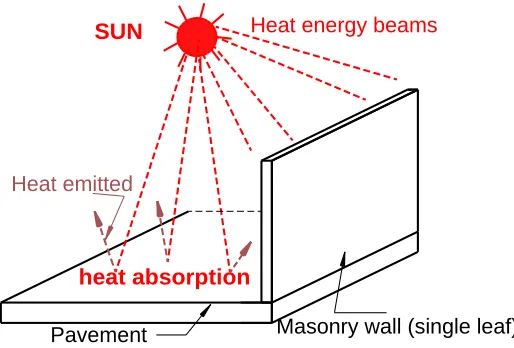
In tropical countries, especially Sub-Sahara Africa, daylight and night darkness have comparatively equal time span of almost 12 hours each. During the day, the temperature in most cases is higher than 25°C. For example in Zanzibar and Dar es Salaam cities, the temperature may rise up to even 34°C especially in the months of October to March of each year. During the day, there is strong sun light which is accompanied with heat energy from the sun rays. The radiating heat is normally absorbed by concrete and masonry elements which are the main construction materials for walls and paving slabs especially in urban streets, and parking lots. The absorbed heat is later on released by the paving materials into the surrounding air causing it to be hot and therefore uncomfortable. This phenomenon of heat absorption and emission is illustrated by Figure 1.
Masonry wall (single leaf)
Heat energy beams
Pavement
Heat emitted
SUN
heat absorption
Figure 1: Heat radiation schematic
http://www.gjaets.com © Global Journal of Advance Engineering Technology and Sciences 25
Objective
The purpose of the study was to assess the suitability of roofing grass (ref. Fig 2) as heat insulation material. With regard to this objective, the specific objectives were:
To test the heat flow in the grass in comparison to the common heat insulator materials
To embed grasses in cement-sand mix for producing masonry paving bricks units and test the heat flow in comparison to the traditional solid masonry paving bricks.
Figure 2: Soil brick house thatched with grass.
Review on Grass
Thatch or grassis one of the oldest of building materials known, it is a good insulator and is easily harvested. Many African tribes have lived in homes made completely of grasses and soil/clay for many years. Grass is still widely used as a traditional roofing material in most parts of Sub-Sahara Africa such as a house depicted in Figure 2 from Shinyanga Tanzania. In Europe, thatch roofs on houses were once prevalent but the material fell out of favor as industrialization and improved transport increased the availability of other roofing materials. Today, though, the practice is undergoing a revival, in the Netherlands, for instance, many new buildings have thatched roofs with special ridge tiles on top[1].
Figure 3: Conic grass roof and Turf roof (contains planted grass on roof)
http://www.gjaets.com © Global Journal of Advance Engineering Technology and Sciences 26
Methodology
The study was achieved through collecting grasses from Iringa Tanzania and transporting them to BAM Germany where tests on the grass were conducted. Some grass was kept at the University of Dar es Salaam for further tests. On getting good results from BAM in the sense that the insulation properties of grass was established, to that effect, the grass which was left at the University of Dar es Salaam was sized and embedded in the cement sand mix during production of paving bricks. The bricks were then tested for heat flow capacity. The general procedure on the investigation was as detailed below:
Specimens Preparation
Eleven specimens shown in Figure 4 of thin block type having a size of 300 x 500 x 100 mm thick were prepared from cement sand mortar of ratio 1:8 and w/c 0.4. After finishing the curing process of 7 days, the blocks were left to dry. On attaining the age of 14 days they were ready for testing. Four plate like insulator materials of size 300 x 500 x 60 mm thick were prepared as depicted in Figure 5; thus: one plate was left intact solid, and three plates were each hollowed leaving a 50 mm thick boundary wall to allow for parking of grass as indicated in Figure 5(b). However, one hollowed plate was left without packing any grass.
Grasses of two types; 1-4 mm and 3-8 mm thick, were cut to size that fits to park in the hollowed insulator frame like elements. The weights of the grasses were 740g for thick grass and 888.2g for thin grass, although the volumes were almost equal.
The test setup started by arranging four block elements at bottom, followed by the plate elements, then parking the grasses in the hollows for two sets as shown in Figure 5. One set was left without any grass, while the final set had a solid insulator plate. Temperature gauge sensors were fixed as indicated in Figure 6. The heating was controlled by setting the switch at a maximum temperature of 60°C to assimilate the highest temperature that can be radiated by the sun to the earth.
Measurement of Temperatures
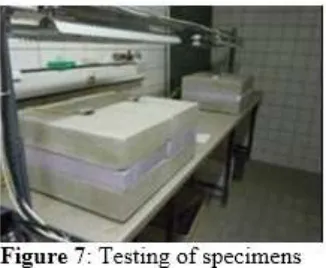
i. The blocks were arranged as shown in Figures 6 and 7. The frame like elements were placed between top and bottom blocks. The far right set contained a standard insulator material to allow for comparison with the insulation of grass and air.
http://www.gjaets.com © Global Journal of Advance Engineering Technology and Sciences 27
Figure 6: Heat flow in grass test set up and positions of temperature gauges
iii. The test was run for four days but the readings were taken for about 10 hours for day one and 14 hours in the last day, because day 2 and 3 were part of weekend.
iv. The room temperature was measured in order to compare with the insulation capacities of the grasses as well as the standard insulator material.
Grass Test Results and Discussion
Test results on grasses are presented in Figures 8 up to 11. As can be seen in Figure 8, at top of the top blocks, the temperature values are almost the same for all four sets; gauges 1 to 4. At bottom of top blocks (gauges 5 to 8 ref Fig 6 and 9), the set without any insulator material (gauge 7) had the lowest temperatures through out by a difference of about 6°C during heat application, and around 4°C at cooling.
Figure 8: Temperature at top of top blocks
Temperature at Top of Top Blocks - Gauges 1 to 4
0 10 20 30 40 50 60 70
0 1 2 3 4 5
Duration
Teme
ra
ture in
°C
T1 T2 T3 T4
1345 1500 1040 1420 hrs
http://www.gjaets.com © Global Journal of Advance Engineering Technology and Sciences 28
At bottom of top of blocks, refer Figure 9, which is also above the grass and above the standard insulator material, the temperatures agree to each other, as it has flown through the cement sand blocks of 100 mm thickness.
The non-insulated set of blocks had lower temperatures of around 7 to 9°C below that of grass as well as the standard insulator material due to the presence of air.
Figure 9: Temperature at bottom of top blocks
Figure 10: Temperature at top of bottom blocks
Temperature at Bottom of Top Blocks - Gauges 5 to 8
0 10 20 30 40 50 60 70
0 1 2 3 4 5
Hours
Teme
ra
ture °C
T5 T6 T7 T8
Temperature at Top of Bottom Blocks - Gauges 9 to 12
0 5 10 15 20 25 30 35 40 45
0 1 2 3 4 5
Hours
Tempe
ra
ture °C
http://www.gjaets.com © Global Journal of Advance Engineering Technology and Sciences 29
Figure 11: Temperature at bottom of bottom blocks
At top of bottom blocks, below the grass as well as the standard insulator material, the temperatures were slightly lower than 30°C for the grass and standard insulator material sets, see Fig 10. However, the set without any insulation material had higher temperatures of 4 to 5°C more than others. The grass insulation properties seem to agree to that of standard insulator material.
At bottom of bottom blocks, the temperatures reached not more than 30°C for the grass and standard insulator material sets. However, the set without any insulation material had the highest temperatures of 4 to 5°C more than others. The recorded room temperature remained below 25°C through out the test as seen in Figure 11.
Measurement of Heat Flow in Bricks
Production of Bricks
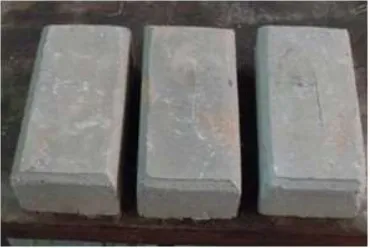
Paving bricks, as shown in Figure 12, were produced from a mix ratio of 1:6 (cement: sand), having a size of 200×100×70 mm thick, being the common mix and size used by vendors in Dar es Salaam. Two samples of paving bricks were prepared, the first sample was common solid paving bricks, and the second was bricks with embedded grass. The grass was embedded in two layers, each having a thickness of 10mm, and spaced at 10 mm between top and bottom layers. A mixture of sand and cement was thoroughly mixed, then water was added and the mixing continued till the required workability was obtained. The mixed material was then filled in a mold and compacted by hand in three layers. When the grass was to be embedded, it was laid on top of a compacted layer 1, then the mixed material was laid on top of it and compacted. The second grass layer was then laid and on top of it, then the final layer of mixed material was added and compacted by ramming. Molding was done using a steel mould to ensure easy release of the brick without any deformation. The bricks were removed from moulds then air dried for one day then curing process followed.
Figure 12: Paving bricks
Temperature at Bottom of Bottom Blocks- Gauges 13 to 17
0 5 10 15 20 25 30 35 40
0 1 2 3 4 5
Hours
Tempe
ra
ture °C
http://www.gjaets.com © Global Journal of Advance Engineering Technology and Sciences 30
The Heat Flow Measuring Machine
A heat flow measuring machine shown in Figure 13 was developed at the College of Engineering and Technology, University of Dar es Salaam[2], having a steel frame, thermostat and a heating chamber. The frame system plus the heating chamber and thermostat cost was 670,000/-TShs (approximately € 300).
The machine uses electricity as source of energy, and the maximum temperature allowed by it is 300oC. The heating chamber consisted of two heating lamps which transfer heat energy to a nearby body of lower temperature through electromagnetic radiation. A thermostat was introduced to control the temperature system so that it is maintained as near as possible to the desired set temperature. The thermostat does this by switching on or off depending on reached degree of temperature. The machine frame could be adjusted depending on the size of the specimens.
Infrared Thermometer
An infrared thermometer is a laser thermometer which infers temperature from a portion of the thermal radiation emitted by the object being measured. It is sometimes called laser thermometers if a laser is used to help aim the heated object, or temperature gun due to its ability to measure temperature from a distance. The thermometer was purchased from Germany at a cost of € 100.
Test Results on Heat Flow in Paving Bricks
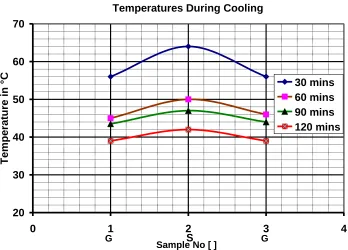
Measured temperature results at bottom surface of brick specimens are shown in graphs in Figures 14 and 15. Each line in the graphs represents average temperatures measured at the bottom surface of sample bricks for two hours at intervals of 30 minutes. The solid paving brick samples were used as acontrol bricks where by their bottom surface temperature was used as standard check against embedded grass bricks in assessing the thermal conductivity of paving bricks
Figure 13: Equipment for heat flow measurement
The test results show that the bricks with embedded grass allowed less heat flow by not less than 8o C below the common solid bricks as seen in Figure 14. A difference of even 2 degrees in temperature is very significant with regard to heat energy, for example; at 0oC degrees we have snow or ice, but at 2oC degrees we have molten ice turned into cold water. On cooling, at 120oC, the difference in temperature is just 2oC, however, the common solid bricks still retains more heat in them when compared to the bricks with embedded grass as shown in Figure 15.
Key to Figures 14 and 15 on sample types
http://www.gjaets.com © Global Journal of Advance Engineering Technology and Sciences 31
Figure 14: Temperature at the bottom surface of brick samples
Figure 15: Temperature recorded during cooling process
Discussion on the Results
With regard to the tested grass, the results show that it is a good insulator material in the same way like the standard insulator material. Figures 10 and 11 show clearly that grass and standard insulator material behave in the same manner with regard to heat insulation; they are both good heat insulators.
The sample bricks which contained grass showed low heat flow rate when compared to the solid bricks. It is evident in the graphs in Figures 14 and 15 that the grass embedded in the bricks act as thermal barrier to the heat flow between
Heat Flow in Solid and Grassed Bricks
30 40 50 60 70 80
0 1 2 3 4
Sample No []
Tem
peratu
re in °C
30 mins 60 mins 90 mins 120 mins
G S G
Temperatures During Cooling
20 30 40 50 60 70
0 1 2 3 4
Sample No [ ]
Tempe
ra
ture in
°C 30 mins
60 mins 90 mins 120 mins
http://www.gjaets.com © Global Journal of Advance Engineering Technology and Sciences 32
the two surfaces of bricks. During the cooling process, the paving bricks which contained layers of grass were losing heat faster when compared to the solid paving bricks. The results show that grass materials can be used to produce thermal insulator paving bricks, because they can reduce heat absorption and lose it easily.
Concluding Remarks
Conclusions
Basing on the results obtained in this study, it has been established that roofing grass material is a good heat insulator like the standard insulator material.
Paving bricks which contained two layers of grass have demonstrated the induction of heat flow at 10°C lower than common solid bricks as depicted in Figure 14.
Most paving bricks in Dar es Salaam are produced locally using small steel moulds and are compacted by hand with repeated ramming.
Recommendations
Roofing grass is a suitable material for heat insulation. Further tests should be done when grass is embedded in bricks and cement sand blocks that are compacted using machines.
More tests on heat insulation properties should be done using other fibers which are available in Tanzania; like coconut fibers and sisal fibers.
There is a need for local manufactures to use automated process including machine compaction for faster production of paving bricks that conform to required standards.
References
1. www.en.m.wikipedia.org/wiki/thatch
2. www.ehow.com/how_4728093_building-tropical-grass-roof.html
3. Midlaster James, “Study On Reduction Of Heat In Pavement By Using Thermal Insulator Paving Bricks,”,