Abstract
In this study, we investigated the effects of salt loading on sympathetic pressor activity, cardiac autonomic activity, mean arterial pressure (MAP), heart rate (HR) and on the relations between them in anesthetized two-kidney, one clip (2K1C) hypertensive rats. We submitted rats to either renal artery clipping or sham operation. Distilled water or 0.5 % NaCl was given orally to the clipped and sham-operated con-trol rats for 4 weeks. Then, MAP and HR differences between pre- and post- autonomic blockade were evaluated as indexes of sympathetic pressor and cardiac autonomic activity, respectively. The autonomic blockade decreased MAP to the similar levels in all groups (between 81.7±7.6 -87.3±7.1 mmHg). Sympathetic pressor activity was greater in the clipped rats than in its sham-operated controls only under salt load-ing (55.3±6.2 vs. 37.0±4.1 mmHg, p<0.05). Cardiac autonomic activity was, predominantly, sympathetic and more in the clipped group than in the sham-operated rats under distilled water (48.3±8.6 vs. 19.7±7.0 beats/min, p<0.05) but not under salt loading. Salt loading inverted the relationship between HR and cardiac autonomic activity in 2K1C hypertensive rats (r=-0.76, p=0.046 vs. r=0.89, p=0.019). These results suggest that salt loading may have augmented the effect of renovascular constriction on MAP by affecting the sympathetic pressor activity and the relation between cardiac autonomic activity and HR in 2K1C hypertensive rats.
© 2011 Association of Basic Medical Sciences of FBIH. All rights reserved
Key WoRDS: renovascular hypertension, sodium, angiotensin II, sympathetic nervous system
and blood pressure in anesthetized
two-kidney, one clip hypertensive rats
Besim Özaykan*, Ayşe Doğan
Department of Physiology, Faculty of Medicine, University of Çukurova, Mithat Özsan Bulvarı, 01330 Balcalı, Adana, Turkey
IntroductIon
Two-kidney, one clip hypertension (2K1C) is primarily caused by high levels of angiotensin II (ANG II) [1, 2] and sympathetic activity [3]. Salt intake has the effects on sym-pathetic activity [4] beside renin angiotensin system [5]. For instance, a high salt diet increases the transmitter release in adrenergic neurons [4] as well as suppresses plasma renin activity in 2K1C hypertensive rats [6]. Salt intake condition may also affect sympathetic activity as a result of an interac-tion between ANG II and baroreflex [7]. When salt intake is low, high ANG II may reset the arterial baroreflex to higher operating pressures. This resetting is likely an important factor in the changes of sympathetic outflow [8]. The effect of salt on baroreflex is also significant, because baroreflex protects against increase in blood pressure (BP) after ANG II injection [9] and plays a significant role in the long-term regulation of BP under variable salt intake conditions [10]. In addition, according to two recent studies, high salt in-take disrupts the normal sympathoinhibitory response to angiotensin II-based hypertension [11] and enhances the
responsiveness of rostral ventrolateral medulla neurons via ventral lamina terminalis [12]. Thus, due to the interaction between ANG II and baroreflex, a high salt diet can affect sympathetic activity both directly and indirectly. Since high salt intake has direct and indirect effects on sympathetic ac-tivity, as mentioned above, salt intake conditions may affect the development of 2K1C hypertension. However, the rela-tionship between salt intake and sympathetic activity in this form of hypertension remains unclear. For this reason, we aimed to investigate the influence of salt loading on sympa-thetic pressor activity, cardiac autonomic activity, mean arte-rial blood pressure (MAP), heart rate (HR) and on the rela-tions between them in anesthetized 2K1C hypertensive rats.
MAterIAls And Methods
The animals and the clipping operation
experiments were carried out on the 30 normotensive male Wistar rats, weighing between 164 and 225 g, from the breed-ing unit of our university (experimental Research Centre, Çukurova University, Adana, Turkey). The experimental protocols were approved by the animal care and use com-mittee of the University of Çukurova. All experiments were performed according to the “Principles of Laboratory Animal Care” (NIH publication No. 85-23, revised 1985). The rats were housed four to a cage in stainless steel cages. All rats
* Corresponding author: Besim Özaykan, Department of Physiology, Faculty of Medicine, University of Çukurova, Mithat Özsan Bulvarı, 01330 Balcal, Adana, Turkey Tel: +90-322-3387077; Fax: +90-322-3386572 E-mail: [email protected] or [email protected]
received standard rat chow (0.5% NaCl and 22% protein) ad libitum. The room temperature was maintained at a constant 22oC. A light was switched on from 8:00 a.m. to 8:00 p.m. In all the animals, the left renal artery was isolated after a mid-line abdominal incision under ketamine (130 mg/kg, im) and chlorpromazine (1.3 mg/kg) anesthesia. The rats were ran-domly assigned to one of two groups. In one group of rats (n=14), the left renal artery was constricted by a ring-shaped silver clip with 0.29 mm internal diameter. In the second (sham-operated) group (n=16), the artery was not constricted.
Diet treatment
Tap water was given to the animals for a one-week after the surgical operation. We then formed the following 4 groups according to the drinking water they received: 1) sham-operated rats + distilled drinking water (SD, n=7); 2) clipped rats + distilled drinking water (CD, n=6); 3) sh-am-operated rats + 0.5% NaCl drinking water (SS, n=9); 4) clipped rats + 0.5% NaCl drinking water (CS, n=8) groups. Salt loading was accomplished by giving 0.5% NaCl drink-ing solution to the rats. All the animals were fed with standard rat chow throughout the study. These different drinking water compositions were maintained for 4 weeks.
BP and HR measurements and autonomic blockade
Surgical trauma [13] and tethering [14] leads to sympathetic activation. Although all anesthetics also affects the neu-ral condition of rats, the sympathetic activity in rats can be evaluated under sodium pentobarbital anesthesia [15, 16] be-cause it does not affect tonic autonomic activity, in contrast its effect on autonomic reflex response [17]. We therefore preferred to measure tonic sympathetic pressor [18, 19] and cardiac autonomic [20] activities by means of autonomic blockade with hexamethonium under pentobarbital sodium anesthesia. A tracheostomy (Pe-240 tubing, Clay Adams, Parsipanny, NJ) and catheterizations (Pe-50 tubing) of the left femoral and jugular veins as well as the left femoral ar-tery were performed under sodium pentobarbital (Sigma, 50 mg /kg, i.p.) anesthesia 5 weeks after the clipping operation. The saline in the Pe-50 tubings was heparinized (100 IU/ml). Insensible fluid losses were compensated with 0.9% NaCl via the jugular vein with an infusion pump (Cole Parmer Instru-ment, IL) at a rate of 20 µl/min during the experiment. A stabilization period was maintained for 30 minutes after the surgical procedure was completed. Throughout the experi-ment, BP was recorded from the femoral artery by means of a pressure transducer (Grass Model PT300) that was connected to an amplifier-oscillograph set (Model 7P122P, Grass Instrument Co, MA). The measurements at the end of the stabilization period were accepted as the baseline BP and HR values. one minute after obtaining these
measure-ments, hexamethonium bromide (25 mg/kg/0.5 ml saline) was injected into the animal as a bolus via the femoral vein. BP and HR were recorded 1, 2 and 3 minutes after the injec-tion. In addition, BP signals were recorded onto a computer at 1-minute intervals by means of a data acquisition system (MP 100 System, BIoPAC Systems, Inc., Santa Barbara, CA). The information on autonomic activity level was obtained from the BP and HR differences between baseline and post-blockade values. The kidneys were isolated and weighed after sacrificing the animals by saturated KCl. We excluded from our study data for clipped rats whose left kidney weight was more than 95% or less than 25% of the right kidney weight.
Data analysis
Statistical analyses were conducted using SPSS program (SPSS Inc., Chicago, IL, USA). The differences between the groups were evaluated by two-way Anova test followed by independent t-test, when parametric test conditions were provided. The differences were analyzed by the Mann–Whit-ney U-test with adjusted α levels under non-parametric test conditions. Wilcoxon matched pairs test with adjusted α level for paired data, was used to analyze the BP and HR changes induced by hexamethonium bromide infusion and to assess other differences within groups. Spearman cor-relation analysis was applied to determine corcor-relations be-tween parameters. The results were expressed as means ± SeM. All tests were performed as two-tailed tests and the values with p<0.05 were considered statistically significant.
results
Basal BP and HR
There were no significant differences between the two clipped groups with regard to basal diastolic (DBP), mean and systolic (SBP) arterial blood pressures (Figure 1).
DBP, MAP and SBP were higher in clipped rats than in sham-operated rats under salt loading (p<0.05) but only tended to be higher under distilled water intake. Basal HR was not significantly different among all the groups.
Effects of autonomic blockade on MAP
Autonomic blockade decreased MAP in all experimental groups (p<0.05) and led to disappear the significant MAP difference between clipped and sham-operated rats un-der salt loading (Figure 2). There was no significant dif-ference between the two clipped groups with regard to the MAP decrease. MAP reduction was greater in the clipped group than in its sham-operated control under salt loading (p<0.05) but not under distilled water intake, for 3 minutes after the autonomic blockade (Figure 3A).
Effects of autonomic blockade on HR
The decrease in HR was greater in the clipped group than in the sham-operated group at 1 minute after the blockade under distilled water (p<0.05, Figure 3B) but this was not the case under salt loading. We did not find any other significant differences among the four experimental groups with regard to the HR change. Baseline heart rate was positively correlat-ed with the change in heart rate 1 min after autonomic block-age in the clipped rats under distilled water (r=0.89, p=0.019, Figure 4) and negatively correlated under salt loading (r=-0.76,
p=0.046). We did not find any significant correlation be-tween the same parameters in the two sham-operated groups.
Renal weights
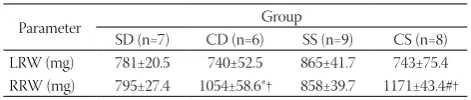
There were no significant differences between clipped rats
and its sham-operated controls with regard to left renal weights at the end of the 4 week diet-treatment period un-der both distilled water and salt loading conditions (Table 1). Right renal weight was greater in the clipped groups than in their respective sham-operated controls (p<0.01). Right re-nal weight was greater than left rere-nal weight in both clipped groups (p<0.01). The two clipped groups did not significantly differ from each other with regard to right kidney weight. FIGURE 2. The effects of autonomic blockade on mean blood
pressure (MAP). MAP values 1 min before and 1-3 min after auto-nomic blockade in the clipped and their sham-operated control
rats. *: p<0.05 for CS vs. SS. FIGURE 3. The amounts of change in blood pressure (MAP) and heart rate (HR) after the blockade. The amounts have been calcu-lated for 1, 2 and 3 min after autonomic blockade in the clipped and their sham-operated control rats. *: p<0.05 vs. SS; #: p<0.05 vs. SD
dIscussIon
Although previous studies investigated the effects of high salt intake on BP in 2K1C hypertensive rats [6] and on sympa-thetic activity in normotensive rats [4], our study is the first one that has elucidated the effect of salt loading on sympa-thetic pressor activity, cardiac autonomic activity and on its relationship with BP and HR in 2K1C hypertension. There are three important results of the present study. Firstly, salt loading condition led the clipping-induced increases in sym-pathetic pressor activity and MAP to be significant in anes-thetized hypertensive rats. Secondly, the change in renin angiotensin system was not sufficient to maintain hyperten-sion in clipped rats without the contribution of an increase in peripheral sympathetic activity, under a salt loading con-dition. Thirdly, salt loading inverted the positive correlation between HR and cardiac autonomic activity in the clipped rats. The clipping reduced the kidney weight in a similar pro-portion under distilled water and salt loading. Thus, renovas-cular constriction caused an increase in MAP under salt load-ing. However, under distilled water intake there was only a tendency toward an increase in MAP. Given this difference, it is possible that salt loading may have augmented the effect of renovascular constriction on MAP. In fact, it has been re-ported that a high salt diet augmented [6] and a low salt diet decreased [21] BP in 2K1C hypertension. Nevertheless, there is also another report on renovascular constriction induced-hypertension under low salt intake [22]. The contrast among studies with regard to the effect of salt intake condition on BP in 2K1C hypertension may be due to the differences in BP measurement methods or clipping period. In the last study [22], BP had been measured by a tail cuff method which is less reliable than intra-arterial measurement [23]. In our other study, direct arterial blood pressure and plasma renin activity increased 3 weeks after unilateral renovascular constriction in conscious rats, without salt loading (unpublished data). Consequently, BP levels may change according to clipping pe-riod beside measurement method, in 2K1C hypertension. Al-though high ANG II activity in circulation has been suggested as the main factor leading to hypertension in the clipped rats
[24], plasma renin activity remains at a normal level 4 weeks after clipping in 2K1C hypertension [25]. This suggests that high local renin-angiotensin system activities (RAS) in the kidney [26] and the brain [27] and, enhanced slow pressor ef-fect of angiotensin II [28] are possible factors in maintaining the hypertension. It has been suggested that ACe probably has an important role in development of renal mass com-pensatory mechanisms [29]. Studies have in fact shown that ANG II injected into cerebral ventricles attenuates cardiac baroreflexes [7]. The effect of local RAS on MAP may involve Ras/MAP kinase pathway because it has been reported that this pathway contributes to ANG-induced hypertension as well as eT-1 induced hypertension [30]. In addition, nitric oxide (No) is an important mediator that opposes ANG II-induced hypertension [31]. No is also a possible mediator for the hemodynamic changes associated with adaptations in re-nal mass [32]. For these reasons, changes in nitrergic control system [33, 34] may also contribute to this type hypertension. Moreover, salt loading may impair baroreflex [35] and sym-pathoinhibitory response to angiotensin II-induced hyperten-sion [11]. Such impairments in pressure control mechanisms which are dependent on local ANG II activity or No may contribute to maintaining high BP in clipped rats under salt loading. Blockade of the sympathetic nervous system with hexamethonium caused a significantly greater decrease in MAP in the clipped group than in sham-operated group un-der salt loading but not unun-der distilled water. Thus, sympa-thetic hyperactivity was primarily responsible for maintaining hypertension under salt loading. This conclusion is consistent with other studies which found sympathetic hyperactivity in renovascular hypertension [36, 37]. ANG II enhances the re-lease of norepinephrine in 2K1C hypertensive rats [38] and is a primary factor in maintaining BP level after sympathectomy in rats [39]. In our study, MAP decreased in the clipped and sham-operated groups after the blockade, causing the MAP values of the groups to approach each other. As a result, the significant difference between clipped and sham-operated rats under salt loading with regard to MAP disappeared after autonomic blockade. Therefore, the change in renin angio-tensin system can probably maintain hypertension in clipped rats with only the contribution of an increase in peripheral sympathetic activity under a salt loading condition. The cen-tral AT1 receptor-mediated enhancement of cardiac sympa-thetic afferent reflex, contributes, in part, to the sympasympa-thetic activation and hypertension, according to a recent research by zhu et. al. [40]. These conclusions are not in agreement with another study which suggests that 2K1C hypertension is maintained by the renin-angiotensin system without much contribution from the sympathetic nervous system [41]. Salt loading led the difference between clipped and sham-operat-ed control rats with regard to sympathetic pressor activity to
Parameter Group
SD (n=7) CD (n=6) SS (n=9) CS (n=8) LRW (mg) 781±20.5 740±52.5 865±41.7 743±75.4 RRW (mg) 795±27.4 1054±58.6*† 858±39.7 1171±43.4#† Table 1. Kidney weights of study groups.
LRW (left renal weight) and RRW (right renal weight) are the values that were measured at the end of 4 weeks of different diets-treatment period. SD: sham-operated rats+distilled water, CD: clipped rats+distilled water, SS: sham-operated rats+0.5% NaCl solution, CS: clipped rats+0.5% NaCl solu-tion groups. values are means±SeM. * p <0.01 v SD, # p <0.001 v SS and †:
be significant. Salt dependent augmentation in the clipping-induced sympathetic activation may be due to changes in the interaction between salt, RAS, the sympathetic system and baroreflexes. Baroreflex control is impaired in 2K1C hyper-tension [42]. When baroreflexes are impaired, an increase in salt intake may increase BP by affecting sympathetic activity via central neural mechanisms [43]. Moreover, high salt in-take increases plasma norepinephrine levels [44], splanchnic sympathetic nerve activity in ANG II-induced hypertension [45] and lumbar sympathetic activity in salt-induced hyper-tension [46]. Because of these effects, salt loading may have caused the clipping-induced increase in MAP to be more prominent under salt loading than under distilled water, as a result of sympathetic potentiation. The HR decreases after the autonomic blockade was greater in the clipped group than in sham-operated group under distilled water but not under salt loading. Thus, it is possible that salt loading led to a decrease in the predominance of sympathetic drive to the heart in clipped rats. In addition, salt loading inverted the relationship between HR and cardiac autonomic activity in the clipped rats. In fact, salt dependent changes in adrener-gic receptors [47] and baroreflex [35] may have caused to the changes in cardiac autonomic activity and its relation-ship with HR in clipped rats under salt loading. However, the salt did not significantly affect the basal HR level in the hy-pertensives. Consequently, the change in cardiac autonomic activity probably did not contribute to the salt induced aug-mentation of MAP in clipped rats. There was no significant difference between two clipped groups with regard to the difference between the left and right kidney weights at the end of the diet-treatment period. Consequently, salt loading did not influence the effect of clipping on renal mass. The effects of high salt on MAP and sympathetic activity may have developed without causing hypertrophy in the kidneys.
conclusIon
In summary, we conclude that salt loading may have caused the clipping-induced increase in MAP to be more promi-nent as a result of the augmentation in sympathetic pressor activity. However, the change in cardiac autonomic activity probably did not contribute to the salt induced augmenta-tion of MAP in clipped rats. Consequently, the change in re-nin angiotensin system can probably maintain hypertension in clipped rats only with the contribution of an increase in sympathetic pressor activity, under a salt loading condition.
AcknowledgeMents
We thank Christine B. Feak for her help in editing the man-uscript and Gulşah Seydaoğlu for her assistance in
statisti-cal analysis. This study was supported by a grant (TF. 97.71) from the Research Foundation of Çukurova University.
declArAtIon of Interest
There is no conflict of interest.
references
1. DeForrest JM, Knappenberger RC, Antonaccio MJ, Ferrone RA, and Creekmore JS. Angiotensin II is a necessary component for the development of hypertension in the two kidney, one clip rat. Am J Cardiol 1982; 49(6): 1515-1517.
2. Cervenka L, vaneckova I, Huskova z, vanourkova z, erbanova M, Thumova M, et al. Pivotal role of angiotensin II receptor subtype 1A in the development of two-kidney, one-clip hypertension: study in angiotensin II receptor subtype 1A knockout mice. J Hypertens 2008; 26(7): 1379-1389.
3. oliveira-Sales eB, Nishi ee, Carillo BA, Boim MA, Dolnikoff MS, Bergamaschi CT, et al. oxidative stress in the sympathetic premo-tor neurons contributes to sympathetic activation in renovascular hypertension. Am J Hypertens 2009; 22(5): 484-492.
4. Nilsson H, ely D, Friberg P, Karlstrom G, and Folkow B. effects of high and low sodium diets on the resistance vessels and their ad-renergic vasoconstrictor fibre control in normotensive (WKy) and hypertensive (SHR) rats. Acta Physiol Scand 1985; 125(2): 323-334. 5. Adams JM, McCarthy JJ, and Stocker SD. excess dietary salt alters angiotensinergic regulation of neurons in the rostral ventrolateral medulla. Hypertension 2008; 52(5): 932-937.
6. Morgan T, Aubert JF, Brunner H. Interaction between sodium in-take, angiotensin II, and blood pressure as a cause of cardiac hyper-trophy. Am J Hypertens 2001; 14(9 Pt 1): 914-920.
7. Gaudet e, Godwin SJ, Head GA. effects of central infusion of ANG II and losartan on the cardiac baroreflex in rabbits. Am J Physiol Heart Circ Physiol 2000; 278(2): H558-566.
8. Bishop vS and Sanderford MG. Angiotensin II modulation of the arterial baroreflex: role of the area postrema. Clin exp Pharmacol Physiol 2000; 27(5-6): 428-431.
9. Bivalacqua TJ, Dalal A, Champion HC, Kadowitz PJ. Role of AT(1) receptors and autonomic nervous system in mediating acute pres-sor responses to ANG II in anesthetized mice. Am J Physiol 1999; 277(5 Pt 1): e838-847.
10. osborn JW, Hornfeldt BJ. Arterial baroreceptor denervation im-pairs long-term regulation of arterial pressure during dietary salt loading. Am J Physiol 1998; 275(5 Pt 2): H1558-1566.
11. McBryde FD, Guild SJ, Barrett CJ, osborn JW, and Malpas SC. Angiotensin II-based hypertension and the sympathetic nervous system: the role of dose and increased dietary salt in rabbits. exp Physiol 2007; 92(5): 831-840.
12. Adams JM, Bardgett Me, and Stocker SD. ventral lamina termina-lis mediates enhanced cardiovascular responses of rostral ventro-lateral medulla neurons during increased dietary salt. Hypertension 2009; 54(2): 308-314.
13. Dorman T, Clarkson K, Rosenfeld BA, Shanholtz C, Lipsett PA, and Breslow MJ. effects of clonidine on prolonged postoperative sympathetic response. Crit Care Med 1997; 25(7): 1147-1152. 14. Adams MR, Kaplan JR, Manuck SB, Uberseder B, and Larkin KT.
Persistent sympathetic nervous system arousal associated with tethering in cynomolgus macaques. Lab Anim Sci 1988; 38(3): 279-281.
15. Abrahams TP and varner KJ. effects of cocaine on adrenal sym-pathetic nerve discharge in anesthetized rats. Physiol Behav 1998; 63(4): 629-634.
2006; 291(2): R376-382.
17. Shimokawa A, Kunitake T, Takasaki M, and Kannan H. Differen-tial effects of anesthetics on sympathetic nerve activity and arterial baroreceptor reflex in chronically instrumented rats. J Auton Nerv Syst 1998; 72(1): 46-54.
18. zoccal DB, Bonagamba LG, Paton JF, and Machado BH. Sympa-thetic-mediated hypertension of awake juvenile rats submitted to chronic intermittent hypoxia is not linked to baroreflex dysfunc-tion. exp Physiol 2009; 94(9): 972-983.
19. Collister JP and osborn JW. The chronic infusion of hexamethoni-um and phenylephrine to effectively clamp sympathetic vasomotor tone. A novel approach. J Pharmacol Toxicol Methods 1999; 42(3): 135-147.
20. Foley CM, McAllister RM, Hasser eM. Thyroid status influences baroreflex function and autonomic contributions to arterial pres-sure and heart rate. Am J Physiol Heart Circ Physiol 2001; 280(5): H2061-2068.
21. de Simone G, Devereux RB, Camargo MJ, Wallerson DC, Laragh JH. Influence of sodium intake on in vivo left ventricular anatomy in experimental renovascular hypertension. Am J Physiol 1993; 264(6 Pt 2): H2103-2110.
22. Pasquie JL, Jover B, du Cailar G, and Mimran A. Sodium but not chloride ion modulates left ventricular hypertrophy in two-kidney, one clip hypertension. J Hypertens 1994; 12(9): 1013-1018. 23. Jamieson MJ, Gonzales GM, Jackson TI, Koerth SM, Romano WF,
Tan DX, et al. evaluation of the IITC tail cuff blood pressure re-corder in the rat against intraarterial pressure according to criteria for human devices. Am J Hypertens 1997; 10(2): 209-216. 24. Martinez-Maldonado M. Pathophysiology of renovascular
hyper-tension. Hypertension 1991; 17(5): 707-719.
25. Koyama T, Hatanaka y, Goda M, zamami y, Hobara N, and Ka-wasaki H. Functional alteration of nervous system in renovascular hypertension. yakugaku zasshi 2009; 129(2): 185-189.
26. Navar LG, zou L, von Thun A, Tarng Wang C, Imig JD, and Mitchell KD. Unraveling the Mystery of Goldblatt Hypertension. News Physiol Sci 1998; 13(4): 170-176.
27. Kagiyama S, varela A, Phillips MI, Galli SM. Antisense inhibition of brain renin-angiotensin system decreased blood pressure in chronic 2-kidney, 1 clip hypertensive rats. Hypertension 2001; 37(2 Part 2): 371-375.
28. Melaragno MG and Fink GD. enhanced slow pressor effect of an-giotensin II in two-kidney, one clip rats. Hypertension 1995; 25(2): 288-293.
29. Babic N, Huskic J, and Nakas-Icindic e. Angiotensin converting enzyme activity in compensatory renal hypertrophy. Bosn J Basic Med Sci 2007; 7(1): 79-83.
30. Ljuca F, Drevensek G, and zerem e. Contribution of Ras farnesyl transferase, MAP kinase and cytochrome P-450 metabolites to en-dothelin-1 induced hypertension. Bosn J Basic Med Sci 2011; 11(2): 84-86.
31. Cervenka L, vaneckova I, Maly J, Horacek v, and el-Dahr SS. Ge-netic inactivation of the B2 receptor in mice worsens two-kidney, one-clip hypertension: role of No and the AT2 receptor. J Hyper-tens 2003; 21(8): 1531-1538.
32. Huskic J, zaciragic A, Babic N, and Mulabegovic N. Nitric oxide in serum and renal tissue during compensatory renal hypertrophy in rats. Bosn J Basic Med Sci 2006; 6(1): 46-49.
33. Koyama T, Hatanaka y, Jin X, yokomizo A, Fujiwara H, Goda M, et al. Altered function of nitrergic nerves inhibiting sympathetic neurotransmission in mesenteric vascular beds of renovascular hy-pertensive rats. Hypertens Res 2010; 33(5): 485-491.
34. de oliveira-Sales eB, Nishi ee, Boim MA, Dolnikoff MS, Berga-maschi CT, and Campos RR. Upregulation of AT(1)R and iNoS in the Rostral ventrolateral Medulla (RvLM) is essential for the sympathetic hyperactivity and hypertension in the 2K-1C Wistar rat model. Am J Hypertens 2010; 23(7): 708-715.
35. Miyajima e, Bunag RD. Dietary salt loading produces baroreflex impairment and mild hypertension in rats. Am J Physiol 1985; 249(2 Pt 2): H278-284.
36. oliveira-Sales eB, Dugaich AP, Carillo BA, Abreu NP, Boim MA, Martins PJ, et al. oxidative stress contributes to renovascular hy-pertension. Am J Hypertens 2008; 21(1): 98-104.
37. Nakada T, Kubota y, Suzuki H, Sasagawa I, Watanabe M, and Ishigooka M. Suppression of sympathetic nervous system attenu-ates the development of two-kidney, one-clip Goldblatt hyperten-sion. J Urol 1996; 156(4): 1480-1484.
38. zimmerman JB, Robertson D, and Jackson eK. Angiotensin II-noradrenergic interactions in renovascular hypertensive rats. J Clin Invest 1987; 80(2): 443-457
39. Lo M, Julien C, Barres C, Medeiros I, Allevard AM, vincent M, et al. Blood pressure maintenance in hypertensive sympathectomized rats. II. Renin-angiotensin system and vasopressin. Am J Physiol 1991; 261(4 Pt 2): R1052-1056.
40. zhu GQ, Xu y, zhou LM, Li yH, Fan LM, Wang W, et al. en-hanced cardiac sympathetic afferent reflex involved in sympathetic overactivity in renovascular hypertensive rats. exp Physiol 2009; 94(7): 785-794.
41. Nystrom HC, Jia J, Johansson M, Lambert G, and Bergstrom G. Neurohormonal influences on maintenance and reversal of two-kidney one-clip renal hypertension. Acta Physiol Scand 2002; 175(3): 245-251.
42. Wang DS, Xie HH, Shen FM, Cai GJ, and Su DF. Blood pressure variability, cardiac baroreflex sensitivity and organ damage in ex-perimentally hypertensive rats. Clin exp Pharmacol Physiol 2005; 32(7): 545-552.
43. Huang BS and Leenen FH. Both brain angiotensin II and "ouabain" contribute to sympathoexcitation and hypertension in Dahl S rats on high salt intake. Hypertension 1998; 32(6): 1028-1033.
44. Sato y, ogata e, and Fujita T. Role of chloride in angiotensin II-induced salt-sensitive hypertension. Hypertension 1991; 18(5): 622-629.
45. Toney GM, Pedrino GR, Fink GD, and osborn JW. Does enhanced respiratory-sympathetic coupling contribute to peripheral neural mechanisms of angiotensin II-salt hypertension? exp Physiol 2010; 95(5): 587-594.
46. Carillo BA, Beutel A, Mirandola DA, vidonho AF, Jr., Furukawa LN, Casarini D, et al. Differential sympathetic and angiotensiner-gic responses in rats submitted to low- or high-salt diet. Regul Pept 2007; 140(1-2): 5-11.