Munich Personal RePEc Archive
A framework of coopetitive games:
applications to the Greek crisis
Carfì, David and Schilirò, Daniele
Institute for the Applications of Mathematics Integrated Sciences,
University of California Riverside, Department DESMaS, Universiy
of Messina
2011
Online at
https://mpra.ub.uni-muenchen.de/78089/
A framework of coopetitive games:
applications to the Greek crisis
David Carf`ı and Daniele Schilir`o
Abstract
In the present work we propose an original analytical model of coopetitive game. We shall apply this analytical model of coopetition (based on normal form game theory) to the Greek crisis, while conceiving this game theory model at a macro level. We construct two realizations of such model, trying to represent possible realistic macro-economic scenarios of the Germany-Greek strategic in-teraction. We shall suggest - after a deep and complete study of the two samples - feasible transferable utility solutions in a properly coopetitive perspective for the divergent interests which drive the economic policies in the euro area.
Keywords. Games and economics; competition; cooperation; coopetition.
1
Introduction
Greece, a country that represents just over 2% of gross domestic product of the Euro area, has led to a deep and widespread crisis in Europe. The Greek economy is locked into a serious and difficult crisis, due to its lack of competitiveness and is still at risk of insolvency, because of its public finance mismanagement. Although the EU Govern-ments and the IMF have provided substantial financial assistance to cover the refinanc-ing needs of Greece in exchange of a serious and though austerity program, and even, the banks have agreed a heavy haircut on the Greek debts, the Greek economy is still on the brink of collapse. Germany, on the other hand, is the most competitive economy of the Euro Area and has a large trade surplus with Greece and other Euro partners; hence significant trade imbalances occur within the Euro Area.
Organization of the paper.The work is organized as follows:
• section 2 examines the Greek crisis, suggesting a possible way out to reduce the intra-eurozone imbalances through coopetitive solutions within a growth path;
• section 3 presents the original model of coopetitive game introduced in the liter-ature by D. Carf`ı;
• section 4 proposes possible solutions concepts for the original model of coopet-itive game;
• section 5, very briefly, provides the general ideas we follow, in this paper, for the applications of coopetitive games to the Eurozone context;
• section 6 provides a first sample of coopetitive game applied to the Eurozone context, showing possible coopetitive solutions; we propose the first sample in an intentionally simplified fashion (without direct strategic interactions among players) to emphasize the new role and procedures of coopetition;
• section 7 provides a second sample of coopetitive game applied to the Eurozone context, showing possible coopetitive solutions; we propose a linear model, with a direct strategic interactions among players;
• conclusions end up the paper.
Section 2 of this paper has been written by D. Schilir`o while sections from 3 to 7 are due to D. Carf`ı, however, in strict joint cooperation. Abstract, introduction and conclusions were written by both authors, together.
2
The Greek Crisis and the coopetitive solution
The deep financial crisis of Greece, which was almost causing the default of its sovereign debt, has revealed the weaknesses of Greek economy, particularly its lack of compet-itiveness, but also the mismanagement of the public finance and the difficulties of the banking sector.
2.1
The crisis and the Greek economy
Greek’s unit labor cost rose over 30 percent from 2000 to 2010. The austerity measures implemented by the Greek government are hitting hard the Greek economy, since its growth is continuing to be expected negative also this year (2012), making the financial recovery very problematic [Mussa (2010)]. Furthermore, Greece exports are much less than imports, so the trade balance shows a deficit above 10% of its GDP. Therefore, the focus of economic policy of Greece should become its productive system and growth must be the major goal for the Greek economy in a medium term perspective. This surely would help its re-equilibrium process.
2.2
The soundest European economy: Germany
Germany, on the other hand, is considered the soundest European economy. It is the world’s second-biggest exporter, but its wide commercial surplus is originated mainly by the exports in the Euro area, that accounts for about two thirds. Furthermore, since 2000 its export share has gradually increased vis-`a-vis industrial countries. Thus Ger-many’s growth path has been driven by exports. We do not discuss in this work the factors explaining Germany’s increase in export share, but we observe that its interna-tional competitiveness has been improving, with the unit labor cost which has been kept fairly constant, since wages have essentially kept pace with productivity. Therefore the prices of the German products have been relatively low, favoring the export of German goods towards the euro countries and towards the markets around the world, especially those of the emerging economies (China, India, Brazil, Russia). Finally, since 2010 Germany has recovered very well from the 2008-2009 global crisis and it is growing at a higher rate than the others Euro partners.
Therefore we share the view that Germany (and the other surplus countries of the Euro area) should contribute to overcome the crisis of Greek economy stimulating its demand of goods from Greece and relying less on exports towards the Euro area in gen-eral. Germany, as some economists as Posen [2010] and Abadi [2010] underlined, has benefited from being the anchor economy for the Eurozone over the last 11 years. For instance, in 2009, during a time of global contraction, Germany has been a beneficiary, being able to run a sustained trade surplus with its European neighbors. Germany is exporting to Greece far more than it imports.
2.3
A win-win solution for Greece and Germany
We suggest, in accordance with Posen [2010], a win-win solution (a win-win solution is the outcome of a game which is designed in a way that all participants can profit from it in one way or the other), which entails that Germany, which still represents the leading economy, should re-balance its trade surplus and thus ease the pressure on the southern countries of the euro area, particularly Greece. Obviously, we are aware that this is a mere hypothesis and that our framework of coopetition is a normative model. However, we believe that a cooperative attitude must be taken within the members of the European monetary union. Thus we pursue our hypothesis and suggest a model of coopetitive game as an innovative instrument to analyze possible solutions to obtain a win-win outcome for Greece and Germany, which would also help the whole economy of the euro area.
2.4
Our coopetitive model
The two strategic variables of our model are investments and exports for Greece, since this country must concentrate on them to improve the structure of production and its competitiveness, but also shift its aggregate demand towards a higher growth path in the medium term. Thus Greece should focus on innovative investments, specially in-vestments in knowledge [Schilir`o, 2010], to change and improve its production struc-ture and to increase its production capacity and its productivity. As a result of that its competitiveness will improve. An economic policy that focuses on investments and ex-ports, instead of consumptions, will address Greece towards a sustainable growth and, consequently, its financial reputation and economic stability will also increase. On the other hand, the strategic variable of our model for Germany are private consumption and imports.
2.5
The coopetition in our model
The concept of coopetition was essentially devised at micro-economic level for strate-gic management solutions by Brandenburger and Nalebuff [1995], who suggest, given the competitive paradigm [Porter, 1985], to consider also a cooperative behavior to achieve a win-win outcome for both players. Therefore, in our model, coopetition represents the synthesis between the competitive paradigm [Porter, 1985] and the co-operative paradigm [Gulati, Nohria, Zaheer, 2000; Stiles, 2001]. Coopetition is, in our approach, a complex theoretical construct and it is the result of the interplay between competition and cooperation. Thus, we suggest a model of coopetitive games, applied at a macroeconomic level, which intends to offer possible solutions to the partially di-vergent interests of Germany and Greece in a perspective of a cooperative attitude that should drive their policies.
3
Coopetitive games
3.1
Introduction
In this paper we develop and apply the mathematical model of a coopetitive game
introduced by David Carf`ı in [11] and [6]. The idea of coopetitive game is already used, in a mostly intuitive and non-formalized way, in Strategic Management Studies (see for example Brandenburgher and Nalebuff).
3.1.1 The idea.
A coopetitive game is a game in which two or more players (participants) can interact
cooperatively and non-cooperatively at the same time. Even Brandenburger and
Nale-buff, creators of coopetition, did not define, precisely, aquantitative way to implement
coopetitionin the Game Theory context.
The problem to implement the notion of coopetition in Game Theory is summarized in the following question:
• how do, in normal form games, cooperative and non-cooperative interactions
can live together simultaneously, in a Brandenburger-Nalebuff sense?
In order to explain the above question, consider a classic two-player normal-form gain gameG= (f, >)- such a game is a pair in whichf is a vector valued function defined on a Cartesian productE×F with values in the Euclidean planeR2and>is
the natural strict sup-order of the Euclidean plane itself (the sup-order is indicating that the game, with payoff functionf, is a gain game and not a loss game). LetE andF
• cooperatively (exchanging information and making binding agreements);
• not-cooperatively (not exchanging information or exchanging information but without possibility to make binding agreements).
The above two behavioral ways are mutually exclusive, at least in normal-form games:
• the two ways cannot be adopted simultaneously in the model of normal-form game (without using convex probability mixtures, but this is not the way sug-gested by Brandenburger and Nalebuff in their approach);
• there is no room, in the classic normal form game model, for a simultaneous (non-probabilistic) employment of the two behavioral extremescooperationand
non-cooperation.
3.1.2 Towards a possible solution.
Firstly David Carf`ı in [6] and then D. Carf`ı with D. Schilir`o in [11] have proposed a manner to overcome thisimpasse, according to the idea of coopetition in the sense of Brandenburger and Nalebuff. In a Carf`ı’s coopetitive game model,
• the players of the game have their respective strategy-sets (in which they can choose cooperatively or not cooperatively);
• there is a common strategy setCcontaining other strategies (possibly of different type with respect to those in the respective classic strategy sets) thatmust be
chosen cooperatively;
• the strategy set C can also be structured as a Cartesian product (similarly to the profile strategy space of normal form games), but in any case the strategies belonging to this new setCmust be chosen cooperatively.
3.2
The model for
n-players
We give in the following the definition of coopetitive game proposed by Carf`ı (in [11] and [6]).
Definition (ofn-player coopetitive game). LetE = (Ei)ni=1be a finiten-family
of non-empty sets and letCbe another non-empty set. We definen-player coopetitive
gain game over the strategy support(E, C)any pairG= (f, >), wheref is a vector
function from the Cartesian product×E×C(here×E denotes the classic
strategy-profile space ofn-player normal form games, i.e. the Cartesian product of the family
E) into then-dimensional Euclidean spaceRnand>is the natural sup-order of this
last Euclidean space. The element of the setCwill be calledcooperative strategies of
A particular aspect of our coopetitive game model is that any coopetitive gameG
determines univocally a family of classic normal-form games and vice versa; so that any coopetitive game could be defined as a family of normal-form games. In what follows we precise this very important aspect of the model.
Definition (the family of normal-form games associated with a coopetitive game). LetG= (f, >)be a coopetitive game over a strategic support(E, C). And let
g= (gz)z∈C
be the family of classic normal-form games whose membergzis, for any cooperative
strategyzinC, the normal-form game
Gz:= (f(., z), >),
where the payoff functionf(., z)is the section
f(., z) : ×E→Rn
of the functionf, defined (as usual) by
f(., z)(x) =f(x, z),
for every pointxin the strategy profile space×E. We call the familyg (so defined)
family of normal-form games associated with (or determined by) the gameGand we callnormal sectionof the gameGany member of the familyg.
We can prove this (obvious) theorem.
Theorem.The familygof normal-form games associated with a coopetitive game
Guniquely determines the game. In more rigorous and complete terms, the
correspon-denceG 7→ g is a bijection of the space of all coopetitive games - over the strategy
support(E, C)- onto the space of all families of normal form games - over the strategy
supportE- indexed by the setC.
Proof.This depends totally from the fact that we have the following natural
bijec-tion between funcbijec-tion spaces:
F(×E×C,Rn)→ F(C,F(×E,Rn)) :f 7→(f(., z))z∈C,
which is a classic result of theory of sets.
Thus, the exam of a coopetitive game should be equivalent to the exam of a whole family of normal-form games (in some sense we shall specify).
3.3
Two players coopetitive games
In this section we specify the definition and related concepts of two-player coopetitive games; sometimes (for completeness) we shall repeat some definitions of the preceding section.
Definition (of coopetitive game). LetE, F and C be three nonempty sets. We
definetwo player coopetitive gain game carried by the strategic triple(E, F, C)any
pair of the formG= (f, >), wherefis a function from the Cartesian productE×F×
Cinto the real Euclidean planeR2 and the binary relation>is the usual sup-order
of the Cartesian plane (defined component-wise, for every couple of pointspandq, by
p > qiffpi > qi, for each indexi).
Remark (coopetitive games and normal form games). The difference among a two-player normal-form (gain) game and a two player coopetitive (gain) game is the fundamental presence of the third strategy Cartesian-factorC. The presence of this third setCdetermines a total change of perspective with respect to the usual exam of two-player normal form games, since we now have to consider a normal form game
G(z), for every elementzof the setC; we have, then, to study an entire ordered family of normal form games in its own totality, and we have to define a new manner to study these kind of game families.
3.4
Terminology and notation
Definitions.Let G = (f, >)be a two player coopetitive gain game carried by the
strategic triple(E, F, C). We will use the following terminologies:
• the functionfis called thepayoff function of the gameG;
• the first componentf1of the payoff functionf is calledpayoff function of the
first playerand analogously the second componentf2is calledpayoff function
of the second player;
• the setEis saidstrategy set of the first playerand the setF thestrategy set of
the second player;
• the setCis said thecooperative (or common) strategy set of the two players;
• the Cartesian productE×F ×Cis called the (coopetitive) strategy space of
the gameG.
Memento. The first componentf1of the payoff functionf of a coopetitive game
Gis the function of the strategy spaceE×F×Cof the gameGinto the real lineR
defined by the first projection
for every strategic triple(x, y, z)inE×F×C; in a similar fashion we proceed for the second componentf2of the functionf.
Interpretation.We have:
• two players, or better an ordered pair(1,2)of players;
• anyone of the two players has a strategy set in which to choose freely his own strategy;
• the two players can/shouldcooperativelychoose strategieszin a third common strategy setC;
• the two players will choose (after the exam of the entire gameG) their cooper-ative strategyzin order to maximize (in some sense we shall define) the vector gain functionf.
3.5
Normal form games of a coopetitive game
LetGbe a coopetitive game in the sense of above definitions. For any cooperative strategyzselected in the cooperative strategy spaceC, there is a corresponding normal form gain game
Gz= (p(z), >),
upon the strategy pair(E, F), where the payoff functionp(z)is the section
f(., z) :E×F →R2,
of the payoff functionf of the coopetitive game - the section is defined, as usual, on the competitive strategy spaceE×F, by
f(., z)(x, y) =f(x, y, z),
for every bi-strategy(x, y)in the bi-strategy spaceE×F.
Let us formalize the concept of game-family associated with a coopetitive game.
Definition (the family associated with a coopetitive game).LetG= (f, >)be a
two player coopetitive gain game carried by the strategic triple(E, F, C). We naturally
can associate with the gameGa familyg= (gz)z∈Cof normal-form games defined by
gz:=Gz= (f(., z), >),
for everyzinC, which we shall callthe family of normal-form games associated with
the coopetitive gameG.
Remark.It is clear that with any above family of normal form games
g= (gz)z∈C,
• a family of payoff spaces
(imf(., z))z∈C,
with members in the payoff universeR2; • a family of Pareto maximal boundary
(∂∗Gz)z∈C,
with members contained in the payoff universeR2;
• a family of suprema
(supGz)z∈C,
with members belonging to the payoff universeR2;
• a family of Nash zones
(N(Gz))z∈C;
with members contained in the strategy spaceE×F; • a family of conservative bi-values
v#= (vz#)z∈C;
in the payoff universeR2.
And so on, for every meaningful known feature of a normal form game.
Moreover, we can interpret any of the above families asset-valued paths in the strategy spaceE×For in the payoff universeR2.
It is just the study of these induced families which becomes of great interest in the examination of a coopetitive gameGand which will enable us to define (or suggest) the various possible solutions of a coopetitive game.
4
Solutions of a coopetitive game
4.1
Introduction
The two players of a coopetitive gameG- according to the general economic principles
ofmonotonicity of preferences and of non-satiation - should choose the cooperative
• the reasonable Nash equilibria of the gameGzaref-preferable than the
reason-able Nash equilibria in each other gameGz′;
• the supremum ofGzis greater (in the sense of the usual order of the Cartesian
plane) than the supremum of any other gameGz′;
• the Pareto maximal boundary ofGzis higher than that of any other gameGz′;
• the Nash bargaining solutions inGzaref-preferable than those inGz′;
• in general, fixed a common kind of solution for any gameGz, sayS(z)the set
of these kind of solutions for the gameGz, we can consider the problem to find
all the optimal solutions (in the sense of Pareto) of the set valued pathS, defined
on the cooperative strategy setC. Then, we should face the problem ofselection
of reasonable Pareto strategiesin the set-valued pathS via proper selection methods (Nash-bargaining, Kalai-Smorodinsky and so on).
Moreover, we shall consider the maximal Pareto boundary of the payoff space
im(f)as an appropriate zone for the bargaining solutions.
The payoff function of a two person coopetitive game is (as in the case of normal-form game) a vector valued function with values belonging to the Cartesian planeR2. We note that in general the above criteria are multi-criteria and so they will generate multi-criteria optimization problems.
In this section we shall define rigorously some kind of solution, for two player coopetitive games, based on a bargaining method, namely a Kalai-Smorodinsky bar-gaining type. Hence, first of all, we have to precise what kind of barbar-gaining method we are going to use.
4.2
Bargaining problems
In this paper, we shall propose and use the following originalextended(and quite gen-eral) definition of bargaining problem and, consequently, a natural generalization of Kalai-Smorodinsky solution. In the economic literature, several examples ofextended
bargaining problemsandextended Kalai-Smorodinski solutionsare already presented.
will naturally hold; we remark, otherwise, that, in this paper, we are not interested in proving general or deep mathematical results, but rather to find reasonable solutions for new economic coopetitive context.
Definition (of bargaining problem).LetSbe a subset of the Cartesian planeR2
and letaand bbe two points of the plane with the following properties:
• they belong to the small interval containing S, if this interval is defined
(in-deed, it is well defined if and only ifSis bounded and it is precisely the interval
[infS,supS]≤);
• they are such thata < b;
• the intersection
[a, b]≤∩∂∗S,
among the interval[a, b]≤with end pointsaandb(it is the set of points greater
thanaand less thanb,it is notthe segment[a, b]) and the maximal boundary of
Sis non-empty.
In these conditions, we callbargaining problem onS corresponding to the pair
of extreme points(a, b), the pair
P= (S,(a, b)).
Every point in the intersection among the interval [a, b]≤ and the Pareto maximal
boundary ofSis calledpossible solution of the problemP. Some time the first extreme
point of a bargaining problem is calledthe initial point of the problem(or
disagree-ment pointorthreat point) and the second extreme point of a bargaining problem is
calledutopia pointof the problem.
In the above conditions, whenSis convex, the problemPis said to be convex and for this case we can find in the literature many existence results for solutions ofP en-joying prescribed properties (Kalai-Smorodinsky solutions, Nash bargaining solutions and so on ...).
Remark.LetSbe a subset of the Cartesian planeR2and letaandbtwo points of
the plane belonging to the smallest interval containingSand such thata≤b. Assume the Pareto maximal boundary ofSbe non-empty. Ifaandbare a lower bound and an upper bound of the maximal Pareto boundary, respectively, then the intersection
[a, b]≤∩∂∗S
is obviously not empty. In particular, ifaandbare the extrema ofS(or the extrema of the Pareto boundaryS∗=∂∗S) we can consider the following bargaining problem
P = (S,(a, b)), (or P = (S∗,(a, b)))
and we call this particular problem astandard bargaining problem onS (orstandard
4.3
Kalai solution for bargaining problems
Note the following property.
Property.If (S,(a, b))is a bargaining problem witha < b, then there is at most one point in the intersection
[a, b]∩∂∗S,
where[a, b]is thesegment joining the two pointsaandb.
Proof.Since if a pointpof the segment[a, b]belongs to the Pareto boundary∂∗S,
no other point of the segment itself can belong to Pareto boundary, since the segment is a totally ordered subset of the plane (remember thata < b).
Definition (Kalai-Smorodinsky). We callKalai-Smorodinsky solution (orbest compromise solution)of the bargaining problem(S,(a, b))the unique point of the intersection
[a, b]∩∂∗S, if this intersection is non empty.
So, in the above conditions, the Kalai-Smorodinsky solutionk(if it exists) enjoys the following property: there is a realrin[0,1]such that
k=a+r(b−a),
or
k−a=r(b−a),
hence
k2−a2
k1−a1
= b2−a2
b1−a1
,
if the above ratios are defined; these last equality is thecharacteristic property of
Kalai-Smorodinsky solutions.
We end the subsection with the following definition.
4.4
Nash (proper) solution of a coopetitive game
LetN :=N(G)be the union of the Nash-zone family of a coopetitive gameG, that is the union of the family (N(Gz))z∈C of all Nash-zones of the game familyg =
(gz)z∈C associated to the coopetitive gameG. We callNash path of the gameGthe
multi-valued path
z7→ N(Gz)
and Nash zone ofGthe trajectoryN of the above multi-path. LetN∗be the Pareto maximal boundary of the Nash zoneN. We can consider the bargaining problem
PN = (N∗,inf(N∗),sup(N∗)).
Definition.If the above bargaining problemPN has a Kalai-Smorodinsky solution
k, we say thatkis the properly coopetitive solution of the coopetitive gameG.
The term “properly coopetitive” is clear:
• this solutionkis determined by cooperation on the common strategy setCand
to be selfish (competitive in the Nash sense) on the bi-strategy spaceE×F.
4.5
Bargaining solutions of a coopetitive game
It is possible, for coopetitive games, to define other kind of solutions, which are not properly coopetitive, but realistic and sometime affordable. These kind of solutions are, we can say,super-cooperative.
Let us show some of these kind of solutions.
Consider a coopetitive gameGand
• its Pareto maximal boundaryMand the corresponding pair of extrema(aM, bM);
• the Nash zoneN(G)of the game in the payoff space and its extrema(aN, bN);
• the conservative set-valueG#(the set of all conservative values of the familyg
associated with the coopetitive gameG) and its extrema(a#, b#).
We call:
• Pareto compromise solution of the gameGthe best compromise solution (K-S solution) of the problem
(M,(aM, bM)),
• Nash-Pareto compromise solution of the gameGthe best compromise solution of the problem
(M,(bN, bM))
if this solution exists;
• conservative-Pareto compromise solution of the gameGthe best compromise of the problem
(M,(b#, b
M))
if this solution exists.
4.6
Transferable utility solutions
Other possible compromises we suggest are the following.
Considerthe transferable utility Pareto boundary M of the coopetitive gameG, that is the set of all pointspin the Euclidean plane (universe of payoffs), between the extrema ofG, such that their sum
+(p) :=p1+p2
is equal to the maximum value of the addition+of the real lineRover the payoff space
f(E×F×C)of the gameG.
Definition (TU Pareto solution).We calltransferable utility compromise solution of the coopetitive gameGthe solution of any bargaining problem(M,(a, b)), where
• aandbare points of the smallest interval containing the payoff space of G
• bis a point strongly greater thana;
• M is the transferable utility Pareto boundary of the gameG;
• the pointsaandbbelong to different half-planes determined byM.
4.7
Win-win solutions
In the applications, if the gameGhas a memberG0of its family which can be
consid-ered as an “initial game” - in the sense that the pre-coopetitive situation is represented by this normal form gameG0- the aims of our study (following the standard ideas on
coopetitive interactions) are
• to “enlarge the pie”;
• to obtain a win-win solution with respect to the initial situation.
So that we will choose as a threat pointain TU problem(M,(a, b))the supremum of the initial gameG0.
Definition (of win-win solution).Let(G, z0)be acoopetitive game with an initial
point, that is a coopetitive gameGwith a fixed common strategyz0 (of its common
strategy setC). We call the gameGz0asthe initial game of(G, z0). We callwin-win
solution of the game(G, z0)any strategy profiles= (x, y, z)such that the payoff of
Gatsis strictly greater than the supremumLof thepayoff coreof the initial game
G(z0).
Remark 1. The payoff core of a normal form gain gameGis the portion of the Pareto maximal boundaryG∗ of the game which is greater than the conservative bi-value ofG.
Remark 2.From an applicative point of view, the above requirement (to be strictly greater thanL) is very strong. More realistically, we can consider as win-win solutions those strategy profiles which are strictly greater than any reasonable solution of the initial gameGz0.
Remark 3.Strictly speaking, a win-win solution could be not Pareto efficient: it is a situation in which the players both gain with respect to an initial condition (and this is exactly the idea we follow in the rigorous definition given above).
Remark 4.In particular, observe that, if the collective payoff function
+
(f) =f1+f2
has a maximum (on the strategy profile spaceS) strictly greater than the collective payoffL1+L2 at the supremumLof the payoff core of the gameGz0, the portion
M(> L)of Transferable Utility Pareto boundaryM which is greater thanLis
non-void and it is a segment. So that we can choose as a threat pointain our problem
(M,(a, b))the supremumLof the payoff core of the initial gameG0to obtain some
4.7.1 Standard win-win solution.
A natural choice for the utopia pointb is the supremum of the portion M≥a of the
transferable utility Pareto boundaryM which is upon (greater than) this pointa:
M≥a={m∈M :m≥a}.
4.7.2 Non standard win-win solution.
Another kind of solution can be obtained by choosingbas the supremum of the portion ofM that is bounded between the minimum and maximum value of that playerithat gains more in the coopetitive interaction, in the sense that
max(pri(imf))−max(pri(imf0))>max(pr3−i(imf))−max(pr3−i(imf0)).
4.7.3 Final general remarks.
In the development of a coopetitive game, we consider:
• a first virtual phase, in which the two players make a binding agreement on what cooperative strategyzshould be selected from the cooperative setC, in order to respect their own rationality.
• then, a second virtual phase, in which the two players choose their strategies forming the profile(x, y)to implement in the gameG(z).
Now, in the second phase of our coopetitive gameGwe consider the following 4 possibilities:
1. the two players are non-cooperative in the second phase and they do or do not exchange info, but the players choose (in any case) Nash equilibrium strategies for the gameG(z); in this case, for some rationality reason, the two players have devised that the chosen equilibrium is the “better equilibrium choice” in the en-tire gameG; we have here only one binding agreement in the entire development of the game;
2. the two players are cooperative also in the second phase and they make a binding agreement in order to choose a Pareto payoff on the coopetitive Pareto boundary; in this case we need two binding agreements in the entire development of the game;
4. the two players are non-cooperative in the second phase (and they do or do not exchange information), the player choose (in any case) Nash equilibrium strate-gies; the two players have devised that the chosen equilibrium is the equilibrium with maximum collective gain and they make only one binding agreement to share the collective gain according to a certain subdivision; in this case we need two binding agreements in the entire development of the game.
5
Coopetitive games for Greek crisis
Our first hypothesis is that Germany must stimulate the domestic demand and to re-balance its trade surplus in favor of Greece. The second hypothesis is that Greece, a country with a declining competitiveness of its products and a small export share, aims at growth by undertaking innovative investments and by increasing its exports primarily towards Germany and also towards the other euro countries.
The coopetitive models that we propose hereunder must be interpreted as normative models, in the sense that:
• they impose some clear a priori conditions to be respected, by binding contracts,
in order to enlarge the possible outcomes of both countries;
• consequently, they show appropriate win-win strategy solutions, chosen by
con-sidering both competitive and cooperative behaviors, simultaneously;
• finally, they propose appropriate fair divisions of the win-win payoff solutions.
The strategy spaces of the two models are:
• the strategy set of Germany E, set of all possible consumptions of Germany, in our model, given in a conventional monetary unit; we shall assume that the strategies of Germany directly influence only Germany pay-off;
• the strategy set of GreeceF, set of all possible investments of Greece, in our model, given in a conventional monetary unit (different from the above Germany monetary unit); we shall assume that the strategies of Greece directly influence only Greece pay-off;
• a shared strategy set C, whose elements are determined together by the two countries, when they choose their own respective strategiesxandy, Germany and Greece. Every strategyzinCrepresents an amount - given in a third con-ventional monetary unit - of Greek exports imported into Germany, by respecting a binding contract.
6
The first model
Main Strategic assumptions.We assume that:
• any real number x, belonging to the unit intervalU := [0,1], can represent a consumption of Germany (given in an appropriate conventional monetary unit);
• any real numbery, in the same unit intervalU, can represent an investment of Greece (given in another appropriate conventional monetary unit);
• any real numberz, again inU, can be the amount of Greek exports which is imported by Germany (given in conventional monetary unit).
6.1
Payoff function of Germany
We assume that the payoff function of Germanyf1is itsgross domestic demand:
• f1 is equal to the private consumption functionC1 plus the gross investment
functionI1plus government spending (that we shall assume equal0, or constant)
plus export functionX1minus the import functionM1, that is
f1=C1+I1+X1−M1.
We assume that:
• the private consumption functionC1is the first projection of the strategic
Carte-sian cubeU3, that is defined by
C1(x, y, z) =x,
for every consumptionxinU, since we assume the private consumption of Ger-many the first strategic component of strategy profiles inU3;
• the gross investment functionI1is constant on the cubeU3, and by translation
we can supposeI1equal zero;
• the export functionX1is defined by
X1(x, y, z) = (1 +x)−1,
for every consumptionxof Germany; so we assume that the export functionX1
is a strictly decreasing function with respect to the first argument;
• the import functionM1is the third projection of the strategic cube, namely
M1(x, y, z) =z,
for everyz ∈ U, because we assume the import functionM1depending only
upon the cooperative strategyz of the coopetitive gameG, our third strategic component of the strategy profiles inU3
Recap.We then assume as payoff function of Germany its gross domestic demand
f1, which in our model is equal, at every triple(x, y, z)in the strategic cubeU3, to the
sum of the strategiesx,−zwith the export functionX1, viewed as a reaction function
with respect to the German domestic consumption (so thatf1is the difference of the
first and third projection of the Cartesian productU3
plus the function export function
X1).
Concluding, the payoff function of Germany is the functionf1of the cubeU3into
the real lineR, defined by
f1(x, y, z) =x+ 1/(x+ 1)−z,
for every triple(x, y, z)in the cubeU3; where the reaction functionX
1, defined from
the unit intervalUinto the real lineRby
X1(x) = 1/(x+ 1),
for every consumptionxof Germany in the intervalU, is the export function of Ger-many mapping the level xof consumption into the level X1(x) of German export
corresponding to that consumption levelx.
The functionX1is a strictly decreasing function, and only this monotonicity is the
relevant property ofX1for our coopetitive model.
6.2
Payoff function of Greece
We assume that the payoff function of Greecef2is again its gross domestic demand
-private consumptionC2plus gross investmentI2plus government spending (assumed
to be0) plus exportsX2minus importsM2),
f2=C2+I2+X2−M2.
We assume that:
• the functionC2is irrelevant in our analysis, since we assume the private
con-sumption independent from the choice of the strategic triple(x, y, z)in the cube
U3, in other terms we assume the functionC
2constant on the cubeU3and by
translation we can supposeC2itself equal zero;
• the functionI2is defined by
I2(x, y, z) =y+nz,
• the export functionX2is the linear function defined by
X2(x, y, z) =z+my,
for every(x, y, z)inU3
(see later for the justification);
• the functionM2is irrelevant in our analysis, since we assume the import
func-tion independent from the choice of the triple(x, y, z)inU3, in other terms we
assume the import functionM2constant on the cubeU3and, by translation, we
can suppose the importM2equal zero.
So the payoff function of Greece is the linear functionf2of the cubeU3into the
real lineR, defined by
f2(x, y, z) = (y+nz) + (z+my) = (1 +m)y+ (1 +n)z,
for every pair(x, y, z)in the strategic Cartesian cubeU3
.
We note that the functionf2does not depend upon the strategiesxinU chosen by
Germany and thatf2is a linear function.
The definition of the functions investmentI2and exportX2must be studied deeply
and carefully, and are fundamental to find the win-win solution.
• For every investment strategyyinU, the termmyrepresents the quantity (mon-etary) effect of the Greek investmentyon the Greek exports. In fact, the invest-ments, specially innovative investinvest-ments, contribute at improving the competi-tiveness of Greek goods, favoring the exports.
• For every cooperative strategy z inU, the term nz is the cross-effect of the cooperative variablez representing the additive level of investment required to support the production of the productionzitself.
• We assume the factorsmandnstrictly positive.
6.3
Payoff function of the game
We so have build up a coopetitive gain game with payoff function given by
f(x, y, z) = (x+ 1/(x+ 1)−z,(1 +m)y+ (1 +n)z) =
= (x+ 1/(x+ 1),(1 +m)y) +z(−1,1 +n)
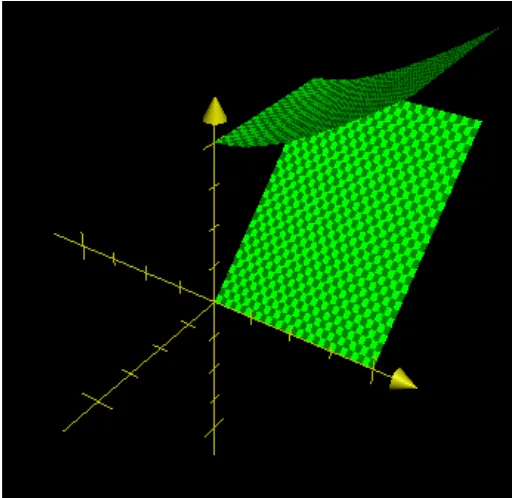
Figure 1: 3D representation of the initial game(f(.,0), <).
[image:23.612.177.435.386.635.2]6.4
Study of the game
G
= (
f, >
)
Note that, fixed a cooperative strategyzinU, the section gameG(z) = (p(z), >)with payoff functionp(z), defined on the squareU×U by
p(z)(x, y) =f(x, y, z),
is the translation of the gameG(0)by the “cooperative” vector
v(z) =z(−1,1 +n),
so that we can study the initial gameG(0)and then we can translate the various infor-mations of the gameG(0)by the vectorv(z).
So, let us consider the initial gameG(0). The strategy squareS=U2ofG(0)has
vertices02,e1,12ande2, where02is the origin,e1is the first canonical vector(1,0),
12is the sum of the two canonical vectors(1,1)ande2is the second canonical vector
(0,1).
6.5
Topological Boundary of the payoff space of
G
0In order to determine the Pareto boundary of the payoff space, we shall use the technics introduced by D. Carf`ı in [5] and used in [2],[7], [8], [9] and [10]. We have
p0(x, y) = (x+ 1/(x+ 1),(1 +m)y),
for everyx, yin[0,1]. The transformation of the side[0, e1]is the trace of the
(para-metric) curvec:U →R2defined by
c(x) =f(x,0,0) = (x+ 1/(x+ 1),0),
that is the segment
[f(0), f(e1)] = [(1,0),(3/2,0)].
The transformation of the segment[0, e2]is the trace of the curvec:U →R2defined
by
c(y) =f(0, y,0) = (1,(1 +m)y),
that is the segment
[f(0), f(e2)] = [(1,0),(1,1 +m)].
The transformation of the segment[e1,12]is the trace of the curvec:U →R2defined
by
c(y) =f(1, y,0) = (1 + 1/2,(1 +m)y),
that is the segment
Critical zone ofG(0). The Critical zone of the gameG(0)is empty. Indeed the Jacobian matrix is
Jf(x, y) =
1 + (1 +x)−2 0
0 1 +m
,
which is invertible for everyx, yinU.
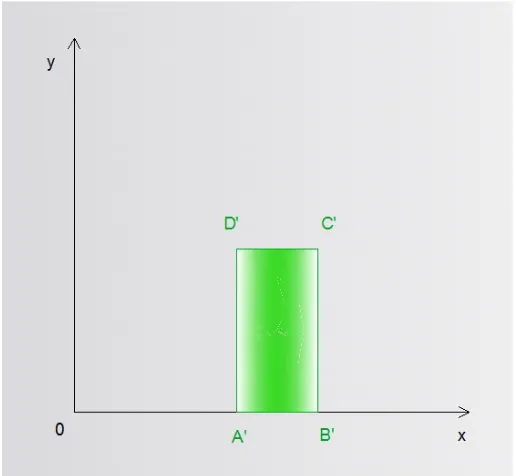
[image:25.612.177.435.261.499.2]Payoff space of the gameG(0). So, the payoff space of the gameG(0) is the transformation of topological boundary of the strategic square, that is the rectangle with verticesf(0,0),f(e1),f(1,1)andf(e2).
Figure 3: Initial payoff space of the game(f, <).
Nash equilibria.The unique Nash equilibrium is the bistrategy(1,1). Indeed,
1 + (1 +x)−2>0
so the functionf1is increasing with respect to the first argument and analogously
1 +m >0
6.6
The payoff space of the coopetitive game
G
The image of the payoff functionf, is the union of the family of payoff spaces
(impz)z∈C,
that is the convex envelope of the union of the imagep0(S)(S is the squareU ×U)
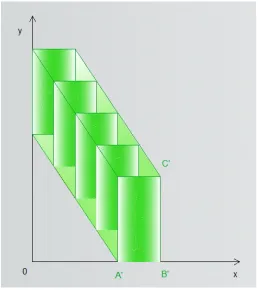
and of its translation by the vectorv(1), namely the payoff spacep1(S): the image of
[image:26.612.177.435.246.536.2]fis an hexagon with verticesf(0,0),f(e1),f(1,1)and their translations byv(1).
Figure 4: Payoff space of the game(f, <).
6.7
Pareto maximal boundary of payoff space of
G
The Pareto sup-boundary of the coopetitive payoffspacef(S)is the segment[P′, Q′], whereP′=f(1,1)and
Possibility of global growth. It is important to note that the absolute slope of the Pareto (coopetitive) boundary is1 +n. Thus the collective payofff1+f2of the game
is not constant on the Pareto boundary and, therefore, the game implies the possibility of a global growth.
Trivial bargaining solutions.The Nash bargaining solution on the segment[P′, Q′]
with respect to the infimum of the Pareto boundary and the Kalai-Smorodinsky bargain-ing solution on the segment[P′, Q′], with respect to the infimum and the supremum
of the Pareto boundary, coincide with the medium point of the segment[P′, Q′]. This
solution is not acceptable from Germany point of view, it is collectively better than the supremum ofG0but it is disadvantageous for Germany (it suffers a loss!): this solution
can be thought as a rebalancing solution but it is not realistically implementable.
6.8
Transferable utility solution
In this coopetitive context it is more convenient to adopt a transferable utility solution, indeed:
• the point of maximum collective gain on the whole of the coopetitive payoff space is the point
Q′= (1/2,2 +m+n).
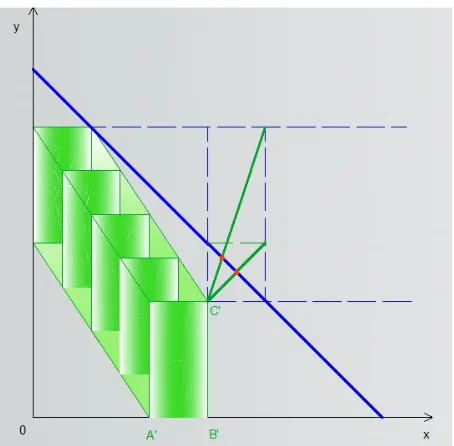
6.8.1 Rebalancing win-win best compromise solution.
Thus we propose a rebalancing win-win kind of coopetitive solution, as it follows (in the casem= 0):
1. we consider the portionsof transferable utility Pareto boundary
M := (0,5/2 +n) +R(1,−1),
obtained by intersectingM itself with the strip determined (spanned by convex-ifying) by the straight linese2+Re1and
(2 +n)e2+Re1,
these are the straight lines of maximum gain for Greece in gamesG(0)andG
respectively.
2. we consider the Kalai-Smorodinsky segments′ of vertices(3/2,1)- supremum of the gameG(0)- and the supremum of the segments.
3. our best payoff coopetitive compromise is the unique pointKin the intersection of segmentss and s′, that is the best compromise solution of the bargaining
problem
Figure 5: Two Kalai win-win solutions of the game(f, <), represented withn= 1/2.
6.9
Win-win solution
This best payoff coopetitive compromiseKrepresents a win-win solution with respect to the initial supremum(3/2,1). So that, as we repeatedly said, also Germany can
increase its initial profit from coopetition.
Win-win strategy procedure.The win-win payoffKcan be obtained (by chance) in a properly coopetitive fashion in the following way:
• 1) the two players agree on the cooperative strategy1of the common setC;
• 2) the two players implement their respective Nash strategies of gameG(1); the unique Nash equilibrium ofG(1)is the bistrategy(1,1);
• 3) finally, they share the “social pie”
5/2 +n= (f1+f2)(1,1,1),
7
The second model
In this second model, we consider a linear affine mutual interaction between Germany and Greece, more adherent to the real state of the Euro-area.
Specifically, in opposition to the above first model:
• we consider an interaction between the two countries alsoat the level of their
non-cooperative strategies;
• we assume thatGreece also should import (by contract) some German produc-tion;
• we assume, that the German revenue, given by the exportations in Greece of the above production, is absorbed by the Germany bank system - in order to pay the Greece debts with the German bank system - so that this money does not appear in the payoff function of Germany (as possible gain) but only in the payoff function of Greece (as a loss).
7.0.1 Main Strategic assumptions.
We assume that:
• any real numberx, belonging to the intervalE := [0,3], represents a possible consumption of Germany (given in an appropriate conventional monetary unit);
• any real numbery, in the same intervalF :=E, represents a possible investment of Greece (given in another appropriate conventional monetary unit);
• any real numberz, again in the intervalC= [0,2], can be the amount of Greek exports which is imported by Germany (given in conventional monetary unit).
7.1
Payoff function of Germany
We assume that the payoff function of Germanyf1 is its Keynesian gross domestic
demand:
• f1 is equal to the private consumption functionC1 plus the gross investment
functionI1plus government spending (that we shall assume equal2, constant in
our interaction) plus export functionX1minus the import functionM1, that is
f1= 2 +C1+I1+X1−M1.
• the German private consumption functionC1is the first projection of the
strate-gic coopetitive spaceS :=E2×C
, that is defined by
C1(x, y, z) =x,
for every possible german consumptionxinE, this because we assumed the private consumption of Germany to be the first strategic component of strategy profiles inS;
• the gross investment functionI1is constant on the spaceS, and by translation
we can supposeI1equal zero;
• the export functionX1is defined by
X1(x, y, z) =−y/3,
for every Greek possible investmenty in innovative technology; so we assume that the export functionX1 is a strictly decreasing function with respect to the
second argument;
• the import functionM1is the third projection of the strategic space, namely
M1(x, y, z) =z,
for every cooperative strategyz ∈2U, because we assume the import function
M1depending only upon the cooperative strategyzof the coopetitive gameG,
our third strategic component of the strategy profiles inS.
Recap. We then assume as payoff function of Germany its Keynesian gross do-mestic demandf1, which in our model is equal, at every triple(x, y, z)in the profile
strategy setS, to the sum of the strategiesx,−zwith the export functionX1, viewed
as a reaction function to the Greece investments (so thatf1is the difference of the first
and third projection of the strategy profile spaceS plus the function export function
X1).
Concluding, the payoff function of Germany is the functionf1of the setSinto the
real lineR, defined by
f1(x, y, z) = 2 +x−y/3−z,
for every triple(x, y, z)in the spaceS; where the reaction functionX1, defined from
the spaceSinto the real lineRby
X1(x, y, z) =−y/3,
for every possible investmenty of Greece in the interval3U, is the export function of Germany mapping the levely of Greece investment into the levelX1(x, y, z)of
German export, corresponding to the Greece investment levely.
The functionX1is a strictly decreasing function in the second argument, and this
7.2
Payoff function of Greece
We assume that the payoff function of Greecef2is again its Keynesian gross domestic
demand - private consumptionC2plus gross investmentI2plus government spending
(assumed to be2) plus exportsX2minus importsM2), so that
f2= 2 +C2+I2+X2−M2.
We assume that:
• the functionC2is irrelevant in our analysis, since we assume the Greek private
consumptions independent from the choice of the strategic triple(x, y, z)in the spaceS; in other terms, we assume the functionC2constant on the spaceSand
by translation we can supposeC2itself equal zero;
• the functionI2:S→Ris defined by
I2(x, y, z) =y+nz,
for every(x, y, z)inS(see above for the justification);
• the export functionX2is the linear function defined by
X2(x, y, z) =z+my,
for every(x, y, z)inS(see above for the justification);
• the function M2 is now relevant in our analysis, since we assume the import
function, bycoopetitive contract with Germany, dependent on the choice of the triple(x, y, z)inS, specifically, we assume the import functionM2defined on
the spaceSby
M2(x, y, z) :=−2x/3,
so, Greece too now, must import some German product, with value−2x/3for each possible German consumptionx.
So, the payoff function of Greece is the linear functionf2of the spaceSinto the
real lineR, defined by
f2(x, y, z) = 2−2x/3 + (y+nz) + (z+my) =
= 2−2x/3 + (1 +m)y+ (1 +n)z,
for every pair(x, y, z)in the strategic Cartesian spaceS.
We note that the functionf2depends now significantly upon the strategiesxinE,
chosen by Germany, and thatf2is again a linear function.
7.3
Payoff function of the game
We so have build up a coopetitive gain game with payoff functionf :S→R2, given by
f(x, y, z) = (2 +x−y/3−z,2−2x/3 + (1 +m)y+ (1 +n)z) =
= (2,2) + (x−y/3,−2x/3 + (1 +m)y) +z(−1,1 +n),
[image:32.612.190.422.249.458.2]for every(x, y, z)in[0,3]2×[0,2].
Figure 6: 3D representation of(f, <).
7.4
Study of the second game
G
= (
f, >
)
Note that, fixed a cooperative strategyzin2U, the section gameG(z) = (p(z), >)
with payoff functionp(z), defined on the squareE2by
p(z)(x, y) :=f(x, y, z),
is the translation of the gameG(0)by the “cooperative” vector
v(z) =z(−1,1 +n),
Figure 7: 3D representation of(f, <).
[image:33.612.190.421.396.629.2]So, let us consider the initial gameG(0). The strategy squareE2
ofG(0)has ver-tices02,3e1,32and3e2, where02is the origin of the planeR2,e1is the first canonical
vector(1,0),32is the vectors(3,3)ande2is the second canonical vector.
7.5
Topological Boundary of the payoff space of
G
0In order to determine the the payoff space of the linear game it is sufficient to transform the four vertices of the strategy square (the game is an affine invertible game), the critical zone is empty.
7.5.1 Payoff space of the gameG(0).
So, the payoff space of the gameG(0)is the transformation of the topological boundary of the strategy square, that is the parallelogram with verticesf(0,0),f(3e1),f(3,3)
andf(3e2). As we show in the below figure 9.
B' = (4,3) C' = (1,5)
D' = (2,2)
[image:34.612.191.469.373.588.2]A' = (5,0)
7.5.2 Nash equilibria.
The unique Nash equilibrium is the bistrategy(3,3). Indeed, the functionf1is linear
increasing with respect to the first argument and analogously the functionf2is linear
and increasing with respect to the second argument.
7.6
The payoff space of the coopetitive game
G
The image of the payoff functionf, is the union of the family of payoff spaces
(impz)z∈C,
that is the convex envelope of the union of the imagep0(E2)and of its translation by
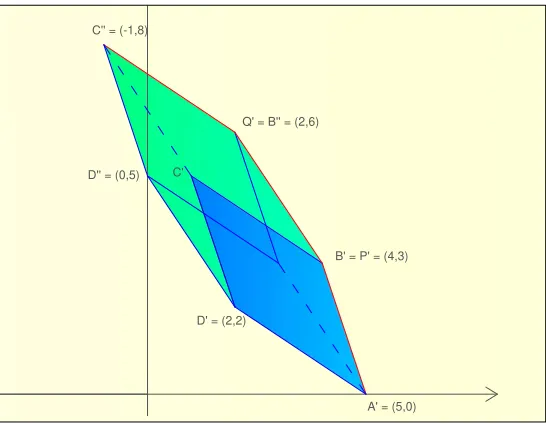
the vectorv(2), namely the payoff spacep2(E2): the image off is an hexagon with
verticesf(0,0),f(3e1),f(3,3)and their translations byv(2). As we show below.
B' = P' = (4,3) C'
D' = (2,2)
A' = (5,0) Q' = B'' = (2,6)
C'' = (-1,8)
[image:35.612.194.467.377.589.2]D'' = (0,5)
7.7
Pareto maximal boundary of the payoff space of
G
The Pareto sup-boundary of the coopetitive payoff spacef(S)is the union of the seg-ments[A′, B′],[P′, Q′]and[Q′, C′′], whereP′=f(3,3,0)and
Q′=P′+v(2).
7.7.1 Possibility of global growth.
It is important to note that the absolute slopes of the segments[A′, B′],[P′, Q′]of the
Pareto (coopetitive) boundary are strictly greater than1. Thus the collective payoff
f1+f2of the game is not constant on the Pareto boundary and, therefore, the game
implies the possibility of a transferable utility global growth.
7.7.2 Trivial bargaining solutions.
The Nash bargaining solution on the entire payoff space, with respect to the infimum of the Pareto boundary and the Kalai-Smorodinsky bargaining solution, with respect to the infimum and the supremum of the Pareto boundary, are not acceptable for Germany: they are collectively (TU) better than the Nash payoff ofG0 but they are
disadvanta-geous for Germany (it suffers a loss!): these solutions could be thought as rebalancing solutions, but they are not realistically implementable.
7.8
Transferable utility solutions
In this coopetitive context it is more convenient to adopt a transferable utility solution, indeed:
• the point of maximum collective gain on the whole of the coopetitive payoff space is the pointQ′= (2,6).
7.8.1 Rebalancing win-win solution relative to maximum gain for Greece inG.
Thus we propose a rebalancing win-win coopetitive solution relative to maximum gain for Greece inG, as it follows (in the casem= 0):
1. we consider the portionsof transferable utility Pareto boundary
M :=Q′+R(1,−1),
obtained by intersectingM itself with the strip determined (spanned by convexi-fying) by the straight linesP′+Re
1andC′′+Re1,these are the straight lines of
Nash gain for Greece in the initial gameG(0)and of maximum gain for Greece
2. we consider the Kalai-Smorodinsky segments′of verticesB′- Nash payoff of
the gameG(0)- and the supremum of the segments.
[image:37.612.192.468.297.508.2]3. our best payoff rebalancing coopetitive compromise is the unique pointKin the intersection of segments sands′, that is the best compromise solution of the bargaining problem(s,(B′,sups)).
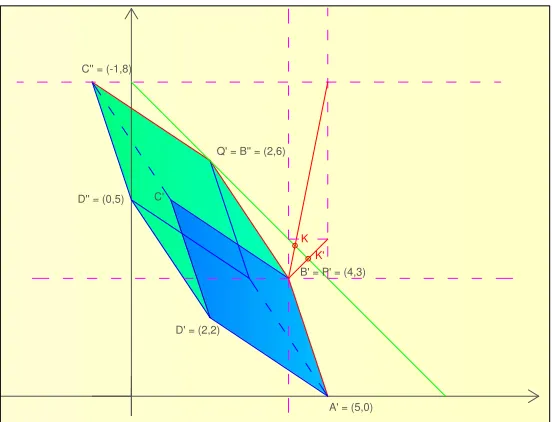
Figure 11 below shows the above extended Kalai-Smorodinsky solution K and the Kalai-Smorodinsky solutionK′ of the classic bargaining problem(M, B′). It is
evident that the distributionKis a rebalancing solution in favor of Greece with respect to the classic solutionK′.
C'
D' = (2,2)
A' = (5,0) Q' = B'' = (2,6)
C'' = (-1,8)
D'' = (0,5)
B' = P' = (4,3)
K K'
Figure 11: Two Kalai win-win solutions of the game(f, <), represented withn= 1/2.
7.8.2 Rebalancing win-win solution relative to maximum Nash gain for Greece.
1. we consider the portionsof transferable utility Pareto boundary
M :=Q′+R(1,−1),
obtained by intersectingM itself with the strip determined (spanned by convex-ifying) by the straight linesP′+Re
1andQ′+Re1,these are the straight lines
of Nash gain for Greece in the initial gameG(0)and of maximum Nash gain for
Greece inG, respectively.
2. we consider the Kalai-Smorodinsky segments′of verticesB′- Nash payoff of the gameG(0)- and the supremum of the segments.
3. our best payoff rebalancing coopetitive compromise is the unique pointKin the intersection of segments sands′, that is the best compromise solution of the
[image:38.612.188.456.382.588.2]bargaining problem(s,(B′,sups)).
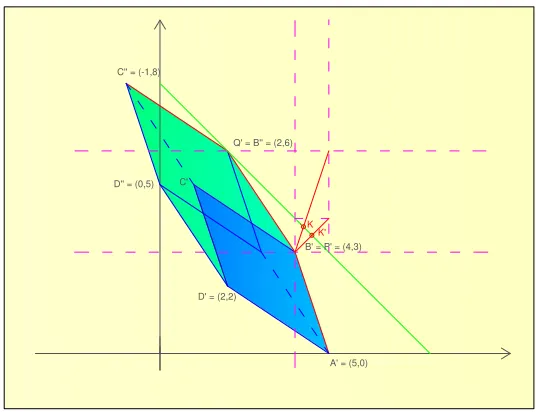
Figure 12 below shows the above extended Kalai-Smorodinsky solutionKand the Kalai-Smorodinsky solutionK′ of the classic bargaining problem(M, B′). The new distributionK is a rebalancing solution in favor of Greece, more realistic than the previous rebalancing solution.
C'
D' = (2,2)
A' = (5,0) Q' = B'' = (2,6)
C'' = (-1,8)
D'' = (0,5)
B' = P' = (4,3) K
K'
7.9
Win-win solution
The payoff extended Kalai-Smorodinsky solutionsKrepresent win-win solutions, with respect to the initial Nash gainB′. So that, as we repeatedly said,also Germany can
increase its initial profit from coopetition.
7.9.1 Win-win strategy procedure.
The win-win payoffKcan be obtained in aproperly transferable utility coopetitive fashion, as it follows:
• 1) the two players agree on the cooperative strategy2of the common setC;
• 2) the two players implement their respective Nash strategies in the gameG(2), so competing `a la Nash; the unique Nash equilibrium of the gameG(2)is the bistrategy(3,3);
• 3) finally, they share the “social pie”
(f1+f2)(3,3,2),
in atransferable utility cooperative fashion(by binding contract) according to the decompositionK.
8
Conclusions
In conclusion, we desire to stress that:
• the two samples of coopetitive game, provided in the present contribution, are essentiallynormative models.
• our samples of coopetition have pointed out the strategies that could bring to win-win solutions, in atransferable utility and properly cooperative perspective, for Greece and Germany.
In the paper, we propose:
• a properly coopetitive solution, which is not convenient for Germany, which is the Kalai-Smorodinsky bargaining solution on thecoopetitive Nash path, set of all possible Nash equilibria of the coopetitive interaction.
• a new extended Kalai-Smorodinsky method, appropriate to determine rebalanc-ing partitions, forwin-win solutions, on the transferable utility Pareto boundary of the coopetitive game.
The solutions offered by our coopetitive model:
• aim at “enlarging the pie and sharing it fairly”;
• show win-win and rebalancing outcomes, for the two countries, within a coopet-itive and poscoopet-itive non constant-sum game path.
• allow us to find “fair” amounts of Greek exports which Germany must coopera-tively import as well as the optimal Greek investments necessary to improve the Greek economy in this context, thus contributing to growth and to the stability of both the Greek and Germany economies.
Acknowledgments
The authors wish to thank Dr. Eng. Alessia Donato for her valuable help in the preparation of the figures. Moreover the authors wish to thank Albert E. Steenge, E. Perrone and three anonymous referees for their helpful comments and suggestions.
References
[1] C. Abadi, 2010, “Germany Debates Euro Instability Fault”,Global Post, March 19.
[2] S. Agreste , D. Carf`ı, A. Ricciardello, 2012, “Algorithms for differentiable para-metric games”,Applied Sciences (APPS)14, pp. 1-14.
[3] O. Blanchard, G. Dell’Ariccia, P. Mauro, 2010, “Rethinking Macroeconomic Pol-icy”,IMF SPN Working Paper, February, pp. 1-18.
[4] A. M. Brandenburger, B. J. Nalebuff, 1995, “The Right Game: Use Game Theory to Shape Strategy”,Harvard Business Review64, pp. 57-71, July-August.
[5] D. Carf`ı, 2009, “Payoff space inC1
-games”, Applied Sciences (APPS)11, pp. 1-16.
[6] D. Carf`ı, 2012, “A Model for Coopetitive Games”, MPRA working paper, pre-sented at Sing6, Palermo, July 6-9 (2010).
[8] D. Carf`ı, E. Perrone, 2011, “Game Complete Analysis of Bertrand Duopoly”,
Theoretical and Practical Research in Economic Fields, Association for
Sustain-able Education, Research and Science,2(1), pages 5-22, June.
[9] D. Carf`ı, A. Ricciardello, 2010, “An Algorithm for Payoff Space inC1
-Games”,
Atti della Accademia Peloritana dei Pericolanti, Classe di Scienze Fisiche
Matem-atiche e Naturali,88(1), pp. 1-19.
[10] D. Carf`ı, A. Ricciardello, 2012, “Topics in Game Theory”,APPS Monograph,9.
[11] D. Carf`ı, D. Schilir`o, 2011, “Crisis in the Euro area: coopetitive game solutions as new policy tools”, TPREF-Theoretical and Practical Research in Economic
Fields2(1), pp. 23-36, June.
[12] Eurostat, 2011, News Release, Euro Indicators, Bruxelles, pp. 1-14, April.
[13] R. Gulati, N. Nohria, A. Zaheer, 2000, “Strategic Networks”,Strategic
Manage-ment Journal21, pp. 203-215.
[14] M. Mussa, 2010, “Beware of Greeks Bearing Debts”,Working Paper, Peterson
Institute for International Economics,May 17, http://www.piie.com.
[15] M. Porter, 1985, “Competitive Advantage: Creating and Sustaining Superior Per-formance”,Free Press, New York.
[16] A. S. Posen, 2010, “Having a Large Euro Area Is an Advantage for Germany”,
Die Welt, February 19. http://www.piie.com.
[17] D. Schilir`o, 2010, “Investing in Knowledge: Knowledge, Human Capital and Institutions for the Long Run Growth”,Governance Of Innovation, edited by M.J. Arentsen, W. van Rossum, A.E. Steenge, Edward Elgar, Cheltenham, pp. 33-50.
[18] D. Schilir`o, 2011, “A new governance for the EMU and the economic policy framework”, MPRA Paper No. 30237, April, pp. 1-18.