© 2018 IJSRST | Volume 4 | Issue 2 | Print ISSN: 2395-6011 | Online ISSN: 2395-602X Themed Section: Science and Technology
Innovative Mobility Model to Capture Rural Customer Behaviour
Patterns through KYC Data Using Open Source Technology
Suresh A. S.1, Dr.Varsha Namdeo2
1Research Scholar, Dept. of Computer Science, Radhakrishnan University, Bhopal, India 2Assistant Professor, Dept. of Computer Science, Radhakrishnan University, Bhopal, India
ABSTRACT
The purpose of the research is to address the major key challenges in the Rural India while deploying technology is Electricity, connectivity and non-availability of resource in the last mile. We have proposed an innovative future technology solutions for both online and offline methods to handle rural India’s main problem on not having Electricity, not able to connect at rural India- Connectivity and non-availability of Resource Reachable to the last mile, this solution will create an robust reliable support systems which will address and allow to access to multiple rural financial requirements from a single mobile Connect solution. This will empower the Business and collection Task Force to serve the Rural Customers of their multiple financial demands.
Keywords: KYC, EFTPOS, WAP, ATM, MPIN, E-Business
I.
INTRODUCTION
Mobile banking is a service provided by a bank or other financial institution that allows its customers to conduct financial transactions remotely using a mobile device such as a smart phone or tablet. Unlike the related internet banking it uses software, usually called an app, provided by the financial institution for the purpose. Mobile banking is usually available on a 24-hour basis. Some financial institutions have restrictions on which accounts may be accessed through mobile banking, as well as a limit on the amount that can be transacted. Transactions through mobile banking may include obtaining account balances and lists of latest transactions, electronic bill payments, and funds transfers between a customer and mobile banking differs from mobile payments, which involves the use of a mobile device to pay for goods or services either at the point of sale or remotely, analogously to the use of a debit or credit card to effect an EFTPOS payment. The earliest mobile banking services used SMS, a service known as
E-Business where less of Electronics and more of Emotions is captured through this solutions, this will enable and empower a unique Point of Contact to serve the existing rural customers and create new customers deploying multiple tailor-made last mile technology solutions at customer door steps. This will enable fundamental nature deleverage Infrastructure required at the last mile from financial services at Rural India. This has empowered the Financial Services to focus on financial solutions and products and not on Infrastructure. Further such solutions can be deployed towards Education and medical health care of the same customers through different solutions using the same channels.
Having financial services at customer door step will improve the emotional bonding with the rural customer for the given population and area; this will reduce operational cost of financial services manifolds. This will improvise productivity, service effectiveness and cost efficiency. We propose a dynamic application of multiple financial products from different Services to allow the common interface to access the individual Business of different participating Financial Solution Services.
II.
LITERATURE REVIEW
V. Devadevan(2013) focused on the technology plays an important role in banking sector. Banking is one of the largest financial institutions constantly explores the opportunity of technology enabled services to provide better customer experience and convenience. Mobile phone is a common technology device that became part of every individual in the information era. Mobile Banking is an emerging alternate channel for providing banking services. India is the second largest telecom market in the world, which is having high potential for expanding banking services using mobile. However, mobile banking has not become the choice of millions of people. The main objective of this study is to identify the mind-set and analyse the security issues in Mobile banking among the banking
customers in India. Technical problem increases along with the increasing number of mobile banking customers like problems in Banking transactions, Password / MPIN.
Shashank Bansa(2014) discussed on the economic welfare and growth of a nation depends upon the accessibility of people to financial product and services. Efficiently mobilizing their household saving and allocating them effectively to the growing credit requirement of the economy helps in sustainable development of the country. Govt., RBI and banking sectors are making tremendous effort to bring every section of the country into the mainstream financial system. Still there exists a significant gap between the growth expectations and the ground realities in context of ‘mobilization and utilization of funds’ that support inclusive growth of the country. There is also a significant disparity among the people of rural and urban area in availing the services of the financial system. There is a need of effective tools to bridge the gap and bring in every section of people from all parts whether rural or urban to take part in the mainstream financial activities.
Purvi Shah and MedhaDubhash(2015) focused on the financial inclusion plays a major role in inclusive growth of the country. It is estimated that globally over 2.5 billion people are excluded from access to financial services of which one third is in India. The origins of the current approach to financial inclusion can be traced to the United Nations initiatives, which broadly described the main goals of inclusive finance as access to a range of financial services including savings, credit, insurance, remittance and other banking / payment services to all ‘bankable’ households and enterprises at a reasonable cost.
emerging research literature on m-banking. It presents a classification framework for m-banking research based on 65 m-banking papers published between 2000 and mid-2010 in Information Systems (IS), technology innovation, management, and marketing journals, and major IS conferences. These papers are classified into five main categories: m-banking overview and conceptual issues, Features & Benefits of Mobile Banking, Current operating practices of commercial banks, Mobile banking/payment practices in Indian Commercial Banks and Challenges in India strategic, legal and ethical issues. It is expected that the comprehensive list of references and assessments presented in this paper will provide a useful anatomy of young banking literature to anyone who is interested in m-banking and help stimulate further interest.
Kasina V. Rao and Rajendra M. Sonar(2016) discussed an innovative idea brings banking to unreached areas of rural India and contributing to financial inclusion of poor people through mobile applications is a major step for their better life. The financial sector’s relative neglect of the rural segment can be rationalized however not reasonable. Innovation of process in or a part of the service is helpful to deliver towards development of the needy, is a researchable point. The solution to inadequate credit with low productivity leads to invent new ways to attain minimum credit services reach using mobile technology. In this paper such inclusive solution provided by zero platforms is studied with data collected from across three socio cultural regions (SER) with random stratified sample using socio economic classification (SEC) households in a state of Maharastra.
GomathyM(2015) discussed the inclusive growth is possible only through proper allocation and accessing of all the resources from top to bottom. Financial inclusion is an innovative concept which makes alternative techniques to promote the banking habits of the rural people because, India is The largest rural
people consist in the world. The Eleventh Five year Plan (2007-12) envisaged inclusive growth as a key objective as well as a strategy for economic development. Financial inclusion is aimed at providing banking and financial services to all people in a fair, transparent and equitable Manner at affordable cost. The main objectives of this study were to know the rural development taken by the banks for financial inclusion, to examine the difficulties involved in the adoption of financial inclusion and also to enhance the extent of financial inclusion. The data required for the study was collected from both primary and secondary sources.
Vijay Mahajan and Bharti Gupta Ramola(1996) discussed the a study commissioned by the World Bank, reviews the performance of Indian financial institutions in providing services to the rural poor and examines the key issues facing policy makers and institutions as the country moves forward on financial sector reforms. The study posits two sets of causal variables for institutional performance: (i) Internal Practices Attitudes (IPAs); and (ii) mechanisms for client interface that either enhance or thwart access by the rural poor and women (MEAs). Both of these variables are largely within the control of the financial institutions. The study sought to identify changes in these variables that could improve access to financial services by the rural poor.
income and asset-holding pattern. While using logistic regression, we find that having a bank account has a significant correlation with income.
III. PROBLEM STATEMENT
People across India, are not able to either apply or get the financial needs, addressed timely, Local infra like connectivity, electricity, and recourse availability In the last mile, is a big challenge, Challenges in terms of three entities _ like Mgmt, Task Force & Customer, had no clue on the execution from customer on-board during the tenure or any exit process. The researcher proposed a dynamic application of multiple financial products from different Services to allow the common interface to access the individual Business of different participating Financial Solution Services. This has empowered the Financial Services to focus on financial solutions and products and not on Infrastructure. Further such solutions can be deployed towards Education and medical health care of the same customers through different solutions using the same channels.
Research Objectives
1.
To study the reliable support system with respect to rural customer behavior patterns.2.
To identify the factors which are significant to improve the financial services in rural areas?3.
To identify the technology components which are significant for the rural areas customer satisfaction?Research Questions
1.
What are the reliable supporting system and its components of innovative mobility model?2.
What are factors which directly affected to the rural customer behaviors patterns?3.
What are the causes of customer dissatisfaction?4.
What is E-business?Research Hypothesis
H01: Reliable support system does not predict to rural customer behaviors
HA1: Reliable support system is supported to rural customer behaviors with respect to their financial services from banking system.
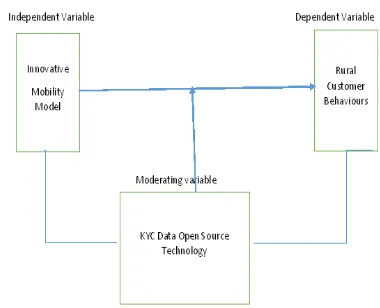
IV. CONCEPTUAL FRAMEOWRK OF RESEARCH
STUDY
Figure 1. Conceptual Framework of Research Study
Uniqueness Of The Solution
1. Infrastructure, Resource, Connectivity and Electricity, Constraints in Rural India - resulting delays in processing of loans, causing adverse effect on business volumes.
2. Inadequate customer data to meet financial inclusion and compliances.
3. Unavailability of effective mechanism to monitor TAT on business proposals.
4. Customer dissatisfaction – Due to delay in processing of business proposals. TAT
5. Effect on Employee confidence level - Unable to achieve the business targets.
into the system. This data transition obviously results delay in information flow.
7. Dependency on Back office team for data entry: The Business team was heavily dependent upon Back office / data entry team for business proposals to go online.
8. Erroneous data entry due to duplication of work – In addition to delay, the duplication of data entry often results in erroneous data entries.
9. Heavy paper usage for data consolidation.
10. Difficulties in handling high business volumes during month ends.
11. High enslavement on non-portable IT assets (PCs, Printers, Routers, UPSs, leased-circuits) for data processing.
A mobile account will have to be opened by every user for doing mobile banking transactions. The present focus of the banks and telecom companies will be on the unorganized sector like migrant laborers who need money remittance services. A remitter in one city of India can send money back to his home in another city or village either by account transfer or instant money transfer module. The account transfer method is where money is transferred from the account of the remitter to that of the beneficiary when they both have accounts with the same bank. The second method is by the instant money transfer module, whereby, the remitter with an account with a particular bank remits money to the beneficiary who has a registered mobile connection but does not have a bank account.
Advantages Of Mobile Banking
1. Providing banking service to unbanked areas and to those customers who otherwise would not have got the banking service.
2. The wage earners staying away from their homes and finding it difficult and expensive to
remit money to their families, can send money instantly through mobile banking
3. The wage earners can do bank transactions without visiting the bank. The advantage being that they do not lose a day’s wages which they would otherwise lose by going to the branch for getting any banking service. 4. All non-cash banking requirements can be
carried out using mobile phones.
Constraints to rapid widespread adoption of mobile banking channels
1. Genuine concerns about security aspects of mobile banking have to be addressed.
2. Different mobile operating systems and diversity of devices. Banks and telecom companies have to launch mobile apps. WAP sites that will run on all handsets and operating systems.
3. Reluctance of customers to learn new technology and lack of incentives for customers to use a new channel. As most of the customers would be first time banking users, they would need to be made aware of the mobile banking platform and the best way to use this platform.
4. Lack of pertinent initiatives from banks to move people to mobile banking channels
The difference in the two products of mobile banking i.e. (i) in retail banking and (ii) as a channel of financial inclusion is that in retail banking:
1. The target group is the urban middle and high income individual customers
2. There are no intermediaries. The customer is dealing directly with the bank. It is basically a self-service where the customer is making payments himself, or requesting the bank for issue of a cheque book directly. All instructions are carried out by self.
3. Account opening, cash in and cash out is not possible
In mobile banking as a product of financial inclusion 1. The target group is low income urban and
rural individuals/customers
2. The Business Correspondent is the intermediary
3. Account opening, cash in and cash out is possible
4. Self-service is possible for some activities only, e.g. remittances and balance enquiry
5. All other facilities like Demat etc are not possible
6. Security is either biometric or PIN
V.
CONCLUSION
In this paper research identified the problem which are facing by the customer in rural areas with respect to banking services due to Connectivity and non-availability of Resource Reachable to the last mile, this solution will create an robust reliable support systems which will address and allow to access to multiple rural financial. This will empower the Business and collection Task Force to serve the Rural Customers of their multiple financial demands. The researcher develop a supporting system which works offline and as well as online to fulfill the customer banking services requirements beyond the availability of electricity and internet connection.
VI. REFERENCES
[1]. V. Devadevan(2013),'Mobile Banking in India-Issues &Challenges',International Journal of Emerging Technology and Advanced Engineering Website: www.ijetae.com (ISSN 2250-2459, ISO 9001:2008 Certified Journal, Volume 3, Issue 6, June 2013)
[2]. Purvi Shah and Medha Dubhash(2015),'Review Paper on Financial Inclusion-The Means of Inclusive Growth',Chanakya International Journal of Business Research, Vol 1(1), 37–48, March 2015 ISSN (Online) : Applied for
[3]. Vishal Goyal1 and Dr.U.S.Pandey(2012),'Mobile Banking in India: Practices,Challenges and Security Issues',International Journal of Advanced Trends in Computer Science and Engineering, ISSN No. 2278 -3091 Volume 1, No.2, May-June 2012
[4]. "The World's first WAP Bank is Norwegian". Itavisen no. 1999-09-24. Retrieved 2010-10-18. [5]. Dr.Yogesh Jain (2013),' Mobile Banking: A
Study On Adoption & Challenges In Southern Rajasthan, India', International Journal Of Innovative Research & Development, ISSN: 2278-0211 (Online).
[6]. Yu.S (2009), Factors Influencing the Use of Mobile Banking: The Case of SMS-based Mobile Banking, Scientific Journal of King Faisal University.
[7]. Kumbhar.V (2011), Financial Inclusion Through M-Banking Services: Scope and Problems in India, MPRA
[8]. Bangens.L and Soderberg.B (2008), Mobile Banking-financial Services For the Unbanked?, Retrieved On:22-Dec-2013, Retrieved From: http:// www.spidercenter.org/files/m-bankingstudy.pdf
[9]. Ms.Rati Dhillon(1991),' Mobile Banking in Rural India: Roadmap to Financial Inclusion'PARIPEX - INDIAN JOURNAL OF RESEARCH, , Volume : 3 | Issue : 1 | Jan 2014ISSN - 2250-1991
[10]. Kasina V. Rao and Rajendra M. Sonar(2016),' Financial inclusive innovation with branchless mobile banking applications for rural poor',SJM School of Management, Indian Institute of Technology Bombay Powai Mumbai 400076. India.
[12]. Jesse Marsden (2013),'Challenges in Mobile Banking: Early findings from the field', Microcredit Summit Campaign* Craig Tower, Senior Research Officer, Microfinance Opportunities ZainebMajoka, Program & Research Intern, Microcredit Summit Campaign [13]. Vijay Mahajan and Bharti Gupta Ramola(1996),'
Financial services for the rural poor and women in India: Access and sustainability',• First published: March 1996Full publication history,DOI: 10.1002/(SICI)1099-1328(199603)8:2<211::AID-JID378>3.0.CO;2-W [14]. Dhananjay Bapat(2012),'Perceptions on Banking
Service in Rural India: An Empirical Study',First Published August 8, 2012 Research Article. [15]. Dhananjay Bapat(2014),'Use of Mobile Financial