An Efficient Code Compression Technique For
Ecg Signal Application Using Xilinx Software
M. Mohana Soundarya, S. Jayachitra
Abstract: This paper introduces a strategy to compress ECG in remote and zero lossless decompression utilizing a mix of 3 unique procedures so as to expand storage room while diminishing transmission time. The principal system utilized in the proposed calculation is a versatile straight expectation; it accomplishes high affectability and positive forecast. The second procedure is content versatile Golomb Rice coding, use with a window size for encoding the leftover of expectation blunder. The third procedure is the utilization of reasonable pressing configuration to empower the ongoing interpreting process. The proposed calculation is assessed to confirm the utilization of more than 48 chronicles from MIT-BIH arrhythmia data set. It appeared to most likely accomplish a lossless piece pressure rate of 2.83 in Lead V1 and 2.77 in Lead V2. This algorithm demonstrates better execution results in contrast with past lossless ECG compression. It very well may be utilized in information transmission strategies for prevalent biomedical signs for limited transfer speed crosswise over e-wellbeing gadgets. This task is created utilizing Xilinx programming.
Keywords: Electrocardiogram (ECG), Golomb rice coding, lossless data compression, wearable devices, healthcare monitoring, telemedicine. ————————————————————
1. Introduction
Cardiovascular disease have turned into the best reason for death all inclusive as of late, in charge of over 31% of every worldwide demise yearly [1]. Perusing electrocardiogram flag is the ordinarily utilized strategy for screening the pulse rate. This biomedical flag is broadly utilized in drug as a screening apparatus for heart illness conclusion. This had different segments, for example, waves, portions and interims. A run of the mill ECG flag is appeared in Fig. 1 [2]. The prudent advantages of electrocardiogram information were constrained because of its low accessibility.
Long haul electrocardiogram recording is frequently used for patients conceded in heart issues. Electrocardiogram is also recorded ceaselessly for portable cases [3]. In this manner, lot of information was gathered utilizing ceaseless ECG observing frameworks over such periods. So as to lessen the measure of information, a constant information pressure calculation which can spare storage room is required. Three sorts of pressure strategies are utilized on electrocardiogram information [4] (figure 2).
Fig 1 A period of typical ECG signal [2]
1) The direct information strategy utilizes the information in time area for pressure. A few surely understood direct information procedures are utilized with delta beat code modulation (DPCM) [5], [6], defining moment (TP) [7], adequacy zone time age coding (AZTEC) [8], [9], arrange decrease time encoding framework (CORTES) [10], the delta calculation and Fan calculation [11].
Fig 2 The overview of ECG compression technique.
The changed strategy changes over the time space into a recurrence area; the key thought depends on vitality re-appropriation. Customarily, Fourier change, Fourier
————————————————
M. Mohana Soundarya is PG Scholar, Department of ECE, Vivekanandha College of Engineering for Women, Namakkal Dt. , India. E-mail: [email protected]
INTERNATIONAL JOURNAL OF SCIENTIFIC & TECHNOLOGY RESEARCH VOLUME 8, ISSUE 09, SEPTEMBER 2019 ISSN 2277-8616
1959
ˆ descriptor [12], Karhunen Loeve change (KLT) [13],
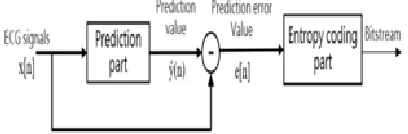
Discrete cosine change (DCT) [14], [15] and Wavelet change [16], [17] has been generally utilized. Some new thoughts, for example, packed detecting, are as yet dependent on this strategy [18]. The parameter extraction technique extricates the prevailing highlights from the crude flag; others created incorporate the pinnacle picking and forecast strategy [19] and neural network based syntactic strategies [20]. By and large, the compression technique connected in the electrocardiogram flag incorporates lossless and loss compression. Albeit loss compression systems convey more noteworthy pressure execution, they are not acknowledged by therapeutic administration. In the lossless frameworks, the first electrocardiogram flag was accurately decoded with no misfortune and the precision for conclusion of cardiovascular sickness is enhanced; therefore, these frameworks are increasingly underscored in biomedical flag use.Lossless pressure methods intrinsically have lower compress proportions contrasted with lossy compression. A traditional electrocardiogram lossless compression calculation comprises of a prediction usage component and entropy coding component, as appeared in figure 3. Straight or customary forecast is the strategy utilized for 1-D ECG flag expectation procedures [21].
Fig 3 Block diagram of basic loss less compression
Chua et al announced a discrete heart beat code modulation for straight forecast [22] and Deepu and Lian developed a forward expectation methodology for direct forecast. This expectation strategy gives a basic method to diminish the forecast blunders of a flag. Entropy coding is a fundamental advance in electrocardiogram compression like Huffman coding [23]–[25], Golomb rice coding [21] and Prediction blunder coding [22], [25]. These entropy coding procedures consider an effective and low multifaceted nature lossless pressure technique. The investigation presents a productive electrocardiogram compression calculation for tele prescription applications. The essential procedure of the proposed calculation comprises of two components. The versatile expectation component depends
on forward examples, so as to diminish the excess inside the first information. It can improve the prescient exactness and in this manner upgrade the pressure rate. The entropy coding components comprises of a window measure dependent on substance versatile Golomb rice and are utilized to pack electrocardiogram information.
1.1 Lossless ECG Compression
Figure 3 demonstrated a square graph of the lossless electrocardiogram compression conspires. An expectation esteem, ŷ(n), is utilized to get the active incentive from previous examples. In this manner the expectation blunder esteem, e(n), is created by the present esteem and forecast esteem, characterized as:
e (n) = y (n) − yˆ (n) (1)
Where ŷ(n) is the prediction value and y(n) is the present value of the input data to ECG. To improve the pressure execution for the ECG flag, this examination proposes a successful versatile straight indicator and a setting versatile Golomb-Rice code with a window size to build the pressure proportion. Forecast mistake esteem is used in Golomb rice code and is utilized to figure k—parameter moreover. The proposed pressure encoding and deciphering square graph is appeared in Fig. 4.
1.1.1 Adaptive Linear Prediction
Electrocardiogram signal has various states with soak plentifulness varieties, for example, QRS wave, P wave and T wave. These waves produce higher forecast blunder. So as to diminish the total mistake, the indicator with the best prephrasing can limit the forecast blunder and advance the precision of the expectations. This examination proposes a versatile direct indicator system as indicated by the fluffy choice hypothesis [33] to lessen the forecast mistake beyond what many would consider possible. Ordinarily, the forward straight forecast is utilized to gauge the present example y(n) of the electrocardiograph motion in these methodologies from its previous m tests:
m
y ˆ(n) =
INTERNATIONAL JOURNAL OF SCIENTIFIC & TECHNOLOGY RESEARCH VOLUME 8, ISSUE 09, SEPTEMBER 2019 ISSN 2277-8616
ˆ
− −
− −
FIGURE 4 Lossless compression and decompression method
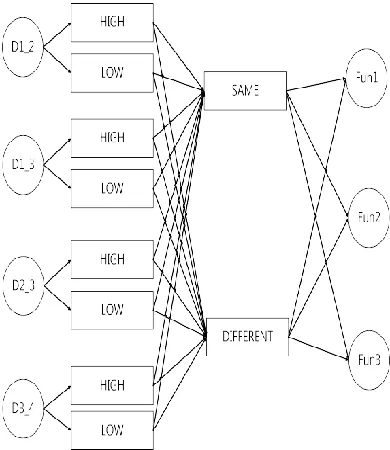
where ŷ (n) is a prediction assessment of y(n), and hk is the predictor coefficients. This proposed strategy utilizes the forward 4 examples to assess the forecast esteem. There are 5 parameters: D1_2, D1_3, D2_3, D3_4 and 'dir'. The presented technique decides the present expectation esteem as indicated by the past qualities. The 'dir' parameters decide if the slant bearing of these forward examples is the equivalent or notBe that as it may, on the off chance that present example esteem ends up littler than past one, at that point slant is diverse as prior incline was ascending because of rising example esteems however at this point slant will tumble down abruptly as past example esteem is more noteworthy than current example esteem. The relations of the four past examples are appeared in Fig. 5.
FIGURE 5 Relation of forward 4 samples
D1_2(n) ois gotten by the past esteem y(n−1) short the past esteem y(n-2), D1_3(n) can be acquired by the past esteem y(n-1) less the past esteem y(n-3), D2_3(n) can be acquired by the past esteem y(n-2) less the past esteem y(n-3), and D3_4(n) can be acquired by the past value y(n-3) less the past esteem y(n-4). The conditions are provided in (3) to (6):
D1_2 (n) = y (n − 1) − y (n − 2) (3)
D1_3 (n) = y (n − 1) − y (n − 3) (4)
D2_3 (n) = y (n − 2) − y (n − 3) (5)
D3_4 (n) = y (n − 3) − y (n − 4) (6)
Considering the qualities of the ECG flag, this investigation utilizes an unassuming coefficient with differential indicators that has low multifaceted nature calculation and great execution for assessing expectation esteem. Three request differential indicators are proposed as (7) to (9):
Fun1 : yˆ (n) = y (n − 1) (7)
Fun2 : yˆ (n) = 2y (n − 1) − y (n − 2) (8)
Fun3 : yˆ (n) = 3y (n − 1) − 3y (n − 2) + y (n − 3) (9)
Because of the time sensitive variety of the ECG flag, the pre-dictor will be looked over these three differential capacities for various areas of the ECG flag, and the correct expectation will be For level area, Fun1 will be chosen as it is first request capacity and first request work has better exactness for expectation esteem. For incline locale, Fun2 will be chosen which is a second requested work. For pinnacle locale test, third request indicator will be chosen which is Fun3. Third request indicators are better to discover expectation esteem for pinnacle test. The versatile direct expectation with fluffy choice method is appeared in Fig. 6.
INTERNATIONAL JOURNAL OF SCIENTIFIC & TECHNOLOGY RESEARCH VOLUME 8, ISSUE 09, SEPTEMBER 2019 ISSN 2277-8616
1961
=
1.2 Lossless Data Compression Technique
Entropy coding is an essential coding procedure utilized in information pressure, and speaks to parallel bits, normally show up ing designs and rare double bits. Huffman coding, number juggling coding, run length coding and Golomb coding are popular lossless entropy coding strategies, in spite of the fact that Huffman and math codes entirely pursue the information and need a sufficient memory structure to consummate the information of the information image probabilities. In light of [26] and [27], this work talks about in detail encoding compressive detecting estimations by methods for a low-intricacy entropy encoder like Golomb– Rice code as the entropy coding for the proposed strategy.
1.3 Content-Adaptive Golomb-Rice Code
W. Golomb built up an information pressure method called Golomb coding in 1960 which relies upon entropy encoding and geometric dispersion. Geometric appropriation is very reasonable for displaying expectation mistake with higher probability of littler forecast blunder contrasted with different strategies. Specifically, a Rice code compares to a Golomb code where the tunable parameters are of 2 intensities. These make Golomb code advantageous to use for a PC since increase and divided by 2 was executed utilizing a bit move task; it tends to be performed amazingly rapidly. Also, in ECG information event of little qualities is entirely high when contrasted with vast qualities hence Golomb code was very valuable as it has ideal prefix code.
1.4 Data Packing Format
So as to pack an electrocardiogram motion continuously, the crude flag is first isolated into a few fragments, the extent of which was controlled by window estimate. Each section works on the proposed lossless calculations all together. Each fragment must include all the essential data to the decoder to change the first flag. The bit stream of the primary window contains the principal test of electrocardiogram information with eleven bits and k parameter with three bits alongside the expectation blunder which was encoded by Golomb code. Since the bit stream of the main window contains the principal test, the bit stream of different windows just required to record the k parameters and the forecast blunder with a few bits.
2. PERFORMANCE EVALUATION AND
COMPRESSION
The ratio of the compressed signal size of the original signal size is called the compression ratio (CR). It provides all the information and avoids the unwanted information. By decreasing the ratio, the information bits needed for storing and transmitting are decreased obviously:
CR= So (12)
Sc
Where So is the bits in the original information and Sc is the
number of bits after compression. We assess the outcome and CR for the presented plan in inserted framework. As appeared Table 3 five uses are genuine tried information with 10 min account. The normal CR for the inserted framework configuration is 3.349.
3. RESULTS AND DISCUSSION
The Architecture design and analysis
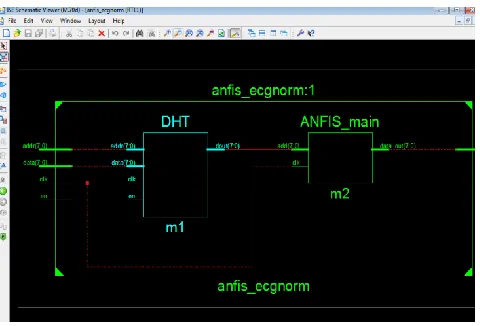
The sram having just a single information flag and 2 contrlo flag like clk and en.the adrress regsiter is accustomed to referencing the RAM wher information can be going to compose .anfis_ecg examination is a problematic innovation that can reform the execution of items in numerous zones, from shopper gadgets and PCs to car, restorative, military and space.
Figure 7 Anfis ECG classification block with DHT module
it can take out multi-chip bundles (MCPs), give a bound together memory subsystem, and lessen framework control utilization for broadened battery life. In PCs, it can swap SRAM for rapid reserve, Flash for non-unstable store, and PSRAM and DRAM for fast program execution. With a two nanosecond (ns) compose time, STT-RAM is as quick as SRAM, which at present has a compose time going from 1 to 100 ns, contingent upon the innovation utilized. To the extent cell measure, STT-RAM passages much superior to SRAM cell estimate. At the point when STT-RAM achieves the 32 nm innovation hub, the cell will be equivalent to or littler than DRAM or NOR streak.
Figure 8:cache memroy
The figure 8 demonstrates the reserve memory plan for rapid ecg examination. Store memory is a rapid memory kept in the middle of processor and RAM to expand the information execution speed. It is kept close to the processor. A CPU reserve was a store used by the focal PC to decrease the normal time to enter into memory. The reserve was a littler, quicker memory which copies the duplicate of the data from the most of the time used primary memory areas.
Figure:9 L1 cache for ANFIS Main
L1 guidance reserve can be killed to spare vitality amid the execution of the ANFIS loop. L1 guidance stores are regularly built with superior (HP) cells to accomplish lower access dormancy at an expense of high static power utilization. Static intensity of L1 guidance stores could be tantamount or significantly higher than that of L2 reserves.
Along these lines, it is vital to lessen the static vitality utilization of guidance reserves notwithstanding their moderately little size.
Figure 10:stt_sleepy cell
The stt_sleepy cell is utilized to lessen the L1 reserve static power dissemination at DHT detail. By utilizing this idea the STT-RAM reserves are great focuses to apply the power gating strategy. Generally, SRAM stores experience the ill effects of a tradeoff between state maintenance and spillage control decrease. State retentive power gating on SRAM cell requires cautious change in accordance with maintenance voltage in light of procedure variety. Power gated STT-RAM reserves can accomplish critical spillage control decrease and immaterial execution misfortune at the same time.
Figure 11: L2 loop basic cache memory
INTERNATIONAL JOURNAL OF SCIENTIFIC & TECHNOLOGY RESEARCH VOLUME 8, ISSUE 09, SEPTEMBER 2019 ISSN 2277-8616
1963 utilization by power gating the stores with negligible effect
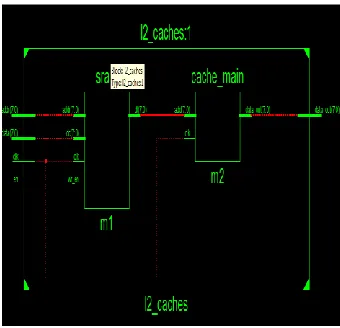
on execution. At the point when the ECG processor executes a circle, the guidance reserve L2 serves few directions inside the circle body more than once until its end. In this manner, by including a small cradle called a circle reserve, directions of the circle body could be served from the cushion rather than the L1 guidance store when it contains the whole circle body. This empowers a chance to kill the L1 guidance reserve amid the execution of circles littler than the limit of the circle store.
Figure 12 final Architecture of ECG_in Spartan 3E FPGA
The figure 12 lingerie the gathering of design in ECG investigation of Spartan 3E FPGA which incorporates 9 obstructs for allotting separate squares of memory beginning from preprocessor stage to conclusive calculation usage.. The preprocessing stage is utilized to get the examples of significant worth from the ECG flag which is given by ECG principle processor module. For de-noising highlight extraction and an order we are utilizing DHT module, ANFIS module and ecgnorm_selections modules. The SRAM and mux modules are utilized to hold the procedure tasks and select the flag conditions separately. The proposed modules are utilized to make the square of the stationary wavelet change (SWF) which is utilized for commotion decrease of the ECG signals.
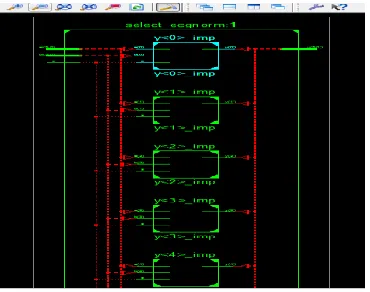
Figure 13: inner architecture for classification of ECG signal
The figure 13 represents the inner synthesized architecture of Loop Aware static selections of ecg signal classification. i.e ecg normal and up normal distribution result .
Figure 14: simulation results of proposed architecture.
The figure 14 intimates the different level of ECG signal analysis, which is starting from ECG sampling signal to ECG normal/upnormal analysis.
4. Conclusion
The figure 12 lingerie the gathering of engineering in ECG investigation of Spartan 3E FPGA which incorporates 9 hinders for designating separate squares of memory beginning from preprocessor stage to conclusive calculation executions.. For de-noising highlight extraction and a grouping we are utilizing DHT module, ANFIS module, and ecgnorm_selections modules. The SRAM and mux modules are utilized to hold the procedure activities and select the flag conditions individually. The proposed modules are utilized to make the square of the stationary wavelet change (SWF) which is utilized forThis paper proposes a decreased intricacy lossless ECG pressure calculation utilizing a versatile straight indicator and setting versatile Golomb-Rice code. An improved setting versatile Golomb code with a window estimate is utilized to upgrade and diminish the capacity of the k esteem. The presented compression method accomplishes an average compression proportion of 2.84 times on the MIT/BIH arrhythmia Lead V1 database and 2.77 times on the MIT/BIH arrhythmia Lead V2 database. The presented pressure technique shows diminished multifaceted nature with high pressure execution when contrasted with other detailed strategies.
References
[1] World Health Statistics 2013, World Health Org., Geneva, Switzerland, 2013.
[2] Electrocardiography, Univ. Michigan Health Syst., Ann Arbor, MI, USA, 2017.
[3] H. Sugano et al., ‚Continuous ECG data gathering by a wireless vital sensor- Evaluation of its sensing and transmission capabilities,‛ in Proc. IEEE ISSSRA, Taichung, Taiwan, Oct. 2010.pp.98-102. [4] B. Singh, A. Kaur, and J. Singh, ‚A review of ECG
data compression Techniques,‛ Int. J. Comput. Appl., vol. 116, no. 11, pp. 39-44, Apr. 2015.
[5] S. Alam and R.Gupta, ‚ADPCM based
electrocardiogram coder with thresholding for real time telemonitoring applications,‛ in Proc. Int. Conf. Commun. Signal Process., Apr. 2014, pp. 176-180. [6] Z. Peric, D. Denic, J. Nikolic, A. Jocic, and A.
Jovanovic, ‘‘DPCM quan- tizer adaptation method for efficient ECG signal compression,’’ J. Com- mun. Technol. Electron.., vol. 58, no. 12, pp. 1241–1250, Dec. 2013.
[7] W. C. Mueller, ‘‘Arrhythmia detection program for an ambulatory ECG monitor,’’ Biomed. Sci. Instrum., vol. 14, pp. 81–85, Apr. 1978.
[8] J. R. Cox, F. M. Nolle, H. A. Fozzard, and G. C. Oliver, ‘‘AZTEC, a preprocessing program for real-time ECG rhythm analysis,’’ IEEE Trans. Biomed. Eng., vol. BME-15, no. 2, pp. 128–129, Apr. 1968.
[9] B. Furht and A. Perez, ‘‘An adaptive real-time ECG compression algo- rithm with variable threshold,’’ IEEE Trans. Biomed. Eng., vol. 35, no. 6, pp. 489–494, Jun. 1988.
[10] J. P. Abenstein, ‘‘Algorithms for real-time ambulatory ECG monitoring,’’ Biomed. Sci. Instrum., vol. 14, pp. 73–79, Apr. 1978.
[11] R. C. Barr, S. M. Blanchard, and D. A. Dipersio, ‘‘SAPA-2 is the fan,’’ IEEE Trans. Biomed. Eng., vol. BME-32, no. 5, p. 337, May 1985.
[12] B. R. S. Reddy and I. S. N. Murthy, ‘‘ECG data compression using Fourier descriptors,’’ IEEE Trans. Biomed. Eng., vol. BME-33, no. 4, pp. 428–434, Apr. 1986.
[13] M. E. Womble, J. S. Halliday, S. K. Mitter, M. C. Lancaster, and J. H. Triebwasser, ‘‘Data compression for storing and transmitting ECG’s/VCG’s,’’ Proc. IEEE, vol. 65, no. 5, pp. 702–706, May 1977.
[14] L. V. Batista, E. U. K. Melcher, and L. C. Carvalho, ‘‘Compression of ECG signals by optimized quantization of discrete cosine transform coef- ficients,’’ Med. Eng. Phys., vol. 23, no. 2, pp. 127–134, Mar. 2001.
[15] S. Lee, J. Kim, and J. Lee, ‘‘A real-time ECG data compression and transmission algorithm for an e-health device,’’ IEEE Trans. Biomed. Eng., vol. 58, no. 9, pp. 2448–2455, Sep. 2011.
[16] Z. Lu, D. Y. Kim, and W. A. Pearlman, ‘‘Wavelet compression of ECG signals by the set partitioning in hierarchical trees algorithm,’’ IEEE Trans. Biomed. Eng., vol. 47, no. 7, pp. 849–856, Jul. 2000.
[17] L. Brechet, M.-F. Lucas, C. Doncarli, and D. Farina, ‘‘Compression of biomedical signals with mother wavelet optimization and best-basis wavelet packet selection,’’ IEEE Trans. Biomed. Eng., vol. 54, no. 12, pp. 2186–2192, Dec. 2007.
[18] H. Mamaghanian, N. Khaled, D. Atienza, and P. Vandergheynst, ‘‘Com- pressed sensing for real-time energy-efficient ECG compression on wire- less body sensor nodes,’’ IEEE Trans. Biomed. Eng., vol. 58, no. 9, pp. 2456–2466, Sep. 2011.
[19] A. Al-Shrouf, M. Abo-Zahhad, and S. M. Ahmed, ‘‘A
novel compres- sion algorithm for
electrocardiogram signals based on the linear predic- tion of the wavelet coefficients,’’ Digit. signal. Process., vol. 13, no. 4, pp. 604–622, 2003.
[20] A. Iwata, Y. Nagasaka, and N. Suzumura, ‘‘Data compression of the ECG using neural network for digital Holter monitor,’’ IEEE Eng. Med. Biol. Mag., vol. 9, no. 3, pp. 53–57, Sep. 1990.
INTERNATIONAL JOURNAL OF SCIENTIFIC & TECHNOLOGY RESEARCH VOLUME 8, ISSUE 09, SEPTEMBER 2019 ISSN 2277-8616
1965 [22] C. J. Deepu and Y. Lian, ‘‘A low complexity lossless
compression scheme for wearable ECG sensors,’’ in Proc. IEEE Int. Conf. Digit. Signal Process. (DSP), Singapore, Jul. 2015, pp. 449–453.
[23] G.-A. Luo, S.-L. Chen, and T.-L. Lin, ‘‘VLSI implementation of a lossless ECG encoder design with fuzzy decision and two-stage Huffman coding for wireless body sensor network,’’ in Proc. 9th Int. Conf. Inf., Commun. Signal Process. (ICICS), Tainan, Taiwan, Dec. 2013, pp. 1–4.
[24] S.-L. Chen and J.-G. Wang, ‘‘VLSI implementation of low-power cost- efficient lossless ECG encoder design for wireless healthcare monitoring application,’’ Electron. Lett., vol. 49, no. 2, pp. 91–93, Jan. 2013.
[25] C. J. Deepu and Y. Lian, ‘‘A joint QRS detection and data compression scheme for wearable sensors,’’ IEEE Trans. Biomed. Eng., vol. 62, no. 1, pp. 165–175, Jan. 2015.
[26] W. D. Leon-Salas, ‘‘Encoding compressive sensing measurements with Golomb–Rice codes,’’ in Proc. IEEE Int. Symp. Circuits Syst. (ISCAS), Lisbon, Portugal, May 2015, pp. 2177–2180.
[27] C. P. Antonopoulos and N. S. Voros, ‘‘Resource efficient data compres- sion algorithms for demanding, WSN based biomedical applications,’’ J. Biomed. Inform., vol. 59, pp. 1–14, Feb. 2016.
[28] S.-L. Chen, H.-Y. Lee, C.-A. Chen, H.-Y. Huang, and C.-H. Luo, ‘‘Wire- less body sensor network with adaptive low-power design for biometrics and healthcare applications,’’ IEEE Syst. J., vol. 3, no. 4, pp. 398–409, Dec. 2009.
[29] K. Li, Y. Pan, F. Chen, K.-T. Cheng, and R. Huan, ‘‘Real-time lossless ECG compression for low-power wearable medical devices based on adap- tive region prediction,’’ Electron. Lett., vol. 50, no. 25, pp. 1904– 1906, Dec. 2014.
[30] C. J. Deepu, C.-H. Heng, and Y. Lian, ‘‘A hybrid data compression scheme for power reduction in wireless sensors for IoT,’’ IEEE Trans. Biomed. Circuits Syst., vol. 11, no. 2, pp. 245–254, Apr. 2017.
[31] Z. Arnavut, ‘‘ECG signal compression based on burrows-wheeler trans- formation and inversion ranks of linear prediction,’’ IEEE Trans. Biomed. Eng., vol. 54, no. 3, pp. 410–418, Mar. 2007.
[32] S. K. Mukhopadhyay, M. Mitra, and S. Mitra, ‘‘ECG signal process- ing: Lossless compression, transmission via GSM network and feature extraction using Hilbert transform,’’ in Proc. IEEE Point-Care Healthcare Technol. (PHT), Jan. 2013, pp. 85–88.
![Fig 1 A period of typical ECG signal [2]](https://thumb-us.123doks.com/thumbv2/123dok_us/8629948.1419656/1.612.337.561.539.676/fig-period-typical-ecg-signal.webp)