Low density nuclear matter in effective field theory
S. Krewald1,3,a, P. Saviankou1, E. Epelbaum1,2, and Ulf-G. Meißner1,2,3
1 Institut f¨ur Kernphysik und J¨ulich Center for Hadron Physics, Forschungszentrum J¨ulich, D-52425 J¨ulich, Germany
2 Universit¨at Bonn, Helmholtz-Institut f¨ur Strahlen- und Kernphysik und Bethe Center for Theoretical Physics, Nußallee
14-16, D-53115 Bonn, Germany
3 Institute for Advanced Simulation, Forschungszentrum J¨ulich, D-52425 J¨ulich, Germany
Abstract. The two- and three-nucleon interaction derived in chiral effective field theory is used to obtain the binding energy of nuclear matter for small densities at next-to-leading (NLO) and next-to-next-to-leading orders
(N2LO). The order N2LO is not yet sufficient to push the range of validity of the expansion beyond the empirical
Fermi momentum of nuclear matter. A phenomenological extension of the interaction suggests that both effective
three- and four-nucleon interactions are required for a description of the bulk properties of nuclear mater.
1 Introduction
Within the last two decades, effective field theory (EFT) has provided new methods for nuclear structure investiga-tions. Both two- and three-nucleon interactions based on the most general chiral effective pion-nucleon Lagrangian have been developed utilizing Weinberg’s power count-ing scheme. The phase shifts of the nucleon-nucleon in-teraction below the pion production threshold are repro-duced with a precision that is comparable with the one achieved by the best phenomenological two-nucleon po-tentials, when pushing the expansion to next-to-next-to-next-to-leading order (N3LO), see Refs.[1, 2]. These forces
together with three-nucleon forces at N2LO have been
ap-plied to a cornucopia of reactions, as reviewed in Ref. [3]. Given these successes, the question arises whether eff ec-tive field theory can contribute to the solution of the nu-clear matter problem. First attempts in this direction have been undertaken by the Munich group, see e.g. Refs. [4, 5] and references therein. We apply the NLO and N2LO ver-sions of the chiral nucleon-nucleon interaction to nuclear matter. This differs from the Munich approach which con-centrates on the development of a chiral effective interac-tion to be used exclusively in the nuclear medium with no direct link to the two-nucleon interaction in the vacuum. In Ref.[6], nuclear matter has been studied with a low-momentum two-nucleon force Vlow−kderived from the
Ar-gonnev18 potential via renormalization group techniques.
It was found that the low-momentum interactions can be used in second order perturbation theory to describe nu-clear matter, provided Pauli blocking effects due to the medium are properly included. This approach was recently extended to the Vlow−k versions of the chiral N3LO
po-tentials [7]. Note, however, that chiral three-body forces at N2LO are included without appropriate running down
a e-mail:[email protected]
to low momenta as the two-nucleon forces. Here, we fol-low a similar path but make use of effective field theory to maintain a systematic connection between the two- and many-nucleon forces at each order of the chiral expansion as reviewed in Ref. [3].
2 The method
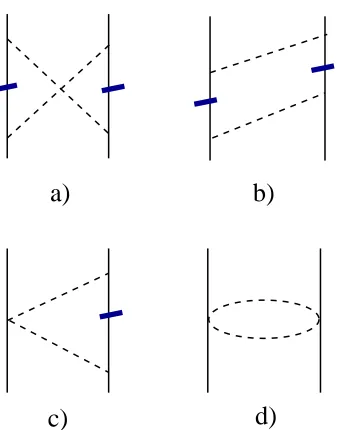
The major ingredient of chiral effective field theory is power counting which allows to organize various contributions to the nucleon forces in a systematic way. In Ref.[8], chi-ral power counting was applied to derive nuclear forces from the most general effective chiral Lagrangian for pions and nucleons by eliminating the pionic Fock-space com-ponents via the FST-Okubo projection method [9, 10]. The two-pion exchange diagrams relevant for the discussion of the properties of nuclear matter are shown in Fig. 1 up to NLO. The Weinberg-Tomozawa term generates a class of triangle diagrams (c) characterized by one internal nu-cleon line. Moreover, there are diagrams with two internal nucleon lines such as the crossed-box two pion exchange (a). Diagram (b) is an example of the so-called wave func-tion renormalizafunc-tion graphs which are not two-nucleon-reducible and therefore also generate contributions to the nuclear forces [11]. Finally, the so-called football diagram (d) does not involve nucleon propagators in the intermedi-ate stintermedi-ates.
In the nuclear medium, the two-nucleon interaction eval-uated in the vacuum is modified by Pauli blocking effects. The most important and well-known Pauli blocking effect affects the intermediate two-nucleon states. For the chiral two-nucleon interaction, there are additional Pauli block-ing effects due to the intermediate one- and two-nucleon propagators in the diagrams shown in Fig. 1.
Formally, its is trivial to take those blocking effects into account. The chiral forces are derived using the
FST-DOI:10.1051/epjconf/201006007
a)
b)
c)
d)
Fig. 1. Two-pion exchange corrections to the chiral two-nucleon
potential in NLO: a) crossed box, b) wave-function
renormaliza-tion, c) triangle and d) football diagrams. Solid/dashed lines
de-note nucleons/pions. The thick lines indicate medium
modifica-tions due to Pauli blocking.
Okubo method of unitary transformations introducing a projectorηon the two-nucleon space and a projectorλon the remaining part of the Fock space which consists of two-nucleon and one- or multi-pion states. An effective Hamil-tonian in the two-nucleon space is obtained by solving the decoupling condition
λ(H−[A,H]−AHA)η=0, (1)
for the transition operator A=λAη. In the nuclear medium, one has to introduce medium-modified projectors
¯ η=
Z
d3k1
Z
d3k2(1−n(k1))(1−n(k2))
× |k1k2ihk1k2|,
¯ λ=
Z
d3k1
Z
d3k2
Z
d3qπ(1−n(k1))(1−n(k2))
× |k1k2qπihk1k2qπ| , (2)
where n(k)=1 for k≤kF and n(k)=0 for k>kF denotes the occupation probability of the level k. The momenta of the two nucleons and the pion are denoted by k1,k2 and
qπ, repectively.
The binding energy is obtained by summing all two-nucleon reducible diagrams, as it is done in Brueckner-Hartree-Fock theory. Ref. [6] corresponds to the limit of the present approach for weak potentials. At NLO, genuine three-body forces are not yet included. The two-nucleon interactions derived in Ref. [2] are characterized by two regulators, the cut-offΛ˜introduced in the spectral function representation of the two-pion exchange diagrams and the cut-offΛrequired for the non-perturbative renormalization of the Lippmann-Schwinger equation. The actual poten-tials are derived for a large set of regulators ˜ΛandΛin
order to generate theoretical error bands for a given order of the expansion.
3 Results at next-to-leading order
-40 -20 0 20 40 60
0 100 200 300
delta [deg]
Lab. Energy [MeV]
1
S0
0 50 100 150
0 100 200 300
delta [deg]
Lab. Energy [MeV]
3
S1
-30 -20 -10 0
0 100 200 300
delta [deg]
Lab. Energy [MeV]
1
P1
-30 -25 -20 -15 -10 -5 0
0 100 200 300
delta [deg]
Lab. Energy [MeV]
3
P1
-30 -20 -10 0 10
0 100 200 300
delta [deg]
Lab. Energy [MeV]
3
P0
5 15 25 35 45 55
0 100 200 300
delta [deg]
Lab. Energy [MeV]
3P 2
-30 -20 -10 0
0 100 200 300
delta [deg]
Lab. Energy [MeV]
3
D1
-4 -2 0 2
0 100 200 300
delta [deg]
Lab. Energy [MeV] e1
Fig. 2. Two-nucleon phase shifts versus the nucleon laboratory
energy. The Lippman-Schwinger cut offΛtakes the values 450
MeV (red), 500 MeV (green), 550 MeV (blue), and 600 MeV (magenta). The filled circles correspond to the Nijmegen PWA results.
EFT represents the two-nucleon interaction at next-to-leading order by one- and two-pion exchange diagrams, two S-wave contact terms accompanied by the low energy constants (LECs) CS and CT, and seven contact terms for P- and D-waves, with the corresponding LECs C1, ..C7.
There are no three-body interactions at this order. Details may be found in Ref. [12].
Fig. 2 shows the phases obtained for regulators with values 450 MeV ≤ Λ ≤ 600 MeV as compared to the Nijmegen phase shifts [13]. In the vicinity of the largest proton energy considered, ELab=300 MeV, the3P2phase
shifts and the mixing parameter e1 of the3S1−3D1
par-tial waves separate into clearly distinguishable bands char-acterized by the Lippmann-Schwinger cut-offΛ. With de-creasing proton energy, the distances between those bands diminish until all bands merge near 50 MeV. In the case of the other P-waves and the S-waves, the bands merge at about 100 MeV. The experimental phase shifts are re-produced from threshold till approximately 50 MeV. For larger energies, the fit quality deteriorates. Although the description of the phase shifts at NLO leaves room for improvement in detail, the corresponding two-nucleon in-teraction shows interesting properties already at this order which makes an application to nuclear matter interesting. The 1S
0 and3S1 phase shifts become negative at ELab =
a weak dependence on the cut-off momenta. In meson-exchange models, negative S-wave phase shifts at large en-ergies are related to the repulsive core due to theω-meson which dominates the short distance physics and is assumed to play an essential role in producing the saturation of nu-clear matter [14]. EFT treats long-range physics explicitly and summarizes the effects of short-range physics by tact interactions with their corresponding low-energy con-stants. Given the good reproduction of the experimental S-wave phase shifts, EFT may be expected to produce sat-uration of nuclear matter qualitatively already at NLO. A quantitative description of the empirical saturation point of nuclear matter may not be expected, however, because of the strong dependence of the higher partial waves on the regulators.
-70 -65 -60 -55 -50 -45 -40 -35 -30 -25 -20 -15 -10 -5 0
0.5 1 1.5 2 2.5 3
E/A [MeV]
kF [fm-1]
Fig. 3. Binding energy per particle of nuclear matter as a
func-tion of the Fermi momentum kF for the NLO potentials. The
Lippman-Schwinger cut offΛtakes the values 450 MeV (red),
500 MeV (green), 550 MeV (blue), and 600 MeV (magenta).
The binding energy per particle of nuclear matter is shown in Fig. 3 as a function of the Fermi momentum
kF. For small Fermi momenta, kF ≤ 0.7fm−1, all satura-tion curves merge into a universal line, as required by the Hugenholtz-van Hove theorem [15]. A similar behaviour has been found in Ref. [6]. At larger values of the Fermi momenta, the saturation curves split into bands character-ized by the Lippmann-Schwinger regulatorΛ. For the cut-offΛ=450 MeV, one obtains a saturation curve with clos-est distance to the empirical saturation point, but produc-ing saturation at an unrealistically large Fermi momentum with extreme overbinding. The S-wave phase shifts pro-duced with the cut-offΛ = 450 MeV are more repulsive than the ones due to larger values of the cut-off, but on the other hand,Λ=450 MeV produces1P
1and3P1phase
shifts which are too attractive. Both S- and P-wave phase shifts are reproduced better employing larger cut offs, such asΛ=550 MeV ofΛ=600 MeV. The corresponding sat-uration point moves down to kF=1.5 fm−1.
4 Results in next-to-next-to-leading order
The phase shifts obtained at next-to-next-to-leading order are shown in Fig.4. The error bands corresponding to dif-ferent values of the Lippman-Schwinger cut-offbegin to
-40 -20 0 20 40 60
0 100 200 300
delta [deg]
Lab. Energy [MeV]
1S 0
0 50 100 150
0 100 200 300
delta [deg]
Lab. Energy [MeV]
3S 1
-30 -25 -20 -15 -10 -5 0
0 100 200 300
delta [deg]
Lab. Energy [MeV]
1P 1
-45 -35 -25 -15 -5
0 100 200 300
delta [deg]
Lab. Energy [MeV]
3
P1
-30 -20 -10 0 10
0 100 200 300
delta [deg]
Lab. Energy [MeV]
3P 0
5 15 25 35 45
0 100 200 300
delta [deg]
Lab. Energy [MeV]
3P 2
-30 -20 -10 0
0 100 200 300
delta [deg]
Lab. Energy [MeV]
3
D1
-4 -2 0 2
0 100 200 300
delta [deg]
Lab. Energy [MeV] e1
Fig. 4. Two-nucleon phase shifts versus the nucleon laboratory
energy at N2LO. The Lippman-Schwinger cut offΛtakes the
val-ues 450 MeV (red), 500 MeV (green), 550 MeV (blue), and 600 MeV (magenta).
merge even for the partial P- and D-waves. The fit of the
1S
0 phase reduces the too repulsive behaviour of the1S0
phase shift in NLO, which is a definite improvement. The
3P
1 and3P2 phase shifts are now much closer to the
Ni-jmegen ones, showing more repulsion at higher energies than in the NLO approximation.
-45 -40 -35 -30 -25 -20 -15 -10 -5 0 5
0.5 1 1.5 2
E/A [MeV]
kF [fm-1]
Fig. 5. Binding energy per particle of nuclear matter as a
func-tion of the Fermi momentum kF for the NNLO potentials. The
Lippman-Schwinger cut offΛtakes the values 450 MeV (red),
500 MeV (green), 550 MeV (blue), and 600 MeV (magenta).
The binding energy per particle of nuclear matter due to two-nucleon forces at order N2LO is shown in Fig. 5.
sat-uration point, the cut offdependence introduces an uncer-tainty in the binding energy due to two-body interactions of about 10 MeV, which signals that the order N2LO does not
yet suffice for an acceptable description of nuclear matter. Note that in the counting scheme of EFT, three-nucleon in-teractions appear for the first time at N2LO. For each
com-bination of regulatorsΛand ˜Λ, the low energy constants cD and cEof the three-nucleon force have to be determined. In Fig. 6, the binding energy of nuclear matter obtained from the two-nucleon potential employing a Lippman–Schwin-ger cut-offΛ=326 MeV is shown by the dashed doubled-dotted line. Clearly, this potential overbinds, as the em-pirical binding energy of−16 MeV is reached already at
kF =1.2 fm−1. For small cut offs, a perturbative treatment of the three-body interaction is justified [6]. We vary the strength of the force parameter cDin the range from−0.4 to 1.2 in order to study the effect of the three-body forces on the binding energy. For cD = 1.2, one obtains satura-tion of nuclear matter near the empirical Fermi momentum
kF = 1.36 fm−1 but finds a binding energy of−10 MeV, thus underbinding nuclear matter by∼6 MeV.
1 1,2 1,4 1,6
Fermi momentum [1/fm] -18
-16 -14 -12 -10 -8
Binding energy [MeV] c_D=-0.4 c_D=+0.4 c_D=+1.2
Fig. 6. Binding energy per particle of nuclear matter as a
func-tion of the Fermi momentum kF for the N2LO potential using a
Lippman-Schwinger cut offΛ =326 MeV. The dashed-double
dotted green line refers to the N2LO result using only the
two-nucleon potential. The effects of the three-body forces is shown
by the solid red line corresponding to cD =1.2 GeV. For
com-parison, we show additional calculations performed with smaller
values of cD. The empirical saturation point is indicated by the
red circle.
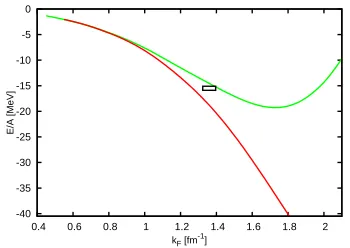
After the inclusion of the three-body terms, the satu-ration point of nuclear matter is obtained near the empir-ical Fermi momentum kF = 1.36 fm−1, but nuclear mat-ter is underbound by about 6 MeV, using a soft cut off. An increase of the binding energy goes together with an enhancement of the saturating Fermi momentum. Employ-ing larger values of the Lippman-SchwEmploy-inger cut offdoes not modify this conclusion. The binding energy of nuclear matter obtained from the N2LO potential corresponding to the regulatorsΛ= 550 MeV and ˜Λ =500 MeV is shown in Fig. 7. The parameters of the three-nucleon interaction are determined from a fit to the binding energies of light nuclei, E(3H) = −8.482 MeV, E(4He) = −27.88 MeV, and the alpha particle radius r(4He) = 1.959 fm, which
leads to the values cD =−4.5 and cE = −1.38 [16].
Fol-lowing Ref. [6], we transform the three-body interation into a density-dependent two-body interaction. Below kF = 1 fm−1, the contribution of the three-nucleon interaction
is negligible. At larger Fermi momenta, the three-nucleon force produces more attraction than provided by the two-nucleon interaction only. At larger densities, however, the
-40 -35 -30 -25 -20 -15 -10 -5 0
0.4 0.6 0.8 1 1.2 1.4 1.6 1.8 2
E/A [MeV]
kF [fm-1]
Fig. 7. Binding energy per particle of nuclear matter as a
func-tion of the Fermi momentum kF for the N2LO potential using a
Lippman-Schwinger cut off Λ = 550 MeV. The red solid line
refers to the N2LO result. For comparison, a calculation omitting
the three-body forces is shown by the dashed green line. The em-pirical saturation point is indicated by the black box.
N2LO result becomes unrealistic, as the saturation point
moves beyond kF =2 fm−1. At a first look, it seems odd that the saturation point is not stable when the order of the expansion is increased. One has to realize, however, that there is a major difference between effective field theories and, for example, meson-exchange models of the nucle-onic interaction. By their very nature, effective field theo-ries are valid only at low momenta determined by scales of the degrees of freedom taken into account explicitly. In lowest order of the expansion, acceptable quantitative agreement with experiment is achieved only for very low momenta. With increasing order of the expansion, the range of quantitatively acceptable agreement with experiment in-creases. The effective field theory of the two-nucleon in-teraction provides a good example of this kind of con-vergence. Likewise, one may expect a quantitative render-ing of the bindrender-ing energy of nuclear matter only for small Fermi momenta in NLO. At order N2LO, the contribu-tion of the three nucleon interaccontribu-tion to the binding en-ergy scales with an additional power of k3
F, which becomes dominant at large kF. Clearly, for large values of kF, one has to include four-body interactions which make small contributions near the empirical saturation point, but guar-antee the correct asymptotic behaviour of the binding en-ergy at large densities. The results obtained in Figs. 6 and 7 show that effective field theory at order NLO and N2LO
5 Effective density–dependent
two-nucleon interaction
The present investigation suggests that both three- and four-nucleon interactions are required in an effective field the-ory of nuclear matter. Before proceeding to the order N3LO,
it may be worthwhile to consider the question whether den-sity dependent modifications of the contact terms should be taken into account. To motivate such terms, consider a hypothetical effective field theory of the two-nucleon inter-action which treats for example heavy mesons such as the ωand theρexplicitly. The low-energy constants defined in Ref. [12] should be obtained by integrating out the heavy mesons from the underlying hypothetical theory. When ap-plied to nuclear matter, the short range part of the underly-ing theory changes, which leads naturally to a density de-pendent modification of the low-energy constants. In order to estimate the coupling constants of such medium depen-dent corrections, we abandon the chiral counting scheme and construct a simplified two-nucleon interaction which consists of the leading order of the chiral interaction and only the contact terms of the next-to-leading interaction. Explicitly, the effective interaction reads:
Ve f f =VOPEP+V(0)+V(2), (3)
VOPEP=− gA 2Fπ
!2
τ1·τ2σ1·qσ2·q,
×
2
q2+M2
π±
− 1
q2+M2
π0
, (4)
V(0)=CS +CTσ1·σ2 (5)
V(2)=C1q2+C2k2+(C3q2+C4k2)σ1·σ2,
+iC5
1
2(σ1+σ2)·k×q,
+C6σ1·qσ2·q+C7σ1·kσ2·k, (6)
withgAthe nucleon axial-vector couplng constant, Fπthe weak pion decay constant and Mπ0(Mπ±) refer to the
neu-tral (charged) pion mass. Further, q = p′−p and k =
1/2(p′+p) with p′and p being the final and initial CMS
momenta of the nucleons. The coefficients CS, CT, and
Ci,1 ≤ i ≤ 7 are determined by a fit to the phase shifts of the Nijmegen group. A regulator for internal pion loops is no longer required, but one has to employ a regulator for the solution of the Lippman-Schwinger equation. We used the same regulator as in the N2LO investigation,Λ=
550 MeV. The results are shown in Table 1.
The corresponding phase shifts are shown in Fig. 8. The simplified interaction generates phase shifts similar to the ones obtained at next-to-leading order. The3S
1phase
shift is close to the Nijmegen values for all energies consid-ered, the1S0 phase shift reproduces the Nijmegen values
for energies of the incident nucleon ranging from threshold up to 100 MeV, as was the case for the full NLO calcula-tion, see Fig. 2. Likewise, both the NLO interaction and the simplified interaction overestimate the attraction in the
3P
1and3P2phase shifts.
Next, we simulate the effects of three- and four-body interactions by a density dependent modification of the
ef-Table 1. Coefficients of the contact terms
CA[10−4GeV−2]
CS -0.009792
CT -0.000860
Ci[10−4GeV−4]
C1 +0.026292
C2 +0.080494
C3 -0.004566
C4 -0.013290
C5 +0.049980
C6 -0.002209
C7 -0.107220
-40 -20 0 20 40 60
0 100 200 300
delta [deg]
Lab. Energy [MeV]
1S 0
0 50 100 150
0 100 200 300
delta [deg]
Lab. Energy [MeV]
3
S1
-30 -25 -20 -15 -10 -5 0
0 100 200 300
delta [deg]
Lab. Energy [MeV]
1P 1
-35 -25 -15 -5
0 100 200 300
delta [deg]
Lab. Energy [MeV]
3
P1
-30 -20 -10 0 10
0 100 200 300
delta [deg]
Lab. Energy [MeV]
3
P0
5 15 25 35 45
0 100 200 300
delta [deg]
Lab. Energy [MeV]
3P 2
-30 -20 -10 0
0 100 200 300
delta [deg]
Lab. Energy [MeV]
3D 1
-2 0 2
0 100 200 300
delta [deg]
Lab. Energy [MeV] e1
Fig. 8. Two-nucleon phase shifts versus the nucleon laboratory
energy for a contact interaction, using a Lippman-Schwinger cut
offΛ=550 MeV.
fective two-nucleon interaction V(0)as follows:
V(0)=CS − 1
4A[CS −3CT] x (x−1)
+σ1·σ2 CT+
1
4A[CS −3CT]x(x−1) !
x=(ρ/ρc)13. (7)
There are two parameters, A andρc=2k3
C/(3π
2). The
em-pirical saturation point can be reproduced with the choice
A = 0.025 and kC = 284 MeV. The1S0 partial wave
de-pends on the combination CS −3CT of the S-wave LECs and is changed by the modification above. The3S
1partial
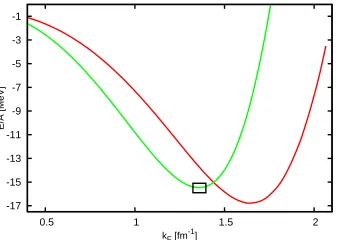
similar finding has been obtained for the NLO interaction. The saturation found is not due to many-body forces, but exclusively due the repulsive components of the two-body interaction which are fixed by the phase shifts. In order to get a quantitative description of the saturation properties of nuclear matter, both three- and four-body forces have to be taken into account, however. At densities corresponding to the critical Fermi momentum kC, the contributions of the three-body and four-body terms cancel. Below the critical density, the effective three-body interactions generate at-traction in addition to the contributions from the two-body forces. At large densities, the four-body interactions gen-erate repulsive contributions which stabilize the system. The compression modulus of nuclear matter is found to be
K=220 MeV. This is quite remarkabable, as the breathing mode of finite nuclei has been used by Blaizot to obtain empirical constraints on the compression modulus of nu-clear matter[17], with a recent update by Colo et al. finding values ranging from K=230 MeV to K=240 MeV [18].
-17 -15 -13 -11 -9 -7 -5 -3 -1
0.5 1 1.5 2
E/A [MeV]
kF [fm-1]
Fig. 9. Binding energy per particle of nuclear matter as a
func-tion of the Fermi momentum kF for a contact interaction, using
a Lippman-Schwinger cut offΛ=550 MeV(red line). The solid
(green) line shows the effect of a phenomenological density
de-pendence. The empirical saturation point is indicated by the black box.
6 Conclusions
The two- and three-nucleon interactions derived from ef-fective field theory at orders NLO and N2LO have been used to obtain the binding energies of nuclear matter in the limit of small densities. The binding energies of nuclear matter are insensitive to the cut-offparameters employed for Fermi momenta less than kF = 0.9 fm−1. The order N2LO does not yet allow to study the vicinity of the empir-ical saturation point of nuclear matter, kF =1.36 fm−1. A simplified two-nucleon interaction supplemented by a phe-nomenological consideration of the effects of three- and four-nucleon interactions allows to simultaneously describe nucleon-nucleon phase shifts and the empirical binding en-ergy and saturation density of nuclear matter.
7 Acknowledgements
We thank A. Nogga for providing the three-body constants. A helpful comment by Victor Tselyaev is gratefully ac-knowledged. We thank the DFG for partial support by the grant GZ:432RUS113/994/0-1. This work was further sup-ported in parts by funds provided from the Helmholtz As-sociation to the young investigator group “Few-Nucleon Systems in Chiral Effective Field Theory” (grant VH-NG-222) and the Virtual Institute “Spin and strong QCD” (grant VH-VI-231). This work was further supported by the DFG (SFB/TR 16 “Subnuclear Structure of Matter”) and the Eu-ropean Community-Research Infrastructure Integrating Ac-tivity “Study of Strongly Interacting Matter” (acr.: Hadron Physics2, Grant Agreement n. 227431) under the Seventh Framework Programme of the EU.
References
1. D. R. Entem and R. Machleidt, Phys. Lett. B 524 (2002) 93 [arXiv:nucl-th/0108057].
2. E. Epelbaum, W. Gl¨ockle and U.-G. Meißner, Nucl. Phys. A 747 (2005) 362 [arXiv:nucl-th/0405048]. 3. E. Epelbaum, H. W. Hammer and U.-G. Meißner,
arXiv:0811.1338 [nucl-th].
4. N. Kaiser, S. Fritsch and W. Weise, Nucl. Phys. A 697 (2002) 255 [arXiv:nucl-th/0105057].
5. N. Kaiser, M. Muhlbauer and W. Weise, Eur. Phys. J. A 31 (2007) 53 [arXiv:nucl-th/0610060].
6. S. K. Bogner, A. Schwenk, R. J. Furnstahl and A. Nogga, Nucl. Phys. A 763 (2005) 59 [arXiv:nucl-th/0504043].
7. S. K. Bogner, R. J. Furnstahl, A. Nogga and A. Schwenk, arXiv:0903.3366 [nucl-th].
8. E. Epelbaum, W. Gl¨ockle and U.-G. Meißner, Nucl. Phys. A 637 (1998) 107 [arXiv:nucl-th/9801064]. 9. N. Fukuda, K. Sawada and M. Taketani, Prog. Theor.
Phys. 12 (1954) 156.
10. S. Okubo, Prog. Theor. Phys. 12 (1954) 603.
11. E. Epelbaum, W. Gl¨ockle and U.-G. Meißner, Nucl. Phys. A 671 (2000) 295 [arXiv:nucl-th/9910064]. 12. E. Epelbaum, Prog. Part. Nucl. Phys. 57 (2006) 654
[arXiv:nucl-th/0509032].
13. N. G. J. Stoks et al., Phys. Rev. C48 (1993) 792 14. H. A. Bethe, Annu.Rev.Nucl.Sci.21 (1971)93 15. N. M. Hugenholtz, Physica 23 (1957) 533 16. A. Nogga, private communication
17. J. P. Blaizot, Phys. Rep. 64 (1980)171.