R E S E A R C H
Open Access
Persistent effect at 30-month post
intervention of a community-based
randomized trial of KM2H
2
in reducing
stroke and heart attack among senior
hypertensive patients
Jie Gong
1*, Yunan Xu
2*, Xinguang Chen
2, Niannian Yang
1, Fang Li
1and Yaqiong Yan
1Abstract
Background:The effect of the Keep Moving toward Healthy Heart and Healthy Brain (KM2H2) program at 6-month post intervention has been assessed. The purpose of this study is to evaluate the KM2H2program at 30-month post intervention.
Methods:A total of 450 senior hypertensive patients from 12 community health centers were randomized by center to either receive KM2H2plus standard care (6 centers,n= 232) or standard care only (6 centers,n= 218). Data for outcome measures at 30-month post intervention were analyzed. New cases of stroke and heart attack were verified with medical records; levels of physical activity were assessed using self-reported questionnaire. In addition to comparative analysis, adjusted incidence rate and program effects were determined using mixed effects modeling method.
Results:At the 30-month follow-up, the adjusted incidence rate [95% CI] of stroke was 11.81% [5.90, 17.72] for patients in the intervention group and 19.78% [14.07, 25.50] (p= 0.03) for the control group. The adjusted incidence rate of heart attack was 3.34% [1.91, 8.58] and 6.68% [1.64, 11.73] for the intervention and control groups (p= 0.16), respectively; the proportion and the duration of engaging in regular physical activity were significantly greater for the intervention group than the control group. The reductions in blood pressure between the intervention and the control was not statistically significant.
Conclusions:The KM2H2program showed a persistent effect up to 30 months post intervention in enhancing physical activity and reducing the risk of cardio-cerebrovascular events, particularly stroke. These findings
demonstrate the persistent effect of the KM2H2and suggest the need for a full-scale evaluation of the intervention program for practical use.
Trial registration:ISRCTN Register ISRCTN12608966. Registered 03 March 2015. Retrospectively registered.
Keywords:Physical activity, Stroke and heart attack, Hypertension, Multicenter trial
* Correspondence:
[email protected];[email protected];[email protected]
1Wuhan Center for Disease Prevention and Control, 24 Jianghan North Road,
Wuhan 430022, China
2Department of Epidemiology, University of Florida, 2004 Mowry Road,
Gainesville, Florida 32610, USA
Background
Preventing stroke and heart attack represents a very promising approach to reduce mortality from cardio-and cerebrovascular diseases [1]. Hypertension is one of the important modifiable risk factors, responsible for 45% of the deaths due to heart disease and 51% of the deaths due to stroke [2]. Along with rapid economic growth and the adaption of modern sedentary life styles, the prevalence of hypertension in China has increased 6.6 times in the past decade [3, 4]. The prevalence of hypertension increases to 56.6% for people 65 years of age and older [3, 4].
Antihypertensive medication has been used as a pri-mary strategy to control blood pressure and prevent complications [5, 6]. Research has shown that antihyper-tensive drug therapy alone can reduce the risk of stroke by 30–47%, heart disease by 27–40%, and the overall cardiovascular disease mortality by 15% [7, 8]. The effect from antihypertension medication can be enhanced by physical activity. The role of physical activity in control-ling blood pressure has long been recognized [9, 10]. Participating in regular moderate or higher levels of physical activity can also reduce other cardiovascular risks, such as weight gain, hypercholesterolemia, meta-bolic syndrome, and diabetes [11, 12]. However, few reported studies have examined the impact of physical activity on reducing the incidence of cardio- and cere-brovascular diseases among patients under antihyperten-sive medication.
A number of barriers may prevent senior patients with hypertension from engaging in physical activities at the community level [13, 14]. Hypertensive patients are often older in age and lower in self-confidence to engage in physical activity [15, 16]; these patients are also lack of adequate societal and familial supports [15, 16] to maintain recommended activity levels [17, 18]. In addition, senior hypertensive patients differ from each other dramatically. For example, some are retired while others are still working; some may live with spouse and children while others may live alone; some are better off while others live on social security funding.
Considering the barriers described above, a program “Keep Moving toward Healthy Heart & Healthy Brain” (KM2H2) was developed to promote senior hypotensive patients to engage in physical activities. The program is guided by the Transtheoretical Model (TTM) to encour-age and monitor the intervention progress by stencour-ages from pre-contemplation, to contemplation, preparation, action, and maintenance [19]. Our adaption of TTM is based on the existing studies and other intervention pro-grams conducted among Chinese populations [16, 19–21]. Considering the large between-patient differences, the KM2H2has incorporated a one-on-one consulting strat-egy guided by the Model of Personalized Medicine to
enhance tailored precision intervention [22, 23]. To achieve long-term effect, a group-based intervention strat-egy is used with guidance of the social capital theory [24]. With group-based sessions delivered in the community settings, the KM2H2provides opportunities for the partic-ipants to develop network connections to enhance social and emotional supports for physical activity initiation and maintenance [24, 25].
The intervention modules of KM2H2and the measure-ments of physical activity were established through a series of rigorous pilot tests [26]. In a previous evaluation study, we demonstrated that participants who received KM2H2were more likely to engage in physical activity at 3-month and 6-month post intervention and less likely to experience stroke and heart attack at 6-month post inter-vention [27]. The purpose of this study is to evaluate if the observed effects of KM2H2on encouraging physical activ-ity and reducing the risk of cardio- and cerebrovascular events persist at 30-month post intervention.
Methods
Design of the trial
Design of the trial has been descried in detail elsewhere when reporting the effect of KM2H2at 3- and 6-month post intervention [27]. Briefly, a two-arm cluster ran-domized controlled trial was used. When planning the trial, power analysis indicated the need for a sample of 440~480 patients to ensure 80% power to detect a mod-erate effect size with alpha at 0.05 level (2-sided). Key factors such as the number of clusters, cluster size and waves of data collection were considered in the power analysis [28]. Participants were selected from Wuhan, a provincial capital city located in central China.
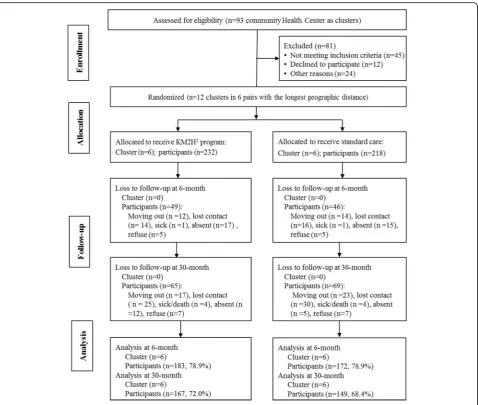
Following the design, a total of 12 community health centers from the city of Wuhan were identified and grouped into 6 pairs with largest geographic distance and similar socioeconomic conditions. Approximate 50 participants per center were enrolled. The enrolled participants were randomized by center pairs to receive either KM2H2 plus standard care as the intervention group or standard care only as the control group. A total of 586 hypertensive patients were approached, 450 agreed to participate with 232 from 6 centers to receive the intervention and 218 from 6 centers to receive the control condition. Data collected at the baseline, 3-, 6-and 30-month post intervention were included in this analysis. More detailed information regarding the re-search design, follow-up assessments and attrition was presented in Fig. 1.
Hong Kong Polytechnic University (for initial funding support to initiate the project and for participation in the intervention program development) and the University of Florida (for statistical analysis of the collected data and the development of the manuscript for publication). All participants provided written informed consent before they were included in the trial.
Participants, inclusion and exclusion criteria
Participants were recruited among patients who were enrolled in a Community-Based Hypertension Control Program (CBHCP) of Wuhan. The CBHCP was launched by Wuhan CDC in 2006 to provide antihypertensive drug therapy for all residents who were diagnosed with hypertension. In addition to the provision of relevant medication, standard care was provided to individual patients on a regular basis, including health education about blood pressure management, dietary, and physical
activities, as well as follow-up checkups on blood pressure, side effect of medication, and any other related issues. The standard care services were provided at the community health centers.
Participants were recruited during January 20 and November 28, 2012. The inclusion criteria were: 1) 55 years of age or older, 2) diagnosed with hypertension and currently on antihypertensive medication, 3) be able to complete the planned intervention activities, 4) no history of stroke and heart attack, and 5) can safely complete the recommended moderate or higher levels of physical activities.
The following criteria were imposed to exclude partici-pants who 1) were failed to the Physical Activity Readi-ness Questionnaire test [29], 2) suffered from obvious heart dysfunction, 3) had other physical, mental, and medical conditions that prevented them from completing the required research activities.
Intervention program KM2H2
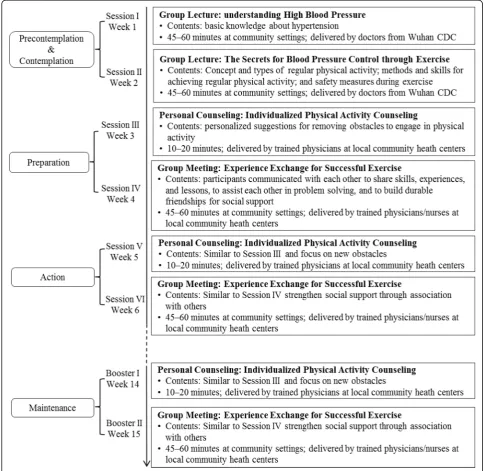
The intervention program KM2H2 was briefed in the Introduction and elsewhere [27]. The program is guided by a multi-theory conceptual framework, con-sisting of TTM [30], Model of Personalized Medicine [22, 23], and social capital theory [24]. The KM2H2 consists of six sessions, plus two booster sessions (Fig. 2). The six intervention sessions were delivered on a weekly basis during the first six weeks, including two group lectures (Session I and II), two personal counseling sessions (Session III and V), and two small group meetings (Session IV and VI). With these
planned intervention sessions, participants were ex-pected to move across the five TTM stages from Pre-contemplation (not ready), to Contemplation (getting ready), Preparation (ready), Action and finally Main-tenance to engage in the enlisted physical activities.
Session I covers the basic knowledge of hypertension, risk and protective factors, and blood pressure self-management. Sessions II focuses on skills training, including the concept and types of regular physical activity, methods and skills for achieving regular physical activity, and safety measures for exercise. Participants were also asked to identify barriers that might prevent
them from engaging in physical activities. The two sessions were delivered at community health centers by preventive medical doctors from Wuhan CDC. The two lecture sessions aim to assist participants in evaluating pros and cons of engaging in physical activity and pro-moting positive behavior expectations.
After the two lecture sessions, participants were fostered to make plans for physical activity. To assist individual participant in preparing and initiating regu-lar physical activity, an one-on-one telephone coun-seling was provided at week three, followed by a small group meeting session at week four. The tele-phone counseling was delivered by trained physicians to solve problems identified through the first two ses-sions that might prevent participants from engaging in physical activity. The small group meeting (8–10 patients per group) was initiated and supervised by the trained physicians/nurses at community health centers. For each group, a group leader was elected by all participants of the group to coordinate the re-quired activities. Through group activities, participants in a group were expected to build durable and trust-worthy network connection, share successful experience and lessons on engaging in physical activities, ensure safety, and overcome barriers for physical activity.
At week five, a second one-on-one telephone counseling (session V) was delivered to help remove new obstacles that might have prevented a participant from engaging in physical activity continuously. A second group meeting (session VI) was arranged in the week six to further strengthen their social network connection to support long-term intervention effects and maintain the estab-lished physical activities.
Since the purpose of the KM2H2 is to establish a new active lifestyle, two booster sessions were added for longer-term behavior maintenance, including a telephone one-on-one counseling session at week 14, followed by a group meeting session at week 15. The personal telephone counseling was used to solve additional problems confronted by individual participant since the last session in week six; the group session was designated to further the social connection for information exchanging, experi-ence sharing, and mutual supporting.
To ensure the fidelity of the intervention, we se-lected the interventionists among senior staffs from Wuhan CDC who were experienced in implanting be-havioral interventions, including lecturing, telephone consulting, and group-activity organization. We also limited the number of interventionists to minimum, with one person to deliver the lecture and organize group activities and one for telephone consulting. The interventionists received rigorous training and all interventional activities were conducted following the established protocol.
Data collection, variables and their measurement
Data collection
To the time of this analysis, four waves of data were collected, including the baseline assessment prior to the KM2H2delivery, and follow-up assessments at 3, 6 and 30 months post intervention. Survey data were collected using self-reported questionnaire through in-person interview. All data collectors, including graduate students, physicians, nurses and staffs were trained according to a standard data collection protocol. The survey was administrated separately by trained graduate students who were blinded from the intervention condi-tions. Clinical data, including family history, height and weight, and blood pressure were obtained from patients medical records. The medical records were generated through routine clinical practice by physicians and nurses who were also blinded from the intervention con-ditions. Participants were compensated with a free meal (equivalent to ~$3) upon completion of each wave of survey data collection.
Events of stroke and heart attack
Stroke and heart attack were the primary outcomes of this study. As indicated in the inclusion criteria early in this paper, only participants with no heart attack and/or stroke at baseline were included in the analysis. New heart attack/stroke events were identified and deter-mined using a two-step strategy – patients’ self-report through in-person interview first, and then verified by medical records from the corresponding CBHCP com-munity health centers. At all assessments, participants were asked two questions, one related to stroke and another on heart attack: “Since last interview, have you had stroke (heart attack) or diagnosed by your doctor that you had a stroke (heart attack)?” For patients who responded positively to a question, the trained data collectors confirmed the reported results against their medical record stored in the corresponding CBHCP community health centers. Only new events of stroke and heart attack during the follow-up period were in-cluded in analysis.
Physical activity
average duration per day using a 5-point rating scale (0: no exercise, 1: <15 min, 2: 15–29 min, 3: 30–59 min, and 4: 1 h or more). Qualified regular physical activity and duration were created using these reported data. Regular physical activity was defined as currently en-gaging in the designated physical activities for at least 30 min per day and for at least 3–5 times per week. For participants who qualified as engagement in regular physical activity, their duration of excise was measured using the 5-point index score with 0 = zero minutes and 4 = 1 h or more. This duration measure, although semi-quantitative, showed adequate validity and frequently used in published studies [26, 32, 33].
Blood pressure
Blood pressure (mmHg) was measured as part of the standard care of CBHCP by registered nurses. These nurses were blinded from the intervention status of individual participants. The measurement of blood pressure was completed following standard procedure recommended by the American Heart Association [34], and mean blood pressure of two separate mea-sures at least 3 min apart was used in analysis. Both systolic and diastolic blood pressures were recorded.
Covariates
Covariates included age, sex (male and female), marital status (married/cohabit vs. divorced/separated), monthly income (RMB), regular cigarette smoking (yes/no), regularly alcohol consumption (yes/no), years of hyper-tension, adherence to antihypertensive medication, and family history of cardiovascular disease.
Statistics methods
Chi-square test (for binary variables) and t-test (for continuous variables) were used to assess baseline comparability of the intervention group and the con-trol group. Multivariate methods for longitudinal data, including mixed effects modeling (for continuous var-iables) and generalized linear mixed effects modeling (for binary variables) were used to assess the effects of the KM2H2 on enhancing physical activities and reducing risk of cardio- cerebrovascular events, con-trolling for the design effect, including cluster randomization and repeated measures, baseline difference between intervention and control, and co-variates. These two multivariate modeling methods are robust to handle missing data due to follow-up attrition and capable of estimating adjusted outcome measures and their 95% confidence intervals. With a multivariate mixed effect modeling approach, the interaction between time and intervention conditions provides a rigorous measure of the efficacy of our
intervention program KM2H2. Statistical analyses were completed using commercial software SAS ver-sion9.30. As usual, type I error was set at p< 0.05 (two-tailed) for statistical inference.
Results
Characteristics of the study participants
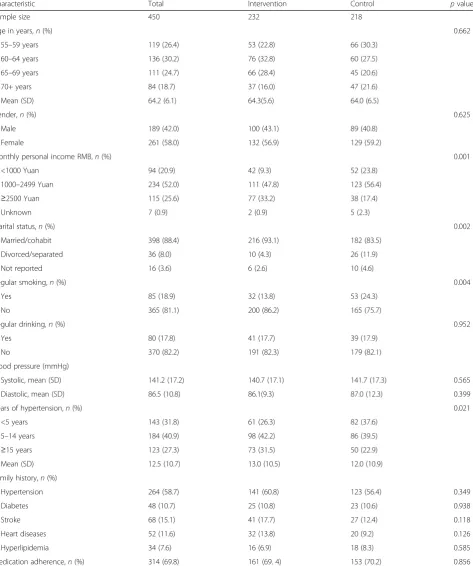
Of the total 450 participants, 355(78.9%) completed the assessment at 6 months follow-up, including 183 (78.9%) from the intervention group and 172 (78.9%) from the control group; 316 (70.2%) completed the assessment at 30 months post intervention with 167 (72.0%) from the intervention group and 149 (68.4%) from the control group. Comparative analysis indi-cated no significant differences in demographic and other factors between those who were lost to follow-up and those who remained in the trial with one ex-ception - participants who were lost were older than those who remained in the study. Reasons for lost to follow-up were summarized in Fig. 1. Baseline charac-teristics of the study participants were reported in the previous study [27]. We presented these data again for the convenience of reviewing (Table 1).
Intervention effect on stroke
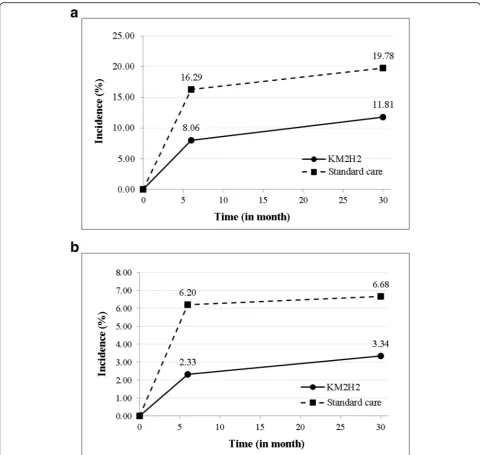
Up to the 30-month post intervention, 19 (11.18%) new stroke cases among the 170 intervention partici-pants were reported, including 2 new cases since 6-month post-intervention. Among the 157 participants in the control group, 43 (27.39%) new stroke cases were reported, including 5 new cases since 6-month post intervention. Results in Fig. 3a from the general-ized linear mixed effects modeling analysis indicated that the adjusted 30-month incidence rate [95% CI] was 11.81% [5.90, 17.72] for the intervention group and 19.78% [14.07, 25.50] for the control group. The model coefficient [95% CI] for the time*intervention term of the generalized linear mixed effect modeling was −0.06 [−0.09, −0.02] (p= 0.03). The results were obtained after controlling for the complex design ef-fect, baseline differences and the key covariates.
Intervention effect on heart attack
control group. The model coefficient [95% CI] for the time*intervention term of the generalized linear mixed effects modeling was −0.03 [−0.06, 0.01] (p= 0.16).
Intervention effect on physical activity
Results from the upper panel of Table 2 indicate that at 30-month post intervention, 64.98% [54.81, 75.16] of the Table 1Baseline characteristics of participants in KM2H2program
Characteristic Total Intervention Control pvalue
Sample size 450 232 218
Age in years,n(%) 0.662
55–59 years 119 (26.4) 53 (22.8) 66 (30.3)
60–64 years 136 (30.2) 76 (32.8) 60 (27.5)
65–69 years 111 (24.7) 66 (28.4) 45 (20.6)
70+ years 84 (18.7) 37 (16.0) 47 (21.6)
Mean (SD) 64.2 (6.1) 64.3(5.6) 64.0 (6.5)
Gender,n(%) 0.625
Male 189 (42.0) 100 (43.1) 89 (40.8)
Female 261 (58.0) 132 (56.9) 129 (59.2)
Monthly personal income RMB,n(%) 0.001
<1000 Yuan 94 (20.9) 42 (9.3) 52 (23.8)
1000–2499 Yuan 234 (52.0) 111 (47.8) 123 (56.4)
≥2500 Yuan 115 (25.6) 77 (33.2) 38 (17.4)
Unknown 7 (0.9) 2 (0.9) 5 (2.3)
Marital status,n(%) 0.002
Married/cohabit 398 (88.4) 216 (93.1) 182 (83.5)
Divorced/separated 36 (8.0) 10 (4.3) 26 (11.9)
Not reported 16 (3.6) 6 (2.6) 10 (4.6)
Regular smoking,n(%) 0.004
Yes 85 (18.9) 32 (13.8) 53 (24.3)
No 365 (81.1) 200 (86.2) 165 (75.7)
Regular drinking,n(%) 0.952
Yes 80 (17.8) 41 (17.7) 39 (17.9)
No 370 (82.2) 191 (82.3) 179 (82.1)
Blood pressure (mmHg)
Systolic, mean (SD) 141.2 (17.2) 140.7 (17.1) 141.7 (17.3) 0.565
Diastolic, mean (SD) 86.5 (10.8) 86.1(9.3) 87.0 (12.3) 0.399
Years of hypertension,n(%) 0.021
<5 years 143 (31.8) 61 (26.3) 82 (37.6)
5–14 years 184 (40.9) 98 (42.2) 86 (39.5)
≥15 years 123 (27.3) 73 (31.5) 50 (22.9)
Mean (SD) 12.5 (10.7) 13.0 (10.5) 12.0 (10.9)
Family history,n(%)
Hypertension 264 (58.7) 141 (60.8) 123 (56.4) 0.349
Diabetes 48 (10.7) 25 (10.8) 23 (10.6) 0.938
Stroke 68 (15.1) 41 (17.7) 27 (12.4) 0.118
Heart diseases 52 (11.6) 32 (13.8) 20 (9.2) 0.126
Hyperlipidemia 34 (7.6) 16 (6.9) 18 (8.3) 0.585
Medication adherence,n(%) 314 (69.8) 161 (69. 4) 153 (70.2) 0.856
intervention patients maintained regular level of physical activity, while the adjusted proportion was 40.97% [30.78, 51.16] for control patients. The model coefficient [95% CI] for the time*intervention term of the mixed effects modeling was 0.24 [0.14, 0.34] (p< 0.01).
Results in the bottom panel of Table 2 indicated that the mean exercise duration index [95% CI] was 2.83 [2.54, 3.12] for the intervention group and 2.46 [2.17,
2.76] for the control group. The model coefficient [95% CI] for the time*intervention term of the mixed effects modeling was 0.36 [0.03, 0.69] (p= 0.04).
It is worth noting that the level of physical activity for patients in the control group was relatively high. This is because before participating in this trial, both the intervention and control patients received stand-ard care as part of the CBHCP with physical activity being included.
Fig. 3Differences in the adjusted incidence of stroke and heart attack between patients receiving KM2H2and the standard care at 6- and
Intervention effect on blood pressure
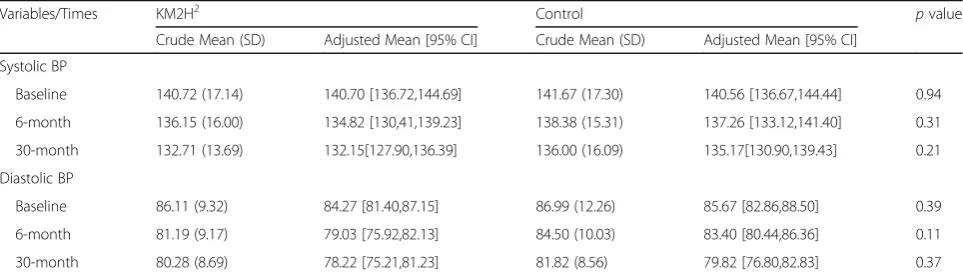
Results from the Table 3 indicate that at 30-month post intervention, the average systolic blood pressure [95% CI] was 132.15 mmHg [127.90, 136.39] for intervention group and 135.17 mmHg [130.90, 139.43] for control group; the average diastolic blood pressure [95% CI] was 78.22 mmHg [75.21, 81.23] for intervention group and 79.82 mmHg [76.80, 82.83] for control group. The differences between the two groups for both systolic and diastolic blood pressure were not statistically significant atp< 0.05 level.
Discussion
The intervention program KM2H2 is a theory-guided and community-based behavioral intervention for senior hypertensive patients. It is developed with guidance of an integrative theoretical model including the TTM, the Model of Personalized Medicine and the social capital theory. This program was implemented to enhance
physical activity among senior patients on antihyperten-sion medication and improve their control of blood pressure, further reducing the risk for stroke and heart attack. Findings of this study and previous evaluation study [27] indicate the intervention effects of the KM2H2largely persisted up to 30 months post interven-tion. There is a lack of physical activity intervention program for the senior hypertensive patients in China. The KM2H2 is the first study that shows significant effects up to 30 months post-intervention in improving physical activity and reducing the risk of stroke and heart attack among this vulnerable population.
Findings of study indicate that appropriate level and frequency of physical activity can significantly reduce the risk of stroke and heart attack, the effect can be main-tained for two and half years. The effects of the KM2H2 in reducing the risk of stroke and heart attack is in con-sistent with that of reported studies by others showing negative associations between physical activities and the Table 2Differences in regular physical activity between the KM2H2and the standard care groups at baseline, 6-month and
30-month post intervention
Variables/Times KM2H2 Control pvalue
Regular physical activity Crude Adjusted Crude Adjusted
% (n/N) % [95% CI] % (n/N) % [95% CI]
Baseline 56.28 (130/231) 54.26 [44.84,63.68] 48.58 (103/212) 45.68 [36.38,54.98] 0.08
6-month 79.23 (145/183) 75.57 [65.60, 85.54] 42.69 (73/171) 42.12 [32.22,52.03] <0.01
30-month 65.27 (109/167) 64.98 [54.81,75.16] 43.62 (65/149) 40.97 [30.78,51.16] <0.01
Duration of regular physical activity Crude Adjusted Crude Adjusted
Mean (SD) Mean [95% CI] Mean (SD) Mean [95% CI]
Baseline 2.93 (1.20) 2.71 [2.43,2.99] 2.84 (1.12) 2.74 [2.46,3.02] 0.87
6-month 3.48 (0.99) 3.34 [3.05,3.62] 2.97 (1.35) 2.84 [2.54,3.12] <0.01
30-month 3.00 (1.85) 2.83 [2.54,3.12] 2.64 (1.23) 2.46 [2.17,2.76] 0.04
Note:SDstandard error,CIconfidence interval. The adjusted proportion and mean were estimated and compared by using general linear mixed effects model (regular physical activity) and mixed effects model (duration of regular physical activity) controlling for effect of cluster randomization, repeated measures, baseline difference, and covariates
Table 3Systolic and diastolic blood pressure in the KM2H2and standard care groups at baseline, 6-month, and 30-month post intervention
Variables/Times KM2H2 Control pvalue
Crude Mean (SD) Adjusted Mean [95% CI] Crude Mean (SD) Adjusted Mean [95% CI]
Systolic BP
Baseline 140.72 (17.14) 140.70 [136.72,144.69] 141.67 (17.30) 140.56 [136.67,144.44] 0.94
6-month 136.15 (16.00) 134.82 [130,41,139.23] 138.38 (15.31) 137.26 [133.12,141.40] 0.31
30-month 132.71 (13.69) 132.15[127.90,136.39] 136.00 (16.09) 135.17[130.90,139.43] 0.21
Diastolic BP
Baseline 86.11 (9.32) 84.27 [81.40,87.15] 86.99 (12.26) 85.67 [82.86,88.50] 0.39
6-month 81.19 (9.17) 79.03 [75.92,82.13] 84.50 (10.03) 83.40 [80.44,86.36] 0.11
30-month 80.28 (8.69) 78.22 [75.21,81.23] 81.82 (8.56) 79.82 [76.80,82.83] 0.37
morbidity and mortality of various cardiovascular dis-eases [35–37]. The cost for delivering the intervention is rather smaller relative to the medication for the antihy-pertension treatment; but the effect is substantial. A full-scale phase III trial is necessary to assess the effective-ness of the KM2H2program for a wider use.
Receiving the KM2H2was associated with 3.02 mmHg and 1.60 mmHg reductions in the systolic and diastolic blood pressure, respectively while the reductions in blood pressure were not statistically significant. This ap-pears to be inconsistent with other physical activity intervention program that showed a significant effect of physical activity on reducing elevated blood pressures [38–40]. A possible reason is that the majority of published studies were conducted among adolescents and adults while the participants of our study were se-nior hypertensive patients. Hypertensive patients at older age have undergone degenerative changes in their cardiac/cerebra vascular systems [41]. It is much harder to reverse these age-related pathogenic changes through physical activity alone [42].
In supporting the reductions in the risk of stroke and heart attack, the KM2H2 showed persistent effect in encouraging and maintaining physical activities among senior hypertensive patients who are under antihyper-tensive medication. The significant and sustained program effect has been observed at all follow-up assess-ments. The proportion of patients engaging in physical activity at baseline was comparable between intervention and control group (54.26% vs. 45.68%). By 6 months post-intervention, 21.3% of participants in the interven-tion group initiated regular physical activity (Acinterven-tion stage) while none in the control group did so. At 30 months post intervention, 64.98% of the intervention participants engaged in and maintained regular physical activity compared to 40.97% for the control participants. Although the guiding role of the TTM has also been challenged by the lack of observed intervention effect for physical activity intervention [30], findings from our research indicate that inclusion of social capital-based intervention and personalized consulting provides a remedy.
There are several strengths with our study. First, our intervention program KM2H2 is established through a series of rigorous pilot tests. By conducting these pilot studies, we identified appropriate barriers (e.g. lack of knowledge, psychosocial support, and self-confidence) and facilitators (e.g. some interests and willingness to participate if offered by health professionals and not for commercial purpose) for physical activity [26]. These data are essential for targeted interventions. Second, our intervention program emphasizes both the precision
medicine-based personal intervention and the social capital theory-based group intervention [22–24]. The
personalized intervention part enables us to solve prob-lems for specific individuals, while the group-based intervention encourages social cohesion and social sup-port to achieve long-lasting program effect. It shows a promising result in encouragement for engaging in physical activity at community level. Further, there are few physical activity promotion programs in China tar-geting for older persons who are affected most by CVDs, particularly for the hypertensive senior adults. Lastly, the intervention effect was evaluated using the rigorous mixed effects modeling methods, controlling for the in-fluence of cluster randomization, repeated measurement, as well as potential baseline differences and key covari-ates that are inherited from the cluster randomization design.
There are limitations to this study. No objective measures were used to assess physical activities. Although the methods we used are pilot-tested and appropriate for community-based trials [43, 44], no criterion validity was established. More objective mea-sures of physical activity such as wearable pedometers should be used in future study. In addition, the protocol used to determine stroke and heart attack could be further improved. Although patient-report plus medical record verification has often been used in community-based research [45], miss report is likely. Like in many trials, not all participants were assessed at 30 months post intervention and the attri-tion rates may differ for the intervenattri-tion and control groups. Despite the use of advanced mixed effects modeling method for data analysis, bias cannot be fully ruled out. Lastly, the participants of this trial are recruited from one city in China, caution is necessary when interpreting our findings to other population.
Conclusions
Despite these limitations, this study demonstrates the efficacy of the KM2H2 program in successfully encour-aging physical activity and reducing the risk of stroke and heart attack among senior hypertensive patients up to 30 months post intervention. These findings under-score the urgency for a full-scale trial to establish the utility of KM2H2. In the full scale trial, a number of issues must be considered, such as objective measuring for physical activity and rigorous protocol to determine stroke and heart attack. In addition, training for commu-nity health workers for program delivery should also be emphasized.
Acknowledgements
Funding
(1) The Health and Family Planning of Hubei Province Scientific Research Project funding to Gong J;
(2) The Wuhan Yellow Crane Scholarship for Medical Scientists to Gong J;
(3) The University of Florida Startup funding to Chen X.
Availability of data and materials
The datasets used and/or analyzed in this study are available by contacting Dr. Jie Gong or Dr. Xinguang Chen.
Authors’contributions
GJ was in charge of the development of the KM2H2program, conducted the
trial in the community, participated in data collection, data processing and statistical analysis, and reviewed and finalized the manuscript. XY planned and conducted the statistical analysis, participated in result interpretation and drafted the manuscript. CX provided theoretical guidance to the KM2H2
program and method selection for statistical analysis, worked closely with other authors to interpret the results and devoted much time to manuscript development. YN, LF, and YY participated in developing KM2H2, delivered
the program to participants, participated in data collection, and reviewed the manuscript. All authors read and approved the final manuscript.
Ethics approval and consent to participate
The intervention trial was approved by the corresponding Institutional Review Boards at Wuhan Center for Disease Prevention and Control (Wuhan CDC), Hong Kong Polytechnic University and the University of Florida. All participants provided written informed consent before they were included in the trial.
Consent for publication Not applicable.
Competing interests
The authors declare that they have no competing interests.
Publisher’s Note
Springer Nature remains neutral with regard to jurisdictional claims in published maps and institutional affiliations.
Received: 4 July 2017 Accepted: 14 December 2017
References
1. Luscher TF. Prevention: some important steps forward, but many unmet needs in a world with cardiovascular disease as the leading cause of death. Eur Heart J. 2016;37:3179–81.
2. Hwong WY, Bots ML, Selvarajah S, Abdul Aziz Z, Sidek NN, Spiering W, et al. Use of antihypertensive drugs and ischemic stroke severity - is there a role for angiotensin-II? PLoS One. 2016;11:e0166524.
3. Wang Y, Peng X, Nie X, Chen L, Weldon R, Zhang W, et al. Burden of hypertension in China over the past decades: systematic analysis of prevalence, treatment and control of hypertension. Eur J Prev Cardiol. 2016;23:792–800.
4. Gao Y, Chen G, Tian H, Lin L, Lu J, Weng J, et al. Prevalence of hypertension in china: a cross-sectional study. PLoS One. 2013;8:e65938.
5. Chobanian AV, Bakris GL, Black HR, Cushman WC, Green LA, Izzo JL, Jr.,et al. The seventh report of the joint National Committee on prevention, detection, evaluation, and treatment of high blood pressure: the JNC 7 report. JAMA 2003,289:2560–2572.
6. James PA, Oparil S, Carter BL, Cushman WC, Dennison-Himmelfarb C, Handler J, et al. 2014 evidence-based guideline for the management of high blood pressure in adults: report from the panel members appointed to the eighth joint National Committee (JNC 8). JAMA. 2014;311:507–20. 7. Mazza A, Ramazzina E, Cuppini S, Armigliato M, Schiavon L, Rossetti C, et al.
Antihypertensive treatment in the elderly and very elderly: always“the lower, the better?”. Int J Hypertens. 2012;2012:590683.
8. Katsanos AH, Filippatou A, Manios E, Deftereos S, Parissis J, Frogoudaki A, et al. Blood pressure reduction and secondary stroke prevention: a systematic
review and Metaregression analysis of randomized clinical trials. Hypertension. 2017;69:171–9.
9. Anunciacao PG, Farinatti PT, Goessler KF, Casonatto J, Polito MD. Blood pressure and autonomic responses following isolated and combined aerobic and resistance exercise in hypertensive older women. Clin Exp Hypertens. 2016:1–5.
10. Ito K, Iwane M, Miyai N, Uchikawa Y, Mugitani K, Mohara O, et al. Exaggerated exercise blood pressure response in middle-aged men as a predictor of future blood pressure: a 10-year follow-up. Clin Exp Hypertens. 2016:1–5.
11. Lee DC, Sui X, Church TS, Lavie CJ, Jackson AS, Blair SN. Changes in fitness and fatness on the development of cardiovascular disease risk factors hypertension, metabolic syndrome, and hypercholesterolemia. J Am Coll Cardiol. 2012;59:665–72.
12. Nelson L, Jennings GL, Esler MD, Korner PI. Effect of changing levels of physical activity on blood-pressure and haemodynamics in essential hypertension. Lancet. 1986;2:473–6.
13. Zhang YX, Chen M, Xue LH, Zhao JS, Chu ZH. Comparison of body shape and physical activity among adolescents with normotensive and elevated blood pressure in Shandong, China. Ann Hum Biol. 2013;40:88–93. 14. Chao J, Wang Y, Xu H, Yu Q, Jiang L, Tian L, et al. The effect of
community-based health management on the health of the elderly: a randomized controlled trial from China. BMC Health Serv Res. 2012;12:449.
15. Zhao Y, Yan H, Marshall RJ, Dang S, Yang R, Li Q, et al. Trends in population blood pressure and prevalence, awareness, treatment, and control of hypertension among middle-aged and older adults in a rural area of Northwest China from 1982 to 2010. PLoS One. 2013;8:e61779. 16. Chang L, McAlister AL, Taylor WC, Chan W. Behavioral change for blood
pressure control among urban and rural adults in Taiwan. Health Promot Int. 2003;18:219–28.
17. Goertzen L, Halas G, Rothney J, Schultz A, Wener P, Enns JE, et al. Mapping a decade of physical activity interventions for primary prevention: a protocol for a scoping review of reviews. JMIR Res Protoc. 2015;4:e91. 18. Semlitsch T, Jeitler K, Hemkens LG, Horvath K, Nagele E, Schuermann C, et
al. Increasing physical activity for the treatment of hypertension: a systematic review and meta-analysis. Sports Med. 2013;43:1009–23. 19. Carvalho de Menezes M, Bedeschi LB, Santos LC, Lopes AC. Interventions
directed at eating habits and physical activity using the Transtheoretical model: a systematic review. Nutr Hosp. 2016;33:586.
20. Lee JY, Park HA, Min YH. Transtheoretical model-based nursing intervention on lifestyle change: a review focused on intervention delivery methods. Asian Nurs Res (Korean Soc Nurs Sci). 2015;9:158–67.
21. Horiuchi S, Tsuda A, Kobayashi H, Fallon EA, Sakano Y. Self-efficacy, pros, and cons as variables associated with adjacent stages of change for regular exercise in Japanese college students. J Health Psychol. 2016;
22. Abrahams E. Right drug-right patient-right time: personalized medicine coalition. Clin Transl Sci. 2008;1:11–2.
23. Abrahams E, Ginsburg GS, Silver M. The personalized medicine coalition: goals and strategies. Am J Pharmacogenomics. 2005;5:345–55. 24. Chen X, Stanton B, Gong J, Fang X, Li X. Personal social capital scale: an
instrument for health and behavioral research. Health Educ Res. 2009;24:306–17.
25. Chen X, Wang P, Wegner R, Gong J, Fang X, Kaljee L. Measuring social capital investment: scale development and examination of links to social capital and perceived stress. Soc Indic Res. 2015;120:669–87.
26. Yan Y, Li S, Yang N, Sun H, Li F, Zhang G. Psychological factors affecting the adaptation and maintenance of physical activities for individuals with hypertension in a community. Chinese Journal of Epidemiology. 2012;33:779–83.
27. Gong J, Chen X, Li S. Efficacy of a community-based physical activity program KM2H2 for stroke and heart attack prevention among senior hypertensive patients: a cluster randomized controlled phase-II trial. PLoS One. 2015;10:e0139442.
28. Cohen JA. Power primer. Psychol Bull. 1992;112:155–9.
29. Cardinal BJ, Esters J, Cardinal MK. Evaluation of the revised physical activity readiness questionnaire in older adults. Med Sci Sports Exerc. 1996;28:468–72. 30. Hutchison AJ, Breckon JD, Johnston LH. Physical activity behavior change
interventions based on the transtheoretical model: a systematic review. Health Educ Behav. 2009;36:829–45.
32. Barengo NC, Hu G, Kastarinen M, Lakka TA, Pekkarinen H, Nissinen A, et al. Low physical activity as a predictor for antihypertensive drug treatment in 25-64-year-old populations in eastern and south-western Finland. J Hypertens. 2005;23:293–9.
33. Biddle SJH, Mutrie N, Gorely T. Psychology of physical activity: determinants, well-being and interventions. 3rd ed. London: Routledge; 2015.
34. Kurtz TW, Griffin KA, Bidani AK, Davisson RL, Hall JE, AHA council on high blood pressure research P, et al. Recommendations for blood pressure measurement in animals: summary of an AHA scientific statement from the council on high blood pressure research, professional and public education subcommittee. Arterioscler Thromb Vasc Biol. 2005;25:478–9.
35. Tambalis KD, Panagiotakos DB, Georgousopoulou EN, Mellor DD, Chrysohoou C, Kouli GM, et al. Impact of physical activity category on incidence of cardiovascular disease: results from the 10-year follow-up of the ATTICA study (2002-2012). Prev Med. 2016;93:27–32.
36. Deijle IA, Van Schaik SM, Van Wegen EE, Weinstein HC, Kwakkel G, Van den Berg-Vos RM. Lifestyle interventions to prevent cardiovascular events after stroke and transient ischemic attack: systematic review and meta-analysis. Stroke. 2017;48:174–9.
37. Hua K, Hao G, Li W. Cardiovascular outcomes of lifestyle intervention in hypertensive patients with antihypertensive agents. Int J Cardiol. 2017;227:751–6.
38. Appel LJ. Lifestyle modification as a means to prevent and treat high blood pressure. J Am Soc Nephrol. 2003;14:S99–S102.
39. Lakshminarayanan S, Bala SM, Ramanujam M, Kannan G. Effectiveness of physical activity promotion in blood pressure and blood sugar reduction: a community-based intervention study in rural south India. J Family Community Med. 2012;19:81–7.
40. Bento VF, Albino FB, Moura KF, Maftum GJ, Santos Mde C, Guarita-Souza LC, et al. Impact of physical activity interventions on blood pressure in Brazilian populations. Arq Bras Cardiol. 2015;105:301–8.
41. Fonck E, Feigl GG, Fasel J, Sage D, Unser M, Rufenacht DA, et al. Effect of aging on elastin functionality in human cerebral arteries. Stroke. 2009;40:2552–6.
42. Gerage AM, Benedetti TR, Farah BQ, Santana Fda S, Ohara D, Andersen LB, et al. Sedentary behavior and light physical activity are associated with brachial and central blood pressure in hypertensive patients. PLoS One. 2015;10:e0146078.
43. Schmidt ME, Wiskemann J, Ulrich CM, Schneeweiss A, Steindorf K. Self-reported physical activity behavior of breast cancer survivors during and after adjuvant therapy: 12 months follow-up of two randomized exercise intervention trials. Acta Oncol. 2017:1–10.
44. Aparicio-Ting FE, Farris M, Courneya KS, Schiller A, Friedenreich CM. Predictors of physical activity at 12 month follow-up after a supervised exercise intervention in postmenopausal women. Int J Behav Nutr Phys Act. 2015;12:55.
45. Britton A, Milne B, Butler T, Sanchez-Galvez A, Shipley M, Rudd A, et al. Validating self-reported strokes in a longitudinal UK cohort study (Whitehall II): extracting information from hospital medical records versus the hospital episode statistics database. BMC Med Res Methodol. 2012;12:83.
• We accept pre-submission inquiries
• Our selector tool helps you to find the most relevant journal
• We provide round the clock customer support
• Convenient online submission
• Thorough peer review
• Inclusion in PubMed and all major indexing services
• Maximum visibility for your research Submit your manuscript at
www.biomedcentral.com/submit