154
The Use Of Content And English Language
Integrated Learning (CELIL) Methodologies In
Teaching Selected Concepts In Physics
Ian Phil CanlasAbstract: This study is part of an integrated teaching program in physics and English that attempted to develop and implement a teaching sequence on selected physics concepts using content and English language integrated learning (CELIL) methodologies. Specifically, this paper discussed its advantages and challenges as implemented in a school following a trilingual curriculum design. About 8 teachers were involved in the development and validation of the teaching sequence and 55 students from 5 classes were involved in the implementation process. Effectiveness was measured through students’ achievement using criteria-based assessment and simple Collaizi method was used to process the external observers’ and teacher-researchers’ reflections. Preliminary results revealed that CELIL methodologies maybe helpful in developing and increasing students’ conceptual understanding of selected physics concepts as well as improving their English language skills.
Keywords: content and English language integrated learning (CELIL), integrated teaching, teaching sequence, physics
————————————————————
1
I
NTRODUCTIONTHE end of the 20th century was also characterized by an increased utilization of content and language integrated learning (CLIL) approach along teaching and learning especially to non-English speaking countries such as countries in Europe, Asia, and South America. As defined by Coyle, Hood and Marsh [1], CLIL is an approach whereby a second language is used in teaching and learning both the non-language subject content and the second non-language. Ideally, it is assumed that in this approach, the learning objectives of subject content and second language are interwoven throughout the teaching and learning process. Through the years, a number of studies have identified and enumerated compelling reasons for an increased and more advanced utilization of CLIL [2, 3]. These include the ability of CLIL approach to create conditions for natural learning of the second language. Moreover, it provides a defined purpose for the use of second language in the classroom, which may result to a positive effect on language learning through putting emphasis on the meaning instead of the form. Lastly, it increases the level and length of exposure to the second language. Along this line, Naves [4] and de Graaf, Koopman, and Westhoff [5] identified several crucial indicators and characteristics of a successful CLIL program implementation. These include the active teaching behavior of the teacher and the selection of appropriate strategies in presenting new information. In addition, immediate feed backing and creation of opportunities to respond in various ways were also found to significantly affect as well as the consistent integration of content and language in the teaching and learning process.
Moreover, utilizing local contexts, using hands-on, and minds-on activities, and the use of collaborative, autminds-onomous, and self-directed learning were also among the important factors that may define the success of CLIL implementation. In the last decade, a number of frameworks were developed to position CLIL in the teaching and learning process. Zydatiß [6] developed a curricular framework for CLIL showing the interaction of communication, content, culture and cognition (4Cs) as shown in Figure 1.
Figure 1. Curricular framework for CLIL [6]
This framework, illustrates the central role of communication in developing cognition, content and culture as well as how these factors shape communication. Moreover, Coyle, Hood, and Marsh [1] developed another framework. Aside from the 4Cs discussed and illustrated by Zydatiß [6] they recognize the role of context when implementing CLIL as shown in Figure 2.
Figure 2. Framework for CLIL [1] ___________________________
IAN PHIL CANLAS holds a degree on Master of Arts in
Science Education – Physics from University of San Carlos in the Philippines. Currently he is a science faculty at University of Central Asia-Naryn Campus in Naryn City,
Kyrgyz Republic. E-mail: [email protected] or
155 In that, a number of manuals and guidebooks on CLIL
implementation have been developed, tested, and published. These include the ones developed by the European Commission [7, 8] and the ones developed by University of Cambridge [9, 10]. There are also available guidebooks put together for local contexts such as the ones developed by Pinkley, [11], Gimeno, O Donaill, and Zygmantaite [12] and Ionnou-Georgiou and Pavlou [13]. Few studies have reviewed the implementation of CLIL in Europe [14] and the rest of the world [15]. These include some country-specific studies such as the work of Bonces [16] in Columbia, Suwannoppharat and Chinokul [17] in Thailand, Wolff [18] in Germany, Leone [19] in Italy, Smala [20] in Queensland, Australia and Cross and Gearon [21] in Victoria, Australia. A number of studies have investigated the effectiveness of some specific strategies within the framework of CLIL. These include the use of collaborative approach [22], task-based approach [23, 24], blended learning strategy [25], the use of information and communication technology [26] and the use of videos [27] among others. Some studies investigated the implementation of CLIL in specific disciplines such as geography [28], chemistry [29] and physics [30, 31] These studies have proven the effectiveness of CLIL approach in teaching and learning. However, despite the progressive implementation of CLIL in the different parts of the world, a number of limitations and gaps still exist [32]. In the work of Dalton-Puffer [2], a question was raised as to what language learning goals and objectives are pursued during the implementation of CLIL in a non-language subject. This came up from the observations that teachers teaching non-language subjects were more focused in achieving content-related objectives. Moreover, in the study of Harrop [33], she pointed out that using CLIL in a non-language subject increases the level of difficulty in learning new themes which may result to leaving the weakest learners vulnerable for being left out. This may imply the need for a sufficient reinforcement for language development that is subject-specific. In addition, she was skeptical on the issue of cultural awareness. She argued that although CLIL frameworks included culture, the role of cultural awareness during CLIL implementation is less well established and not defined in CLIL models. Despite these differences in perspectives, the above-mentioned studies have recognized the important role of the teacher in defining the success of CLIL implementation. Pavron-Vasquez and Ellison [34] enumerated key competencies necessary for CLIL implementation in the classroom which include mastery of the subject matter as well as mastery of the second language among others. For reason of advancing the English language proficiency among learners in a Kazakh and Russian dominated school context, this study was conceptualized. Specifically, this study was aimed at developing and implementing a teaching sequence that uses CELIL methodologies in teaching selected physics concepts to Year 9 students. Moreover, it attempted to find out its effectiveness, advantages and challenges as implemented in a school that implements a trilingual science curriculum.
2
M
ETHODOLOGYThis study followed the descriptive-developmental design. This design allowed the researchers to gather observations from the process of developing and implementing the teaching sequence using CELIL methodologies. It was implemented in a school following a trilingual (Russian, English, Kazakh) curriculum framework and accepts students with outstanding academic achievement. For all levels, the number of students
in each class vary from nine (9) to ten (10). Due to the unique characteristics of the teaching force, such that local physics teachers have very minimal command of the English language, it was necessary to perform a distinctive integration method in the process. During the developmental phase of the study, eight (8) teachers were involved in the development and validation of the integrated lessons. These include four (4) local physics teachers, three (3) local English teachers, and one (1) international physics teacher. The group identified themes in physics and English that can be interwoven. The guiding principle in the integration process is that, the physics group should use teaching and learning strategies that develop English language skills while the English group should use the physics themes in teaching English language skills. This principle was conceived to give more opportunity for the learners to use English language in physics classes while newly learned concepts in physics are repeated and reinforced in English classes. The implementation phase involved 55 students from five (5) classes. It was agreed that the physics group commences first before the English group. This allowed the learners to get acquainted with the concepts as well as the procedure and activities. At least two (2) observers were asked to write observations and reflections regarding the implementation of every lesson which took for a month. Moreover, the teacher-researchers implementing the lessons were also asked to write down reflections during and after every lesson. These collective observations and reflections were used in the revision of the teaching sequence during the revision phase of the study. Meanwhile, in an attempt to establish the effectiveness of the teaching sequence, the criteria-based assessment employed by the school was used. In that, every learner is rated achieved or learning towards in every specific lesson objective. Results of which were presented in frequency counts and percentages. Meanwhile, observations and reflections were analyzed using Collaizi method of which themes and patterns were sought, presented and discussed in this paper.
3
R
ESULTS AND DISCUSSIONPreliminary results of the study revealed that the use of CELIL methodologies in teaching selected physics concepts maybe effective in developing and increasing conceptual understanding, as well as developing English language skills among year 9 students.
3.1 Development of the teaching sequence
In the developmental phase, seven (7) themes in physics and English were identified that is possible for interweaving. These themes were summarized in Table 1.
Table 1
Integrated themes in physics and English
Themes in Physics Themes in English
Properties of light Traditions: reading about superstitions History of light Language: the history Simple harmonic motion Language: post reading activity
Sound and human ear Language: listening activity Properties and characteristics of
sound Music: listening with task Amplitude and frequency Musical instruments: writing report Forms of energy and energy
156 Meanwhile, Table 2 summarized of the lesson objectives in
physics that were derived from the identified themes. These appeared in the criteria-based assessment from which students’ achievement were based upon.
Table 2
Lesson objectives derived from the physics themes
Properties of light Describe reflection
Illustrate images formed by flat mirrors using ray diagram Illustrate images formed by convex mirror using ray diagram Illustrate images formed by concave mirror using ray diagram Describe refraction
Illustrate images formed by concave lens using ray diagram Illustrate images formed by convex lens using ray diagram Describe interference
Differentiate between destructive and constructive interference Describe diffraction
History of Light
Trace the chronological development on the study of light
Name some important scientist that made important contributions on the study of light
Simple Harmonic Motion Describe simple harmonic motion
Use simple harmonic equation in solving practical problem sets Identify events/phenomena manifesting simple harmonic motion Perform an experiment related to simple harmonic motion Sound and Human Ear
Identify the parts of the human ear and their specific functions in sound transmission
Trace the transmission of sound in the human ear Properties and Characteristics of Sound Describe the properties of sound
Differentiate between a sound wave and a light wave Describe the production of sound
Trace the transmission of sound in different media Amplitude and Frequency
Identify the different parts of a wave Describe amplitude
Describe frequency
Solve problem sets related to amplitude Solve problem sets related to frequency
Perform an experiment related to amplitude and frequency Forms of Energy and Energy Transformation
Describe the different forms of energy
Differentiate between renewable and non-renewable energy Describe the law of conservation of energy
Trace energy transformation
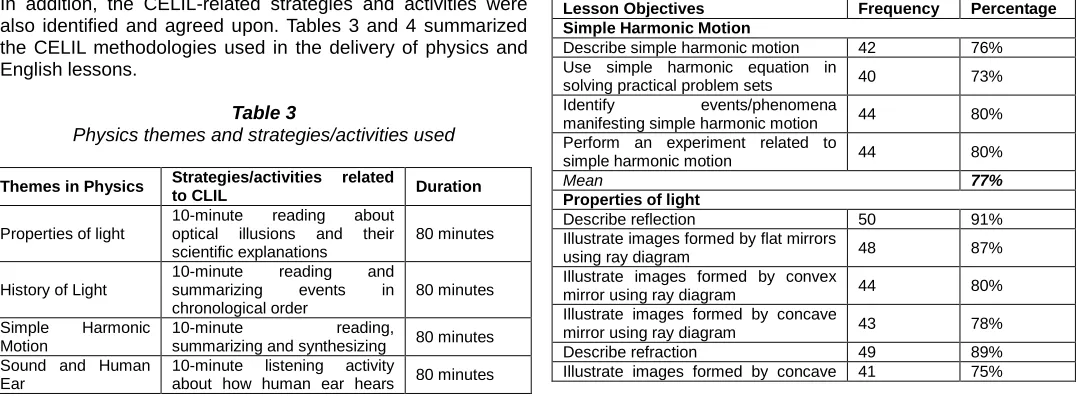
In addition, the CELIL-related strategies and activities were also identified and agreed upon. Tables 3 and 4 summarized the CELIL methodologies used in the delivery of physics and English lessons.
Table 3
Physics themes and strategies/activities used
Themes in Physics Strategies/activities related
to CLIL Duration
Properties of light
10-minute reading about optical illusions and their scientific explanations
80 minutes
History of Light
10-minute reading and summarizing events in chronological order
80 minutes
Simple Harmonic Motion
10-minute reading,
summarizing and synthesizing 80 minutes Sound and Human
Ear
10-minute listening activity
about how human ear hears 80 minutes
sound, summarizing and synthesizing
Properties and Characteristics of Sound
Listening to music played with different musical instruments; writing observations and inference
80 minutes
Amplitude and Frequency
Playing musical instruments and writing a synthesis report on how these selected musical instruments produce sound and music
80 minutes
Forms of Energy and Energy
Transformation
Film showing and video
analysis 80 minutes
Table 4
English themes and strategies/activities used
Themes in English Strategies/activities related
to CLIL Duration
Traditions: Reading
about Superstitions Reading about optical illusions 40 minutes Language: The
history
Reading about the history of
light 40 minutes
Language: Post Reading Activity
Reading about simple
harmonic motion 40 minutes Language:
Listening Activity
Listening a narration about
how human ears hear sound 40 minutes
Music: Listening with Task
Listening a narration about how music and melodies are produced
40 minutes
Musical
Instruments: Writing Report
Investigating how musical instruments produce sound and music
40 minutes
Information Gap Analysis: Video
Watching a video on energy
forms and transformation 40 minutes
3.2 Implementation of the teaching sequence
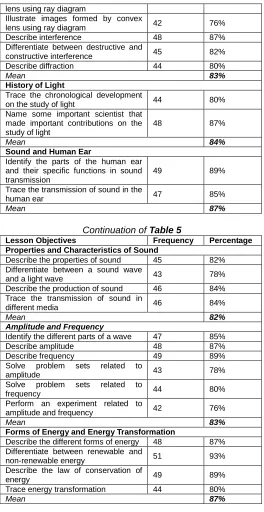
The criteria-based assessment revealed that a greater majority of the learners were able to achieve the identified lesson objectives after the implementation of the teaching sequence. About 84% of the learners were rated achieved from the different lesson objectives. Table 5 summarized the specific frequencies and percentages of learners who were marked achieved from these lesson objectives.
Table 5
Distribution of learners and their achievement of lesson objectives using criteria-based assessment
Lesson Objectives Frequency Percentage Simple Harmonic Motion
Describe simple harmonic motion 42 76% Use simple harmonic equation in
solving practical problem sets 40 73% Identify events/phenomena
manifesting simple harmonic motion 44 80% Perform an experiment related to
simple harmonic motion 44 80%
Mean 77%
Properties of light
Describe reflection 50 91%
Illustrate images formed by flat mirrors
using ray diagram 48 87%
Illustrate images formed by convex
mirror using ray diagram 44 80%
Illustrate images formed by concave
mirror using ray diagram 43 78%
Describe refraction 49 89%
157 lens using ray diagram
Illustrate images formed by convex
lens using ray diagram 42 76%
Describe interference 48 87%
Differentiate between destructive and
constructive interference 45 82%
Describe diffraction 44 80%
Mean 83%
History of Light
Trace the chronological development
on the study of light 44 80%
Name some important scientist that made important contributions on the study of light
48 87%
Mean 84%
Sound and Human Ear
Identify the parts of the human ear and their specific functions in sound transmission
49 89%
Trace the transmission of sound in the
human ear 47 85%
Mean 87%
Continuation of Table 5
Lesson Objectives Frequency Percentage Properties and Characteristics of Sound
Describe the properties of sound 45 82% Differentiate between a sound wave
and a light wave 43 78%
Describe the production of sound 46 84% Trace the transmission of sound in
different media 46 84%
Mean 82%
Amplitude and Frequency
Identify the different parts of a wave 47 85%
Describe amplitude 48 87%
Describe frequency 49 89%
Solve problem sets related to
amplitude 43 78%
Solve problem sets related to
frequency 44 80%
Perform an experiment related to
amplitude and frequency 42 76%
Mean 83%
Forms of Energy and Energy Transformation
Describe the different forms of energy 48 87% Differentiate between renewable and
non-renewable energy 51 93%
Describe the law of conservation of
energy 49 89%
Trace energy transformation 44 80%
Mean 87%
Nine (9) learners were marked learning towards after the implementation of the teaching sequence. Six (6) of these learners were marked achieved after giving one (1) reinforcement activity. The remaining three were marked achieved after giving two (2) reinforcement activities. Interviews revealed that these learners have difficulty coping up and understanding the concepts using English language.
3.3 Advantages and challenges of using CELIL
The advantages and disadvantages of using CELIL methodologies were derived and synthesized from the reflections of external observers and teacher-researchers. Reflections of both groups confirmed that the use of CELIL methodologies in teaching physics gave the learners an opportunity to practice the use of English language both for speaking and writing. Moreover, it initiated cognitive stimulation among the learners during the process. Below are
transcripts of some written observations of external observers that maybe proofs of cognitive stimulation.
“Learners working in groups started asking questions and finding meaning of the words in
English that were associated with the
instructions and other activities that uses English language.”
“The students opened dictionaries to check the meaning of words.”
“Some students started using Google Translate to understand the instructions given in English.”
In addition, teacher-researchers were in agreement that using CELIL methodologies gave them a new variation of teaching approach. Moreover, it also gave them English language learning opportunity through increasing their physics-specific vocabularies and a number of speaking opportunities. Below were some transcripts of their reflections during the implementation phase.
“I also need to memorize and understand the English equivalent term of many words.”
“Many times, I am pressed to answer in English since my students started asking questions in English.”
In addition, the external observers agreed that the strategy was helpful in learning physics-specific vocabularies. The following are some transcripts of their observations.
“The students started using the English physics vocabulary words.”
“Some students asked the teacher for meanings of new vocabulary words.”
On the other hand, a number of challenges were identified. Teacher-researchers and external observers noted that longer time is necessary to accomplish CELIL-related activities and tasks. This is evident when external observers noted that some activities were cut short by the teacher due to lack of time, hence, no emphasis or discussions were given. Teacher-researchers also noted that there were some CELIL-related activities and tasks they skipped due to lack of time. In addition, teacher-researchers were uncertain whether or not they have given enough information or build enough knowledge among the learners. Below were transcripts of their reflections and discussions.
“It feels like my students did not understand enough about the topic because of the use of English language.”
158 “I also have the feeling that many times I think I
missed understanding correctly what my
students were saying especially when they do it in English language.”
4
I
MPLICATIONSThe preliminary result of this study revealed that using CELIL methodologies in teaching selected concepts in physics maybe effective in developing and increasing conceptual understanding among students. Moreover, it maybe an effective strategy in creating an opportunity for the increase use of English language, hence may result to learning English language skills. In addition, observation revealed that the use of English language in selected activities may lead to cognitive stimulation that could result to the development of critical thinking skills. On the other hand, the use of CELIL also posed a number of challenges. This include the increased difficulty in understanding the selected physics concepts brought by the use of English language in a number of activities. Moreover, there is a threat of misinterpretation and misunderstanding both for teachers and students especially during discussions, hence, the need for the teacher to have a good command of the English language.
5
R
ECOMMENDATIONS5.1 On the result
1. As using CELIL maybe an effective strategy for developing and increasing students’conceptual understanding and learning English language skills, it is recommended to use the same methodology in other physics topics across different levels.
2. CELIL may also be used in various contexts as well as in other non-language related subjects such as biology, chemistry, history, geography among others.
5.2 On the methodology
1. For comparison, the same study may be replicated in another context.
2. Aside from the ones used in this study, other CELIL-related activities and strategies may also be used and its effectiveness be explored.
3. The use of other assessment tools to measure achievement and effectiveness may also be utilized. 4. A correlation study may also be done between students’
achievement in physics and English.
5. A comparison between the physics and English achievement between the Russian and the Kazakh group may also be explored.
6. The change in index of difficulty of the non-language subject taught in English or other second language may also be measured and sought.
7. Perspectives of teachers, students, parents and stakeholders on the use of English in teaching a non-language subject may also be explored.
R
EFERENCES[1] D. Coyle, O. Hood, and D. Marsh, Content and Language Integrated Learning. Cambridge: Cambridge University Press, 2010.
[2] C. Dalton-Puffer, ―Outcomes and processes in Content and Language Integrated Learning (CLIL): current research from Europe‖, Future Perspectives for English Language Teaching, D. Werner and V. Laurenz, eds., Heidelberg: Carl Winter, pp. 1-19, 2007.
[3] C. Dalton-Puffer and U. Smit, eds., Empirical Perspectives on CLIL Classroom Discourse. Franktfurt, Vienna etc.: Peter Lang., pp. 7-23, 2007.
[4] T. Navés, ―Effective content and language integrated learning (CLIL) programmes‖, Content and language integrated learning. Evidence from research in Europe, Y. Ruiz de Zarobe & R. M. Jiménez Catalán, eds., Bristol: Multilingual Matters, pp. 22-40, 2009.
[5] R. de Graaff et al., ―An observation tool for effective l2 pedagogy in content and language integrated learning (CLIL)‖, The International Journal of Bilingual Education and Bilingualism, vol. 10, no. 5, pp. 603-624, 2007.
[6] W. Zydatiß, Bilingualer Fachunterricht in Deutschland: eine Bilanz. Fremdsprachen Lehren und Lernen, vol. 36, pp. 8-25, 2007.
[7] European Commission, Improving the effectiveness of language learning: CLIL and Computer-assisted language learning, 2014, online available http://ec.europa.eu/languages/library/studies/clil-call_en.pdf
[8] D. Marsh et al., European Framework for CLIL Teacher Education, 2011, online available www.unifg.it
[9] University of Cambridge ESOL Examinations, Teaching Knowledge Test (TKT) Content and Language Integrated Learning (CLIL) Handbook for Teachers, 2010, online available http://www.cambridgeenglish.org
[10]University of Cambridge ESOL Examinations, Teaching Science through English – a CLIL Approach, 2011, online available http://www.cambridgeenglish.org
[11]D. Pinkley, Children learning English as a foreign language, Pearson Longman, 2012, online available http://www.pearsonlongman.com/primaryplace/pdf/clilmonograp h.pdf.
[12]A. Gimeno, C. Ó Dónaill, and R. Zygmantaite, ―Clilstore Guidebook for Teachers‖, Tools for CLIL Teachers, 2013, online available
http://www.languages.dk/archive/tools/book/Clilstore_EN.pdf
[13]S. Ioannou-Georgiou, and P. Pavlou, eds., Guidelines for CLIL implementation in primary and pre-primary education, Cyprus: Cyprus Pedagogical Institute, 2011.
159 available http://www.eurydice.org.
[15]J. Harris and P. Ó Duibhir, ―Effective Language Teaching: a Synthesis of Research‖, NCCA report #13, Dublin: NCCA, 2011.
[16]J.R. Bonces, ―Content and Language Integrated Learning (CLIL): Consideration in the Colombian Context‖, Gist Education and Learning Research Journal, vol. 6, pp. 177-189, 2012.
[17]K. Suwannoppharat, and S. Chinokul, ―Applying CLIL to English Language Teaching in Thailand: Issues and Challenges‖, Latin American Journal of Content and Language Integrated Learning, vol. 8, no. 2, pp. 237-254, 2015.
[18]D. Wolff, Content and Language Learning: An Evaluation of the German Approach, Unpublished Manuscript, University of Wuppertal, Wuppertal, Germany, n.d., online available http://share.dschola.it/dd4pinerolo/clil/Shared%20Documents/Th eory_strategies/Dieter%20Wolff.pdf
[19]A.R. Leone, ―Outlooks in Italy: CLIL as Language Education Policy‖, Working Papers in Educational Linguistics, vol. 30, no. 1, pp. 43-63, 2015.
[20]S. Smala, ―Introducing: Content and Language Integrated Learning (CLIL)‖, Literacy Learning: the middle years, Queensland: University of Queensland, vol. 17, no. 3., 2009.
[21]R. Cross, and M. Gearon, Research and Evaluation of the Content and Language Integrated Learning (CLIL) Approach to Teaching and Learning Languages in Victorian Schools, 2013, online available www.education.vic.gov.au
[22]M.L. Carrio-Pastor, and D. Perry, ―The Collaborative Approach in Content and Language Integrated Learning‖, Revisita Alicantina de Estudios Ingleses, vol. 23, pp. 69-81, 2010.
[23]C. Tardieu, and M. Doltisky, ―Integrating the task-based approach to CLIL teaching‖, Teaching and Learning English Through Bilingual Education, L. de Dios, coord., Cambridge: Cambridge Scholars Publishing, pp. 3-35, 2012.
[24]C.E. Urmeneta, and A.S. Sola, ―Language Learning through Tasks in a Content and Language Integrated Learning (CLIL) Science Classroom‖, Porta Linguarum, vol. 11, pp. 65-83, 2009.
[25]M. Goffredo, et al. Teaching Physics in CLIL/Blended Learning Environment at Primary School, Unpublished Manuscript, n.d.,
online available
http://www.fisica.uniud.it/URDF/mptl14/ftp/full_text/T4_94%20Fu ll%20Paper.pdf
[26]M.M. Juárez, ―Teaching and learning science in context‖, Revista de Lenguas para Fines Específicos, vol. 19, pp. 183-208, 2013.
[27]C. Oddone, ―Using Videos from Youtube and Websites in the CLIL Classroom‖, Studies About Languages, vol. 18, pp. 105-110, 2011.
[28]K. Dourda, et al., ―Content and Language Integrated Learning through an Online Game in Primary School: A case study‖, The Electronic Journal of e-learning, vol. 2, no. 3, pp. 243-258, 2014.
[29]C.I. Pavisic, ―CLIL Teaching: an Opportunity to Teach Chemistry. ICT for Language Learning‖, 4th Pixel Conference Proceedings, Milan: Simonelli Editore, 2011.
[30]C. Haagen-Schutzenhofer, and M. Hopf, Content and Language Integrated Learning in Physics Teaching: Benefits, Risks, Requirements, and Empirical Studies, 2010, online available www.univ-reims.fr.
[31]M. S. Lopez-Mesa, Applying CLIL to a Physics and Chemistry Unit (2014), Master Thesis, Universidad de Oviedo, Spain, online available digibuo.uniovi.es
[32]N. Luanganggoon, ―Key Issues for Content Language Integrated Learning (CLIL) Classroom Assessment‖, Proceedings from the 40th Annual Conference of the Association for Educational Assessment, Singapore, May 25-30,
2014, online available
http://www.iaea.info/documents/paper_371f6c4.pdf
[33]E. Harrop, ―Content and Language Integrated Learning (CLIL): Limitations and possibilities‖, Encuentro, vol. 21, pp. 57-70, 2012.
![Figure 2. Framework for CLIL [1]](https://thumb-us.123doks.com/thumbv2/123dok_us/9003452.1437960/1.612.341.546.382.470/figure-framework-for-clil.webp)