Student’s Worksheets Design For Eighth Grade
To Improve Problem-Solving Ability With RME
Fitria Wahidatul Mujahidah, Suparman
Abstract: The most important thing about learning mathematics is to understand the concept of the material presented. To understand the mathematical concept students must have certain competencies, the competencies concerned are problem solving. This study aims to design a student's worksheet on two-variable linear equation system material using the RME approach to improve problem-solving skills used for students of class VIII MTs Nurul Ummah, Yogyakarta, Indonesia. This study uses research and development (R & D) in designing worksheets for students with an ADDIE model. Development procedures include five phases, namely: analysis, design, development, implementation, and evaluation. This research is limited to analysis, design, and development. The research object is the curriculum, student characteristics, and evaluation of the teaching materials used. The instruments used are observations, problem solving skills tests, and interview guides. Data analysis techniques using Miles and Huberman. The results showed that students needed students worksheet materials with RME approaches to improve problem solving skills.
Index Terms: Student’s worksheet, RME, Problem Solving, Mathematics, Two variable linear equation systems, ADDIE Model, Development research
————————————————————
1 INTRODUCTION
Mathematics is a subject given at every level of education [1]. Nowadays his time mathematics is also one of the sciences that underlies the development in the era of industrial revolution [2]. But in reality, mathematics is also a lesson that is considered difficult for some students, especially in terms of problem solving skills [3]. This is also following the results of observations made by researchers at MTS Nurul Ummah Kota Gede, Yogyakarta, Indonesia. Here the researcher gets information that students still need to improve their mathematical problem solving abilities, especially in the material of the Two Variable Linear Equation System, because in this material there are many problems with the story and understanding the concepts is still difficult for students. low problem solving abilities of students will result in difficulties in achieving learning goals [4]. Therefore, mathematical problem solving skills must be possessed by students, because of the ability to solve the underlying problems of mathematics [5]. Problem solving ability is the stage where students problems correctly [6]. Through troubleshooting, expected students can solve the problem of the story understanding the mathematical concepts that are being studied [7]. Students can improve and develop problem-solving skills both in school and outside school [8]. Problem solving skills must often be done to students so students are used to solving problems [9]. One of the causes that lead students to experience difficulties in resolving problems is problems in the form of stories and understanding concepts, teaching materials that have not been in line with the right approach in terms of solving problems [10]. [11] The stages in solving problems by Polya (1973) have been divided into four stages: understanding problems, planning problem solving, implementing problem solving strategies, and verifying. To overcome this problem, it is expected that a teacher can master various learningapproaches and apply appropriate and effective learning approaches [12]. Because the learning process that runs varied, interesting and related to everyday life can help students better understand mathematical concepts and can train students' mindsets more actively and develop during the learning process [13]. Realistic Mathematics Education is considered a good approach used in the learning process of mathematics to improve problem-solving skills because it is by curriculum objectives [14]. RME is one approach in mathematics learning that is directly related to everyday life where experience can be obtained by students both in the school environment and outside of school [15]. RME is an approach that relates to the context of everyday life and is one part of human activity [16]. In RME, learning can begin with contextual problems (real-world or everyday life) so students can directly use their previous experience [17]. RME is the right approach to using mathematics teaching by a curriculum that is focused on teaching high-level thinking and helps build students' problem solving skills [18]. Based on previous research, proving that making student worksheets made using the RME approach to improve problem-solving skills is very effective in helping the learning process in the classroom [19]. Meanwhile, [20] examined the ability to solve problems through education in realistic mathematics education, the results of which were concluded that the RME approach could improve the ability to solve elementary school students' problems infractions. RME approach is more effective and efficient if applied with learning resources, one of the students [21]. Student Worksheets are one of the teaching materials that can be used by students to improve problem solving skills during the learning process [22]. Learners ' worksheets contain activities that can make learners improve and develop problem-solving skills, understand mathematical concepts and problems with stories. Student worksheets based on the RME approach are designed to improve problem-solving skills of the eight-grade MTs students.
———————————————— Fitria Wahidatul Mujahidah is currently pursuing a master’s degree
program in Mathematics Education at Ahmad Dahlan University, Indonesia, PH-085233253183. E-mail: [email protected] Suparman is an associate professor in mathematics at Ahmad
2094
2
METHOD
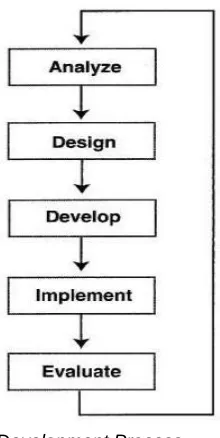
This research is development research in the field of mathematics, intending to produce learning instruments in the form of student worksheets that are designed with a Realistic Mathematics Education approach to improve problem solving abilities. This study uses Research and Development (R & D) methods with the ADDIE model. The development procedure includes five stages, namely: Analysis, Design, Development, Implementation, and Evaluation [23]. The ADDIE model has the first phase of the analysis phase, which is the phase in which the research design creates explanations to provide direction during the analysis process, in the second phase of the design, each learning component is presented Systematically and specifically, in the development of the third phase, where this phase is done to create and combine the content that has been designed at the design stage, the fourth phase is phase implementation phase, including the duplication of materials and materials Other supporters, as well as preparation for technical issues and discussing alternative plans with students, the fifth or final stage is an evaluation of the stage in which an educator get feedback from students, then educators make improvements Learning [24].
Fig. 1. Development Process
The subjects of this study were eighth-grade students of MTs Nurul Ummah, Yogyakarta, Indonesia. The object of this research is curriculum, student characteristics and evaluation of teaching materials. The instruments used were observation, interviews, and problem solving ability tests. Observation guidelines are used to observe the learning approach used by the teacher, interview guides are conducted with teachers and students to find out the curriculum and character of studentsin school, and tests to find out students 'problem solving skills before and after using the module so that it is known whether there are improvements in students' problem solving skills . Data analysis using Miles and Huberman [25] which consists of data reduction, data presentation, and conclusions. Data reduction is the stage where researchers classify things or data that are considered important (headmaster) and make things that are not needed during the interview process, presenting data is the stage where the researcher presents data that has been analyzed at the stage of data reduction so
that it is relevant and can be presented as information that can be concluded, the conclusion is to provide conclusions accompanied by strong and valid evidence based on data obtained by researchers in the field.
3 RESULTS AND DISCUSSION
Development research with the ADDIE model using the first few stages is analysis. This analysis is done on students and teachers who include the curriculum used, the difficulties that are experiencing, the necessary things in the learning process, the obstacles that often occur in each learning, and others. In the curriculum analysis phase, teachers in the school used the 2013 curriculum as a reference in learning. The basic competence also uses special basic competencies for junior high school. In this research, researchers want to design a development product in the form of student worksheets which in the student's worksheet there is a set of planned learning, Systematic, and can improve the ability Students ' problem-solving. The five ADDIE stages will be described as follows:
3.1 Determine the Stage
This stage is conducted by researchers to obtain guidance about the teaching materials that researchers will develop, as well as the underlying problems about the importance of developing student worksheets.
3.1.1 Preliminary Analysis
In the initial analysis, researchers conducted a curriculum analysis used by schools to be studied further. Based on the results of the initial analysis, it is known that the learning process in schools uses the 2013 curriculum.
3.1.2 Student Analysis
In the analysis of student researchers get information about abilities and characters as the basis of researchers in developing student worksheets, it is also known that the students' problem solving skills still need to be improved.
3.1.3 Material Analysis
One material that requires problem solving capabilities is a two-variable linear equation system. So in this study, the development of material for linear equation systems was found
3.1.4. Formulation of objectives
The formulation of the objectives referred to by researchers at the fourth stage is an indicator of competency achievement. To formulate a competency indicator is adjusted to the basic competencies that have been set in the 2013 curriculum. Student worksheets are created to allow learners to understand the system material of two variable linear equations, and improve their problem solving capabilities.
3. 2 Design Phase
In a later stage, researchers have come to the design phase, designing some parts of the sheet. The sections that have been designed include cover, preface, Table of Contents, basic competencies and core competencies, usage instructions, concept maps, materials, and tasks. Researchers compiled student worksheets based on RME steps. Below are presented some designs that have been made by researchers.
3.2.1 Cover
Researchers designed the cover to be used, the cover page consists of: a title with RME approach, 2013 curriculum logo, material title, user target, author's name, institution logo, and agency name. The cover is very important because it recognizes the content to be delivered. The author's identity is contained in the cover to show the compiler work of several learners ' worksheets. Cover of the student worksheets are shown in figure 2
Fig. 2. Cover 3.2.2 Preface
The preface is placed on the page after the cover of the student's worksheet as the initial communication opening between the compilers and users. It aims to give the impression that the student worksheets are organized are important to read and learn. In the preface of the author hopes that the students work in this lesson can be a learning tool for the person to facilitate Students to understand the material. The preface can be seen in Figure 3.
3.2.3 Table of Contents
The table of contents contains the learning discussion that will be added to and contains a list of all the part pages of the student's worksheet with the aim that users will find the subject to search. Table of contents can be seen in Figure 4 .
Fig. 4. Table of contents
3.2.4 Instructions for Use
The Guidelines for Student Worksheets contain guidelines for procedures for using Student Worksheets, namely; steps that must be taken to study the Student Worksheet correctly. Directions for use can be seen in Figure 5.
Fig. 5. Introduction for use
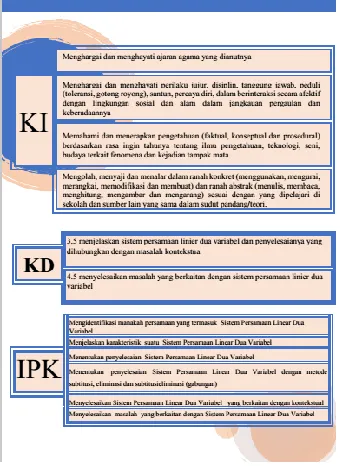
2096 Fig. 6. core competencies and basic competencies
3.2.6 Concept Map
This concept map is made to map out what material will be studied in this Student Worksheet. Concept maps can be seen in Figure 7
Fig. 7. Concept Map
3.2.7 Supporting Information / Material
The support information or material is a piece of additional information in the student's worksheet for learners to more easily understand and master the material to be taught. In this material, it is about a two-variable linear equation system prepared to help students deepen and master the material. The material can be seen in Figure 8.
Fig. 8. supporting information
3.2.8 Evaluation
This evaluation was prepared with the aim of honing students' problem solving skills in understanding the system material of linear equations two overall variables that have been studied. The validation can be seen in Figure 9.
.
After designing the Student Worksheet, the next step is to validate the design of the student worksheet. The validation of the student worksheet design aims to determine the validity of the design of the Student Worksheet developed. The suitability of this validation includes aspects of the appearance and suitability of the material. In this development research, the expert who validated the instrument for assessing product quality was Laili Nur Rosyidah, S.Pd. Al - Al-Mutamakkin High School Mathematics Teacher, Klapak, Sitiaji, Sukosewu, and Eddy Supriyadi, S.Pd. Mathematics Teacher 2 Kalasan Muhammadiyah Middle School. The following are input and suggestions from the validator summarized in table 1.
TABLE1
INPUT AND SUGGESTIONS FROM THE VALIDATOR
The input and suggestions from the validator were then revised. Furthermore, the feasibility of module design is assessed by two validators. The following are the results of calculating instruments regarding the feasibility of instructional media by the material experts shown in Table 2
.
TABLE2
RESULT OF FEASIBILITY CALCULATION BY VALIDATOR
Based on Table 2, it can be seen that from the first validator Laili Nur Rosyidah, S.Pd. get a score of 49 with a very good category. While from the second validator Eddy Supriyadi, S.Pd. get a score of 47 with a very good category. The average score of the assessment by the validator is 48. These
results indicate that the design of the Student Worksheet developed is in a good category. This shows that the design of the learning module is considered feasible as a guideline for making Student Worksheets learning with revisions under comments and suggestions from the validator.
4
CITATIONSBased on the details of the interviews and test results conducted by the researchers, it finally revealed that learners need teaching materials that improve problem-solving, the teaching material in question is a student's worksheet with RME approach. The resulting design is a student's worksheet based on the approach (RME). The maximum teaching material is the learner's spreadsheet to improve problem-solving skills. Before creating the student worksheets, the researchers designed the first to be validated and based on the results of the validation then the development design of this student worksheet can be developed with the records need to be revised first, Tailored to the suggestions and comments of the validator.
ACKNOWLEDGMENT
Acknowledgments conveyed by researchers to Ahmad Dahlan University, which provided an opportunity to facilitate the author in completing this research and the school that has provided opportunities for researchers to conduct research, also helped a lot in providing information related to learning problems experienced in school and also to validators who has been prepared to provide comments and suggestions for improvement of the Student Worksheet to be developed. school
REFERENCES
[1] Mataka, Lioyd. M, Coburn William W. Grunert Megan. L. Mutambuki Jacinta, and Akom George. (2014).The effect of using an Explicit general problem solving teaching approach on elementary pre-service teacher' ability to solve heat transfer problems. International journal of education in mathematics, science on technology ( IJEMST )
[2] www.p21.org (2016), Framework for 21st Century Learning. P21 PARTNERSHIP FOR 21ST CENTURY LEARNING.
[3] Otoo Dominic, Iddrisu Wahab A, Kessie A Justice, and Larbi Ernest. (2018). Structural Model of Students' Interest and Self-Motivation to Learning Mathematics. Education Research International.
[4] Senthamarai Kannan B, Sivapragasam C, & Senthilkumar R. (2016). A study on problem solving ability in the mathematics of IX standard students in Dindigul district. International Journal of Applied Research 2(1): 797-799
[5] Aydogdu, at al. 2014. Research on geometri problem solving strategies Used by Elementary mathematics teacher candidates. Journal of Education and instructional studies in the word.
[6] Nopriani Lubis Jumaita, Panjaitan Asmin, Surya Edy, Syahputra Edi. (2017). Analysis Mathematical Problem Solving Skills of Student of the Grade VIII-2 Junior High. International Journal of Novel Research in Education and Learning. Vol. 4, Issue 2, pp: (131 - 137).
[7] Minarni Ani E. Napitupulu Elvis, Husein Rahmad.
Comment Suggestion
Student’s worksheet design already contains RME steps
Please complete again
Information on Student’s Worksheet is unclear and cannot be captured properly
The information is further clarified so the reader can catch it properly.
The contents of the Student’s Worksheet design are arranged systematically according to the IPK
The contents of the Student’s Worksheet are by the indicators of achievement of competence
Still lacking in terms of measuring problem solving abilities
Researched again and input the problem solving indicators in the making of the Student’s worksheet so that the Student’s worksheet made could measure students' problem solving abilities
No Evaluator Position Score
Criteria for Quantitative Data
1
Laili Nur Rosyidah, S.Pd.
Mathematics teacher at Al-Mutamakkin High School, Klapak, Sitiaji, Sukosewu
49 Very good
2 Eddy Supriyadi, S.Pd. Mathematics Teacher-Middle School Muh. 2 Kalasan
47 Good
Total 96
2098 (2016). Mathematical Understanding And
Representation Ability Of Public Junior High School In North Sumatra. Journal on Mathematics Education. Volume 7, No. 1, January ISSN 2087-8885, E-ISSN 2407-0610, pp. 43-56
[8] Akma Tio, Suparman. (2018) .The Design of Student Worksheet Problem based Learning to Improve Problem Solving Ability of the Eighth-Grade Students Junior High School in Indonesia. International Journal of Engineering & Technology, 7 (4.30) 11-15).
[9] Simamoraa Rustam E., Sidabutarb Dewi Rotua ,Surya Edy. (2017). Improving Learning Activity and Students' Problem Solving Skill through Problem Based Learning (PBL) in Junior High School. International Journal of Sciences: Basic and Applied Research (IJSBAR) 33(2):321-331
[10]Özsoy Gökhan, Kuruyer Hayriye Gül, Çakiroğlu Ahmet . (2015). Evaluation Of Students’ Mathematical Problem Solving Skills In RElation To Their Reading Levels. International Electronic Journal Of Elementary Education, 8(1), 113-132.Issn:1307-9298
[11]Rahman, A, and Ahmar, A. S. 2016. Exploration of Mathematics Problem Solving Process Based on the Thinking Level of Students in Junior High School. International Journal of Enviromental and Science Eduaction: 11 (14), 7278-7285.
[12]Turgut Sedat. (2018) The Effects of cooperative learning on mathematics Achievement in turkey: A Meta-Analysis Study. International journal of instruction. Vol 11, no 3
[13]Imafuku Rintaro, Saiki Takuya, & Suzuki Yasuyuki.(2015). How do Students’ Perceptions of Research and Approaches to Learning Chage in Undergraduate Research?. International Journal Of Madical Education.
[14]Harap Selpi Septiani, Hasratuddin, Simamora Elmanani. (2018). The Development of Learning Devices Based Realistic Approach for Increasing Problem Solving Mathematics Ability of Student in SMPS Gema Buwana. Mathematical Theory and Modeling. Vol.8, No. 1
[15]Muhammad Saleh. (2017) The Enhancement Of Problem Solving Ability Through Realistic Matematics Education Approach. International Journal Of Education and Research. Volume 05 No 05 Mey [16]Ekowati Ch.Krisnandari, Ardi Muhammad, Darwis
Muhammad, Upa Pua H.M.D., Tahmir Suradi, Dirwan D. Gufran. (2015). The Application of Realistic mathematics Education Approach in Teaching Mathematics In Penfui Kupang. International Journal of Education and Information Studies. Vol. 5, No. 1 [17]Lady Agustina, Utomo Tri Bendot, and Chikita Lovi.
(2018). Improving mathematical ability and student learning outcomes through realistic mathematic education (RME) approach. International Journal of Engineering & Technology. Vol 7, No. 2.
[18]Palupi ELW & Khabibah S,. (2018).Developing workshop module of real-istic mathematics education Follow-up workshop IOP”, Conf. Ser Mater Sci Eng 296 012006.
[19]Maulydia Siti Syarah , Surya Edy , Edi Syahputra Edi .(2017). The Development Of Mathematic Teaching Material Through Realistic Mathematics Education To
Increase Mathematical Problem Solving Of Junior High School Students. International Journal Of Advance Research And Innovative Ideas In Education. 3(2):2965-2971
[20]Saleh Muhammad, Darhim, Sabandar Jozua. (2017). The Enhancement of Problem Solving Ability Through Realistic Mathematics Education Approach. International Journal of Education and Research Vol. 5 No.5 May - 159
[21]Umbara Uba. (2016). The Development of RME Learning Module Based Local Wisdom in Cigugur Traditional Community. The First International Conference on Law, Economics and Education, At Muhammadiyah University of Metro, Indonesia. [22]Rufii Rufii. (2015). Developing Module on
Constructivist Learning Strategies to Promote Students’ Independence and Performance. International Journal of Education. Vol. 7, No. 1 [23]Piskurich GM, (2015).“What is this instructional
design stuff anyway?” in Rapid Instructional Design Learning USA.
[24]Handayani Ruri & Suparman,(2018) Design Of Mathematics Student Worksheet Based On Realistic Mathematics Education Approach To Improving The Mathematical Communication Ability Students Of Class Vii Junior High School In Indonesia. International Journal of Engineering & Technology [25]Miles MB, Huberman AM & Saldana J.