www.orientjchem.org
An International Open Access, Peer Reviewed Research Journal
2019, Vol. 35, No.(1): Pg. 289-301
This is an Open Access article licensed under a Creative Commons license: Attribution 4.0 International (CC- BY). Published by Oriental Scientific Publishing Company © 2018
Phytoremediation of Heavy Metals Spiked Soil by
Polyscias fruticose
NASEER INUWA DURUMIN IYA
1, 2*, ZAINI BIN ASSIM
1, ISA BIN IPOR
1,
SAMINU MURTALA YAKASAI
2, SHINA ISMAIL SADIQ
2and BINTA HADI JUME
31Faculty of Resource Science and Technology, Universiti Malaysia, 94300 Kota Samarahan, Sarawak, Malaysia.
2Department of Chemistry, Federal University Dutse, Ibrahim Aliyu Bye-Pass, 7156 – Dutse, Jigawa State, Nigeria.
3Department of Chemistry, Preparatory School, Aljoup University, Sakaka, 72388, Aljoup Region, KSA.
*Corresponding author E-mail: [email protected] http://dx.doi.org/10.13005/ojc/350135
(Received: November 24, 2018; Accepted: January 10, 2019)
ABSTRACT
This study was to assess the phytoremediation potential of Polyscias fruticose in the removal of heavy metals from spiked soil. P. fruticose cuttings were transplanted then grown on 2.00 kg soil spiked with several heavy metals in polyethylene bags. The experiment was conducted for 300 days and concentrations of heavy metals in plant and soil over the growth period were determined. Appreciable concentrations of heavy metals in P. fruticose parts were obtained. The indices used to show the ease of heavy metals uptake and translocation indicated that Co, Cr, Mn, Ni and Pb displayed the greatest ease of absorption while Zn, Fe and Cu were accumulated in the root but not translocated to the shoot. The results obtained shows that this study pioneered the use of P. fruticose in the phytoremediation of several heavy metals spiked soil at a greenhouse level.
Keywords: Heavy metal, Phytoremediation, Polyscias fruticose, Phytoextraction, Spike,
Bio-concentration factor.
INTRODUCTION
The world industrial activities, such as electroplating, fertilizer, municipal solid waste, smelting, gas exhaust, pesticides, fuel production, iron ores, energy production and mining have a large contribution in the release of significant amounts
plants and microorganism. Common harmful heavy metals are Al, Cr, Cd, Cu, Pb, Mn, Zn, Hg and some metalloids like Sb and As are also harmful2. Heavy metals are dangerous to terrestrial and aquatic ecological community, and affect the health of human and animal3. They get in contact with human and animal body system through food chain, water, atmospheric air and also direct or indirect contact with the skin2. The major health problem related to consumption or coming in contact with heavy metals are cardiovascular disease, prolonged anaemia, cognitive disability4, cancer problem, kidneys diseases5, problem of nervous system and brain damage, skin infection, bones and teeth2. Reducing harmful heavy metals from the environment is necessary and very important in order to prevent the environment from the harmful effects of heavy metals and also save it for future uses. Many physical, chemical and biological techniques have been applied for the removal and reduction of heavy metals, which is considered to be cost effective and more complex1. The use of plant to reduce or remove harmful contaminants from polluted environment is defined as biological remediation6. Biological remediation is considered to be the most efficient method of heavy metal reduction or removal. The techniques include land forming, bioremediation, bioventing, bioleaching, bioreactors, bio-remediation composting, phytoremediation, bio-augmentation and stimulation. Among these techniques, bio-remediation and phytobio-remediation are the most important methods6. These techniques have more advantages over physical and chemical techniques because it is a natural process, environmentally friendly, less expensive, no machine application and publically accepted. It also preserve natural soil properties and depend on solar energy6. Therefore, the aim and objectives of this study were (a) to assess the ability of P. fruticose to survive and grow on a soil spiked with several heavy metals (b) and to evaluate the uptake and translocation of heavy metals to aboveground tissues. The novelty of the present study is the potential of P. fruticose to grow in a heavy metals contaminated soil, extract, accumulate and translocate heavy metals to above ground tissues in a normal plant growth condition at the greenhouse. The outcome of the experiment shows that P. fruticose was effective and efficient for the phytoremediation of soil spiked with several heavy metals.
MATERIALS AND METHODS
The study was performed at the greenhouse of Faculty of Resource Science and Technology, Universiti Malaysia Sarawak, (N 01o 33’ 03.6’’ E 110o 45’ 56.5’’) from 17th April 2017 to 26th March, 2018. The harvest of the first set of P. fruticose after 2 months took place on 20th Jun, 2017.
Apparatus and Instrumentations used
Pe r k i n E l m e r A t o m i c A b s o r p t i o n Spectrometer (AAS) model Optima 8300 series, Stuart/FX105-27 series muffle furnace, Memmert oven model XMM-UNB200, stainless steel mesh BS 410-1: 2000 model, Favorit HS 0707V2 series hot plate, polyethylene bag, weighing balance model FX-300i series 15621105 and scoop.
Soil and Plant Samples
In this study Polyscias fruticose (Ming Aralia) plant was selected for its ability to produce good root system and more biomass. It is from the family of Araliaceae, Polyscias is the genus and fruticose is its species. Fresh young plant samples of P. fruticose were collected within the Universiti campus and about 5.0 cm cuttings were made and kept for 3 h to dry. About 2.5 cm from the bottom of the cutting were scraped (one side) with a sterilized surgical blade to enable the growth of roots. These cuttings were used for pot experiment. The top soil was collected from Kota Samarahan, Kuching, it was allowed to dry and larger particles were removed and homogenized.
Pot Experiment
Quality control and quality assurance
Plastic containers and glasswares used in the experiment were washed with tap water and distilled water then immersed in 2.0 N HNO3 solutions before use. All the standard reagents and chemicals used for atomic absorption spectrophotometer (AAS) analysis were of analytical grade and certified standards. Five replicates samples data of analysis showed a good precision within the results.
Soil and Plant analyses Soil analyses
Soil sample was grind and sieved through 2.0 mm stainless steel mesh model BS 410-1:2000 before the analysis.The experiment was carried out as stated in the procedure outlined by Durumin Iya et al.,9 with minor modifications. Exactly 1.0 g of dried soil sample in a crucible was dry-digested (dry ashing) by heating to ash at 5000C for 5.0 h in a Stuart/FX105-27 series muffle furnace. On cooling, 1.0 mL of distilled water and 1.0 mL of concentrated HNO3 acid were added. It was evaporated to dryness on a Favorit HS 0707V2 series hot plate then heated to 4000C for 15 min in a muffle furnace. Immediately 1.0 mL and 2.0 mL of distilled water and concentrated HCl acid, respectively were added then evaporated to dryness. Then 10.0 mL of distilled water was added and filtered with 0.45 micron filiter in 100 mL volumetric flask. Distilled water was added to the mark of 100 mL volumetric flask.
Plant organs analyses
Plant organs analysis was performed as stated in the procedure decribed by Durumin Iya
et al.,9. Plant organs were grind to fine powder and digested before heavy metals analysis. Approximately, 0.5 g of each plant organ (root, stem and leaf) was ashed at 4800C for 4.0 h in a muffle furnace model Stuart/FX105-27 series. At a low temperature exactly 1.0 mL of distilled water and 1.0 mL of concentrated HNO3 acid were added. It was then evaporated to dryness on a hot plate model Favorit HS 0707V2 series. When cooled, 2.0 mL of 20% (v/v) HNO3 was added then heated to 1000C on hot plate. Then 20 mL of distilled water was added to sample and filtered through 0.45 μm filter paper into 100 mL volumetric flask distilled water was then added to 100 mL mark of the flask. Soil and plants samples were analyzed on a Perkin Elmer AAS model Optima 8300 series.
Phytoextraction and phytostabilization potential of the plant
Bioconcentration factor (BCF = Metal concentration in tissue of whole plant/Initial concentration of metal in soil) and translocation factor (TF = Shoot metal accumulation/ Root metal accumulation) were the two indices used to calculate the potential of P. fruticose to be a phytoextractor of the heavy metals or phytostabilizer10,11. Plants are suitable for phytoextraction if they have high BCF values greater than 1, and suitable for phytostabilization if BCF value is high and TF value is low10.
Statistical analysis
All data reported were averaged values, standard deviation (SD) and standard error of five good replicates selected from eight independent replicates. Statistical analysis of the data was carried out using one-way analysis of variance (ANOVA). Differences in the concentration between harvesting time and between plant organs were considered statistically significant value at p 0.05. Capital letters were used to indicate the differences in soil and plant organs, while small letters were used to indicate the differences of heavy metals concentration on different harvesting period. The statistical analysis was accomplished by IBM SPSS Statistics version24.
RESULTS AND DISCUSSION
Plant growth
P. fruticose survived in the soil spiked with
several heavy metals. Plant growth was observed to be around 98% and plant was able to adapt the condition of the soil. Moreover, it was observed that the P. fruticose survive and grow without any adverse effect or sign of yellowish leaf or undeveloped growth throughout the period. P. fruticose has the potential to uptake 8 heavy metals during first harvest in its roots, these are Co, Cr, Cu, Pb, Fe, Mn, Ni and Zn and were able to translocate some of the heavy metals to the aboveground biomass. Cadmium and arsenic were not detected by the plant, while the accumulation of Fe was higher compared to other metals.
Heavy Metals uptake by the plant organs
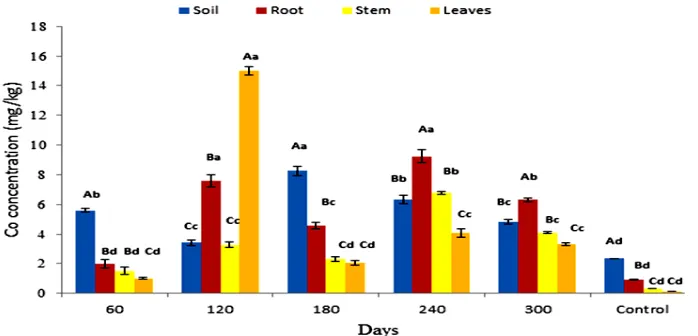
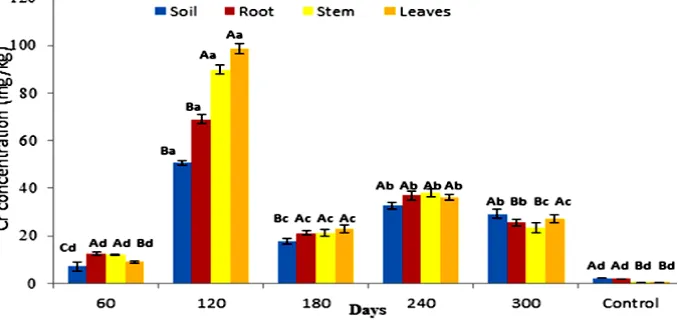
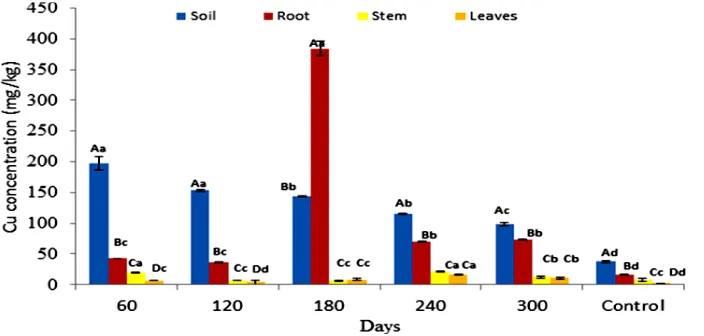
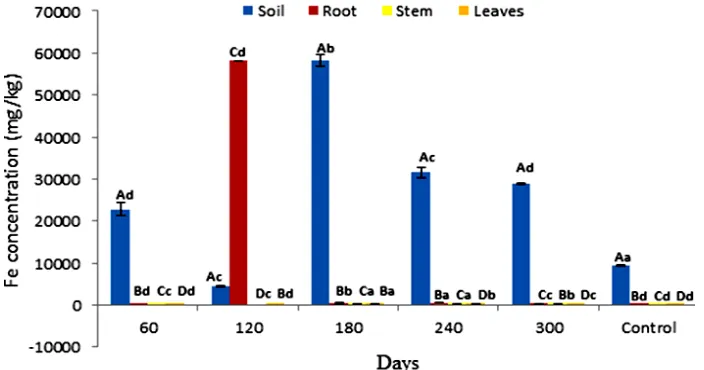
Co and Cr which both were accumulated more in the leaf on 120 harvesting day. However, the quantity of Fe were consistently more in soil than in the root, stem and leaf of the plant on all the harvesting days. In this experiment, heavy metals uptake by the roots were in the ranges of (36.88 to 384.19) Cu, (1.99 to 9.24) Co, (12.61 to 68.94) Cr, (24.41 to 226.36) Mn, (21.01 to 56.89) Ni, (14.56 to 193.34) Zn, (3.09 to 21.75) Pb and (23.14 to 499.24) Fe, all in mg/kg. Moreover, the accumulation of heavy metals in the plant organs was higher higher than its concentration in the control plant organs.
Cobalt
P. fruticose was able to uptake and
accumulates Co from heavy metals spiked soil with a high concentration. As it was shown in Fig. 1, a significant (p < 0.05) concentration of Co in the leaf of the plant was observed to be 15.0 ± 6.23 mg/kg on 120 harvesting day, followed by the root on 120 and 240 harvesting days with concentration 7.588 ± 0.43 mg/kg and 9.24 ± 0.85 mg/kg respectively. It was observed that the concentration of Co in soil and plant organs on 300 days were lower than those on 240 days. The concentration of Co accumulated by plant organs was 1 to several folds compared to control soil and plant. Another high accumulation was observed in the stem of the plant on 240 day with concentration 6.77 ± 1.22 mg/kg. In a similar study on Co, Cr and Ni contents in soils and plants from a Serpentinite quarry, the roots of Juncus sp.
accumulated a large amount of Co, both Festuca
rubra L. and Juncus sp. L. accumulated Co in the
roots more than the shoot12, while in contrary to this study the accumulation was not consistent. Accordingly, concentration of Co was found in the tissues of Luff cylindrica planted on two different soil samples (i) and (ii) with values 0.414 and 0.597 mg/ kg, respectively13. Clethra barbinervis was found to accumulate quiet a number of heavy metals such as Mn, Co, Zn, Ni and Cd but accumulated more Co and Ni in the leaf14. It was observed that Ni and Co interacts regularly and acts against each other in the plant15. Another opposite interaction between Co and Ni was recorded from Alyssum bertolonii and Berkheya coddii and this opposite relationship between Co and Ni may lead to great competition in their translocation, binding ligands and also their function14. The endurance and accumulation mechanism of Co are not sufficiently understood which could be due to some Co accumulator plants use to uptake and accumulate Cu14,16. It was reported that a common criteria used to identify a metal hyper-accumulator plant followed the concentration of metal in dried leaf of a plant that grow in a natural way. A hyper-accumulator plant for Co, Cu and Cr should accumulate 300 mg/kg of the metal before being considered as hyper-accumulator16. Another important issue about Co accumulator is considered to be Co ddetoxification will shun the uptake of ions that can cause stress from oxidation17.
Chromium
Uptake of chromium by P. fruticose grown on a soil contaminated with heavy metals is shown on
was observed from the plant leaf on 120 harvesting day with an amount 98.74 ± 11.97 mg/kg. Other high Cr accumulations were also recorded on the soil, root and stem on 120 harvesting days with a concentration of 50.65 ± 2.87, 68.94 ± 9.97 and 89.74 ± 12.14 mg/kg respectively. It was observed that the accumulation of Cr on 300 harvesting days was lower compared to 240 days accumulation. Accordingly, Cr concentrations in control soil and control plant part were several folds lower than the treated ones. This experiment agrees with a similar study conducted on soil and plants from Serpentinite quarry, it was
observed that, the two plants Festuca rubra L. and
Juscus species L. were able to accumulate Cr in
their roots and shoots. The concentration of Cr accumulated by F. rubra and Juscus species were ranged 13.74 ± 0.63 to 15.37 ± 1.60, 11.21±1.02 to 46.83± 5.91 mg/kg, respectively12. It was noticed that Cr accumulation was significantly higher in the roots than in the shoot. It was also reported that Jatropha
curcas accumulated Cr in the root more than stem
and leaf with concentration 27.99±8.10, 15.90±4.52 and 15.17±3.31 mg/kg, respectively1.
Fig. 2. Accumulation of Cr concentration in soil and P. fruticose root, stem and leaf on all the harvesting days
These results agree with findings of Adki
et al.,18 and Rafati et al.,19, where both authors found out that Cr concentration is lower at the shoot and vegetables of the plant compared to the root. In another study which is contrary to this one, Portulaca oleracea has the potential of accumulate higher concentration of Cr>1000 mg/kg20, and a suggestion was made that any plant that can accumulate Cr more than 1000 mg/kg should be considered as a Cr hyper-accumulator plant21. The antagonistic relationship and synergistic interactions between the concentration of Cr and other heavy metals in plants tissues were observed22. It was reported that Cr use to interact with the uptake of other heavy metals such as Fe and Mn in the root and aboveground which eventually reduces organs or tissue concentration22. In this study, P. fruticose grown on soil spiked with several heavy metals was found to accumulate a significant (p < 0.05) quantity 98.74 mg/kg of Cr dry weight in the leaf. Based on the Cr uptake in this study, P. fruticose cannot be considered as Cr hyper
accumulator plant. It was observed that some plants grown on soil treated with wastewater containing Cr, less quantity was transferred to the aboveground plant organs. Moreover, plants grown on hydrated magnesium silicate soil rich in Cr were found to accumulate few quantities. Generally, plants differ from their potential to absorb and retain Cr in organs and most plants have low capability to uptake and transfer Cr to aboveground tissues9.
Copper
Fig. 3. Accumulation of Cu concentration in soil and P. fruticose root, stem and leaf on all the harvesting days
It was observed in a similar case, where both
Brassica napus and Brassica juncea accumulated
more Cu in their roots than in shoots under Cu stress for 7 and 14 days in hydroponic solution23. In contrast, the study carried out on the use of Amaranthus
paniculatus and B. juncea for phytoextraction of Pb
and Cu from contaminated soil, both plants were able to accumulate Cu concentration ranged from 15.7 to 18.1 and 18.7 to 21.4 mg/kg respectively. But the concentrations were found to be 2 to 4 times more in the shoots than in the roots of the plants24. Cu is a metal that plants needs for growth, but a concentration of Cu beyond 20.00 mg/kg in the aboveground organs is harmful to the plant9. In this experiment, Cu accumulation was higher (p 0.05) in roots 384.19±20.69 mg/kg than stem 21.87±0.67 mg/kg and leaf 16.39±0.98 mg/kg. Higher quantity of Cu in the roots may be due to its ability to move from soil to roots continuously which make it easier for P. fruticose to absorb more and translocate less to above ground tissue. Deficient transfer of heavy metals to aboveground plant organs could be to the retention of heavy metals in protoplasmic fractions of vacuoles, producing coordination complex with some organic acids at the two layers of root or due to separation of heavy metals from anionic sites of cell wall25.
Iron
A significant (p < 0.05)concentration of Fe was observed in P. fruticose root on 120 harvesting day with values 499.24±29.69 mg/kg as it was shown in Fig. 4. Other high amount of Fe was found in the stem and leaf on 180 harvesting day with concentration of 382.51± 106.71 and 433.08
±199.08 mg/kg respectively. Moreover, significant (p < 0.05) concentration of Fe in plant parts was ranged 7.13 to 499.24 mg/kg. Increases of Fe uptake by the root from 60 to 300 harvesting days were also observed with concentration ranged 23.14 to 499.24 mg/kg. All the quantity of Fe accumulated in the
P. fruticose organs was higher than the control soil
was able to tolerate, uptake and accumulate higher concentrations of Fe from spiked soil medium. Furthermore, plants uptake Fe in the form of ferric (Fe3+) ions and ferrous (Fe2+) ions and make effective use of different Fe absorption mechanisms. The mechanism of some plant in Fe uptake includes the release of proton (H+) and gets reduced by the root of the plant in order to lower the soil pH value. And low pH value at the root zone increases and improves Fe solubility and uptake, respectively29.
Moreover, the metals use to pass through the roots before translocation to the aboveground organs of the plant. Plant roots system play an important role in nutrients and water uptake by osmosis from the soil. High quantity of Fe uptake through osmosis was transferred to aerial plant organs via xylem29. And also Fe was translocated via phloem vessels due to some insufficient transpiration flow of xylem vessels in some young plant organs such as apex29.
Fig. 4. Accumulation of Fe concentration in soil and P. fruticose root, stem and leaf on all the harvesting days
Manganese
Accumulation of Mn by P. fruticose on the experimental days was presented on Fig. 5. The plant has the potential to absorb a significant (p < 0.05) concentration of Mn from contaminated soil to the root and translocated it to the shoot. A high accumulation was observed in the root on all the harvesting days with a value of 24.42, 101.65, 226.36, 98.68 and 109.97 mg/kg on 60, 120, 180, 240 and 300 experimental days respectively. Furthermore, the amount of Mn accumulated by the plant tissues increases in the trend stem > leaf > roots. The concentrations of Mn accumulated by
P. fruticose parts were were higher than the control
plant with several folds. This experiment agreed with the study conducted on Eucalyptus grandis and E. urophylla to identify a Mn hyper-accumulator. Both plants were subjected to the same treatment of hydroponic solution 5.0, 500, 10 000 and 20 000 μM of Mn and were able to accumulate higher concentration in the leaf and stem on the first 3 treatment. On exposure to higher hydroponic
Fig. 5. Accumulation of Mn concentration in soil and P. fruticose root, stem and leaf on all the harvesting days
Nickel
The quantity of Ni accumulated by
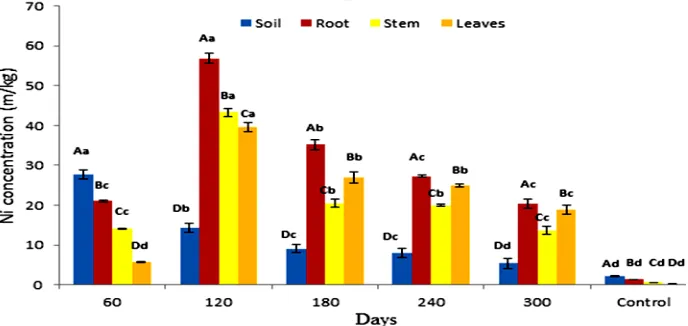
P. fruticose is presented on Fig. 6 A significant (p
< 0.05) quantity of Ni (56.89±16.18 mg/kg) in the root on 180 harvesting day was observed. Other high accumulations were observed on the stem and leaf on 180 experimental days with concentrations 43.28 ± 6.71 and 39.55 ± 11.15 mg/kg respectively. All the accumulation in the P. fruticose organs was observed to be higher compared to the control plant and soil samples. Moreover, it was observed that the accumulation of Ni in plant parts was higher on 120 and 180 days compared to 240 and 300 days. In a similar study by Roccotiello32 in a Ni phytoremediation potential of Mediterranean Alyssoides utriculata (L.) Medik, the finding showed that, concentration of
Ni accumulated in the leaf of the plant was greater than 1000 μg/g and this classified the plant as a Ni hyper accumulator plant32. A high concentration of Ni was observed in the root of P. fruticose at all the harvesting days, followed by the stem on 60 and 120 days. Accumulation of Ni decreases in the trend root > stem > leaf on 60 and 120 experimental days and root > leaf > stem on 180 and 240 harvesting days. In contrast to this experiment, a higher concentration of Ni was found on the stem and leaf of Vetiveria
zizanioides more than the root of the plant33. Uptake of Ni in the root, stem and leaf of P. fruticose was observed to be inconsistent in the trend, instead the accumulation followed the trend root > stem >leaf for 60 and 120 days, while root > stem < leaf for 180 and 240 days.
Fig. 6. Accumulation of Ni concentration in soil and P. fruticose root, stem and leaf on all the harvesting days
Furthermore, results indicated a relatively less Ni ranslocation from root to stem and stem to
Ni in the root on all the experimental days. Salvinia
cucullata was found to accumulate Ni in the leaf
more than root in the first 3 treatments applied. It was observed that as the effluent concentration increases the accumulation of Ni in the leaf decreases while at the extreme concentration of the treatment, S.
cucullata accumulated more Ni in the root 34.9±0.93
mg/kg27. Most plants are able to accumulate Ni into the root and translocate it to the aboveground tissue by passive and active processes. A high concentration of Ni was observed in the root more than the stem and leaf when plants are grown on soil contaminated with high quantity of Ni. It was noticed also that excess Ni in the soil may affect the biosynthesis of metalloenzymes by making some important metals iinadequate and also decreases the absorption of Fe by the plant34.
Lead
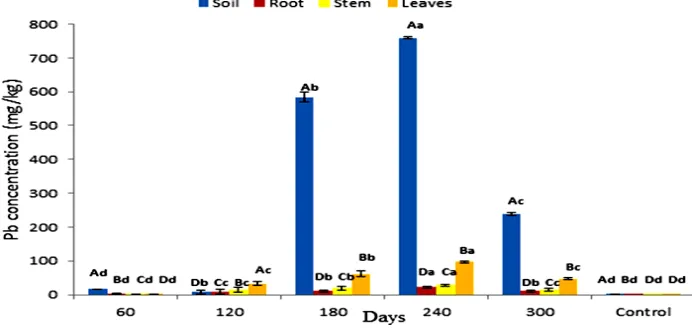
The quantity of Pb accumulated by
P. fruticose is presented on Fig. 7 and a significant
(p < 0.05) concentrations were observed to increase from 60 to 240 harvesting days and also from root to leaf except for the 60 and 300 experimental days. Furthermore, the accumulation of Pb by P.
fruticose parts was several times higher than the
concentration in the control plant parts. A significant (p < 0.05) amount of Pb accumulated by P. fruticose was found in the leaf (96.37 ± 3.89 mg/kg) and least Pb accumulation was also found in the leaf (1.22 ± 0.17 mg/kg) on 240 and 60 harvesting days, respectively. In the experiment conducted on phytoremediation potential for Pb, Zn and Cu using indigenous plants, a range of Pb accumulation was presented as 3.44 to 364.47 mg/kg dry weight in the
tissues of the plants35. This study is in accordance with the finding reported by Mkumbo et al.,35. The low accumulation of Pb found in this experiment was in accordance with finding reported by Knapp
et al.,36, in the Pb uptake by carrots, tomatoes and amaranth with concentrations ranged from 0.3 to 1.9 mg/kg36. Normally, the plants that accumulated low Pb concentration they do so may be as a result of the toxicity of Pb. Photosynthetic processes, anti-oxidant enzymes and synthesis of chlorophyll can be affected by Pb toxicity37. Olowu et al.,38 stated that the uptake and high accumulation of Pb at the plant roots may not be translocated to shoots, fruits and seed due to its low solubility and strong barrier38. Experiment on Pb uptake in P. fruticose shows that leaf has accumulated higher amount of Pb compared to stem and root. Increasing quantity of Pb accumulation in the leaf was found to be 32.85, 61.71 and 96.37 mg/kg on 120, 180 and 240 days, respectively. It was observed that, the amount of Pb accumulated by the tissues of P. fruticose increases from root to stem to leaf. Therefore, the uptake followed the trend root < stem < leaf on all the harvesting days except on the first 60 days. The trend of Pb transfer indicated that Pb was efficiently transferred from the soil to root, root to stem and stem to leaf. The accumulation of Pb into plant organs is an indication of the quantity of Pb contained in the soil or environment. It was observed that small quantity of Pb are soluble and bioavailable for absorption into plants root from the soil, which could be due to a strong binding between Pb/organic materials and Pb/colloidal materials39. The potential of plant and cultivars species differs in Pb accumulation, which also depends on Pb availability in the soil and various soil properties39.
Zinc
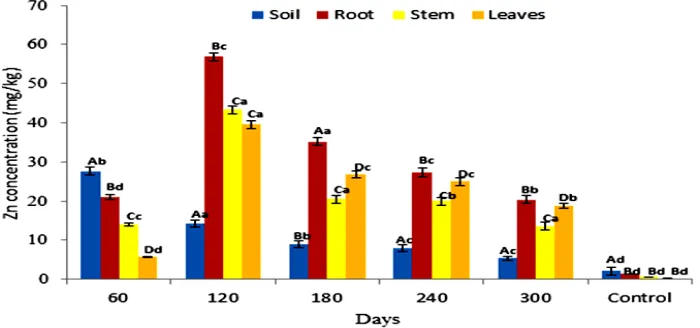
Accumulation of Zn by P. fruticose root, stem and leaf is presented on figure 8. A significant (p < 0.05) concentration of Zn was observed to be higher in the root of the plant at all the harvesting days compared to other plant parts with concentrations 14.56, 58.58, 193.34, 49.25 and 73.27 mg/kg on 60, 120, 180, 240 and 300 days respectively. The quantity of Zn in P. fruticose part was found higher compared to Zn concentration in control plant part on all harvesting days. A significant (p < 0.05) amount was found in the root on 120 day
with concentration 193.34 ± 36.07 mg/kg. It was observed that, translocation of Zn from root to shoot of the plant decreases in the trend root > stem > leaf on all harvesting days. Other higher amount of Zn in stem and leaf of the plant were found on 180 and 120 harvesting days with a concentration 29.75 ± 4.40 and 27.88 ± 2.21 mg/kg respectively. This study agreed with the similar experiment carried out on Zn uptake using different plant species by Subhashini
et al.,40, they reported that Acalypha indica and
Ruellia tuberosa accumulated Zn in the tissues
following the trend root > stem > leaf.
Fig. 8. Accumulation of Zn concentration in soil and P. fruticose root, stem and leaf on all the harvesting days
A. indica was able to accumulate Zn 131.36,
53.93 and 49.92 mg/kg and R. tuberosa 49.99, 44. 86 and 32.77 mg/kg both for the root, stem and leaf respectively on 60 experimental day40. In contrary to this experiment, Limnobium laevigatum was found to accumulate a significant concentration of Zn in the leaf. They also reported that there were no significant changes in the accumulation of Zn from the root and leaf over a period of time41. High Zn concentration (193.34 mg/kg) was found in the root on 180 days followed by (58.58mg/kg) on 120 days and (49.25mg/ kg) on 240 days. Zinc is an essential metal to plant in which a normal plant can have an average value of Zn 66.0 mg/kg in the stem or leaf 9. In this study the concentration of Zn in the stem and leaf were below the normal plant Zn concentration. However, the uptake of Zn from root to stem and stem to leaf were found to be decreasing on all the harvesting days. Consequently, Zn concentration was found higher in the root than the stem and leaf. Moreover, transfer of Zn from root to stem and leaf was lower compared to transfer from soil to the root of the plant. It was reported
that, when Zn is effective it can move and transfer from plant root to shoot and becomes accountable for lowering the amount of important plants nutrients and hinder some biochemical reaction42. It was also reported that in order to translocate Zn from root to the shoot, Zn has to move through many different tissues before the xylem of the plant was reached43. But in this experiment Zn was not transferred to aboveground tissue so easily. Accordingly, Zn is capable of moving and it is accessible biologically, consequently, its high amount in the soil and plant can enter into the food chain9.
Bio-concentration Factor (BCF), Translocation Factor (TF) and Extraction Coefficient (EC)
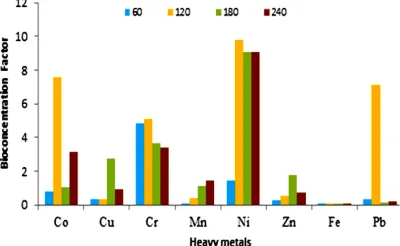
(5.08), Co (7.55) and Pb (7.09) on 120 harvesting day. It was detected that Cr and Ni achieved a BCF value of >1 in the entire harvesting days of 60,120,180 and 240, while Fe was not able to achieve the BCF threshold value. Minimum value was observed in Fe on 60 harvesting day with BCF value of 0.002. High and low BCF values of 5.57 and 0.02 were observed in Sphaeranthus africanus (L.) and Celosia triggna L. respectively35 and is similar to this experiment. The TF threshold of >1 was observed in Co, Cr, Ni, Mn, Zn, Fe and Pb heavy metals at different experimental days except Cu which did not achieve TF value >1 on all the experimental days. Chromium (Cr) was observed to achieved TF threshold of >1 on all the harvesting days. It was observed that Pb has the highest TF value on 120, 180 and 240 harvesting days compared to other metals. Chromium failed to be efficiently translocated to the shoot when compared to other heavy metals, and Fe was poorly translocated. The highest TF values were observed at different experimental days, Cr (TF = 2.73), Pb (TF = 7.37), Pb (TF = 5.7) and Pb (TF = 5.29). Therefore, these results indicated that P. fruticose is an excluder species to Cu and Fe while it is an accumulator to Co, Cr, Ni, Mn, Pb and zinc.
Fig. 9. Comparative BCF of Co, Cu, Cr, Mn, Ni, Zn, Fe and Pb in P. fruticose at different harvesting time
Fig. 10. Comparative TF of Co, Cu, Cr, Mn, Ni, Zn, Fe and Pb in P. fruticose at different harvesting days
Fig. 11. Comparative EC of Co, Cu, Cr, Mn, Ni, Zn, Fe and Pb in
P. fruticose at different harvesting days
The EC threshold value of >1 was obtained by Ni and Cr on all the harvesting days. Maximum EC was achieved by Pb on 120 days with value 5.96 followed by Ni on 120, 180 and 240 harvesting days with values 5.79, 5.21 and 5.63 respectively. Cobalt (Co) also obtained a maximum value of 5.34 on 120 experimental days, while the remaining metal shows EC < 1 throughout the harvesting days.
CONCLUSION
Soils that are polluted with heavy metals or metalloid are not easy to be remediated. The practice of soil clean-up is very expensive; therefore a low cost technology is needed for rectifying contaminated soil. A recent technology called phytoremediation is cost effective and affordable for reducing or removing heavy metals and metalloids from contaminated soil. In this study, growth, survival ability, accumulation of heavy metals in the roots, stem and leaf, the relationship between the metal concentration in the soil, root and shoots were the factors of concern in conducting the experiment. According to the results obtained, P. fruticose was a good accumulator for most of heavy metals because the concentration ratio of the heavy metals in the plant to that in the soil (BCF) was > 1. P. fruticose plant has the potential to be used in the phytoextraction of some heavy metals with BCF and TF > 1. Furthermore, it has the ability to be used in phytostabilization for the heavy metals with BCF and TF values < 1. The results obtained can be considered as a practical demonstration for the use of
P. fruticose in the phytoremediation of several heavy
All authors contributed in carrying out the experiments and writing of the manuscript. All authors read and approved the final manuscript.
ACKNOWLEDGMENT
The authors would like to express gratitude to the Faculty of Resource Science and Technology,
Universiti, Malaysia, Sarawak, and the study leave granted to Naseer Inuwa Durumin Iya by Federal University Dutse, Jigawa State Nigeria for his Ph.D is also acknowledged.
Conflict of interest
We declare that we have no conflict of interest.
REFERENCES
1. Chang, F.C.; Ko, C.H.; Tsai, M.J.; Wang, Y.N.; Chung, C,Y. Ecotox., 2014, 23(10), 1969 – 1978.
2. Ullah, A.; Henga, S.; Munis, M. S. H.; Fahad, S.; Yanga, X. Environ and Exp Bot., 2015, 17, 28 – 40.
3. Pandey, V. C. Ecotox. Environ. Safe., 2012, 82, 8–12.
4. Iqbal, M. P. Pak J Pharm Sci., 2012, 25, 289–294.
5. Wuana, R. A.; Okieimen, F. E. Ecol., 2011, 1–20.
6. Beskoski, V. P.; Gojgic-Cvijovic, G.; Milic, J.; Ilic, M.; Miletic, S.; Solevic, T.;Vrvic, M. M.
Chemos., 2011, 83, 34 – 40.
7. Sawidis, T.; Krystallidis, P.; Veros, D.; Chettri, M. Bio
Trace Element Resour., 2012, 148(3), 396-408.
8. Singh, R.; Singh, D. P.; Kumar, N.; Bhargava, S. K.; Barman, S. C. J Environ Bio., 2010, 31, 421- 430.
9. Durumin Iya, N. I.; Assim, Z.B.; Ipor, I.I.; Omolayo, A.O.; Umaru, I.J.; Jume, B.H.
Indones. J. Chem., 2018, 18(3), 503 – 513.
10. Karam, D.; Rajoo, K.; Ismail, A.; Muharam, F.M. Am. J. Agric. Environ. Sci., 2016, 16(8),
1504–1514.
11. Kaewtubtim, P.; Meeinkuirt, W.; Seepom, S.; Pichtel,
J. Appl. Ecol. Environ. Res., 2016, 14 (1), 367– 382.
12. Lago-Vila, M.; Arenas-Lago, D.; Rodríguez-Seijo, A.; Andrade Couce, M. L.; Vega, F. A.
Solid Earth., 2015, 6, 323–335.
13. Khan, Z. I.; Ahmad, K.; Ashraf, M.; Parveen, R.; Mustafa, I.; Khan, A.; Bibi, Z.; Akram, N. A. Pak. J. Bot., 2015, 47(1), 217-224.
14. Yamaguchi, T.; Tomioka, R.; Takenaka. Int. J.
Mol. Sci., 2015, 16, 21378-21391.
15. Kabata-Pendias, A. Trace Elements in Soils
and Plants., 2011, 227–251.
16. Ali, H.; Khan, E.; Sajad, M. A. Chemos., 2013, 91, 869–881.
17. Lange, B.,; van der Ent, A.; Baker, A. J. M.; Echevarria, G.; Mahy, G.; Malaisse, F.; Meerts, P.; Pourret, O.; Verbruggen, N.; Faucon, M. P.
New Phytol., 2016, 213, 537 – 551.
18. Adki, V. S.; Jadhav, J. P.; Bapat, V. A. Environ.
Sci .Pollut. Res., 2013, 20, 1173-1180.
19. Rafati, M.; Khorasani, N.; Moattar, F.; Shirvany, A.; Moraghebi, F.; Hosseinzadeh, S. Intl. J. Environ. Res., 2011, 5, 961–970.
20. Tayim, A.; Alyazouri, A.; Jewsbury, R. A.; Tayim, H.; Humphreys, P. N.; Al-Sayah, M. H. Toxicol.
Environ. Chem., 2014, 95(8), 1029 – 486.
21. Ali, H.; Naseer, M.; Sajad, M. A. Int . J. Environ.
Sci., 2012, 2, 1459–1469.
22. Emamverdian, A.; Ding, Y.; Mokhberdoran, F.; Xie, Y. The Sci. World J., 2015, 1-18.
23. Feigl, G.; Kumar, D.; Lehotai, N.; Tugyi, N.; Molnar, A.; Ordog, A.; Szepesi, A., Gemes, K.; Laskay, G.; Erdei, L.; Kolbert, Z. Ecotoxicol.
Environ. Safe., 2013, 94, 179–189.
24. Rahman, M. M.; Tan, P. J.; Faruq, G.; Sofian, A. M.; Rosli, H.; Boyce, A. N. Int. J. Agri.c Bio.,
2013, 15, 903 – 908.
25. Leura-Vicencio, A.; Alonso-Castro, A. J.; Carranza-Alvarez, C.; Loredo-Portales, R.; Torre, M. C. A.; Cruz, R.F. G. Bull. Environ.
Cont. Toxicol., 2013, 90, 650–653.
26. Lorestani, B.; Cheraghi, M.; Yousefi, N. Arch.
Bio. Sci., 2011, 63(3), 739 –745.
27. Das, S.; Mazumdar, K. Chemos., 2016, 163, 62–72.
28. Tangahu, B.V.; Abdullah, S.R.; Basri, H.; Idris, M.; Anuar, N.; Mukhlisin, M. Int. J. Chem.
Eng., 2011, 1-31.
29. Bhat, I. U.; Mauris, E. N.; Khanam, Z. Int. J.
Phytorem., 2016, 18(9), 918-23.
30. Xie, W.; Huang, Q.; Li, G.; Rensing, C.; Zhu, Y. Int. J. Phytorem., 2013, 15, 385–397.
31. Satpathy, D.; Reddy, M. V. Appl. Ecol. Environ.
32. Roccotiello, E.; Serrano, H. C.; Giorgio, M.; Branquinho, M. C. Chemos., 2015, 119,
1372 – 1378.
33. Gunwal, I.; ingh, L.; Mago, P. Int. J. Sci. Res.
Pub., 2014, 4(10), 1–7.
34. Nie, J.; Pan, Y.; Shi, J.; Guo, Y.; Yan, Z.; Duan, X.; Xu, M. Int. J. Environ. Res. Pub. Health.,
2015, 12, 15075–15087.
35. Mkumbo, S.; Mwegoha, W.; Renman, G. Int.
J. Environ. Sci., 2012, 2(4), 2425–2434.
36. Knapp, L.; Sangster, J.; Bartelt-hunt, S. L.
Int. J. Serv. Earn. Eng., 2013, 8(2), 1-7.
37. Nematian, M.A.; Kazemeini, F. Intl. J. Agric.
Crop Sci., 2013, 5(4), 426–432.
38. Olowu, A. R.; Adewuyi, O. G.; Onipede, J. O.;
Oladipo, A.; Lawal, A.O.; Owolabi, M.; Sunday, M. O. Am J Chem., 2015, 5(1), 40 – 48.
39. Amin, H.; Arain, B.A.; Jahangir, T.M.; Abbasi, M.S.; Amin, F. Geology, Ecology, and
Landscapes., 2018, 2(1), 51-60.
40. Subhashini, V.; Swamy, A.V.V.S.; Krishna, R. H. World. J. Environ. Eng., 2013, 2, 27-33.
41. Aran, D.S.; Harguinteguy, C.A.; Fernandez-Cirelli, A.; Pignata, M.L. Environ. Sci. Pollut.
Res. Int., 2017, 24(22), 18295-18308.
42. Sheel, D. R.; Anand, M.; Nisha, K. Intl. J. Sci.
Res., 2013, 4(7), 1238 –1241.
43. Gupta, N.; Ram, H.; Kumar, B. Rev. Environ.