Adaptive Motion Analysis
in Machine and Biological
Vision
Colin W.G. Clifford
University College London
December 1996
ProQuest Number: 10045807
All rights reserved
INFORMATION TO ALL USERS
The quality of this reproduction is dependent upon the quality of the copy submitted. In the unlikely event that the author did not send a complete manuscript and there are missing pages, these will be noted. Also, if material had to be removed,
a note will indicate the deletion.
uest.
ProQuest 10045807
Published by ProQuest LLC(2016). Copyright of the Dissertation is held by the Author. All rights reserved.
This work is protected against unauthorized copying under Title 17, United States Code. Microform Edition © ProQuest LLC.
ProQuest LLC
789 East Eisenhower Parkway P.O. Box 1346
A bstract
A cknow ledgem ents
I am grateful to many people at UCL, especially Chris Benton, Oliver Braddick, Kate Bradford, Willie Curran, John Draper, Paul Hibbard, Alan Johnston, Peter McQwan, Justin O'Brien and Simon Prince for their advice, assistance, tolerance and general calming influence over all or part of the last three years, my long-suffering housemates, Paul Chambers and Jim Davy, for their company and friendship, the Psychology Allstars football team for many hours of cold, muddy enjoyment, and Keith Langley for his enthusiastic supervision.
I would also like to thank Johannes Zanker for inviting me to visit ANU, Michael Ibbotson and Richard Mark for introducing me to electrophysiology, and everyone who helped make my three months in Canberra so enjoyable, especially the Zanker family and Cathy Leamey.
This thesis is dedicated to the memory of my father,
Publications arising from the thesis:
C hapter 2:
Clifford, C.W.G. & Langley, K. (1996a). "A model of temporal adaptation in fly motion vision", Vision Res., 36, 2595-2608.
C hapter 3:
Clifford, C.W .G ., Ibbotson, M.R. & Langley, K. (1997). "An adaptive Reichardt detector model of motion adaptation in insects and mammals", Visual
N euroscience, in press.
Ibbotson, M.R., Clifford, C.W.G. & Mark, R.F. (1997). "Adaptation enhances the dynamic range of directional neurons in the nucleus of the optic tract: physiology and simulation", Journal o f N europhysiology, under review.
C hapter 4:
Clifford, C.W.G. & Langley, K. (1996b). "Psychophysics of motion adaptation parallels insect electrophysiology". Current Biology, 6, 1340-1342.
C hapter 5:
Clifford, C.W.G., Langley, K. & Fleet, D.J. (1995). "Centre-frequency adaptive HR temporal filters for phase-based image velocity estimation", Proc. 5th. lE E Int.
Contents
1 I n t r o d u c t i o n to im age m otion a n a l y s i s ... 14
Motion as a fundamental visual dimension ... 15
The use o f motion in f o r m a tio n ... 17
Existing theories of motion p e r c e p t i o n ... 18
Intensity-based a p p r o a c h e s ... 19
Relationships between approaches ... 22
Methodological issues in the study of biological v i s i o n ... 23
Computational vision as a Lakatosian research programme . . . . 25
Adaptive motion analysis in biological vision ... 27
Adaptive motion analysis in machine vision ... 28
Steering or shearing? ... 31
Recursive filters ... 33
O v e r v i e w ...- ... 34
2 A n a d a p tiv e R e i c h a r d t d e te c to r m odel o f te m p o r a l a d a p t a ti o n in fly m o tio n v i s i o n ... 36
The Reichardt d e t e c to r ... 37
Adaptation in fly motion analysis ... 40
The phenomenology of adaptation ... 40
The adaptive Reichardt detector model ... 44
Delay filters ...T ... 46
Spatial integration... 47
Adaptation to flickering s t i m u l i ... 48
Adaptive d y n a m i c s ... 49
Response p r o p e r tie s ... 50
Steady-state p r o p e r t i e s ... 52
Recovery from ad a p ta tio n ... 55
Velocity contrast ... 58
Modelling H S ... 65
Coding e ffic ie n c y ... 67
Problems with differential coding ... 67
"Leaky" predictive c o d i n g ... 68
Alternative coding stra te g ie s ... 71
S u m m a r y ... 72
Appendices ... 73
Appendix 2.1 ... 73
Appendix 2.2 ... 74
Appendix 2.3 ... 75
Appendix 2.4 ... 76
3 E x te n d in g th e m odel to m a m m a lia n m o tio n a d a p t a t i o n ... 78
I n tr o d u c tio n ... 79
R e s u l t s ... 84
Temporal frequency dependency of response decay ... 84
Temporal frequency dependency of adapted time constant . . . . 84
Directionality of ad aptation ... 87
Effect of adaptation on temporal frequency tuning ... 92
Is adaptation generated locally? ... 96
D i s c u s s i o n ... 96
Adaptation: function or f a t i g u e ? ... 98
S u m m a r y ... 99
Appendices ... 100
Appendix 3.1: Time constant a d a p t a ti o n ... 100
Appendix 3.2: Recursive implementation of first-order low-pass filters ... 101
Appendix 3.3: Dependence of peak gain on filter time constant 103 4 P sychophysics o f m o tio n a d a p t a ti o n p a rallels insect a n d m a m m a l ia n e l e c tr o p h y s io l o g y ... 106
I n tro d u c tio n ... 107
M ethod ... 108
5 A n ap p lic a tio n o f a d a p tiv e filters to the m e a s u r e m e n t o f im age velocity in
m a c h in e v i s i o n ... 122
In tr o d u c tio n ... 123
Measuring velocity from band-pass f il te r s ... 125
Calculating confidence e s tim a te s ... 130
Spatial filters ... 130
Space-time oriented filters ...132
Causal recursive temporal fil te r s ... 132
Cascaded temporal f i l t e r s ... 135
Digital filter d e s i g n ... 136
Temporal adaptation ... 139
Dynamics of adaptation ... 143
R e s u l t s ... 144
Im plem entation... 144
Error m e a s u r e s ... 145
Measured flow fields ... 146
C o n c lu sio n ... 150
6 C onclusions ... 152
Rapid neural adaptation to m o t i o n ... 154
Motion adaptation in i n s e c t s ... 154
Comparing motion adaptation in insects and mammals ... 155
velocity ... 158
The role of adaptive motion analysis in machine and biological vision . 159 Further q u e s t i o n s ... 161
Electrophysiology... 162
Psychophysics ... 163
Machine v i s i o n ... 164
List of figures
1.1 Strategies for the detection of m o t i o n ... 20
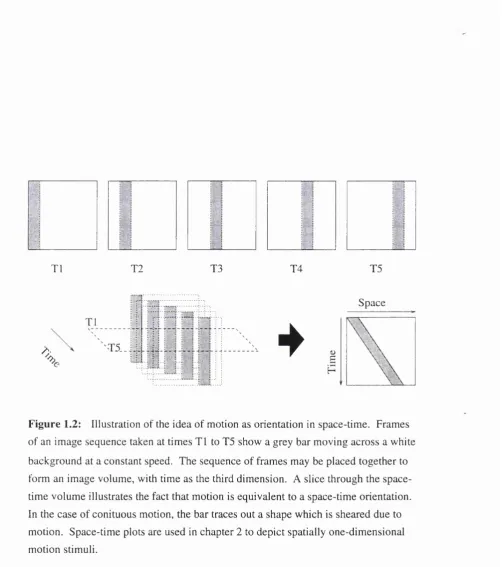
1.2 Motion as orientation in space-time ... 21
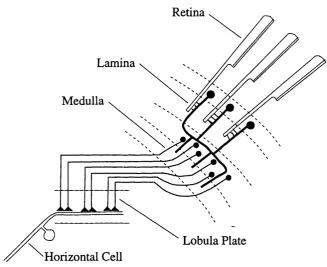
1.3 The horizontal cells o f the fly lobula p l a t e ... 29
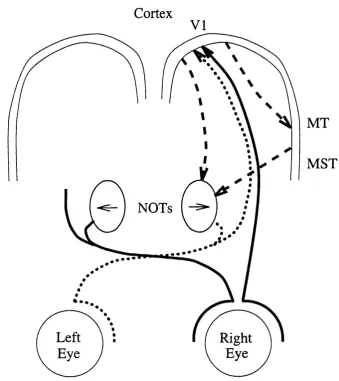
1.4 Neural pathways to the nucleus of the optic t r a c t ... 30
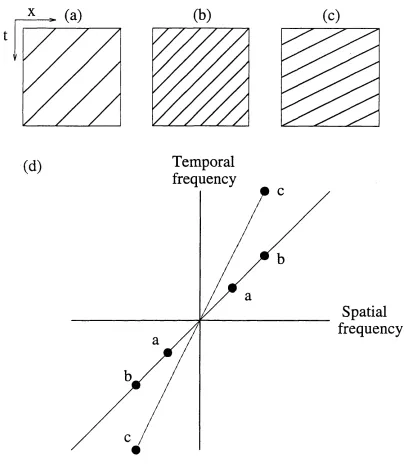
1.5 Motion in the frequency d o m a i n ... 32
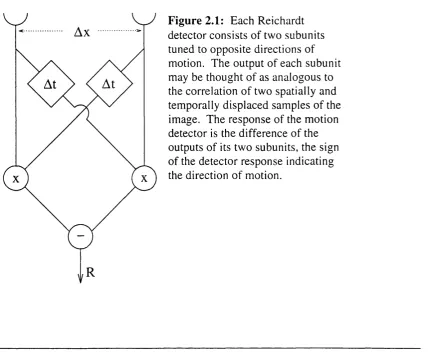
2.1 The Reichardt d e te c to r ... 39
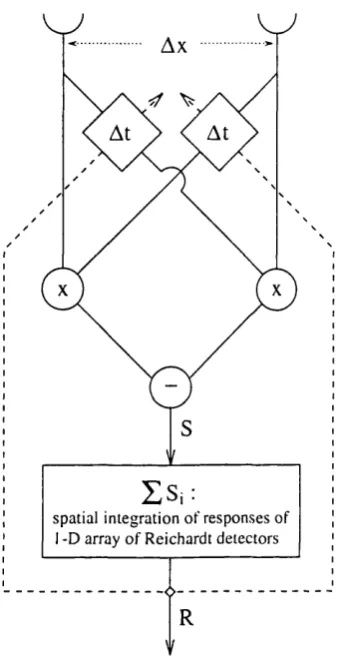
2.2 The adaptive Reichardt d e t e c to r ... 43
2.3 Amplitude spectra of Reichardt detector arrays ... 45
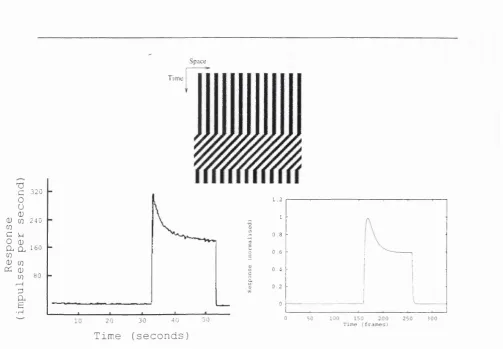
2.4 Response of H I and model to maintained m o t i o n ... 51
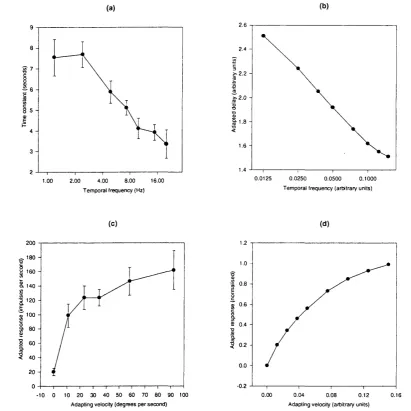
2.5 Time constant as a function of temporal frequency of adapting stimulus 54 2.6 Response recovery after adaptation ... 57
2.7 Response to increments and decrements of velocity around baseline . . . 59
2.8 Response to velocity modulated stimuli ... 62
2.9 Response modulation as a function of frequency of velocity modulation 64 2.10 Response of HS and model to maintained m o t i o n ... 66
3.1 Old and new versions of adaptive Reichardt d e t e c t o r ... 82
3.5 Adapted impulse responses of wallaby N O T n e u r o n ... 89
3.6 Time constants after adaptation in four conditions . . T... 91
3.7 Temporal frequency response functions before and after adaptation . . . 93
3.8 The model's impulse response before and after adaptation ... 95
3.9 The locus of adaptation in wallaby NOT cells and the model ... 97
3.10 Recursive implementation of the temporal filter used in the model . . . 104
4.1 Experimental procedure used for p s y c h o p h y s ic s... 110
4.2 Perceived speed as a function of adaptation duration ... 113
4.3 Controlling for contrast a d a p ta tio n ... 115
4.4 Further controls for perceived speed e x p e rim e n t... 116
4.5 Adaptation of perceived speed varying spatial and temporal frequencies 118 4.6 Detection of velocity modulation as a function of adaptation duration 119 5.1 Adaptive scheme for image velocity measurement ... 126
5.2 Spatial filters used to implement the phase-based s c h e m e ... 131
5.3 The construction of spatiotemporally oriented filters ... 133
5.4 Temporal filters used to implement the phase-based s c h e m e ... 137
5.5 Recursive implementation of the temporal filters ... 140
5.6 Filters adapting to a plane of power in frequency space ... 142
5.7 Confidence map from the diverging tree sequence ... 147
List of tables
5.1 Parameters for the discrete-time transfer function of the third-order filter and its derivative according to equation 5.19 ... 139
Chapter 1
Introduction to image
Next to the simple detection of light and dark, the ability to perceive motion may be the oldest and most basic of visual capabilities (Young & Lesperance, 1993). The world that we live in is constantly in motion and, when awake, we are
constantly moving around interacting with objects and other organisms. Our view of the world is constantly changing. This means that the ecological stimulus for vision is inherently spatiotemporal; a changing optic array (Lee, 1980).
Consequently, we might expect motion detection to be a fundamental role of any biological vision system. This does indeed seem to be the case: while numerous animals lack colour vision or significant binocular vision, the ability to see motion is com mon among all visual animals (Nakayama, 1985).
Visual analysis is an active process involving the continual adaptation of
elementary processing units. Such rapid adaptation is a fundamental property of vision with moment to moment relevance to perception. While much previous work has considered the functional benefits of photoreceptor adaptation (e.g. Laughlin, 1989), adaptation at subsequent levels of the visual system has often been neglected or viewed as a limitation of the system associated with neural fatigue. In this thesis, functional roles for rapid adaptation in the robust and efficient processing of motion information are considered in the contexts of machine and biological vision.
M otion as a fundam ental visual dim ension
high degree of modularity within the visual system such that we can talk of a specific motion sub-system (Ullman, 1^91). Below, the evidence for functional specialisation within the primate visual system is reviewed, and for motion as a fundamental visual dimension, like form and colour, rather than the result of a secondary stage of processing based on prior extraction of some other attribute. The first demonstration of a separate motion process was provided by the
"waterfall illusion" (Wohlgemuth, 191 1). The waterfall illusion is an example of the motion aftereffect (MAE) whereby stationary objects are seen to move in the direction opposite to the motion of a previously fixated object, giving rise to a perceptual dissociation of motion and position. This is a paradox unless motion and position are regarded as separate sensory dimensions (Gregory, 1966). More recently, studies of the cytoarchitecture of the visual cortex coupled with single cell recording have provided evidence for functional specialisation at the neural level (Zeki & Shipp, 1988; Zeki, 1993). In the macaque monkey, the neural substrate of motion perception is a pathway originating in the M ganglion cells in the retina, which relay to the magnocellular layers of the lateral geniculate
nucleus (LGN). From the LGN the output is relayed to layer 4 8 of the primary visual cortex, V I, and from there to V5, both directly and through the thick stripes of area V2 (Zeki, 1993). Corroboration of functional specialisation at the neural level in the human visual system has come from a clinical study by Zihl et al reporting a case of akinetopsia, a syndrome in which a patient is specifically unable to perceive motion following a lesion to the extra-striate cortex (Zihl et al,
The use o f m otion inform ation
The previous section stressed the fundamental role of motion processing in visual function. This point is illustrated by examining various functions which rely on motion information. It is helpful to make a distinction between the low-level processes which extract motion information from the optic array and higher-level processes contingent upon that motion information. Transduction of light
incident on the retina gives rise to a time-varying pattern of activity. The pattern of retinal activity is the result of the projection of a spatially three-dimensional environment onto the two-dimensional retina. The projection of the 3-D velocity field onto the retina is known as the optical flow field (Horn & Schunk, 1981). It is the role of low-level motion processing to provide an estimate of the optical flow field for the higher level functions reviewed below.
Given a 2-D retinal image, the visual system must provide the third dimension, depth. One of the most fundamental monocular cues to depth is motion parallax. The optical flow field contains a wealth of information regarding the layout of the surrounding environment (Longuet-Higgins & Prazdny, 1980), as is evidenced from our ability to achieve a perception of depth from moving random dot
determined by the optical flow field is the time-to-contact, t , between the object and the observer, which from an ecological standpoint is a more basic parameter (Lee, 1980).
Depth and time-to-contact information are vital if we are to navigate through our environment without colliding with objects. Equally important in navigation is the proprioceptive information optical flow provides about our own motion (Gibson, 1979), and the motion of objects and other people (Johansson. 1971). Motion is also important as a stimulus to drive eye movements (Rashbass, 1961), and for the segmentation of images into different physical objects.
E xisting theories o f motion perception
There are two distinct strategies prevalent in current theories of motion
perception: the feature-based approach, where edges or corners are detected and tracked over time (e.g. Deriche & Faugeras, 1989), and intensity-based
approaches which compute motion from the output of spatiotemporal filters without passing through a feature extraction stage. This thesis details the extension of two intensity-based approaches to incorporate adaptive temporal filters. Different intensity-based approaches have in common the use of
Intensity-based approaches
Intensity-based approaches can be sub-divided into four classes: gradient, energy, phase and correlational schemes (Figure 1.1). The first three rely on the fact that motion can be considered as orientation in space-time (Figure 1.2) to exploit the analogy with orientation in static 2-D images. Gradient-based approaches use filters which take "fuzzy derivatives" (Koenderink & van D oom, 1987), blurring and differentiating the image, and combine the filter outputs as a quotient of temporal and spatial derivatives to estimate velocity (Fennema & Thompson,
1979; Horn & Schunk, 1981; Johnston, McOwan & Buxton, 1992; Johnston & Clifford, 1995ab; Young & Lesperance 1993). Energy- and phase-based
approaches calculate velocity from the representation of signal structure provided by quadrature pairs of bandpass filters (Gabor, 1946). Each quadrature pair can be thought of as a complex bandpass filter, so the response of each pair to a real image is also complex. Energy-based approaches calculate velocity from the amplitude of this complex signal (Adelson & Bergen, 1985; Heeger, 1987), phase-based approaches from the phase (Fleet, 1990; Fleet & Jepson, 1990). Evidence for a quadrature phase relationship between adjacent cells in the visual cortex has been reported by Pollen & Ronner (1981). Correlation-based
approaches compute motion according to a delay-and-compare principle (Reichardt, 1961; van Santen & Sperling, 1985). Under the correlational approach, the basic unit of motion detection consists of a pair of spatially
X
t
Reichardt Correlation
( A ' x B ) - ( B ' x A)
Motion Energy
R - L
Space-Time Gradients
JL
S
Figure 1.1: Schematic diagram of strategies for the detection of motion. In the correlation model, motion is detected by filters separated in space and time. The motion energy model requires the construction of oriented filters in space-time. In
both the correlational and the Reichardt models, the final output is a comparison of
the responses of leftward and rightward detectors. The gradient model compares the response of filters tuned to flicker (T) and static pattern (S) by calculating the
ratio of the flicker to pattern responses. Under the phase-based approach, the image is filtered initially with space-time oriented filters of the form used in the
T1 T2 T3 T4 T5
\
'T5__J.*5^a4
4
Space
OJ
p H
Relationships between approaches
It is interesting to consider the relationships between the four classes of intensity- based approach. The Elaborated Reichardt Detectors proposed by van Santen & Sperling (1985) involve spatial pre-filtering to avoid problems of aliasing. If the spatial displacement and temporal delay between the filters are both set to be equivalent to a phase shift of n /2 , then van Santen and Sperling (1985) showed that their Elaborated Reichardt Detector is mathematically equivalent to the motion energy detector of Adelson & Bergen (1985), although the different implementations give rise to different physiological predictions regarding the responses of constituent cells (Emerson, Bergen & Adelson, 1992). In certain simple cases, it has also been shown that energy and gradient schemes are mathematically equivalent (Adelson & Bergen, 1986; Simoncelli & Adelson,
derivatives of a filter kernel can be linearly combined to produce a
spatiotemporally oriented filter suitable for motion energy calculation. In particular, the equivalence does not hold for asymmetric temporal filter profiles necessary in the design of causal filters. Thus, while both energy and gradient models can employ causal filters, the two classes of model will not be equivalent in such cases. Since the problem of motion perception demands temporal
causality, any physically realisable gradient scheme will not be equivalent to a motion energy approach based upon spatiotemporally oriented filters. There is clearly also a relationship between gradient schemes, based on derivatives of low- pass filtered images, and phase-based schemes using derivatives of the phase output of band-pass filtered images. However, we lack as yet a wholly
satisfactory understanding of phase-based techniques, and consequently the exact nature of the relationship is not yet apparent.
M ethodological issues in the study o f biological vision
Compared to visual psychophysics and electrophysiology, the emergence of computational methods for studying visual perception has been relatively recent. W hile the experimental techniques have been refined over the course of more than a century, the attempt to characterise biological vision in computational terms (which I shall term "computational vision") only began to develop in the 1970’s with the application of information processing principles. Foremost among the theorists during these early years was David Marr, who attempted to give
to build (Marr, 1982). Marr saw the visual system as a complex information processor, recognising that such a system could be understood on a number of levels, but stressed the critical importance of the level of computational theory in understanding both the problems to be solved in visual perception and the
solutions adopted by biological systems.
Given the historical development of the study of vision, it is interesting to
consider what methodologies might be relevant for today's work. While we have a wealth of empirical data, a strong theoretical basis from which to understand it has emerged only recently through the computational approach. Given this lag of theory behind experimental work, it is unreasonable to expect current theories to explain all the available data, or even to attempt to do so. But this leaves us with the problem of how to evaluate theories that are incomplete or limited in scope. Moreover, if there is to be profitable interaction between experimental and computational vision, we must ask what is the proper role of empirical work in the evaluation of emerging theories.
correlational approach to motion perception to include adaptive temporal filters.
Com putational vision as a Lakatosian research program m e
The previous section discussed the way in which the historical development o f the study of biological vision has determined which methodological issues are most relevant today. I have chosen to characterise the computational study of vision as a Lakatosian research program because, in trying to explicate how science is a rational enterprise, Lakatos treats science very much as a historical process (Lakatos, 1970, 1978). Lakatos sees science as a succession of theories, in which the new theories developed often preserve many of the important characteristics of the theories they are replacing. According to Lakatos, successive and
contemporaneous theories are linked together into a research programme by a "hard core" of common assumptions shared by all investigators. Around this core is a "protective belt" of auxiliary assumptions changeable to accommodate new evidence. Progress within a research programme consists of developing new theories in the protective belt while leaving the core assumptions unchallenged. Lakatos makes an important distinction between theoretical progress and
Attempting to characterise computational vision as a research programme in the Lakatosian framework shows the necessary interdependence of visual
psychophysics and electrophysiology on the one hand and computational
modelling on the other. The empirical disciplines are necessary to generate data and test hypotheses. Computational models serve as illustrations of theories, forcing them to be explicitly specified, and to generate predictions to be tested empirically.
The basic assumptions underlying computational vision have been discussed in depth by Ullman (Ullman, 1991). These include the assumption that the brain is principally an information processing device, that its computations can
meaningfully be studied on their own, that the visual system is sufficiently modular for different modalities such as the motion sub-system to be studied separately, and that, at least at the lower levels, processing is primarily bottom-up. While justifiable to a greater or lesser extent by neurobiological or psychophysical evidence, these are all still assumptions. These basic assumptions form part of the conventional wisdom within computational vision. Any actual theories which have not yet been received into the conventional wisdom will necessarily contain auxiliary assumptions, for example that there are specialised mechanisms to deal with different classes of stimuli, or that perceptual mechanisms adapt according to their input.
be within the same modality, for instance applying a theory of motion perception to a further class of motion stimuli, across modalities by drawing upon an analogy such as that between the recovery of image transformations over time necessary for motion perception and those between left and right images for depth in
stereoscopic vision, or across species to show convergent evolution. However, to make empirical progress requires experimental confirmation of the claims made on the basis o f theory. It is here that computational vision depends crucially on experimental studies if it is to have an impact on the study of biological vision, for without empirical confirmation it cannot hope to be a progressive research programme. In order to be viable, computational vision must rely on visual psychophysics and electrophysiology to provide an empirical test of
computational theories.
A daptive m otion analysis in biological vision
neural adaptation to motion observed in insect, mammalian and human visual systems. The adaptive correlator is used to model physiological data recorded from the insect lobula plate (figure 1.3) in chapter 2, and the mammalian nucleus o f the optic tract (figure 1.4) in chapter 3. The lobula plate neurons are believed to process motion information involved in the stabilisation of flight (e.g. Shi Jian & Horridge, 1989), while the NOT forms part of the accessory optic system, which plays a role in the control of eye movements (Simpson, 1984).
Psychophysical evidence of rapid neural adaptation to motion in humans is presented in chapter 4.
A daptive m otion analysis in m achine vision
Adaptive filters have found application in many fields for tasks such as system identification, control, and interference cancelling (Widrow & Stearns, 1985; Clarkson, 1993). Here, they are applied to the problem of image velocity measurement. In a comparative study of optical flow techniques (Barron et al,
Retina
Lamina
M edulla
Lobula Plate Horizontal C ell
Cortex
V I
MT
MST
NOTs
• • • •
Left
Eye
Right
Eye
U nder the adaptive scheme proposed in chapter 5, the temporal filters used to im plem ent the phase-based scheme adapt on the basis of a model of local image translation. Follow ing Horn and Schunk (1981), nearly all current models of m otion perception, including phase-based approaches, assume that image velocity is locally constant over a small region of space-tim e, such that im age motion in that region is purely translational. If m otion in an im age is translational then, in the frequency dom ain, all the pow er in the im age lies on a plane through the origin (figure 1.5). The translational motion of a spatial profile corresponds to a shearing o f its frequency spectrum parallel to the temporal frequency axis, with the angle o f shear related to the velocity of the translation (W atson & Turano,
1994). U nder the proposed scheme, the filters adapt their temporal frequency tunings such that they move towards the plane of pow er in frequency space
corresponding to the measured image velocity in the region of the image on which they operate. In this way, the filters tend to m axim ise the signal pow er in their output.
Steering or shearing ?
t
(b)
(c)
(d)
Temporal
frequency
Spatial
frequency
The latter approaches rely on "steering" the w eights attached to the outputs o f a fixed set o f basis filters to interpolate the response o f a filter o f the sam e form as the basis set but of arbitrary spatiotem poral orientation. Steering is thus a form of m ultidim ensional adaptation, while the shearing approach taken here is one dim ensional, involving temporal adaptation but fixed spatial filters. W hile steerable filters are applicable to dom ains where the dim ensions are o f the same form (e.g. purely spatial filtering), they are not ideal for problem s involving a tem poral dim ension. In contrast, the shearing approach forw arded here em ploys causal filters suitable for temporal adaptation.
Recursive filte rs
As m entioned in the previous section, temporal filters must be causal in that they can only rely on past information, whereas spatial filters can integrate
sym m etrically over an image. Consequently, while the com putational theory underlying the detection of orientation is com m on to both dom ains, there will necessarily be differences in the im plem entation of spatial and tem poral filters. A natural im plem entation for causal tem poral filters which reflects the dynam ic nature o f tem poral filtering is provided by recursive (HR) filters (Bozic, 1986; Papoulis, 1984). Recursive temporal filters have been used for im plem entations o f phase-based (Langley & Fleet, 1992) and gradient schemes (Fleet & Langley,
filters as dynam ic entities through recursive im plem entation when m aking the filters adaptive rather than fixed in their tem poral response properties (W idrow & Stearns, 1985; Clarkson, 1993), and so the adaptive schem e of chapter 5 is
im plem ented using recursive adaptive temporal filters.
O verview
The perception o f m otion is of fundam ental im portance in vision, and motion inform ation is required for many higher-level visual processes. There are several current theories o f motion perception, and m any w ell-docum ented biological phenom ena to be explained. However, as H olland (1992) com m ented when w riting about the central nervous system, the adaptive system s fram ew ork gives us a fresh look at fam iliar facts, occasionally suggesting new consequences w hich m ight otherw ise be overw helm ed in the plethora o f behavioural and physiological data. This thesis treats the neural and com putational substrate of vision as an adaptive system , and investigates the incorporation o f adaptive tem poral filters into existing m otion algorithms. The correlation-based Reichardt detector is extended to include adaptive temporal filters in order to account for existing physiological data from insects (chapter 2). The m odel is refined to account for physiological data from a mammalian visual system (chapter 3), and the
estim ation o f velocity in noisy image sequences. The relationships between the various classes o f intensity-based scheme im ply that an extension o f any o f the existing theories to incorporate temporal adaptation should generalise
Chapter 2
An adaptive Reichardt
detector model of temporal
adaptation in fly motion
In this chapter the applicability of ideas from adaptive signal processing to a correlation-based motion detection scheme are demonstrated. It was w ork on insect vision that led Reichardt (19 61 ) to propose the first correlation-based motion detector. The precise retinotopic mapping o f the fly visual field onto the optic ganglia and the accessibility o f its visual system to physiological and neuroanatomical investigation make the fly particularly suitable for the study of the basic principles underlying motion processing (Zaagman et al, 1983; Strausfeld, 1989). Here, a computational model is proposed to account for the adaptive properties o f the fly motion system, and the functional benefits of such a scheme are discussed in terms o f the coding and processing o f image information. The response properties o f motion-sensitive neurons in the fly are modelled using an underdam ped adaptive scheme to adjust the delays o f tem p oral filters in an array o f Reichardt detectors. It is shown that the increase in both tem poral resolution and sensitivity to velocity change observed following adaptation to constant motion can be understood as a consequence o f local adaptation o f the filter delays on the basis of the outputs of elementary m otion detectors.
T he R eichardt detector
reach the correlation stage o f the detector, one from each receptor, but one o f them has been delayed by a temporal filter. The peak response occurs when signals from corresponding parts o f the image reach the correlation stage at the same time. This happens when the time taken for a particular phase of the grating to move between the two receptors is equal to the delay o f the detectors' temporal filters.
It is generally accepted that some form of Reichardt detector underlies fly m otion detection. T he R eichardt detector has also been shown to account for aspects of mammalian motion detection (Ibbotson et al, 1994), and has been put forw ard in elaborated form as a m echanism o f human motion detection (van Santen & Sperling, 1985; Borst & Egelhaaf, 1989; Zanker,
Ax
F ig u re 2.1: Each Reichardt detector consists o f two subunitsA daptation in fly m otion analysis
This section reviews the experimental evidence for adaptation in fly motion analysis, and examines existing ideas on the site of adaptation within the visual system, the information on w hich it is based, and its functional significance.
The p henom enology o f adaptation
by temporally modulating the luminance of a spatially uniform field, a stimulus containing no velocity information at all. M addess & Laughlin (1985), while reporting only negligible adaptation to a contrast-reversing grating, find that adaptation to translating stimuli is strongly dependent on temporal frequency. Adaptation has also been reported in the responses of another class of wide-field movement sensitive neuron, the horizontal (H S) cells (B orst & Egelhaaf, 1987; Egelhaaf & Borst, 1989).
The origin o f the adapting signal
from the locally integrated response of a 1-D array of elementary motion detectors, and is fed back to adapt the time constants of their temporal filters.
E stablishing the fu n ctio n a l significance o f adaptation
Ax
At
sp a tia l in te g r a tio n o f r e s p o n se s o f I - D array o f R e ich a rd t d e te c to r s
T he adaptive R eichardt detector model
1
0 . 5
0 0 . 5
1
0 . 2 0 . 3 0 . 3 0 . 2 0 . 1 0 0 . 1
1
0 . 5
0
0 . 5
1
0 . 3 0 . 2 0 . 1 0 0 . 1 0 . 2 0 . 3
T e m p o r a l f r e q u e n c y ( a r b i t r a r y units) T e m p o r a l f r e q u e n c y ( a r b i t r a r y uni t s )
Figure 2.3 Amplitude spectra o f spatially integrated R eicha rdt d e te c to r arrays at each o f two peak tunings for (left) pure delay filters and (right) first-order low-pass filters. In each case the solid line corresponds to the amplitude spectrum in the u n ad a p te d state and the d o tted line coiresponds to the amplitude spectrum after adaptation to a stim ulus with tem poral frequency o f 0.05 units on the horizontal scale show n. T he a m plitude spectra at tem poral frequencies less than that at which the peak response occurs are seen to be largely unaffected by the form
D elay filte rs
In modelling the adaptive properties of HI it is steady-state properties which are of primary interest. In this chapter the delay filters are simulated with a pure delay to eliminate temporal transients from the model's response and reveal its adaptive behaviour. In chapter 3 a more biologically realistic low-pass filter is used to model the impulse response o f the delay filter (Egelhaaf & Reichardt, 1987) and thus predict the overall form of the response o f H I more closely. At temporal frequencies less than that at which the peak response occurs the steady- state responses are very similar. Figure 2.3 shows the amplitude spectra of spatially integrated Reichardt detector arrays at each of two peak tunings, incorporating either pure delay or first- order low-pass filters. The magnitude of the response to a moving sine grating is a function o f the spatial and temporal phase shifts between samples of the image, and the degree of intensity modulation. For pure delay filters, the response, /?, of a 1-D array o f movement detectors is given by:
R
= ( A / y sin(A:Q sin(a)T)
(2.1)
filters is o f interest, so it is convenient to manipulate the stimulus temporal frequency while keeping the other param eters constant. U nder these conditions equation 2.1 reduces to:
R
sin(wT:)
(2.2)
w here both the temporal delay, x, and the response, R , can vary.
Spatial integration
w hen low -pass tem poral filters are adapted on the basis of the responses of individual R eichardt detectors.
It should be noted that, in all the experiments simulated in this chapter, the stimuli used were spatially uniform. In such cases the responses of all units carrying out the first stage of integration are identical to each other and to the result of subsequent spatial averaging carried out by H I. Thus the model implemented does not involve a second stage of spatial averaging, and the signal, R , which controls adaptation is identical to the response o f H I.
A daptation to flickerin g stim uli
A daptive dynam ics
In equation 2.2 we saw that at any instant the response of an array of correlational motion detectors, and hence of the model, depends on stimulus temporal frequency and the delay of the temporal filters. However, since the filter delay is an adaptable param eter, we have two unknow ns in equation 2.2, R and t . Thus the interdependence of R and t over tim e in the
adapting system must also be specified. A simple differential equation is proposed to describe the adap tation o f the filter delay over time as a function of the locally integrated motion detector response. The absolute response is fed back to reduce the duration o f the delay such that temporal resolution increases, and the response desaturates, under adaptation to m oving stimuli. The magnitude of the response is em ployed to ensure adaptation to motion in either the preferred o r non-preferred direction, as reported with HI (de Ruyter van Steveninck et al, 1986; B orst & Egelhaaf, 1987). To prevent the duration of the delay tending to zero a term is included which determines the stable value of the delay in the absence of stim ulation. The adaptive dynam ics of the model are described by the following differential equation:
= -T|T:(hlAhl +
(2.3)
close to its unadapted value. The response properties o f the model are discussed in detail in the next section, when the results of com puter sim ulations are presented and com pared with previous experimental results. The theoretical basis o f the adaptive scheme in terms of signal coding and transm ission is then addressed in the context of existing theories.
R esponse properties
Space 320 C 0 U OJ (D CO 2 4 0
CO
C M O (D
a a 160
CO CD CO
a ; CD
CO 8 0
' 1
P
1 - H
Tim e
1 . 2
1
Î
0 . 80 . 6
I
^
- - - - !
1
0 . 4
1
1
0 . 2
0
!
1
1
i
20 30 4 0 50 5 0 1 0 0 1 5 0 2 0 0
T i m e (frames)
2 5 0 3 0 0
Ti me ( s e c o n d s
Steady-state properties
The response o f the model tends asymptotically towards an adapted steady-state in response to a m aintained motion stimulus, as illustrated in figure 2.4. In the adapted steady-state the model has ceased to adapt and its tuning depends on the adapting stimulus. Solving equation 2.3 in the steady-state case, d x/d t = 0, gives:
(2.4)
(a) (b)
— 6
-16.00
4.00 8.00
1.00 2.00
2.6
0.0125 0.0250 0.0500 0.1000
Tem poral frequency (Hz) Temporal frequency (arbitrary units)
(C) ( d )
200
_ 180
Q. 140
-100
80
-20
-10 0 10 20 30 40 50 60 70 80 90 100
I
a
-0.2
0.00 0.04 0.08 0.12 0.16
Adapting velocity (d e g r e e s per s ec o n d ) Adapting velocity (arbitrary units)
Figure 2.5 (a) Measured time constant (redrawn from M addess & Laughlin, 1985, figure 9b)
R ecovery fr o m adaptation
The dynamics o f adaptation in the model are described by the antagonistic interaction o f two tendencies, which can be likened to physical forces, described by the two terms on the right- hand side o f equation 2.3. The first term represents the force tending to null out the response to sustained motion by reducing the duration of the delay. The second represents the tendency to keep the delay as near as possible to its unadapted length, ensuring stability o f the adaptive scheme. The first term is proportional to |/? | , so we can think o f the strength o f the nulling force as being weighted by the response magnitude. When the model is presented with constant motion the delay adapts to a steady value which can be thought of as an equilibrium between the tw o opposing forces. If the motion ceases the response of the model will drop to zero, as will the strength o f the force tending to reduce the duration of the delay. The only force operating after the cessation o f motion will tend to return the delay to its un adapted state. The rate at which the delay reverts to this state is given by the second term on the right- hand side o f equation 2.3. Solving this differential equation reveals that the delay approaches its unadapted value exponentially over time during recovery (see A ppendix 2.3):
•
(2.5)
(a) (b)
100
I
â
I
E2
I
40-30
3.0 10.0
0.3 1.0
.0
.9
. 8
.7
.6
10 100
R e c o v e r y tim e ( s e c o n d s ) R e c o v e r y tim e (arbitrary u nits)
Velocity contrast
A daptation to a sustained motion stimulus causes a drop in the model's response, as shown in figure 2.4. M addess & Laughlin (1985) suggest that a possible function of adaptation is to desaturate the response of H I so that it becomes more sensitive to changes in motion around the sustained level. As evidence for this view they examine the responses o f H I during adaptation to a sustained motion. They find that the H 1 cell's response to all velocities o f the test stimulus is lower after adaptation. They also find that the slope of the response curve in the region o f the adapting velocity is steeper after adaptation, dem onstrating that HI becomes m ore sensitive to changes in velocity around that value. That we should expect similar behaviour from the model is apparent from inspection of its amplitude spectrum at tw o different delays shown in figure 2.3. Figure 2.7 shows the output of the model to a constant velocity adapting stim ulus during which there are short bursts at a faster or slow er velocity, revealing the same increase in relative sensitivity and decrease in absolute sensitivity during adaptation.
Space
Time
3 2 0
2 4 0
v-i
(V
G. 1 6 0 CO
(U to 60
4 6 6 10 12
T r i a l t i m e (seconds)
1 6 0
6 0
10
T r i a l t i m e ( s e c o n d s
1 . 2
1
0 . 8
0 . 5
0 . 4
0 . 2 0
0 100 2 0 0 3 0 0 4 0 0 5 0 0 6 0 0
1 . 2 1 0 . 8 0 . 6
0 . 4
0 . 2
0
0 100 200 3 0 0 4 0 0 5 0 0 6 0 0
T i m e (frames) T i m e (frames)
In analogy with the signalling of photom etric contrast by photoreceptors, M addess & Laughlin (1985) suggest that HI might be coding for velocity contrast, c^, defined as follows:
Av
= — (2.6)
m
Space
Tim e
i
%3 0 0 4 0 0 5 0 0 6 0 0 7 0 0 8 0 0 9 0 0 1 0 0 0
Ti m e (ar b i t r a r y units)
I
00 02 0 4 0 6 0 8 1 0
I
0.0 02 0,4 0 6 0.8 1.0 V e lo c ity c o n t r a s t
V e lo c ity c o n t r a s t
Figure 2.8 (Top Left) Space-time plots o f velocity m od u lated sine grating stimuli at modulation depths o f (left) 0.0, (middle) 0.3 and (right) 0.9 at two different velocities (top and
b o t t o m ) . (Top Right) Responses o f the model at four different m odulation depths.
Space
Time
t
3 0 0 4 0 0 5 0 0 6 0 0 7 0 0 8 0 0
T i m e (arbit r a r y units)
120
100
-2^ 8 0
-6 0 '
4 0
20
-8 10 12 14
0 2 4 6
V e l o c ity m o d u l a t i o n I r e q u e n c y ( H z )
0 . 0 0 . 0 0. 2 0 . 3 0 . 4 0 . 5 0. 6 0. 7 V e l o c ity m o d u l a t i o n I r e q u e n c y ( a r b i t r a r y u n i t s )
Figure 2.9 (Top Left) Space-tim e plots o f velocity mocluiatcij sine grating stimuli with the
sa m e mean velocities and velocity contra sts but different m odulation frequencies. (Top
M odelling H S
Space
Time
'Û
T i m e
M
c o
a m 0)
cc
T i m e
&
-0 . 0 5
I
-0 . 1 5
-0 . 2 5
6 0 8 0 100 120 1 4 0 1 6 0 1 8 0
0 20 4 0
T i m e ( a i r b i t r a i r y u n i t s )
Coding efficiency
T he response properties o f the H 1 neuron in its adapted state present us with an apparent paradox: H I seems to be signalling changes in velocity over time, since changes in its response approximate velocity contrast coding; yet the steady-state response of the cell is a monotonie function o f the velocity of the adapting stimulus. It is as though H 1 is coding both for relative velocity and absolute velocity, and during the course o f adaptation absolute sensitivity is being sacrificed for relative sensitivity.
P roblem s with differential coding
Contrast coding is simply a form o f differential coding in which the m agnitude of fluctuations about the mean level are predicted to be proportional to that level, such that a relative rather than an absolute difference is transmitted. There is, however, a serious problem inherent in differential coding strategies: the effect o f transmission errors on their perform ance (Gibson, 1980; Clarkson, 1993). This problem is illustrated by considering the behaviour of a discrete tim e differential encoder which transmits the difference between the current and previous values o f a sam pled signal. Given knowledge of the initial value of the original signal, the transmitted signal can be decoded and the original signal reconstructed by keeping a running total o f the differences transmitted. However if, at any time, there is an error in transm ission, the wrong difference value will be received and the values of the original and reconstructed signals will diverge. A robust form of coding is required if convergence o f the original and reconstructed signals is to be ensured. O f course, to continue processing a transm itted signal in a biological system it may not be necessary to reconstruct it explicitly, but the sam e coding considerations apply in ensuring that information is accurately and reliably transm itted (B ruckstein et al, 1983).
"Leaky" predictive coding
transmitted following unbiased prediction. The transmission of some redundant information causes the effect of transmission errors to decay over time, at the cost of sub-optimal perform ance in noiseless situations (Clarkson, 1993).
There is a relationship between the adaptive scheme employed here, described in equation 2.3, and the leaky least mean squares (LMS) algorithm (W idrow & Stearns, 1985; Clarkson, 1993). U nder the leaky LMS algorithm a known or estimated signal is adaptively encoded for transmission across a channel of finite bandwidth subject to transmission errors (both limitations o f any real communication system). The leaky LMS algorithm can be shown to converge on a solution which minimises mean square error subject to a constraint on the filter coefficients (Darlington & Xu, 1991). Similarly, we can think of the model operating to minimise its response magnitude subject to the constraint that the duration of the delay remains as close as possible to its un adapted value. Analysis of the proposed model o f H 1 is complicated by the fact that detection and encoding o f motion information are achieved at the sam e stage o f com putation, the operation of adaptive Reichardt detectors, rather than as successive detection and encoding steps. To exam ine its behaviour the differential equation in 2.3 can be cast in discrete form as a first difference:
■c(TVl) -
t(7) = -TiT(r)|i?(7)| +
h(T
j-
t(7))
(2.7)
simulations o f the model. Rearranging gives a leaky update equation for a single coefficient filter (see Appendix 2.4):
t ' ( r . i ) . ( i - n ) x ' ( r ) + (2-s)
w here x ' = T q -t, 1-p is a constant leakage factor, r |' = r |T ( r ) is the adaptation rate, and
R (T ) can be seen as the (biased) prediction error transm itted. In the case where p = 0, the
second term in equation 2.8 will tend to increase the value of x ' until T' = (equivalent to a delay o f zero duration) causing the response m agnitude to fail to zero. Values of p greater than zero prevent the system from going unstable in this way as the value o f x ' leaks away, dam ping the adaptation and resulting in convergence to a non-zero value of the delay, x.
Adaptation in response to a maintained motion stimulus reduces the m agnitude of the model's respo nse, as w ould be expected under a simple differential coding scheme. H ow ever, the response to a maintained stimulus drops not to zero but to a steady level dependent on stimulus parameters, as though a prediction biased to underestimate the response of the model w ere being subtracted. As detection and encoding of the motion signal are carried out in a single stage, no explicit calculation and subtraction o f a prediction takes place. N evertheless, the adoption of a particular adapted state by the m odel, defined by the value o f t, implicitly
Alternative coding strategies
(Bruckstein & Zeevi, 1979; Zeevi & Bruckstein, 1981), although again it is not clear that the increased tem poral resolution found after motion adaptation could be accounted for in this way.
Sum m ary
Appendices
A p p en d ix 2.1
Here we derive the spatially integrated response o f an array o f Reichardt detectors with pure delay filters to a sine grating stimulus, I(xd)'
I(x,t) = + A/sin(fcc-Ci)0 (2.9)
where k, (O and A l are the spatial and temporal frequencies o f the grating and its amplitude, and is its mean luminance.
A Reichardt detector with pure delay filters samples the image at four discrete
spatiotemporal locations. Letting Ç and x be the spatial and temporal offsets between samples:
Iq = Iq +
A/sin(fcc-o)f)
= Iq + M s m (k x -(jd it+ z )) (2.10)
Tq = 7q + A /sin (A :(x + 0 - « 0 ) Tj
= /q + A /sin(^(x+0
- o ) ( r + T ) )where /«, and are the undelayed and delayed inputs to the left and right branches o f the Reichardt detector.
The response, 5 , o f the Reichardt detector is given by the difference o f the correlated signals:
^ = 'o'"! - ''oh ■
Substituting for Iq, li, r<, and r, gives:
( A l f [sm(A%-or).sin(A:(%+^)-o(r+i:)) - sin (^ % + Q -o r).sin (b :- o ( r +t ) ) ] (2.12)
S =
+ /Q A /[sin(fcc-o)r)+ sin(^(x+ ^)-G )(r+ T ))-sin(^(j[:+ 0"t^O -sin(fcc-G )(r+ T ))] .
If R is the mean response o f a 1-D spatial array o f N Reichardt detectors with responses
N
then:
(2.14)
R = (A /) [sm(A% -wf).sin(^(% +Q-ù)(f+T)) -sin(^(% + Q -w f).sm (A % -w (f+ T ))]
since integrating over space rem oves the term in I^AI. Sim plifying using trigonom etrical identities gives the desired result:
R = (A/)^ sin(A:Ç) sin(a>r) . (^'^ )
A p p en d ix 2.2
H ere we derive the adapted steady-state response o f the m odel. The m odel can be said to have reached an adapted steady-state when the duration, x(t), o f the R eichardt detectors’ delay filters has ceased to change in response to a m aintained stim ulus. In this case, d'l/dt
= 0 and x(t) is a constant,
T he dynam ic equation governing the adaptation o f the delay, xfO, is:
= - tit( 0 |R ( 0 | + p(Xo- t(0 ) (2.3)
a t
w here R (t) is the m odel response and Tq, p and r| are constants. Substituting in the adapted steady-state conditions stated above gives:
0 = - n i : o l W ) | + p (T o -T ^ ) (2.15)
R earranging in term s o f the response magnitude:
'' (2.16)
i m i = ^
T1
' 2 2 . 1
we see that the right-hand side o f the expression is com posed entirely o f constants,
I . J = ^ (2.4)
A p p en d ix 2.3
H ere w e derive the dynam ic equation describing the m odel’s recovery from adaptation. A fter adaptation to a m aintained stim ulus the duration o f the filter delay tends tow ards a steady value, w hich depends on the adapting stim ulus. If the tem poral variation in the stim ulus ceases abruptly then the response o f the m odel w ill also drop to zero (see
equation 2.2). Substituting R (t) = 0 into equation 2.3 gives the dynam ic equation describing the m odel’s recovery from adaptation:
d t
(2.17)
Substituting x '( t) = where x '( t) is the difference o f the duration o f the delay from its unadapted value gives:
^
= -lix'C Oa t
(2.18)
since dx(t)/dt = ‘d 'i'(t)/d t. R earranging and integrating gives:
At')
I At)
i
(2.19)
w here t ' is the tim e elapsed since the cessation o f the adapting stim ulus and z / = (where x^ is the adapted steady-state delay). Evaluating the integrals gives:
In
(2.20)“z 'it') = . (2.21) S ubstituting for x ' ( t ' ) and in term s o f x(t) and and rearranging gives:
t(0 = To
-w here here t denotes the time elapsed since the cessation o f motion.
A p p en d ix 2.4
H ere w e show that the adaptive dynam ics o f the m odel, described in continuous tim e by equation 2.3, can be approxim ated in discrete time by a leaky update equation. A discrete form o f equation 2.3 can be obtained by approxim ating the derivative, dz(t)/dt, by a first difference, giving:
T (r - f l) - t(7) = - i i i : ( D |/ J ( D | + n ( T o - c ( r ) ) (2.7)
w here T is discrete time. This is the form o f the equation used in com puter sim ulations o f the m odel.
W e define, z '( t) , as the difference o f the filter delay from its unadapted value: z '( t ) =
ZQ-x(t). Substituting in equation 2.7 and rearranging gives:
D efining t | ' ( t ) = T|x(T) as an adaptation rate proportional to the current value o f z(t)
gives:
x'cr+l) = (I-(
i)
t'(T^ + n'|A(T)l ■
(2.8)
It can be seen that the above equation is o f the form o f a leaky coefficient update equation for a single coefficient filter:
leakage factor (where a = 1 represents no leakage), and P is the adaptation rate (where p=0 represents no adaptation). In this way the model adapts to minimise the magnitude o f its response subject to the tendency for x'(t) to decay to zero (equivalent to x(t)
Chapter 3
Extending the model to
Introduction
In the previous chapter we reviewed evidence o f the adaptation to motion o f wide-field, direction-selective neurons in the fly lobula plate (M addess & Laughlin, 1985; de Ruyter van Steveninck et al, 1986; Borst & Egelhaaf, 1987). A daptation o f m otion-sensitive neurons over the course o f a few seconds has also been reported in the optic lobes o f the butterfly (M addess et al, 1991), in area 17 o f the cat visual cortex (Vautin and Berkley, 1977; H am m ond et al. 1988; M addess et al, 1988; Giaschi et al, 1993), and in the nucleus o f the optic tract (NOT) o f the wallaby (Ibbotson & M ark, 1996). Here, physiological data on m otion adaptation is recorded from cells found in the N O T o f adult wallabies. M acropus
eugenii (m ethods as in Ibbotson et al, 1994). N eurons in the N OT provide the signals that
control the slow phases o f horizontal optokinetic nystagm us (e.g. Collewijn, 1975a,b; H offm ann & Schoppm ann, 1981; Schiff et al, 1988; Simpson, 1984; Soodak & Sim pson,
1988). They are directional and respond preferentially to wide-field stimulation.
M arked sim ilarities are revealed between the adaptation to motion observed in wide-field directional neurons found in the mammalian nucleus o f the optic tract and cells in the insect lobula plate. It is found here that the velocity im pulse response (Srinivasan 1983) in wallaby N O T neurons depends on stimulus history within local regions o f the neuron's receptive field, as with cells in the fly lobula plate (M addess & Laughlin, 1985; de Ruyter van Steveninck et al, 1986). The corresponding tem poral frequency response functions are found to be shifted laterally and com pressed by m otion adaptation. The lateral shift serves to enhance dynam ic range and differential motion sensitivity. It will be argued that the
in that w allaby N O T cells appear to adapt much less strongly to anti-preferred m otion and flicker than do cells in the fly lobula plate (Borst & Egelhaaf, 1987).
The response to m otion o f both fly lobula plate neurons (Egelhaaf et al, 1989) and cells in the N O T o f the w allaby (Ibbotson et al, 1994) are consistent with the com putation o f m otion by a correlation-based R eichardt detector (Reichardt, 1961). In chapter 2, a model based on the R eichardt detector was proposed to describe m otion adaptation in the insect visual system . In this chapter, the model is reform ulated to account for the key features o f m otion adaptation in cells found in the mammalian NOT and the insect lobula plate, with only minor m odifications required to account for the observed differences in directionality between the two phyla.
M odel
In chapter 2, the increase in both temporal resolution and sensitivity to velocity change of neurons in the fly lobula plate following motion adaptation were m odelled by adjusting the delay filters in an array o f Reichardt detectors. H owever, there were three points on w hich the previous m odel's perform ance was not satisfactory: (a) only adaptive steady-state behaviour was accounted for, not transient responses; (b) data on directionality and flicker sensitivity (Borst & Egelhaaf, 1987) were not predicted; and (c) a degree o f spatial
integration o f m otion detector responses was required prior to obtaining the signal upon w hich adaptation was based, while experimental evidence shows that such integration could only operate over a very limited range (M addess & Laughlin, 1985; de Ruyter van
Steveninck et al, 1986).
transients from the m odel’s response and focus on its adaptive behaviour (Fig. 3.1a). The lim itations o f the m odel proposed in chapter 2 are largely due to the idealised nature o f the detector im plem ented. E gelhaaf et al (1989) described a version o f the R eichardt detector w hich, while not adaptive, accurately described other aspects o f lobula plate physiology. H ere we extend the adaptive Reichardt detector m odel to incorporate the realistic m otion detector characteristics described by Egelhaaf et al (1989), and to predict the spatially localised nature o f adaptation. Three significant modifications to the m odel are made which im prove its predictive pow er and increase its scope to account for data from neurons found in the w allaby N O T as well as the fly lobula plate. W hile the revised m odel can be used to predict the m ajority o f effects observed in both species, it was necessary to introduce slight differences in the form o f the model to account for observed differences in the directionality and flicker-sensitivity o f adaptation. These differences are detailed later in the context of results on the directionality o f adaptation. The m odifications to the m odel are;
1. First-order low -pass temporal filters (A ppendix 3.1) are used in the detectors' input channels (Reichardt, 1961; Egelhaaf et al, 1989). The use o f low -pass filters (Fig. 3.1b) enables transient responses to be modelled. In chapter 2 pure delay filters were used (Fig. 3.1a) and, as a consequence,*only adapting steady-state behaviour was shown. In order to capture fully the dynam ic nature o f the adaptive process, a recursive im plem entation of the temporal filters is now em ployed (A ppendix 3.2).