Two Level Inverter Based on Space Vector Pulse
Width Modulation Technique
Swagata Banerjee
#1, Biswamoy Pal
*2#P.G. Student, Dept. of EE, JIS College of Engineering #
Assistant Professor, Dept. of EE, JIS College of Engineering Kalyani, West Bengal, India
Abstract— The latest trends in modern industrial applications
are the use of variable voltage & frequency supply to the AC drives from a three phase voltage source inverter (VSI) by using different types of Pulse Width Modulation (PWM) schemes. The most commonly used PWM schemes for three-phase VSI are carrier-based sinusoidal PWM and space vector PWM (SVPWM). Researchers adequately prefer the use of space vector PWM (SVPWM) because of their easier digital realization and better dc bus utilization. In this paper the theory and implementation of the Space Vector Pulse Width Modulation for two level VSI have been explained using MATLAB/SIMULINK environment and the inverter performance is evaluated in terms of Total Harmonic Distortion (THD).
Keywords— SVPWM, Two Level VSI, THD,
MATLAB/SIMULINK
I. INTRODUCTION
The use of SVPWM based voltage source inverters is suitable for many high power industrial applications as SVPWM shows good utilization of dc link voltage, easier implementation of the system, less switching loss, & also less total harmonic distortion. Consequently inverter performance improves to a great level as the overall THD becomes reduced. In this paper a topology of a two level inverter based on space vector pulse width modulation technique is described, duration time & switching time for each sector are explained, variation in total harmonic distortion with the variation in modulation index is also shown.
II. LITERATURE REVIEW
1. Ashish Gupta, Sanjiv Kumar proposed a topology which comprehensively analyses the design of Space Vector PWM (SVPWM) using Simulink and presents the comparative analysis of improved quality three phase PWM-VSI for Adjustable Speed Drives (ASD‟s). In SVPWM the complex reference voltage phasor is processed as a whole, therefore, interaction between three motor phases is exploited, and this strategy reduces the switching losses by limiting the switching. The performance of three phase Space Vector PWM based VSI for ASD‟s using fuzzy logic controller are verified through simulation model and a good consistency is achieved.
2. K. Vinoth Kumar, Prawin Angel Michael, Joseph P. John and Dr. S. Suresh Kumar introduced a model for Space vector PWM & simulated it using MATLAB/SIMULINK software and its performance is compared with Sinusoidal PWM. The simulation study reveals that Space vector PWM utilizes dc bus voltage more effectively and generates less THD when compared with sine PWM. 3. K. Mounika, B. Kiran Babu introduced a topology in
which they applied PWM techniques like Sinusoidal pulse width modulation (SPWM) and Space Vector Pulse width Modulation (SVPWM) to inverter and studied its performance. In Sinusoidal Pulse width modulation (SPWM) the gating signals is generated by comparing a sinusoidal reference signal with a triangular carrier wave. In Space vector Modulation (SVPWM) a rotating phased which is obtained by adding all the three voltages is considered. Modulation is accomplished by switching state of an inverter. Thus by comparing these two techniques the performance of our inverter is studied.
III.PRINCIPLE OF PROPOSED THEORY
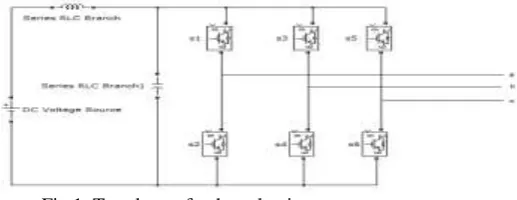
The circuit of a three-leg voltage source inverter is shown in Fig. 1. The upper switches are S1,S3,S5 respectively and the
lower switches are S2,S4,S6 respectively. The source voltage is
Vdc.A voltage source inverter has eight topologies which are
easily distinguishable from each other. Six out of these eight topologies produce a nonzero output voltage and are known as non-zero switching states and the remaining two topologies produce zero output voltage and are known as zero switching states.
Fig.1. Topology of a three-leg inverter
The switches must be designed in such a manner so that both the switches in the same leg can never be turned on. i.e. if S1 is on then S2 is off and vice versa. This phenomenon provides six active switching vectors and two zero vectors.
The phase voltage space vectors can be represented by the following simplified diagram:
Fig.2. Phase Voltage Space Vectors
IV.REFERENCE VECTOR
Space vector representation of the three-phase inverter output can be explained by using the Clark‟s Transformation theory and for that the reference vector should be represented in a αβ plane. This is a two-dimensional plane which is transformed from a three-dimensional plane and contains the vectors of the three phases.
Fig.3.The reference vector in the two and three dimensional plane
The αβ plane consists of the horizontal α axis and the vertical β axis which is the imaginary axis. The reference voltage Vref
makes an angle Ɵ with the horizontal axis.
When the three phase voltages are applied to an AC machine a rotating flux is created. This flux is represented as a rotating voltage vector. The magnitude and angle of this vector can be
Vα
=
Vβ 1 Cos(2ᴫ/3) Cos(4ᴫ/3) Va
(2/3) Vb
0 Sin(2ᴫ/3) Sin(4ᴫ/3) Vc
1 -1/2 -1/2 Va
= (2/3) Vb
0 √3/2 -√3/2 Vc
Therefore,
Vα = (2/3) (Va - (1/2) Vb - (1/2) Vc) (1)
Vβ = (2/3) ((√3/2) Vb - (√3/2) Vc) (2)
V. TIME DURATION
The following table shows the duration time for each sector. Let, (√3 |Vref|/Vdc) = a (constant)
Sector T1 T2 T0
1 Tz a
Sin[(ᴫ/3)-Ɵ]
Tz a SinƟ Tz-(T1+T2)
2 Tz
aSin[(2ᴫ/3)-Ɵ]
Tz a Sin[Ɵ
-(ᴫ/3)]
Tz-(T1+T2)
3 Tz a Sin(ᴫ-Ɵ) TzaSin[Ɵ
-(2ᴫ/3)]
Tz-(T1+T2)
4 Tz
aSin[(4ᴫ/3)-Ɵ]
Tz a Sin(Ɵ
-ᴫ)
Tz-(T1+T2)
5 Tz
aSin[(5ᴫ/3)-Ɵ]
TzaSin[Ɵ
-(4ᴫ/3)]
Tz-(T1+T2)
6 Tz a Sin(2ᴫ-Ɵ) TzaSin[Ɵ
-(5ᴫ/3)]
Tz-(T1+T2)
Table 1: Duration time (T1,T2,T0) at each sector
The generalized formula of the duty times (T1 & T2) for each
of the sectors is given by:
T1=Tz a Sin [(nᴫ/3)-Ɵ] (3)
T2=Tz a Sin [Ɵ-{(n-1)ᴫ/3}] (4)
VI.SWITCHING TIME
There are 7 switching states for each cycle. It always starts and ends with a zero vector.
The switching time diagrams for six sectors are shown below:
Fig.4. Switching time in sector 1
Fig.5. Switching time in sector 2
Fig.6. Switching time in sector 3
Fig.7. Switching time in sector 4
Fig.8. Switching time in sector 5
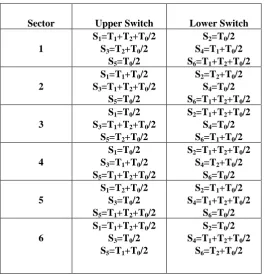
The following table shows the time calculation of each switch.
Table 2: Switching time of upper switches & lower switches at each sector
VII. IMPLEMENT IN MATLAB/SIMULINK
The SIMULINK representation of a space vector modulated inverter is shown in Fig.10.
Step 1:
Using the equation (1) & (2) the magnitude and angle of the reference vector have been simulated. Balanced three phase supply has been given. The constant „a‟ which is represented as (sqrt(3)*Tz*Vref*/Vdc) is determined. Then the output is
applied to the different sectors. The modulation index „m‟ which is represented as (3Vref / 2Vdc) is determined for
different values of Vdc.
Step 2:
Using the equation (3) & (4) the duration times (T1,T2,T0) for
each sector have been established at a specific value of Tz.
Step 3:
given in table 2 and also by comparing the values with a repeating sequence.
Step 4:
The outputs obtained in step 3 are then used to trigger the gate terminals of six IGBTs which are connected to the load. Finally the three output voltages (Vab,Vbc,Vca) are determined.
The output result is shown in Fig.11. Step 5:
The THD analysis for three phase voltages at different values of Vdc & modulation index(m) is shown in table 3 & also the
graphical representations of the analysis are shown in Fig.12, Fig.13 & Fig.14.
Fig.10. Simulink model of a two-level space vector pulse width modulated inverter
VIII. RESULTS
Sector Upper Switch Lower Switch
1
S1=T1+T2+T0/2
S3=T2+T0/2
S5=T0/2
S2=T0/2
S4=T1+T0/2
S6=T1+T2+T0/2
2
S1=T1+T0/2
S3=T1+T2+T0/2
S5=T0/2
S2=T2+T0/2
S4=T0/2
S6=T1+T2+T0/2
3
S1=T0/2
S3=T1+T2+T0/2
S5=T2+T0/2
S2=T1+T2+T0/2
S4=T0/2
S6=T1+T0/2
4
S1=T0/2
S3=T1+T0/2
S5=T1+T2+T0/2
S2=T1+T2+T0/2
S4=T2+T0/2
S6=T0/2
5
S1=T2+T0/2
S3=T0/2
S5=T1+T2+T0/2
S2=T1+T0/2
S4=T1+T2+T0/2
S6=T0/2
6
S1=T1+T2+T0/2
S3=T0/2
S5=T1+T0/2
S2=T0/2
S4=T1+T2+T0/2
THD Analysis:
Table3: Variation in %THD for three phase voltages at different values of Vdc & modulation index(m)
Fig.12. THD variation of Vab with respect to modulation
index m
Fig.13. THD variation of Vbc with respect to modulation
index m
Conclusions
In this paper space vector pulse width modulation is discussed. SVPWM based duration time, switching time are described and simulated by using MATLAB/SIMULINK environment. SIMULINK representation of a two level inverter based on SVPWM scheme is shown.
The Total Harmonic Distortion is determined for three different phase voltages at different values of source voltage & modulation index.
REFERENCES
[1] K. Mounika, B. Kiran Babu. “Sinusoidal and Space Vector Pulse Width Modulation for Inverter”. IJETT, Volume4Issue4- April 2013. [2] P.Tripura, Y.S.Kishore Babu, Y.R.Tagore. “Space Vector Pulse Width
Modulation Schemes for Two-Level Voltage Source Inverter”. ACEEE Int. J. on Control System and Instrumentation, Vol. 02, No. 03, October 2011.
[3] Nisha G. K., Member, IAENG, Ushakumari S. and Lakaparampil Z. V. “Harmonic Elimination of Space Vector Modulated Three Phase Inverter”. IMECS 2012, Vol. II, March 14-16, 2012, Hong Kong. [4] Atif Iqbal, Adoum Lamine, Imtiaz Ashraf, Mohibullah. “
MATLAB/SIMULINK MODEL OF SPACE VECTOR PWM FOR THREE-PHASE VOLTAGE SOURCE INVERTER”.
[5] Hind Djeghloud, Hocine Benalla. “Space Vector Pulse Width Modulation Applied to the Three-Level Voltage Inverter”.
[6] Ashish Gupta, Sanjiv Kumar. “Analysis of Three Phase Space Vector PWM Voltage Source Inverter for ASD‟s”. IJETAE, ISSN 2250-2459, Volume 2, Issue 10, October 2012.
[7] Shiny G, M.R.Baiju. “Space Vector based Pulse Width Modulation Scheme for a Five - Level Inverter using Open - End Winding Induction Motor”. International Journal of Engineering and Advanced Technology (IJEAT) ISSN: 2249 – 8958, Volume-3, Issue-5, June 2014.
[8] Waheed Ahmed, Syed M Usman Ali. “Comparative study of SVPWM (space vector pulse width modulation) & SPWM (sinusoidal pulse width modulation) based three phase voltage source inverters for variable speed drive”. ICSICCST 2013. IOP Conf. Series: Materials Science and Engineering 51 (2013) 012027. doi:10.1088/1757-899X/51/1/012027. [9] K. Vinoth Kumar, Prawin Angel Michael, Joseph P. John and Dr. S.
Suresh Kumar. “SIMULATION AND COMPARISON OF SPWM AND SVPWM CONTROL FOR THREE PHASE INVERTER”. ARPN Journal of Engineering and Applied Sciences, VOL. 5, NO. 7, JULY 2010.
[10] Ashish B Chaudhari, S. Jebarani Evangeline. “A Space Vector Pulse Width Modulation Technique to Reduce the Effects of Voltage Unbalances”. International Journal of Engineering and Advanced Technology (IJEAT) ISSN: 2249 – 8958, Volume-3, Issue-4, April 2014. [11] Rong-Wu Zhu, Xiao-Jie Wu. “Simplified SVPWM that Integrates
Overmodulation and Neutral Point Potential Control”. Journal of Power Electronics, Vol. 14, No. 5, pp. 926-936, September 2014.
Fig.14. THD variation of Vca with respect to modulation index
m
MI
THD
Vab Vbc Vca
1.0 35.83% 38.46% 32.91%
0.9 36.52% 39.54% 33.95%
0.8 37.55% 55.19% 60.97%
0.7 38.81% 63.84% 66.30%
0.6 41.42% 82.97% 45.78%