Interactive Image Segmentation using Edge
Point Techniques (EPT) for Background
Subtraction and Object Tracking
R.Neela#1,S. Lordhu Adaikala Mary *2#
Assistant Professor, Department of Computer Science, AVC College (Autonomous), Mannampandal, India.
2 M.Phil. Research Scholar, AVC College(Autonomous), Mannampandal
Abstract—
This paper focus on developing interactive
image segmentation using Edge Point
Technique(EPT). There are a lot of Image segmentation techniques are used in image processing such as adaptive constraint propagation,
mean shifting techniques, graph based
Segmentation, hybrid segmentation etc. The
proposed research uses Edge Point Technique (EPT) for Background and Foreground Separation. EPT makes decisions based on particular pixel information and are effective when the moderation levels of the objects fall squarely outside the range of levels in the background. EPT generates pairwise
constraints and performs seed propagation.
Pairwise constraints in EPT propagate characteristics of the user’s interactive information through the whole image and effectively preserve global discriminative data coherence, thus avoiding bias caused by the limited interactive information. Seed propagation in EPT significantly reduces the computational complexity in interactive image
segmentation by decomposing the learning
procedure of an image into blocks. The method first extract features from superpixels obtained by existing threshold based segmentation in an image and Pairwise constraints are generated from the user’s interactive information. Next, EPT performs seed propagation on both features and pairwise constraints to learn the global structure in an image. Experimental results demonstrate that the proposed EPT successfully segments foreground objects from
the background and remarkably acceptable
computational costs.
Keywords — Image segmentation, Background subtraction, Feature extraction and object tracking. Put your keywords here, keywords are separated by comma.
I. INTRODUCTION
This paper propose an interactive image segmentation using Edge Point Techniques (EPT).The edge representation of an image significantly reduces the quantity of data to be processed, yet it retains essential information regarding the shapes of objects in the scene. This
explanation of an image is easy to incorporate into a large amount of object recognition used in computer vision along with other image processing applications. The major property of the edge point technique is its ability to extract the exact edge line with good orientation as well as more literature about edge detection has been available in the past three decades. On the other hand, there is not yet any common performance directory to judge the performance of the edge point detection techniques. The performance of an edge detection techniques are always judged personally and separately dependent to its application.
The problem of image segmentation has been an active research field over the past several decades and remains as a very challenging task. Although user (human) knowledge can recognize and partition an image into necessary regions, current automated algorithms failed to capture such boundaries on a consistent basis over wide ranging image modalities, i.e., there exists no ―universal‖ segmentation algorithm. The issue of effectively integrating user prior knowledge into a segmentation design is a driving principle behind existing state-of-the-art methods. These application-driven methodologies utilized prior models to aid in the segmentation process. However, these methods remain automated and suffer from the same tacit issues for which they were designed to overcome. As a result, users directly participate in the segmentation loop in various image segmentation systems.
The image retrieval [5]system works as a classifier to break up the images in the image database into two modules, either relevant or irrelevant. When results are irrelevant, the feedback loop is repeated until the user is satisfied. Relevance feedback involves the user to label the similar and dissimilar image. An efficient image retrieval[5]technique is used to retrieve similar images in various stages. The images firstly retrieved on color basis and the resultant retrieved images further match with their shape and texture feature respectively. Content-based image retrieval (CBIR)[6] is the use of computer vision to the image retrieval difficulty that is the crisis of searching for digital images in huge databases. "Content-based" means that the search will evaluate the actual contents of the image. 'Content' word refers colors, shapes, textures, or some other information that can be taking from the image itself. The CBIR[6] technique is used in various fields such as medical, agriculture, security, weather forecasting, biological modeling, remote sensing, architecture, web image classification, crime prevention, satellite images, identification and retrieval, etc.
CBIR consists of two phases , first is the indexing phase where image information like the color, shape, and texture is enumerated into features that are stored in an index data structure. Second is the retrieval phase where searching for an image in the CBIR index. Color similarity is obtained by computing a color histogram for every image with the purpose of identifies the ratio of pixels within an image holding specific values. The color searches will usually keep comparing color histograms. Texture descriptor provides a measure of properties such as smoothness, roughness, and regularity. The texture of the region is structural, statistical and spectral are three principal approaches used in image processing. Shape is the external form, contours or outline of someone or something. A shape is the form of an object or its external surface as opposed
to other properties such as color, texture or material composition.
In the last decade, two important trends in image segmentation are the introduction of various user interaction techniques, and the development and increased reliance on global optimization methods. Interactive segmentation is became popular because in different domains, user interaction is available, and it can greatly reduce the ambiguity of segmentation caused by complex object appearance, weak edges, etc. Global optimization, often formulated as a graph problem, became popular because it is more robust compared to the local methods such as thresholding or region growing. That research address the segmentation of an object from its background in the graph cut[7],[8] framework. The advantage of this framework is that it guarantees a globally optimal solution for a wide family of energy functions, allows incorporation of regional and boundary constraints, and provides a simple user interaction interface. The user has to mark some pixels as object and some pixels as background. Such pixels are usually called seeds.
If one has prior knowledge about the shape of an object (‖shape prior‖),incorporating this knowledge makes segmentation more robust. Shape prior reduces ambiguity by ruling out all segments inconsistent with the prior. Using shape priors to improve segmentation has been investigated in the level set and curve evolution frameworks. Level set [3]methods are usually not numerically stable and are prone to getting stuck in a local minimum. The segmentation of natural images and videos is one of the most fundamental and challenging problems in image processing. One of its applications is to extract the foreground object (or object of interest) out of the cluttered background, and, for example composite it onto a new background without visual artifacts. For complex images, as well as subjective applications, there can be more than one interpretation of the foreground or objects of interest (in absence of higher level knowledge), thus making the task ill-posed and ambiguous. It is often imperative then to incorporate some user intervention, which encodes prior information, into the process. Specifically, the user can draw rough scribbles labelling the regions of interest and then the image/video is automatically segmented.
transparency, with only the observed color), the matting problem also requires priors, such as user interactions, which could be in the form of scribbles as in the segmentation task.
In addition to the standard high quality and accuracy, the overall requirements of an interactive segmentation and matting framework include the ease of scribble marking and adding, with as minimal as possible user input, as well as real-time processing for making the system truly interactive. The distance (geodesic) computation is linear in time, and thereby optimal (with minimal memory requirements as well). The weights are based on simple properties such as spatial and temporal gradients which consider the statistics of the user marked pixels, while more sophisticated features can be naturally included as well. The proposed framework can handle diverse data, including natural and 3D images, dynamic background, moving cameras, and objects crossing each other in the video.
II. LITERATURE REVIEW
Mayank Jain Proposed an An Efficient Technique for Image Retrieval from the Large Database on the Basis of Color and Texture[5]. Now a day’s development of multimedia technology, the possibilities of utility of large databases is rapidly increasing. To handle its management and retrieval CBIR[6] is the best and effective method. CBIR technique uses the visual contents like as color, shape and texture that are called features, to searching, browsing, and navigation of query images for large image databases[5]Color is the visual perceptual property corresponding in humans to the categories called red, blue and yellow etc. Texture is the image and especially physical quality of a surface. Texture is the characteristic structure of the interwoven or intertwined outfit, strands or the like that make up a textile fabric. Vrushali D and Mendhule Proposed an Interactive Image Segmentation Using Combined MRF and Ant Colony Optimizatio[9]. Jian Guan, Guoping Qiu proposed an Interactive Image Segmentation using Optimization with Statistical Priors[10] For some images, the statistical priors can provide good enough constraints to automatically obtain satisfactory foreground segmentation results. For more difficult cases, user interaction is necessary. In such cases, use the segmentation result based on the statistical priors as a starting point for interactive ground segmentation, and as a guide to help users to place the constraints in the correct locations to generate the desired results. In this way, the statistical priors not only guide the user but also help reducing man power in the interaction process. Ning Du and Xiaofei Wang proposed an Attraction Propagation: A User-Friendly Interactive Approach for Polyp Segmentation in Colonoscopy Images[11]. The author developed a user-friendly interactive
approach-Attraction Propagation (AP) in segmentation of colorectal polyps. Compared with other interactive approaches, the AP relied on only one foreground seed to get different shapes of polyps, and it can be compatible with pre-processing stage of Computer-Aided Diagnosis (CAD) under the systematically procedure of Optical Colonoscopy (OC). Michael Bleyer proposed an Object Stereo Joint Stereo Matching and Object Segmentation[12]. The author presented a method for joint stereo matching and object segmentation. In this approach a 3D scene is represented as a collection of visually distinct and spatially coherent objects. Each object is characterized by three different aspects: a color model, a 3D plane that approximates the object’s disparity distribution, and a novel 3D connectivity property. Inspired by Markov Random Field models of image, segmentation employ object-level color models as a soft constraint, which can aid depth estimation in powerful ways. In particular, their method is able to recover the depth of regions that are fully occluded in one input view, that is new for stereo matching.
Most recently proposed method for image segmentation is dynamic region [4]merging. The author described the collection of pixels of an image into meaningful groups of regions or objects, the region homogeneity is used as an important segmentation criterion.
There have been increasing activities in the research community to develop interactive semi-automatic image segmentation techniques. The authors presented an interactive image segmentation technique based on graph cut[7]. Users labelled seed pixels which indicating definite background and foreground were used as strong priors for segmenting images into foreground and background. The authors showed that graph cut [7]based segmentation algorithms could be implemented very fast. The authors presented a segmentation given partial grouping constraints method. User inputs were used as bias to a natural grouping process, and the authors formulated such biased grouping problem as a constrained optimization problem that propagates sparse partial grouping information to the unlabelled data by enforcing grouping smoothness and fairness on the labelled data points.
work has developed an optimization based foreground segmentation technique, where a transparency image was computed by optimizing a quadratic cost function with user supplied linear constraints[13]. The optimization problem has a unique global minimum and can be solved efficiently by standard numerical methods. A review on background subtraction algorithms for videos are discussed by Sprooha Athalye et.al. [14].
III. EDGE POINT TECHNIQUE
A. Architecture of EPT
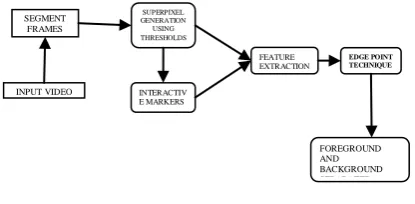
This paper focused on developing a new technique for foreground and background separation using Edge Point technique (EPT). EPT makes decisions based on particular pixel information and are effective when the moderation levels of the objects fall squarely outside the range of levels in the background. EPT generates pairwise constraints [11] and performs seed propagation. Pairwise constraints in EPT propagate characteristics of the user’s interactive information through the whole image and effectively preserve global discriminative data coherence, thus avoiding bias caused by the limited interactive information. Seed propagation in EPT significantly reduces the computational complexity in interactive image segmentation by decomposing the learning procedure in an image into blocks and vice versa. First, extract features from superpixels obtained by existing threshold based segmentation in an image. Pairwise constraints generated from the user’s interactive information. Next, EPT performs seed propagation on both features and pairwise constraints to learn a global structure in an image. Labelling the foreground and background superpixel in the global structure of image helps to segment foreground objects from the background.
Figure 1 Architecture of EPT
B. Algorithm:
Step 1:The first step is to filter out any noise in the original image before trying to locate and detect any edges.
Step 2:After smoothing the image and eliminating the noise, the next step is to find the edge strength by taking the gradient of the image. The 2-D spatial gradient measured on an image. Then, the approximate absolute gradient magnitude (edge strength) at each point can be found. By using a pair
of 3x3 convolution masks, one estimate the gradient in the x-direction (columns) and the other estimate the gradient in the y-direction (rows).
Step 3:The direction of the edge is computed using the gradient in the x and y directions. However, an error will be generated when sumX is equal to zero. So in the code there has to be a restriction set whenever this takes place. Whenever the gradient in the x direction is equal to zero, the edge direction has to be equal to 90 degrees or 0 degrees, depending on what the value of the gradient in the y-direction is equal to.
Step 4:Once the edge direction is known, the next step is to relate the edge direction to a direction that can be traced in an image.
Step 5:After the edge directions are known, non-maximum suppression now has to be applied. Non-maximum suppression is used to trace along the edge in the edge direction and suppress any pixel value (sets it equal to 0) that is not considered to be an edge. This will give a thin line in the output image.
Step 6:Finally, hysteresis is used as a means of eliminating streaking. Streaking is the breaking up of an edge contour caused by the operator output fluctuating above and below the threshold.
IV.EXPERIMENTALRESULTSAND DISCUSSIONS
The proposed method is implemented in Matlab and the dataset are downloaded from CDNet dataset and I2R Dataset. The dataset contains several video category with 4 to 6 video in each categories[15].A Software metrics is the measurement of a particular characteristic of a program’s performance or efficiency. The metrics used for evaluation are F-measure , True negative and False positive[16,17].
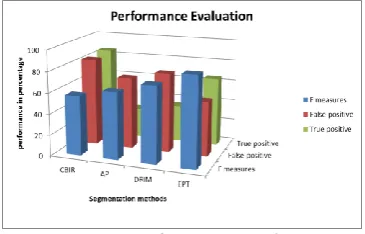
Table 1 and Figure 2 shows the performance evaluation of the EPT method with other existing methods.
Table 1 performance evaluation of EPT with other existing methods
METRICS CBIR AP DRIM EPT
F measures 56.72 63.5 72.8 85.3
False positive
83.25 45.68 75.25 23.7
True positive
85.82 28.25 35.25 65.23
SEGMENT FRAMES
INPUT VIDEO
SUPERPIXEL GENERATION USING THRESHOLDS
INTERACTIV E MARKERS
FOREGROUND AND BACKGROUND SEPARATED OUTPUT FEATURE EXTRACTION
Figure2 Performance Evaluation
Table 2 and Figure 3 shows the computational time for proposed method and other existing methods(CBIR,AP and DRM)
Methods Elapsed time(sec)
EPT 3.45
AP 2.25
CBIR 1.48
DRM 3.35
Table 2 computational time
Figure 3 Computational time
V. CONCLUSIONS
This paper proposed a robust and accurate interactive image segmentation method based on Edge Point techniques (EPT). The proposed Edge Point technique(EPT) is used for Background and Foreground Separation. The EPT produced decisions based on particular pixel information. The EPT generated pairwise constraints and performs seed propagation. Pairwise constraints in EPT propagate characteristics of the user’s interactive information through the whole image and effectively preserve global discriminative data coherence, thus avoiding bias caused by the limited interactive information. Seed propagation in EPT significantly reduced the computational complexity in interactive image segmentation by decomposing the learning procedure in an image into blocks. The features are extracted from superpixels obtained by existing mean-shift segmentation in an image. Pairwise constraints generated from the user’s interactive information. The EPT performed seed propagation on both features and pairwise constraints to learn a global structure in an image. Label the foreground and background superpixel in the global structure of image, helps to segment foreground objects from the background. Experimental results validated that the
proposed EPT successfully segments foreground objects from the background and remarkably acceptable computational costs. The limitations are that it requires more execution time than others (CBIR, AP and DRM), more time when the size of the input video is large and memory utilization is more when compared to existing methods The future extension includes developing better and more efficient way to solving the computational problems. The future enhancements include reduction in memory usage and computational time. Also parallelising the algorithm may be implemented in future.
REFERENCES
[1] Leo grady,‖ Random walk for Image Segmentation‖ IEEE transaction ,VOl 28,NO.11 ,Nov 2006 .
[2] T. N. A. Nguyen, J. Cai, J. Zhang, and J. Zheng, ―Robust interactive image segmentation using convex active contours,‖ IEEE Trans. ImageProcess., vol. 21, no. 8, pp. 3734–3743, Aug. 2012.
[3] Stanley osher , Ronald P.Fedkiw, ― An Overview :Level set Method‖, IEEE Trans.Pattern analy., Vol.43, Sep 2005. [4] B. Peng, L. Zhang, and D. Zhang, ―Automatic image
segmentation by dynamic region merging,‖ IEEE Trans. Image Process., vol. 20, no. 12,pp. 3592–3605, Dec. 2011. [5] Mayank Jain and Divakar Singh, ―An Efficient Technique
for Image Retrieval from the Large Database on the Basis of Color and Texture‖, International Journal of Computer Applications (0975 – 8887) Volume 145 – No.7, July 201 [6] Kranthi kumar, ―content based image retrieval ―, National
conference on Advances in information Security(NCAIS)-2010.
[7] B. L. Price, B. Morse, and S. Cohen, ―Geodesic graph cut for interactiveimage segmentation,‖ in Proc. IEEE Conf. Comput. Vis. PatternRecognit., Jun. 2010, pp. 3161–3168. [8] Y. Zhang, H. Song, J. Gu, S. Yu, and J. Yang, ―Interactive
object extraction using template matching and hierarchical graph cuts,‖ in Proc. Int. Conf. Audio Lang.Image Process., Nov. 2010, pp. 851–858.
[9] Vrushali D. Mendhule, Gaurav Soni and Alesh Sharma, ―Interactive Image Segmentation Using Combined MRF and Ant Colony Optimization‖, International Journal Of Engineering And Computer Science ISSN:2319-7242 Volume 4 Issue 6 June 2015
[10] Jian Guan, Guoping ,‖An Interactive Image Segmentation using Optimization with Statistical Priors‖, International conference of statistics - 2015
[11] Ning Du, Xiaofei Wang, Jianhua Guo and Meidong Xu, ―Attraction Propagation: A User-FriendlyInteractive Approach for Polyp Segmentation in Colonoscopy Images‖, PLOS ONE DOI:10.1371 journal.pone.0155371 May 18, 2016.
[12] Michael Bleyer,‖ Object Stereo Joint Stereo Matching and Object Segmentation‖, 2015
[13] Alisha Abraham,‖ image segmentation based on harmonic functions & reconstructions‖, 2013
[14] Mrs. Sprooha Athalye , Mr. Devendra Gadade , Mr. Pankaj Kadam , Mr. Onkar Ambekar " Study on Universal Background Subtraction Algorithm for Videos ", International Journal of Engineering Trends and Technology (IJETT), V20(5),248-251 Feb 2015. ISSN:2231-5381. www.ijettjournal.org. published by seventh sense research group
[15] A New change detection benchmark dataset in IEEE workshop at CVPR 2012, Downloaded from www.changedetection.net
[16] Van Rijsbergen,V.J,‖ information retrieval‖, Butterworth 2nd edition.