http://www.sciencepublishinggroup.com/j/ijmsa doi: 10.11648/j.ijmsa.20180703.12
ISSN: 2327-2635 (Print); ISSN: 2327-2643 (Online)
Analysis of the Interaction of NH
4
Cl-Doped Process Gases
with Zinc-Coated Surfaces with Regard to Aluminum
Brazing with Zn-AlSi Duplex Braze Metal Coatings
André Langohr
1, *, Sarah Groß-Bölting
2, Ulrich Holländer
1, Kai Möhwald
11Institute of Materials Science, Gottfried Wilhelm Leibniz Universität Hannover, Hannover, Germany 2
Department of Physics, Technische Universität Dortmund, Dortmund, Germany
Email address:
*
Corresponding author
To cite this article:
André Langohr, Sarah Groß-Bölting, Ulrich Holländer, Kai Möhwald. Analysis of the Interaction of NH4Cl-Doped Process Gases with
Zinc-Coated Surfaces with Regard to Aluminum Brazing with Zn-AlSi Duplex Braze Metal Coatings. International Journal of Materials Science and Applications. Vol. 7, No. 3, 2018, pp. 75-84. doi: 10.11648/j.ijmsa.20180703.12
Received: December 14, 2017; Accepted: January 26, 2018; Published: April 23, 2018
Abstract:
This paper reports on the development of a braze metal coating and a brazing process for joining aluminum alloys at temperatures < 570°C without applying a flux before brazing. This is achieved using a duplex braze metal coating made of an aluminum-silicon alloy and zinc as top layer in combination with the use of hydrogen chloride doped nitrogen as process gas. Here hydrogen chloride deoxidate the surface of the zinc coating and form zinc chloride flux in-situ. Defined hydrogen chloride partial pressures between 100 vpm (volume parts per million) and 300 vpm in nitrogen were produced by thermal decomposition of solid ammonium chloride. Reaction kinetics of hydrogen chloride with the zinc coating was investigated by detecting the generation of reaction heat at different hydrogen chloride concentrations and temperatures. An activation energy of 63 ∗ was determined, a value that matches the values stated in the literature. The order of reaction n was found to be significantly lower than 1, which is consistent with gas solid reactions at microscopically fissured interfaces. An in-situ zinc chloride formation rate of 3 µg/(min cm2) at 400°C and 200 vpm hydrogen chloride concentration was obtained from the measured data, which may be sufficient for triggering the flow of braze metal. Experimental brazing tests showed, that when the reaction time was long enough to permit the formation of zinc chloride and this is followed than by a brazing process at 560°C to 570°C in subsequently hydrogen chloride-free nitrogen atmosphere, a liquid ternary AlSiZn braze metal is formed from the dublex coating enabling a wetting and brazing of the contacting join partner.Keywords:
Aluminum Brazing, In-Situ Fluxing Agent, Reaction Kinetics1. Introduction
Although aluminum only began to be used as a raw material at the beginning of the past century, but by the middle of the 1960s it was in second place after iron in terms of global annual production, and today it is used in a wide variety of areas. Due to its good thermal conductivity, it is the second most frequently used material after copper in the manufacture of heat exchangers. In vehicle manufacturing as well, the light metal aluminum is becoming increasingly important as a substitute material in classic steel applications in the form of wrought alloys as well as in cast parts. The alloys available nowadays on the market cover a wide range
with selected aluminum materials and require the use of special fluxing agents that meet the special processing temperature and surface activation requirements for brazing aluminum.
The introduction of non-corrosive fluxing agents made of alkali fluoroaluminates in particular made it possible to develop an economical and environmentally compatible method for the brazing of aluminum in a continuous inert gas furnace (NOCOLOK process), which is being used more and more often as a substitute for the flux-free, but more expensive vacuum brazing process [1]. However, the brazing alloys consisting of AlSi alloys (Si content of 7% to 12% by weight) primarily used in brazing alloys limit the range of base materials that can be brazed to aluminum alloys with at least 98% aluminum by weight due to their high liquidus temperatures (577°C – 615°C) so that cast aluminum and wrought aluminum alloys, which have lower melting points, cannot be joined using the brazing system described. Furthermore, many of these alloys contain magnesium, and when the Mg content is greater than 0.5% by weight, they cannot be activated any more with the alkali fluoroaluminate flux in the furnace process since the formation of MgF2 has a
passivating effect on the material. At the present time, zinc-based solders such as the alloy ZnAl5 with a liquidus temperature of 380°C are used for brazing high alloy aluminum, which then makes the use of a correspondingly fusible, corrosive, chloride-based flux necessary. The ability to use non-corrosive cesium aluminum fluoride as a fusible fluxing agent to process zinc solders in the CAB (Controlled Atmosphere Brazing) process has been proven [2, 3], but the necessity to overheat the Zn solder to at least 440°C (minimum activation temperature of the flux) leads to substantial amounts of melted base material in the brazing material.
The problem of the small temperature range when brazing higher alloy and high alloy aluminum materials with AlSi brazing alloy was also examined in earlier works in which brazing filler metal systems made of the ternary material system AlSiZn with liquidus temperatures between 540°C and 567°C were developed for this purpose [4, 5]. Another paper examined the flux-free brazing of highly alloyed aluminum with AlSi braze metal modified by adding lithium, which leads to a moderate decrease in the melting point of the brazing alloy on the one hand and, due to its high affinity for oxygen, reacts with aluminum oxide, thus promoting wetting on the passivated aluminum surface [6].
In terms of the brazing application process, automated procedures are used – wherever possible – for example in the case of plating with AlSi braze metal when producing semi-finished aluminum products (foils, aluminum sheets). With the exception of vacuum brazing using special braze metall coatings containing Mg, the brazing process requires an extra process step in advance in which flux is applied. The flux application process in this case is more or less automatable depending on the geometry of the part.
Due to the enormous economical importance of aluminum brazing, a series of research efforts over the past few years
have been initiated with the goal of realizing an economical and environmentally friendly brazing process for aluminum. In addition to the development of new fluxing agents with a wider range in terms of the base materials that can be used [03En2], the bibliography contains references to modified brazing materials and new brazing application processes [7-12] that promise to allow flux-free processing, even when using shielding gas. Furthermore, flux-free brazing processes are described in which ultrasonic excitation [13, 14] or an upstream plasma treatment process is used on the aluminum components [15] that should ensure the surface is activated for the brazing process. The use of zinc coatings opens up whole new opportunities for brazing aluminum alloys, and possibly even flux-free brazing. Since the metallurgical bond between the coating and the substrate was realized for the most part by the coating process, the problem is reduced to ensuring the braze metal coatings melted during the brazing process bond metallurgically in the joint zones, a process which is hindered when using untreated braze metal coatings because the oxide layer on the surface acts as a separating layer. When coated with zinc, though, it is possible through the use of process gases containing hydrogen chloride to influence the passivating top layer so that the surface can be activated during the brazing process without requiring the use of fluxing agents. The effect expected due to the chemistry of the reactants involved (gaseous hydrogen chloride, zinc solder) already be proven in earlier papers [01Ba] is especially interesting when using braze metal-coated aluminum materials since in this case, adequate activation can be expected even for very small concentrations of halides in the process gas. Since the use of zinc as a (sole) solder material is restricted to just a few applications in the area of aluminum brazing, a combination with an AlSi brazing alloy should be pursued in which the top layer exposed to the brazing atmosphere is preferably made of zinc. In the joining process, this results in the production of brazing alloys made of the ternary material system Al-Si-Zn whose zinc content can be controlled by varying the thickness of the metal layer applied.
The following reports on thermophysical analyses performed to explain the reaction kinetics between HCl-doped shielding gases produced using ammonium chloride and a zinc-coated surface. Based on the analyses, suitable process conditions for brazing aluminum using Zn-AlSi10 duplex braze metal coatings are derived.
2. Experiments
Measuring apparatus
The kinetic experiments examining the interaction of nitrogen containing ammonium chloride with zinc surfaces as well as the subsequent brazing tests were conducted using the system shown in Figure 1. The reaction vessel made of quartz glass was heated in a vertically movable, PID-controlled lab shaft furnace.
which solid ammonium chloride is placed that then evaporates according to the formula:
NH4Cl (s) ↔ NH3 (g)+HCl (g) (1)
and thereby releases hydrogen chloride. The reaction is reversible so that unconverted HCl recombines again with the ammonia when leaving the furnace and forms ammonium chloride, which is harmless.
The powdered ammonium chloride from the company Fischer Scientific used for the experiment, which had an NH4Cl purity greater than 99.0% by weight, was dried for 24 hours before starting each experiment by flooding it with nitrogen at 164°C.
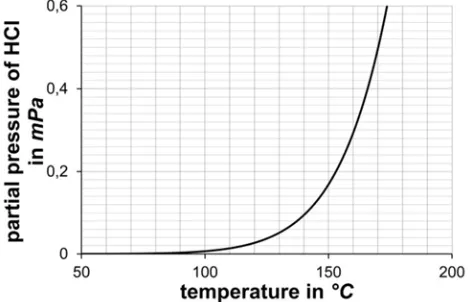
The partial pressure of HCl resulting from the decomposition of the evaporated ammonium chloride is a function of the evaporating temperature selected (measured in the gaseous space above the powdered ammonium chloride), see Figure 2.
Figure 1. Lab apparatus for deoxidation and brazing tests using a shielding gas containing NH4Cl.
Figure 2. Temperature dependency of the partial pressure of hydrogen chloride in ammonium chloride, calculated with FACTSAGE©.
The measurements of the reaction kinetics were taken with a system design comparable to that of the DTA measuring system and consisting of a thermal column with two differentially connected pairs of thermocouples that were positioned in the middle of the reaction vessel (cf. Figure 3). The sample side consisted in this case of a sheath thermocouple tip galvanized with zinc while the reference temperature was measured with an uncoated thermocouple (with a sheath made of corrosion-resistant 1.4521 CrNi steel).
To manufacture the galvanic zinc coating, a commercial acetic zinc electrolyte from the company Dr. Ropertz-GmbH (designation, manufacturer) was used and the coating was deposited according to the manufacturer's specifications via potentiostatic coulometry at a bath temperature of 25°C and a current density less than or equal to 4 A/dm2.
Figure 3. Thermal column consisting of two pairs of differentially connected sheath thermocouples (measured side coated with Zn, reference side uncoated).
To determine suitable process conditions for the experiments, the following observations were made:
The deoxidation of the zinc surface upon the release of zinc chloride occurs according to
ZnO (s) + 2HCl (g) → ZnCl2 (l) + H2O (g) (2)
Only after deoxidation is possible for the zinc to react directly with hydrogen chloride according to
Zn (s) + 2HCl (g) → ZnCl2 (l) + H2 (g) (3)
where by zinc chloride is also produced in this exothermic reaction.
From a thermodynamic analysis of this chemical equation and with knowledge of its Gibbs free energy GR
gg,HCl gg, exp ,
RT (4)
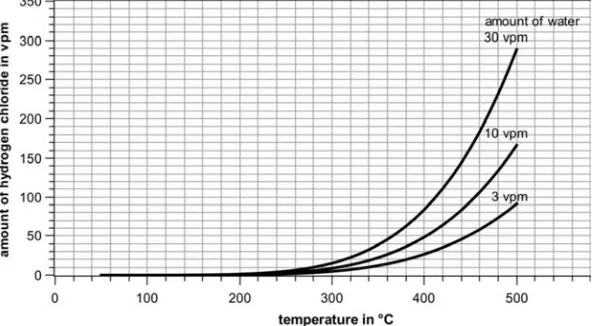
For the typical residual water contents of different qualities of shielding gases, 3 vpm (volume parts per million) to 30 vpm H2O contamination, Figure 4 shows the required
minimum hydrogen chloride concentrations as a function of
the temperature. Since deoxidation and reaction with zinc should occur below the melting point of zinc, a temperature range of 330°C to 370°C was selected for the reaction kinetics experiments. To ensure deoxidation in this temperature range, experiments were conducted for three different hydrogen chloride concentrations above 100 vpm, namely for HCl concentrations of 113 vpm, 155 vpm, and 235 vpm.
Figure 4. Minimum hydrogen chloride concentrations for deoxidation of the zinc surface calculated with FACTSAGE© according to (2).
Production of Zn-SiAl10 duplex braze metal coatings
The production of an aluminum material with a Zn-Al10 duplex braze metal layer for brazing tests was realized using a commercially available metal sheet made of AlMn1Cu (EN-AW 3003) and plated on both sides at the factory with AlSi10 (EN-AW 4045) and a roll-bonded brazing alloy made of AlSi10 (EN-AW 4045, supplier: TMCCL, Leeds, UK). The thickness of the AlSi10 clad plate was specified to be 40 µm. The zinc layer still missing was applied galvanically using the zinc electrolyte mentioned above and produced a layer of zinc about 15 µm thick. The sheet metal to be coated was cleaned beforehand using ethanol and afterwards in an alkaline zinc pickling solution, immediately after which the zinc layer was deposited using a galvanostatic process
conducted at room temperature and with a current density of 0.5 A/dm2. A zinc foil from Alfa Aesar with a purity greater than 99.9% of metallic zinc by weight was used as the anode. The resulting layer thickness ratio between Zn and AlSi10 reflects the ternary brazing alloy system Al67.5-Si7.5-Zn25 (numerical values in% by weight, corresponds to Al80.5-Si7.5-Zn12 mole fractions in%), which is an alloy in the eutectic range of the Al-Si-Zn system according to phase diagram (see Figure 5). With this Zngalv/AlSi10roll-bonded ratio,
an alloy with a liquidus temperature of 548°C forms in situ during the brazing process. The liquidus temperature is therefore theoretically decreased by about 40°C in comparison to that of a pure AlSi10 braze metal coating (Tliq=585°C).
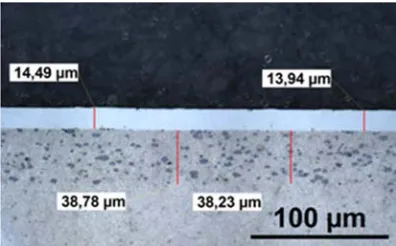
Figure 6. Composite film with duplex layer consisting of 14 µm Zngalv /38 µm
AlSi10roll-bonded / AlMn1Cu.
Figure 7. Composite film galvanized on one side after shielding gas heat treatment at 560°C with unmelted AlSi10 braze metal cladding on the zinc-free underside.
Figure 6 shows the layer structure of the composite made of Zngalv/AlSi10/AlMn1Cu and realized with the desired
layer thickness ratio. Heat treatment of this composite in a conventional continuous inert gas furnace at a maximum sample temperature of 560°C shows the desired effect of the Zn coating on the processing temperature of the duplex braze metal (Figure 7). The duplex coating of Zngalv/AlSi10roll-bonded
has remelted. As a result, the galvanically deposited zinc coating is metallurgically bonded to the roll cladding, which is a prerequisite for a eutectic contact reaction and interdiffusion between the materials during the heat treatment process.
3. Results and Discussion
Starting with the results regarding the reaction kinetics between hydrogen chloride and zinc, Figure 8 shows an example of two measurement curves (after correcting for baseline drift) for a constant hydrogen chloride concentration (155 vpm) for two reaction temperatures (350°C and 370°C). The jumps in the signal marked in the diagrams occur a short time after adding the ammonium chloride to the shielding gas. The height of the signal depends on the heat generated by the reaction of hydrogen chloride with the zinc coating. In the case illustrated, the heat output measured is higher at 370°C than at 350°C; a consequence of the accelerated reaction of hydrogen chloride with the zinc coating. These measurements can be used to calculate the reaction kinetics as described in the following.
(a)
(b)
The theory of heat transfer in solids can be used for quantitative measurement of the heat exchanged between a measuring system and the environment since heat flows always arise in conjunction with temperature gradients. With a suitable experimental design, it is therefore possible to derive the local, temporal temperature difference from the measurement of the heat flow .
Differential thermal analysis does not record the progression of the absolute value of the temperature, but the temperature difference between the measurement system with the sample and a reference system of the same design that is located in the same furnace (tandem arrangement).
In the stationary case with Newtonian boundary conditions along the path of heat flow, the heat flow from the environment to the reference and sample system is given by the following equation according to Fourier's law:
!∗" !∗ #!$ !
%! (5)
= !∗" !∗ #!$ !
%! (6)
where
&: cross-sectional area; ( ) : temperature-dependent thermal conductivity; *: length of the path of heat flow; TO: furnace temperature, TP: sample temperature, TR: reference temperature
It is assumed in this case that the temperature gradients as well as the cross-sectional surface areas & and &+ are constant within the error limits of the experiment over the paths * and *+. If both systems are identical and in a completely symmetric environment, then the following is true:
& = & = &+ * = * = *+ ( = ( = (+ ) = ) = ) + (7) then the following results for the difference between the two
heat flows:
− += ∗" ∗% !$ (8)
or in a reduced form:
= ( ) ∗ .) (9) In fact, the local temperature difference is proportional to the heat flow through the solid body in the stationary and
quasi-stationary states. For this reason, the additional heat flow caused by thermal events in the sample must be small compared to the quasi-stationary heat flow, which then limits the amount of sample and reference that can be used.
In the quasi-stationary reaction process measured here, this heat flow corresponds to the flow of enthalpy of the reaction, whereby the amount of hydrogen chloride is assumed to be constant and matches the concentration specified for the stationary state:
= / ) ∗ .) = − 0∗ ∗1+∗ ∗23456
27 ∗ 8∆+: ) + ∆1:<=> 0 ) ? (10)
In connection with the logarithmic Arrhenius formula, this results in:
= ∗A∗B @
∗C∗8∆ D∆B EF56 ?∗ .) = −GH∗ I
$JK⁄+∗ ∗ M > = (11)
or, after taking the logarithm, results in:
NO .) =$JK
+∗ + O ∗ NOM > +
= $PQ =R ∗A∗B S C
∗C ∗8∆ 4 C T∆B4EF56 C
U (12)
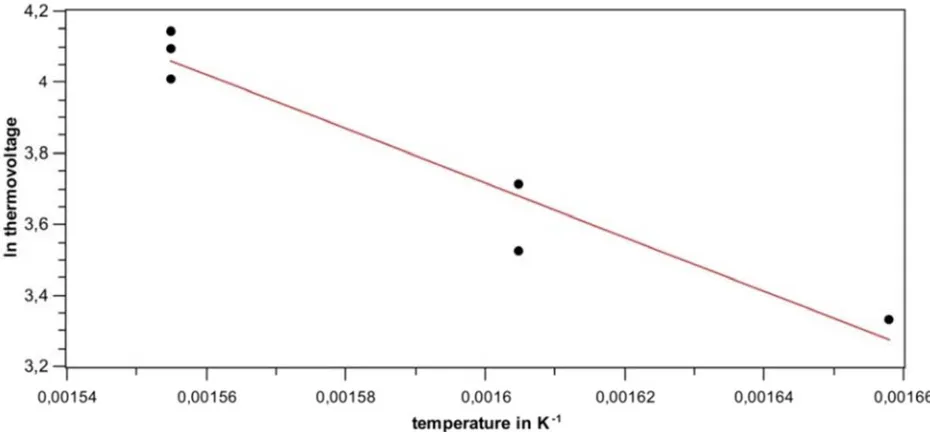
The last term in (12) can be considered almost independent of the temperature since the enthalpies as well as the coefficients of thermal conductivity ( ) in the temperature interval examined are almost constant. The logarithmic plot of the max. thermoelectric voltage (measured height of the signal jump), which is proportional to ∆), vs. 1/T, an activation energy of = 63 ∗ was determined (see
Figure 9, a value that matches the values stated in the literature for comparable gas-solid reactions. In [16], for example, an activation energy of = 67 ∗ is specified for the reaction in (3).
Figure 9. Graphical analysis of the measurement data according to (12) using 6 individual measurements taken between 330°C and 370°C.
(a)
(b)
Figure 10. SEM images of the surface of the zinc coating before (a) and after (b) reacting with hydrogen chloride (235 vpm) at 330°C.
With the help of the experimentally determined activation energy, it is now possible to calculate using an Arrhenius approach the amount of zinc chloride O<=> 0 produced per unit time and per unit surface area:
O<=> 0=0<∗XWK∗ I$YK∗C (13)
where
Z[ 456\ ]`a456 b^X_ , Gc 1,38 ∗ 10$0g h i , j
6,022 ∗ 100g mol$o,
p
>0,0365 kg mol
$oThe exponential function represents the temperature-dependent frequency factor in this case, which means the fraction of hydrogen chloride molecules in the gas phase that make contact with the zinc surface and actually react to form ZnCl2.
For an HCl concentration of 200 vpm (corresponds to corresponds to > 20 Pa , for example, Equation 13 then yields zinc chloride formation rates of around 1 µg/(min cm2) at 330°C and 3 µg/(min cm2) at 400°C.
4. Brazing Tests
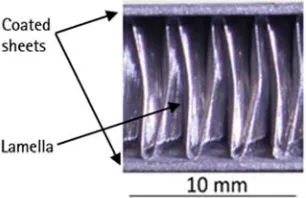
One important joint geometry for aluminum components can be found in brazed engine radiators. In these radiators, thin and usually complexly shaped aluminum fins need to be brazed to flat aluminum pipes. The braze metal is already present on the pipe material in the form of roll cladding. This geometry is particularly suitable for the brazing test since the joint zones are easily accessed by the process gas and generate the reactions illustrated above between the galvanized surface of the brazed joint partner and the hydrogen chloride. As a result, the sample design shown in
Figure 11. Design of the brazing samples.
Figure 12. Brazing jig with brazing sample in the reaction vessel.
Basically, two different procedures were tested while performing the brazing tests:
Procedure 1: The brazing processes were executed in a process atmosphere with a defined chlorine gas content in the process gas without including any hold times during the heating processes and without changing the chlorine gas concentration.
Procedure 2: In this procedure and according to the experiments performed to determine the reaction kinetics, the brazing samples were initially only heated to 350°C-400°C in an atmosphere containing hydrogen chloride, after which the temperature was held constant for 5 minutes to 10 minutes. During this time, the zinc deoxidized and a defined amount of zinc chloride was created depending on the hold time and the chlorine gas concentration used (cf. (13)) which can then act as a flux that has been created in situ. The samples were then heated further to the brazing temperature in pure nitrogen.
A common feature of both procedures was that the heating rates, apart from the variable hold time required to form zinc chloride, were selected so that they match the heating rates of commercial brazing processes, which typically take 10 minutes to 15 minutes to heat up.
Figure 13 shows the temperature vs. time graph for a sample brazed according to Procedure 1. Figure 14 shows an example of the brazing results obtained using this test procedure in the form of a micrograph. In general – and regardless of the selected heating rate and chlorine gas concentration – no brazed connections could be found
between the brazed-coated pipe and the fins, and the few that were found only made point-wise contact. At the same time, the fin material clearly exhibited pitting due to corrosion. The cause of the poor brazing results are presumed to be due to the presence of too much residual moisture in the process gas. The source of this moisture is probably the ammonium chloride itself, which, in spite of going through a complex drying process, cannot be made completely free of water. According to Figure 4, though, the minimum hydrogen chloride concentration required for a constant residual water content in the process gas increases exponentially, which means that upon reaching the brazing temperature, the conditions for deoxidation probably do not exist anymore and the zinc surface oxidizes due to the water content in the process gas. Counteracting this by increasing the hydrogen chloride content by evaporating greater amounts of ammonium will not achieve the desired results since this would simultaneously introduce more moisture into the atmosphere. The corrosion phenomena observed are probably the result of a drastic increase in corrosion on the fin material due to moisture. If the conditions were actually dry, then this would not be expected in the short process times used, not even at 570°C.
Figure 13. T-t regime of a brazing process according to Procedure 1.
t
e
m
p
e
ra
tu
re
i
n
°
C
0 100 200 300 400 500 600
time in s
Figure 14. Light microscope image of a brazing sample brazed according to Procedure 1 (325 vpm HCl, Tbrazing=565°C).
Figure 15 shows an example of the temperature vs. time graph of a brazing process according to Procedure 2, in this case with a holding period of 15 minutes at an average temperature of 370°C. During this period, the zinc should have been deoxidized and formed around 60 µg cm-2 ZnCl2
on the galvanized surface according to Eq. 12, which in turn is converted to zinc on the aluminum material in the subsequent brazing process upon the release of gaseous aluminum chloride. This reaction, which activates wetting, now causes the formation of brazed connections between the brazed-coated sheet metal and aluminum fins upon further heating in a nitrogen atmosphere free of chlorine gas, cf.
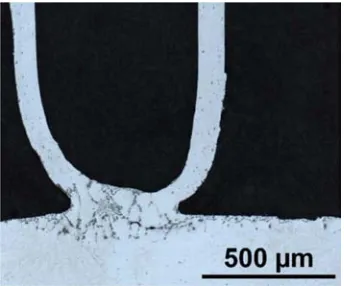
Figure 16. The pronounced brazed fillets exhibit a good flow of braze metal and good wetting of the aluminum fins. There was no corrosive damage to the fins when this procedure is used.
Figure 15. T-t regime of a brazing process according to Procedure 2.
Figure 16. Light microscope image of a brazing sample brazed according to Procedure 2 (325 vpm HCl, Tbrazing=561°C).
5. Conclusions
It was possible to explain the basic mechanisms in the interaction of the ammonium chloride or of the hydrogen chloride released from it with a galvanically deposited zinc top coat and use the results to determine the limits of suitable process parameters when brazing with this system. Essential knowledge of the melting behavior of the heterogeneous duplex brazed coating consisting of approximately 15 µm zinc and 40 µm of the alloy AlSi10 (aluminum with 10% silicon) was gained. The brazed coating forms a homogeneous, ternary brazing alloy with a low melting point within the heating and brazing times typical for brazing processes with a composition of 67% aluminum, 7.5% silicon, and 25% zinc and can be used as a braze metal with the zinc acting as a “melting point reducer”, and therefore can be brazed at a temperature of approximately 560°C.
From the reaction kinetics model, which was derived with the help of macrokinetic experiments, one obtains a theoretical in situ zinc chloride formation rate of up to 3 µg/(min cm2) for an HCl concentration of 200 vpm and 400°C as the components triggering the flow of braze metal.
Experimental brazing tests in which process parameters suitable for a continuous inert gas furnace process were specified showed that when the reaction time was long enough to permit the formation of zinc chloride and is followed by a brazing process at 560°C to 570°C in the subsequently hydrogen chloride-free atmosphere, the ternary AlSiZn braze metal forms in situ and enables the joining process to be performed. Throughout the entire process, it is necessary to ensure the process gas atmosphere is consistently dry.
In summary, it can be stated that the brazing of pipe fin joints pipe bar connections in a process gas enriched with ammonium chloride for hydrogen chloride concentrations greater than 100 vpm is possible when the brazing process is performed according to the procedure described above, i.e. when deoxidation occurs and an adequate amount of zinc chloride is formed at a temperature of 350°C-400°C and the actual brazing process is then carried out at a temperature of approximately 570°C in an HCl-free atmosphere.
There are challenges to overcome with regard to 0
100 200 300 400 500 600
time in s
implementing the research results in the production of brazed joints on aluminum, especially in terms of process and plant technology, before the process can be “upscaled” to an industrial brazing process. The special requirements on the materials built into the furnace must be taken into account, for example the retorts or the conveyor. These requirements are due to the use of ammonium chloride and/or process gases containing hydrogen chloride. For open furnace systems in particular, it is necessary to check and ensure the quantities of reaction products in the process gas are within their respective limit values.
Acknowledgements
Supported by the German Research Foundation (DFG) (Project Number: Mo 881/12-1).
References
[1] Swidersky, H.-W.: Aluminium brazing with non-corrosive fluxes – state of the art and trends in NOCOLOK flux technology, conference transcript of “Löt 2001”, 6th International Conference on Brazing, High Temperature Brazing and Diffusion Bonding, 8-10 May, Aachen, DVS-Reports, Vol. 212.
[2] Wielage, B.: Entwicklung eines Controlled Atmosphere Brazing (CAB) Verfahrens zum Fügen von Aluminiumguss- und Aluminiumknetlegierungen, research report for the project of the same name, AiF Project No. 13.788 N.
[3] Belt, H.-J.; Swidersky, H.-W., Wielage, B., Martinez, L.: Aluminium brazing at 500°C – characteristics of ZnAl-joints, conference transcript of “Löt 2001”, 6th International Conference on Brazing, High Temperature Brazing and Diffusion Bonding, 8-10 May, Aachen, DVS-Reports, Vol. 212, pp. 214–217.
[4] Bach, Fr-W.; Möhwald, K.; Holländer, U.; Ditz, R.: Flammlöten von Aluminiumschmiedeteilen, in: conference transcript of the 10th Material Technology Colloquium – WTK Chemnitz, 2007.
[5] Bach, Fr.-W.; Möhwald, K.; Holländer, U.; Langohr: Niedrig schmelzende Aluminiumhartlote aus dem System Al-Si-Zn, Schweissen und Schneiden Vol. 62, No. 11, pp. 632-637, 2010.
[6] Langohr A.; Swider M. A; Möller F.; Wulf E.; Möhwald K.; Hassel T.; Maier H. J. (2013): Development of flux free filler metals and processes for brazing of aluminum, In: Brazing, high temperature brazing and diffusion bonding. Printed as MS, Düsseldorf: DVS Media (DVS-Reports, 293), 2013, pp. 205–211.
[7] Wielage, B.; Hoyer, I.; Weis, S.: Entwicklung niedrig schmelzender Al-Lote für hochfeste Al-Legierungen, conference transcript of “Löt 2010”, International Conference on Brazing, High Temperature Brazing and Diffusion Bonding, DVS-Verlag GmbH, Düsseldorf 2010, pp. 366-370. [8] Engelbert, Peter et al.: Method for soldering aluminum, Patent
EP 1485224A1.
[9] Nigel, F. C. et al.: Tin- and zinc-based solder fillers for aluminium body parts and methods of applying the same, Patent GB 2387347A.
[10] Hoffmann, R.: Fluxless brazing method and compositions of layered material systems for brazing aluminum or dissimilar metals, Patent WO 03/045618A1.
[11] Childree, D. L: Aluminium filler alloy containing sodium for fluxless brazing, Patent WO 01/98019A1.
[12] Palmer, S.: High temperature aluminium alloy brazing sheet and manufacturing and uses therefor, Patent WO 02/070189A2.
[13] Berkowicz, P.: Method for joining parts of aluminium or aluminium alloys, Patent EP 1030760B1.
[14] Wielage, B., Trommer, F., Hielscher, H., Mücklich, S.: New developments on ultrasonic brazing technologies, conference transcript of “Löt 2001”, 6th International Conference on Brazing, High Temperature Brazing and Diffusion Bonding, 8-10 May, Aachen, DVS-Reports, Vol. 212, pp. 236–239. [15] Engelbert, Peter et al.: Soldering flux for soldering aluminum,
Patent US 7481894B2.