International Journal of Educational Methodology
Volume 4, Issue 4, 195 - 203.
ISSN: 2469-9632 http://www.ijem.com/
Structural Capital’s Contribution to Teacher’s Job Satisfaction: The
Mediating Role of Organizational Commitment
Selcuk Demir *
Ministry of Education, TURKEY
Received: September 15, 2018 ▪ Revised: October 16, 2018 ▪ Accepted: October 24, 2018
Abstract: This study analyses the relationships between schools’ structural capital, teachers’ organizational commitment and job satisfaction. 32 schools were selected randomly with cluster sampling method from the primary schools at Hatay city in the 2017-2018 academic year. Of the 300 questionnaires that were distributed, 264 were found to be validated and taken into analysis. The final structural equation model suggests that schools’ structural capital perceived by teachers is positively related to teachers’ organizational commitment and job satisfaction. Organizational commitment is a full mediator in the relationship between structural capital and job satisfaction. Teachers working at schools which are perceived to have a high level of structural capital, feel more committed to their school and thereby get satisfied with their job. School administrators are recommended to invest in promoting the level of school’s structural capital, if they want teachers to be more committed and satisfied which are key factors of performance at schools.
Keywords: Structural capital, organizational commitment, job satisfaction, teachers, schools.
To cite this article: Demir, S. (2018). Structural capital’s contribution to teacher’s job satisfaction: The mediating role of organizational commitment. International Journal of Educational Methodology, 4(4), 195-203. https://doi.org/10.12973/ijem.4.4.195
Introduction
The importance of intangible assets have been increased together with the shift from industrial society to knowledge society in organizations. Survival of a foundation depends on giving value intangible assets like intellectual capital. Management approach that moves human to central instead of financial power is important for creating difference and superiority. Perceiving value and respect individuals are probable to feel dedication to their organization and satisfaction with their job.
At the present time, while the value of tangible assets is decreasing, the importance of intangible assets is increasing day by day (Huang, Luther, & Tayles, 2007; Powell & Snellman, 2004). Intangible assets constitute to make value and innovations in the competition environment (Bontis, 1998; Mura & Longo, 2013; Tayles, Webster, Sugden, & Bramley, 2005).
The purpose of this research is to make contribution to the literature on intellectual capital, management of human resource and productivity. First, based on the literature review, the research draws an integrated framework to analyse the effects of school’s structural capital on both organizational commitment and job satisfaction of teachers. Second, organizational commitment is included in this proposed model to examine its mediating effect. Supported by former literature, it is pointed out by the researcher that structural capital can enhance a teacher’s level of organizational commitment and promote job satisfaction through organizational commitment. It is expected that when the schools’ structural capital is increased, higher level of job satisfaction will be facilitated through organizational commitment.
*Correspondence:
Selcuk Demir, Kirikhan Imam Hatip Middle School, Ministry of Education, Hatay / Turkey.
Figure 1. Research framework
In this research frame it’s seen that while structural capital enhances level of organizational commitment and job satisfaction increase. The researcher asserts that school’s structural capital can enhance teacher’s job satisfaction by promoting his/ her organizational commitment. In other words, when the perceptions of school’s structural capital are made stronger; teachers’ job satisfaction will be facilitated to increase through organizational commitment.
Structural capital perceived by teachers and Organizational commitment
Intellectual capital is the total of all the assets that are known by all the employees and provide them the competitive superiority. This kind of capital is an intellectual material to be used for getting poetry (Tayles et al., 2005). It is also the reflection of collective brainpower. Intellectual capital of an organization involves the processes, technologies to be used, patents to be had, employees, customers, suppliers providing inputs, even other parties related to organization (Stewart, 1997).
Intellectual capital generally consists of three components: Human capital, structural capital and relational capital (Bontis 1998; Bontis, Keow, & Richardson, 2000; Chen & Wang, 2009; Leal et al., 2015; Tayles et al., 2005). This capital derives from the interaction of these three dimensions. Human capital is an individual’s necessary idea structure,
experiences
and talents for serving the aims of organization and presenting solutions to all the customers (Mura & Longo, 2013; Stewart, 1997). In an organization, human capital is the source of innovations and has the potential of unlimited renewable (Hobikoglu, 2011). Structural capital is an information “no going home at nights” and staying at workplace. Structural capital can be shared and reproduced. The information and knowledge are provided to be gained by managers to their organizations (Stewart, 1997). Structural capital includes with organizational systems, culture, standards that strengthen the human capital to develop and differentiate into an organization to another one. (Chen & Wang, 2009). Relational capital is the kind of capital in which parties taking part outside, have a relationship based on self-interest with the organization.Differently from human and relational capital, structural capital completely belongs to the organization. Quality
employees
must be supported by strong substructure and canalized together in line with a common goal. As emphasized by Stewart (1997) this substructure includes in everything that are left after employees go their home. Organizational commitment is to the extent to how much an employee is dedicated to his/ her organization and its goals (Awamleh, 1996; Schermerhorn et al., 2011). OC is a psychological contract between employee and organization (McDonald & Makin, 2000). Related literatures show that OC is a desirable construct for organizations because of providing and supporting positive attitudes and behaviours (Blau & Boal, 1987; Knoop, 1995). Individuals having highStructural capital is extremely important for schools because of including the organizational systems, culture and procedures that have a potential to transform into value at organizations. Working in a school which has a perception of organizational systems, culture and procedures means prestige for teachers. Teachers feel pride in being a member of the school, and identify with goals and values of their school. So they become committed to school. Related researches set forth a positive relationship between intellectual capital and organizational commitment (Chen & Wang, 2009; Chen et al., 2012; Ghorbanhosseini, 2013; Mura & Longo, 2013; Zeinoddini, Esfahani, & Soleimani, 2015). Thus, the researcher has formulated the following hypothesis:
H1: School’s structural capital perceived by teachers has significantly and positively relation with teachers’ organizational commitment.
Structural capital perceived by teachers and Job satisfaction
Job satisfaction is an affirmative psychological mood that expresses on how much pleasure an individual gets in job and job experience (Kreitner & Kinichi, 2009). Schermerhorn et al. (2011) indicate as the degree to which a person has positive and negative feelings about a job. Previous studies have revealed the relationship between job satisfaction and other key variables in organizations (Kreitner & Kinichi, 2009). Individuals having a high level of job satisfaction develop positive attitudes toward job such as more efficiency and productivity on organizational activities and so their performance increase; and they display less behavior of absenteeism and leave (Ozkalp & Kirel, 2010). Related researches found an affirmative correlation between intellectual capital and job satisfaction (Channar, Talraje, & Bai, 2015; Leal, et al., 2015; Moon & Kim, 2006; Longo & Mura, 2011; Mura & Longo, 2013).
In line with previous research and researcher’s own objectives, the researcher expected to see the following:
H2. School’s structural capital perceived by teachers has significantly and positively relation with teachers’ job satisfaction.
Organizational commitment and Job satisfaction
Organizational commitment and job satisfaction are the most undesirable key outcomes in all the organizations. Job satisfaction has a relation with an individual’s degree regarding satisfaction with his/ her job, whereas organizational commitment is associated with an individual’s commitment to both of his/ her job and workplace (Guney, 2012). Previous studies (Brown, 1996; Lok & Crawford, 1999; Demir, 2018; Shalley, Gilson, & Blum, 2000) showed that organizational commitment has a positive relation with the job satisfaction. If teachers perceive the school which they work at have a strong construct, they will tend to possess high levels of organizational commitment, which could ensure high levels of job satisfaction. Thus, the researcher could hypothesize this relationship as:
H3. Organizational commitment has significantly and positively relation with teachers’ job satisfaction. Purpose of the study
It’s extremely important for teachers to have a high level of perceived structural capital and thereby positive feelings in educational organizations. Researcher hasn’t met any studies regarding the relationship between structural capital, organizational commitment and job satisfaction in educational organizations, so structural capital can be stated in this relationship that is a new construct. This study aims at determining the consequences of school’s structural capital perceived by teachers. In accordance with this purpose, this study focuses on previously stated hypothesizes.
Method
Research Design
In this study a relational screening model design was used to put forward the relationship between two and more variables (Robson, 2015). After structural capital perceptions and teachers’ level of organizational commitment and job satisfaction were revealed by three scales, the relationship among these variables was presented.
Samples
The population of the study consists of primary school teachers that worked at Hatay city in the 2017-2018 academic year. Using the cluster sampling method, a total of 32 schools were selected randomly and of the 300 questionnaires that were distributed, 264 were found to be validated and taken into analysis. 36 questionnaires weren’t found to be validated because of excessive unfilled items. This sample is suitable for representation of this population at 95% confidence interval (Field, 2009).
Research Instruments
Data was obtained by a five-point Likert-type scale with options ranging from “1: I strongly disagree” to “5: I strongly agree”. The independent variable of this study is structural capital and the dependent variables are organizational commitment and job satisfaction. Research variables have been measured with three scales as follows.
The intellectual capital scale was developed by Karakus & Cobanoglu (2013). Intellectual capital scale has three dimensions as Human capital, Structural capital and Relational capital. Structural capital facet of this scale was used in this study. Bartlett value is significant and KMO value is bigger than .50. So the construct is suitable for factor analysis. According to results of the confirmatory and explanatory factor analyses, this facet had thirteen items explaining 62.53% of the variance with factor loadings of the items on the scale varying from .638 to .873. This factor fitted to the data well (χ² = 83.307; df =33; x2/df = 2.527; P-value = 0.00; RMSEA = 0.076; IFI = 0.972, TLI = 0.962 and CFI = 0.972).
The coefficient of Cronbach’s Alpha of the scale was 0.948.
Organizational commitment scale was developed by Karakus and Aslan (2009). A single factor scale had nine items explaining 51.30% of the variance with factor loadings of the items on the scale varying from .664 to .776. This single factor scale presented a good fit to the data (Bartlett = 0.000, KMO = 0.801, χ² = 14.559, df = 8, χ²/df = 1.820, P-value = 0.068, RMSEA = 0.054, IFI = 0.992, TLI = 0.984, CFI = 0.992). The coefficient of Cronbach’s Alpha of the scale was 0.877. To measure job satisfaction, a universal measure of job satisfaction was used. The scale of job satisfaction was developed by Griffin et al. (2010) and adapted to Turkish by the researcher. A single factor scale had five items (S1, S2, S3, S4 and S5) explaining 64.23% of the variance with factor loadings of the items on the scale varying from .519 to .945. A single factor scale fitted to the data well (Bartlett = 0.000, KMO = 0.809, χ² = 10.006, df = 5, χ²/df = 2.001, P-value = 0.075, RMSEA = 0.062, IFI = 0.990, TLI = 0.979, CFI = 0.990). The coefficient of Cronbach’s Alpha of the scale was 0.835.
Data Analysis
Skewness and kurtosis coefficients were checked. These values were between -1.50 and 1.50. Data were normally distributed. Linear relations were detected between the study variables. Multicollinearity problem wasn’t seen between the exogeneous and endogeneous variables. Exploratory factor analyses (with SPSS) and confirmatory factor analyses (with AMOS) were conducted for each scale used in this research (Arbuckle, 2009). For estimating model parameters in confirmatory factor analysis (CFA), the maximum likelihood estimation method was used (Kline, 2011). After proving the reliability and validity of each scale, measurement model was developed, defining covariances between the latent variables. After getting good fit indices at the measurement model, the covariances were deleted and one-way paths were defined between the latent variables for developing a structural model in accordance with theoretical assumptions (Bayram, 2013).
Fit index measurements are examined to reveal how well the proposed model explains the data and these indexes reveal the proposal model is acceptable or not. Fit indexes used in this research are given at table 1.
Table 1. Fit index measurements
Fit indexes The value of ideal fit indexes The value of acceptable fit indexes
χ2 0.05<P≤1.00 (desired)
χ2 /df χ2 /df≤ 2 2<χ2 /df≤ 5
RMSEA 0.00<RMSEA≤0.05 0.05<RMSEA<0.08
IFI 0.95≤IFI<1.00 0.90≤IFI<0.95
TLI 0.95≤TLI<1.00 0.90≤TLI<0.95
CFI 0.95<CFI<1.00 0.90<CFI<0.95
Findings
Descriptive statistics and correlation matrix of the variables is presented in Table 2.
Table 2. Descriptive statistics and correlation matrix of the variables
Variables X Sd std error 1 2 3
1. SC 3.751 .744 .045 1
2. OC 3.860 .740 .045 .541*** 1
3. JS 4.187 .682 .042 .360*** .444*** 1
*p<.05, **p<.01, ***p<.001
Notes: CR: Structural Capital, OC: Organizational Commitment, JS: Job Satisfaction.
The findings of descriptive statistics indicate that structural capital (X=3.751), organizational commitment (X=3.860) and job satisfaction (X=4.187) have moderately high mean scores (the level of “4: I agree”). According to the correlation matrix, structural capital, organizational commitment and job satisfaction are positively correlated. These correlations are significant at .01 level (Table 1).
The correlation of each proposed pair construct was significant. These tests revealed that all the expected relationships were confirmed. The values of the correlations ranged from .360 to .444. To reinforce this research, the proposed model with AMOS and a structural equation model were examined.
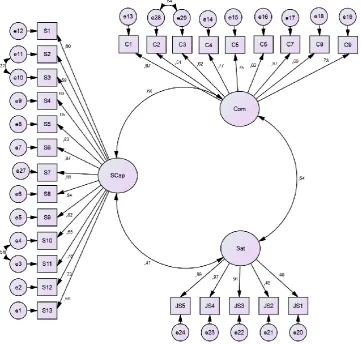
Confirmatory factor analysis was performed to all the scales used in this study. In line with the modification indices, three error covariances were added to the model. Error covariances were added between S2 and S3, S10 and S11, C2 and C3 because the errors of these items were related to each other. The results obtained from the measurement model shows that the scales revealed a good fit to the data (x2 = 639.963, df = 318, x2/df = 1.984, p=0.00, IFI = .937, TLI = .929,
CFI = .936, RMSEA = .061). At this model, all the latent variables appear to be significant and high correlations with each other as shown in Figure 2.
Notes: SCap: Structural Capital, Com: Organizational Commitment, Sat: Job Satisfaction. Fit indices: x2 = 639.963, df =
318, x2/df = 1.984, p=0.00, IFI = .937, TLI = .929, CFI = .936, RMSEA = .061.
After presenting the best fit of the measurement model, the covariances between the latent variables were deleted and one-way paths were added to these latent variables according to the theoretical assumptions. The path of SCap→Sat (B= .064; ß= .135, p= .073) was deleted because of their insignificant path coefficients (Table 2). The final structural equation model revealed a good fit to the data (x2 = 634.397, df = 319, x2/df = 1.989, p=0.00, IFI = .936, TLI = .929, CFI =
.936, RMSEA = .061).
Table 3. Deletions of the insignificant paths for the final structural equation model
x2 df x2/df ∆x2 IFI TLI CFI RMSEA
1. Saturated model 630.963 651 1.984 - .937 .929 .936 .061
2. SCap→Sat 634.397 319 1.989 .005 .936 .929 .936 .061
Note: SCap: Structural capital, Sat: Job satisfaction
Notes: SCap: Structural Capital, Com: Organizational Commitment, Sat: Job Satisfaction. Fit indices: x2 = 634.397, df =
319, x2/df = 1.989, p=0.00, IFI = .936, TLI = .929, CFI = .936, RMSEA = .061.
Figure 3 The final structural equation model with standardized path coefficients
According to this structural model, structural capital has a positive effect on organizational commitment (β = 0.61, t = 7.575, p<.001). Organizational commitment significantly and positively affects job satisfaction (β=.55, t = 5.227, p<.001). Based on the findings of this research, researcher further examine the mediating effect of organizational commitment. The direct effect of structural capital on organizational commitment is significant (β = 0.61, t = 7.575, p<.001), but the direct effect of structural capital on job satisfaction (β = 0.13, t = 1.792, p>.05) is not significant. The indirect effect of structural capital on job satisfaction (β = 0.34, p<.001) is significant. As a result, the mediating effect of organizational commitment is supported. Put it differently, structural capital has a significant and positive relationship with job satisfaction through the full mediation effect of organizational commitment.
Direct, indirect and total effects between latent variables in the study is presented in Table 4.
Table 4 Direct, indirect and total effects between latent variables in the study
Latent Variables Relationships Direct Effects Indirect Effects Total Effects
Structural capital to Commitment .61*** Not applicaple .61***
Structural capital to Satisfaction Not applicaple .34*** .34 ***
*p<.05, **p<.01, ***p<.001
The derived metrics can be explained as follows: when taking into consideration direct effects of perceived structural capital on organizational commitment for every 10% increase in structural capital, an approximate 6% increase will be had in teacher organizational commitment. A 10% increase in structural capital will have an expected 3.3% increase in teacher job satisfaction. For every 10% increase in organizational commitment, an approximate 6% increase will be had in teacher job satisfaction.
Discussion
The positive outcomes of intellectual capital are known widely and the ways in which intellectual capital leads to organizational and personal outcomes for individuals. Based on the earlier studies, in this current study researcher have developed a model for assessing and evaluating the structural capital component of intellectual capital in educational organizations by gathering data from teachers. Data analysis using structural equation modelling with Amos has contributed to developing a measurement and structural model for structural capital that enables certain fundamentals with important methodological characteristics.
The analysis of the model leads to expected and unexpected results. In accordance with the theory, structural capital significantly increases teacher organizational commitment as hypothesized (H1). Also organizational commitment significantly increases teacher job satisfaction as hypothesized (H3). So two hypothesizes (H1 and H3) has been confirmed. Structural capital has not a direct significant effect on job satisfaction. So H2 was not confirmed. Structural capital has a significant effect on job satisfaction through the full mediation effect of organizational commitment. Previous studies point out that there is a positive correlation between perceived intellectual capital and organizational commitment (Chen & Wang, 2009; Ghorbanhosseini, 2013; Mura & Longo, 2013; Zeinoddini et al., 2015). Based on these researches, Hypothesis I in this study has been developed. Chen et al. (2012) revealed that only human capital component of intellectual capital enhanced the organizational commitment. Unlikely, the current study pointed out structural capital had an affirmative effect on organizational commitment. Therefore, hypothesis I in this study was confirmed. If teachers perceive that their school has high levels of structural capital, they tend to believe that they do better in their current school than in other schools. This state enables them to feel committed to their school.
The organizational structure, the competitive position, the system standards, and the organizational culture when positively perceived by teachers influence teachers’ positive attitudes. Previous studies (Longo & Mura, 2011; Leal et al., 2015) found out that structural capital was the only one component of intellectual capital directly promoting job satisfaction. Unlikely, the current study revealed that structural capital perceptions had not a direct effect on teachers’ job satisfaction. Hypothesis II in this study has not been confirmed.
As perceptions regarding the structural capital of schools become more positive, teachers feel more committed. Highly committed teachers feel job satisfaction. Thus, teachers who feel more dedicated to improving their schools’ outcomes, identificate with their school’s aims and they can be more satisfied with their job. Earlier studies showed the job satisfaction was positively correlated with the organizational commitment (Brown, 1996; Demir, 2018; Lok & Crawford, 1999; Shalley, Gilson, & Blum, 2000). Sense of commitment is a crucial factor that leads to obtain increased teachers’ job satisfaction. Thus, the feeling of organizational commitment appears to be fostering positive attitudes at work. It could then be indicated that Hypothesis III has been confirmed.
This study has found out structural capital has a significantly affirmative effect on organizational commitment. Also the current study revealed that organizational commitment significantly and positively affected the job satisfaction. Based on the findings of the study, researcher further examined the mediating effect of organizational commitment. This study has pointed out that organizational commitment works as a full mediator in the relationship between structural capital and job satisfaction. In other words, structural capital indirectly has an impact on teachers’ job satisfaction by enhancing their commitment.
The current study examined how perceived structural capital could enable to develop organizational commitment and job satisfaction at schools. Perceptions that schools have high levels of structural capital have an impact on teachers’ commitment to school and satisfaction with their job. Perceptions that school has a strong organizational system, culture and procedure also influence how teachers think about and evaluate their own school. As limitations, only teachers’ views were consulted and evaluated regarding their schools’ structural capital. As limitations, firstly only teachers’ views were received for consideration and assessed regarding their school’s structural capital. Secondly, this paper is based on a limited sample size from one province of Turkey, the ability to generalize these findings to larger samples might be restricted.
References
Arbuckle, J. (2009). Amos 18 User's Guide. Armonk, NY: IBM/SPSS Incorporated.
Awamleh, N.A.H.K. (1996). Organizational commitment of civil service managers in Jordan: A field study. The Journal of
Bayram, N. (2013). Yapisal Esitlik Modellemesine Giris, AMOS uygulamalari [Introduction to Structural Equation Modeling, AMOS Applications]. Bursa: Ezgi Kitabevi.
Blau, G.J., & Boal, K.B. (1987). Conceptualizing how job involvement and organizational commitment affect turnover and absenteeism. Academy of Management Review, 12(2), 288-300.
Bontis, N. (1998). Intellectual capital: an exploratory study that develops measures and models. Management Decision, 36(2), 63-76.
Bontis, N., Keow, W., & Richardson, S. (2000). Intellectual capital and the nature of business in Malaysia. Journal of Intellectual Capital, 1(1), 85-100.
Brown, S.P. (1996). A meta-analysis and review of organizational research on job involvement. Psychological Bulletin, 235-255.
Byrne, B. M. (2010). Structural Equation Modeling with AMOS. New York: Routledge.
Channar, Z.A., Talraje, S., & Bai, M. (2015). Impact of human capital variables on the effectiveness of the organizations.
Pakistan Journal of Commerce and Social Sciences, 9(1), 228-240.
Chen, M. Yi-Ching, & Wang, Y.S. (2009). Intellectual capital and organizational commitment. Proceedings of the
International Conference on Intellectual Capital, Knowledge Management & Organizational Learning, 303-311.
Chen, M. Yi-Ching, Wang, Y.S., & Sun, V. (2012). Intellectual capital and organizational commitment: Evidence from cultural creative industries in Taiwan. Personnal Review, 41(3), 321-339.
Demir, S. (2018, May). Oz yeterligin is doyumu, orgutsel baglilik, motivasyon ve ise sarginliktaki rolu [The role of self-efficacy in job satisfaction, organizational commitment, motivation and job involvement], Vrd International Eurasian Educational Research Congress, Antalya.
Field, A. (2009). Discovering Statistics using SPSS. Dubai: Oriental Press.
Ghorbanhosseini, M. (2013). The effect of organizational culture, teamwork and organizational development on organizaional commitment: the mediating role of human capital. Tehnički vjesnik, 20(6), 1019-1025.
Griffin, M.L., Hogan, N.L., Lambert, E.G., Tucker-Gail, K.A., & Baker, D.N. (2010). Job involvement, job stress, job satisfaction, and organizational commitment and the burnout of correctional staff. Criminal Justice and Behavior, 37, 239-255.
Guney, S. (2012). Orgutsel Davranis [Organizational Behaviour]. Istanbul: Nobel Yayincilik.
Hobikoglu, E.H. (2011). Entelektuel sermayenin onemi, siniflandirilmasi ve olcme yontemleri: Kuramsal bir cerceve [The measurement methods, classification and importance of intellectual capital: A theoretical frame]. Journal of Social Sciences, 1, 86-99.
Huang, C., Luther, R., & Tayles, M. (2007). An evidence-based taxonomy of intellectual capital. Journal of Intellectual Capital, 8(3), 386-408.
Karakus, M., & Aslan, B. (2009). Teachers’ Commitment Focuses: A Three Dimensioned View, Journal of Management
Development, 28(5), 425–438.
Karakus, M., & Cobanoglu, N. (2013). Ilkokullarda entelektuel sermayenin olculmesi ve bazi degiskenler acisindan incelenmesi [Measuring intellectual capital in primary schools and examining in terms of some variables]. Usak University Journal of Social Sciences, 6(4), 158-181.
Kline, R.B. (2011). Principles and practice of structural equation modeling. New York: The Guilford Press.
Knoop, R. (1995). Relationships among job involvement, job satisfaction, and organizational commitment for nurses.
The Journal of Psychology, 129(6), 643-649.
Kreitner, R., & Kinichi, A. (2009). Organizational Behaviour. New York: Mc Graw-Hill International Edition, Ninth edition.
Leal, C., Marques, C., Marques, C., & Brago-Filho, E. (2015). Internal communication, intellectual capital and job satisfaction: A structural model applied to a credit union. ECIC, 199-207.
Longo, M., & Mura, M. (2011). The effect of intellectual capital on employees’ satisfaction and retention. Information &
Management, 48 (7), 278-287. doi: 10.1016/j.im.2011.06.005.
McDonald, D.J., & Makin, P.J. (2000). The psychological contract, organisational commitment and job satisfaction of temporary staff. Leadership and Organization Development Journal, 21(2), 84-91.
Meyer, J. P., & Allen, N. J. (1991). A three-component conceptualization of organizational commitment. Human Research
Management Review, 1(1), 61-89.
Moon, Y. J., & Kym, H. G. (2006). A Model for the value of intellectual capital. Canadian Journal of Administrative Sciences,
23(3), 253-269.
Mura, M., & Longo, M. (2013).Developing a tool for intellectual capital assessment: An individual-level perspective.
Expert Systems, 30 (5), 436-450.doi: 10.1111/j.1468-0394.2012.00650.x.
Nystrom, P.C. (1993). Organizational cultures, strategies, and commitments in healt care organizations. Health Care
Management Review, 18(1), 43-49
Ozkalp, E., & Kirel, C. (2010). Orgutsel davranis [Organizational Behavior]. Bursa: Ekin Basim Yayin Dagitim.
Powell, W.W., & Snellman, K. (2004). The knowledge economy. Annual Review of Sociology, 30, 199-220. http://dx.doi.org/10.1146/annurev.soc.29.010202.100037
Robson, C. (2015). Bilimsel arastirma yontemleri: Gercek dunya arastirmasi [Real world research] (Sakir CINKIR and Nihan DEMIRKASIMOGLU, eds. of trans.). Ankara: Ani Yayincilik.
Schermerhorn, J. R., Hunt, J. G., Osborn, R. N., & Uhl-Bien, M. (2011). Organizational Behavior. Asia: John Wiley & Sons (Asia) Pte Ltd.
Shalley, C., Gilson, L., & Blum, T. (2000). Matching creativity requirements and the work environment: Effects on satisfaction and intentions to Leave. Academy of Management Journal, 43(2), 215-223.
Stewart, T. A. (1997). Entelektuel sermaye[Entellectual capital] (Trans. Nurettin Elhuseyni). Istanbul: Mess Yayinlari. Tayles, M., Webster, M., Sugden, D., & Bramley, A. (2005). Accounting ‘gets real’ in dealing with virtual manufacturing.
Journalof Intellectual Capital, 6, 322–338.
Zeinoddini, S., Esfahani, S.A., & Soleimani, H. (2015). The effect of intellectual capital on organizational commitment: A case study of the ministry of economic affairs and finance of Kermanshah province. International Journal of