NIKHEF
Annual Report
2004
NI
KH
EF Annual Report 2004
Annual Report
2004
Colofon
Publication edited for NIKHEF
Nationaal Instituut voor Kernfysica en Hoge Energie Fysica
National Institute for Nuclear Physics and High-energy Physics
Address: Postbus 41882, 1009 DB AmsterdamKruislaan 409, 1098 SJ Amsterdam Telephone: +31 20 592 2000
Fax: +31 20 592 5155 E-mail: [email protected]
Editors: Henk Tiecke & Auke-Pieter Colijn Layout/art-work: Kees Huyser
Photos: NIKHEF, CERN, DESY, Fermilab, NASA Cover: Simulated hadronic decay of a Higgs boson URL: http://www.nikhef.nl
NIKHEF is the National Institute for Nuclear Physics and High-Energy Physics in the Netherlands, in which the Foundation for Fundamental Research on Matter (FOM), the Universiteit van Amsterdam (UvA), the Vrije Universiteit Amsterdam (VUA), the Radboud Universiteit Nijmegen (RUN) and the Universiteit Utrecht (UU) collaborate. NIKHEF co-ordinates and supports all activities in experimental subatomic (high-energy) physics in the Netherlands.
NIKHEF participates in the preparation of experiments at the Large Hadron Collider at CERN, notably Atlas, LHCb and Alice. NIKHEF is actively involved in experiments in the USA (DØ at Fermilab, BaBar at SLAC and STAR at RHIC) and in Germany at DESY (Zeus and Hermes). Furthermore astroparticle physics is part of NIKHEFʼs scientific programme, in particular through participation in the ANTARES project: a detector under construction in the Mediterranean Sea. Detector R&D, design and construction of detectors and the data-analysis take place at the laboratory located at Science Park Amsterdam as well as at the participating universities. NIKHEF has a theory group with both its own research program and close contacts with the experimental groups.
Contents
Introduction
3
Report of the Director
5
Reviews
7
LEP
9
The Large Hadron Collider
11
Astroparticle Physics
16
The International Linear Collider
20
25 Years of Internet Activities at NIKHEF
24
Printed circuit boards in high energy physics
26
Mechanical precision support structures very demanding
27
Research
29
ATLAS: construction in full swing
31
ZEUS takes data in 2004
33
B-Physics program: status and physics goals
35
Heavy-Ion Physics
37
HERMES: the proton spin puzzle
39
Theory: towards supersymmetry?
41
GRID, world wide computing
43
ANTARES: neutrinos and the sea
45
TimePix: Innovations in gas-filled detectors
46
Education
49
Research school subatomic physics
51
Master of Science in Particle and Astroparticle Physics
52
Interaction with High Schools
53
Outreach
55
HiSPARC, scholier én wetenschapper
57
Nationale Wetenschapsdag, Open Dag NIKHEF
58
Het vijftigjarig bestaan van CERN in Amsterdam
60
Het vijftigjarig bestaan van CERN in Genève
61
In retrospect 2004 was a turbulent year. Foremost FOM1 launched, debated and approved its “Strategisch
Plan 2004-2010” the wake of which left NIKHEF with a budget reduction and the challenge to secure new funds via e.g. an “Industrial Partnership Program”, EU programs or ad-personam subsidies like the “FOM Projectruimte” and the “NWO Vernieuwingsimpuls”. First successes include: the preliminary EU approval of a design study for an underwater neutrino telescope (KM3NeT); the start of the Virtual Laboratory for e-science (VL-e) in which NIKHEF participates in preparation for data analysis of the large experiments at CERNʼs Large Hadron Collider (LHC); subsidies from several sources for the High School Project on Astrophysics Research with Cosmics (HiSPARC) and the collaboration with a former Philips subsidiary, PANalytical Almelo, on the development of silicon pixel detectors for X-ray imaging.
Today, outreach activities constitute an integral part of the NIKHEF program. Many high schools already joined the quest for the most energetic cosmic-ray in the context of NIKHEFʼs HiSPARC project. In June HiSPARC received the prestigious international Altran Foundation Award. In October the Dutch minister of Education, Culture and Science, M.J.A. van der Hoeven, represented the EU at the official ceremony
celebrating the 50th anniversary of CERN. In November
NIKHEF organized a well attended public symposium celebrating this event in Amsterdam. Throughout the year numerous high school students (and teachers) came to NIKHEF to perform small experiments, to build cosmic-ray detectors, to enroll in a master class or to simply enjoy a guided tour of NIKHEFʼs research activities. Vice versa NIKHEF physicists gave lively presentations on frontier research at high schools and in museums and they took part in various working groups preparing manifestations for the World Year of Physics 2005. During the traditional Dutch science week (“Weten Week”) in October NIKHEF opened its doors for the general public to explain and demonstrate the fascinating research projects and techniques in particle and astroparticle physics.
NIKHEFʼs main research ambition is to exploit the discovery potential offered by the worldʼs flagship particle accelerator: CERNʼs Large Hadron Collider scheduled to start operation in 2007. In 2004 the construction of the LHC experiments progressed well. A major milestone was the installation of the first coils of the huge Atlas magnet system into the underground cavern. The magnet systems for the other two LHC experiments in which NIKHEF participates, Alice and LHCb, have been installed in their respective caverns as well. With most detector construction activities well under way or already nearing completion, most physicists are gradually shifting their focus to the event reconstruction and simulation software and physics
Report of the Director
1 NIKHEFʼs main partner FOM, the Foundation for Fundamental Research on Matter, is the largest government-supported physics organisation in the Netherlands.
performance studies. Of particularl importance in this context, is the NIKHEF participation in the DØ, Babar and Star experiments in the United States which serve not only as LHC precursor experiments but, if nature is kind, also might yield major scientific discoveries. Another crucial ingredient towards the success of the future LHC program is GRID computing. During 2004 several data-challenges were initiated to test the performance of the world-wide available GRID infrastructure in analysing large amounts of data. The Antares neutrino telescope under construction at the bottom of the Mediterranean Sea 40 km of the French coast is a relatively new research activity at NIKHEF in the emerging interdisciplinary field of astroparticle physics. In 2004 the first Dutch Antares PhD student received his degree! In 2005 the first full-sized detector units will be deployed. Within the Netherlands a consortium of astronomers and particle physicists from various universities and research institutes aims to broaden the Dutch role in astroparticle physics. In April NIKHEF hosted the first of a series of Astroparticle Physics Symposia which should lead to a coherent research program addressing key questions like: what are the origins of dark matter, of dark energy and of cosmic-rays?
As a joint venture of FOM and four universities (RUN, UU, UvA and VU) NIKHEF provides an excellent training environment for students. The state-of-the-art technical depstate-of-the-artments offer apprenticeships to engineering students. The Master program in Particle and Astroparticle Physics launched in 2002 has NIKHEF as its home-base. An integral part of this Master program is the highly appreciated 8-12 week stay at CERN as a summer student. In 2004 the first Master students graduated; all of them enrolled in the PhD
program coordinated by the Research School Subatomic Physics. This Research School organizes the training and monitors the progress of the PhD students affiliated with NIKHEF. On average about 15 PhD degrees are awarded annually.
On a personal note, on January 1st NIKHEFʼs former
director Jos Engelen started his job at CERN as Chief Scientific Officer. Jos, all of us at NIKHEF wish you a very successful stay at CERN and please do not forget the counter on your desk ticking away the days until the first LHC proton-proton collisions! As NIKHEFʼs ad interim director Karel Gaemers faced all the vicissitudes related to FOMʼs “Strategisch Plan 2004-2010”. Karel, I am very pleased you spearheaded this difficult task while at the same time preparing me for my task as future NIKHEF director. I hope in return you enjoyed briefly being an experimental physicist wiring the last drift tube for the Atlas muon spectrometer. We at NIKHEF wish you all the best in your new capacity as dean of the science faculty at the University of Amsterdam!
Frank Linde
Last wire for muon chamber placed by NIKHEFʼs ad-interim director Karel Gaemers.
Former NIKHEF director Jos Engelen, now CERNʼs Deputy Director-General and Chief Scientific Officer.
The L3 spectrometer.
LEP
From 1989 through 2000, four detectors at CERN collected data on e+e- interactions produced by the
large electron-positron collider, LEP. Two of these experiments, DELPHI and L3, were supported by FOM. Important components of both detectors, as well as computer software, were developed and built by NIKHEF.
In the first phase of operation of LEP1, up to mid-1995, the centre-of-mass energy was chosen approximately equal to the mass of the Z boson in order to study its properties with high precision. Later at LEP2, the centre-of-mass energy was increased in steps to allow study of the W± bosons, that were produced in pairs,
and to search for the Higgs boson and for new types of particles.
The precision of the measurements of Z properties surpassed all expectations. Most precise is the measurement of the mass of the Z, which has a precision of 23 ppm. Through the many, precise measurements of Z and W properties, the theory of electroweak interactions could be tested in great detail. A major success was the prediction, before its discovery, of the mass of the top quark, which enters the calculation of Z properties as a small electroweak loop correction. Similarly, an upper limit (MH<260 GeV)
is placed on the mass of the Higgs boson.
A direct search for the Higgs boson established the lower limit, MH>114.4 GeV. The Higgs boson is the
only particle of the electroweak theory that has not yet been discovered.
The current situation of the electroweak measurements and the W and top mass determinations is shown in the figure above.
Development and installation of silicon microvertex detectors enabled significant measurements of properties of B-mesons and the tau lepton, areas of research not foreseen at the start of the LEP programme.
Quantum Chromo-Dynamics (QCD), the other component of the Standard Model, was also tested at LEP, the lack of hadrons in the initial state providing a very clean environment for QCD studies. The strong coupling constant was measured and found to depend on the energy scale as predicted by QCD. The LEP evidence for the so-called ʻrunningʼ of the strong coupling constant is shown in the figure on the next page. The colour structure of the final state was also found to be in accordance with the theory.
Despite intensive searches, evidence for particles or processes beyond the Standard Model was not found. The LEP data are consistent with the Standard Model. The high precision experimental tests of the Standard Model provided by the LEP experiments were
acknowledged in the attribution of the Nobel prize
80.2
80.3
80.4
80.5
80.6
130
150
170
190
210
m
H[GeV]
114 300 1000
m
t
[GeV]
m
W[GeV
]
Preliminary
68% CL
∆α
LEP1, SLD Data
LEP2, pp
−Data
Contours at 68% Confidence Level (CL) for the top and W mass measurements in the Standard Model. The red contour corresponds to a fit to the electroweak data measured at LEP1. The green contour to the direct W mass measurement at LEP2 and the top mass determined at the Tevatron. The yellow area spans Higgs mass values from 114 to 1000 GeV.to Martinus Veltman and Gerard ʼt Hooft in 1999 for the electroweak Standard Model and the Nobel prize for Gross, Politzer and Wilczek in 2004 for Quantum Chromo-Dynamics.
PhD students and staff took part in all aspects of the experiments. To date, 49 Dutch PhD theses have been based on LEP results, and 5 more are expected in the near future. The total number of articles in leading scientific journals will be about 300 per experiment. αs(Q) Q (GeV) 50 100 150 200 0.10 0.11 0.12 0.13 0.14 0.15 (Q) fit at single energy ± stat. ± total (Q) combined fit αs αs
LEP Measurements of the strong coupling constant αs as a function of the parameter Q that is proportional to the energy. The red line shows the expected ʻrunningʼ curve in Quantum Chromo-Dynamics.
The Large Hadron Collider
Introduction
A major share of NIKHEFʼs scientific endeavour is focused on the Alice, Atlas and LHCb experiments at CERNʼs upcoming flagship accelerator project: the Large Hadron Collider or LHC. The LHC was first proposed in 1984, officially approved by the CERN Council in December 1994 and is presently scheduled to start operation in 2007. In operation, the LHC will be the worldʼs most powerful accelerator, surpassing its predecessor, the Tevatron of FERMILAB near Chicago, in centre-of-mass energy by almost an order of magnitude. The LHC is likely to revolutionise our understanding of particle physics: exploring a hitherto inaccessible energy domain which allows the researchers to conclude decades of speculation and frantic searches for the elusive Higgs boson and supersymmetric partners of the Standard Model particles.
Large Hadron Collider
The LHC will be constructed in a huge 27 km circumference underground tunnel straddling the Swiss-French border near Geneva, the home of Europeʼs particle physics laboratory CERN. This tunnel was already excavated in the 1981-1986 period to house the LEP electron-positron collider which operated successfully from July 1989 to November 2000 at centre-of-mass energies ranging up to 210 GeV. Synchrotron radiation losses of the relatively light
electrons precluded LEP operation beyond 210 GeV. Compared to electrons, protons are about 1800 times heavier, which render synchrotron radiation losses negligible for the LHC proton-proton collider. Instead, the LHC centre-of-mass limit is set by the realistically achievable bending power of the dipole magnets guiding the counterrotating proton beams around the 27 km circumference LHC ring. With 1232 superconducting 8.3 Tesla dipole magnets the highest attainable LHC centre-of-mass energy is 14 TeV. To maximize the discovery limit for hitherto unknown particles, the LHC luminosity (a measure for the proton-proton collision rate) will gradually increase from 1033 cm-2s-1 during the first years of LHC operation to
1034 cm-2s-1 for nominal LHC operation. Preliminary
studies indicate that the LHC could eventually operate at an unprecedented luminosity of 1035 cm-2s-1. To reach
these high luminosities, the spacing between successive proton bunches in the counterrotating proton beams is only 25 ns (7.5 meters). This narrows down the particle detection concepts and imposes stringent requirements on the data-acquisition electronics of the LHC experiments. Instead of proton-proton collisions, the LHC can also be configured to yield heavy-ion collisions. In this mode the centre-of-mass energy increases in proportion to the charge number Z of the heavy-ions; for example for lead-lead (Z=82) collisions the attainable centre-of-mass energy is 1130 TeV! Apart from its geometric dimensions, the main technological challenge of the LHC, is the 15 m long
superconducting dipole magnet. Each dipole has to guide the counterrotating proton beams (as opposed to a counterrotating proton and an anti-proton beam); to achieve this each LHC dipole constitutes in reality two dipoles with opposite magnetic fields acting on the two separate beam pipes: one for the proton beam circulating clockwise and one for the proton beam circulating counter-clockwise. In total the 1232 dipoles require about 1200 tons of superconductor cable composed of a number of braids each consisting of filaments of niobium-titanium alloy. Intensive R&D with European industries has shown the “twin aperture” dipole magnet concept to be technically feasible and economically realizable. To limit the risks, the dipole contract has been divided between three industrial consortia: Babcock-Noell (Germany), Alston-MSA-Jeumont (France) and Ansaldo Superconduttori (Italy). Despite a number of technical and financial problems, dipole production proceeds smoothly today with more than 500 dipoles available at CERN at the end of 2004. The day-to-day status of the dipoles, and of many other components of the LHC machine, can be followed at the “LHC dashboard” on the web1. Once completed, the LHC with its 27 km circumference will be the largest superconducting installation in the world.
The use of superconductivity requires the dipoles to operate at a temperature of 1.9 K, about -271° C
and hence even colder than outer space! This low temperature is achieved with a huge refrigeration system and a myriad of cryogenic lines circulating liquid helium through the cold mass of each
superconducting dipole. At 1.9 K helium is in a super fluid state that significantly enhances its cooling capabilities; a drawback of the use of super fluid helium is that it can escape through even minute cracks in the cryostat walls. Despite stringent leak tightness requirements CERN will probably become the worldʼs largest consumer of helium during LHC operations. The installation of the cryolines in the LHC tunnel by an industrial firm encountered a serious setback due to failures in the mechanics which allows sliding movements of the helium pipes upon cool down due to thermal contraction. At the end of 2004 the CERN management demonstrated its refreshing no-nonsense attitude by deciding to take over the repair of the cryolines already installed in the LHC tunnel in order to allow the company to concentrate on the correct and timely delivery of the remaining cryolines. This bold action of the CERN management was the only way by which the LHC schedule could be kept. CERNʼs Chief Scientific Officer and former NIKHEF director Jos Engelen is reminded every day of the importance of reaching LHC collisions in 2007 by an electronic display he received as a gift when he left NIKHEF in December 2003! Thus far, the cryoline problem prevented the installation of completed dipoles in the LHC tunnel, as a result of which in every available corner at the CERN site scores of fully assembled LHC dipoles can be
1http://lhc-new-homepage.web.cern.ch/lhc-new-homepage/
DashBoard/index.asp.
Cross section drawing of the LHC dipole magnet. Superconducting cable
found today. Operation of the LHC makes full use of the accelerator infrastructure already available at CERN. The protons begin their journey in the ion source just before a LINAC which injects them via the Booster complex into CERNʼs workhorse accelerator: the Proton Synchroton. In the Proton Synchroton the protons are collected into packages (“bunches”) and accelerated to an energy of 26 GeV to be fed into the Super Proton Synchroton. In the Super Proton Synchroton the protons are further accelerated to an energy of 450 GeV and finally, via newly build transfer lines, injected into the LHC. The LHC accumulates protons until the design current of about 0.6 Amperes is reached upon which the protons are accelerated to their collision energy of 7 TeV. At design luminosity, the stored energy in each proton beam is approximately 400 MJ which is equivalent to the kinetic energy of a 15.000 ton ship cruising at 15 knots! In November 2004, a major milestone was passed when the first proton bunches meeting the LHC specification were sent along the transfer line to come within meters of the LHC tunnel. A photograph of the beam profile recorded at the end of the transfer line is shown above. Plans to operate the CERN accelerator complex from a control room from within the refurbished “Globe de lʼInnovation” had to be abandoned because of cost reasons favouring the old CERN Prevessin control room. Instead, the Globe de lʼInnovation will house CERNʼs Microcosm exhibition in the future.
LHC Experiments
Five experiments are scheduled to collect data during LHC operations: the general purpose experiments Atlas and CMS; the B-physics experiment LHCb; the heavy-ion experiment Alice and the total cross-section experiment Totem. NIKHEF participates in Alice, Atlas and LHCb. Alice and LHCb are located in underground caverns previously occupied by the LEP L3 and Delphi experiments (in both of which NIKHEF groups participated in the past), respectively. Even though the construction of sub-detector equipment for both of these experiments is still in full swing in the participating institutes, the experimental magnets have been installed already in the caverns. For the Atlas experiment a huge new cavern had to be excavated. The civil engineering of the Atlas cavern started in 1999 and was handed over to the Atlas collaboration in February 2003. With the installation of the first, out of eight, superconducting coils comprising the Atlas barrel toroid in November 2004 a major milestone was passed. The expectation is that all three experiments with NIKHEF participation will finish construction early 2007 and be ready to record first proton-proton collisions later in 2007.
The enormous annual data samples to be collected during LHC operation (about 20 PB/year, equivalent to 25 million CDs) require a novel approach vis-à-vis data processing and data storage. In the LEP era, a single large computing facility at the CERN site served
LHC dipole magnets waiting for installation in the tunnel.
Beam profile at the end of the transfer tunnel.
the computing needs of the experiments. Instead, the LHC computing model relies on a geographically distributed architecture with a so-called Tier-0 facility at CERN connected via high-bandwidth (10-100 Gb/s) Tier-1 facilities in different countries, including the Netherlands. A multitude of smaller Tier-2 facilities, serving primarily as physics analysis centres, are connected to each Tier-1 facility. The Tier-0 and Tier-1 facilities together take care of data storage, data reconstruction and data simulation. The Tier complex is operated as a computer GRID. Nikhef is, via its participation in the national Virtual Laboratory for e-Science (VL-e) and the European EGEE project, an important GRID software development centre. In 2004, Nikhef participated in various CERN initiated data challenges by means of which the community intends to gradually increase the handled data volume to cope with the 20 PB/year once LHC data taking and data analysis takes off in 2007.
LHC Physics Program
The high centre-of-mass energy of LHC proton-proton interactions allows probing a completely new territory. The most exciting LHC result would be a surprise discovery of a new process or a new type of particle. Such a discovery could revolutionize our understanding of the structure and the evolution of the Universe since the beginning of time coined the “Big Bang”. Even though surprises are impossible to predict, a tantalizing possibility would be the creation and subsequent decay
of mini-black holes hinting at the existence of extra spatial dimensions. Less revolutionary, but nevertheless still Nobel-prize deserving, would be the discovery of particles that classify as dark matter constituents. Dark, as opposed to ordinary, matter is a collective name for the unknown substance predicted to exist by astronomers based e.g. on the radial dependence of rotational velocities in galaxies. Dark matter is predicted to make-up about 23% of the Universe, the remaining consists of ordinary matter (about 4%) and dark energy (about 73%).
The LHC will almost certainly put an end to the long standing mystery of the mechanism responsible for the breaking of the electroweak symmetry, leaving the carrier of the electromagnetic force, the photon, massless while endowing the carriers of the weak force, the W- and Z-boson, with a large mass. The most elegant mechanism explaining the electroweak symmetry breaking is the Higgs mechanism that predicts the existence of a spinless massive particle: the Standard Model Higgs boson. The kinematics of the LHC proton-proton collisions permit the discovery of a Higgs boson with a mass of up to 1000 GeV, well in excess of the present 95% confidence level upper limit on the Standard Model Higgs boson of 219 GeV. Once discovered, various decay properties of the Higgs boson can be measured, which should lead to a better understanding of not only the masses of the force carriers but also of the masses of heavy matter particles like the bottom- and top-quark and possibly the tau- lepton.
View into the ATLAS cavern where the experiment is being assembled.
Magnets for the ALICE experiment are put into position.
Installation of the spectrometer magnet of LHCb.
The LHC data also allow to probe deeper into a mystery touching upon the very reason of our existence: the fact that in our universe, 13.7 billion years after its beginning, matter apparently dominates anti-matter by a large factor. The origin of this asymmetry can be studied by detailed measurements on bound states comprising bottom-quarks and is the prime motivation behind the design of the LHCb experiment.
The operation of the LHC as a heavy-ion collider should yield an unprecedented nuclear matter density in which the quarks and gluons are no longer confined to the inside of composite particles like protons and neutrons but form a type of “deconfined” matter referred to as the quark-gluon plasma. This new state of matter is predicted to exist by the theory of strong interactions, Quantum Chromo-Dynamics, and was the state of matter a few microseconds after the Big Bang. Today the quark-gluon plasma might still exist in the core of very dense stars. The observation and study of the quark-gluon plasma is the aim of the experiment dedicated to the study of heavy-ion collisions: the Alice experiment.
Example of a simulated proton-proton collision with the
In recent years astroparticle physics has emerged as a highly promising interdisciplinary research field that brings together expertise developed in physics and astronomy with the objective of addressing a number of key questions in science:
• What is the nature of dark matter? • What is the nature of dark energy?
• What is the origin of the highest-energy cosmic rays? • What is the origin of the structure of the universe? An answer found to any of these questions, even a partial one, will represent a major break-through at the frontier of scientific investigations. Finding a constituent of dark matter, a field-theoretical explanation of dark energy, a source of ultra high-energy cosmic rays, or the first unambiguous observation of gravitational waves, will each mark the beginning of an entirely new field of research ranging from ʻDark Matter Physicsʼ to ʻGravitational Wave Astronomyʼ. The aforementioned questions will be discussed briefly in somewhat more detail, especially focusing on possible future research opportunities.
The nature of dark matter
Evidence for the existence of large amounts of dark matter in the universe comes - amongst others - from the measured rotational dynamics of and velocity dispersion in galaxies, observations of the relative velocities of galaxies in a cluster, and from gravitational
Astroparticle Physics
lensing in clusters of galaxies (see figure 1). In fact, all current estimates, including those derived from satellite-based observations of the cosmic microwave background radiation, indicate that dark matter constitutes about 23 ± 4% of the total energy content of the universe. It has been suggested that a large fraction of dark matter consists of the so-called lightest supersymmetric particles. These hypothetical particles (also known as neutralinos) arise in supersymmetry, a theoretical framework that goes beyond the Standard Model of particles and fields. In order to obtain evidence for the predicted existence of neutralinos and measure their mass various methods have been introduced in the last couple of years:
• In direct searches it is tried to measure the recoil energy deposited by a passing neutralino in a very well shielded (underground) detector. Well-known experiments of this type are (amongst others) DAMA, CDMS and Edelweis-II.
• In satellite-based searches gamma rays, positrons or antiprotons are observed originating from the annihilation of a pair of neutralinos in a large celestial body such as the sun. This method has yielded first (unconfirmed) evidence for the existence of a 50 - 200 GeV neutralino using data obtained by the EGRET (γʼs), BESS (e+ʼs), HEAT and AMS-02
(antiprotons) satellites.
• In an indirect search the neutrinos emitted in the decay of W-bosons produced in the annihilation of a pair of neutralinos are detected. This method has the advantage that high-energy neutrinos need to
Figure 1 Three pieces of observational evidence supporting the existence of dark matter in the universe. On the left the
discrepancy between the observed and expected rotational velocities is displayed, in the middle a picture of gravitational lensing is shown, while on the right the temperature fluctuations occurring in the cosmic microwave background are shown.
R (kpc) v (km/s) 5 10 50 100 expected from luminous disk observed M33 rotation curve
be observed, which makes it possible to use the new deep-sea neutrino detectors such as ANTARES, which is presently under construction, for this purpose.
The nature of dark energy
The primary evidence for the existence of dark energy comes from observations of distant type-Ia supernovae that appear dimmer than they would be if the expansion of the universe was decelerating under the pull of gravity alone (see Fig. 2). Other evidence for the existence of dark energy comes from the number density of galaxy clusters, large scale density fluctuations and the number of strong gravitational lenses. By combining information derived from the red shifts of distant type-Ia supernovae (which – to be precise – gives a value for the difference between the amount of dark energy and dark matter) and the data obtained on the temperature fluctuations of the cosmic microwave background by the COBE and WMAP satellites (which gives a value for the sum of the amount of dark energy and dark matter), it is found that dark energy constitutes an astonishing 73% of the total energy content of the universe. This implies that normal (baryonic) matter only accounts for at most 4% of the universe. In order to make progress in understanding the nature of dark energy several research projects have been initiated:
• Cosmological arguments imply that the relative amount of dark energy and dark matter is changing while the universe is expanding. To verify this
prediction, it is of importance to measure the red shifts of type-Ia supernovae out to very large distance scales (i.e. red shifts). Optical astronomy programs of this kind, known as GOODS and ESSENCE, have been started.
• Improved cosmic microwave background
measurements will be performed by the PLANCK satellite that is presently under construction. With PLANCK the temperature fluctuations will be measured to a precision of 10-6 at an angular
resolution of 5 arc minutes.
• A possible source of dark energy is the energy that – according to quantum mechanics – is contained in the vacuum. Unfortunately, simple estimates of this vacuum energy result in a value that is 120 orders of magnitude larger than the (dark) energy observed in the universe. Theoretical astroparticle physics research is needed to investigate whether the presence of a Higgs field or supersymmetry are able to resolve this discrepancy.
The origin of the highest-energy cosmic rays
The atmosphere of the earth is continuously bombarded by protons and heavier atomic nuclei – the so-called cosmic rays – which are causing air showers of
secondary particles. The extent of the air showers, i.e. the spatial spread of the secondary muons reaching the surface of the earth is used to determine the energy distribution of the original cosmic rays hitting the earth. Whereas the steeply falling energy spectrum of cosmic
Figure 2 As the luminosity of type-Ia supernovae is well known, the apparent luminosity gives a measure of the distance (plotted on the y-axis) which can be compared to the redshift (plotted on the x-axis). While the left panel illustrates the concept, the right panel shows the actual data in comparison to various model calculations that include an accelerated expansion of the universe. The dashed purple line has no accelerated expansion included.
rays is well measured, many questions remain: • What is the origin of ultra high-energy cosmic rays,
having energies in excess of 1016 eV? What is the
nature of the cosmic acceleration mechanism(s) that give rise to such high energies?
• Does the cosmic ray spectrum extend beyond the highest possible energy a proton can maintain in the universe due to collisions with the cosmic microwave background radiation (which will result in the production of pions above such energies)? If cosmic rays are observed above this so-called GZK (Greisen, Zatsepin and Kuzmin) limit, can they be attributed to entirely novel phenomena?
In order to answer these questions more detailed experimental information on the nature of cosmic rays must be obtained, for which several opportunities exist: • Unambiguous experimental data on ultra-high energy
cosmic rays need to be obtained in order to establish beyond doubt whether or not the GZK limit is
exceeded. Such measurements will be obtained by the Pierre Auger Observatory (PAO), which is presently under construction in Argentina.
• The development of extended air showers can be measured over many orders of magnitude through radio detection of cosmic rays. The directional sensitivity of radio detection makes it possible to search for anisotropies in the cosmic ray spectrum, and the ability to reconstruct the spatial development of air showers makes it possible to study - under special conditions – cosmic neutrinos. Projects of this type are LOFAR, RICE and ANITA.
• In order to identify specific astrophysical sources that can be associated with high energy cosmic rays, one needs to observe cosmic neutrinos that are not affected by large intergalactic magnetic fields. This opportunity is offered by the new deep-sea neutrino telescopes, such as ANTARES and KM3NeT, that are presently being developed. As these detectors (and similar ones in Antarctica) will have a reasonable (0.2 to 2.0 degrees) angular resolution, it will be possible to use them for searches of neutrino point sources.
The origin of the structure of the universe
The universe is believed to originate from an initial super dense and hot phase, the so-called “Big Bang”. The stars, galaxies and clusters of galaxies observed today – 13.7 billion years later – must have formed later from early density fluctuations. Also, the observed dominance of matter over anti-matter requires the existence of some asymmetric processes in the early phases of the universe. These issues are studied in cosmology, but there are a number of projects that (partially for historical reasons) belong to astroparticle physics:
• The temperature fluctuations of the cosmic
microwave background as measured by the satellites COBE and WMAP provide information on the age of the universe, its curvature, expansion rate and several other cosmological parameters. More importantly, the successor of WMAP, the PLANCK satellite, will – because of its improved angular resolution – be able
Figure 3 In the left-hand panel the energy spectrum of cosmic rays above 1011 eV is shown. The spectrum is scaled by a power of 2.7 in order to make the various features better visible. The data above the GZK limit (5x10¹⁹ eV) are not fully consistent. In this domain new data with much better statistics will be collected by the Pierre Auger Observatory, of which a schematic picture is shown in the right-hand panel.
0.01 0.1 1 10 100 1000 1011 1012 1013 1014 1015 1016 1017 1018 1019 1020 1021 102 103 104 105 106 x ulf elci tra p d ela cs E 7.2 Ed/ Nd mc( 2- rs 1- s 1- VeG 7.1 ) E (eV / particle) √spp (GeV) HERA RHIC TEVATRON LHC fixed target AGASA Akeno CASA-BLANCA CASA-MIA DICE Flyʼs Eye (mono)
Flyʼs Eye (stereo) Grigorov Haverah Park HEGRA JACEE KASCADE MSU Tibet Tien Shan Yakutsk
to probe the period of exponential inflation of the universe. As inflation has presently no firm theoretical foundation in physics, PLANCK has the potential of causing a break-through in this field.
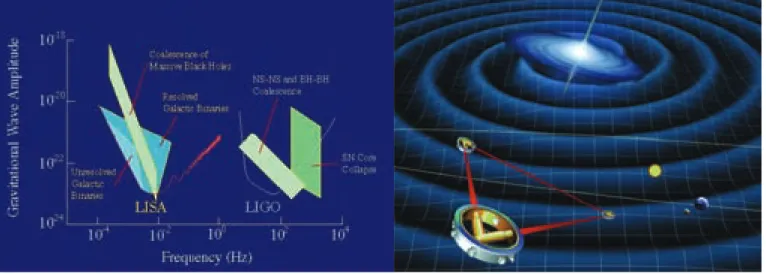
• Gravitation plays a central role in the evolution of the universe. It is well-described by general relativity, but it is unclear how general relativity acts at the quantum level (which has an immediate impact on models of the early universe), One of the – only indirectly confirmed – predictions of general relativity is the existence of gravitational waves. If such waves are observed directly – which in itself would be a major success – it not only proves the validity of the framework of general relativity, but it also represents the start of ʻGravitational Wave Astronomyʼ. Because of the extreme weakness of the gravitational interaction, such waves propagate essentially unperturbed through the entire universe. Hence, the observation of gravitational waves makes it possible to probe the universe to the earliest time scales. Experiments designed to observe (and hence discover!) gravitational waves include resonant detectors such as Explorer, Mini-Grail and Nautilus, and interferometers such as VIRGO, LIGO (see figure 4) and LISA. The sensitivity of the LISA and LIGO gravitational wave observatories is shown in the left-hand panel of figure 4.
Outlook
Many excellent research opportunities exist in the rapidly developing field of astroparticle physics research. In some of these projects Dutch institutions are already playing an important role (LOFAR, ANTARES, mini-GRAIL and the precursor mission of LISA, LISA-pathfinder). Given the discovery potential of the astroparticle physics projects, it is desirable to prepare a coherent research plan for a strong and visible Dutch involvement in this newly emerging field at the interface between physics and astronomy.
Figure 4 In the left-hand panel the estimated amplitudes of gravitational waves emitted by various astrophysical sources are plotted as a function of the frequency of the gravitational wave. This amplitude or sensitivity corresponds to twice the relative length change (ΔL/L) of a given detector (arm) due to the passing of a gravitational wave. The red (blue) curve gives the lower sensitivity limit of LISA (LIGO). In the right-hand panel the configuration of the three satellites constituting the LISA gravitational wave observatory is schematically shown. The relative distance between the three satellites is approximately 5x10⁶ km.
The International Linear Collider
There is a worldwide consensus in the particle physics community that the next major accelerator after the Large Hadron Collider (LHC), still under construction at CERN, should be a linear e+e- collider. As its baseline
option, the total energy of the colliding electrons and positrons should be 500 GeV and the luminosity (a measure of the collision rate) should be above
1034 cm-2s-1, at least a 100 times more than that reached
at the LEP2 collider at CERN, which ended operation in 2000. The energy reach should be upgradeable to about 1 TeV. In summer 2004, after a recommendation of the International Technology Review Panel, the International Committee on Future Accelerators (ICFA) took the decision that this new machine, the International Linear Collider (ILC), should be built using superconducting technology for the accelerating cavities. This technology has been successfully developed at DESY (Hamburg) and a complete Technical Design Report1 for such a
machine, was already produced in 2001.
The scientific case
Over the past thirty years experiments at particle accelerators have firmly established the Standard Model of particle interactions. It describes the fundamental particles and the physics laws that govern matter, energy, space and time. All matter particles of the theory (three families of quarks and leptons) have been discovered and the properties of the
force-carrying particles (the gluon for the strong force, the photon for the electromagnetic force and the W and Z gauge bosons for the weak force) are now well known. The unification of the electromagnetic and the weak forces (“electroweak” interaction) explains the close connection between the photon and the W and Z bosons, and has been experimentally verified to very high precision at LEP. The (large) mass of the W and Z bosons can be understood through an electroweak symmetry breaking mechanism, which is associated to the Higgs field permeating all space. Three of its four components lead to the massive W+, W- and Z bosons.
The fourth component gives rise to a new boson, the Higgs particle, which has so far escaped detection. All the properties of the Higgs boson are precisely predicted by the Standard Model, except its mass. The Higgs particle is expected to play a central role in the experimental program of the ILC. At 500 GeV collision energy a Standard Model (SM) Higgs boson of mass up to 400 GeV can be observed. This is well above the upper limit of about 200 GeV obtained from precision measurements at LEP. If a Higgs boson exists in this mass range it will for sure be discovered at the LHC (and possibly already at the Fermilab Tevatron collider). However, previous experience has shown that proton-(anti)proton colliders and e+e- colliders are
complementary. The W and Z bosons were discovered at the SppS collider of CERN in the early eighties. But precision measurements at LEP of the properties of the Z and W bosons really established the Standard
electron sources
(HEP and x-ray laser) linear
accelerator linear accelerator
x-ray laser
electron-positron collision
high energy physics experiments
positron source aux. positron an d 2nd electron source damping ring damping ring positron preaccelerator e - e + e -H.Weise 33 km
Sketch of the overall layout of the linear collider as it was orginally proposed for the TESLA project (the second interaction region with crossing angle is optional and not part of the baseline design).
Model, allowing a precise prediction of the top quark mass and to constrain the Higgs boson mass. Even if the Higgs is already discovered at the LHC, the clean experimental conditions of the e+e- collider allow
precise determination of its properties like mass, width, spin, decay branching fractions. In addition, the ILC offers the unique possibility to establish the coupling of the Higgs boson to itself.
The precision of the measurements will be vital for the full understanding of the origin of mass. If the electroweak symmetry is broken in a more complicated way than predicted by the Standard Model, high precision measurements of the top quark mass and W mass from threshold scans and of the electroweak mixing angle from a high statistics run at the Z mass, will strongly constrain the alternatives.
The Standard Model, however, fails to predict exact unification of the three forces at a scale of about 1016 GeV. To achieve that, new physics at a scale of a
few hundred GeV up to one TeV is required. New physics in a similar energy range is also needed to solve the so called hierarchy problem, i.e. finding a solution to limit the masses of the Higgs, W and Z bosons, which would otherwise rise to the Planck scale (1019 GeV) due to
quantum fluctuations.
One possibility to solve these problems is the existence of Supersymmetry (SUSY). It predicts many new
particles, a partner for each of the matter and force
particles of the Standard Model that we know today and a total of five Higgs bosons. Each fermion has a boson superpartner and vice versa. Despite extensive searches in past and present experiments, no sign of these particles has yet been observed. Although there is a large spectrum of masses for these supersymmetric particles, depending on the values of the parameters of the theory, again the ILC is complementary to the LHC in the sense that precision measurements of the masses and other properties of the particles accessible in the energy range of the ILC, will allow an accurate determination of the parameters of the theory. One very intriguing possibility is to investigate whether the lightest supersymmetric particle could be a candidate for the dark matter in the universe. This neutral particle (neutralino) can be precisely studied at the ILC.
The Linear Collider facility
The baseline machine should operate as an e+e- collider
up to a maximum energy of 500 GeV. The actual operating point will in first instance be dictated by the maximum of the Higgs production cross-section. The peak luminosity should be above 1034 cm-2s-1,
which would allow to collect an integrated luminosity of 500 fb-1 in the first four years. This would make
the ILC a true Higgs factory with about 10.000 Higgs bosons produced per year. The beam energy precision should be better than 0.1%, which is required to do precision measurements of the Higgs and top quark masses. An important parameter is the degree of
e+e- cross sections √s¬ (GeV) σ (fb) qq_ (q≠t) W+W -HZ 120 GeV tt_ χ+χ -220 GeV µ~Rµ~R 140 GeV HA 300 GeV 10-1 1 10 102 103 104 105 106 107 108 0 200 400 600 800 1000
Cross-sections for several representative processes at the ILC. Computer simulation of the decay of a Higgs particle in the TESLA detector.
polarisation of the electron beam, which is expected to be 80%. History has shown that it is very desirable to have two interaction regions for two experiments, to allow independent measurements and cross-checks of (unexpected) results. One of these interaction regions should then have a crossing angle between the incoming beams to allow for the possibility of a γγ collider. As was done at LEP2, the machine should be able to operate at 91 GeV at the peak of the Z
production cross-section, albeit with a lower luminosity, for short detector calibration runs.
The machine should be upgradeable to a total energy of 1 TeV with a foreseen integrated luminosity of 1000 ab-1
over a period of 3-4 years. Presently existing prototype superconducting cavities have reached an accelerating field of over 35 MV/m, which would correspond to a total energy of 800 GeV. Vigorous R&D is going on to improve on these performance figures.
Several other options of running are planned. One is the doubling of the integrated luminosity over two years after the initial 500 fb-1 period of four years.
Another unique possibility would be to polarise also the positron beam. An e+ polarisation degree of at
least 50% is anticipated. As already mentioned, several very important measurements could be done at the WW threshold with a luminosity of a few 1033 cm-2s-1,
allowing e.g. a W mass determination with a precision better than 10 MeV, and at the Z peak (“Giga-Z” option) with a luminosity of several 1033 cm-2s-1. With a second
interaction region with crossing beams at an angle of few tens of mrad, (polarised) γγ or eγ collisions at 80% of the maximum e+e- energy and 30-50% of the
luminosity would be possible. This option would be much helped with the operation of the ILC as an e-e
-collider, which has intrinsic physics interest on its own.
ILC detectors
The experimental conditions at the e+e- linear collider
are very clean as compared to hadron colliders, permitting a much more detailed understanding of the interactions and the possibly new physics. This however presents much larger challenges to the detectors than those at the earlier e+e- colliders LEP and SLC. E.g. the
precise understanding of the nature of the Higgs boson requires an accurate and unambiguous measurement of its decay branching fractions. This can be done by identifying the different decay particles of the Higgs boson recoiling against a pair of muons from the accompanying Z decay.
Very precise 3D pixel vertex detectors will allow the tagging of b and c quarks in these Higgs decays with high efficiency and purity. The vertex information needs to be complemented by a momentum measurement for charged particles an order of magnitude more precise than achieved before, using tracking detectors surrounding the vertex detector and by highly granular calorimeters for a precise and complete reconstruction of the jets originating from particles decaying. The
aim is to obtain a two-jet invariant mass resolution comparable to the natural widths of the W and Z bosons.
At present three detector concepts are being studied. While there is a broad agreement on the main detector requirements as sketched above, details on the design characteristics and performance are being simulated, prototypes developed and being tested. The various choices range between a large gaseous tracking detector (Time Projection Chamber) and an all-Silicon tracking detector, between a highly-granular Si-W electromagnetic calorimeter and one with scintillators as the active medium and between an analog or digital read-out solution for the hadron calorimeter. The magnetic field strength in these different detector concepts varies between 3 and 5 Tesla.
Organisation of the ILC program
The International Linear Collider Steering Committee (ILCSC) has established a framework for a truly worldwide international organisation that will develop the design of the ILC. Prof. Barry Barish has been appointed (in March 2005) as director of the Global Design Effort for the ILC. The goal is to complete a detailed Technical Design Report by 2007, and to begin the process for site proposals also by 2007, followed by a site selection and approval of international roles and responsibilities by governments in 2008. As a first step it is aimed to complete the accelerator conceptual
design report (CDR) by end 2005/early 2006, including site requirements and an initial cost and schedule plan. Following the time line for the Global Design Effort, and in close collaboration with it, it is planned to have preliminary costing, performance estimates and necessary R&D plan for the existing detector concepts ready by the time of the accelerator CDR, in 2006. More detailed CDRʼs for the experiments are then called for at the time of the accelerator TDR (2007) and Letters of Intent for experiment proposals in 2008.
All these activities for the moment take place at (major) accelerator labs and physics institutes all over the world, with regular international workshops and conferences.
Over 300 physicists and engineers gathered in Paris in April 2004 for the International Linear Collider Workshop, discussing the physics, detectors and machine options for the Linear Collider.
Internet, and networking in general, has a long history at NIKHEF. From an acoustic 110 bits per second (bps) modem 35 years ago to Gigabit networking today has been an interesting growth path. In this article we shall describe some of these developments. We shall also give an overview of current Internet related activities. Networking for NIKHEF started in 1980 with the installation at CERN of a remote batch station. A group of NIKHEF physicists working on one of the ISR experiments at CERN had the need to make use of the computing power of the NIKHEF CDC 6400 mainframe in Amsterdam. This was implemented by connecting two Modcomp II computers via the public telephone network. The Modems used were 110 bps acoustic modems. Data input went via a punch card reader, data output went to a line printer. Sending input while printing output was not a good idea: the sound of the printer interfered with the acoustic modems.
1980 was also the year when the fi rst interactive service between NIKHEF and CERN was installed. A terminal and a 1200 bps modem made it possible to dial in into the WYLBUR service on the CERN IBM mainframes. This was for some time a very popular service. It was also a considerable boost for the NIKHEF phone bill.
In 1983 the fi rst real networking equipment was installed: a Camtec X.25 PAD connected to the Norsk Data Nord-100 CE frontend computer. The network connections went via the public X.25 network of the
25 Years of Internet Activities at NIKHEF
PTT: Datanet-1. The box made the fi rst real interactive services and fi le transfers possible between NIKHEF and CERN. Connections to DESY and SLAC followed later. Network bandwidth: 2400 bps.
1985 saw the birth of the fi rst campus network: WCWLAN. A 10 Mbps ethernet using the Internet protocols TCP/IP. This brought the fi rst electronic mail services to NIKHEF since it connected to the EUnet services at the CWI. Also USEnet News was introduced. The use of these network services saw a steady growth over the next years. Also the costs grew steadily: these costs were related to the volume of the traffi c. In 1989 a point was reached where it became more cost eff ective to go away from public dial-up services and rent private lines. Combining the requirements of NIKHEF, CERN and via CWI the EUnet services enabled the acquisition of a leased line between NIKHEF and CERN. The bandwidth was 64 kbps and the delivery time of the line was 9 months. This was obviously a whole new ball game for the Dutch PTT. In this year NIKHEF went away from traditional UUCP addressing and introduced domain names: nikhef.nl was born.
The next few years the Internet in Europe really took off . Many networks popped up and were interconnected. Most of these interconnections took place in
Amsterdam since the combination of networking for particle physics (NIKHEF) and networking for computer science (CWI) made Amsterdam a natural hub for the
Internet in Europe. In 1991 NIKHEF becomes a customer of SURFnet, the academic and research network in the Netherlands. SURFnet from this date on provides all external networking for NIKHEF. This is also the year that NIKHEFʼs own private networks come to an end. Now we make a big jump in time and we will have a look at the networking situation at NIKHEF in 2004. NIKHEF networking services have seen a steady growth: today we are still connected to SURFnet, however the current bandwidth is 1 Gbps. In the near future this will be upgraded to 10 Gbps. SURFnet also provides additional dedicated bandwidth to CERN (10 Gbps) and FNAL (10 Gbps).
The role of Amsterdam and NIKHEF as an important hub in the global Internet has also evolved on a grand scale. The few network interconnections of the early days have today evolved in a set of so called Internet Exchange Points (IXP), that all have a point of presence at NIKHEF. In 2004 we play host not only to the Amsterdam Internet Exchange (AMS-IX), but also to the Netherlands Internet Exchange (NL-IX), the Xchangepoint Europe (XPE), and the Packet Exchange. Together they constitute the largest concentration of Internet Service Providers (ISP) in the world. The oldest and largest of these IXPs is the AMS-IX - a direct descendant of the early NIKHEF activities in this field. Started in 1996, AMS-IX today interconnects more then 200 Internet Service Providers from all over the world.
The underlying technology of the AMS-IX consists of a mix of high powered Ethernet switches and optical switches. At the end of 2004 this infrastructure switched over 50 Gbps of traffic at peak hours, using about 10% of the total capacity.
For comparison, it is interesting to note that these figures are comparable with the networking requirements of the LHC experiments combined. Apart from involvement with the basic infrastructure of the Internet, NIKHEF is also participant in a few key services such as naming and addressing on the Internet. The Internet works with numbers: the IP addresses. However, users prefer names as defined in the Domain Name System (DNS). So, a mapping takes place between numbers and names. This is the job of the DNS: a distributed, hierarchical database system that consists of a set of about half a million servers worldwide. At the top of this hierarchy sit the so called root servers that tie the system together. NIKHEF plays host to two of such servers: the K-root operated by the RIPE NCC in Amsterdam, and the F-root operated by the Internet Systems Consortium in California.
Next to the root servers, NIKHEF is also hosting top level domain servers for Germany, the UK and Russia.
Printed circuit boards in high energy physics: from simple carrier to
crucial component
ALICE
Printed circuit boards (PCBs) are commonly used in electronics for high energy physics. Starting from a simple interconnecting plate made from phenol paper with a single connection layer in the 1960ʼs, printed circuit boards have evolved to complex multilayer boards made from various base materials carrying many surface mounted devices (SMD) and wire bonded chips. In addition PCB designs are often constrained by environmental requirements, like thermal conductivity, vacuum compatibility and high voltage isolation.
LHCb-VELO
For the LHCb-Vertex project a detector hybrid has been designed which carries 16 Beetle chips reading out 2048 strips of a silicon detector. As the hybrid is operated in vacuum, heat generated by the Beetles has to be taken out by conduction through the PCB material. Base material for this hybrid is a polyimide (KaptonTM)
multilayer partially glued to an aluminium surface. A total of 64 high speed analog and 256 differential digital signal channels are connected by means of flexible flatcables through vacuum. To ensure vacuum compatibility provisions were made, e.g. embedded meshed copper planes.
ATLAS MDT
In the ATLAS muon drift tube test setup a two sided read-out is accomplished by combining two tubes connected via a delay line. A delay of 11 ns is needed with signals at high voltage (3000 Vdc).
This is accomplished by a PCB with planar coils and well defined parasitic capacitance. A 4-layer prototype with 22 coils is tested. The successor of this delay line is a detector end plate for 24 tubes with 12 integrated 5 ns delay lines. It consists of a stackable 6-layer PCB with some external HV parts and 144 embedded planar coils and parasitic capacitors.
LHCb Outertracker
The LHCb-outertracker consists of 50.000 small tubes containing a centre wire connected at high voltage (2000 Vdc). Large capacitors are needed to couple out the detector signals. The technological challenge is to place these relatively large capacitors close to the detector between high density signal wires. Due to small dimensions and high voltage, isolation by air is not sufficient. Therefore capacitors are embedded into the PCB. The high voltage boards with 32 capacitors each are successfully tested for low signal noise and low leakage current.
Example PCB with SMD and 2 wire bonded chips for ALICE. Prototype LHCb-VELO hybrid. Left insert: meshed copper planes. Right insert: Beetle chip.
Above: prototype ATLAS-MDT delayline with 22 embedded coils Below: detector endplate with 12 integrated delay lines
Right insert: endplate mounted on a stack of drift tubes.
Frontend high voltage board for the LHCb outertracker with embedded HV-capacitors highlighted.
The size of the experiments under construction for the Large Hadron Collider at CERN is enormous.
The ATLAS detector for example has a cylindrical shape, 45 meter long, 22 meter in diameter and weighs 7000 tons. The detector is assembled of hundreds of subdetectors. What one often not realizes is that very stringent requirements are put on the accuracy of the assembly of subdetectors as well as on the complete assembly.
One of these subdetectors is the silicon tracker. Layers of silicon detectors surround the point where the beam particles collide. These detectors determine the trajectory of the charged particles produced in the collision with an accuracy of 10-20 micron.
But only when the mechanical support structures fulfil very stringent requirements on flatness, rigidity and stability this goal can be achieved.
Production of particles by 16 GeV negative pions in the first CERN liquid hydrogen bubble chamber.
Inauguration of the ATLAS-MDT barrel organ at the occasion of the first shipment of ATLAS MDT chambers to CERN.
A highlight for the NIKHEF ATLAS programme in 2004 was the completion of the mechanical assembly of ATLAS precision muon chambers in Amsterdam. On October 5th, technicians glued the last layer of
aluminium drift tubes on the 101st and final chamber to
be assembled at NIKHEF. Ninety-six of these chambers make up the full set of the ʻBarrel Outer Largeʼ
chambers, which comprise the major part of the third and outer layer of the detectors in ATLAS that measure the direction and momentum of the muons.
During three years of chamber assembly, following many years of R&D work, 42000 ʻmonitored drift tubesʼ, 30 mm in diameter, five meter long and a wall thickness of 0.4 mm, have been produced.
A semi-automatic wiring machine equipped the tubes with a total of 200 km of tungsten sense wire, as well as 84000 end-plugs. The tubes were then subjected to a number of tests on the precision of the wire location and wire tension, leak tightness under three bar pressure, and the ability to stand high voltage on the sense wire with small dark current. Tubes passing the quality tests were glued into layers of up to 72 tubes in parallel; the full muon chambers consist of two sets of three layers of tubes, separated by a spacer.
To measure high-momentum muons accurately at the LHC, precision and control have been the key words in chamber assembly. Within the chamber dimensions of up to five by two meters, the tubes needed to be mounted with a precision of 20 microns. To achieve
ATLAS: construction in full swing
this, precision jigs were used on a granite table inside a temperature- and humidity-controlled clean room, and tube positions were constantly monitored during assembly, exploiting the NIKHEF RASNIK alignment system.
As from October, sets of five chambers are being routinely tested in a dedicated cosmic-ray test stand, into which the ATLAS muon-detector control system, the RASNIK alignment system, and the ATLAS read-out electronics are also integrated. Since December, batches of chambers are shipped to CERN, where they are mounted together with trigger chambers, the RPCʼs, in a common support. The first of these assemblies will be mounted in the ATLAS experimental area mid-June 2005.
The second large ATLAS detector construction project at NIKHEF is one end-cap of the semiconductor tracker (SCT), which consists of some 1000 modules with silicon strip sensors for charged particle detection, mounted on nine light and strong carbon-fiber disks. Hundred modules have been made at NIKHEF, and have undergone tests on mechanical accuracy and electrical performance. The other modules are being delivered from other institutes; each module is subjected to an acceptance test. The disks have been manufactured, and are now being prepared for module mounting. This involves mounting and testing of cooling pipes, optical and electrical cabling on the disks, and construction of a cold test box for the fully equipped disks.
Parts of the ATLAS detector are being assembled in the experimental area, 65 m below the surface. In the wall (just below the ʻCʼ) the hole, where the particle beam enters the hall, is visible.
One of the goals of ATLAS is to definitively prove the existence or non-existence of the last missing element of the successful Standard Model: the Higgs particle. The ultra-high collision energy of the LHC will also give the opportunity to ATLAS to search for new phenomena, such as super-symmetry, extra space-time dimensions, or other new physics. NIKHEF is preparing simulation, event reconstruction and analysis software, with emphasis on rapid commissioning of the ATLAS detector. In particular we are interested in top quark production events, which also give excellent physics opportunities with first data.
In preparation for the LHC, and to do physics at the high-energy frontier before LHC starts, NIKHEF physicists participate in the DØ experiment at the Tevatron (Fermilab, Chicago: proton-antiproton collisions at 2 TeV). In 2004 the total delivered luminosity in run 2 tripled to 450 pb-1, and first
papers on this dataset have been published. These include studies of properties of bottom quarks, quantum chromodynamics, and backgrounds to Higgs production. Furthermore, the most precise measurement of the top quark mass has been published in Nature.
Large Hadron Collider
At the European Laboratory for Particle Physics (CERN) the construction of the Large Hadron Collider is advancing well. It is expected that in 2007 first proton-proton collisions at the ultra-high energy of 14 TeV will be delivered. The construction of the ATLAS experiment, which will detect and analyse these collisions, has made good progress in 2004: the infrastructure of the experimental hall has been completed, and the installation of the spectrometer magnets has started.
Components of the ATLAS detector are under construction at various locations in the world, or have already been completed. In a dedicated test beam, a representative subset of ATLAS ingredients has been tested successfully, combining all detector elements.
Muon detectors, produced by NIKHEF, are tested before they are shipped to CERN. With cosmic muons the position resolution of each individual channel is measured. At the left, above the table, an LED-display shows the trajectory of a muon.
The ZEUS experiment is located at the electron proton collider HERA in Hamburg (Germany). HERA restarted operation in 2001, after an upgrade of the accelerator. The goal of the upgrade was to increase the luminosity of the machine. Until the beginning of 2004 operation of the accelerator proved to be far more difficult than expected and almost no data could be collected. In 2004 most of the problems were solved and colliding beams were provided on a regular scheme from January until mid August.
After a foreseen shutdown for yearly maintenance the accelerator switched from positron to electron beams colliding with protons as requested by the ZEUS experiment.
The ZEUS experiment
The ZEUS experiment is composed of subdetectors that are built in cylinder like shells around the interaction region. From the inside out the experiment starts measuring the tracks of charged particles, with a high resolution silicon strip detector. This detector was completed in 2001 and for a large part designed and built by NIKHEF. The performance of this detector is very good and reliable. The momentum of the tracks is subsequently measured with the help of a wire chamber, inside the magnetic field of 1.5 Tesla. Due to the poor background conditions given by the HERA machine, the operation voltage of this chamber had to be reduced and this led to a somewhat reduced efficiency at the
trigger level. Just outside this combined tracking system a sampling calorimeter provides the energy measurement of all particles except the muons (that traverse the calorimeter and continue their journey into the muon chambers) and neutrinos (that escape the detector without leaving any trace). Although the calorimeter has already been in operation since 1991, it still works extremely reliably.
Charmed mesons
At HERA the electron serves as fine resolution probe to look inside the proton. The center-of-mass energy of the electron-proton collisions is 320 GeV. At present the main goal of the ZEUS experiment is to explore the contribution of heavy quarks to the structure of the proton.
The production process of heavy quarks can be quite well described by the so called boson gluon fusion: A photon radiated by the electron scatters with a parton (this is either a quark or a gluon) inside the proton. In the final state a charm or bottom quark pair can be formed. Once these heavy quarks are produced they immediately hadronise: pairing up with other quarks in the fragmentation phase. For the charm quark it means that it will form a cū combination in 56% of the cases (called a D0 meson) and a D+ (cd) meson in 24% of the
cases. Each of these are unstable and will decay shortly after their production into stable decay products. These decay particles like pions and kaons are observable
ZEUS takes data in 2004
The silicon strip detector during construction. On the right a reconstructed Deep Inelastic Scattering (DIS) event in the detector, with in the center the elliptical beampipe; the crosses on the lines represent the signals in the individual silicon sensors.
charged particles. If the tracks they follow are
reconstructed accurately the decay point of the charmed meson can be deduced from their common origin. On average this decay point is only a few hundred micrometer away from the primary collision point where most other tracks come from.
In 2004 the charm production deep inelastic scattering was measured with this separated vertex reconstruction method for the first time. Although the data sample is still somewhat small, the measurement of the D+ meson
was successful and this result has been submitted to the summer conference ICHEP-04 in Beijing. A comparable method was also used to tag the decay of B-mesons into at least one muon.
First cross section measurement with polarised beams. The Standard Model predicts the cross section of charged current e+p scattering as a function of the longitudinal polarisation. With negative polarisation (P=-1) this cross section should go to zero. From the data it can be concluded that the exchange of the left handed W boson dominates the cross section. The influence of the proton structure is obtained from earlier data and fixed target data and is described in the ʻZEUS-S fitʼ for ʻstandardʼ. M(Kππ) invariant-mass distribution. The quoted number of
D-mesons, decaying into (Kππ), is a result of a Gaussian fit to the signal and a first-order polynomial for the background.