Optimization of Cylindrical Grinding Process
Parameters of OHNS Steel (AISI 0-1) Rounds
Using Design of Experiments Concept
M.Melwin Jagadeesh Sridhar1 M.Manickam2 V.Kalaiyarasan3
M.Abdul Ghani Khan4 andTtm.Kannan5
1
PG Scholar, 2 Asst.professor, 3 Asst.professor, 4 Professor. 5 Asst.Professor,
1,2,3,4
Department of mechanical Engineering, Ponnaiyah ramajayam college of engineering and Technology,Thanjavur-613 403,India.
5
Department of mechanical Engineering, PRIST UNIVERSITY, Thanjavur-613 403,India.
Abstract: OHNS steel is a widely preferred material for manufacturing of Die blocks, fasteners, automotive components and cutting tools. Metal removal rate is an important performance factor to be considered in grinding process. Research activities that include experimental work and statistical analysis help in improving quality standards of manufacturing of components. Surface quality of OHNS steel after cylindrical grinding process is proposed to be studied in this experimental work using L9 orthogonal array selected for three levels and three input parameters. The inputs parameters are considered in this Experimental study are work speed, depth of cut and number of passes and response parameter is metal removal rate (MRR) during cylindrical grinding process. Higher metal removal rate is the main objectives of this machining process. The different machining parameters of OHNS steel of cylindrical grinding process are optimized by Signal to noise ratio and analyzed by Analysis of variance (ANOVA’s).
Keywords: OHNS steel, Grinding parameters, MRR, S/N ratio, Optimization.
I-INTRODUCTION
Grinding is the most widely used abrasive finishing process among all traditional processes used in production. In grinding operation the material is removed from the work piece surface by relative motion of a cylindrical wheel having abrasive particles embedded on its periphery. The abrasive particles are bonded together to form porous body which come into contact with work piece resulting in material removal. The size and distribution of grits along and wheel abrasive structure play an important role in grinding performance. The application of grinding is mainly available for simple geometries like cylindrical or plane surface where size is limited by grinding
using Al2O3 grinding wheel, It was found that depth of cut dominate all response parameters like metal removal rate, surface roughness, heat flow and tool wear(surface integrity).Choi, T.J et al [8] conducted experiments on cylindrical plunge grinding process on various ferrous materials and produced generalized practical models, he found that surface integrity depends upon the higher speed of grinding wheels. P.Krajnik et al [9] explains design of grinding factors such as wheel speed, work speed, feed rate and depth of cut with using design of experiments orthogonal array model and predicted the surface integrity of grinding parameters. L.P.Khoo et al [10] using genetic algorithm with response surface methodology optimization technique of steel on cylindrical grinding process parameters and concludes metal removal rate depends upon feed rate.
Oil Hardening Non Shrinking Die Steel (OHNS)
OHNS steel refers to a variety of carbon and alloy steels that are particularly well-suited to be made into tools such as Blanking and stamping dies, Punches, Rotary shear blades, Thread cutting tools, Milling cutters, Reamers, Measuring tools, Gauging tools, Wood working tools, Broaches and Chisels. The specific properties of OHNS steels are hardness, resistance to abrasion, ability to hold a cutting edge, and resistance to deformation at elevated temperatures.
Table 1 Chemical composition of OHNS steel
C Mn Cr W V
0.95 1.15 0.5 0.5 0.2
Table 2 Mechanical properties of OHNS Steel
Maximum
Stress (N/mm2)
Yield stress
(N/mm2)
Elongat ion
Impact strength
(joule)
Hardness value
(BHN)
950 465 10% 25 288
Statement of Problem
The identification of cylindrical grinding problem for OHNS Steel rounds which cannot be tackled using conventional technique because of following problems occurs in cylindrical grinding process.
• High surface roughness.
• Difficult to achieve Close tolerance • Poor Chip Breaking.
• Need more cutting pressure for machining. • Need high hardness grinding wheel for machining.
II-EXPERIMENTAL SETUP
The goal of experimental work was to investigate the effect grinding parameters with the process parameters of wheel speed, Number of pass and Depth of cut influencing the metal removal rate of OHNS Die steel. The work material OHNS Die steel in the form of round with 25 mm diameter and length 70 mm. There are 9 experiments are conducted with different machining parameters for determine optimal solution of cylindrical grinding process.
Levels -Low, Medium &High
Factors - Work speed, Depth of cut & No of pass
Response Parameters - Metal removal Rate
Fig 1. Cylindrical grinding Machine
Methodology
State the problem
State the objectives of experiments
Select the factors that may influence the selected quality characteristics
Identify quality and noise factors
Select levels for the factors
Select appropriate orthogonal array
Select interactions that may influence the selected quality characteristics
Conduct the tests described by trails in orthogonal array
Analyze and interpret results of the experimental trails
Conduct confirmation experiment
Taguchi Design of Experiments
Taguchi method is a powerful tool in quality Optimization makes use of a special design of orthogonal array (OA) to examine. Number of experiments used to design the orthogonal array for 3 parameters and 3 levels of grinding parameters.
Minimum experiments = [(L-1)X p]+1
= [(3-1)X 3]+1 = 7
≈L9
Based on the Design of Experiments concept L9 Orthogonal Array (OA) is selected for cylindrical grinding parameters of OHNS steel rounds.
Table 3.Taguchi’s L 9 Orthogonal Array
Test No.
Work speed (rpm)
Depth of
cut(mm) No of pass
1 1 1 1
2 1 2 2
3 1 3 3
4 2 1 2
5 2 2 3
6 2 3 1
7 3 1 3
8 3 2 1
9 3 3 2
Table4 Cylindrical grinding parameters
Test No. work speed (rpm)
Depth of
cut(mm) No of pass
1 150 0.02 1
2 150 0.04 2
3 150 0.06 3
4 250 0.02 2
5 250 0.04 3
6 250 0.06 1
7 350 0.02 3
8 350 0.04 1
9 350 0.06 2
III-RESULT AND DISCUSSION
After conducting the experiment of cylindrical grinding on OHNS Steel cylindrical rounds the following results were obtained.
1. Number of pass is a dominating parameter of metal removal rate (MRR) of cylindrical grinding process of OHNS steel rounds.
3. It was found that the material removal rate (MRR) of OHNS steel rounds greatly depends upon the number of passes on cylindrical grinding process.
4. OHNS steel provides good machinabilty characteristics and Produce excellent surface finish. 5. The work speed, Depth of cut and Number of passes
are dependable parameters of larger metal removal rate of cylindrical grinding process on OHNS steel rounds.
6. Cylindrical grinding is an essential process for final machining of OHNS steel rounds provides smooth surface and precise tolerance.
Table 5 Cylindrical Grinding parameters of metal removal rate
Test No.
work speed (rpm)
Depth of cut(mm)
No of pass
MRR ( Gms/Sec)
1 150 0.02 1 0.061789
2 150 0.04 2 0.032556
3 150 0.06 3 0.027382
4 250 0.02 2 0.020556
5 250 0.04 3 0.0152
6 250 0.06 1 0.031579
7 350 0.02 3 0.021382
8 350 0.04 1 0.058105
9 350 0.06 2 0.052389
Table 6 Response Table for Signal to Noise Ratios (Larger is better)
Level
Work
speed Depth of cut No of pass
1 -23.31 -23.59 -20.88
2 -25.44 -24.44 -23.35
3 -23.22 -23.94 -27.73
Delta 2.22 0.85 6.85
Rank 2 3 1
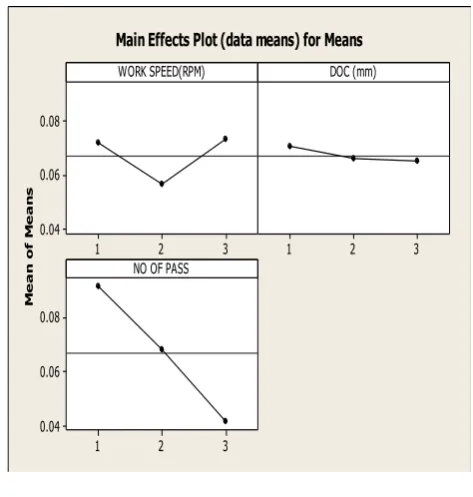
The table 6 represent the Number of pass is a influencing parameter (Rank 1)of material removal rate (MRR) of OHNS steel rounds while cylindrical grinding process calculated from signal to noise ratio.
Fig 3. Main effects plot for MRR of cylindrical grinding parameters
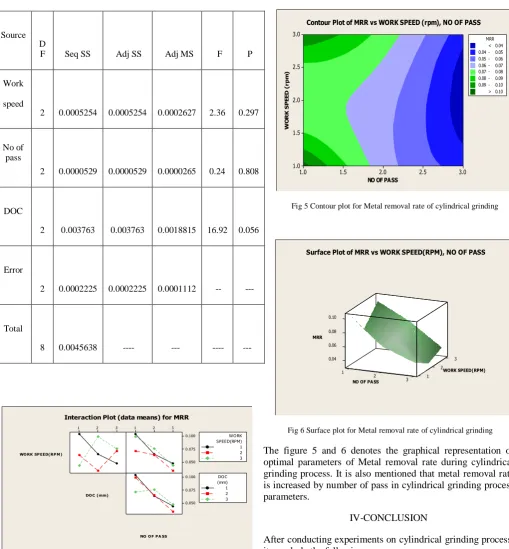
The table 7 shows ANOVA values of cylindrical grinding process and bigger value of F-test represents Number of pass is a dominating parameter while achieving larger metal rate.
The F-test
The F-test is used for comparisons of the components of the total deviation. For example, in one-way or single-factor ANOVA, statistical significance is tested for by comparing the F test statistic
M
e
a
n
o
f
M
e
a
n
s
3 2 1 0.08
0.06
0.04
3 2 1
3 2 1 0.08
0.06
0.04
WORK SPEED(RPM) DOC (mm)
NO OF PASS
Table 7 ANOVA values of Cylindrical grinding parameters
Fig 4 Interaction plot for MRR values of cylindrical grinding process
The figure 4 shows the interaction plot between all parameters such as Work speed, depth of cut and No of pass of cylindrical grinding OHNS steel rounds and also indicate the dependable parameters of achieving larger metal removal rate.
Fig 5 Contour plot for Metal removal rate of cylindrical grinding
Fig 6 Surface plot for Metal removal rate of cylindrical grinding
The figure 5 and 6 denotes the graphical representation of optimal parameters of Metal removal rate during cylindrical grinding process. It is also mentioned that metal removal rate is increased by number of pass in cylindrical grinding process parameters.
IV-CONCLUSION
After conducting experiments on cylindrical grinding process, it conclude the following
OHNS steel produces good surface finish during cylindrical grinding process with optimum grinding parameters.
Precise tolerance can be achieved on OHNS steel rounds during cylindrical grinding.
WO RK SP EED(RP M)
3 2
1 1 2 3
0.100
0.075
0.050
DO C (mm)
0.100
0.075
0.050
NO O F P A SS
WORK
3 SPEED(RPM) 1 2
DOC
3 (mm) 1 2 Interaction Plot (data means) for MRR
NO OF PASS
W
O
R
K
S
P
E
E
D
(
rp
m
)
3.0 2.5
2.0 1.5
1.0 3.0
2.5
2.0
1.5
1.0
MRR
0.05 - 0.06 0.06 - 0.07 0.07 - 0.08 0.08 - 0.09 0.09 - 0.10
<
> 0.10 0.04 0.04 - 0.05 Contour Plot of MRR vs WORK SPEED (rpm), NO OF PASS
3
MRR
0.04
2 0.06
0.08 0.10
WORK SPEED(RPM)
1
2 1
3
NO OF PASS
Surface Plot of MRR vs WORK SPEED(RPM), NO OF PASS
Source D
F Seq SS Adj SS Adj MS F P
Work
speed
2 0.0005254 0.0005254 0.0002627 2.36 0.297
No of pass
2 0.0000529 0.0000529 0.0000265 0.24 0.808
DOC
2 0.003763 0.003763 0.0018815 16.92 0.056
Error
2 0.0002225 0.0002225 0.0001112 -- ---
Total
Number of pass of grinding process play an important role for achieving larger metal removal rate in cylindrical grinding process
The optimal parameter of OHNS steel rounds in cylindrical grinding process are 150 rpm of wheel speed ,0.02 mm of depth of cut and 1 number of pass.
ACKNOWLEDGMENT
We express sincere thanks to our respected chairman Prof.P.Murugesan, Principal, Head of the Department of Mechanical Engineering of Ponnaiyah Ramajayam college of engineering and Technology, Thanjavur for given valuable suggestions and Motivate of this Effort.
REFERENCES
[1] P. Comley, I. Walton2, T. Jin, D.J. Stephenson, “A High Material
Removal Rate Grinding Process for the Production of Automotive Crankshafts”, Annals of the CIRP Vol.55/1/2006
[2] M. N. Dhavlikar, M. S. Kulkarni and V. Mariappan, Combined Taguchi and dual response method for optimization of a centerless grinding operation Journal of Materials Processing Technology, Volume 132, Issues 1- 3, 10 January 2003, Pages 90-94
[3] M.Janardhan, A.Gopala Krishna, “Determination and optimization of cylindrical grinding process parameters using taguchi method and regression analysis”, ISSN 0975-5462, volume 3, page 5659-5665.
[4] A.J.Shih, M.B.Grant, T.M.Yunushonis, T.O.Morris, S.B.McSpadden,
“Vitreous bond CBN wheel for high speed grinding of Zirconia and M2 Tool Steel”, Transactions of NAMRI/SME, Vol. 26.
[5] Jae-Seob Kwak, Application of Taguchi and response surface methodologies for geometric error in surface grinding process, International Journal of Machine Tools and Manufacture, Volume45,Issue3, March2005, Pages327-334
[6] Jae –Seob Kwak, An analysis of grinding power and surface roughness in external cylindrical grinding of hardened SCM 440 Steel using the response surface method., international journal of machine tools &manufacture 46 (2006) 304-312.
[7] N.Alagumurthi, K. Palaniraja and V.Soundararajan, cylindrical grinding – a review on surface integrity. International journal of precision engineering and manufacturing vol. no 3.
[8] Choi, T.J., Subrahmanya, N., Li, H. and Shin, Y.C., 2008, “Generalized practical models of cylindrical plunge grinding process”, International Journal of Machine Tools and Manufacture, 48:61-72.
[9] P.Krajnik, J.Kopac, A.Sluga, Design of grinding factors based on response surface methodology, journal of materials processing technology 162 (2005) 629-636.