Electronic Theses, Projects, and Dissertations Office of Graduate Studies
6-2014
The Linear Cutwidth and Cyclic Cutwidth of Complete n-Partite
The Linear Cutwidth and Cyclic Cutwidth of Complete n-Partite
Graphs
Graphs
Stephanie A. Creswell
California State University - San Bernardino
Follow this and additional works at: https://scholarworks.lib.csusb.edu/etd
Part of the Discrete Mathematics and Combinatorics Commons
Recommended Citation Recommended Citation
Creswell, Stephanie A., "The Linear Cutwidth and Cyclic Cutwidth of Complete n-Partite Graphs" (2014). Electronic Theses, Projects, and Dissertations. 34.
https://scholarworks.lib.csusb.edu/etd/34
A Thesis
Presented to the
Faculty of
California State University,
San Bernardino
In Partial Fulfillment
of the Requirements for the Degree
Master of Arts
in
Mathematics
by
Stephanie Anne Creswell
A Thesis
Presented to the
Faculty of
California State University,
San Bernardino
by
Stephanie Anne Creswell
June 2014
Approved by:
Joseph Chavez, Committee Chair Date
Rolland Trapp, Committee Member
Min-Lin Lo, Committee Member
Peter Williams, Chair, Charles Stanton
Department of Mathematics Graduate Coordinator,
Abstract
The cutwidth of different graphs is a topic that has been extensively studied.
The basis of this paper is the cutwidth of complete n-partite graphs. While looking at
the cutwidth of completen-partite graphs, we strictly consider the linear embedding and
cyclic embedding. The relationship between the linear cutwidth and the cyclic cutwidth
is discussed and used throughout multiple proofs of different cases for the cyclic cutwidth.
All the known cases for the linear and cyclic cutwidth of complete bipartite, complete
tripartite, and complete n-partite graphs are highlighted.
The main focus of this paper is to expand on the cyclic cutwidth of complete
tripartite graphs. Using the relationship of the linear cutwidth and cyclic cutwidth of
any graph, we find a lower bound and an upper bound for the cyclic cutwidth of complete
tripartite graphKr,r,pr wherer is odd and pis a natural number. Throughout this proof
there are two cases that develop, peven andpodd. Within each case we have to consider
the cuts of multiple regions to find the maximum cut of the cyclic embedding. Once all
regions within each case are considered, we discover that the upper and lower bounds
are equivalent. This discovery of the cyclic cutwidth of complete tripartite graph Kr,r,pr
wherer is odd andp is a natural number results in getting one step closer to finding the
Acknowledgements
First I want to give a generous thank you to Dr. Joseph Chavez for all of his
guidance and encouragement with the research and development of this paper. Secondly,
I’d like to thank Dr. Rolland Trapp and Dr. Min-Lin Lo for their feedback and support
throughout this process. I also would like to give a special thank you Dr. Chavez, Dr.
Trapp and Dr. McMurran for their support, encouragement, and belief in me throughout
my whole college education. In addition to their efforts in making me a better student,
they challenged me beyond the classroom exposing me to experiences I never would have
challenged myself to. It has been an honor to work with these professors and they have
inspired me to be a better educator with my own students.
I’d also like to thank my classmates Trinity, Jeff, Matt, and Joe for all of their
support and encouragement throughout each class. It has been a joy walking side by side
with all of them throughout this program. Above all I’d like to give a special thank you
to Trinity. I truly would have not made it through this program without her. She has
been by my side with every class and encouraged me through every challenge I faced.
Lastly I’d like to thank my family for always supporting me in my studies. My
parents and my in-laws have encouraged me and been so understanding with the
com-mitment to this program. Most importantly, the largest thank you goes to my husband
Table of Contents
Abstract iii
Acknowledgements iv
List of Figures vi
1 Background 1
1.1 Complete n-Partite Graphs . . . 1
1.2 Linear Embedding . . . 2
1.3 Cyclic Embedding . . . 3
1.4 Cutwidth . . . 4
1.5 Linear Cut . . . 6
1.6 Linear Cutwidth of Complete Bipartite Graphs . . . 6
1.7 Linear Cutwidth of Complete Tripartite Graphs . . . 11
1.8 Lowerbound for Cyclic Cutwidth . . . 13
1.9 Cyclic Cutwidth of Complete Bipartite Graphs . . . 14
1.10 Cyclic Cutwidth of Complete Tripartite Graphs . . . 15
2 Cyclic Cutwidth of Complete Tripartite Graph Kr,r,pr For r Odd and p a Natural Number 27 2.1 Lower Bound . . . 27
2.1.1 Case 1: p is Odd . . . 28
2.1.2 Case 2: p is Even . . . 29
2.2 Upper Bound . . . 30
2.2.1 Case 1: p is Even . . . 31
2.2.2 Case 2: p is Odd . . . 49
3 Conclusion 81
3.1 Further Exploration of The Cyclic Cutwidth of Complete Bipartite Graphs 81 3.2 Further Exploration of The Cyclic Cutwidth of Complete Tripartite Graphs 82 3.3 Further Exploration of The Cyclic Cutwidth of Completen-Partite Graphs 82
List of Figures
1.1 Complete Bipartite GraphK3,4 and Complete Tripartite Graph K2,3,4 . . 2
1.2 Linear Embedding of Complete Tripartite GraphK2,3,4 . . . 3
1.3 Cyclic Embedding of Complete Bipartite GraphK3,4 . . . 4
1.4 Cut of Each Region of GraphK3,5 Within a Linear and Cyclic Embedding 5 1.5 Cut of Each Region of GraphK3,5 Within a Linear Embedding . . . 5
1.6 Tripartite Arrangement of GraphK3,5,7 . . . 12
1.7 Cyclic Arrangement of GraphG . . . 13
1.8 Linear Arrangement of GraphG . . . 14
1.9 Vertex Arrangement forK5,5,5. . . 18
1.10 Top Black Vertex Edge Contribution toα1 of K5,5,5 . . . 19
1.11 Remaining r−1 Black Vertices Arrangement of K5,5,5 . . . 20
1.12 First Clockwise Black Vertex Edge Contribution toα1 of K5,5,5 . . . 21
1.13 Second Clockwise Black Vertex Edge Contribution toα1 ofK5,5,5 . . . 21
1.14 First Clockwise Grey Vertex Edge Contribution toα1 of K5,5,5 . . . 23
1.15 Second Clockwise Grey Vertex Edge Contribution to α1 of K5,5,5 . . . 23
1.16 First Counter-Clockwise Grey Vertex Edge Contribution to α1 ofK5,5,5 . 25 2.1 Vertex Arrangement forKr,r,pr . . . 31
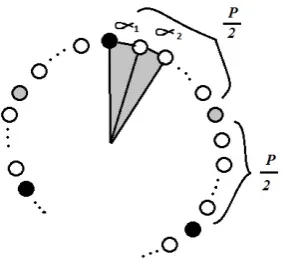
2.2 Regionsα1 and α2 . . . 32
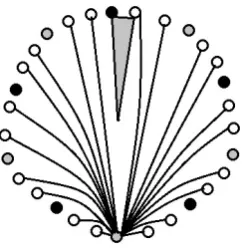
2.3 Diameters ofK5,5,20 . . . 33
2.4 Top Black Vertex Edge Contribution toα1 of K5,5,20 . . . 34
2.5 Remainingr−1 Black Vertices Arrangement of K5,5,20. . . 35
2.6 First Clockwise Black Vertex Edge Contribution toα1 of K5,5,20 . . . 35
2.7 Second Clockwise Black Vertex Edge Contribution toα1 ofK5,5,20 . . . . 36
2.8 Botttom Grey Vertex Edge Contribution toα1 ofK5,5,20 . . . 38
2.9 Grey vertex Placement ofK5,5,20 . . . 39
2.10 First Clockwise Grey Vertex Edge Contribution toα1 of K5,5,20 . . . 39
2.11 Second Clockwise Grey Vertex Edge Contribution to α1 of K5,5,20. . . 40
2.12 Regions α1 and α2 . . . 42
2.13 Regionα2 of K3,3,24 . . . 43
2.14 First Clockwise White Vertex Edge Contribution toα2 of K3,3,24 . . . 43
2.15 Second and Third Clockwise White Vertex Edge Contribution toα2ofK3,3,24 44
2.17 Diameters Contributing to The Cut of Regionα2 of K3,3,24 . . . 47
2.18 Regions α1,α2,α3, andα4 . . . 50
2.19 Top Black Vertex Edge Contribution toα1 of K3,3,21 . . . 51
2.20 Remaining r−1 Black Vertices Arrangement of K3,3,21. . . 52
2.21 First Clockwise Black Vertex Edge Contribution toα1 of K3,3,21 . . . 53
2.22 First Clockwise Grey Vertex Edge Contribution toα1 of K3,3,21 . . . 54
2.23 Regions α1,α2,α3, andα4 . . . 57
2.24 Rotation of Cyclic Embedding for α2 ofK3,3,21 . . . 57
2.25 Top Grey Vertex Edge Contribution to α2 ofK3,3,21 . . . 58
2.26 Remaining r−1 Black Vertices Arrangement of K3,3,21. . . 59
2.27 First Clockwise Grey Vertex Edge Contribution toα2 of K3,3,21 . . . 60
2.28 First Clockwise Black Vertex Edge Contribution toα2 of K3,3,21 . . . 61
2.29 Regions α1,α2,α3, andα4 . . . 63
2.30 Regionα3 of K3,3,21 Rotated . . . 64
2.31 Top White Vertex Edge Contribution to α3 ofK3,3,21. . . 65
2.32 Top Set of White Vertices Edge Contribution toα3 of K3,3,21 . . . 65
2.33 First Set of White Vertices Clockwise Top Set Edge Contribution to α3 of K3,3,21 . . . 66
2.34 Black Vertex in Set Opposite Top White Set Edge Contribution to α3 of K3,3,21 . . . 68
2.35 First Black Vertex Clockwise Top White Vertex Edge Contribution to α3 ofK3,3,21 . . . 69
2.36 First Black Vertex Counter-Clockwise Top White Vertex Edge Contribu-tion toα3 of K3,3,21 . . . 70
2.37 Regions α1,α2,α3, andα4 . . . 72
2.38 Regionα4 of K3,3,21 Rotated . . . 73
2.39 Top White Vertex Edge Contribution to α4 ofK3,3,21. . . 73
2.40 Top Set of White Vertices Edge Contribution toα3 of K3,3,21 . . . 74
2.41 First Set of White Vertices Clockwise Top Set Edge Contribution to α4 of K3,3,21 . . . 75
2.42 First Black Vertex Clockwise Top White Vertex Edge Contribution to α4 ofK3,3,21 . . . 77
Chapter 1
Background
In this chapter we will introduce complete n-partite graphs and two different
ways these graphs can be arranged. Within the linear embedding we will discuss the
linear cutwidth of complete bipartite and complete tripartite graphs. We will only
dis-cuss the proofs involving the linear embedding and linear cutwidth of complete bipartite
graphs, since the proofs for the complete tripartite graphs are similar. Within the cyclic
embedding we will discuss certain cases discovered for the cyclic cutwidth of complete
bipartite graphs and complete tripartite graphs. We will only discuss the proof of the
lower bound for the cyclic cutwidth of any complete tripartite graph and the proof of the
cyclic cutwidth for graphKr,r,r when r is odd since they relate to the proof in chapter 2.
1.1
Complete n-Partite Graphs
A graph consists of vertices and edges, where one edge connects two vertices.
Visually, vertices are represented by dots and edges are represented by lines. Although
there are many different types of graphs, the focus of this paper will be on complete
n-partite graphs, denoted Km1,m2,...,mn. A complete n-partite graph is defined to have
n different groups of vertices V1, V2, ..., Vn, where |V1|=m1,|V2|=m2, ...,|Vn|=mn, such
that no vertex within group Vk,k= 1,2, ..., n, connects to any other vertex within group
Vk, but is connected to every vertex not in groupVk. Notemk≥1 and n≥2.
Many examples and proofs within this paper will consist of complete bipartite
n = 2. A complete tripartite graph is a complete n-partite graph where n= 3. In this
paper a complete bipartite graph will be represented by Km,n and complete tripartite
graph will be represented by Kr,s,t. Below Figure 1.1 shows examples of a complete
bipartite graph K3,4 and a complete tripartite graph K2,3,4.
Figure 1.1: Complete Bipartite GraphK3,4 and Complete Tripartite GraphK2,3,4
Vertices of an n-partite graph can be arranged in many different embeddings.
This paper will focus on a linear embedding and a cyclic embedding.
1.2
Linear Embedding
A linear embedding consists of an arrangement of all the vertices in a single line.
Figure 1.2 is the linear embedding of the complete tripartite graph K2,3,4 from Figure
1.1. The vertices that were connected in the non-linear representation of the graph will
Figure 1.2: Linear Embedding of Complete Tripartite GraphK2,3,4
A region in a linear embedding is the area between two adjacent vertices denoted
(v1, v2, ..., x−(v1 +v2+...+v(n−1))) for Km1,m2,...,mn, where x represents the number
of vertices to the left of the cut and vk represents the number of vertices left of the cut
from group Vk. Note that x−(v1+v2+...+v(n−1)) is the number of vertices to the left
of the cut from group Vn. In Figure 1.2 above, the region between vertices four and five
is shaded and is denoted as (1,1,2) wherex= 4.
1.3
Cyclic Embedding
A cyclic embedding consists of an arrangement of all the vertices in a circle.
Figure 1.3 is the cyclic embedding of the complete bipartite graph K3,4 from Figure 1.1.
The vertices that were connected in the non-cyclic representation of the graph will also
Figure 1.3: Cyclic Embedding of Complete Bipartite Graph K3,4
A region in a cyclic embedding is the area of a sector from the center of the circle
to two consecutive vertices on the edge of the circle. It is important to note that the cut
of a region (discussed later) is dependent on how many edges cross through the region.
Thus, no edge can pass through the center of the circle and must take a path through
adjacent regions to connect two vertices. Above in Figure 1.3, the region between vertices
four and five is shaded.
1.4
Cutwidth
The cut of a region is the number of edges that cross through the region between
two consecutive vertices. The region with the maximum cut within an embedding is the
region with the most edges crossing through it. Figure 1.4 shows the cut of each region for
one possible arrangement of the linear embedding and cyclic embedding of the complete
bipartite graph K3,5. The maximum cut of the arrangement for the linear embedding is
Figure 1.4: Cut of Each Region of Graph K3,5 Within a Linear and Cyclic Embedding
Note that these maximum cuts may not be the smallest maximum cut for the
linear embedding and the cyclic embedding for the graph K3,5. There may be another
arrangement within these embeddings that produce a smaller maximum cut. Figure 1.5
shows a second linear arrangement of the graph K3,5 that reduces the maximum cut.
Figure 1.5: Cut of Each Region of Graph K3,5 Within a Linear Embedding
The smallest maximum cut for all arrangements within each embedding is the
cutwidth of a graph. How to find the linear cutwidth and cyclic cutwidth for complete
1.5
Linear Cut
Recall a region in a linear embedding is the area between two adjacent vertices
denoted (v1, v2, ..., x−(v1+v2+...+v(n−1))) for Km1,m2,...,mn, where x represents the
number of vertices to the left of the cut and vk represents the number of vertices left
of the cut from group Vk. The cut of a region in a linear embedding can be found by
multiplying the number of vertices from each group left of the cut vi, i = 1,2, ..., n by
the number of vertices from each group right of the cut mj−nj, j = 1,2, ..., nand j6=i.
Thus, for a bipartite graph the cut of a region for a linear embedding can be found by
using the following.
cut(v1, x−v1) = v1(n−(x−v1)) + (x−v1)(m−v1)
Similarly for a tripartite graph the cut of a region for a linear embedding can
be found by using the following.
cut(v1, v2, x−(v1+v2)) = v1[(s−v2) + (t−(x−v1−v2))]
+v2[(r−v1) + (t−(x−v1−v2))]
+(x−v1−v2))[(r−v1) + (s−v2)]
1.6
Linear Cutwidth of Complete Bipartite Graphs
Before we look at the linear cutwidth of complete bipartite graphs we will look
at an arrangement of the linear embedding that minimizes the cut of each region.
Theorem 1 ([Bow04]). Let Km,n be a complete bipartite graph with two sets of vertices
V1 and V2, where |V1|= m and |V2|= n, and let m ≤ n. Let x represent the number of
vertices to the left of a region. Then the cut of each region of a linear embedding forKm,n
is minimized by placing 2x+m−n4 vertices fromV1 to the left of the cut.
The following proof is a modified version of S. Bowles’ proof. [Bow04]
Proof. Letx be the number of vertices to the left of region, (v1, x−v1), within the linear
V1 to the left of this region. Thus, there arex−v1 vertices left of this region from setV2.
Note there are m−v1 vertices from set V1 and n−(x−v1) vertices from set V2 to the
right of this region. The cut of this region is as follows.
cut(v1, x−v1) = v1(n−(x−v1)) + (x−v1)(m−v1)
= v1n−v1x+v21+xm−v1x−v1m+v21
= 2v21+ (n−2x−m)v1+xm
Letf(v1) = 2v12+(n−2x−m)v1+xm. Notice thatf(v1) is a continuous function
of v1 ∈R, andf(v1) = cut(v1, x−v1) for 0≤v1 ≤m and v1 ∈Z. Note that the cut of
a region will vary depending on the arrangement of the linear embedding. The different
values for the cut of a region can be represented by a discrete function since we cannot
have an edge partially intersect a region. However, the function f(v1) is a continuous
representation of the possible cuts for a region and only the natural numbered solutions
can be considered. Since f(v1) is a positive quadratic function it has a minimum value.
If this minimum value is an integer, it represents the number of vertices from set V1 to
be are placed to the left of a region and will provide a minimum cut for that region. To
find this minimum value, we take the derivative off(v1) and set it equal to zero. Thus,
f0(v1) = 4v1+n−2x−m
0 = 4v1+n−2x−m
=⇒ v1 = m+24x−n
If v1 is not an integer, then f(v1) is a positive quadratic function, we get this
minimum value of f(v1) by rounding to the nearest whole number, denoted [v1]. Note
that this only happens since the graph is a positive quadratic. Thus, we are gaurenteed
the linear embedding of Km,n, it’s cut is minimized by placing
m+2x−n
4
vertices from
set V1 to the left of each region.
Now that the linear embedding of a complete bipartite graph can be arranged
such that the cut of each region is minimized, we will now look for the region of this
arrangement that contains the maximum cut.
Corollary 1 ([Bow04]). Let Km,n be a complete bipartite graph whose linear embedding
is arranged by Theorem 1. Then the maximum cut will occur when x= m+2n for m+n
even and whenx= m+2n−1 andx= m+2n+1 for m+nodd. Also, the cuts to the left of the middle cut will be strictly increasing left to right and the cuts to the right of the middle cut will be strictly decreasing left to right.
The following proof is a modified version of S. Bowles’ proof. [Bow04]
Proof. Arrange the linear embedding by Theorem 1. Recall from the proof of Theorem 1, cut(v1, x−v1) = 2v12+ (n−2x−m)v1+xm. Also recallv1 = m+24x−n, minimizes the
cut of each region for the specific linear embedding. So consider the following.
cut(v1, x−v1) = 2v12+ (n−2x−m)v1+xm
= 2v2 1−4
(m+2x−n)v1
4 +xm
= 2v12−4v21+xm
= −2v21+xm
= −2
(m+2x−n) 4
2
+xm
= −18(m+ 2x−n)2+xm
for the minimized arrangement can be represented by a discrete function since we cannot
have an edge partially intersect a region. However, the function f(x) is a continuous
representation of the the cuts for each region for the minimized arrangement, and only
the natural numbered solutions can be considered. Since f(x) is a negative quadratic
function it has a maximum value. If this maximum value is an integer, it represents
the region where the maximum cut occurs for the minimized arrangement. To find this
maximum value, we take the derivative of f(x) and set it equal to zero. Thus,
f0(x) = −41(m+ 2x−n)2 +m
= m+2n−x
0 = m+2n−x
Observe that m+2n −x > 0 when 1 < x < m+2n and f(x) is increasing. Also
m+n
2 −x <0 when
m+n
2 < x < m+n andf(x) is decreasing. Thus, form+n even, the
maximum cut occurs at x = m+2n. However, whenm+n is odd, m+2n is not an integer
but is equally spaced between m+2n−1 and m+2n+1. Thus, the maximum cut will occur at
x= m+2n−1 andx= m+2n+1.
The proof of the linear cutwidth of a complete bipartite graph follows from
Theorem 1 and Corollary 1.
Theorem 2 ([Bow04]). Let Km,n be a complete bipartite graph. Then,
lcw(Km,n) =
mn
2 mn even
mn+1
2 mnodd
The following proof is a modified version of S. Bowles’ proof. [Bow04]
Proof. Let the complete bipartite graphKm,n be arranged by the algorithm in Theorem
1. From Theorem 1 and Corollary 1 the linear cutwidth of Km,n occurs when x = m+2n
form+neven, and whenx= m+2n−1 and x= m+2n+1 form+n odd. To find the linear
Case 1: m+n even
Letm+nbe even, then the middle region of the linear embedding is atx= m+2n.
By Theorem 1 placev1 =
2x+m−n
4
vertices from setV1 to the left of the middle region.
Substituting m+2n forx, we getv1 =
m+n+m−n
4
=m
2
. Thus, v1 = m2 when m is even
and v1 = m+12 when m is odd. Since m+n is even, we know that whenm is evenn is
also even, and when m is odd n is also odd. Therefore, the number of vertices, v2, from
set V2 to the left of the middle region are as follows.
v2=
x−m
2 =
n
2 forneven x− m+1
2 =
n−1
2 fornodd
Recall from section 1.5, the cut of a region can be found by cut(v1, x−v1) = v1(n−(x−v1)) + (x−v1)(m−v1). Consider the cut when mand nare both even.
cut m2,n2
= m2 n2 +m2 n2
= mn2
Now consider the cut whenm and nare both odd.
cut m2+1,n−21
= m2+1n−21 +m−21n+12
= mn2+1
Case 2: m+n odd
Let m+n be odd, then the middle regions of the linear embedding are at
x = m+2n+1 and x = m+2n−1. Without loss of generality, let’s consider the region where
x= m+2n−1. By Theorem 1 placev1 =
2x+m−n
4
vertices from setV1to the left of the
mid-dle region. Substituting m+2n−1 for x, we get v1 =
m+n−1+m−n
4
= 2m−1 4
=m
2 − 1 4
.
Thus, v1 = m2 when m is even and v1 = m−21 when m is odd. Since m+n is odd, we
know that when mis evennis odd, and whenmis oddnis even. Therefore, the number
v2=
x−m
2 =
n−1
2 fornodd x−m−1
2 =
n
2 forn even
Consider the cut whenm is even and nis odd.
cut m2,n−21 = m2 n+12 +m2 n−21
= mn2
Now consider the cut whenm is odd andn is even.
cut m−21,n2 = m−21n2 +m+12 n2
= mn2
Therefore,
lcw(Km,n) =
mn
2 mn even
mn+1
2 mnodd
1.7
Linear Cutwidth of Complete Tripartite Graphs
To find the linear cutwidth of a complete tripartite graph, the same structure
of proofs of a complete bipartite graph was followed. As a result Theorem 1, Corollary 1,
and Theorem 2 were developed. Note that the middle region consists of an arrangement
of rvertices from each setV1,V2, andV3, wherer represents the number of vertices from
the smallest set. The outer region is the arrangement of the remaining vertices and is
Figure 1.6: Tripartite Arrangement of GraphK3,5,7
Theorem 3 ([Bow04]). LetKr,s,t be a complete tripartite graph with three sets of vertices
V1,V2, andV3, where|V1|=r,|V2|=s, and|V3|=t, and letr≤s≤t. Also letxrepresent
the number of vertices to the left of a region. To minimize each cut of the linear embedding for Kr,s,t, the middle and outer sections of the graph are minimized independently. The
middle cuts are minimized by placing 2x+2r−s−t6 vertices from A, 2x+2s−r−t6 vertices from B, 2x+2t−r−s6 vertices from C to the left of each cut. The outer sections are minimized according to Theorem 1 for complete bipartite graphs.
Corollary 2 ([Bow04]). Let Kr,s,t be a complete tripartite graph whose linear embedding
is arranged by Theorem 3. Then the maximum cut will occur when x= r+2s+t forr+s+t
even and when x= r+s+2t−1 and x= r+s+2t+1 for r+s+t odd.
Theorem 4 ([Bow04]). Let Kr,s,t be a complete tripartite graph. Then,
lcw(Kr,s,t) =
rs+rt+st
2 for two or more s,r,teven
rs+rt+st+1
2 otherwise
As a result, the linear embedding of complete bipartite and tripartite graphs
can be arranged in such a way that the cut of each region can be minimized. From this
the region with the maximum cut can be located and the cut itself can be found. These
discoveries were used to relate the linear embedding with the cyclic embedding, which in
return resulted in multiple cases for the cyclic cutwidth of complete bipartite and
1.8
Lowerbound for Cyclic Cutwidth
The following relationship has been made between linear cutwidth and cyclic
cutwidth for any graphG.
Theorem 5 ([Joh03]). For any graphG,
ccw(G)≥ lcw(G) 2
The following proof is a modified version of M. Johnson’s proof. [Joh03]
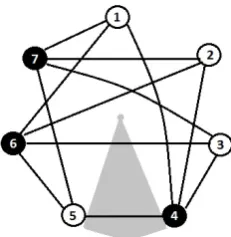
Proof. Consider the cyclic embedding of graph G. Number the vertices clockwise from a1 to an, where n represents the number of vertices in graph G. Let a1 be the vertex
immediately clockwise to the region where the cyclic cutwidth occurs. Letxrepresent the
cyclic cutwidth. Also let the cut of the region immediately counter-clockwise to vertex
ai beαi for all i= 1,2, ..., n.
Figure 1.7: Cyclic Arrangement of Graph G
Now take the cyclic embedding above and place the same arrangement of vertices
in a linear embedding such that vertex an is the most left vertex and vertex a1 is the
most right vertex. Let the region from the cyclic embedding with cut αi be the same
region within the linear embedding where the maximum cut occurs. Lety represent this
linear cutwidth. Note the cut of this region within the linear embedding will increase by
Figure 1.8: Linear Arrangement of GraphG
Recallxis the cyclic cutwidth andy=αi+lis the linear cutwidth of any graph
G. Assume x < y2. Since l < x we know αi+l≤αi+x. Also since αi < xwe can claim
αi+l≤2x. So by the hypothesis,αi+l≤y. However, this is a contradiction sinceαi+l
is strictly equal to y. Thus, x≥ y2, which implies the following.
ccw(G)≥ lcw(G)
2
Theorem 5 is used to prove multiple algorithms for finding the cyclic cutwidth
of complete bipartite and tripartite graphs. In the following sections we will only look at
some of the proofs since all of these proofs follow a similar structure.
1.9
Cyclic Cutwidth of Complete Bipartite Graphs
Unlike the linear embedding, one algorithm to find the cyclic cutwidth for any
complete bipartite graph has yet to be discovered. However, there have been multiple
dis-coveries to find the cyclic cutwidth of complete bipartite graphs with different restrictions.
Below is a list of the known discoveries.
ccw(Km,n) = mn
4 m,nboth even
mn+3
4 m=n both odd
mn+j
4 m odd, j=
n
m,j even
mn+j+2
4 modd, j=
n
m,j odd
mn+2
4 m≡2(mod 4),n odd, 2n≥m
mn+4
4 m≡0(mod 4),n odd, 2n≥m
mn+l+2
4 m even, nodd, 2n < m,l even, m−ln <2n,m−ln≡2(mod 4)
mn+l+4
4 m even, nodd, 2n < m,l even, m−ln <2n,m−ln≡0(mod 4)
mn+l+2
4 m and nodd, m < n,l odd, n−lm <2m,n−lm≡2(mod 4)
Even though many cases to find the cyclic cutwidth of complete bipartite graphs
have been proven, there are still other cases to be considered and they can be very tedious.
The different cases still to be considered will be discussed later. Thus, some territory for
the cyclic cutwidth of complete tripartite graphs has been explored. The results show
similarities to the cyclic cutwidth of complete bipartite graphs.
1.10
Cyclic Cutwidth of Complete Tripartite Graphs
A lower and upper bound for the cyclic cutwidth has been proven for any
com-plete tripartite graph. Lemma 1 has been used to find the cyclic cutwidth of comcom-plete
tripartite graphs with different restrictions shown in the following theorems.
Lemma 1 ([All06]). Let Kr,s,t be a complete tripartite graph. Then, the lower bound for
the cyclic cutwidth of Kr,s,t is,
ccw(Kr,s,t)≥ rs+rt4+st
Proof. Recall by Theorem 5, for any graphG we have the following.
ccw(G)≥ lcw(G)
2
Also recall by Theorem 4, for any complete tripartite graph the linear cutwidth
is as follows.
lcw(Kr,s,t) =
rs+rt+st
2 for two or more s,r,teven
rs+rt+st+1
2 otherwise
Since we are looking for a lower bound we will only consider rs+rt2+st. Thus, we
can claim the following is a lower bound for the cyclic cutwith for any complete tripartite
graph Kr,s,t.
ccw(Kr,s,t)≥ rs+rt4+st
Lemma 2 ([All06]). Let Kr,s,t be a complete tripartite graph. Then, the upper bound for
the cyclic cutwidth of Kr,s,t is,
ccw(Kr,s,t)≤ ccw(Kr,s) +ccw(Kr+s,t)
Theorem 7 and Theorem 8 are two different cases that have been proven for the
cyclic cutwidth of complete tripartite graphs.
Theorem 7 ([All06]). Let Kr,s,t be a complete tripartite graph such that r, s, t are all
even. Then,
ccw(Kr,s,t) = rs+rt4+st
ccw(Kr,r,r) = 3r
2+1 4
The following proof was inspired by H. Allmond’s proof. [All06]
Proof. To show the cyclic cutwidth ofKr,r,r is as stated above we need to show the lower
bound and upper bound are equivalent. Consider the following.
Lower Bound
By Lemma 1, a lower bound of the cyclic cutwidth for any complete tripartite
graph Kr,s,t is as follows.
ccw(Kr,s,t)≥ rs+rt4+st
Using Lemma 1 consider the complete tripartite graph Kr,r,r where r is odd.
The lower bound is as follows.
ccw(Kr,r,pr) ≥ rr+rr4+rr
≥ 3r2 4
However, 3r42 is not an integer. Sincer is odd, to round to the next integer let
r = 2m+ 1 where m= 1,2,3, .... Then
3r2 = 3(2m+ 1)2
= 12m2+ 12m+ 3
So 3r2+ 1 ≡ 0(mod 4), hence 4|(3r2+ 1). So to round up to the next integer we would need to add 1 to the numerator. Thus, the lower bound for the cyclic cutwidth
of Kr,r,r withr odd is,
ccw(Kr,r,pr)≥ 3r
2+1 4
Upper Bound
The following arrangement will be used to come up with an upperbound. Within
the arrangement we are going to look for a region that has the maximum cut. Let V1
consist of rblack vertices, V2 consist ofr grey vertices, andV3 consist ofr white vertices.
We will make r groups of vertices consisting of one black vertex, one grey vertex and
one white vertex. Within each cyclic embedding the vertices will be arranged clockwise
starting with a black vertex at the top followed by one white vertex, then one grey vertex.
This pattern will continue until all 3r vertices have been placed. This arrangement
minimizes the number of regions we need to consider for the maximum cut. Since each
set of black, grey, and white vertices is a repeated pattern, the cuts for each similar region
will also be repeated, so we only need to consider the different regions within one set of
black, grey, and white vertices. Thus, we only need to consider one region where the
maximum cut may lie, the region immediately clockwise to the black vertex call it α1.
The remaining regions will be similar to regionα1 and will be discussed further after the
upperbound of the cyclic cutwidth is found for region α1. Figure 1.9 is an example of
this arrangement forK5,5,5.
For graphKr,r,r,r being odd results in the total number of vertices to be odd,
thus there will be no diameters to consider. Therefore, all edges will take the shortest
route within the cyclic embedding to connect two vertices. This will ensure each cut to
be minimized so that not one or more regions are overloaded with edges. To get the cut
of region α1 we will look at the vertices whose edges contribute to the cut. We will look
at them in the following order: the top black vertex connecting to the grey and white
vertices, the remaining black vertices connecting to the grey and white vertices, and the
grey vertices connecting to the white vertices.
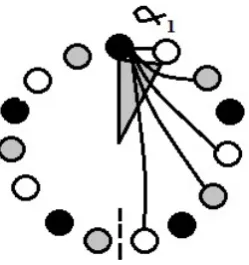
Let’s first consider the edges connecting the top black vertex to the grey and
white vertices that will contribute to the cut of region α1. Since the total number of
vertices is odd, each vertex will be directly across from a region. Thus, there would be
a combination of r white and grey vertices clockwise from the top black vertex to the
opposite region and the remaining r white and grey vertices counter-clockwise from the
top black vertex to the opposite region. The grey and white vertices counter-clockwise
from the top black vertex to the opposite region will not contribute any edges to the cut
of region α1. However, each grey and white vertex clockwise from the top black vertex
to the opposite region will contribute an edge to the cut. Thus, the top black vertex will
contribute a total of r edges to the cut of region α1. As you can see in Figure 1.10 only
the grey and white vertices clockwise from the top black vertex to the opposite region
will contribute an edge to the cut of region α1.
We now need to consider the remainingr−1 black vertices. There will be r−21 black vertices clockwise from the top black vertex to its opposite region and r−21 black
vertices counter-clockwise from the top black vertex to its opposite region. Also, there
will be a combination of r grey and white vertices clockwise from a black vertex to its
opposite region and the remaining r grey and white vertices counter-clockwise from the
same black vertex to its opposite region. Therefore, between each pair of consecutive
black vertices there will be one grey vertex and one white vertex. Thus, each black
vertex clockwise and counter-clockwise from the top black vertex to its opposite region
will have a multiple of two grey and white vertices between the top black vertex and the
black vertex being considered. As you can see in Figure 1.11 there are two black vertices
clockwise and counter-clockwise from the top black vertex to its opposite region. There
is one grey vertex and one white vertex between each black vertex.
Figure 1.11: Remaining r−1 Black Vertices Arrangement ofK5,5,5
Let’s consider the first black vertex clockwise from the top black vertex. The
grey and white vertices clockwise to this black vertex to its opposite region will not
contribute any edges to the cut of region α1. So consider the remainingr grey and white
vertices counter-clockwise. There will be two grey and white vertices between this black
vertex and the top black vertex that also will not contribute any edges to the cut of region
α1. However, the remainingr−2 grey and white vertices will each contribute an edge to
Figure 1.12: First Clockwise Black Vertex Edge Contribution to α1 ofK5,5,5
Now consider the second black vertex clockwise from the top black vertex.
Sim-ilarly the grey and white vertices clockwise to this black vertex to its opposite region will
not contribute any edges to the cut of region α1. Considering the remaining r grey and
white vertices counter-clockwise, there will be four grey and white vertices between this
black vertex and the top black vertex that will also not contribute any edges to the cut
of region α1. Therefore, the remaining r−4 grey and white vertices will each contribute
an edge to the cut of region α1.
Figure 1.13: Second Clockwise Black Vertex Edge Contribution toα1 of K5,5,5
This pattern will continue until we reach the region opposite the top black
ver-tex. Thus, the total edges contributing to the cut of regionα1 from each r−21 black vertex
[r−2] + [r−4] +...+ [r−2 r−21] =
r−1 2
P
n=1
[r−2n]
=
r−1 2
P
n=1 r−2
r−1 2
P
n=1 n
= r r−21−2
r−1 2 (
r−1 2 +1) 2
= r2−24r+1
Considering the other r−21 black vertices counter-clockwise from the top black
vertex, the same pattern will occur contributing another r2−24r+1 edges to the cut of
re-gion α1.
Now we need to consider the edges connecting the grey vertices to the white
vertices that will contribute to the cut of region α1. There will be r−21 grey vertices
clockwise from the top black vertex to its opposite region and r+12 grey vertices
counter-clockwise from the top black vertex to its opposite region. Let’s consider the grey vertices
clockwise to the top black vertex first. For each grey vertex clockwise to the top black
vertex to the region opposite it there are r−21 white vertices clockwise to the grey vertex
being considered that will not contribute an edge to the cut of region α1. However,
there are r+12 white vertices counter-clockwise to each of these grey vertices that need
to be considered. So let’s look at the first grey vertex clockwise to the top black vertex.
There is one white vertex between this grey vertex and the top black vertex that will not
contribute an edge to the cut of regionα1. However, the remaining r+12 −1 white vertices
Figure 1.14: First Clockwise Grey Vertex Edge Contribution toα1 of K5,5,5
Now consider the second grey vertex clockwise to the top grey vertex. Note
between consecutive grey vertices there is one white vertex. Also between any two grey
vertices there is a multiple of of white vertices. So considering the second grey vertex
clockwise to the top black vertex, we now have two white vertices between the top black
vertex and the second grey vertex that will not contribute any edges to the cut of region
α1. However, the remaining r+12 −2 white vertices counter-clockwise to this grey vertex
will each contribute an edge to the cut of region α1.
Figure 1.15: Second Clockwise Grey Vertex Edge Contribution to α1 of K5,5,5
This pattern will continue until the last grey vertex just before the region
op-posite the top black vertex is reached. Thus, the total edges contributing to the cut of
[r+12 −1] + [r+12 −2]+ ... +[r+12 −r−1 2 ]
=
r−1 2
P
n=1
r+1
2 −n
= 12
"r−1 2
P
n=1 r+
r−1 2 P n=1 1 # −
r−1 2
P
n=1 n
= 12r r−21+r−21−
r−1
2 ( r−1
2 +1) 2
= r28−1
Now consider the other r+12 grey vertices counter-clockwise from the top black
vertex to the region opposite of it. Note, for each grey vertex counter-clockwise to the top
black vertex to the region opposite it there are now r+12 white vertices counter-clockwise
to the grey vertex being considered that will not contribute any edges to the cut of region
α1. However, there are r−21 white vertices clockwise to each of these grey vertices that
need to be considered. So let’s look at the first grey vertex counter-clockwise to the top
black vertex. Now there are no white vertices between this grey vertex and the top black
vertex. Thus, all r−21 white vertices clockwise to this grey vertex will each contribute an
Figure 1.16: First Counter-Clockwise Grey Vertex Edge Contribution to α1 of K5,5,5
Also between consecutive grey vertices there is still one white vertex, and
be-tween any two grey vertices there is still a multiple of white vertices. So a pattern
similar to the other grey vertices occurs. Thus, the total edges contributing to the cut of
regionα1from each r+12 grey vertex clockwise from the top black vertex will be as follows.
[r−21] + [r−21 −1] + [r−21 −2]+ ... +[r−21 − r+12 −1
] = r+1 2 P n=1 r−1
2 −(n−1)
= 12
"r+1 2 P n=1 r− r+1 2 P n=1 1 # − r+1 2 P n=1 n+ r+1 2 P n=1 1
= 12
r r+12
−r+1 2 − r+1 2 ( r+1
2 +1) 2
+ r+12
= r28−1
Now that all possible edges contributing to the cut of regionα1 have been
cut(α1) = r+ 2
r2−2r+1 4
+ 2
r2−1 8
= 3r24+1
Now let’s consider the other regions within the set of one black vertex, one grey
vertex, and one white vertex that will have a similar cut to the regionα1. The cut of the
region immediately clockwise to the white vertex and the cut of the region immediately
clockwise to the grey vertex will be equal to the cut of regionα1 since all the regions are
symmetrical.
Since the cut of all regions for this cyclic arrangement have been evaluated, we
claim the upperbound for the cyclic cutwidth of Kr,r,r forr odd is,
ccw(Kr,r,r)≤ 3r
2+1 4
Also, since the upper bound and the lower bound are the same, we claim the
cyclic cutwidth of Kr,r,r forr odd is,
ccw(Kr,r,r) = 3r
2+1 4
Theorem 7 and Theorem 8 only scratch the surface of cyclic cutwidth of complete
tripartite graphs. In Chapter 2 we explore a new case for the cyclic cutwidth of complete
Chapter 2
Cyclic Cutwidth of Complete
Tripartite Graph
K
r,r,pr
For
r
Odd
and
p
a Natural Number
In this chapter we are going to explore the cyclic cutwidth of complete tripartite
graph Kr,r,pr, where r is odd and p is a natural number. In order to find the cyclic
cutwidth we will find a lower and upper bound and show that they match. When looking
at both bounds two cases develop, when p is even and whenp is odd.
Theorem 9. For a complete tripartite graph Kr,r,pr where r is odd and p a natural
number, the cyclic cutwidth is,
ccw(Kr,r,pr) =
(2p+1)r2+1
4 forp odd
(2p+1)r2+3
4 forp even
Proof. To show the cyclic cutwidth ofKr,r,pris as stated above we need to show the lower
bound and upper bound are equivalent. Consider the following.
2.1
Lower Bound
By lemma 1, a lower bound of the cyclic cutwidth for any complete tripartite
ccw(Kr,s,t)≥ rs+rt4+st
Using lemma 1 consider the complete tripartite graphKr,r,pr wherer is odd and
p a natural number. The lower bound is as follows.
ccw(Kr,r,pr) ≥ rr+r(pr4)+r(pr)
≥ (2p+1)4 r2
However, (2p+1)4 r2 is not an integer. There are two cases when rounding up to
the next integer, p being odd andp being even.
2.1.1 Case 1: p is Odd
p is odd. Letp= 2n+ 1 wheren= 1,2,3.... Then,
2p+ 1 = 2(2n+ 1) + 1
= 4n+ 3
≡ 3(mod 4)
(2p+ 1)r2 ≡ 3r2(mod 4)
≡ 3(2m+ 1)2(mod 4)
≡ 3(4m2+ 4m+ 1)(mod 4)
≡ 3(mod 4)
Thus, (2p+ 1)r2+ 1≡0(mod 4) hence 4|(2p+ 1)r2+ 1. Therefore, to round up to the next integer we would need to add one to the numerator. Thus, when p is odd a
lower bound for the cyclic cutwidth of Kr,r,pr withr odd is,
ccw(Kr,r,pr)≥ (2p+1)r
2+1 4
2.1.2 Case 2: p is Even
p is even. Letp= 2nwhere n= 1,2,3.... Then,
2p+ 1 = 2(2n) + 1
= 4n+ 1
≡ 1(mod 4)
(2p+ 1)r2 ≡ r2(mod 4)
≡ (2m+ 1)2(mod 4)
≡ 4m2+ 4m+ 1(mod 4)
≡ 1(mod 4)
Thus, (2p+ 1)r2 + 3 ≡ 0(mod 4) hence 4|(2p+ 1)r2 + 3. Therefore, to round up to the next integer we would need to add 3 to the numerator. Thus, whenp is even a
lower bound for the cyclic cutwidth of Kr,r,pr withr odd is,
ccw(Kr,r,pr)≥ (2p+1)r
2+3 4
Therefore, for a complete tripartite graphKr,r,pr whereris odd andpa natural
number, a lower bound of the cyclic cutwidth is,
ccw(Kr,r,pr)≥
(2p+1)r2+1
4 forp odd
(2p+1)r2+3
4 forp even
2.2
Upper Bound
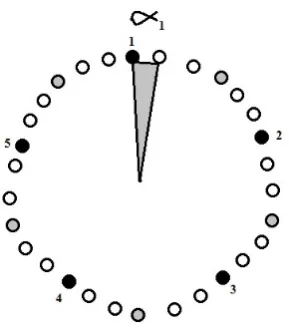
A specific arrangement will be used to come up with an upperbound. Within the
arrangement we are going to look for a region that has the maximum cut. LetV1 consist
of r black vertices, V2 consist of r grey vertices, andV3 consist of prwhite vertices. We
will maker groups of vertices consisting of one black vertex, one grey vertex andpwhite
vertices. Within each cyclic embedding the vertices will be arranged clockwise starting
with a black vertex at the top followed by p2 white vertices, then a grey vertex followed
by another p2 white vertices. If p is even then p2 is an integer andp white vertices will
be evenly distributed between consecutive black and grey vertices. If p is odd then p2 is
the black vertex and 2 white vertices immediately clockwise to the grey vertex. This
pattern will continue until all (p+ 2)rvertices have been placed. Figure 2.1 is an example
of this arrangement for K3,3,6 and K3,3,9.
Figure 2.1: Vertex Arrangement for Kr,r,pr
This arrangement minimizes the number of regions we need to consider for the
maximum cut. Since each set of black, grey and white vertices is a repeated pattern, the
cuts for each similar region will also be repeated. Thus, we only need to consider the
different regions within one set of black, grey, and white vertices.
As each region is considered for the upper bound of the cyclic cutwidth two cases
develop, whenpis even and whenpis odd. Whenpis even, we need to consider diameters
and how that will affect the maximum cut. When pis odd, there will be no diameters to
consider; however, the white vertices will no longer be grouped evenly between each black
and grey vertex. In either case the non-diameter edges will take the shortest route within
the cyclic embedding to connect two vertices. This will ensure each cut to be minimized
such that not one or more regions are overloaded with edges. So consider the following
two cases.
2.2.1 Case 1: p is Even
Letp be even. Recall when p is even the arrangement will consist of one black
vertices and then the pattern repeats. With this case we need to consider two different
regions where the maximum cut may lie, the region immediately clockwise to the black
vertex, call it α1, and the region immediately clockwise of the first white vertex, call it
α2. The remaining regions will be similar to either region α1 or region α2 and will be
discussed further after an upperbound of the cyclic cutwidth is found for region α1 and
region α2.
Figure 2.2: Regions α1 and α2
Consider region α1. To get the cut of this region we will look at the vertices
whose edges contribute to the cut. We will look at them in the following order:
diame-ters, the top black vertex connecting to the grey and white vertices, the remaining black
vertices connecting to the grey and white vertices, and the grey vertices connecting to
the white vertices.
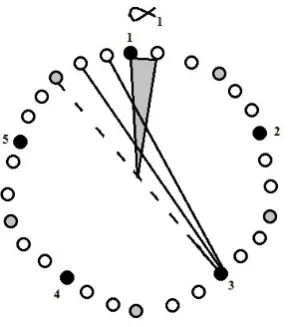
Let’s first consider the diameters. In this arrangement for every black vertex
there will be one grey vertex directly across from it within the cyclic embedding. Also
directly across from a white vertex there will always be another white vertex. Since white
vertices cannot connect to white vertices, there will only ber diameters connecting each
black vertex to the one grey vertex directly across from it. Since the diameters cannot
travel straight through the center of the cyclic embedding, we will alternate each
diame-ter clockwise then coundiame-ter-clockwise around the cendiame-ter as shown in Figure 2.3. This will
minimize the number of diameters crossing through each region. Therefore, either r−21
diameters or r+12 diameters will be contributing to the cut of each region . Since we are
Figure 2.3: Diameters ofK5,5,20
Now let’s consider the edges connecting the top black vertex to the grey and
white vertices that will contribute to the cut of region α1. Since the edge connecting
the top black vertex to the bottom grey vertex directly across from it is included in the
diameters we will consider the grey and white vertices clockwise from the top black vertex
to the bottom grey vertex and the grey and white vertices counter-clockwise from the top
black vertex to the bottom grey vertex. There will be pr2 white vertices clockwise from
the top black vertex to the bottom grey vertex and pr2 white vertices counter-clockwise
from the top black vertex to the bottom grey vertex. There will also be r−21 grey vertices
clockwise from the top black vertex to the bottom grey vertex and r−21 grey vertices
counter-clockwise from the top black vertex to the bottom grey vertex. The grey and
white vertices counter-clockwise from the top black vertex to the bottom grey vertex will
not contribute any edges to the cut of region α1. However, each grey and white vertex
clockwise from the top black vertex to the bottom grey vertex will contribute an edge
to the cut. Thus, the top black vertex will contribute a total of pr2 +r−21 edges to the
cut of region α1. As you can see in Figure 2.4 only the grey and white vertices clockwise
from the top black vertex to the bottom grey vertex will contribute an edge to the cut of
Figure 2.4: Top Black Vertex Edge Contribution toα1 of K5,5,20
We now need to consider the remainingr−1 black vertices. There will be r−21 black vertices clockwise from the top black vertex to the bottom grey vertex and r−21 black
vertices counter-clockwise from the top black vertex to the bottom grey vertex. Recall
that each black vertex will be directly across from a grey vertex and will be connected
by a diameter. Since the edges connecting a black vertex to its opposite grey vertex were
already considered with the diameters they will not be counted here. Thus, there will be
pr
2 white vertices clockwise from a black vertex to its opposite grey vertex and
pr
2 white
vertices counter-clockwise from the same black vertex to its opposite grey vertex. As well
there will be r−21 grey vertices clockwise from the same black vertex to its opposite grey
vertex and r−21 grey vertices counter-clockwise from the same black vertex to its opposite
grey vertex. Therefore, between each pair of consecutive black vertices there will be a set
ofp+ 1 grey and white vertices. Thus, each black vertex clockwise and counter-clockwise
from the top black vertex to the bottom grey vertex will have a multiple ofp+ 1 grey and
white vertices between the top black vertex and the black vertex being considered. As you
can see in Figure 2.5 there are two black vertices clockwise and counter-clockwise from
the top black vertex to the bottom grey vertex. There is a total of five grey and white
vertices between each black vertex, one grey vertex and four white vertices. Consider
the black vertex 3 in Figure 2.5. There are two sets of grey and white vertices between
the top black vertex and black vertex 3, making a total of ten grey and white vertices
Figure 2.5: Remaining r−1 Black Vertices Arrangement ofK5,5,20
Let’s consider the first black vertex clockwise from the top black vertex. The
grey and white vertices clockwise to this black vertex to the grey vertex directly across
from it will not contribute any edges to the cut of region α1. So consider the remaining
pr
2 +
r−1
2 grey and white vertices counter-clockwise. There will be p+ 1 grey and white
vertices between this black vertex and the top black vertex that also will not contribute
any edges to the cut of region α1. However, the remaining pr2 + r−21 −(p+ 1) grey and
white vertices will each contribute an edge to the cut of region α1. See Figure 2.6 for an
example.
Now consider the second black vertex clockwise from the top black vertex.
Simi-larly the grey and white vertices clockwise to this black vertex to the grey vertex directly
across from it will not contribute any edges to the cut of region α1. Considering the
remaining pr2 +r−21 grey and white vertices counter-clockwise, there will be 2(p+ 1) grey
and white vertices between this black vertex and the top black vertex that will also not
contribute any edges to the cut of regionα1. Therefore, the remaining pr2 +r−21−2(p+ 1)
grey and white vertices will each contribute an edge to the cut of region α1. See Figure
2.7 for an example.
Figure 2.7: Second Clockwise Black Vertex Edge Contribution toα1 of K5,5,20
This pattern will continue until we reach the last black vertex just before the
bottom grey vertex. Thus, the total edges contributing to the cut of region α1 from each
r−1
[pr2 +r−21 −(p+ 1)] + [pr2 + r−21−2(p+ 1)] +...+p2
= (p+1)(r−2 2)−1+ (p+1)(2r−4)−1 +...+ (p+1)(r−2(r−1))−1
=
r−1 2
P
n=1
(p+1)(r−2n)−1 2
= p+12
"r−1 2
P
n=1 r−2
r−1 2 P n=1 n # −
r−1 2
P
n=1 1 2
= p+12
r−1 2
r−2
(r−1 2 )(
r−1 2 +1) 2
−12 r−21
= (p+1)(8r−1)2 −r−41
Considering the other r−21 black vertices counter-clockwise from the top black
vertex, the same pattern will occur contributing another (p+1)(8r−1)2 − r−41 edges to the cut of regionα1.
Now we need to consider the edges connecting the grey vertices to the white
vertices that will contribute to the cut of region α1. First consider the bottom grey
vertex. The white vertices clockwise from the bottom grey vertex to the top black vertex
will contibute no edges to the cut of region α1 as shown in Figure 2.8. Similarly the
white vertices counter-clockwise from the bottom grey vertex to the top black vertex will
contribute no edges to the cut of regionα1. Thus, we only need to consider the remainig
Figure 2.8: Botttom Grey Vertex Edge Contribution toα1 of K5,5,20
There will be r−21 grey vertices clockwise from the top black vertex to the bottom
grey vertex and r−21 grey vertices counter-clockwise from the top black vertex to the
bottom grey vertex. Recall that each grey vertex will be directly across from a black
vertex. Thus, there will be pr2 white vertices clockwise to a grey vertex to its opposite
black vertex and pr2 white vertices counter-clockwise to the same grey vertex to its opposite
black vertex. Therefore, between each pair of consecutive grey vertices there will be a set
ofpwhite vertices and between each pair of consecutive grey and black vertices there will
be a set of p2 white vertices. Thus, each grey vertex clockwise and counter-clockwise from
the top black vertex to the bottom grey vertex will have a multiple of p2 white vertices
between the top black vertex and the grey vertex being considered. As you can see in
Figure 2.9 there are two grey vertices clockwise and counter-clockwise from the top black
vertex to the bottom grey vertex. Also there are two white vertices between consecutive
grey and black vertices and four white vertices between consecutive grey vertices. For
example, grey vertex 2 has three sets of two white vertices between the top black vertex
Figure 2.9: Grey vertex Placement ofK5,5,20
Let’s consider the first grey vertex clockwise from the top black vertex. The
white vertices clockwise of this grey vertex to the black vertex directly across from it will
not contribute any edges to the cut of region α1. So consider the remaining pr2 white
vertices counter-clockwise. There will be p2 white vertices between this grey vertex and
the top black vertex that also will not contribute any edges to the cut of region α1.
However, the remaining pr2 −p2 white vertices will each contribute an edge to the cut of region α1. See Figure 2.10 for an example.
Figure 2.10: First Clockwise Grey Vertex Edge Contribution toα1 of K5,5,20
white vertices clockwise to this grey vertex to the black vertex directly across from it will
not contribute any edges to the cut of region α1. So consider the remaining pr2 white
vertices counter-clockwise. There will be 3 p2
white vertices between this grey vertex
and the top black vertex that also will not contribute any edges to the cut of region α1.
However, the remaining pr2 −3 p2
white vertices will each contribute an edge to the cut
of region α1. See Figure 2.11 for an example.
Figure 2.11: Second Clockwise Grey Vertex Edge Contribution to α1 ofK5,5,20
This pattern will continue until we reach the last grey vertex just before the
bottom grey vertex. Thus, the total edges contributing to the cut of region α1 from each
r−1
[pr2 −p2] + [pr2 −32p] + [pr2 −52p] +...+ 0
= p(r−21)+ p(r−23) +...+p(r−r2 )
=
r+1 2
P
n=1
p[r−(2n−1)] 2
= p2
"r+1 2
P
n=1 r−2
r+1 2 P n=1 n+ r+1 2 P n=1 1 #
= p2
r r+12 −2
(r+1 2 )(
r+1 2 +1) 2
+ r+12
= p(r+1)(8r−1)
Considering the other r−21 grey vertices counter-clockwise from the top black
vertex the same pattern will occur contributing another p(r+1)(8r−1) edges to the cut of
region α1.
Now that all possible edges contributing to the cut of regionα1 have been
con-sidered, the total edges contributing to the cut are as follows.
cut(α1) = r(p+1)
−1
2 +
r+1 2 + 2
h(p+1)(r−1)2
8 −
r−1 4
i
+ 2hp(r+1)(8r−1)i
= (2p+1)4r2+3
Now let’s consider the other cuts within the set of one black vertex, one grey
vertex, and p white vertices that will have a similar cut to the region α1. The cut of
the region immediately counter-clockwise to the black vertex will be less than or equal
will contribute an equivalent number of edges to the cut. The edges from diameters will
contribute the same number of edges or one edge less than the region adjacent to it.
Since the number of black vertices is equivalent to the number of grey vertices and the
arrangement of the cyclic embedding is symmetrical, the region immediately clockwise
and counter-clockwise to the grey vertex will also be less than or equal to the cut of region
α1 for the same reasons.
Now that an upper bound has been found for the region α1 and the regions
similar to it, we now need to consider the remaining regions. So consider regionα2.
Figure 2.12: Regions α1 and α2
To get the cut of this region we will look at the vertices whose edges contribute
to the cut. We will look at them in the following order: the first set of white vertices
clockwise to the top black vertex connecting to the black and grey vertices, the other sets
of white vertices connecting to the black and grey vertices, the diagonals connecting each
black vertex to its opposite grey vertex, and the other black vertices connecting to the
grey vertices.
Let’s consider the first set of white vertices clockwise from the top black vertex.
There are p2 white vertices in this set. Also there is a combination of r black and grey
vertices clockwise from this set of white vertices to the set of white vertices opposite of
them and the remainingrblack and grey vertices counter-clockwise from this set of white
vertices to the set of white vertices opposite of them. As shown in Figure 2.13 there are
vertices clockwise from the top black vertex to the set of white vertices opposite of them.
Figure 2.13: Region α2 ofK3,3,24
Consider the first white vertex clockwise from the top black vertex. The
com-bination of r black and grey vertices counter-clockwise to this white vertex to the white
vertex opposite of it, will not contribute any edges to the cut of region α2. However, the
remaining r black and grey vertices clockwise to this white vertex to the white vertex
opposite it, will each contribute an edge to the cut of region α2.
Figure 2.14: First Clockwise White Vertex Edge Contribution to α2 ofK3,3,24
black and grey vertices clockwise to this white vertex to the white vertex opposite of it
will not contribute any edges to the cut of region α2. However,r black and grey vertices
counter-clockwise to the white vertex to the white vertex opposite it will each contribute
an edge to the cut of region α2. This pattern will continue for each white vertex in the
first set of white vertices clockwise to the top black vertex. Thus, this set of white vertices
will contribute a total of r p2 edges to the cut of the regionα2.
Figure 2.15: Second and Third Clockwise White Vertex Edge Contribution toα2ofK3,3,24
Now we need to consider the remaining white vertices. We are first going to
look at each set of white vertices clockwise from the first set of white vertices we just
considered and then look at the set of white vertices counter-clockwise to the same set.
For each white vertex in the first set of white vertices clockwise to the set of white vertices
of region α2, there is a combination of r black and grey vertices clockwise and
counter-clockwise to this set of white vertices. The r black and grey vertices clockwise to the
set of white vertices will contribute no edges to the cut of the region α2. So consider
the remaining r black and grey vertices counter-clockwise to the set of white vertices
being considered. There is now one grey vertex between the first and second set of white
vertices that will not contribute an edge to the cut of the region α2. Thus, there will be
r−1 edges contributing to the cut of the region α2 from each white vertex in this set,
Figure 2.16: Second Set of Clockwise White Vertex Edge Contribution to α2 ofK3,3,24
This same pattern happens for each set of white vertices clockwise from the first
set. However, for each set you move clockwise, there is an additional grey or black vertex
between the first set of white vertices and the set of white vertices being considered. For
example, for the third set of white vertices clockwise from the top black vertex there will
be two grey and black vertices between the first and third set of white vertices resulting
inr−2 edges contributing to the cut of the region ofα2. This makes a total of (r−2) p2
edges contributing to the cut of the regionα2from the third set of white vertices clockwise
from the top black vertex. So the fourth set of white vertices will contribute a total of
(r−3) p2edges to the cut of the regionα2. Continuing this pattern for each set of white
vertices clockwise to the set of white vertices containing α2 we will have the following
[p2(r−1)] + [p2(r−2)] + [2p(r−3)] +... + [p2(r−r)]
=
r
P
n=1
p
2(r−n)
= p2
r P
n=1 r−
r
P
n=1 n
= p2
h
r(r)−r(r2+1)i
= p(r24−r)
Considering the other sets of white vertices counter-clockwise from the top black
vertex the same pattern will occur contributing another p(r24−r) edges to the cut of region
α2.
Now let’s consider the diameters. Recall in this arrangement for every black
ver-tex there will be a grey verver-tex directly across from it within the cyclic embedding. Also
directly across from a white vertex there will always be another white vertex. Since white
vertices cannot connect to white vertices there will only be r diameters connecting each
black vertex to the one grey vertex directly across from it. Since the diameters cannot
travel straight through the center of the cyclic embedding we will alternate each diameter
clockwise then counter-clockwise around the center as shown in Figure 2.17. This will
minimize the number of diameters crossing through each region. Therefore, either r−21
diameters or r+12 diameters will be contributing to the cut of each region . Since we are
Figure 2.17: Diameters Contributing to The Cut of Regionα2 of K3,3,24
The last set of edges that need to be considered are the non-diameter edges
connecting black vertices to the grey vertices. So for each black vertex there are r−21
grey vertices clockwise and counter-clockwise to the black vertex being considered to
the grey vertex directly across from it. The top black vertex will contribute r−21 edges
to the cut of region α2 by connecting to each r−21 grey vertices clockwise to the top
black vertex. Now consider the black vertices clockwise from the top black vertex to the
bottom grey vertex. The edges connecting to the grey vertices clockwise from each black
vertex will not contribute any edges to the cut of regionα2. So consider the grey vertices
counterclockwise to each black vertex. The top black vertex and the black vertex being
considered will have a multiple of grey vertices between them that will not contribute an
edge to the cut of region α2. This number of grey vertices will increase by an increment
of one for each black vertex that is farther from the top black vertex. Thus, the first
black vertex clockwise from the top black vertex will contribute r−21−1 edges, the second black vertex clockwise from the top black vertex will contribute r−21 −2 edges, and the third black vertex clockwise from the top black vertex will contribute r−21−3 edges. This pattern will continue until the last black vertex clockwise from the top black vertex just
before the bottom grey vertex is reached. Thus, the black vertices clockwise from the top
[r−21 −1] + [r−21−2] + [r−21 −3] +... + [r−21 −r−1 2 ]
=
r−1 2
P
n=1
r−1 2 −n
= 12
"r−1 2
P
n=1 r−
r−1 2 P n=1 1 # −
r−1 2
P
n=1 n
= 12r r−21− r−1 2
−
r−1 2 (
r−1 2 +1) 2
= r2−48r+3
Considering the other black vertices counter-clockwise from the top black
ver-tex the same pattern will occur contributing another r2−48r+3 edges to the cut of regionα2.
Now that all possible edges contributing to the cut of regionα2 have been
con-sidered, the total edges contributing to the cut are as follows.
cut(α2) = r p2
+ 2
p(r2−r) 4
+r+12 +r−21 + 2
r2�