51.66 µg/ml, respectively. The isolated TLC fractions were detected for their purity using Knauer HPLC machine. Fraction 1 was found to be the most pure, while fraction 2 and 3 showed multiple peaks as an indication of the presence of other compounds in each fraction. The high antileishmanial activity of fraction 2 and 3 may be attributed to synergistic action of these additional compounds.
A potent antileishmanial activity was observed when
L. donovani was treated with A. maritima extracts (IC50 <5 μg/ml). Further in vivo studies are needed to
confirm the bioactivity of this plant.
The present study concludes that A. indica leaves lack anti leishmanial activity (IC50 value >1 mg/ml). In a previous study, it was reported that the methanol extract of A. indica leaves exhibited a moderate antileishmanial activity[7]. In fact, A. indica preparations are used locally in treatment of many parasitic diseases. Oil extracted from the seeds is used in both man and animals as an anthelmintic, and in scabies, abdominal ulcers, rheumatism and muscular pain[8].
The extracts of the tested plants illustrates the diversity of antiprotozoal compounds found in those plants. Some of them may act on systems present in the parasite which are absent in the host cells. These are worthy of
further study and perhaps semi synthetic modification in
order to improve their therapeutic/toxic ratios.
ACKNOWLEDGEMENTS
Authors acknowledge the help of Dr. Ibrahim M. A. Sudanese, Botanist, Department of Pharmacognosy, Faculty of Pharmacy, University of Khatoum for plant authentication.
REFERENCES
1. Desjeux P. Leishmaniasis: current situation and new perspectives. Comp Immunol Microbiol Infect Dis 2004;27:305–18.
2. Anonymous. Control of the Lesishmanaisis. Report of a WHO Expert Committee. World Health Organ Tech Rep Ser 1990;793:1‑158. 3. Khalid SA, Farouk A, Geary TG, Jensen JB. Potential antimalarial
candidates from African plants: An in vitro approach using Plasmodium falciparum. J Ethanopharmacol 1986;15:201‑9.
4. Ibrahim AM. Anthelmintic activity of some Sudanese medicinal plants. Phytother Res 1992;6:155‑7.
5. Watt JM. Leguminosae. In: Watt JM, Brandwijk MG, editors. The Medicinal and Poisonous Plants of Southern Africa. Edinburgh: E and S Livingstone Ltd.; 1962. p. 546.
6. Labadie RP, van der Nat JM, Simons JM, Kroes BH, Kosasi S, van den Berg AJ, et al. An ethnopharmacognostic approach to the search for immunomodulators of plant origin. Planta Med 1989; 55:339-48.
7. Fatima F, Khalid A, Nazar N, Abdalla M, Mohomed H, Toum AM, et al. In vitro Assesment of anti-cutaneous leishmaniasis activity of some Sudanese plants. Turk Parazitol Derg 2005;29:3‑6.
8. Fernando S. Herbal food and Medicine in Siralanka. New Delhi: Navrang Booksellers and Publishers; 1982. p. 114.
Accepted 23 March 2012 Revised 16 March 2012 Received 18 May 2011 Indian J. Pharm. Sci., 2012, 74 (2): 171‑174
Development and Evaluation of Patient Information
Leaflets (PIL) Usefulness
R. ADEPU* AND M. K. SWAMY1
Department of Pharmacy Practice, JSS College of Pharmacy, Mysore‑570 015, 1Department of Pharmacy Practice, SAC
College of Pharmacy, B.G. Nagara‑571 448, India
Adepu and Swamy: Usefulness of Patient Information Leaflets
A prospective study was conducted to develop, validate and assess the usefulness of the patient information leaflets for selected diseases among the patient population. Flesch readability ease score, Baker Able leaflet design criteria were applied to develop the patient information leaflets. The leaflets were validated for both content and translation. Eligible patients meeting the study criteria were enrolled in the study. Suitably designed knowledge, attitude and practice questionnaire was administered at base line followed by patient education complimented with an information leaflet. After a month, knowledge, attitude and practice questionnaire was administered once again to assess the influence of education and usefulness of patient information leaflets on knowledge, attitude and practice scores. The mean readability score of the information leaflets is 80 and Baker Able leaflet design criteria score is 22. Post
*Address for correspondence
In recent years, public has become increasingly conscious about their health and wish to know more about the medicines they receive from the pharmacists. Due to heavy patient load, often doctors give limited information to the patients regarding their disease and medication usage. Majority patients may not be able retain the verbal information given by the doctors for long time. Print materials may act as valuable tools in these situations to retain the medication usage related information[1]. Print materials can convey the basic information related to disease or medication and enabling the health care professional to concentrate on the diagnosis and treatment process[2].
Information regarding the disease and medications is important in patients diagnosed with chronic and complex diseases such as diabetes, hypertension, asthma, angina and peptic ulcer. Long term management of these diseases involves the self-care by the patient. Several studies have shown that patients were not able to manage their diseases, because they do not receive the information necessary to manage the disease[3]. A Study conducted by Joseph et al. has
shown that, patients wanted information leaflets and
were more concordant with their medication, when they received information leaflet from their health care professional[4]. Another study conducted by Gibbs
et al. in Southampton showed that well designed patient information leaflets improved the patients’ acceptance and the satisfaction[5].
The important elements while designing an
information leaflet to be considered are literacy and
individual’s comprehension level. In an English speaking country like United States of America (USA), many researchers have reported that most Americans of 14 years of age or older cannot read better than a seventh grade student[6].
Studies have shown that the qualities required for preparing a patient information leaflet (PIL) are, information should be authentic and unbiassed, information given in the leaflet text should be opitimum as per patients requirement, and the
language used should be so simple and easy to understand the content of the information and the sentences should not be too long, emphasis should be made on avoiding self medication, sharing of medicines, and the reader should be motivated to use medicines only with medical advise.
Good readability, layout and design are the important
factors in developing the information leaflets. Flesch
reading ease (FRE) score is commonly used to assess readability of a written text[7-9]. An internationally
accepted Baker Able leaflet design (BALD) criterion
is used for good design characteristics of an
information leaflet[10-11]. A well designed information
leaflet with good readability scores help patients to
understand the content given in the leaflets which may in turn improve their knowledge, attitude and practices towards their disease management[12-14]. For the study purpose, PIL on diseases such as diabetes mellitus, hypertension, asthma, peptic ulcer, and angina were developed referring to standard text books and compendia. The readability of the
prepared leaflets was calculated using FRE formula. FRE =206.84–0.85W–1.02S. Where W = Number of
syllables per 100 words, S = Number of words in an average sentence.
The reading ease scores on FRE scale are 0-100. If the score of a written text is less than 60, the document is considered to be difficult to read by the general public. The ideal PIL should have a readability score of more than 80.
Layout and design of the information leaflets were assessed by BALD criteria. Length of the line, space between the lines, letter type, font size, indenting, pictograms, box type text, use of colors, paper quality
are the features used to assess the leaflet layout and
design characteristics in BALD criteria.
Content in the designed information leaflets was validated by a team of clinical pharmacists and physicians at JSS Hospital. The content in the
information leaflets was translated in to Kannada, the
local language with the help of a language expert at Central Institute of Indian Languages (CIIL), Mysore.
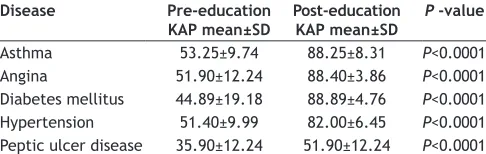
education knowledge, attitude and practice scores were significantly (P<0.0001) improved in all the enrolled patients in all disease. The study concludes that patient education complemented with suitably designed information leaflet has greater impact on knowledge, attitude and practice of the patients towards their disease management.
Patients visiting to the JSS Hospital outpatient pharmacy with the selected diseases were informed about the study and those who met the study criteria and willing to give the written informed consent were enrolled in to the study. Demographic details of the enrolled patients were documented in a suitably
designed patient profile form. At base line, patient’s
knowledge, attitude and practices were assessed using knowledge, attitude and practice (KAP) questionnaire. Structured patient education was provided to all the
patients complemented with the information leaflets in
Kannada for the selected diseases. After one month, KAP questionnaire was administered once again on all the enrolled patients. The study was approved by the Institutional Research and Ethical Committee.
Unpaired Student “t” test was applied (P<0.001 is considered as significant) to assess the impact of patient education and usefulness of patient information
leaflets on KAP using Instat 3 statistical software. PIL for five chronic disorders such as hypertension,
diabetes mellitus, asthma, peptic ulcer disease and angina were developed. The mean readability score of the PILs was found 80 on FRE scale. BALD criteria were used to evaluate the layout and design characteristics of the PIL. The mean BALD score
of the PIL is 22. The readability scores and design
scores of the patient information leaflets are presented
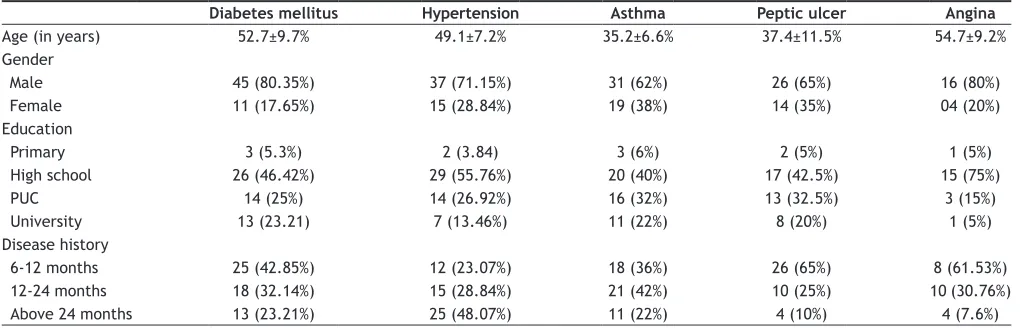
in Table 1. Mean age of the patients enrolled in diabetes was 52 y, in hypertension 49 y, in asthma 35 y and in angina 54 y. Majority subjects enrolled in to the study are males (155) compared to females (63). All the patients enrolled are educated. Among them more than 20% of the patients are having high school education and 14% of the patients are possessing university degree. The demographic details of the patients enrolled in to the study covering all the diseases are presented in Table 2. The mean pre education KAP scores and post education KAP scores of the patients were analyzed using the unpaired student t test. A significant improvement in post education KAP scores was observed in the study population. The results are presented in Table 3.
Patient counseling is defined as providing information
regarding the disease, medications, diet and life style change to patients or patient’s representatives in lay man language[15]. Structured patient education
supported with patient information leaflets will have
a greater improvement in patient’s understanding about the disease management[1-5]. A good patient
information leaflet should have desirable readability
characteristics for easy comprehension and understanding the content[16].
In order to assess the readability of designed patient
information leaflets, about 40 formulas were recognized
worldwide. Most of them are derived statistically and considers language variables such as word complexity and sentence length to calculate the readability[9]. A readability formula is a simple method to predict the reading grade level required to comprehend the written materials and documents[17]. More commonly,
TABLE 1: READABILITY, LAYOUT AND DESIGN CHARACTERISTICS OF THE PILS OF THE SELECTED DISEASES
Disease Flesch reading
ease (FRE) score Mean BALD scores
Hypertension 82 23
Peptic ulcer 81 23
Diabetes mellitus 84 22
Angina 74 21
Asthma 79 21
FRE = Flesch Reading Ease (FRE) Score, BALD = Baker Able leaflet design criteria
TABLE 2: DEMOGRAPHIC DETAILS OF THE PATIENTS ENROLLED IN TO THE STUDY
Diabetes mellitus Hypertension Asthma Peptic ulcer Angina
Age(in years) 52.7±9.7% 49.1±7.2% 35.2±6.6% 37.4±11.5% 54.7±9.2%
Gender
Male 45 (80.35%) 37 (71.15%) 31 (62%) 26 (65%) 16 (80%)
Female 11 (17.65%) 15 (28.84%) 19 (38%) 14 (35%) 04 (20%)
Education
Primary 3 (5.3%) 2 (3.84) 3 (6%) 2 (5%) 1 (5%)
High school 26 (46.42%) 29 (55.76%) 20 (40%) 17 (42.5%) 15 (75%)
PUC 14 (25%) 14 (26.92%) 16 (32%) 13 (32.5%) 3 (15%)
University 13 (23.21) 7 (13.46%) 11 (22%) 8 (20%) 1 (5%)
Disease history
6‑12 months 25 (42.85%) 12 (23.07%) 18 (36%) 26 (65%) 8 (61.53%)
12‑24 months 18 (32.14%) 15 (28.84%) 21 (42%) 10 (25%) 10 (30.76%)
FRE, Flesch KinKaid Grade Level (FKGL) and SMOG formulas are used to assess the readability. FRE and FKGL formulas are available in Microsoft word. To calculate FRE, FKGL using the computer, the text of the PIL should be typed in word document, and then using the tool bar click on readability, the calculated readability scores of the document appear on the screen. Any leaflet scores more than 70 out of 100 score is considered as fairly easy to read. In the present study, mean readability scores of the PILs were found as 80. These scores suggest that, the readability of the
information leaflet is very easy. More the readability
easiness more will be the acceptance of the PIL by the client. Readability easiness in PIL can be increased by using simple English words[18].
A leaflet with good design characteristics such as font size, use of pictograms, sentence length etc will improve the acceptability of the PILs[19]. BALD criteria were applied to assess the design characteristics. As per the BALD criteria, a leaflet scoring between 20 and 25 (The total score is 32) is considered as having good layout and design characteristics. PILs developed in the present study scored more than 20 and met the Bald Criteria. In an Australian based study, 30 customer product information leaflets produced by manufacturers were subjected for readability and lay out design characteristics. The results suggest that, mean FRE score was 51 and mean BALD criteria score was 17, suggesting poor readability and design characteristics. The same study suggests that a leaflet with good readability scores and design characters like, space between sentence, font sizes, pictograms, and paper quality has an impact on patient’s comprehension and acceptability[11].
In India, the literacy rate is less than 50% and the level of English understanding may be 4th grade level. Thus due care was taken in designing the
information leaflets with good readability and design
characteristics. In the present study incorporation of pictograms in PILs helped the respondents recalling capacity (such as causes of the diseases symptoms diet
and lifestyle modification). The same was reflected in
answering KAP questions in various diseases.
Patients enrolled in the study were with mixed educational backgrounds and with various lengths of disease duration. Many patients were from school and pre university educational levels. Most of the patients were from agriculture and business category. A significant improvement in KAP scores was observed in all categories of the patients after the patients were counseled and complimented with patient information leaflets. In most of the studies, it was found that the structured verbal advice along
with patient information leaflet has a significant effect
on patient awareness, knowledge about disease and medicines.
Hill and Bird developed and evaluated drug information for patients with rheumatoid arthritis. The results of the study indicates that a significant improvement (P<0.001) was observed in knowledge of patients regarding the drug (D-penicillamine), at the study exit compared to study entry, suggesting the influence on information leaflets in knowledge levels[19]. Livingstone et al. in their study conducted in community pharmacy observed that patients when counseled with PILs, 65% of patients could able to recall the information about their drugs compared to 30% of patients before the education and PIL about their drugs[20]. Gibb’s et al. have demonstrated that verbal advice complimented with a PIL greatly enhanced the knowledge level of 67% patients in recognising the uses and side effects of medications after the education compared to 40% of patients at the entry level[5].
Leiia and Ros studied the effect of pictograms in leaflets in recalling the information. Results of the present study have shown that the pictograms improved the comprehension of more complex information[21]. The findings of the above studies
supports the findings of the present study showing an influence of leaflets complimented with education in
improving awareness about their disease, signs and
symptoms and other life style modifications.
The information leaflets in the present study met the minimum readability and design criteria scores
TABLE 3: PRE AND POST EDUCATION KAP SCORES OF THE ENROLLED PATIENTS
Disease Pre‑education
KAP mean±SD Post‑education KAP mean±SD P ‑value
Asthma 53.25±9.74 88.25±8.31 P<0.0001 Angina 51.90±12.24 88.40±3.86 P<0.0001 Diabetes mellitus 44.89±19.18 88.89±4.76 P<0.0001 Hypertension 51.40±9.99 82.00±6.45 P<0.0001 Peptic ulcer disease 35.90±12.24 51.90±12.24 P<0.0001
KAP = Knowledge, attitude and practices. SD = Standard deviation, P<0.0001is
meeting the patients’ education and comprehension. It was also observed that pharmacist provided patient
education with information leaflets has a significant
(P<0.0001) impact on KAP of the patients from diabetes mellitus, hypertension, asthma, peptic ulcer and angina towards their disease management showing
the usefulness of patient information leaflet.
ACKNOWLEDGEMENTS
Authors thank JSS University, Head, Department of Pharmacy Practice, and Principal JSS College of Pharmacy for the academic support and Dr. Lingadevaru Mulemane, Central Institute of Indian Languages, Mysore for translation support.
REFERENCES
1. Wilson M, Robinson EJ, Blenkinsopp A, Panton R. Customer recall of information given in community pharmacy. Int J Pharm Pract 1992;1:152‑9.
2. Hulka B, Cassel JC, Kupper LL, Burdette JA. Communication, compliance and concordance between physicians and patients with prescribed medications. Am J Public Health 1976;66:847‑53.
3. Louis A, Halparin JA. Effects of written drug information on patient knowledge and compliance: A literature review. Am J Public Health 1979;69:47‑52.
4. Nathan JP, Zerilli T, Cicero LA, Rosenberg JM. Patient’s use and perception of medication information leaflets. Ann Pharmacother 2007;41:777‑82.
5. Gibbs, S. Waters WE. George CF. Prescription Information leaflets, a national survey. J R Soc Med 1990;83:292‑7.
6. Louise M, William J. Spruill. Readability Evaluation of Nine Patient Drug Education Sources. Am Pharm 1988;NS28:33‑6.
7. Judy RM, Patrick AC, Heather RY. RAIN, SMOG, FOG and printed educational Material. J Pharm Pract Res 2003;33:284‑5.
8. Adepu R, Nagavi BG. Patient information leaflets design and Readability. Pharma Rev 2003;2:135‑43.
9. Spadaro DC, Robinson LA, Smith LT. Assessing readability of patient information materials. Am J Hosp Pharm 1980;37:215‑21.
10. Basara LR, Juergens JP. Patient Package inserts Readability and Design. Am Pharm 1994;34:48‑53.
11. Baker S. Who can read Consumer Product Information? Aust J Hosp Pharm 1997;27:126‑31.
12. Gibbs S, Waters WE, George CF. Benefits of prescription information leaflets. Part 1. Br J Clin Pharmacol 1989;27:723‑39.
13. Winfield AJ, Owen CW. Information leaflets means of improving patient’s compliance. Br J Pharm Pract 1990;206:208‑9.
14. Gibbs S, Waters WE, George CF. Benefits of prescription information leaflets. Part 2. Br J Clin Pharmacol 1989;28:345‑51.
15. ASHP guidelines on pharmacist-conducted patient education and counseling. Am J Health‑Sys Pharm 1997;54:431‑4.
16. Mary A, Kirkpatrick F, Cherri P, Mahler BS. Using the Readability Assessment Instrument to evaluate Patient Medication Leaflets. Drug Inform J 1999;33:557‑63.
17. Morris LA. Application of the readability concept to patient oriented drug information Am J Hosp Pharm 1980;37:1504‑9.
18. David RF, Denise HR. Readability of Printed Information for Epileptic Patients. Ann Pharmacother 2002;36:1856‑61.
19. Hill J, Bird H. The development and evaluation of a drug information leaflet for patients with rheumatoid arthritis. Rheumatology 2003;42:66‑70.
20. Carina RL, Anthony LG, Sandra W. Developing community pharmacy services wanted by local people. Information about advice about prescription medicines. Int J Pharm Pract 1996;4:94‑102.
21. Leiia EM, Ros D. Effect of pictograms on Readability of Patient Information Materials.Ann Pharmacother 2003;7:1003‑9.
Accepted April 05, 2012 Revised March 19, 2012 Received April 09, 2010 Indian J. Pharm. Sci., 2012, 74 (2): 174‑178
Detection of Carbonaceous Material in Naga Bhasma
S. K. SINGH AND S. B. RAI*
Laser and Spectroscopy Laboratory, Department of Physics, Banaras Hindu University, Varanasi‑221 005, India
Singh and Rai: Carbonaceous Material in Bhasma
Traditional medicines have maintained their popularity in all regions of the developing world and are being adopted increasingly by people worldwide. Indian traditional system of medicine Ayurveda make use of unique metallic‑herbal preparations (called Bhasma) which involves different processing steps including repeated steps of calcination of metal in the presence of natural precursor (herbal juices, decoctions, and powders, etc). It has been recently established that Bhasma contains nano/sub‑micron size particles and different nutrient elements. However, the role and the end product of the raw materials, especially the herbal parts, used during the synthesis of the drug (Bhasma) is one of the important but unanswered problems in such medicinal preparations. Present work on Naga Bhasma is an attempt to understand the role of natural precursors in detail. Our results on infrared, Raman and X‑ray photoelectron spectroscopy along with thermal measurements identify the presence of carbonaceous
*Address for correspondence