324 | P a g e
ABNORMAL EVENT DETECTION IN VIDEO STREAMS
USING HOFO
M. Manjula
1, K.Malarvizhi
2, K. Thirupathi Latcham
31,2
PG Scholar,
3Associate Professor, Raja College of Engineering and Technology,
Madurai, Tamilnadu, (India)
.
ABSTRACT
The aim of this paper is to detect abnormal eventsin video streams, a challenging but important subject in videosurveillance.Recentlyincreasing concern over security problem of everywhere people assembling. The video surveillance a smart way of providing security in the place such as public areas, airports, railway stations, parking lots, and industrial plants are monitored by operators. A novel abnormal event classifier algorithm proposed for video surveillance. The algorithm is based on an image descriptor and a nonlinear classification method. Here, a histogram of optical flow orientation is used as a descriptor to encoding the moving information of each video frame. The nonlinear one-class support vector machine classifier is trained with features extracted from video, sequences of frames to classify abnormal events from normal one. The features provided in training and testing of classifier is histogram optical flow descriptor that describes objects in video frame movements efficiently
.
Keywords: Abnormal Detection, Optical Flow, HOFO, One-Class SVM.
I.INTRODUCTION
Discovery of suspicious or anomalous events from videostreams is an interesting yet challenging problem for many
video surveillance applications. By automatically finding suspicious events, it significantly reduces the cost to label
and annotate the video streams of hundreds of thousands of hours. In many scenarios, the video camera is fixed and
the site being monitored is mainly static. Abnormal event detection is a challenging problem in that it is difficult to
define anomaly in an explicit manner. It is possible that we may need to identify an abnormal event when it appears,
despite the fact that it had never occurred before. The more practical approach is to detect normal events first (as
they follow some regular rules) and treat the rest as abnormal events. For abnormal event detection tasks in video,
the descriptor used to encoding the movement information of the global frame. Moreover, the one-class support
vector machine (SVM), used to distinguish the abnormal event from the reference model. The proposed descriptor,
histogram of optical flow orientation (HOFO), is described to provide feature vectors for classification algorithm.
The classifier is trained with features extracted from video, sequences of frames to classify abnormal events from
normal one. The features provided in training and testing of classifier is histogram optical flow descriptor that
325 | P a g e
II. RELATED WORK
In abnormal detection approaches the behaviour patterns modelled by using optical flow In [12], eachframe was split
into small blocks. Motion was detected by optical flow and represented by a semantic word. A histogram of optical
flow was used to identify human beings, the derivatives of optical flow, duand dv, were considered. The two components, u and vof optical flow vector, are used to compute an angle of each pixel at a fixed resolution. The histogram of optical flow orientation (HOFO) descriptor applies a Gaussian down weightingcentred on the current
block, and then makes votes weighted by the magnitude of the optical flow vector into orientation histograms. Each
pixel voted into the orientation bins is multiplied by a weight coefficient. In this paper, abnormal events are detected
by nonlinear one-class SVM classification methods. In general, a non-linear one-class SVM algorithm shows high
performance results based on learning normal behaviour frames. The research in the machine learning field focusing
on improving the effectiveness of pattern classification can be adapted to obtain more accurate abnormal detection
results.
III.PROPOSED SYSTEM
In this section, a method for detecting abnormal events in video streams is described. The normal events are people
walking in park and abnormal events are vehicles entered into the place. Assume that a set of frames [I1....In] in
which the persons are walking toward all the directions, are considered as normal events. The frames in which the
vehicles are moving toward the same direction are considered as abnormal events. The definition represents that
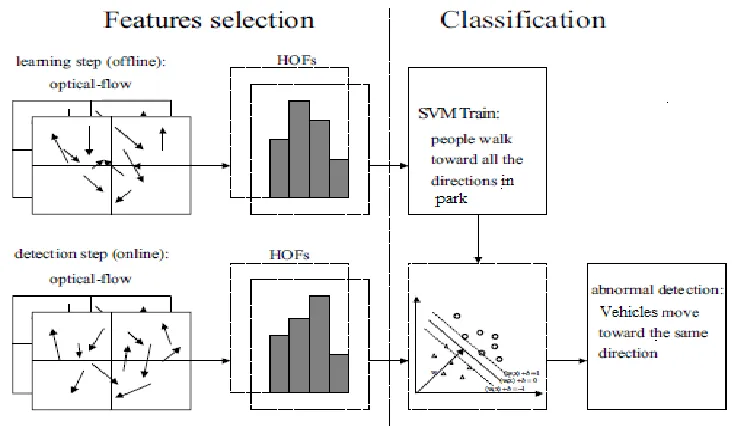
people are attracted by the particular event or escape from the dangerous zone. The general architecture of the
abnormal detection method is presented in Fig. The original incoming frames are processed via Horn-Schunck (HS)
optical flow method to get the moving features at every pixel.
326 | P a g e
The optical flow features are computedat grey scale.Calculate the histograms of the orientation of optical flow
(HOFs) on individual frames. One-class SVM is used to classify feature samples of incoming video frames. The
abnormal events can be considered as false alarms if they just appear few frames intermittently in the long normal
sequence, which can be adjusted to ’normal’. Similarly, it also works on short clips of normal events which are
found in long abnormal sequence. The results are post-processed by presenting a threshold % on the number of
detected frames. If negative predicted results (abnormal states) continue beyondthe threshold in positive results
(normal states) stream, then change the state from ’normal’ to ’abnormal’.
IV.FEATURES SELECTION
Optical flow is the distribution of apparent velocities ofmovement of brightness patterns in an image. It can give
important information about the spatial arrangement of the objects and the change rate of this arrangement.
Abnormal action can be exhibited by the direction and the amplitude of the movement, optical flow is chosen for
scene description. B.Horn and B. Schunck proposed the algorithm introducing a global constraint of smoothness to
computer optical flow. The basic Horn-Schunck (HS) optical method is used in our work. The HS method combines
a data term that assumes constancy of some image property with a spatial term that models how the flow is expected
to vary across the image
The HOFO descriptor iscalculated at each block, and then accumulated into one global vector denoted as feature Fk
for the kth frame. The computation of HOFO, it is a feature vector in nblocks ×nbinsdimension. Horizontal and vertical optical flow (u and v fields). The decision hyperplane of the one-class SVM divides the data in the feature space. Aredistributedinto 9 orientation bins, over a horizon 0◦-360◦. The HOFO is computed with an overlapping
proportion set as 50% of two contiguous blocks. A block contains bh×bw cells of ch×cw pixels, where bh and bw are the number of cells in y and x direction in Cartesian coordinates respectively, ch is the height of the cell, and cw is the width of the cell. Analysing jointly local HOFO blocks permits us to consider the behavior in the global frame.
Put another way, concatenation of HOFO cells allows us to model the interaction between the motionsof the local
blocks.
V.CLASSIFICATION
Support Vector Machine (SVM) is a method based onstatistical learning theory and risk minimization for
classification and regression. The one-class SVM framework is then suitable to the specificity of the abnormal event
detection where only normal scene data are available. In machine learning, support vector machine (SVM) is a
method of statistical learning theory that analyses data and recognizes patterns, used for classification and regression
analysis. By adopting a kernel trick, which implicitly maps inputs into high-dimensional feature space, SVM can
effectively perform non-linear classification problems. The objective of non-linear one-class SVM is to determine a
327 | P a g e
maximizes its distance from the origin, while only a small fraction of data falls between the hyperplane and the
origin.
V. RESULT AND DISCUSSSION
This section presents the results of experiments conducted to analyze the performance of the proposed method.
UMN and PETS2009 datasets are adopted in our abnormal frame events detection experiments. Taking an HOFO
of foreground imageand originalimageas a feature descriptor has similar abnormal detection results, we only show
the results based on the original imageHOFO of the PETS2009 dataset.
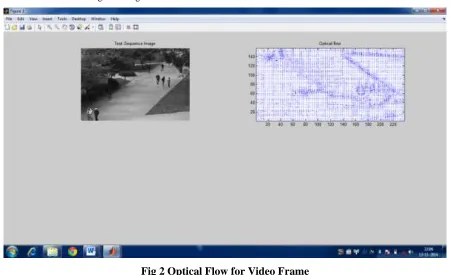
Fig 2 Optical Flow for Video Frame
The training samples and the normal testing samplesare extracted from theindividuals are walking in different
directions. The abnormaltesting samples are the frames where the vehicles are movingin same direction. The
accuracy of abnormal detectionresults before state transition post-processing is 90.00%. Fig 1 shows the optical flow for the given dataset.The HOFs descriptor can also deal with the abnormal scenesin which vehicles are moving
toward the same directions. HOFs descriptor can represent not only the information of direction of optical flow, but
also the magnitude of the optical flow. The normal scenes are in which the people walking toward all the directions,
these frames are chosen as training samples and normal testing samples. The abnormal scenes are in which vehicles
moving in the same direction, these frames are the abnormal testing frames. The detected results which are adjusted
by the state transition restriction are shown in Fig. 11,the false negative predictions are at the first few frames of the
328 | P a g e
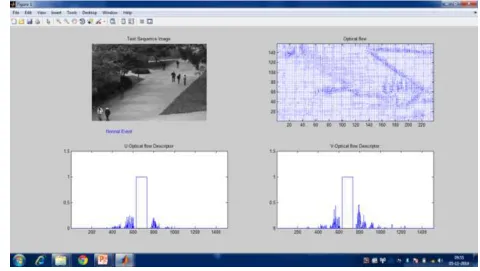
Fig 3 Histogram of Optical Flow Orientation
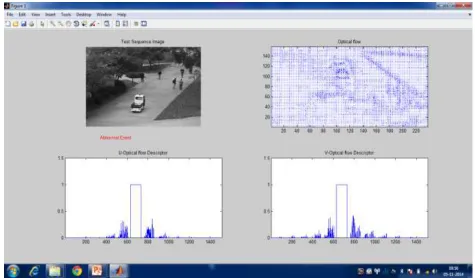
Figure 3 shows the histogram of optical flow orientation for given training and testing datasets. Normal
events in the training dataset is shown in figure 4 and also abnormal event in testing dataset is shown in
figure 5
329 | P a g e
Fig 5 Abnormal Events Detected from testing Dataset
VII. CONCLUSION AND FUTUREWORK
A method for abnormal detection is proposed. The methodis based on two components, compute histograms of the
orientation of optical flow (HOFs), and applying one-class SVM for classification. The HOFs features are for the
monolithic frame. The resulting algorithm has been tested on several sequences and we have shown that the method
is able to classify unexpected events, such as whether the object which moves toward the same direction or merely
the velocity is changed. Future work will aim at reducing the wrong detections, and training the samples online. And
also multiclass SVM classifier used for abnormal event classification method. Several solutions are under
consideration: to capture more efficient features based on the optical flow, to replace the optical flow by other
approaches which can also represent the information of the events. To train the SVM by an online approach is also
urgent. For the normal examples is commonly in large amount, is hard to put all the normal events as training
samples simultaneously.
REFERENCES
[1] O. P. Popoola and K. Wang, ―Video-based abnormal human behaviorrecognition—A review,‖ IEEE Trans. Syst., Man, Cybern. C, Appl. Rev.,vol. 42, no. 6, pp. 865–878, Nov. 2012.
330 | P a g e
[3] J. Candamo, M. Shreve, D. B. Goldgof, D. B. Sapper,and R. Kasturi, ―Understanding transit scenes: A survey on
humanbehavior-recognition algorithms,‖ IEEE Trans. Intell. Transp. Syst.,vol. 11, no. 1, pp. 206–224, Mar. 2010.
[4] P. Metro. (2013, Oct. 1). Autonomous Operator of Parisian Transports[Online]. Available: http://www.ratp.fr/ [5] F. Ziliani et al., ―Performance evaluation of event detection solutions:The creds experience,‖ in Proc. IEEE
Conf. AVSS, Sep. 2005,pp. 201–206.
[6] G. Lavee, E. Rivlin, and M. Rudzsky, ―Understanding video events:A survey of methods for automatic interpretation of semantic occurrencesin video,‖ Technion-Israel Inst. Technol., Haifa, Israel, Tech.
Rep.CIS-2009-06, 2009.
[7] G. Lavee, E. Rivlin, and M. Rudzsky, ―Understanding video events:A survey of methods for automatic
interpretation of semantic occurrencesin video,‖ IEEE Trans. Syst. Man, Cybern. C, Appl. Rev., vol. 39,no. 5,pp. 489–504, Sep. 2009.
[8] D. Kosmopoulos and S. P. Chatzis, ―Robust visual behavior recognition,‖IEEE Signal Process. Mag., vol. 27, no. 5, pp. 34–45, Sep. 2010.
[9] Á. Utasi and L. Czúni, ―Detection of unusual optical flow patterns bymultilevel hidden Markov models,‖
Opt.Eng., vol. 49, no. 1, p. 017201,2010.
[10] T. Xiang and S. Gong, ―Incremental and adaptive abnormal behaviourdetection,‖ Comput. Vis. Image Understand vol. 111, no. 1, pp. 59–73,2008.
[11] Xiang and S. Gong, ―Video behaviour profiling and abnormalitydetection without manual labelling,‖ in Proc. IEEE 10th ICCV, vol. 2. Oct. 2005, pp. 1238–1245.
[12] T. S. Haines and T. Xiang, ―Delta-dual hierarchical Dirichlet processes: A pragmatic abnormal behaviour Detector,‖ in Proc. IEEE ICCV, Nov. 2011, pp. 2198–2205.
[13] J. Varadarajan and J.-M. Odobez, ―Topic models for scene analysis and abnormality detection,‖ in Proc. 12th ICCV Workshops, 2009, pp. 1338–1345.
[14] S. Kwak and H. Byun, ―Detection of dominant flow and abnormal events in surveillance video,‖ Opt. Eng., vol. 50, no. 2, pp. 027202-1–027202-8, 2011.
[15] J. Kim and K. Grauman, ―Observe locally, infer globally: A space-time MRF for detecting abnormal activities